 Last week, a Norwegian official-looking – and in my view – climatesceptic website praised Eigil Friis-Christensen from the Danish space center (featuring in the Great Global Warming Swindle) and hailed him for having given the best speech ever in the annual Birkeland seminar organized by Norwegian Academy of Science and Letters (NASL). There were rumours of controversy behind the scene before the seminar, as the NASL is regarded as a prestigious body in Norway.
Furthermore, Svensmark and Friis-Christensen have written a response (title ‘Reply to Lockwood and Fröhlich – The persistent role of the Sun in climate forcing’; DNSC Scientific Report Series 3/2007) to a recent paper by Lockwood and Frohlich (LF2007). In this response, they state ’… [LF2007] argue that this historical link between the Sun and climate came to an end about 20 years ago‘. Another quote from their response is ‘Here we rebut their argument comprehensively’. So the cosmic ray theory isn’t quite dead after all?
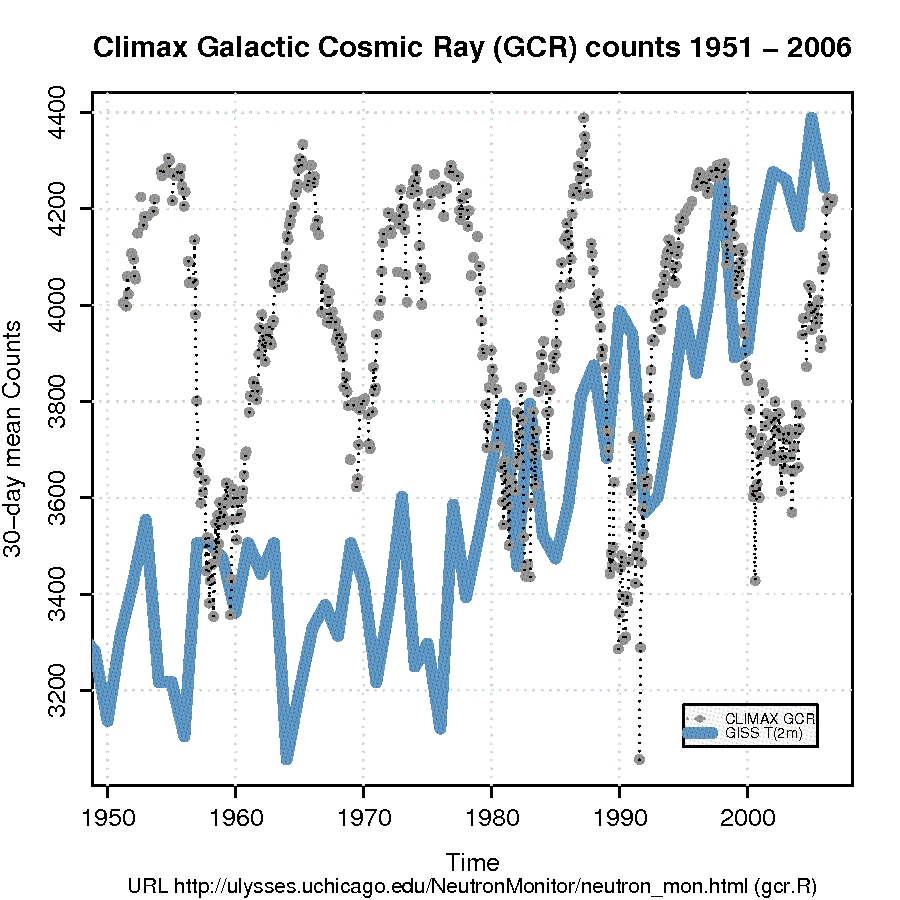
There are several earlier posts here on RC that provide a background to the story about the galactic cosmic rays (GCR) and our climate (here, here, here, here). There is still no long-term trend in the GCR, not even in the Svensmark and Friis-Christensen’s response (see also figure below). This seems to be acknowledged now.
The LF2007 paper and the response focus on just the last 2-3 decades for which there were direct measurements of the total solar irradiance (TSI= solar energy summed over all wavelength), but if they had read my paper on this issue in GRL 2005, they would have seen that there has not been any trend in solar activity or GCR since 1952 (also seen in the figure below).
In addition, there is no evidence of any long-term trend in the low cloud cover (IPCC AR4), and the GCR-hypothesis has a problem with explaining the trend in the diurnal cycle, enhanced warming in the Arctic and a cooling in the stratosphere. The only explanation we can offer is an enhanced greenhouse effect.
It may be of interest for historians that the story about the GCR has been a long-winded epic (total cloud cover, low clouds, adjustment of ISCCP cloud data, etc.), and now new characters are thrown onto the stage: radiosonde measurements (HadAT2) representing the tropospheric temperatures and data from a ‘simple’ ocean data assimilation (SODA).
SF2007 argue that: ‘When the response of the climate system to the solar cycle is apparent in the troposphere and ocean, but not in the global surface temperature, one can only wonder about the quality of the surface temperature record’. This is a rhetorical question, and not a very scientific one. For starters, one cannot exclude the possibility that near-surface processes dominate at lower altitudes thus degrading any correlation. But, in the mind of Svensmark and Friis-Christensen, it is perhaps the GCR that is the most dominant driver.
Svensmark and Friis-Christensen do not disclose the geographical coverage of the ocean temperature they use to correlate with GCR, but the strong annual cycle and inter-annual variations are typical characteristics of local observations rather than global fluctuations. Note, the global surface temperature includes the world oceans (~70%) of the surface.
Another interesting aspect is the improved correlation with altitude. This is not what one would expect to see if the GCR mechanism played a key role, as changes in cloudiness would affect the planetary albedo, and hence the solar energy absorbed by the surface. The troposphere would then respond to the surface changes.
A more likely explanation could be that changes in UV associated with the solar cycle affects the stratosphere (a little disputed hypothesis), and that the signal then propagates down into the troposphere. Thus, we cannot rule out that solar activity influences our climate in ways that do not involve GCR and clouds.
The physical link between any ultra-small particles and much larger the cloud condensation nuclei is still lacking, even after the experiment performed in Copenhagen. Thus, the hypothesis is still speculative. The GHG-effect, on the other hand, is well-established.
According to the official looking Norwegian climatesceptic website, Friis-Christensen states that his work has been controversial, but mainly because of political and not scientific reasons. The fact that he and Svensmark now offer a response to LF2007 seems to contradict his own belief.
Svensmark and Friis-Christensen object to LF2007 by stating ‘Lockwood and Frohlich erase the solar cycle from various data sets by using running means of 9 to 13 years’. It is interesting to note that Svensmark and Friis-Christensen now acknowledge the fact that filtering time series can produce misleading impression after the dubious curve-fitting magic in the famous Friis-Christensen & Lassen (1991) science paper.
Svensmark and Friis-Christensen further argue ‘In any case, the most recent global temperature trend is close to zero’. This is not true, as the IPCC AR4 highlights. I think the the statements in their response ‘use of a long running mean creates the illusion that the temperatures are still rising rapidly early in the 21st Century’ and ‘global surface temperatures have been roughly flat since 1998’ are dishonest (see figure above ).
Svensmark and Friis-Christensen should know of the chaotic nature of our climate system and the fact that it takes more than a few years to determine whether there is a trend or a pause in the trend. The most convincing explanation is that there are also many factors (such as aerosols) playing a role, adding to inter-annual and inter-decadal variations.
It is worrying that the director of the Danish space center makes such misleading claims and then receives honours in Norway by NASL. The controversy running up to the event was therefore understandable, even though Friis-Christensen was supposed to talk about geomagnetism rather than climate.
To answer the question I posed in the beginning of this post, I think that the chapter on the connection between GCR and clouds is not yet closed, but all the evidence goes against the notion that GCR are the cause of the present global warming.

This is quite worrying scientifically and somewhat opportunist on their part and brings to mind the fact that climate science and earth science are fast becomming the most politicised sciences of all time which seems to be influencing some scientists.
Let us hope that the integrity of science is not itself compromised by some that claim to practise it.
The problem with this analysis is that it doesn’t look at the period prior to
1950 and as such is pretty irrelevant.
You need to look at the period before and after you claim AGW.
If you don’t accept this, then you invalidate your claim to AGW. The period
post 1945 had increasing CO2, and decreasing temperatures. The claim being that
something else causes the cooling.
Apply the same logic to the above, and the research fails for the same reason.
My first post to RC, sorry it’s OT!
That infamous piece of denialist merde du jour:
The ‘Environmental Effects of Increased Atmospheric Carbon Dioxide’
ARTHUR B. ROBINSON , SALLIE L. BALIUNAS , WILLIE SOON , AND ZACHARY W. ROBINSON
is no longer available from http://www.oism.org, it has been updated, lost two authors and gained a new one! It’s also dropped the reference to the George C. Marshall Institute! [smell that oil]
The new, but unimproved version is
‘Environmental Effects of Increased Atmospheric Carbon Dioxide’
ARTHUR B. ROBINSON, NOAH E. ROBINSON, AND WILLIE SOON
The website http://www.oism.org/pproject/ still proclaims ‘Click here to see this peer reviewed research paper.’
I haven’t checked thoroughly, but it’s still stating lies like:
‘In all seven glacial and interglacial cycles, the reported changes in CO2 and CH4 lagged the temperature changes and could not, therefore, have caused them (66).’
Reference
66. Soon, W. (2007) Physical Geography, in press.
Clearly this one is going to need some examination and debunking!
First 3 comments and what do we have?
1. A claim that climate science is becoming politicized. Is that a joke? It’s been political for a long time; you’d think everyone knew that. Indeed how could it avoid being political?
2. “it doesn’t look at the period prior to
1950 and as such is pretty irrelevant.” Did he read it? – It was a rebuttal of the L&F contention that the last 20 years cannot be explained by natural variations. It seems generally accepted now that prior to the last 20 years the theory fits ok. Or does it? Kevin Trenberth makes 1970 the cut-off point from natural effects. L&F say 1985. At any rate few people seems now to argue AGW prior to the 50’s.
3. lies like.. “in all seven glacial and interglacial cycles, the reported changes in CO2 and CH4 lagged the temperature changes and could not, therefore, have caused them”. This is actually something that everyone agrees on. Whether it is misleading or not is the issue but it is by no means a lie.
Try and keep up guys! Is this a scientific site or a fan club?
Excuse me? Friis-Christensen still is propagating his GCR hypothesis? Against common sense? This is outragous.
I did an intensive check of the Lassen-Frijs hypothesis in my blog and what came up was that the scientists placed their claim on a short time series of data and even made some very grave mistakes in the data reduction. These were already debunked:
Paul Damen and Peter Laut, Pattern of Strange Errors Plagues Solar Activity and Terrestrial Climate Data, EOS, 2004, pp370
Laut,P. (2003), Solar activity and terrestrial climate: An analysis of some purported correlations, J.Atmos. Solar-Terr.Phys.,65, 801–812.
It is also quite interessting to note hat one of the main proponents of the GCR hypothesis Kund Lassen released new and corrected old data and actually debunked the GCR hypothesis himself since these data showed that the conclusion “GCR may influence climate was very permature” and could not be proven over longer time scales.
See: P. Thejll, K. Lassen, Solar forcing of the Northern hemisphere land air temperature: New data. Journal of Atmospheric and Solar-Terrestrial Physics 62, 1207-1213 (2000).
[edit – no personal comments please]
SacredAmobea 3. Doesnt all this lag issue get covered in Hansens recent Trace Gases paper, where they examine at length the CO2 lag issue?
Their conclusion is that:
*…we can only say with certainty that the temperature and gas
changes are nearly synchronous.*
http://www.planetwork.net/climate/Hansen2007.pdf End of s2 (a).
although they do earlier acknowledge that:
*…The GHGs, because they change almost simultaneously with the climate, are a major ‘cause’ of glacial-to-interglacial climate change, as shown below, even if, as seems likely, they slightly lag the climate change and thus are not the initial instigator of change.*
So its a near-run thing. Basically it looks like the butterfly flutters, and the GHGs come out to play, and pretty well similtaneously the climate change gets underway.
I think we are way past the butterfly flutter this time round, already.
But attempting to return to the topic (as Gavin would hope I do! :) )
This insisting that we accurately identify the cause is worthy of our attention only because we think that if we can identify the mechanism we can maybe find the magic bullet to put it down, and we have saved the world.
While admirable when we are a long way back from the edge, to the slightly informed and hence potentially very worried layman this has the appearance of a house-fire…
Our house is burning. We want to call the brigade and chuck water on the blaze so we have a home to live in (albeit slightly smoke damaged). But the fire chiefs say:
No! We have to wait until the arsonist is identified, captured, tried and found guilty before we will start to put out the fire.
Sheesh! Lets start damping it down now, and worry about how or why its happening later from the luxury of our porch overlooking the great inland sea of central Australia (at 80m of sea level rise).
http://cegis.usgs.gov/sea_level_rise.html
http://cegis.usgs.gov/video/sealevel_world.avi
So regarding the Norwegians, while debunking and refuting may be satisfying, would we not be better discussing how best to get the refined truth before the powers-that-be? That way at least we are building the arguement in the right direction. I dont think the anti-AGW group have any steam left in their shovels to undermine the vast structure of reality that is pouring in upon us. So lets concentrate on building on the good science and the good communications, rather than wasting too much time destroying the bad.
Climate science and earth science are definitely far less politicized than any of the social sciences, speaking as someone who made a transition from the social to the natural sciences. Academics often cry “politics” when they feel that their findings are not recognized or are being disputed by established scientific authorities. The persistence of climate scientists in coming to a consensus which supports the effects of greenhouse gases actually demonstrates that political and financial pressure cannot always prevail over sound science.
The Soon, W. 2007 paper in Physical Geography:
http://icecap.us/images/uploads/Soon07-CO2-TempCORR-Preprint.pdf
Rasmus, thanks for a thorough and lucid post debunking this tripe. I have been pointing out for years that the main problems with this model are 1)GCR fluxes aren’t changing, 2)the model doesn’t reproduce all of the observed trends, and 3)there really is no physical mechanism for the proposed effects.
Actually, the first of these issues affects me directly. If we were seeing significant systematic changes in the GCR fluxes, then the rates for single-event upsets (bit flips) in microcircuits flown on orbit would deviate systematically from the predicted rates. They do not, and we have been using essentially the same model for the predictions since the early 1980s.
The second point is quite important, and Rasmus makes it quite well. The anthropogenic ghg mechanism is the only one that explains all of the trends we are seeing. Nick (#2 above) claims that the above analysis is irrelevant because it looks only at the post-1950 period. I disagree. Most of the CO2 has actually been spewed into the atmosphere during this period (remember, energy consumption increases exponentially). Moreover, the comfounding effects of aerosols were only removed with clean air legislation after the ’70s. The temporal signature of the trends we are seeing is itself pretty strong support of anthropogenic causation.
Finally, the lack of a physical mechanism is perhaps the most damning of the criticisms. These guys wave their hands so much around this question, it’s amazing they stay on the ground!
The only reason this one is not quite dead is because Svensmark et al. refuse to recognize a persistent vegetative state and pull the plug.
Rasmus – It is Svensmark (not LF2007) who makes the argument: “When the response of the climate system to the solar cycle is apparent in the troposphere and ocean, but not in the global surface temperature, one can only wonder about the quality of the surface temperature record.”
[Response: Fixed. Thanks. -gavin]
Re:2
Do some reading about the role of aerosol cooling in that post-1945 period. I’m not sure whether you’re questioning the lack of pre-1950 cosmic ray counts.
At any rate, I’m seeing a lot of rehashed old arguments in online debating. CO2 lagging temperature in historical records, water vapor driving temperature, disputes among scientists means we know nothing, etc. etc. These are all red herring arguments, and used in much the same manner creationists argue their case – sow “reasonable doubt” as if this were a court case…
Re: Nick@2
The ‘problem’ is one for those who propose a solar mechanism. They are the ones who are ignoring a perfectly adequate physical mechanism (GHGs) for the observed warming and suggesting an alternative explanation. If instrumental records for whatever measure of solar activity they are proposing as the dominant forcing don’t exist prior to ~1950 then they need to get cracking on isolating a decent proxy – if their hypothesis is correct then locating such a beast will strengthen their case.
Meanwhile the rest of us can mutter ‘entia non sunt multiplicanda’ under our breaths and stick with C02 + CH4 + particulates = C20th trends.
Regards
Luke
There is no scale on the RHS of the graph – pls add it in for clarity – thanks.
Why DNSC? wasn’t it good enough to publish as a reply?
BTW: http://www.spacecenter.dk/publications/scientific-report-series/Scient_No._3.pdf
Am I missing something or is this rebuttal fatally flawed?
Look at their Figure 2. Figure 2A shows a poor correlation between tropospheric temperature and cosmic rays.
They mash the tropospheric temperature data by removing the effects of El Nino’s (how?), NAO (how?, volcanic aerosols (how?) a linear trend (they call all this “removal of confusions”!) to give something that matches CRF and tropospheric temperature beautifully in figure 2b.
However the mashed data that correlates with the CRF indicates that since 1957 or so, the Earth’s temperature has decreased by around 0.2 oC. In other words, the contribution from CRF since 1957 has resulted in around a 0.2 oC of cooling.
And they rationalise this by suggesting that the land surface temperature data must be wrong (they say “When the response of the climate system to the solar cycle is apparent in the troposphere and ocean, but not in the global surface temperature, one can only wonder about the quality of the surface temperature record”.)
In other words their own analysis indicates that the CRF has made no contribution to warming since the late 50’s (which Dr. Benestad has already pointed out to us in his excellent intro.), and they rationalise this by suggesting that the temperature anomaly data that we’re all familiar with must be wrong..
Can someone tell me if I’m going mad, or are these guys really trying to sell this odd notion?
Do some reading about the role of aerosol cooling in that post-1945 period. I’m not sure whether you’re questioning the lack of pre-1950 cosmic ray counts.
At any rate, I’m seeing a lot of rehashed old arguments in online debating. CO2 lagging temperature in historical records, water vapor driving temperature, disputes among scientists means we know nothing, etc. etc. These are all red herring arguments, and used in much the same manner creationists argue their case – sow “reasonable doubt” as if this were a court case…
—————–
I’m quite aware. Let me spell it out.
The article says for one factor, for recent times, there is no link between solar and climate.
OK. We then apply the same standard to CO2. It is one factor.
For C02 in a one factor model, there is no link between CO2 and climate, 1945-200. For part of the time the link was negative, then it was positive. Overall no statistical evidence.
Even Gavin will claim that you have to include more factors such as polution to get a match with CO2 and
climate.
However, the argument here is that solar and climate aren’t linked, and we’ve use a one factor model to prove it. Not only that, but there is cherry picking of the range in which the comparison is made.
Accept that, and the skeptic will pick 1945-1980 as the test of C02.
[edit]
[Response: You misunderstand the point being made. To do a full attribution you need to have all relevant factors included, I think we agree. But to demonstrate that the sign of the trend that would be induced is contrary to the actual trend is sufficient to rule out any one factor from being causal. This is true for solar over the last fifty years and indeed for CO2 over the 1940-1975 period. Pointing out that solar is not dominant now does not imply anything for the past, and pointing out that other things were involved in the 1940-1975 period (to the extent that that internal climate variability can be taken into account), does not imply the CO2 is not dominant now. The ‘skeptic’ is confused if he thinks that mainstream climate science is based on a single factor model, it isn’t, and so demonstrations that it is not, do not make very persuasive arguments. – gavin]
The ‘problem’ is one for those who propose a solar mechanism. They are the ones who are ignoring a perfectly adequate physical mechanism (GHGs) for the observed warming and suggesting an alternative explanation. If instrumental records for whatever measure of solar activity they are proposing as the dominant forcing don’t exist prior to ~1950 then they need to get cracking on isolating a decent proxy – if their hypothesis is correct then locating such a beast will strengthen their case.
————————
Sorry, but you are making the science mistake.
Just because you have one variable that fits after a few fudges, doesn’t mean that there are other variables that also fit.
C02 produces a very small change that is then amplified.
There are plenty of other plausible effects that produce small changes and solar is one of them.
There is no evidence that the amplification is restricted to the small warming produced by C02.
[Response: Who said it was? Feedbacks to solar warming or CO2 warming are very similar. – gavin]
The second point is quite important, and Rasmus makes it quite well. The anthropogenic ghg mechanism is the only one that explains all of the trends we are seeing. Nick (#2 above) claims that the above analysis is irrelevant because it looks only at the post-1950 period. I disagree. Most of the CO2 has actually been spewed into the atmosphere during this period
———————-
Again, not statistically valid.
You’ve made an assumption into a fact.
You need the before and after in order to show something has changed.
Nick
>3 and sorry for digressing
— it’s ba-a-a-a-ck … as a review. Note the books reviewed in the same issue. Peculiar. http://www.jpands.org/jpands1203.htm
#16: Thanks Hank, I nearly choked when I read the concluding sentence:
We are living in an increasingly lush environment of plants and animals as a result of this CO2 increase. Our children will therefore enjoy an Earth with far more plant and animal life than that with which we now are blessed.
Is this for real?
Nick, (Re: 18), Either you are being deliberately obtuse or you have a very strange understanding of climate science. The period from 1945 to ~1980 is pretty well understood as having been due to the combined forcings of CO2 and aerosols. Once the aerosols go away (due to clean air legislation and the fall of the Eastern Bloc), you have greenhouse warming.
With respect to GCR forcing, the sign isn’t even right, even after you “massage” (hell, they didn’t massage it, they mugged it!) the data 6 ways to Sunday. In contrast, not only does anthropogenic ghg get the sign right, it reproduces the qualitative features we see in the current warming epoch.
You keep appealing to statistics, but I have yet to see you use a single statistical test to back up your assertions. If you think we will be intimidated simply by the use of the word statistics, I think you walked into the wrong bar.
‘It is worrying that the director of the Danish space center makes such misleading claims and then receives honours in Norway by NASL.’
It is worrying Rasmus, but it is also very fortunate there are people like you with a skeptical eye. I don’t understand how people from this website can point to the IPCC and NOAA and say that these organizations are somehow immune to science miscarraiges like those at NASL.
I commented on this issue on my own site yesterday so I will be brief here. Doesn’t this just mean that we don’t know enough? All of the cries of politicizing science aside, we need climate science to evolve to the point that most other sciences have achieved. We need more effort by our governments and universities in this area. There are cries for billions of dollars in expenditures for climate change but no one is crying for millions of dollars just to truly understand all of the causality. I speak more about this several times on my site and most recently on the GCR issue http://globalwarming-factorfiction.com/2007/10/03/the-persistent-role-of-the-sun-in-climate-forcing/
Interesting comments by Chris, in #15, although I am not sure I entirely follow the analysis. Can Chris/someone just expand on it a bit for the rest of us? I want to be sure I understand this more clearly.
On another tack, could one usefully apply a ‘reductio ad absurdum’ here, i.e. take the GCR argument entirely at face value, assume that it does indeed explain everything they say it does, and then see what physically based results – and hence maybe laws of physics – we have to throw out as a consequence? Might be an interesting exercise, or at least a useful test of Ockham’s razor.
Michael, I don’t think that anyone has said NOAA or the IPCC are immune to being misled or in error. But we are not just talking NOAA or the IPCC. We also have the National Academy of Sciences, nearly every professional society of scientists, DOD, NASA… It is very hard to find responsible experts who think we aren’t affecting climate. Even most of the “skeptics” admit we are having some effect. It is the consensus that is important. When you’ve got so many disparate groups in agreement, the chances that you are seriously in error are quite small.
In fairness of NASL they also quite clearly say that the reward has nothing at all to do with his global warming theory…
Re15:
Yes it seams as if they explain a cooling with the rays ad to that the axis of rays and temps are at different levels in the two diagrams. Don’t know where the dip around 92 comes from, El Nino? And where did the linear trend come from?! And it isn’t small either… and a linear trend give or take 0.4K… and so on… not surprised that they didn’t try to publish this!
Re Nick (#23)
There are several serious problems with The Svensmark and Friis-Christensen “rebuttal”, but their Figure 2 seems to trash their own argument (unless I’m completely misreading this which is possible!). Figure 2 seems to support the argument that the Cosmic Ray Flux (CRF) leaves a signal in the temperature record (possible but not very convincing, I think), but doesn’t support the idea that the marked late 20th century warming can have had any significant contribution from the sun (or at least from the CRF that they bang on about). In fact Figure 2 indicates exactly the opposite…that the contribution from the CRF is at best negligible, and is strictly (following S and F-C’s analysis to the letter) a cooling one.
Look at Figure 2a of S and F-C. Part A shows some raw tropospheric temperature data overlaid with the CRF data. There’s no particular correspondence, we all agree (including S and F-C).
O.K. so there are other contributions to the tropospheric temperature. Let’s try to eliminate these and dissect out the contribution from the CRF. S and C-F do this in Figure 2b.
How do they do this? They remove all sorts of contributions to the tropospheric temperature (they don’t say how). They remove the contributions from El Nino’s and the North Atlantic Oscillation and from volcanic aerosols. Fair enough.
They remove an unspecified “linear trend” of 0.14 +/- 0.4 K per decade (isn’t that the global warming? caused by…ummmm…the greenhouse effect????)
And are left with a wonderful correlation. The curves match beautifully (the CRF and the mashed and denuded tropspheric temperature march side by side in Figure 2b).
However the contribution from the CRF now matches a residual tropospheric temperature evolution since 1958 (?) whose overall trend is a cooling one (by about 0.2 oC between 1958ish and now)..
Have I got this wrong? I think that S and F-C have produced an analysis of the contribution of the CRF to mid-late 20th century temperature evolution that is a mild cooling one. Much as everyone else that studies this stuff properly, concludes. One could argue that their analysis shows a signature from the CRF in the temperature record once other contributions are removed. But in doing this dissection they arrive at a match of the CRF to a mid to late 20th century temperature trend that is a mild cooling one…….
Ray,
I’m not asking if we’re affecting the climate. When I breath I affect the climate or I suffocate. I am asking what the future looks like. Over the last couple of decades if you were to ask individual scientists from NOAA, IPCC, DoD, NAS, NASA what the future looks like, most would say its going to be warmer, but you would get a wide range of answers on how much warmer. I take issue with people saying the science is settled.
Also, the IPCC is just as capable of error (both at the scientist level and at the scientist community level) for all the obvious reasons: personal views, politics, industry pressure, peer pressure, etc. These organizations should be viewed with a skeptical eye and hammered from every side with counter-theories. I don’t see this or encouragement of this at RC.
Michael, here: http://ipcc-wg1.ucar.edu/wg1/Comments/wg1-commentFrameset.html
Michael, You are misunderstanding the situation. If it were ONLY the IPCC or ONLY NOAA, your position might have merit. It is the aggregate of scientific opinion–by individuals and groups with disparate preferences and instances–that is reliable. What is more, while estimates from individuals might vary, mean estimates are pretty reliable, and have been converging with time. That is not a sign of unsettled science. Nor is the fact that there simply is no credible alternative theory. You can challenge evolution as easily as you can challenge anthropogenic causation of climate change–as indicated by the fact that denialists have to resort to the same tactics as fundies from the Discovery Institute (publish in non-peer-reviewed journals, etc., publish in the press…).
There simply are no credible counter theories. You seem to persist in the belief that there are two sides to every argument. In settled science, this is not true. There are either many sides (e.g. competint theories) or one.
Re 28 Michael: “I’m not asking if we’re affecting the climate. When I breath I affect the climate or I suffocate.”
I do hope that you are not implying that respiration is contributing to the increase in atmospheric CO2.
“These organizations should be viewed with a skeptical eye and hammered from every side with counter-theories. I don’t see this or encouragement of this at RC.”
And what would these counter-theories be, besides the ones that have been shown over and over to be not worth the paper they are printed on? I’m starting to question your sincerity here, Michael.
Jim, we have some pretty dismal projections, which call for big decisions to be made. I do not know how many counter-theories are out there, or what thier worth is. I don’t know how open Working Group 1 is to exploring counter-theories. The more a theory stands up to counter-theories, the more useful it is to science. There had better be counter-theories out there, if not something is seriously wrong with modern science.
I see a lot of value in RC, it is the closest thing out there to a level playing field, but the obsession with snuffing deniers is bordering on madness.
Michael, click the link, here: http://ipcc-wg1.ucar.edu/wg1/Comments/wg1-commentFrameset.html
Re Michael # 32.
You say “I do not know how many counter-theories are out there, or what thier worth is. I don’t know how open Working Group 1 is to exploring counter-theories. The more a theory stands up to counter-theories, the more useful it is to science. There had better be counter-theories out there, if not something is seriously wrong with modern science.”
But what counter-theories?? That’s the question. If there are counter theories they will be explored obviously. So where are these counter theories? Well we’re discussing one here aren’t we?
You say that “the obsession with snuffing deniers is bordering on madness”. But what “snuffing deniers” are you talking about? On this part of the RC board we are discussing the “counter-theory” of Svensmark and Friis-Christensen that global warming is dominated by solar effects, in particular the contribution of the cosmic ray flux to cloud formation via seeding of particulates.
It turns out Svensmark and Friis-Christensen’s own analysis indicates that their counter-theory is deficient. It apparently doesn’t make any contribution to the most marked warming on record.
So what other counter theory would you like to bring to our attention? And why should there be counter-theories anyway if the science is settled. I don’t think there is any question that atmospheric CO2 is a greenhouse gas, that increasing its concentration results in warming, and that this has dominated at least mid to late and contemporary global warming. We don’t need a “counter theory” to something that is rather obviously the case.
Clearly it would be wonderful if we knew exactly how much warming we have in store. So far we know that enhanced CO2 has a relationship with the earth’s temperature response equivalent to between around 1.7 to 4.5 oC at 95% confidence limits. Why not just accept what we know and encourage endeavours to improve our knowledge and predictions.
And if anyone comes up with viable “counter-theories” these will obviously be explored and tested.
Re 32 Michael : “I do not know how many counter-theories are out there, or what thier worth is. I don’t know how open Working Group 1 is to exploring counter-theories. The more a theory stands up to counter-theories, the more useful it is to science. There had better be counter-theories out there, if not something is seriously wrong with modern science.”
OK, let’s back up a step. Just so we’re all clear, please define “counter-theories.” Theories that counter what, exactly? Theories about what is happening, how it’s happening and why? Theories about what will happen? Theories about what we should do about it?
“the obsession with snuffing deniers is bordering on madness.”
Honest skepticism is of course healthy and necessary, but judging from my encounters with out and out “deniers”, it seems like an awful lot of them are well past the border of madness. That wouldn’t be a problem, except that there are very clearly some people deliberately propagating the disinformation that is feeding that madness. It’s really that disinformation that is being challenged and snuffed. As Hank likes to ask, in an equally healthy skeptical spirit, “where are you getting your information?”
Michael, I there a counter-theory to evolution? to gravity? how about atomic theory? They all did at one point in their history. However, when a scientific field becomes sufficiently mature and the evidence becomes overwhelming, then there are simply no credible alternative scientific theories. Climate science is over 150 years old. Why wouldn’t it be mature? And it’s not as if there are any controversies over basic issues–the consensus of anthropogenic causation has been strengthening for >20 years. The fact that you don’t like the implications of the science cannot be a basis for rejecting a successful theory
Michael, you start chipping away at Golden Calves and you’re in for a heap of trouble. I think Confucius said that… or somebody [;-). Nothing riles a scientist more than questioning his religion. I said that. (with apologizes to Bob Dylan)
Question: Anybody, what is the physical/astrophysical process that theoretically enhances global warming by decreasing cosmic radiation?
[Response: Galactic Cosmic Rays (GCR) are supposed to create particles which become cloud condensation nuclei (CCN). Thus, more GCR the more clouds and vice versa. Less clouds reflect less of the sunlight, and more is absorbed at the surface. Hence, the hypothesis claim that:: less GCR -> less CCN -> less low-level clouds -> more sunlight absorbed by the surface -> higher temperature. -rasmus]
Is DNSC peer reviewed?
[Response: No, I don’t think so. -rasmus]
Re: #20 “I nearly choked when I read the concluding sentence:” Nice pun. BTW maybe he’s talking about phytoplankton and jellyfish? There’s bound to be more of those, right?
Oh yeah, there are lots of counter theories to atomic theory. You can read all about them on http://www.crank.net. Every idiot who learned algebra thinks that he can throw down reams of scribble proving something or other. Eli was at a meeting last night at a fairly important scientific conference where some clown screwed up a trivial heat of formation problem and said that he had proved that conservation of energy and the uncertainty principle were not compatible. He made several other mistakes.
RE: #37
This is according to my read of “The Chilling Stars”:
Increased cosmic radiation of the right type leads to increased cloud condensation nuclei, leading to increased low cloud cover, causing overall cooling. Conversely, fewer cosmic rays of the right type lead to sunnier skies and warmer temperatures.
Interestingly, this theory would explain how Antarctica doesn’t follow global warming trends. Antarctica has such a high albedo that clouds cause overall warming.
[Response: The Antarctic connection is bogus (the Arctic has the same features for instance). My take on their book is here – gavin]
Hank Roberts Says:
– it’s ba-a-a-a-ck … as a review. Note the books reviewed in the same issue. Peculiar.
http://www.jpands.org/jpands1203.htm
I can’t decide whether you’re talking about the Soon & Baliunas junk or the abortion-breast cancer junk.
There does not need to be a trend in solar activity since 1952 to explain the recent warming, if there had been a prior increase in solar activity, and the thermal inertia of the oceans had not yet responded. The mid-century cooling presumably due to other causes (possibly aerosols and lead particulates), would only postpone the response to this plateau of high solar activity, until the recent warming.
Feedbacks to solar activity and CO2 forcing are very similar in models given their similar treatments, but are perhaps not so similar in reality.
[Response: If this is true, then we would expect the GCMs to have under-estimated the effect from the increase in CO” as such a long lag would mean that more than we expect still lies in the pipe-line. Furthermore, this would suggest a higher climate sensitivity, and we have no reason to think that the magnitude of the response would be particularly sensitive to whether it is an increased greenhouse effect or changes in the total solar irradiance (TSI). However, I think that the lag time scale is more likely less than 10 years.. -rasmus]
I don’t see many comments here that address the content of the paper. I can only agree with Gavin’s comment that the cosmic ray theory isn’t dead. In fact it correlates pretty well to fluctuations, when other forcings are accounted for, and interestingly enough, when a small, mysterious, linear upward trend is removed.
[Response: You cannot possibly know it these fluctuations are due to GCR or other solar factors, as the GCR correlates with the sunspots, 10.7 cm flux and the solar UV. It’s still a mystery why you would see stronger correlation in the troposphere than near the surface. I do not yet believe the figure showing the ocean temperatures (it looks suspiciously like one location is being cherry picked, as more ‘convetional’ sea surface temperatures do not provide such good match). -rasmus]
Earlier papers which claimed that the solar forcing was overwhelmed by CO2 had such long smoothing as to carry over temp trends long after they had dissipated, or so the new paper claims, and so were flawed.
I guess that in wishing to be the first to denounce the paper, many here neglected to read it.
Rasmus, your 2005 GRL paper seems to refer to global average surface temperature. I think any correlation with solar cycle length and average temperature is in the Northern Hemisphere, as reported by Armagh Observatory, for example:
http://www.arm.ac.uk/press/200years-on-the-Net.html
This 2002 GRL paper finds evidence agianst an indirect solar link between cosmic rays and low clouds, but evidence for a direct link via UV:
http://folk.uio.no/jegill/papers/2002GL015646.pdf
#4 JamesG:
“3. lies like.. “in all seven glacial and interglacial cycles, the reported changes in CO2 and CH4 lagged the temperature changes and could not, therefore, have caused them”. This is actually something that everyone agrees on. Whether it is misleading or not is the issue but it is by no means a lie.”
“The” changes in CO2 and CH4 and “the” temperature changes were not isolated events in time as such language implies. Most of the changes overlapped each other so saying one change could not cause the other (at all is implied) is a lie.
JamesG: “Try and keep up guys!”
JamesG would make a good start by taking his own advice.
Rod B., OK, where’s the religion. I see evidence, Rod, not faith. Do you have any evidence to put up against the mountain of evidence in favor of climate change (or evolution, for that matter)? In the absence of any such evidence, I would suggest that your scientific views might be better characterized as faith based.
Actually, judging scientific evidence is in many ways easier when there are competing alternatives theories. One can then compare the values of the likelihood functions based on the available evidence. When you are down to a single credible theory, all you can say is that the evidence support the theory or not–the degree of support is difficult to quantify without resorting to Bayesian arguments.
Re:42
I’m sure you’ve seen this attempt to paint AGW research and conclusions as religious. The argument works both ways.
The “skeptics” share argument tactics with creationists. Take one piece of research which on its surface seems to contradict the whole and use it to damn the whole. Throw the baby out with the bathwater.
Tactic 2 involves papers like the subject of this post. If all else fails, fake it. Like planting human fossils amid dinosaur fossils then claiming coexistence.
The key is to keep ignoring rebuttals, and referring to the same specious arguments. Of course, the skeptics side will claim the same of science, but science does have a mechanism for self-correction and arguments.
Re 43 and 44. OK, now let me try to get your arguments straight. Yorick, you seem to be saying that the rather alarming warming we’re seeing in the past 25 years or so correlates “pretty well” with some putative change in cosmic rays (which we know isn’t happening by several measures) once we neglect some “mysterious” upward trend, and despite the fact that there is no mechanism beyond hand waving and mumbling about clouds. That about got it?
And Martin, you seem to be saying that we need to posit some increasing solar term prior to 1952 for which we have zero evidence–and also no mechanism–and that this stayed hidden until ~1980. Right?
Guys, rather than doing all these mental cartwheels and torturing this poor theory well past death, wouldn’t it be easier to look at the possibility that a mechanism we know is occurring and can explain not just the quantitative but also the qualitative features of the current warming epoch?
Svensmark’s and Friis-Christensen’s (S & F-C)”rebuttal” is surely an excellent example that properly done science tends to lead to well-supported conclusions where the systems studied (solar contributions to mid-late 20th century and contemporary warming) are amenable to the methodologies at hand.
The thing that stands out is that S and F-J come to the same conclusion that Dr. Benestad and Lockwood and Frolich (and many others) have estabilished. That solar contributions to the most recent very large warming has a negligible solar contribution. That’s very clear from S & F-C’s figure 2 where they isolate the solar component (they use the Cosmic ray Flux; CRF) to tropospheric temperature, and demonstrate that this fits to a solar contribution that is a mild cooling one (around 0.2 oC) since 1960.
That’s what pretty much all the other research in this area has established; i.e. that the sun has been a minor plaer with respect to mid-late 20th century warming.
It seems to me that S and F-J’s “rebuttal” concerns a misunderstanding or “straw-man”. They say in the first paragraph “These authors [i.e. Lockwood and Frolich] accept that “there is considerable evidence for solar influence on Earth’s pre-industrial climate and the Sun may well have been a factor in post-industrial climate change in the first half of the last century”. But they argue that this historical link between the Sun and climate came to an end about 20 years ago. Here we rebut their argument comprehensively”.
However Lockwood and Frolich (L & F) say no such thing. L & F analyze the various measured solar parameters and show that each of these is in the wrong direction for warming for the last 20 years or so. But they certainly don’t say that “the historical link between the Sun and climate came to an end about 20 years ago”, nor imply any such thing. We all know that the link between the Sun and the climate is an ever-present. It’s just that it’s contribution at any particular time varies. The Sun may dominate the evolution of the climate or it may be insignificant compared to other factors. We know that the latter pertains for the warming of the last 35 years or so.
So S & F-C set out to “rebut” a notion of their own construction. They make a great effort to show that there is a residual solar “signature” in the tropospheric temperature. We might be able to agree with this once they’ve shown us exactly how they’ve manipulated the data to “dissect out” the solar (CRF) component.
But at the end of the day there’s nothing really controversial in S and F-C’s “rebuttal” (apart from some silly statements). Their analysis shows that solar contributions have not been significant to warming since at least 1958, and that the solar cycle might be apparent in the fluctuations in the record once the dominant contributions to tropospheric temperature have been accounted for.