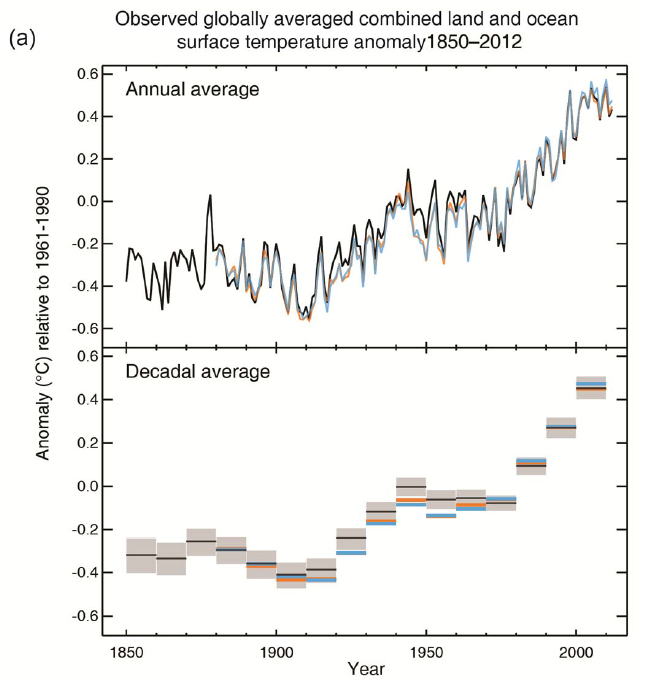
Two and a half years ago, a paper was published in Nature purporting to be a real prediction of how global temperatures would develop, based on a method for initialising the ocean state using temperature observations (Keenlyside et al, 2008) (K08). In the subsequent period, this paper has been highly cited, very often in a misleading way by contrarians (for instance, Lindzen misrepresents it on a regular basis). But what of the paper’s actual claims, how are they holding up?
More »
Technical Note: We have changed the contact email for the blog to reduce the amount of unsolicited email. If you want to contact us at the blog, please use contact-at-realclimate.org.
So how did that global cooling bet work out?
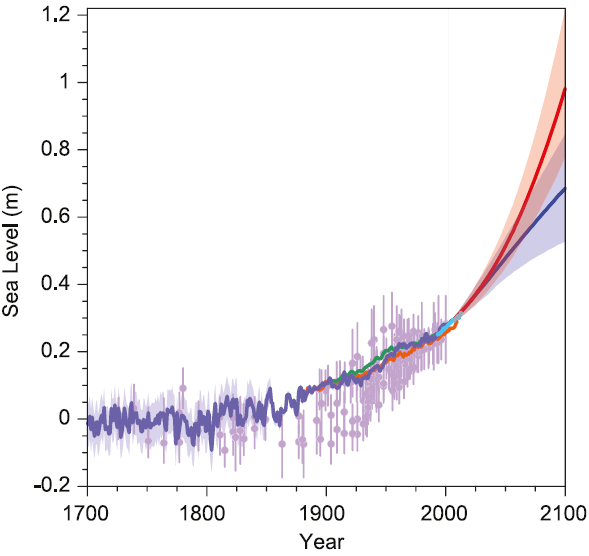
Sea level rise: The New York Times got the story
Yesterday, the New York Times ran an excellent cover story on sea level rise, together with two full pages inside the paper, fancy graphs and great photographs (online version here). The author, Justin Gillis, researched the piece for months, visited Greenland and talked to most of the leading scientists in the field – many of which he cites in the article. The science presented is correct and up-to-date and the story is a gripping read. That’s how science journalism should be!
What is going on in Greenland? (c) The New York Times.More »
Revisiting the Younger Dryas
Guest Commentary by Chris Colose
One of the most intriguing and well-studied climatic events in the past is the Younger Dryas (YD), a rather abrupt climate change between ~12.9 and 11.6 thousand years ago. As the world was slowly warming and ice was retreating from the last glaciation, the YD effectively halted the transition to today’s relatively warm, interglacial conditions in many parts of the world. This event is associated with cold and dry conditions increasing with latitude in the North, temperature and precipitation influences on tropical and boreal wetlands, Siberian-like winters in much of the North Atlantic, weakening of monsoon intensity, and southward displacement of tropical rainfall patterns. RealClimate has previously discussed the YD (here and here) however there have been a number of developments in recent years which deserve further attention, particularly with respect to the spatial characteristics and causes of the YD.
More »
Ocean heat content increases update
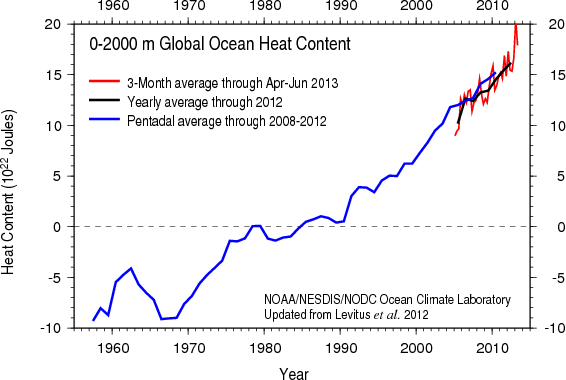
There is a new paper in Nature this week on recent trends in ocean heat content from a large group of oceanographers led by John Lyman at PMEL. Their target is the uncertainty surrounding the various efforts to create a homogenised ocean heat content data set that deals appropriately with the various instrument changes and coverage biases that have plagued previous attempts.
We have discussed this issue a number of times because of its importance in diagnosing the long term radiative imbalance of the atmosphere. Basically, if there has been more energy coming in at the top than is leaving, then it has to have been going somewhere – and that somewhere is mainly the ocean. (Other reservoirs for this energy, like the land surface or melting ice, are much smaller, and can be neglected for the most part).
Sealevelgate
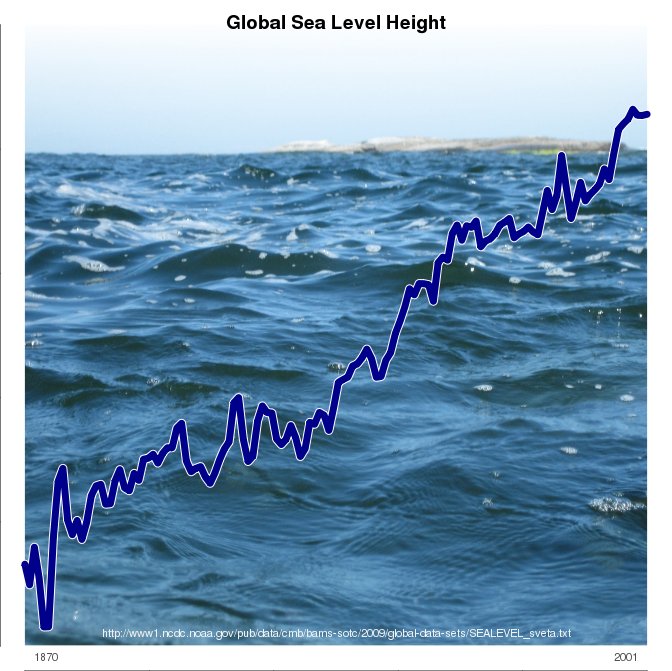
Imagine this. In its latest report, the IPCC has predicted up to 3 meters of sea level rise by the end of this century. But “climate sceptics” websites were quick to reveal a few problems (or “tricks”, as they called it).
First, although the temperature scenarios of IPCC project a maximum warming of 6.4 ºC (Table SPM3), the upper limit of sea level rise has been computed assuming a warming of 7.6 ºC. Second, the IPCC chose to compute sea level rise up to the year 2105 rather than 2100 – just to add that extra bit of alarmism. Worse, the IPCC report shows that over the past 40 years, sea level has in fact risen 50% less than predicted by its models – yet these same models are used uncorrected to predict the future! And finally, the future projections assume a massive ice sheet decay which is rather at odds with past ice sheet behaviour.
Some scientists within IPCC warned early that all this could lead to a credibility problem, but the IPCC decided to go ahead anyway.
Now, the blogosphere and their great media amplifiers are up in arms. Heads must roll!