Currently, a few errors –and supposed errors– in the last IPCC report (“AR4″) are making the media rounds – together with a lot of distortion and professional spin by parties interested in discrediting climate science. Time for us to sort the wheat from the chaff: which of these putative errors are real, and which not? And what does it all mean, for the IPCC in particular, and for climate science more broadly?
Technical Note: We have changed the contact email for the blog to reduce the amount of unsolicited email. If you want to contact us at the blog, please use contact-at-realclimate.org.
Please, show us your code
The 1991 Science paper by Friis-Christensen & Lassen, work by Henrik Svensmark (Physical Review Letters), and calculations done by Scafetta & West (in the journals Geophysical Research Letters, Journal of Geophysical Research, and Physics Today) have inspired the idea that the recent warming is due to changes in the sun, rather than greenhouse gases.
We have discussed these papers before here on RealClimate (here, here, and here), and I think it’s fair to say that these studies have been fairly influential one way or the other. But has anybody ever seen the details of the methods used, or the data? I believe that a full disclosure of their codes and data would really boost the confidence in their work, if they were sound. So if they believe so strongly that their work is solid, why not more transparency?
Are the CRU data “suspect”? An objective assessment.
Kevin Wood, Joint Institute for the Study of the Atmosphere and Ocean, University of Washington
Eric Steig, Department of Earth and Space Sciences, University of Washington
In the wake of the CRU e-mail hack, the suggestion that scientists have been hiding the raw meteorological data that underpin global temperature records has appeared in the media. For example, New York Times science writer John Tierney wrote, “It is not unreasonable to give outsiders a look at the historical readings and the adjustments made by experts… Trying to prevent skeptics from seeing the raw data was always a questionable strategy, scientifically.”
The implication is that something secretive and possibly nefarious has been afoot in the way data have been handled, and that the validity of key data products (especially those produced by CRU) is suspect on these grounds. This is simply not the case. More »
A warming pause?
The blogosphere (and not only that) has been full of the “global warming is taking a break” meme lately. Although we have discussed this topic repeatedly, it is perhaps worthwhile reiterating two key points about the alleged pause here.
(1) This discussion focuses on just a short time period – starting 1998 or later – covering at most 11 years. Even under conditions of anthropogenic global warming (which would contribute a temperature rise of about 0.2 ºC over this period) a flat period or even cooling trend over such a short time span is nothing special and has happened repeatedly before (see 1987-1996). That simply is due to the fact that short-term natural variability has a similar magnitude (i.e. ~0.2 ºC) and can thus compensate for the anthropogenic effects. Of course, the warming trend keeps going up whilst natural variability just oscillates irregularly up and down, so over longer periods the warming trend wins and natural variability cancels out.
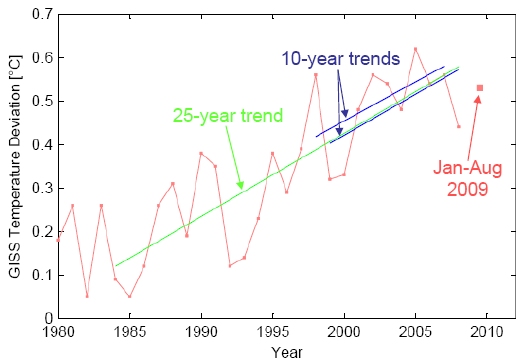
(2) It is highly questionable whether this “pause” is even real. It does show up to some extent (no cooling, but reduced 10-year warming trend) in the Hadley Center data, but it does not show in the GISS data, see Figure 1. There, the past ten 10-year trends (i.e. 1990-1999, 1991-2000 and so on) have all been between 0.17 and 0.34 ºC per decade, close to or above the expected anthropogenic trend, with the most recent one (1999-2008) equal to 0.19 ºC per decade – just as predicted by IPCC as response to anthropogenic forcing.
Figure 1. Global temperature according to NASA GISS data since 1980. The red line shows annual data, the larger red square a preliminary value for 2009, based on January-August. The green line shows the 25-year linear trend (0.19 ºC per decade). The blue lines show the two most recent ten-year trends (0.18 ºC per decade for 1998-2007, 0.19 ºC per decade for 1999-2008) and illustrate that these recent decadal trends are entirely consistent with the long-term trend and IPCC predictions. Even the highly “cherry-picked” 11-year period starting with the warm 1998 and ending with the cold 2008 still shows a warming trend of 0.11 ºC per decade (which may surprise some lay people who tend to connect the end points, rather than include all ten data points into a proper trend calculation).
Plimer’s homework assignment
Some of you may be aware of George Monbiot’s so-far-unsuccessful attempt to pin down Ian Plimer on his ridiculous compendium of non-science. In response to Monbiot’s request for explanation and sources for some of Plimer’s more bizarre claims, Plimer has responded with a homework assignment that is clearly beyond even his (claimed) prowess. This is quite transparently a device to avoid dealing with Monbiot’s questions and is designed to lead to an argument along the lines of “Monbiot can’t answer these questions and so knows nothing about the science (and by the way, please don’t notice that I can’t cite any sources for my nonsense or even acknowledge that I can’t answer these questions either)”. (Chris Colose and Greenfyre have made similar points). It’s also worth pointing out as Andrew Dodds has done that each question is actually referencing a very well known contrarian and oft-debunked argument, but dressed up in pseudo-scientific complexity.
However, as a service both to Plimer and Monbiot (as well as anyone else interested), we give a quick scorecard on the relevance, actual scientific content (whether the questions can actually be answered) and sources for discussion for each of the, to be charitable, ‘odd’ questions. For relevance, we grade each question on a scale from 0 to 5, 0 being irrelevant to the issue of detection and attribution of 20th Century climate change, 5 being extremely relevant. For scientific content, we rate the reasonableness of the question posed (i.e. does it make any sense at all), from A to F (A being a very well posed question, F making no sense). For sources, we generally point to a paper or discussion that addresses the real issue.
More »