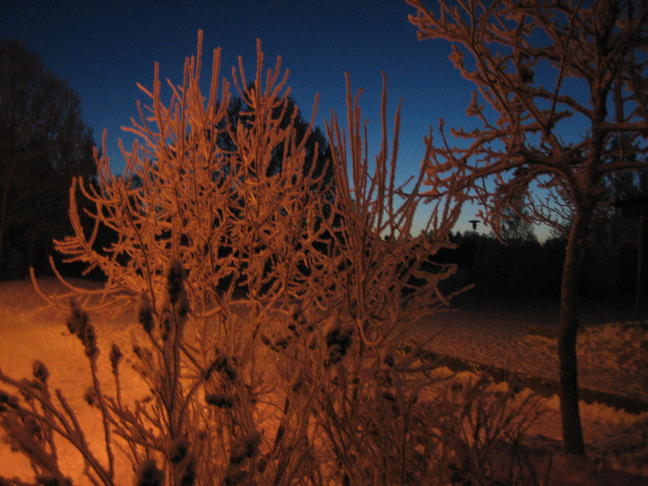
Last June, during the International Polar Year conference, James Overland suggested that there are more cold and snowy winters to come. He argued that the exceptionally cold snowy 2009-2010 winter in Europe had a connection with the loss of sea-ice in the Arctic. The cold winters were associated with a persistent ‘blocking event’, bringing in cold air over Europe from the north and the east.
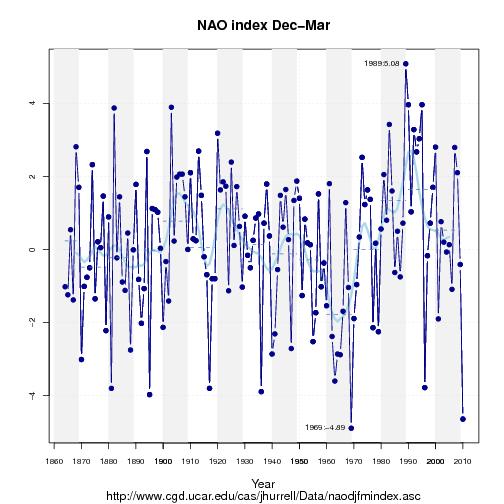
Last year’s cold winter over northern Europe was also associated with an extreme situation associated with the North Atlantic Oscillation (NAO), with the second lowest value for the NAO-index on record (see figure below).
I admit, last winter felt quite cold, but still it wasn’t so cold when put into longer historical perspective. This is because I remember the most recent winters more vividly than those of my childhood – which would be considered to be really frosty by today’s standards. But such recollections can be very subjective, and more objective measurements show that the winters in Europe have in general become warmer in the long run, as explained in the German blog called ‘Wissenlogs’. If there were no trend, then such a low NAO-index as last year’s would normally be associated with even colder conditions over Europe than those observed during the previous winter.
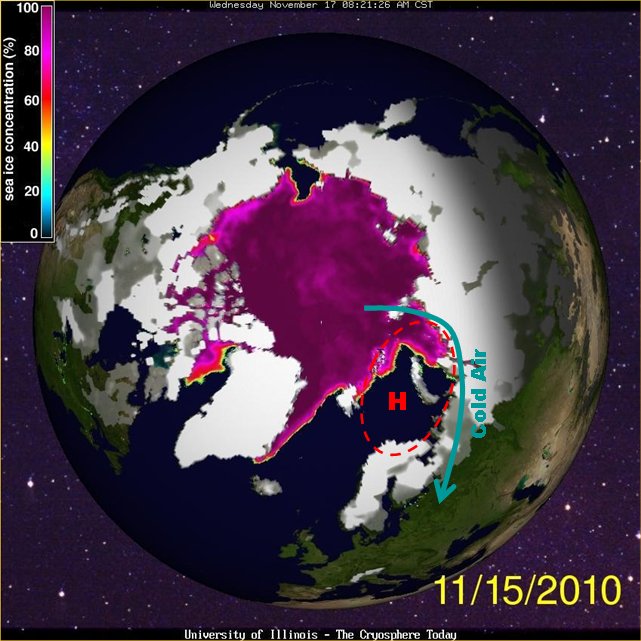
In a more recent press-release, Vladimir Petoukhov and Vladimir Semenov, argue that Global Warming could cool down winter temperatures over Europe, and a reduced sea-ice extent could increase the chance of getting cold winters. Also they propose that cold winters are associated with the atmospheric circulation (see schematic below), and their press-release was based on a paper in Journal of Geophysical Research (JGR), which may seem to have a serendipitous timing with the cold spell over Europe during the last weeks. However, the original manuscript was submitted in november 2009 (before the statement made by James Overland) and accepted in May 2010. One could regard the paper more as a ‘prediction’ rather than an ‘explanation’.
Although Petoukhov and Semenov’s findings sound plausible, I don’t think they are as straight-forward as they initially seem in terms of their implications for this winter either. For one thing, it is impossible to prove that one single event is due to a change in the long-term, as we pointed out for the case of hurricanes (The 2010 hurricane season this year, by the way, was quite active).
I think it is important to keep in mind that the Petoukhov and Semenov study is based on a global atmosphere model that simulated a non-linear response to the loss of sea-ice in the Barents-Kara seas: initially warm winters, followed by cold, and then warm winters, as the sea-ice extent is gradually reduced.
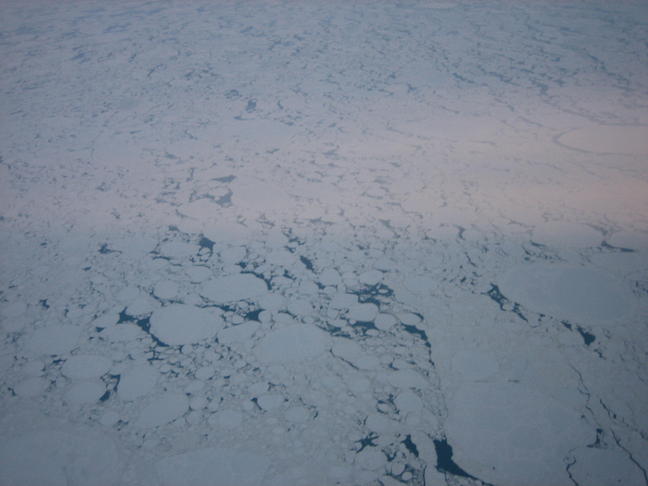
One interesting question is how the Barents-Kara sea-ice affects the winter temperatures over the northern continents. By removing the sea-ice, the atmosphere above feels a stronger heating from the ocean, resulting in anomalous warm conditions over the Barent-Kara seas. The local warming gives rise to altered temperature profiles (temperature gradients) along the vertical and horizontal dimensions.
Changes in the temperature profiles, in turn, affect the circulation, triggering a development of a local blocking structure when the sea-ice extent is reduced from 80% to 40%. But Petoukhov and Semenov also found that it brings a different response when the sea-ice is reduced from 100% to 80% or from 40% to1%, and hence a non-linear response. The most intriguing side to this study was the changing character of the atmospheric response to the sea-ice reduction: from a local cyclonic to anti-cyclonic, and back to cyclonic pattern again. These cyclonic and anti-cyclonic patterns bear some resemblance to the positive and negative NAO phases.
They also show a different response in surface air temperature (SAT) during December, January, and February. From their Figure 2, it is not immediately obvious from that figure that a sea-ice reduction leads to lower SAT during January. This is, however, very much in line with similar analysis that I have carried out with colleagues and struggled to find a consistent response (albeit we looked at the summer season).
But Petoukhov and Semenov provide theoretical support for their observations, and argue that the non-linear response can be explained in terms of ‘convectional-frictional’ and ‘baro-clinic-frictional’ mechanisms. The former includes warming over the areas where sea-ice disappear, and changes in the vertical temperature gradients, stability, and hence friction, while the latter involves a change in the surface friction force associated with temperature changes over distances.
I think that the scientific community will need some time to confirm this link, and there are some
important caveats: For one thing, the spatial model resolution (the size between the boxes in the grid mesh, through which the models represent the world) has an influence on their ability to represent blocking frequency. Hazeleger et al. Has observed that “… different horizontal resolutions … confirm the resolution-dependence found in NWP [Numerical Weather Prediction]”. The atmospheric model used by Petoukhov and Semenov has a fairly coarse spatial resolution (2.8 degrees x2.8 degrees), and it is legitimate to question whether it can reproduce the
frequencies of blocking events realistically, and whether that has a bearing for the conclusions.
But also the fact that the sea-surface temperatures (SSTs) were fixed in these experiments may affect the conclusions. Balmaseda et al. found that the atmospheric response to changes in sea-ice conditions may depend on the background SSTs, at least for the summer months. They also compared results from a coupled ocean-atmosphere model with the results from an atmosphere model for which the SSTs were given. Their unexpected finding was that the atmospheric response in these two cases were very different.
In fact, global atmospheric and climate models are better at describing the large picture than more regional and local characteristics. There is a limit to what they are able to describe in terms of local regional details, and it it reasonable to ask whether the response to changes in regional sea-ice cover is beyond the limitation of the global model. If different models give different answers, then it is likely that the response is not robust.
Another interesting question is whether the sea-ice the is whole story. Not long ago, there were some suggestions of a link between low solar activity and cold winters (this correlation, however, is so weak that you would never notice without statistical analysis. Also see comment here). Do these factors affect the circulation patterns over the North Atlantic? The sunspots tend to vary on a time scale of 10-12 years, but the NAO-index suggests that few of the extreme low values were repeated over two subsequent years. In other words, the NAO doesn’t show the same persistence as the sunspots. It will be interesting to see if this winter will break with previous patterns – if it does, that could be interpreted as a support of Petoukhov and Semenov hypothesis.
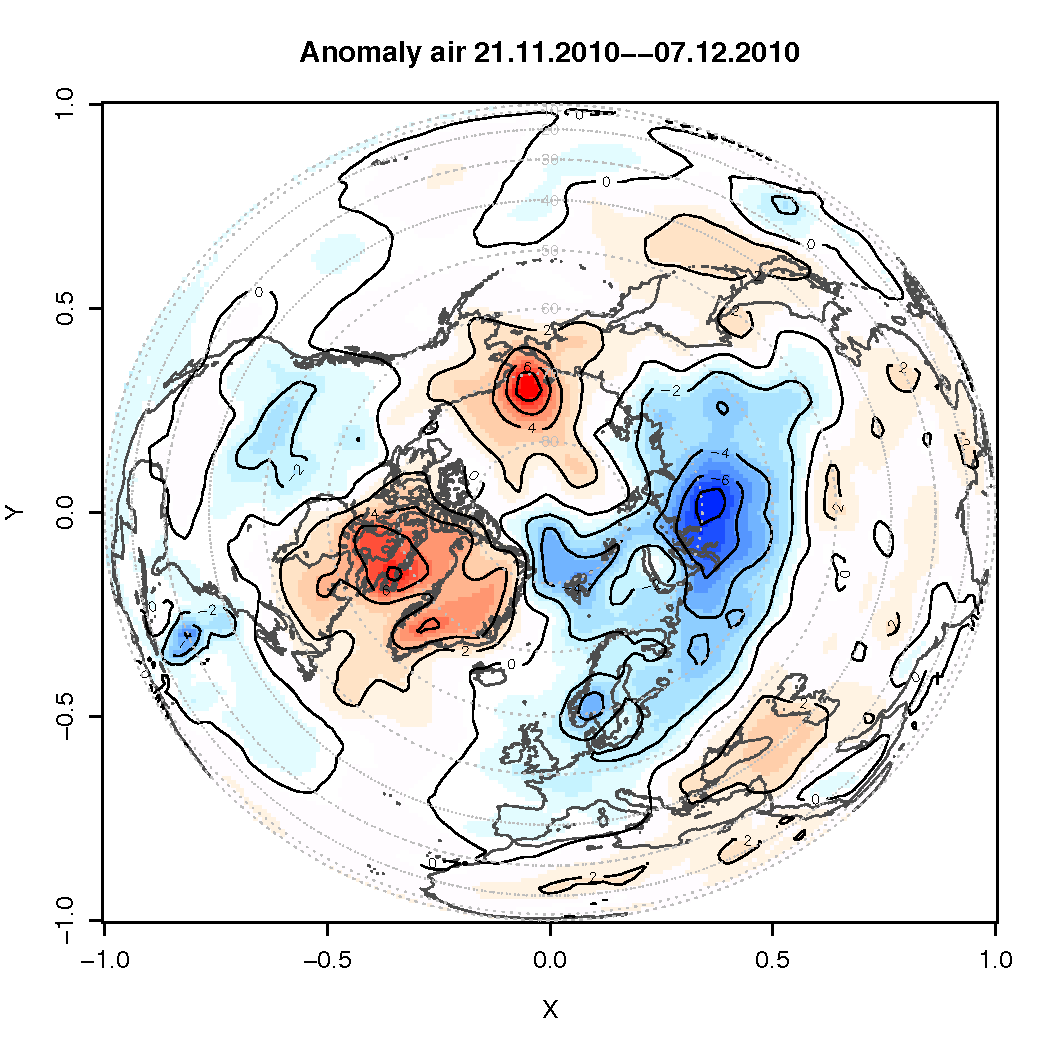
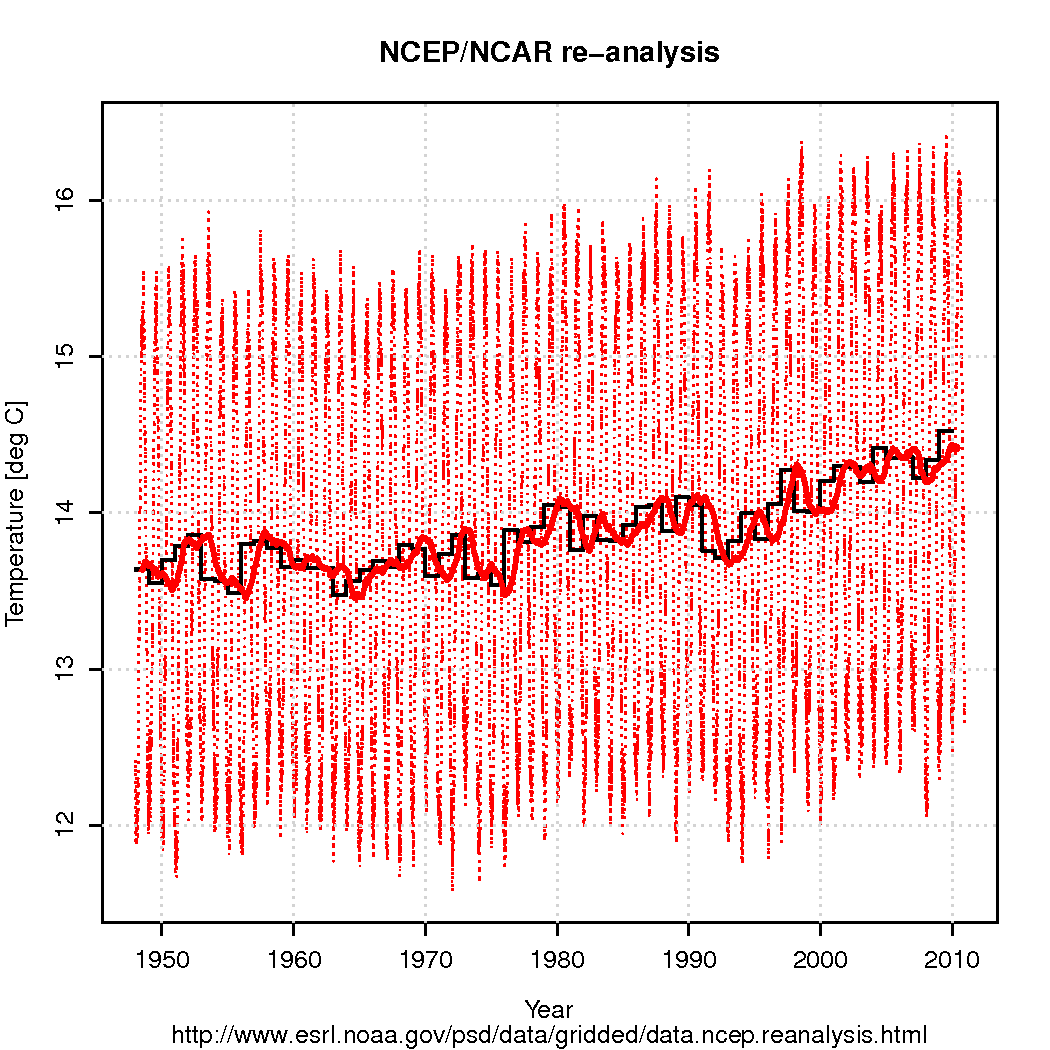
It is nevertheless no contradiction between a global warming and cold winters in regions like Europe. Rather, recent analysis suggest that the global mean temperature is marching towards higher values (see figure below), and Petoukhov and Semenov argue that the cold winter should be an expected consequence of a global warming.

Re: #1 Gavin’s response:
THANK YOU for that hilarity. One needs a break from all the distressful news on occasion.
#38–Mike, apparently it is not safe to assume that the comparisons are indeed “baseline adjusted”–see:
http://tamino.wordpress.com/2010/12/13/odd-man-out/
It’s kind of sad when a denialist wallpaper artist gets their own sources wrong, as I expect happened with the apparent confusion between CRU data and UAH data.
Gavin : “It’s difficult for me to understand how one can evaluate the consequences of the Earth’s passage around the sun, if the local changes are so much unknown. ….if the LOCAL variance is higher than the seasonal cycle (which can be true even if the GLOBAL one is not)”
Gavin, concerning your question, I have an answer : the local variance during a season is NOT smaller than the seasonal change – if it were, we wouldn’t indeed have seasons.
Kevin : “Now if we run a set of lottery machines in 10 different locations worldwide, and once a decade we collect all the balls in a pool and then refill the machines at random, then we won’t even know the mean of the numbers in any one machine. But we still know what the mean of the numbers across all the machines is.”
That’s plainly wrong – the mean of the numbers in any machine is on average the same as the global one. Only the variance is higher.
Ray : “Answer: focus on long-term trends and the underlying fundamentals. ”
I agree, but only because, as I said, the trend becomes larger than the variance after some time intervaL My question is only : do we have a proper estimate of the time when this will occur for the average local temperature ? (which must be significantly longer than for the global one ?).
I would offer a quantitative answer : If you approximate the global temperature as an average of N spatially autocorrelated, relatively homogeneous regions (defined by a typical autocorrelation length), you expect the global variance to be the local variance divided by N^1/2. (This should be refined by considering the influence of different latitudes and sea/land differences for instance, but it is just a first approximation). So the time needed for the trend to exceed the local variance should be of the order of N^1/2 times that for the global one. An idea for N ?
“Gavin, concerning your question, I have an answer : the local variance during a season is NOT smaller than the seasonal change ”
I meant “is NOT larger” , of course.
Norman Page 15,
Please read:
http://BartonPaulLevenson.com/Sun.html
Ken 45,
Get a clue. The world is not cooling down. Take a look:
http://data.giss.nasa.gov/gistemp/
http://www.cru.uea.ac.uk/cru/data/temperature/
http://www.ncdc.noaa.gov/temp-and-precip/msu/
#47 Phil,
You need to read Francis 2009 “Winter Northern Hemisphere weather patterns remember summer Arctic sea-ice extent.” Particularly figure 3 and assoc text which demonstrates and discusses the memory in the Arctic system that carries disturbance in the atmosphere from autumn into winter. e.g.
Modelling studies like the one discussed here may help to confirm and elucidate the exact processes in play.
This is discussed in NOAA Arctic Report Card 2010: Atmosphere. http://www.arctic.noaa.gov/reportcard/atmosphere.html
Message #9
I was right;
Gavin 1999 : Greenhouse Effect Makes Winters Warm
[edit]
[Response: Since you ask, I think that long term impact of changing CO2 on the stratosphere-troposphere temperature gradient will likely drive a shift towards more positive winter NAO/AO patterns, that would – all other things being equal – lead to more zonal flow and less cold air outbreaks like the ones we have seen this winter in Europe. Whether the impact of reducing sea ice adds a countervailing pressure for an opposite effect is an interesting idea, and one that needs to be examined more thoroughly than it has been. But it is certainly worth pointing out that the tendencies from either effect are much smaller than the in-season variability in these patterns and conclusions are not going to be found from looking at single seasons. – gavin]
“Watch the next 10, 20 or more years progressively get colder and colder each and every year.”
Good luck with that. I wish you were right, but of course you’re just an example of the worst of the denialists.
Septic Matthew (39), I think your main idea is correct but I’m bothered by a couple of your nuances or insinuations. Cold weather periods do not disprove AGW as you say, but neither do they add supporting evidence of proof of AGW as is so often implied or even stated.
You paraphrase that statistical analysis is necessary in climate science and that [just] mechanisms can’t predict future climate. Yet the thought was that statistical analyses alone are insufficient evidence in climate science, and mechanisms are a necessary requirement. Your comment does not technically counter the latter, but it sure sounds like you are trying to convince people otherwise. Am I right, or did I miss it?
Here in south west England, and the rest of the UK too, we are having our third very, very cold winter. 1963 was the last time it was like this.
But this time, there are not the letters in newspapers that are claiming “global warming is dead!”
Now, I am not saying that the deniers are back peddling, but people on the whole seem to realise that the wind is coming from the north-east,and as it is from the north-east it is cold.
Jeff Masters has a great article along the same lines:
http://www.wunderground.com/blog/JeffMasters/comment.html?entrynum=1710
Basically, instead of low pressure dominating the arctic during the winter, high pressure does.
This is similar to leaving the door to the refrigerator open.
It allows cold arctic air to invade the continents and warm air to move north.
Not clear how much this is due to general warming of the atmosphere versus reduction in sea ice or some combination of a larger number of factors.
However, there has been a general trend towards increasing precipitation in the Northern Hemisphere which during November/December means more snow storms.
For me, the key point is relatively straightforward (and has already been made in one way or another by several commenters): as Arctic sea ice refreezes in autumn and early winter it releases heat to the atmosphere. In recent years, the amount of ice forming has increased significantly, and so the amount of heat entering the atmosphere has also increased. The amount of heat varies regionally. Hansen mentions Hudson Bay, but there were also large persistent anomalies in the Chukchi and Kara Seas (both now frozen over). The circumpolar atmospheric circulation is therefore “seeing” and responding to new, large heat and moisture inputs in fixed areas, and that may well be driving the WACCy weather. In fact, it would be a miracle if the changes in the Arctic ocean energy budget were not having some significant effects.
My speculation would be that this a transient phenomenon. If Arctic sea ice extent and volume continues to decline, eventually the release of heat to the atmosphere in autumn and early winter would become “smeared out” around the Arctic, rather than “pinned ” to particular locations, perhaps making the current WACC pattern less likely.
Worth remembering that climate change is not only delivered by slow changes in long term averages, but also by changes in patterns of weather.
I’d be interested to see an analysis of the frequency of cold spells in the UK and western Europe over the last half century, and the synoptics that drove them. My recollection is that cold outbursts were usually associated with intense high pressures becoming established over Scandinavia funnelling cold Russian air westwards. The current pattern seems to depend more on high pressure over Greenland — but perhaps I’m not seeing the bigger picture… ;-)
“Watch the next 10, 20 or more years progressively get colder and colder each and every year. I bet none of you warmers will wise up! Hope you all freeze!”
If you’re a young man, find enough warmers to bet with. You’ll be rich enough to retire!
[Response: I don’t know.. Stefan offered a bet on the last 10 years, which no one took. If they had though, the ‘warmer’ Stefan would be 10,000 euros richer.–eric]
#47 Phil,
You need to read Francis 2009 “Winter Northern Hemisphere weather patterns remember summer Arctic sea-ice extent.”
I have but they don’t say that there isn’t a temperature inversion over sea ice in the Arctic winter.
#25 Chris R and #46 Patrick 027
Many thanks for the responses about Rossby waves. I had a feeling they might be a little complex … but I think I’ve understood some of it. Mind, I’ve only read it three times so far.
À propos of the top post, the arctic oscillation is off the chart again this winter, and many areas have more precipitation than expected with La Niña.
#58 (Lazarus): The connection between general warming and increased frequency of positive phases of the NAO is well documented. Look into work done by the Norwegian Bjerknes Centre. However, the (much) faster than anticipated melting of the Arctic sea ice and resulting changes to the atmospheric circulation patterns has introduced a forcing that seems to be overpowering this (at least temporarily). However, note that models predicting a connection between low ice cover and negative phases of the NAO are not new. For example, have a look at Magnusdottir et al. (2004). They found that negative anomalies in the Greenland sea ice cover would help force a negative NAO. In short: warming forces positive NAO until ice loss induced atmospheric changes take over and force a negative NAO. Models have shown that this will be the case until the ice cover drops to a stage where the resulting net forcing will once again favor the positive NAO.
Shortest explanation for most laypeople*:
The circulation patterns of polar air have been altered by global warming, shifting both the location and strength of high and low pressure systems that steer polar jet streams. These changes are leading to unusual and unpredictable changes in temperature in winter in the northern hemisphere; sometimes it may be colder than usual in some places. However, in most places it is warmer. Also, because warmer air holds more moisture, many locales may see higher snowfalls than normal. Remember, “warmer” does not necessarily mean “warm”: though 15 degrees is significantly warmer than 5 degrees, it doesn’t make most people want a refreshing dip in a pond.
—
*i.e., those whose most recent science course was 10 or more years ago, poorly taught, and less interesting than the attractive lab partner.
Accurate enough?
60, Rod B.: Cold weather periods do not disprove AGW as you say, but neither do they add supporting evidence of proof of AGW as is so often implied or even stated.
I agree, but I have not read that cold winters are supporting evidence of AGW; what I have read are detailed analyses of specific cold winters (such as what is happening now, and some aspects of the last NH winter) where the complete mechanism is supportive of AGW. I don’t think anyone actually predicted that this winter in GB would be as cold and snowy as last winter, but the combination of warmer Arctic winters and worst GB winters illustrates how more total warmth can produce a region and time with unusually cool temps.
Yet the thought was that statistical analyses alone are insufficient evidence in climate science, and mechanisms are a necessary requirement. Your comment does not technically counter the latter, but it sure sounds like you are trying to convince people otherwise.
If what I wrote is correct in the main, then models incorporating mechanisms will not make correct detailed predictions (about what places will be unusually warm/cold over any prespecified time interval, such as predicting last summer’s unusual heat near Moscow and simultaneous unusuall coolness NE of Moscow.) Consequently, as everyone has emphasized on this site, they can’t be even potentially disconfirmed over short time spans by particular model failures. I think it is likely that an appropriate statistical model that eschews detailed mechanisms (Possibly Barton Paul Levenson’s Granger Causality; but more likely a non-linear, non-stationary vector autoregressive model) may provide more accurate predictions of global averages than will long runs of mechanism-based models. I don’t think I am trying to persuade anyone, I think I am trying to keep the idea alive in case, as I think likely, mechanism-based models don’t become good enough to make precise predictions. On the whole, I wish I hadn’t written that because I think it detracts from the rest of the post, as you wrote.
“Because of the thermal inertia of the oceans and the absence of the UHI effect the Hadley CRU SST data are the best for discussion purposes. This data shows that the warming trend peaked in 2003…” Norman Page — 17 December 2010 @ 8:08 AM
Do you mean these SST “cooling” trends?
Re 53 Gilles
(re Kevin) That’s plainly wrong – the mean of the numbers in any machine is on average the same as the global one. Only the variance is higher.
The expectation value of the mean is the same until you run the experiment, upon which you will likely find that some machines have recieved a different mean value for there numbers, by chance. Kevin was refering to the likely statistics that would come from running these machines, according to the probability knowing that some machines will have different means.
Re Ray My question is only : do we have a proper estimate of the time when this will occur for the average local temperature ? (which must be significantly longer than for the global one ?).
I don’t know that one quantitatively, though it requires some clarification – do you mean when the trend is larger than the noise relative to the daily and hourly means, etc, of an average year, or when the trend is larger than all the variations, including the diurnal and seasonal cycles? I’d think, for much of the globe, we won’t see the later for a long, long, long time.
#11, Dr Hansen is completely right, I came up with the same conclusion a few days earlier (scroll down eh2r,com on my Dec 2 presentation) . Although I must study Rossby waves.
Please look fast as models will change with days:
http://www.weatheroffice.gc.ca/model_forecast/animateweb_e.html?imagetype=model_forecast&imagename=12_054_G1_north@america@zoomout_I_4PAN_CLASSIC@012_….jpg
A North Atlantic low pressure system moving from East of Labrador to a great deal Westwards! Very unusual but true, look at the upper right panel.
Its not only open water, but rather thinner ice, which insulates the ocean less, incoming low pressures from the south cool less.
This current low gives 11 Km tropopauses at Mid december at location 74,5 degrees North. Unreal. Along with DWT’s 250 Kelvin strong, September troposphere Upper air in December.
If Hudson Bay and Baffin Bay remains longer with thinner ice or open water, I don’t see how Europe may not freeze more in December. Its all bad news, not only weather wise.. Global warming hits hardest in unpopulated Arctic, while it gives colder weather in densely populated areas. Its a propaganda piece by nature itself,
encouraging lackadaisical response to climate change.
Explaining Global warming is made a whole lot tougher
Septic Matthew, Rod B…
You do realize these “cold” winters aren’t all that cold, historically?
Unlike the unprecedented heat wave in Russia this year?
Snow in Europe isn’t exactly thought to be uncommon, dudes.
Patrick 027 : including the diurnal and seasonal cycles? I’d think, for much of the globe, we won’t see the later for a long, long, long time.”
Of course, Patrick, the trend must be computed and compared only after averaging over known periodic cycles. I meant only the variance of random fluctuations.
47 Patrick 027: Alfven waves require ionized gas [plasma] and happen on the sun. See “Cosmical Electrodynamics” by Alfven and Falthammer. Thanks for the discussion of Rossby waves, which are more than sufficiently complicated without electricity and magnetism. I am learning the language. IIt seems to me that Rossby waves could be the cause of the Cold Europe Warm Greenland thing. John Houghton’s “The Physics of Atmospheres is Very slow going for me. I am seeing whole “new” to me kinds of wave phenomenon by studying climate.
More discussion of wave anchoring on melting ice and Greenland would be most welcome. Those high and low pressure areas and cyclones are part of the wave stuff that is going on. I am just starting to learn this subject and would like more articles from the professors.
#68 Pete Dunkelberg,
I’ve been watching the ensemble forcecasts:
http://www.cpc.noaa.gov/products/precip/CWlink/daily_ao_index/ao_index_ensm.shtml
Which are very negative, with all ensemble members showing a grouping of very low index for the next 7 days or so. When they group like that they’re normally pretty accurate. It’ll be interesting to see how the rest of this winter and future winters play out. I think this Winter weather is related to the reduced ice in the Arctic – however that doesn’t mean that every Winter will be like this. The Arctic ice crash happened in 2007, winters 2007/08 & 2008/09 didn’t play out like 2009/2010 and (as now seems likely) this winter.
#71 Septic Matthew,
I personally wouldn’t argue that cold winters ‘support’ AGW. I do think last winter and this are likely to be a secondary consequence of AGW, because AGW has caused what has caused the cold winters – the loss of Arctic ice. 1) AGW -> 2) Reduced Sea Ice -> 3) Cold winters. AGW -> Cold Winters is IMHO incorrect because without the sea ice term it’s wrong.
#75 dhogaza,
Last winter and this winter (so far) are unusual in the context of what we’ve become used to in the UK, however so far nowhere near as bad as 1963 (I suspect we won’t see as bad). Furthermore Overland is saying (as reported by Jeff Masters) that there have only been 4 occurrences like last winter since 1850: 1881, 1936, 1963, 1969, and that Winter 2009/10 was at least as sruprising as the sea-ice crash of 2007. Although as I state above, it’ll be interesting to follow future winters, patience is a virtue.
#66 OK Phil, I was trying to keep things simple – pursue it to whatever depth of complexity keeps you happy.
“75
dhogaza says:
18 December 2010 at 11:55 PM
You do realize these “cold” winters aren’t all that cold, historically?
Unlike the unprecedented heat wave in Russia this year?
Snow in Europe isn’t exactly thought to be uncommon, dudes.”
You are showing your obvious bias Dude.
According to Thomas Globig from the weather service Meteo Media talking to wetter.info.
The last two weeks have been the coldest in England since the second-to-last solar minimum, many hundreds of years ago.
Also the December temperatures in Berlin are the coldest for 100 years.
So dude, the Russian weather eventn is no more unusual than the current cold weather events.
Implications for short term UK policy.
Has Beddington been offered a poisoned chalice?
#75 (dhogaza): Absolutely true that snow in Europe isn’t unusual, but the thing is that these very cold winters are following a string of approx. 20 winters that were mostly extremely mild. These mild winters made lots of folks suspect that something was indeed wrong. However, now that populated areas are freezing, everything seems to be fine again (to the uninformed). The professional disinformers probably can’t believe their luck, and are using the cold weather for all that it is worth. The MSM laps it up: cold weather in the winter is front page news, while the warmest global average temperature on record is barely mentioned.
I should imagine that the most common response of policy-makers [and the informed general public other than the inane AGW deniers, that is] to this information would be to say,
“So you say these bitter European winters are probably caused by melting Arctic sea-ice, which is caused by global warming. Global warming is expected to continue, with annual variations, so decline in sea-ice should likewise continue. It is noted that preliminary studies show that once much of the sea-ice has gone then maybe warmer winters will return. So, what is the prognosis? Should we expect bitter European winters every year from now on and if so for how long? Five years? Ten? Fifty? I’ve got an economy/transport system/ski industry etc etc to plan and these bitter winters have thrown everything into chaos.”
Any guesses as to how long before you can provide an answer?
One can argue forever what is more significant, current cold temps or the many warm records this year. One thing to keep in mind, though, is that 19 countries set all time warm records in 2010, while only one set an all time cold record. The only thing that really matters in the case of “proving/disproving” AGW is the fact that the global average temperature is at the highest in recorded history, and the La Nina cooled troposphere temps have now surpassed the El Nino warmed temps of the same time last year. This is UAH satellite data, run by a fellow that can probably be classified as a skeptic.
If the global average was at an all time low, or at least plummeting, the local cold would be interesting, but with average temps at an all time high (despite natural cooling) it is more an indication of what happens when circulation patterns are disturbed from ice loss, tropospheric warming, etc.
BTW, if I lived in Russia, I would get myself an air conditioner in preparation for the 2011 summer, as it looks like patterns are repeating and 1000 year events aren’t as rare as they used to be.
We seem to have discovered a new breed of denialist that hibernates in the months of April through November. The enterprising little beasties have rediscovered winter.
The “new breed of denialist” seems to be a reverse snowbird in search of endless winter, spending time in the southern hemisphere between the Vernal Equinox and the Autumn Equinox, and the balance in the northern hemisphere. RE: Globig, I wonder what he had to say after 2007 became Germany’s warmest winter on record. This probably is somewhere between a dumb question and a lazy question, but is there any thought that Iceland’s Eyjafjallajökull volcano might have an effect on the European winter (or the Russian summer, for that matter)?
In reply to #80 — British Government science advisors have a sorry history of being lauded when they agree with the current bunch in power, and ignored when they don’t. When reality jars with policy, policy people ignore reality…
All the above discussion about the present cold weather in Europe is interesting, but may be missing a major point (or 2) IMHO.
For starters, there’s no hint that there might be underlying changes in ocean circulation, such as might be the result of changes in the THC. Such would likely result in patterns of ocean SST’s which could be linked to the recent unusual outbreaks of cold air from the Arctic over Europe. The paper by Petoukhov and Semenov, mentioned in the opening commentary, is said to use fixed SST’s with a slab ocean, which could not capture any changes in ocean heat transport via currents such as the Gulf Stream. Previous cold periods with low NAO index values may also have been associated with reduced THC flows linked to the Great Salinity Anomaly. Given the data which has shown an on going reduction in surface salinity found in the Nordic Seas, it’s logical to expect this would have an impact on the THC, which we may now be experiencing.
Secondly, the discussion hasn’t included any mention of the impact of tidal forces on the atmosphere. The gravitational vector relative to Earth appears to move in a westward direction, as the Earth rotates once a day. At the Equator, the speed is about 1,670 km/h (1,038 mph). Most of the tide force is due to the Moon’s gravity and it may be worth noting that the Moon’s orbital precession cycle lasts about 18 years the Saros cycle. Researchers over the years have claimed to have found this period in weather data using frequency analysis. This may be important just now as the Moon’s tidal vector is aligned with that of the Sun, as a solar eclipse is due on 21 December.
Lastly, I think that the posting by Jeff Masters mentioned above makes a major mistake in physics. In that post, Masters wrote:
“Through east-west oscillation motions of the Icelandic Low and the Azores High, the NAO controls the strength and direction of westerly winds and storm tracks across the North Atlantic. A large difference in the pressure between Iceland and the Azores (positive NAO) leads to increased westerly winds and mild and wet winters in Europe. Positive NAO conditions also cause the Icelandic Low to draw a stronger south-westerly flow of air (emphasis added) over eastern North America, preventing Arctic air from plunging southward. In contrast, if the difference in sea-level pressure between Iceland and the Azores is small (negative NAO), westerly winds are suppressed, allowing Arctic air to spill southwards into eastern North America more readily…”
I think this to be completely incorrect, as it is impossible to “draw” or pull with the atmosphere. A fluid simply can not transmit a tension force, i.e., pull. The pulling force within the atmosphere (and the ocean) is gravity, which pulls the denser masses of fluid to the lowest level, thereby displacing the less dense air in a generally upward direction. The areas of low pressure are the result of the overall flows within the atmosphere as the air circulates both vertically and horizontally, not the cause of the flows. The patterns or mode within the atmosphere associated with the pressure differences are characterized by the NAO index, but those pressure differences do not provide a cause for those patterns, IMHO. I am aware that folks who watch the weather tend to focus on those low pressure areas, since they provide the most “interesting” weather events, but physics rules the day…
E. S.
Steckis:
The Russians claimed that the heat wave in Moscow is unprecedented, which is somewhat more unusual than “coldest for 100 years” or even “many hundreds of years”.
Some estimates have it as being possibly a one-in-three-thousand year event.
Unprecedented. You can look up that word in the dictionary …
Steve R says:
70
18 December 2010 at 10:47 PM
Accurate enough?
Not really. How do you explain the record low temperatures accompanying the current snowfall?
75, dhogaza: You do realize these “cold” winters aren’t all that cold, historically?
That’s incidental to my main point: even extreme cold spells, analogous to extreme wave troughs, are not evidence against AGW, as long as globally averaged temps do not follow a long-term downward trend.
However, the current temps in GB and Northern Europe do seem to be cold by comparison to the last 100 years or so.
The unpredicted record heat of Russia in mid 2010 was accompanied by unpredicted record cold in other places.
Esop: if I lived in Russia, I would get myself an air conditioner in preparation for the 2011 summer, as it looks like patterns are repeating
Which patterns? If enough of the patterns repeat, then summer of 2010 will repeat the summer of 2010, with record highs in the same places as last year, and record lows in the same places as last year — with overall continued warmth comparable to the last 10 years.
Are reasonably accurate regionally specific 6-month-ahead forecasts possible with current knowledge and models? Six months ago NOAA published (and I noted here) a forecast that subsequent months would be colder (compared to average) than the previous 6 months.
#78
2007 December 2
http://arctic.atmos.uiuc.edu/cryosphere/IMAGES/ARCHIVE/20071202.jpg
2008 dec 2
http://arctic.atmos.uiuc.edu/cryosphere/IMAGES/ARCHIVE/20081202.jpg
2009 dec 2
http://arctic.atmos.uiuc.edu/cryosphere/IMAGES/ARCHIVE/20091202.jpg
1981-2010 dec 2 comparison
http://igloo.atmos.uiuc.edu/cgi-bin/test/print.sh?fm=12&fd=02&fy=1981&sm=12&sd=02&sy=2010
it is also very fair to say that ice thickness has been reduced. Sea ice extent difference
between 81 and 2010 is mainly Hudson Bay and Bafiin Bay having a whole lot less ice,
1958-1966 Past studies help us understand significantly:
“By early November the ice extends roughly 50 miles offshore from Southamp-
ton Island to Churchill, and has formed along shore from Churchill to Winisk.
Coastal ice is forming locally elsewhere
as well, but by far the greatest part of the
Bay is open water. The pack ice continues to grow most rapidly from the north-
west, although extensive shore ice rings the entire Bay by early December. Ob-
servational and climatological evidence indicate that freeze-up is nearly complete
by the end of December, with significant
amounts of open water (apart from shore
leads) only in the extreme southeast. Except for the ever-present shore leads, the
surface is entirely ice covered by early January.
http://arctic.synergiesprairies.ca/arctic/index.php/arctic/article/viewFile/3119/3095
In particular look at figure 4 early July
where this year:
http://igloo.atmos.uiuc.edu/cgi-bin/test/print.sh?fm=07&fd=01&fy=1981&sm=07&sd=01&sy=2010
much ice as vanished..
1963 and 1969 were years when there was an early melt… Fig 17:
http://www.cmos.ca/Ao/articles/v320208.pdf
IN my opinion, thanks to AGW the UK will have more often than before a touch of Canadian winters… Its survivable hey! , while Nunavut will have much milder winters.
Several people: Thank you. The high pressure due to heat release upon freezing links to Rossby waves and NOAA’s report card. The phenomenon can be thought of correctly either as a weather forecaster would or as a climate scientist would, I think. The linkage is important.
“The last two weeks have been the coldest in England since the second-to-last solar minimum, many hundreds of years ago.” and “…the Russian weather event is no more unusual than the current cold weather events.” Richard Steckis — 19 December 2010 @ 6:06 AM
1. The “last two weeks” isn’t an historically cold winter.
II. According to http://www.esrl.noaa.gov/psd/csi/moscow2010/, the Russian heat wave began the first of July, and broke about August 19. Not two weeks.
B. You’re confusing Joe Bastardi’s statement Dec 10, widely mangled throughout the denialosphere –
“Gavin Partridge has supplied the details:
The central England Temperature (CET) from the 1st-7th of December is -1.9, making this the coldest opening week of December since 1879; 1879 is the coldest opening week on CET record, so this week has been the second coldest opening week to December since CET records began in 1659.
The two-week period, last week of November and first week of December is the coldest since CET records began in 1659.” with “the last two weeks.”
Yes I’m being nitpicky, but I think that’s better than not paying attention.
Meanwhile, in the southern hemisphere, – http://www.bom.gov.au/climate/current/season/aus/summary.shtml –
“In Brief –
Wettest spring on record for Australia. Individually, most states had a very wet season, with the NT, Queensland and NSW all having their wettest spring on record, and all states except Tasmania in the top 10 wettest. Maximum temperatures were generally much cooler than normal, with the exception of western WA, which was much warmer than normal.”
Are these record events teleconnected by AGW, or just one in a thousand coincidences?
Re #79, Richard Steckis:
The original claim was that the single day 2010-12-01 has been the coldest since start of weather records in much of Germany, including Berlin. That’s true. Next claim was that the first decade of December has been the coldest since 100 years in Berlin. That seems not quite true.
I don’t know if that long continuous weather records exist for Berlin, but they do exist for the neighbour city Potsdam, where 1933 (-5.1 °C) and 1925 (-6.0 °C) were colder than 2010 (-4.6 °C) (not counting 1902 at -8.5 °C). Latest figures for 1 Dec – 18 Dec are -7.4 °C (1933), -6.0 °C (1902), -3.9 °C (1899, 2010). Lowest December means so far are -6.2 °C (1969) and -4.1 °C (1933). Preliminary means for 2010 may drop to -4.5 °C again the next days, but then will rise until the end of reliable forecasts. Yes, it’s cold, but not unprecedented. And much more pronounced temperature anomalies are common in the Berlin region in January and February (up to -12 K in Feb 1929); they just tend to be less extreme that early in the season.
Note that if I pick 10 days of data, I can easily get record highs for most stations in recent years. E.g., for Potsdam, 2010-07-08 – 2010-07-17 has been the hottest period at that time of the year by a big margin: +26.1 °C compared to the previous record of +24.0 °C (1923).
I don’t have data at hand for England, but nobody will for a period reaching back to the Maunder Minimum (?), reliable enough to say that just 2 weeks were the coldest since then.
I live near Hohenpeißenberg, a weather station with 230 years on record, in southern Germany. So far, December 2010 doesn’t even fall into the lowest 1/3 of Decembers. It’s cold and snowy here too, particulary if compared to the very warm Decembers of the 80s, but not extreme.
The Histalp project has carefully homogenized time series for the “Greater Alpine Region” and seasonal plots. There weren’t any really extreme cold winters since 1961/1962 (note that data ends at May 2008; with operational data, Hohenpeißenberg had a mean of -2.3 °C in the last (“cold”) winter.
Re #4, Esop:
Actually, December NAO is positiveley correlated with NAO later in winter, although much weaker than one may expect (according to long term NAO series. At Hohenpeißenberg, if December is in the coldest 1/3, then Jan-Mar is also in the coldest 1/3 in 46% of all cases (normal 32%, warm 21%). That’s much more correlation than caused by cold spells around New Year and bias due to the long term trend. In regions where normal temperatures are around 0 °C, a pronounced warm spell is needed to melt out a thick snow cover, once it could develop, and snow cover will keep temperatures low. Atlantic SSTs cause also some persistance in European weather.
To put worrying about getting colder locally in context, see this. Over the last 12 months, it has cooled in a few isolated spots – and much of the area where there have been cold snaps have actually warmed on average over the year. But that’s not the big picture.
#94 (Andreas): I should have mentioned that I was focusing on the years after 1987/88 (that is when we saw an abrubt change in the Scandinavian winter climate. Curiously, this coincided with the jump in global average temperature).
From 1987/88 until 2009/10, the NAO has flipped from negative in December to positive in January no less than 13 times. Five times it has stayed negative in both December and January, and five times it has stayed positive in both December and January. We need to go back to 1986/87 in order to find a year where it went from positive in December to negative in January.
Interesting to note that both 08/09 and 09/10 had negative NAO in both Dec and Jan, while 07/08 had positive index during both months. I have a feeling that it will flip to positive this coming January, but could very well be wrong, as the weather is acting fairly odd these days.
First: I am no scientist. My only formal merit: an elementary course i climatology at the Univerity of Stockholm about 20 years ago.
My hypothesis (or, say, guess) is, in a few words: The comparatively mild climate of Scandinavia is supposed to be to a great part due to the gulf stream. Warm water has a lower density than cold water. Freshwater has a lower density than salt water. The increased melting of Greenland´s glaciers give an increased contribution of cold freshwater to the surface water of the North Atlantic. When the warm surface water of the Gulf Stream meets this cold glacier water it, at least partly, sinks down below it, So the surface of the stream that reaches Scandinavia -and will exchange heat with the atmosphere-will contain less heat than before. – This early winter is said to be the coldest for 150 years in Sweden and, I think, in great part of western Europe Of course, one winter´s weather does not say very much about the climate and its possibly change. But my hypothesis, if it is correct, may explain the apparent paradox that global heating may cause local or regional cooling.
Tore Pihl
Årstavägen 31
120 52 Årsta
Swrden
tore.pihl@tele2.se
#79 Richard Steckis
said, “The last two weeks have been the coldest in England since the second-to-last solar minimum, many hundreds of years ago.”
Just to be clear, it is the anomaly that appears to have been lowest for some of that period, not the temperature. This is obvious from the following graphs:
http://hadobs.metoffice.com/hadcet/graphs/HadCET_act_graphEX.gif
It can be seen, according to this graph, that the blue Central England Daily Temperature does dip below the turquoise Lowest in Record 1772-2009 for a short time. Equally clearly, lower temperatures have been experienced later in December and in January and February in other years.
Steckis, Neither the Russian heat wave nor the current European cold constitutes evidence for or against anthropogenic climate change. It is interesting weather, that is all. Since the science of climate change is well established and well founded, it need not go looking for support from such tenuous sources.
Re 87 Eric Swanson –
‘atmospheric pull’ – well, yes, it all comes from gravity pulling down on the air, giving it weight, thus applying pressure; in hydrostatic balance, the downward acceleration of gravity is balanced by the vertical pressure gradient; variations in density cause variations in the rate at which pressure decreases with height, so that with such variations horizontally, it is impossible to have zero horizontal pressure gradient at all levels. Hence thermal highs and lows, inflow and outflow, warm air rises, cool air sinks (in terms of potential temperature; temperature changes adiabatically as pressure changes) (and then you also get cold-core lows and warm-core highs, which must increase in strength going upward).
But it isn’t necessary to review this all the time; whereever the pressure gradient comes from, it can accelerate the air (and then the coriolis effect acts on velocity to accelerate it in a different direction). Farthermore, IPV anomalies will, after geostrophic adjustment (which emits inertia-gravity waves), induce circulations. Given certain things, an IPV anomaly can appear to pull and direct the air – and in fact this happens, via the physical basis of what an IPV anomaly is and the tendency for geostrophic adjustment to occur (scale and latitude dependent), which needn’t always be rehashed.
—-
gravitational tides don’t do much to the atmosphere or much of the solid and inner Earth, at least not over short periods (of course they will over time have cummulative effects, such as causing the axis to wobble by pulling on the equatorial buldge, and causing the Earth’s rotation to slow down by pulling on the tidal bulges themselves (involves the ocean, too, though). Most of the tidal energy (from memory, roughly 4 TW, an order of magnitude smaller than the geothermal flux) is dissipated in the ocean. It is a significant contributor to oceanic mixing (along with wind and plankton), from what I’ve read; so presumably stronger tides could cool the surface a bit, given the thermal structure of the oceans (PS aside from some complexities that could occur, this wouldn’t by itself change the long-term equilibrium climate – if strong mixing persisted over a thousand years, the deeper waters would get warmer.) The largest variations, aside from the tides themselves, are the spring-neap variations. It doesn’t seem obvious at all that the smaller variations over longer time periods could have a signficant effect, but maybe that’s just because I haven’t read a lot about how the tides end up mixing the ocean (aside from coastal processes, I know some internal gravity waves may be involved). I have read of a coastal glacier whose flow is affected by tides, which makes physical sense. Also, I suppose stronger tides might open up polynyas by pulling sea ice along or from coasts and past islands, etc. PS I may have seen the paper you might be refering to; they gave tidal strength in terms of angular speed of the moon; I’m not familiar enough with the celestial mechanics to know how that translates into tidal acceleration or equilibrium tidal buldge; it would help to know the variation in terms of equilibrium cm change (by equilibrium I mean the rise and fall of Earth’s surface if it had time to conform to the total gravitational field; of course the reason we notice tides is that the oceans don’t respond that way (there’s Kelvin waves (and/or inertia-gravity waves?) and amphidromic points – and this different response of the ocean must of course be why most tidal energy is expended there and not in the crust and mantle, etc.), and thus rise and fall differently than the adjacent land; nonetheless, we could expect the response to be nearly proportional to the forcing for the same tidal period (moon, sun, semidiurnal vs diurnal), latitude and rotation rate, geography, etc.).