A new paper undermines totally inaccurate claims in the DOE report. … Read Full Article about Koonin’s Temperature of the LOL Stratosphere
Main Content
Featured Story
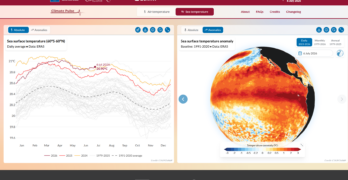
This new El Niño is different
There is a new El Niño out there and it was officially declared already on June 11 by NOAA. This is both unusually early in the year and very soon since the last El Niño in 2023-24. Another remarkable thing is the seasonal forecasts, which for a couple of months have indicated that it may well be at strengths by the end of the year that we have not seen before. All these three aspects combined … Read Full Article about This new El Niño is different
Recent Posts
Unforced Variations: Oct 2026
This month's open thread. El Niño continues to build, annual mean temperatures are starting to become clear, sea ice is doing it's thing, and NYC Climate Week has come and gone. Surely some fodder for constructive dialogue....? Please be respectful and concise. … Read Full Article about Unforced Variations: Oct 2026
Unforced Variations: Sep 2026
This month's open thread on climate topics. Please be constructive and keep nonsense to a minimum. … Read Full Article about Unforced Variations: Sep 2026
Unforced Variations: Aug 2026
This month's open thread on climate topics. The annual ranking horse race is in full swing, discussions of extreme weather abound, Arctic sea ice is reaching it's annual minimum, and the future of evidence-based policy making seems dim. Oh well. … Read Full Article about Unforced Variations: Aug 2026
Unforced Variations: July 2026
This month's open thread on climate topics. Impending El Niño, fossil fuel funded wedges, retirements, heat waves, and the same old, same old, from the usual suspects. Try to discuss these things calmly! … Read Full Article about Unforced Variations: July 2026
Unforced Variations: June 2026
This month's open thread on climate topics. Please be respectful and substantive. … Read Full Article about Unforced Variations: June 2026
“The Arctic Council is not dead”
The 4th UArctic congress on the Faroe islands finished with the message that the Arctic Council is still alive. It has overcome recent setbacks with difficulties concerning two of its member states, Russia and the US. The Arctic Council represents 8 nations together with indigenous peoples and has … Read Full Article about “The Arctic Council is not dead”
Scenarios, schmenarios…
The fantasy version of the normal updating of scenarios for a new round of CMIP simulations doing the rounds is bad faith BS. … Read Full Article about Scenarios, schmenarios…
Unforced Variations: May 2026
This month's open thread on climate topics. El Niño coming (shades of 2023), competitive predictions, ill-advised geo-engineering ideas, and massive shifts in renewable energy roll out. Surely something there to discuss... … Read Full Article about Unforced Variations: May 2026
Unforced Variations: Apr 2026
Somewhat belated open thread for this month! (Oops). Please stick to climate related topics, and remain respectful. … Read Full Article about Unforced Variations: Apr 2026
A reflection on reflection
Confirmation bias and a profound lack of curiosity mark the latest ABC (Anything But Carbon) contrapalooza in DC this week and a decade-old albedo error trips them up. … Read Full Article about A reflection on reflection