Site Google Custom Search

RealClimate logo

13 July 2007

Friday roundup

Filed under: — group @ 2:36 PM

An eclectic round-up of the week's climate science happenings (and an effort to keep specific threads clear of clutter).

It's the sun! (not)

As regular readers here will know, the big problem for blaming the sun for the recent global warming is that there hasn't been a trend in any index of solar activity since about 1960, and that includes direct measurements of solar output by satellites since 1979. Well, another paper, has come out saying exactly the same thing. This is notable because the lead author Mike Lockwood has worked extensively on solar physics and effects on climate and certainly can't be credibly accused of wanting to minimise the role of solar forcing for nefarious pro-CO2 reasons!

Stefan was quoted in Nature as saying this is the 'last nail in the coffin' for solar enthusiasts, but a better rejoinder is a statement from Ray P: "That's a coffin with so many nails in it already that the hard part is finding a place to hammer in a new one."

TGGWS Redux

The still-excruciating 'Great Global Warming Swindle' got another outing in Australia this week. The heavily edited 'new' version dumped some of the obviously fake stuff that was used the first time around, and edited out the misleading segment with Carl Wunsch. There is some amusing feedback in the post-show discussion panel and interview (via DeSmogBlog).

RC Wiki

As an aside, this is as good a time as any to point people to a new resource we are putting together: RC Wiki, which is an index to the various debunkings of the contrarian articles, TV programs, and internet pseudo-science that is out there. The idea is to have a one-stop shop so that anyone who comes across a piece and wants to know what the real story just has to start there. For instance, the page on TGGWS has a listing of many of the substantive criticisms from the time of the first showing.

Editing the wiki is by invitation only, but let us know if you want to help out, or if you have any suggestions or comments.

The sweet spot for climate predictability
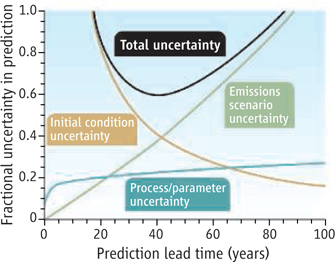
Between the difficulty of long-term weather forecasts and the impossibility of accurate predictions for economic conditions a century hence, there is a sweet spot for climate forecasts. This spot, maybe between 20 and 50 years out, is where the emissions scenarios don't matter too much (given the inertia of the system) and where the trends start to be discernible over the noise of year to year weather. Cox and Stephenson have a good discussion of the point in this week's Science and a great conceptual graphic of the issues.

One could quibble with the details (we'd put the sweet spot a little earlier) but the underlying idea is sound, and in judging climate forecasts, it will be projections in that range that should be judged (i.e. the early Hansen projections).


350 Responses to “Friday roundup”

  1. Steve Bloom Says:

    Thanks for taking these excellent steps! They’ll make RC much more accessible and effective.

  2. Robert Bergen Says:

    I like very much the cocept of the Friday Roundup. Keep it, please. And the entry in Wikipedia is nothing short of brilliant, in view of your own self-given mandate to spread the word. I have used your site many times to (try to) educate both the uninformed and the naysayers, with, of course, mixed results. But you are the authority, and hard to deny. Keep it up!

  3. Brian Says:

    RC continues to get better…thanks.

    As an aside, I very much enjoy reading the progression of comments for various posts. Although you guys likely get frustrated much of the time, another way to look at it is that all this attention, scrutiny, debate, debunking, etc. is so great for the progress of climate science. Yes, there are certainly misunderstandings and setbacks that result from all of this, but in the LONG VIEW, I think all this brouhaha is beneficial.

    Keep up the good work.

  4. Jim Eager Says:

    Re TGGWS Redux
    Thanks for the link to the Tony Jones interview with Durkin. He sure is a piece of work, dodging and sputtering to downplay his truncating of the graphs and claiming that the more recent data record is “moot”.
    What an [expletive deleted].

  5. SteveF Says:

    From the Durkin interview:

    Tony Jones: “Why didn’t you continue the [solar] graph from 1980 to now with more up to date data?”

    Martin Durkin: “Well it was a historical part of the program where we talked about key discoveries in the recent history of climatology.”

    Tony Jones: “Why weren’t we told that temperature and solar activity diverges sharply after 1980?”

    Durkin: “It’s a very moot point what happens after 1980.”

    In todays Grauniad, Durkin has a letter in which he describes Lockwood’s work as “feeble”. Interestingly, in view of the above exchange, he says:

    “However, according to the Climate Research Unit at the University of East Anglia (as used by the Intergovernmental Panel on Climate Change), global temperature peaked in 1998 - the warmest year in the last decade. The temperature then fell. It did not change at all from 2001 to 2005 and then fell slightly, again, in 2006. In short, according to the IPCC’s own figures, the global temperature has been static or else slightly declining for several years. The satellite data confirms this picture. Why is this happening when increasing CO2 levels are meant to be driving the temperature up? Could it be because solar activity has waned?”

    Hmmmmm

  6. Timothy Chase Says:

    From the essay:

    As an aside, this is as good a time as any to point people to a new resource we are putting together: RC Wiki, which is an index to the various debunkings of the contrarian articles, TV programs, and internet pseudo-science that is out there.

    Great idea!

    Although I am not that fond of coding wiki-pages (I am more of an old-fashioned custom-your-own-html kinda guy), they do have their benefits, and it may complement the blog quite well. However, besides the coding, there is also the tendency to create cob-webs. I saw that sort of thing with another wiki not too long ago.

    It may just be me or perhaps the way my mind works, but I prefer good hierarchical structures - with cross-referencing between distant branches. Back in my old Mac days I wrote a program in HyperCard with two navigation listboxes: branches and bridges. The first entry in the branches was the parent of the current location - which was followed by the children. The structure was dynamic so that you could cut and graft a branch to anywhere else in the structure. This is something which wikis don’t encourage - but which is certainly still possible. (Incidently, the program “BrainStorm” ended up being spread out across a good number of files and including all my notes and technical papers with over 2000 pages of type-written information. I guess you could say I found it useful.)

    … but I can see that you already have a little of that going already.

    Quick note: just so you know that I am not stealing your idea - I have been working on a wiki of my own. I got started last weekend. I was going to keep it a surprise, but… what the hay!

    Anyway, it isn’t ready for show as of yet, but I am hoping that it may be something of value in a bit. And yes, this is what has been keeping me busy. I want to do something to try and make a difference. Besides, I figure I will learn a bit in the process of putting it together. We will see what happens.

  7. Neil B. Says:

    I would like to see more commentary on the change in average dew point over the centuries and recently. The data may be hard to pin down for below 19th century (and, is it really so much harder to estimate than temperature?) However, it could be more revealing than temperature. I expect dew points to have risen more than temperature, from increased evaporation. It could impress people more for PR. Also, the temperature changes are raw averages, but isn’t the rise in nighttime temperatures much more? More often warm at 3 am. etc., and maybe dew points then too even worse increase.

    Also, I get the observational impression that temperatures have risen more than the reports of maybe 0.5 degree or so C (?) in recent decades. Here in SE Virginia, in the 60s, I remember well it snowed rather often. Now, it hardly ever does. Maybe there is another explanation, but people from all around tell me similar stories. What do you know or suspect?

  8. Dylan Says:

    One notable exception from the GGWS post-show discussion was Ian Plimer. I had greatly admired Ian in his years tirelessly battling the small but persistent creationist movement in Australia.
    But his views on AGW are baffling - having fought creationists on their ideology, he now appears to falling under the same trap; as an associate of the “free market” think tank I.P.A., he apparently believes that there is no justification for governmental intervention into our economy in order to keep emissions under control.
    One of his points I don’t understand at all - he claims that there are ~10000 earthquakes a year, and that the associated CO2 release is not included into the GCMs or properly researched as far as their effect on the climate. In fact, I can’t find any numbers on just how much CO2 is released by earthquakes (or other non-volcanic seismic events), but even if we had those numbers, would it really make much difference?

    [Response: None whatsoever. There is less CO2 in the atmosphere than we have put into it. We know therefore that the carbon cycle is on average taking away human CO2, not adding more of it’s own. - gavin]

    [Response: To correct Gavin slightly: he should have said less additional CO2. Concentration has risen from 280 to 380 ppm, which is an addition of 200 GtC, raising the atmospheric CO2 content from 600 to 800 GtC. These 200 GtC we added is 57% of the fossil carbon we added to the atmosphere. -stefan]

  9. viento Says:

    The conclusions by Lockwood are based on the fact that sun output does not display a positive trend since 1985 or so. However, a couple of years ago Waple and Mann showed that there is a lag of about 20-40 years between solar irradiance and global temperature. Therefore, according to both papers, the effect of solar output on Earth’s temperature should be peaking now.

    [Response: If 1985 were really the peak. However, you can take the analysis back further and find that solar hit its peak in 1960 or so and any response from that would be well damped by now, yet the last decade is the warmest yet and the rate of warming is increasing. - gavin]

  10. Nick Gotts Says:

    Re #5 Just a note for non-UK (and probably younger UK) readers. “Grauniad” is a nickname for “The Guardian” (mildly liberal - or in US terms extreme left :-) - daily newspaper). The nickname was coined many years ago by the satirical magazine “Private Eye”, because of the number of misprints appearing in the newspaper.

    On another point, the “Friday roundup” is an excellent idea.

  11. viento Says:

    #9
    Well I am reading the paper again, and I see in several places that the last grand maximum was 1985. Concerning the ‘rate’ of warming, it is not very clear that it is increasing. The trend in global T and, in particular sea-surface-temperatures in the last 10 years is not as large as in the 90s, though positive indeed - with the uncertainties in determining a 10-year trend.

  12. Hank Roberts Says:

    The rate of earthquakes hasn’t changed much over time. No reason to think that the rate of CO2 coming out from earthquakes has changed much over time either. And this stuff is studied a lot: http://www.osti.gov/energycitations/product.biblio.jsp?osti_id=891824

    Now, if the Atlantaeans and Lemurians had an extensive project of carbon sequestration — some quantum stringer found a way for them to sequester their excess CO2 by pumping it into a parallel universe (ours), and it’s just now rising up close enough to the surface to all start bubbling out since 1970 or so, we’re in trouble.

    But as Gavin said, there’s no change in the natural background. We know how much fuel we’ve burned; we know how much CO2 has been produced; and we know not all of it’s still in the atmosphere: “the carbon cycle is on average taking away human CO2″ — not keeping up with what we’re adding, but taking care of some, and the excess shows up as the big change since 1880 or so that got bigger after the 1970s.

    The increase is from us.

    And for the other argument, you can imagine a free market because there’s a functioning ecology. As long as there is room in the economics for the free ecological services they can’t get a price put on them and at some point made worthless.

    We blew it with the air and oceans. They can’t be “free” any longer. We sunk expenses into them — all the excess CO2 is in the air and oceans, and the bill’s got to be paid sometime. So the “free market” suddenly has to cope with a price on what used to be free —- no avoiding it, the commitment is already made. We’re just arguing over who picks up the check and whether we can postpone the decision til our children have inherited our seats.

    Some markets are trying to be perennials — others are trying to be one-=shot annual weeds that extract everything they can use and let the rest burn or erode, making conditions worse for the perennials and better for the next generation of annuals that thrive on disturbance.

  13. Ron Tuckwell Says:

    On Thursday 12th July at 8.30pm [South Australian time] the Australian Broadcasting Corporation [ABC] aired Martin Durkin’s “The Great Global Warming Swindle”. This was an edited version, which, for example, did not contain any of Carl Wunsch’s input. Tony Jones, who hosts the ABC’s current affairs program “Lateline” travelled to Britain prior to the airing to interview Martin Durkin. This interview was played after the airing of the documentary[?mockumentary?]. This was followed by a panel [members described on this website http://abc.net.au/tv/swindle/panel.htm] and audience discussion. Tony Jones’ hardhitting interview with Durkin dismembered his position and exposed his fraudulence. The panel clearly answered all of the arguments of the sceptics in a clinical fashion. Yet, I note this morning that an internet poll showed that 48% accepted human involvement in global warming while 47% did not. I wonder whether that will change as there is more opportunity to hear the real facts.

  14. Eric (skeptic) Says:

    The Lockwood paper seems to dismiss the decrease in cosmic rays and 20th century warming as “context” because the correlation broke around 1985. Obviously there are other factors, but ignoring the long term correlation because there is no short term or cyclical correlation seems cavalier.

  15. Lawrence Brown Says:

    Congratulations on the addition of RC-Wiki. Hope the Friday roundup becomes a regular feature.It will be another reason for TGIF.

    Here are a few comments by Sir John Houghton about “The Great Global Warming Swindle” concerning previous comments on Solar and Volcanic activity:

    5. Volcanic eruptions emit more carbon dioxide than fossil fuel burning � NOT TRUE. In fact, none of the large volcanic eruptions over the last 50 years feature in the detailed record of increase in atmospheric carbon dioxide.

    6. Changes in the sun influence climate � TRUE. They cited the Maunder Minimum in the 17th century when no sunspots were observed, as a probable example. Solar influences are the main driver of global average temperature in the 20th century � NOT TRUE.

    Changes in solar output together with the absence of large volcanoes (that tend to cool the climate) are likely to have been causes for the rise in temperature between 1900 and 1940. However, the much more complete observations of the sun from space instruments over the past 40 years demonstrate that such influences cannot have contributed significantly to the temperature increase over this period. Other possibilities such as cosmic rays affecting cloud formation have been very carefully considered by the IPCC (see the 3rd Assessment Report on www.ipcc.ch) and there is no evidence that they are significant compared with the much larger and well understood effects of increased greenhouse gases such as carbon dioxide.

    Sir John Houghton was co-chair of IPCC Scientific Assessment working group 1988-2002, and Director General of the UK Meteorological Office 1983-1991.

  16. David B. Benson Says:

    I encourage frequent, not necessarily weekly, Friday roundups. Only when there is something to roundup, that is…

  17. Craig Allen Says:

    Following up on the playing of the Great Global Swindle on Australia’s ABC, there is a good interview with Professor Carl Wunsch here on the ABC’s Lateline show. A segment distorting Professor Wunch’s views was pulled from the version shown on the ABC, at his request. He puts his case every well in this interview.

  18. Ben Kalafut Says:

    I’m surprised that nothing is said in this wrap-up about the unscientific sophistry put out by a group of people advocating strict adherence to certain rules-of-thumb (among them, such stupidity as “avoid nonlinear models” and “don’t use fits to estimate parameters”) when making predictions. Now that the Sun is dead it’s the new refuge for my favorite reflexive denialists.

  19. ray ladbury Says:

    Eric, What decrease in cosmic rays? There has been none in 30 years according to satellite measurements; none in >50 years according to neutron fluxes. And even if there were such a decrease, how do you take a driver that is 5 particles (mostly protons) per square cm per second and turn it into a 1 degree rise in global temperature? I’ve seen nothing to date beyond handwaving about clouds. Meanwhile we are dumping gigatons of a known greenhouse gas into the atmosphere. Ever wonder why you guys can’t get any scientists who actually understand climate to support your position?

  20. Stu Says:

    Re 8 - Ian Plimer may have been missing from the TV debate, but he did get a say on the ABC’s Science Show earlier in the week when they were discussing global warming ahead of TGGWS. I had a very comprehensive look at what he had to say at http://www.frogworth.com/stuart/blog/?p=88

  21. Mark A. York Says:

    Damn good! The most annoying thing about critics is they keep repeating the same disproven crap as if it’s Day One, and they’ve had an epiphany no one else is privy to. It’s just soooo wrong on every human level. And stupid!

  22. Alan Says:

    I watched the GGWD and was delighted that Tony Jones had been chosen to rip Durkin apart. But my favorite part was when one of the panels “skeptics” (who had been strugling to say something impressive) interupted Robyn Williams. Williams was quoting a well known scientist when the “skeptic” blurted out “I know him” in a way that insinuated Williams should be carefull what he says.

    Williams has hosted ABC radio’s science show for 32yrs and has interviewed thousands of top scientists. He turned to the skeptic and said “Do you? He’s a good freind of mine I called him last night to check my quotes. Matter of fact his father was a guest on the first science show”. He then continued on with what he was saying without batting an eyelid.

    Having said that, I was dissapointed with the wacko’s in the audience. One appeared to be a creationist ranting about C14 in coal, another rejected the validity of statistics as a tool because of something Keppler once said, I can’t remember what the third nut-job was banging on about but you get the idea.

    And although Tony seemed somewhat confused when all the scientists on the panel started calling themselves skeptics, he did a fine job of genuinely skeptical science reporting.

  23. Steve Bloom Says:

    Re #16: Sure, although the volume of significant papers and news lately has become such that I doubt we’ll be seeing any lack of material. Even if there is no material, or more likely if the RC authors are too busy, an “empty” open post would still help keep the topical threads uncluttered.

  24. Julian Flood Says:

    Re 12

    quote But as Gavin said, there’s no change in the natural background. We know how much fuel we’ve burned; we know how much CO2 has been produced; and we know not all of it’s still in the atmosphere: “the carbon cycle is on average taking away human CO2″ — not keeping up with what we’re adding, but taking care of some, and the excess shows up as the big change since 1880 or so that got bigger after the 1970s unquote

    Had there been a time in the last 100 years when the carbon sink has managed to match or beat our outputs? I’ve seen one graph which suggests a four year period when sequestration was greater than production, but it’s on the internet and you know what that means for confidence levels.

    If there has been, I’d be grateful for guidance to a graph of isotope ratios for that period. I’ve not found that anywhere — and I’d also love to see a simple C isotope ratio graph for the last 1000 years. It has to be graphs, I’m a nurseryman of little brain and I need the pictures.

    JF

  25. Timothy Chase Says:

    Ben Kalafut (#18) wrote:

    I’m surprised that nothing is said in this wrap-up about the unscientific sophistry put out by a group of people advocating strict adherence to certain rules-of-thumb (among them, such stupidity as “avoid nonlinear models” and “don’t use fits to estimate parameters”) when making predictions.

    The following is what I have been able to gleen so far:

    1. Reliance upon models based the actual physics involved betrays an amateurish lack of sophistication. Abstract rules of thumb which bear no relation to the physics are the basis for a truly modern scientific methodology.

    2. The fact that so many of the so-called experts are in agreement is regarded as a sign of the maturity of climatology as a science and as a reason for being confident in its projections - when in fact this good reason for considering its results highly suspect.

    3. Scientists try to take into account a large array of elements when making their predictions are under the illusion that such comprehensiveness makes their results more reliable. But what this actually suggests is that their methodology is entirely ad hoc and arbitrary - where any fit with the actual world is at best illusory and quite possibly a form of deception. A genuinely scientific theory would take into account as few elements as possible.

    4. A genuinely scientific forecasting methodology would be quite conservative, not make any claims about winter days tending to be colder than the days of summer if it couldn’t reliably predict how warm the weather will be on a particular day four weeks from now.

    5. It is appropriate to forecast on the basis of observed trends - if one avoids any of the messy complexity that might come into play if one were to attempt to explain those trends by reference to the subject matter. However, one should always assume that those trends will tend to become dampened over time such that things will return to normal.

    The conclusion should be obvious: Armstrong is clearly far better qualified to give climate forcasts than Hansen, Mann and all the other climatologists put together, the ranking of his website in the Google search engine for “forecasting” proves it.

  26. Bruce Tabor Says:

    Re. #4, #5, #8, #13, #17, #20, #22
    I will repost what I put in the Greenland thread about the ABC’s GGWS show…

    The unusual audience comments/questions can perhaps be explained by this article on the LaRouche Youth Movement’s (LYM) US site. Interesting reading for us “warmers”. See:

    http://larouchepac.com/news/2007/07/12/australian-lym-raises-nazi-eugenics-roots-environmentalism.html

    ‘Australian LYM Raises the Nazi Eugenics Roots of Environmentalism
    July 12, 2007 (LPAC) At a live Australian Broadcasting Corporation debate on Global warming, with 15 Larouche activists present in the audience out of 80 attendees, the ALYM and Australian chapter members present got to ask 4 questions to the panelists, exposing the genocidal roots of environmental philosophy.

    The show was aired at 8:30pm, the two and a half hour broadcast on Australian TV started with a showing of the Global Warming Swindle documentary, then showed 2 interviews. The first was with the director of the documentary, Martin Durkin, in which he fended off attacks on his work. The other was with Karl Wunsch, the MIT oceanographer who has said that his contributions to the documentary were misquoted and misconstrued. After this, a live broadcast roundtable discussion was held with 5 “warmers” and 3 “skeptics.” Some notable panelists were Professor Bob Carter, (James Cook University), Australia’s most famous global warming skeptic, and Greg Bourne, CEO of the Australian branch of the World Wildlife Fund. The broadcast’s aim was to completely discredit the Global Warming Swindle documentary.

    It was at this live debate in the studio of ABC Sydney and broadcast on Australian national television that we intervened. Three organizers were kicked out on sight for “suspicion of being potentially disruptive,” while 15 activists, LYM and chapter members, made it in safely. Two of questions centered on the relationship between Nazi race science, eugenics, and environmentalism. One ALYM member, wearing a t-shirt that said “Anthropogenic Global Warming is a bigger fraud than your girlfriend’s orgasm!”, asked about statistical vs. dynamic analysis concerning the method in which the “warmers” gather their data. For the last question of the broadcast an organizer sharply asked if the panelists were for or against human populations. A more detailed report, including the reactions of the panelists to the questions, is forthcoming.

    The ALYM will stay in Sydney for a week in effort to force the Australian Government to investigate the BAE scandal. A full report on this campaign is also forthcoming.’

    OK, the quote is over so what you are reading should make sense now! The poll on the ABC site had about 900 votes by the next morning. In an attempt to prevent double counting, these were counted by giving the ABC your email address and then replying to an automatically generated email - in the manner of an online subscription. Given the relatively small number of votes it should not have been difficult for an organisation like LYM to stack the voting.

  27. Thomas Palm Says:

    Given all the different kinds of “sceptical” positions that exist it might be useful to have a questionnaire that people can fill in. It is so confusing not to know what part of the established science the person you argue with accept. It would be even more useful if you could get the more known sceptics to fill it in, so that when someone points to, say, Jaworowsky you can point out how many other sceptics disagree with him.

    Kind of like:
    1. Carbon dioxide levels
    a) Carbon dioxide levels haven’t risen significantly recently.
    b) Carbon dioxide levels are rising, but for natural reasons
    c) The rise in carbon dioxide levels is anthropogenic

  28. Hans Vermeer Says:

    Yesterday Dutch television broadcasted �The great global warming swindle�. It was introduced in comparison with �An Inconvenient Truth�. The broadcast was finished with a forum discussion. In the discussion sceptics equaled convinced scientists. The final conclusion was that a lot of uncertainty remained. But that there may be common ground on being careful with remaining resources.
    The next day several conversations showed me a glimpse of the effect, watching the programme may have had on interested but not deeply informed people. Renewed doubt. It seems to me that it is still hard to imagine that what we small creatures do, may have any noticeable effect compared to overwhelmingly present forces of nature, like that of the sun.
    If this is a relevant response in the minds of the public, it will take more time and effort to introduce appropriate measures of mitigation and adaption. An informed sense of urgency (see for example Hansen june �07) is constantly delayed. Scientists will need time to evaluate new information they harvest from this I.P.Y. But the public needs to be informed. Even if not everything scientists reflect on is proven, try to debate this in public. Speak up. We must react if a sceptic states bluntly that �the melt of the arctic sea-ice is not relevant� and the media lets him get away with it. (I guess he meant it in terms of sea level change, but he failed to inform the public why the loss of sea-ice has consequences broader than that).
    After putting this in words, I try to see the bright side here. Two years ago Dutch broadcasters wouldn�t have thought of giving this subject prime-time. So lets hold on to the momentum.

  29. ray ladbury Says:

    Re: 18. Wow, That article is the biggest bunch of twaddle I’ve read since I…, well, since I tried to plow through something Bob Carter wrote at the request of a skeptic. So the gist of the paper is “don’t try anything hard ’cause you might make mistakes”? Did these guys even look at any descriptions of climate modeling? And I love the fact that it’s version 43–implying that it required substantial revisions even to meet the “rigorous” standards of Energy and Environment.

  30. John Finn Says:

    the big problem for blaming the sun for the recent global warming is that there hasn’t been a trend in any index of solar activity since about 1960, and that includes direct measurements of solar output by satellites since 1979. Well, another paper, has come out saying exactly the same thing

    Not quite. The Lockwood paper shows a rise in all solar parameters up to around 1985 (more like 1987 actually) before a downturn. Unfortunately the paper doesn’t discuss any possible temperature lag nor does it consider papers such as Mischenko et al which shows measurements of AOT (aerosol optical thickness) have undergone a significant reduction in the last 15 years.

    A post on the Lockwood paper may be useful - particularly if you draw attention to the graphics on Page 9.

    thanks

  31. Bruce Tabor Says:

    Further to my earlier post about the bizarre audience at the panel discussion of GGWS on Australia’s ABC.

    Crikey.com.au has footage of the audience question time in two parts.

    The story:
    http://www.crikey.com.au/Media-and-Arts/20070713-The-Swindle-rent-a-crowd.html
    Part 1:
    http://www.crikey.com.au/Media/video/MCRIKEY-Global-Warming-Part-1-01-d17cec26-2e1c-40ed-a198-250ca3b1ab46.wmv
    Part 2:
    http://www.crikey.com.au/Media/video/MCRIKEY-Global-Warming-Part-2-01-423af689-664f-411f-af99-c8a06608d30c.wmv

  32. SCM Says:

    There were at least one or two Aussie LaRouchites in the studio audience in the discussion of TGGWS (they are known here as the Citizens Electoral Council). They came out with utterly bizarre conspiracy theories linking environmentalism to eugenics.

    Ah ha…I just checked their website and found:

    Australian LYM* Raises the Nazi Eugenics Roots of Environmentalism Increase DecreaseJuly 12, 2007 (LPAC) At a live Australian Broadcasting Corporation debate on Global warming, with 15 Larouche activists present in the audience out of 80 attendees, the ALYM and Australian chapter members present got to ask 4 questions to the panelists, exposing the genocidal roots of environmental philosophy…”

    This certainly explains the poor & bizarre quality of the studio audience questions/statements!

    *LYM = LaRouche Youth Movement

  33. Eric (skeptic) Says:

    #19 Ray, you are right that there’s no decrease in 50 years (figure 4d in the Lockwood paper). That doesn’t mean there wasn’t some warming from the decrease before that. I think the cloud formation model is more than just hand waving despite Lockwood’s strawman handwave. The recent warming is not due to some hypothetical 50 year lag as Lockwood has recently pointed out. But some lag is possible although more likely to be a lag in cooling as cosmic rays increase.

  34. Alex Tolley Says:

    When arguing with GW deniers/skeptics, my sense is that the argument is really “religious” at this point. The denier’s core belief is that the western (growth based) way of life is inviolate and changes to this cannot happen. Thus deny any evidence that we need to adapt. The arguments are mostly like those creationists use against evolution - i.e. try to find one piece of evidence that cannot be explained and assume that this brings the whole GW edifice down.

    Having said that, this website is by far the best resource I have to counter the GW deniers. One hopes that eventually rationality will win out.

  35. Bird Thompson Says:

    I’m not a scientist but I know that the debate over AGW is over among scientists. I guess you guys are trying to figure out how best to con-vince the skeptics but I’d like to see more energy put into real plans to mitigate GHGs & to adapt to the ongoing catastrophe of climate change. Is there a website for such action?

  36. Philippe Chantreau Says:

    Re 33: You know, Eric, you’re starting to sound kind of desperate. That’s a lot of hypothetical conditions: conveniently sized delay, effects that are not proven or without a clear physical process behind them and so on. If you’re willing to accept that, I wonder why you can’t accept something much clearer, with known physics and that has been quanitifed and correlated with the rest of the overall picture. Like say increased GH effect due to anthropogenic CO2 that can be measured and happens while tropospheric and stratospheric temps are diverging. It’s so much more plausible than your scenarios that, for a layman like me, you are beginning to appear as convincing as the LaRouche people, even though your scientific qualifications are better than theirs.

  37. Jack Roesler Says:

    #35 Bird: Think I’ll take this opportunity to brag about what I’ve done over the last 15 yrs. Starting at where I’m at now, my equivalent CO2 emissions are about 8 tons/yr. 15 yrs ago they were at least 19 tons/yr. That’s when I got rid of an old energy hog refrigerator, and went vegetarian. Bought a used, 4 cyl Honda that got 52 mpg hwy. 12 yrs ago went vegan, thus no longer responsible for the emissions from animal ag. Then replaced my light bulbs with CFLs, and my 63% eff furnace with a 93% one. Then had the house(66 yr old wood frame, 924 ft2) walls insulated, added insulation to the attic, started wearing thermal underwear, and turned the stat down to 63 F in the winter. Then had the old windows replaced with high eff. ones. My old central AC is used on only the 5-8 hottest days of the summer. My starting CO2 load was considerably higher than the 19 tons, because that old refrigerator was a real hog. I can’t remember the numbers. I use my bicycle around town for the 8 rideable months in the Toledo, OH area, logging about 1000 miles/yr. Including a trip/yr to NJ, my total car miles are 4500/yr(I’m 67, retired, and don’t drive much). It’s a 4 cyl Corsica that gets 25 city, 37 hwy. I live alone, but if I get lucky, and find a woman, this household energy use shouldn’t go up much. The only thing I can do now is install solar panels in my backyard. Using net metering, I could actually make some money. If, that is, the PUCO can force First Energy into paying me their actual generation cost for the excess I pump into their grid, and allow me to pump as much as I want. If that happens, I can be carbon neutral.

    I’m sure most households can do what I’ve done, as the investments will pay for themselves in energy cost savings, and in the case of the vegan diet, health care savings. The furnace paid for itself in 5 yrs, and the windows and insulation will take no more than 10 yrs to pay for themselves. The furnace cost $2500, and the others, $4600. Finally, if I install the solar panels, I could buy an electric car, and recharge it with the electricity I make in my backyard.

  38. Stephen Berg Says:

    Excellent work on the Wiki idea! It’s a very welcome addition to RC and is very easy to access.

    Thanks for all the hard work!

  39. Ike Solem Says:

    RC continues to be the best climate science site on the web! Regarding the “sweet spot” for climate prediction:

    Weather prediction has a short future limit (1-2 weeks) but it’s entirely dependent on having comprehensive data about current conditions that are delivered by radiosonde and satellite. If we take the oceans as the major component of the climate system, and try to analyze climate as ‘the weather of the oceans’, than how far forward can one make reliable predictions of ocean weather? This would also rely on having the best data possible about current and past conditions in the ocean, which is why the current oceanic data collections systems still need much improvement. Is this notion of ’short-term climate as the weather of the oceans’ too simplistic?

    Well, the cryosphere is also obviously important. My understanding is that ice sheet dynamics did play a large role in the abrupt termination of glacial events - it seems that at some point, ice sheets reach ‘tipping points’ where melting becomes a self-reinforcing phenomenon, due to albedo effects. As the oceans continue to absorb heat, the poles will warm. How fast will the poles warm, and how fast will the ice sheets in Greenland and West Antarctic respond to the warming? That seems to be the question that will determine the rate of sea level rise this century. We will see the effects of the heat being absorbed into the ocean today decades into the future, in other words. How far into that pipeline are we? Again, if we had more comprehensive data about the oceans this would be a bit more certain.

    There do seem to be people in government who believe that no news is good news, however. The efforts to defund climate satellites and muzzle government scientists are well-documented, as is the lack of support for comprehensive oceanic data-gathering. There is also a noticeable failure to prepare for the expected and unavoidable short-term effects (heat wave planning, levee construction, etc.). It’s as if the US government doesn’t want to take any action at all, because that would unavoidably involve acknowledging that there really is a problem.

    The only solution to the problem is to replace all CO2-generating energy sources with CO2-neutral energy sources like solar and wind, as well as to use very efficient technology in all areas. The need for this was recognized decades ago, but efforts to actually move in that direction have been repeatedly shut down by the existing energy interests, even though the technology to make the transition already exists. The question is this: how do you get a multi-trillion dollar fossil fuel-based energy infrastructure to reinvent itself as a renewable energy supplier? There are a few web sites dedicated to this, such as www.greencarcongress.com.

    The only bright spot is that such a transition is indeed possible from a science & engineering viewpoint. The only barriers are political and economical, not physical.

  40. Florian Boehm Says:

    Re 24 by Julian Flood:
    >Had there been a time in the last 100 years when the carbon sink has
    >managed to match or beat our outputs? I’ve seen one graph which suggests
    >a four year period when sequestration was greater than production, but
    >it’s on the internet and you know what that means for confidence levels.

    Depends on what time scale you look. On a seasonal scale atmospheric CO2 swings up and down with northern hemisphere winters and summers.
    On an interannual time scale there were a few years around 1940 in the ice core CO2 reconstruction of Etheridge et al. (1996; Journal of Geophysical Research, 101, 4115-4128) that showed slightly reduced values, i.e. a short decline of atmospheric CO2.

    >If there has been, I’d be grateful for guidance to a graph of isotope
    >ratios for that period. I’ve not found that anywhere — and I’d also
    >love to see a simple C isotope ratio graph for the last 1000 years. It
    >has to be graphs, I’m a nurseryman of little brain and I need the
    >pictures.

    The 1000 year data and a graph have been measured and published by Francey et al. (1999, Tellus Ser. B, 51B, 170-193). The short term variations during the 20th century, however, are very small and may partly be analytical artefacts.

    People blaming rising CO2 levels on ocean outgassing of CO2 or CO2 from the earth’s interiors appear to overlook that industrial CO2 is characterized by its isotopic composition. In addition it is formed from carbon and oxygen. So, an increase of CO2 in the atmosphere comes along with an equivalent decrease in atmospheric oxygen. Neither volcanic, nor “earthquake” nor ocean degassing CO2 show this effect.

  41. DocMartyn Says:

    Comment by Florian Boehm
    “People blaming rising CO2 levels on ocean outgassing of CO2 or CO2 from the earth’s interiors appear to overlook that industrial CO2 is characterized by its isotopic composition. In addition it is formed from carbon and oxygen. So, an increase of CO2 in the atmosphere comes along with an equivalent decrease in atmospheric oxygen. Neither volcanic, nor “earthquake” nor ocean degassing CO2 show this effect”

    Are you suggesting that people have measured a decrease in atmospheric oxygen over the last fifty years?

    Are you suggesting that the isotopic ratio of subtetrainian CO2 is measurably different from CO2 generated by burning coal or oil?

    [Response: Yes and yes. - gavin]

  42. Hank Roberts Says:

    >equivalent decrease in atmospheric oxygen
    I thought that was too small to measure?

  43. Hank Roberts Says:

    Oops, my question was typed in before Gavin’s answer appeared; I was recalling that there’s no _worrisome_ reduction of oxygen because there’s so much more available from photosynthesis (someone had argued that if we had too much CO2 we had to be running correspondingly short of oxygen, which ain’t so).

  44. Florian Boehm Says:

    Re 41 and 42, Decreasing oxygen:
    R. Keeling et al. published papers about declining atmospheric oxygen in the early 1990s, e.g.:
    Keeling, R. F., R. P. Najjar, M. L. Bender, and P. P. Tans (1993), What atmospheric oxygen measurements can tell us about the global carbon cycle, Global Biogeochem. Cycles, 7(1), 37�68.

    The difference between carbon isotope ratios of CO2 from fossil fuels and “subterranean” (volcanic or metamorphic) CO2 is on the order of 1%. The first has much more light carbon (C-12). The typical analytical precision for measuring stable carbon isotope ratios is about 0.01%. That is a factor of 100 better than necessary to distinguish the two sources. So it is very easy to make that distinction.

  45. catman306 Says:

    If there were some way of educating these people about the seriousness of the climate situation, alternatives to fossil fuel would be next week’s Big Thing.

    Rank Nation Number of billionaires
    1 United States 371
    2 Germany 56
    3 Russia 47
    4 India 36
    5 United Kingdom 34
    6 Australia 30
    7 Japan 27
    8 Turkey 26
    9 Canada 22
    10 Brazil 18

    http://en.wikipedia.org/wiki/List_of_countries_by_the_number_of_billionaires

    Although these people probably have more power than governments to change the way that the world uses energy, does business, and make the required changes quickly, they will resist the re-education. It might cost them their fortunes. But their present day business achievement won’t guarantee their grandchildren’s success in a world of difficult-to-predict extreme weather, failing ecosystems and rising sea levels. Their grandchildren are going to suffer, too.

    How does a planet, full of so many different kinds of living things, get 946 billionaires’ collective attention and get them to change the way they see the web of life that is Earth and get them to willingly change their behavior? What will it take?

  46. Jilm Says:

    “there hasn’t been a trend in any index of solar activity since about 1960″

    This is not so.

    From Lockwood et al. 1999 (abstract):
    “Here we show that measurements of the near-Earth interplanetary magnetic field reveal that the total magnetic flux leaving the Sun has risen by a factor of 1.4 since 1964.”

    Lockwood, M., et al. (1999), A doubling of the Sun’s coronal magnetic field during the past 100 years, Nature, 399, 437-439.
    http://www.nature.com/nature/journal/v399/n6735/abs/399437a0.html
    (Fig. 3)

    similar findings from:

    Solanki, S. K., et al. (2000), Evolution of the Sun’s large-scale magnetic field since the Maunder minimum, Nature, 408, 445-447.
    http://www.nature.com/nature/journal/v408/n6811/abs/408445a0.html
    (Fig. 2)

    Even considering that 1960 occurred in solar max, and we are presently in solar min, there is nonetheless an upward trend in the aa index since 1960.

  47. Figen Mekik Says:

    Hey catman306, I am very curious, where did you get those numbers? I’m from Turkey and am mildly surprised that Turkey is in the top ten with world billionaires :)

  48. Eric (skeptic) Says:

    #36, Phillipe, I would say CO2 forcing is a lot clearer than the cosmic ray influence, but once you add water vapor feedback, things get cloudier although still clearer than the mechanisms hypothesized for cosmic rays. I am not at all desperate to disprove or prove anything, only pointing out that Lockwood did not comprehensively model solar factors in the past and present or analyze warming or cooling lag in any quantitative way.

  49. ray ladbury Says:

    OK, now maybe I’m being dense, but can somebody explain to me how you get a time lag for solar forcing. Radiant energy is either there or not. Any putative GCR forcing–the ionization is either there or it isn’t–there is no persistent effect. I just don’t see a physical mechanism.

  50. Hank Roberts Says:

    Jilm, you cite Solanki; did you read the previous discussion? Type that name into the Search box, top of page.

    The link you use is to a letter published in 2000 that refers to its reference 3 as supporting it — but that reference isn’t available unless you’re a paying subscriber. Do you know what it says that Solanki’s relying on?. Can you find a copy of it elsewhere? And who’s cited it since then in research publications?

    You might want to look at the earlier comments on Solanki before relying on that as your main source.
    This by Dano for example: http://www.realclimate.org/index.php?p=228#comment-7296
    points to an online graph worth a look; http://www.astro.phys.ethz.ch/papers/fligge/solfli_rev.pdf

  51. Joseph O'Sullivan Says:

    A periodic wrap up is a great idea. As an interested but busy layman who wants to keep up with the news in climate science this would be a great resource. It allows me, and others like me, to keep up with recent events.

    I will second Ike Solem (#39), RealClimate is the best climate science site on the web. The one thing I have noticed since the beginning of RC is how many more comments there are now. If you don’t check in every day its hard to keep up with the discussions. Its good that RC is getting alot of traffic and feedback!

  52. dhogaza Says:

    I would say CO2 forcing is a lot clearer than the cosmic ray influence, but once you add water vapor feedback, things get cloudier although still clearer than the mechanisms hypothesized for cosmic rays.

    So presumably this increase in cosmic rays has been measured, and you can provide a cite, right?

  53. Bruce Tabor Says:

    Re. #26, #28 Hans Vermeer #31, #32…

    Doubt and delay: “it will take more time and effort to introduce appropriate measures of mitigation and adaption. An informed sense of urgency…is constantly delayed.”

    Yes, all this careful scientific analysis means little if it doesn’t ultimately inform the policy decisions of the world’s greatest CO2 emitting nations. Should RC have a section dealing with the politics of climate change?

    I’m not an expert in this area by any means, but it seems to me that it is vital that the press and the government are on side to effect policy change. If vested interests - and those who are genuinely misguided - have a significant influence here, then appropriate responses to any important issue can be delayed interminably. Witness the success of big tobacco in delaying action on smoking, or the AIDS disaster in South Africa where the government did not believe the science. There are numerous other examples.

    In Australia, government scientists in the CSIRO are allowed to speak publically about climate science, but not the policy implications of what they spend their lives studying. The goivernment has placed managers above them to stop them even commenting. Several have lost their jobs. I understand there have been similar efforts to censor Jim Hansen at GISS.

    Parts of the mining, power and metals industries, our federal government, and Murdoch’s Newscorp (70% of our newspapers) have assisted the obfuscation. Other parts of the press have given equal coverage to both sides, which only adds to the confusion.

    As scientists we tend to think that if we present the scientific evidence clearly, the public will see the truth and appropriate policy will automatically follow. Watching the GGWS, the subsequent panel debate and the LaRouchian’s in the audience, made me realise it is far more complex than that. (The bizarre statements of the latter probably helped our case.) If the press and the government allow the message to be confused, it is difficult for the science to be heard, and its implications digested, until the danger is obvious and it’s too late.

  54. Lloyd Flack Says:

    I know people have been working on the Earth’ total heat budget. Are there any graphs easily available, of the total heat content of the atmosphere and the oceans. Much of the year to year fluctuation in Global average temperature is from things like El Nino moving heat between the oceans and the Atmosphere. I would expect the total heat content of the Atmosphere and the oceans to show a smoother upward trend than surface temperature trends by themselves. For example I would not expect 1998 to be as much of an outlier from the trend of total heat content or perhaps it might not be an outlier at all.

  55. Dick Veldkamp Says:

    Re #28 TGGWS in the Netherlands

    Another bright point: there is now debate going on here, about whether news outlets should continue to report on climate in the “he said, she said, I don’t have a clue, the truth is probably in the middle” fashion. Some journalists reject this kind of reporting, and publicly wondered why TGGWS should have been broadcast at all.

    Having said that, this morning there was a “science journalist” on the radio (I suppose I must use quotes), who voiced exactly the “there is controversy, we don’t know whether it’s the sun or the CO2″ nonsense, and threw in some “there’s not enough solar scientists in IPCC” stuff for good measure, as well as “we must not be so arrogant as to presume that we know the cause of global warming”.

    About this last point: to me it’s clear as day: based on the evidence (evaluated by thousands of scientists), there is a 99%+ probability that warming is real and CO2 (+ other gases) is the cause, so we better operate on that assumption. I’m genuinely puzzled how people can NOT see this. Is there some deep psychological explanation?

  56. FurryCatHerder Says:

    Kudos on the Wiki and Friday Roundup. I predict the Friday Roundup will keep threads from be diverted — until maybe Monday or Tuesday rolls around :)

    I’m more inclined to work with Wikis than Tim, so if you’d like to add me, well, you’ve got my e-mail address.

    And Tim, lee me know where your Wiki is an I’ll give it my special perspective as well ;)

  57. Lawrence Brown Says:

    Comment #35 asks for information on mitigation of of greenhouse gases. One site is at the Princeton Environmental Institute which goes into detail on Pacala and Socolow’s Stabilization Wedges using current technologies. It also includes an interactive site with a simulation game. The web site is at:
    http://www.princeton.edu/~cmi/resources/stabwedge.htm

    Julie is probably on the mark about keeping threads from being diverted for a short while. It’s a worthy effort but probably like Sisyphus pushing his rock up the hill.
    There’s an old saw that if millions of primates were to peck away long enough at their typewriters, they’d eventually produce a work worthy of Shakespeare. The internet has definitely shot that down.

  58. Bird Thompson Says:

    Thanks Jack, #37, for yr practical tips on becoming more carbon neutral.

    To Dick, #55: the Buddhist pyschological explanation would be that the individual filters out information that challenges the ego’s need for security, thus the deniers & the skeptics & the do-nothings. Also, the corporate-controlled media (like Murdoch) want the people to consume happily & not think too deeply about anything. Global warming (& nuclear war) are the biggest threats to humanity’s security since…what? some supervolcano was it? Somehow we survived that; somehow we will survive climate change & nuclear weapons & toxic chemicals & species extinction & eco-chaos.

    Thanks #45, catman, for the concept of earth having 946 billionaires. They are running the show. How many are aware of the dangers to life on earth? Maybe Al Gore is getting thru to some of them. Maybe the number of people concerned is reaching a tipping point. Maybe the corporate elite will figure they”ll have to make their money by supporting green technology now.

    Thanks to all the contributors to RC. We’re all in this together.

  59. RomanM Says:

    There are some real problems with the Lockwood paper. As pointed out earlier in the comments, the paper contends that there has been no solar effect over the past 20 years. The statistical (non)analysis justifying this consists of calculating some moving averages, drawing some graphs coupled with an arm-waving “see, there is no connection”. But the biggest problem with the paper is that the authors do not demonstrate that they have taken some other possibly relevant factors into account. They make reference to the relationship between cloud formation and solar activity, but they neglect to look at the possible effect that existing clouds can have on solar irradiation. Try looking at the NASA GISS web-site. In particular, the graph at the top of the page shows the global cloud annual cloud cover since 1983. You will notice that it reaches a relative maximum (~70%) about 1987 and then steadily declines to a relative minimum (~63%) about 2001, before starting to increase since then. Regardless of the reason for the variation in the cloud cover, one has to believe that decreasing the 1987 amount by about 10% must have a substantial effect on global temperature because of increased surface irradiation. The actual size of this effect would require looking at the specific pattern of the cloud cover and the incident solar irradiation at the corresponding global locations. I would have thought that this would have been done by Lockwood et al. or by other climate scientists.

    With regard to your statement “This is notable because the lead author Mike Lockwood has worked extensively on solar physics and effects on climate and certainly can’t be credibly accused of wanting to the role of solar forcing for nefarious pro-CO2 reasons!” perhaps you have not seen the Letters in the publication News and Reviews in Astronomy and Geophysics. He and his co-authors make the statement: “This raises two key questions: firstly, is this mechanism viable and, secondly, can George Bush gain comfort from it in terms of the origins of present-day climate change?” But of course, this is just a scientific assessment and not some sort of politically-motivated “pro-CO2 reason”.

    RomanM

  60. Jilm Says:

    Thanks Hank -

    The Solanki reference 3 is to the Lockwood et al. 1999 paper. Solanki’s paper is an analysis of solar magnetograms, which show a secular increase in the solar magnetic flux throughout the 20th century, including the latest decades. Lockwood et al. 1999 show similar findings using the geomagnetic aa index.

    I am simply trying to correct the false assertion at the opening of this article that there are no upward-trending solar indices since 1960. This claim is contradicted by the citations I provided, in addition to the raw aa data, using even a very generous selection of start and end points.

    ftp://ftp.ngdc.noaa.gov/STP/SOLAR_DATA/RELATED_INDICES/AA_INDEX/AA_MONTH

  61. Philippe Chantreau Says:

    Re 48: Fair enough. Ray has a point, however: postulating a delay in the decades range requires some sort of mechanism for the delay, which is lacking so far. Furthermore, the GCR hypothesis has mainly to do with CCN. There are so few particles involved and, on the other hand, so many other possible, abundant sources of CCN from Earth, that I am highly skeptical of the significance of GCR. In my modest (informed but non scientific opinion) the idea that GCRs can have a major influence on climate sounds like hype.

  62. Hank Roberts Says:

    There’s a later Solanki et al. letter, I think from 2006, in which he comes to the same conclusion, using a proxy (trace elements in meteorites) also. I haven’t seen any discussion of it, just a mention I think at Pielke Sr.’s website a while back.

  63. Dave Berry Says:

    The Wiki looks a good start. I agree with an earlier comment that it would be useful to have an indexby argument as well (e.g. index entries for “GW is a result of a natural solar cycle”, “The temparature of the higher atmosphere is not increasing”, “More CO2 is emitted by volcanos”, etc.). If you have the time, of course!

    What I’d really like to see is a TV programme or DVD that presents the science behind AGW in a reasonably layman-friendly way. Al Gore’s film doesn’t present much detail - I saw it after I saw The Great Global Warming Swindle and I thought the latter was better presented, even though the interpretation of the science was wrong. I recall the BBC made a Horizon programme with David Attenborough but I don’t recall how much science it presented.

    If you can find suitably telegenic people to interview, maybe the existence of realclimate.org might give the journalists a “hook”. “A group of embattled scientists, using the new technology of the internet to combat GW sceptics from around the world …” Journalists seem to like their scientists to be embattled, working outside the mainstream, etc.

  64. Timothy Chase Says:

    jilm (#60) wrote:

    I am simply trying to correct the false assertion at the opening of this article that there are no upward-trending solar indices since 1960. This claim is contradicted by the citations I provided, in addition to the raw aa data, using even a very generous selection of start and end points.

    ftp://ftp.ngdc.noaa.gov/STP/SOLAR_DATA/RELATED_INDICES/AA_INDEX/AA_MONTH

    Well, I don’t know exactly what you mean by “upward-trending” vs Gavin’s “no trend” or “flat.”

    It would, afterall, be quite a coincidence if the trendline had a slope exactly equal to zero, so something could have an upward trend, but it might be a very small upward trend, in which case both you and Gavin might be right. Likewise, I don’t know what you mean by “a very generous selection of start and end points.” Undoubtedly there are may different points we could select to show whatever we might want to show - given the quasi-periodic nature of the data.

    But to try and make sense of this, I decided to begin by comparing the first half of the century to the second half.

    Using the data that you linked to, I got the following:

    jan 1900 to jan 1950: y=0.2464x -457.14
    jan 1950 to jan 2000: y=0.0129x-1.7515

    The slope for the first half of the century was 19.1X greater than the second half. But why leave out the data which so conveniently goes up to April of 2007? For that I get the following linear trend:

    jan 1950 to apr 2007: y=0.0099x+4.0713

    The first half of the century has a linear trendline with a slope 24.89X great than that between January 1950 and April 2007.

    However, you had difficulty with Gavin saying that trends had been flat as far back as 1960. I can see why.

    I get:

    jan 1960 to apr 2007: y=0.0568x-89.309

    Which means that the slope of the trendline from 1900 to 1950 is only 4.34X greater than that from 1960-April 2007. It seems it would have been better if he had said 1950 rather than 1960.

    But now lets look at what is most relevant - from the beginning of the sharp rise in temperatures (~1980) until today:

    jan 1980 to apr 2007: y=-0.1416x + 306.72

    Ladies and gentlemen, we have a negative trend.

    Right where one would be expecting a positive trend if one were trying to explain global warming in terms of this indice. And it looks like a fairly significant trend, almost comparable to that of the first half of the twentieth century, but going in the opposite direction.

  65. Hank Roberts Says:

    Jilm, he’s right you know.
    Take the data you cited, put it into Excel or anything else that can make you a chart, and eyeball it, if you don’t want to do the trendline calculation.

  66. Hank Roberts Says:

    Alastair, how can people be taking pictures from satellites that show the Earth, in the 15-micron wavelength, if none of the light from the Earth gets past 30′? Surely from above you’d see nothing in that wavelength but a glowing fog, if all the 15-micron light was just intercepted and scattered right on the deck. Yet people have been writing for decades about photographing the Earth from space in 15-microns. Can you get this from your library, perhaps?
    http://stinet.dtic.mil/oai/oai?&verb=getRecord&metadataPrefix=html&identifier=AD0256238

  67. Hank Roberts Says:

    This also might help. Polar bears _are_ invisible in the infrared.
    But not because the infrared is absorbed by 30′ of the atmosphere. It’s the fur.
    http://infrared.als.lbl.gov/pubs/PolarBearASME.pdf

    “One of the most interesting radiative properties of polar bear fur is that it is invisible in the infrared region.”

  68. Eli Rabett Says:

    The “sweet spot” was already pointed out by honest Jim Hansen in his 1988 paper.

    Forecast temperature trends for time scales of a few decades or less are not very sensitive to the model’s equilibrium climate sensitivity (reference provided). Therefore climate sensitivity would have to be much smaller than 4.2 C, say 1.5 to 2 C, in order for us to modify our conclusions significantly.

    with similar comments about forcing scenerios.

  69. Betsy S Says:

    Geez. But couldn’t this also be further evidence that the recent land temperature record is tainted. Its bad enough that proxies, sat. temps, and sst all diverge from the land-record “warmest decade” data.

  70. Hank Roberts Says:

    Betsy, you need some physical mechanism to argue that the solar activity _should_ be predictive, before you use it to claim that the thermometers have to be wrong. No one’s argued that it wasn’t useful in the past, but remember half the fossil fuel burned so far has been burned since about 1970 — that means there will be, for decades, a lot of warming coming even if we stopped now.

    What’s your source for saying that ‘proxies, satellite temperatures, and sea surface temperature all diverge from the land record, by the way?

  71. dhogaza Says:

    What’s your source for saying that ‘proxies, satellite temperatures, and sea surface temperature all diverge from the land record, by the way?

    She didn’t say SIGNIFICANTLY :)

    Maybe she expects sensors to be perfect …

  72. Hank Roberts Says:

    Maybe, but I suspect she’s quoting someone she trusts to be reliable rather than direct cites. Let’s ask again.
    Betsy? Source please? No shame quoting what you believe to be a reliable source — just tell us who you trust on this.

  73. Mark R Says:

    Re #45 and #58
    The political climate will change in the US when some Democratic presidential candidate is savvy enough to employ GW as a coalescent strategy for creating a lasting majority. Al Gore does not count, since he has no stated political ambitions (he’s the wrong man for that job, anyway).
    FDR built just such a majority in 1932 by co-opting the already-existant Progressive movement, casting a fifty-year shadow. We only have fifty years at best, so this must happen soon. There is no FDR on the horizon right now, unfortunately.
    The electorate needs a simple GW plan like the so-called Contract with America (Americans love slogans), limited to five or six points: a massive wind-turbine-construction campaign (Texas has to be useful for something), solar water-heating panels for every home rooftop, high-speed modern inter-city lev-rail connections to replace airplanes, tax breaks for all participants, mandatory auto-mileage standards of 50 mpg.
    One more hurricane destroying Miami or NYC ought to transform the public perception of global warming. Unfortunately, such a disaster is what it will take.

  74. Tom Adams Says:

    Question about the forecast uncertainty sweet spot.

    They must be constraining the notion of forecast. Are they really saying that its easier to predict a yearly mean 40 years out as opposed to 4 years, for instance?

    They seem to be confusing the long-term forecasts with long-period forecast. Long-period forecasts for about a 40 year period are easier than a 4 year period, or predicting that the temperature will be higher in 40 years is easier than for 4 years.

    Am I missing something? Or could they be clearer about the types of forecasts they mean?

  75. Roger Willaim Chamberlin Says:

    Like it or not, many countries and private concerns are already going ahead with experiments in adding iron to the dead seas to bring them to life … the reasons are simple/simplistic:-

    -1.- it is potentially forty times cheaper to remove CO2 from the atmosphere this way than any other proposed mechanism and the sea has a vast area already absorbing CO2 and not yet recycling much of it

    -2.- sea life itself can , if increased, reverse the acidification of the seas which is already killing the food web in the sea from the base upwards , reducing life in the sea and adding the burden of CO2 from decaying life [until eventually man can no longer get food from the sea … all just because we let the corals and phytoplanktoon die now , instead of increasing sea life to solve some of the problems we have ,and will have more of , because of our way of life]

    … many other proposed methods of CO2 sequestration actually increase [!] the acidification of the seas, kill life under the sea [and as now discovered in the rocks under the sea - strange lifeforms we only very recently know do even exist, that need no sunlight and live deep under the sea bed], or some methods just do nothing to solve this problem of killing off of our own food supply from the sea and of most of its lifeforms eventually.

    -3.- The sea is potentially just as productive per acre as the land since productivity is determined by sunlight input, but farming the seas is much easier and cheaper because one largely needs only traces of elements missing in much seawater… compare then the expansion of human civilisation, on discovering agriculture ,to the potential we have in farmimg the seas instead of the ‘hunter-gathering’ of current fishing and whaling methods - methods which have been rather uncontrolled and have devastated their own fisheries in many places.

    -4.- giving trace elements to the sea causes a vast increase in sea biomass of all kinds fairly swiftly, the kind of swift response to the crisis that is needed to bring CO2 back under control [instead of the current accelerating run-away of CO2 under positive feedback seen behind current measurements] … man can thus benefit enormously from expanded fisheries and whaling as the sea can most easily provide all the additional food we need to feed everyone [so we need to expand family planning to all countries as well, but at least we solve the problem of the misery of 40,000 little kids starving to death EVERY DAY in our so-called ‘civilised’ world…]

    -5.- Biomass increase in the seas , increasing the mass of life greatly in the seas, is the ONLY safe long-term place for the excess CO2 man is emitting in our lust for easy liviing … paradoxically we are destroying our own home currently through running our lives by the false principle of the ‘Growth Paradigm’ [of our short-sihted current ‘economic’ theories]… the seas provide us one last chance to escape our infantile theories and grow up to be responsible people, caring for and feeding all nations [instead of exploiting the poor to give even more to the rich, which the rich don’t need, doesn’t make them happier, and actually shortens their lives through weight problems, etc] and caring about our world so that it serves all of us well in return.

    Biomass is where the excess CO2 originated, so we know it is safe for long-term and there is no other such safe place known for CO2 .

    -6.- Expanding fisheries and whaling not only makes existing fishermen happy, whilst they are now disgruntled with tiny quotas and throwing dead fish back into the sea , but makes a vast number of new jobs and utilises much laid-up fishery tackle and boats … something which appeals to more than just governement employment statistics…

    -7.- If controlled, sea farming, like forrestry, can majorly affect rainfall and climate on the land and even restore some deserts to use … phytoplankton can be controlled [through the feed of iron trace element] to release dimethyl sulphide en masse , a gas which rises through the air and creates clouds by oxidation to very effective sulphate nuclei which condense the rain droplets…
    One can thus make rain cheaply at last , but also one can seed the ocean in the path of hurricanes and take away their sting , their power, over the sea ,where it does much good [stirring the sea] , and so protecting the land.
    In time men may learn how to use this facility to divert hurricanes too

    — Sadly all this potential good can be undone by the uncontrolled race to exploit this new-found ‘toy’ which nationalistic and competitive urges have taught men to follow… it has the potential of use as a weapon too for obvious reasons..

    What is needed then is immediate international control of the situation so that scientists can manage the continual monitoring of the development of the seas for farming [and for the above other uses] and saving the planet from our past mistaken beliefs [such as the all-pervading idea that money can buy anything even when the resource has run out and the earth has died] … we are capable of this , we can do it, so why not help spraed the word and get everyone worldwide onboard on getting life back under control to everyone’s benefit, why not make earth a better place by changing our priorities from greed to benefit the few to sufficient for all so that we stop warring and competing and destroying… it is there for the taking, but we do not have so long since we are already killing the seas … and buying a very overheated end to civilisation … man cannot live on earth without coming to terms with being dependent upon nature and seeking her solution to our BIG MISTAKE … a little jumility is needed then and ‘asking’ nature to help… something men find so very hard… but it seems our lives and those of our children may require it now, else men really are headed already to mess up the seas ,having fought over and nmessed up the land to great extent… time to rethink, take stock, and ask what future we want … and act ,but swiftly and in controlled manner … can men learn to do this , this time?

    We have a really hard choice to make between turning the earh into a loving caring paradise by co-operating internationally and caring about equality and sharing at last, or destroying our earth to a chaotic overheated ‘hell’ by our usual mad chaotic scramble of devil-take-the -hindmost…

  76. Timothy Chase Says:

    Hank Roberts (#65) wrote:

    Take the data you cited, put it into Excel or anything else that can make you a chart, and eyeball it, if you don’t want to do the trendline calculation.

    Excel will calculate the trendline for you, too. Linear, polynomial, exponential, logarithmic, etc.. The annoying bit was parsing the text to get at the numbers since spaces were used. I wrote a little code to transform it en masse on the clipboard, but you could probably just save a textfile and open it in Excel. It will ask how you want the columns parsed.

    Excel is your friend.

  77. Steve Reynolds Says:

    Interesting African take on mitigation vs. adaptation:

    http://allafrica.com/stories/200707130443.html

  78. Hank Roberts Says:

    New from David Brin on replies to what he calls Enronistas, those denying CO2 is a problem, down the page quite a ways here: http://davidbrin.blogspot.com/

    Find: Friday, June 29, 2007
    Perspectives on Climate Change - and The Ritualization of Denial

    Contributors — he’s a well recognized author, and published scientist. He is worth reading if you don’t know him.

    EXCERPT:

    “Recently, on the pages of a very high-ranked tech commerce newsletter, I was personally challenged by a former top member of Enron, to answer a series of standard neoconservative mantras concerning global climate change. Talking points that - in my opinion and in the opinion of almost every scientifically-educated person I know - smack of ritualized denial.

    “Alas, what we are seeing, nowadays, is not a debate, but rather, two subsets of the same civilization shouting past each other from entirely different assumptions and motivations and even mental processes. It can be difficult to find discursive bridges — ways to cross this dangerous gulf — when one side relies completely upon illogical and frantic catechisms of faith.

    He refers readers to New Scientist’s “26 Common Questions” then writes:

    “…. what follows here is not so much a refutation based upon facts — there are countless papers, books and sites devoted to compiling, presenting and hurling mountains of evidence — as it is a list of points offered in perspective. Spotlighting some deceitful tricks used by those who want civilization to sit on its hands, despite a looming crisis that could end our recent golden age.

    “Let’s start with an excerpt from that former Enronista — an example from the deniers’ playbook of talking points ….. “

  79. Barton Paul Levenson Says:

    After much delay, I have put into final form and posted my catalog of climate sensitivity estimates, including distribution charts and descriptive statistics. I have 61 estimates from the literature from 1896 to 2006, 25 estimates for named global climate models. My climatology page is here:

    http://members.aol.com/bpl1960/Climatology.html

  80. Rainer Sachs Says:

    OT:
    Does anybody know when Working Group II will release its Report “Impacts, Adaptation and Vulnerability”?

  81. Justin Says:

    In regards to the recent (i.e. 20 year) decline of solar activity, Lockwood and Frolich refer to the PMOD data composite, which has been criticized by Willson and Mordvinov (2003) as unreliable due to its reliance on solar modelling techniques that have been shown to produce inconsistencies in the record. Lockwood explicitly referred to the differences between the two views, but didn’t seem to provide a satisfactory answer as to why PMOD is gives different results than Willson’s composite.

    Additionally, Lean (2005) was referred to in the paper by Scafetta and West, which did not show a decline (even though a solar/temp divergence is still detected) in total solar irradience since 1980.

    My questions are: who has properly handled the data? Was the PMOD composite ever reliable? Or was Willson, et al. mistaken? If the latter, why is this?

    I’m sorry to say that I’m a little confused, and I hope that some of you can help clear this up.

  82. tamino Says:

    Re: #81 (Justin)

    It’s no surprise Lockwood & Frohlich would prefer the PMOD composite, as Frohlich is one of its authors. They also argue for better inter-satellite calibration in the PMOD composite:

    … we use the Physikalisch-Meteorologisches Observatorium (PMOD) TSI data composite (Frohlich & Lean 2004) that does differ from others (Willson & Mordvinov 2003) but has the most rigorous set of time-dependent intercalibrations between the radiometers that account for both instrument degradations and pointing “glitches” (Frohlich 2006).

    The Lean (2005) data show neither decline nor increase. However, those data are a proxy reconstruction rather than direct measurement.

  83. Dan G Says:

    Regarding 75. — an admirable posting for its reflection and expression . . . there’s just this funny little paragraph stuck in between paragraphs 5 and 6 about the excess carbon dioxide coming from biomass — we don’t think of that carbon has having come from biomass . . . unless you consider our rate of consumption of 800 years of deposits/yr as biomass? Other references call carbon from fossil fuels new carbon; i.e., newly introduced (previously inactive) into the active carbon cycle. Old carbon is that which is already in the active cycle which does include biomass.

    I don’t really know about that 800 to 1 ratio — I merely doubled the amount an old rumour from the eighties used to quote. Actually, that would be an interesting figure to know — how many years of organic deposits it takes to supply one year’s fossil fuel consumption — should any one happen to know that. It is just the kind of catchy little relationship that would grip the man/woman on the street.

  84. John Dove Says:

    #18, #25, #29, on this paper upcoming in Energy and Environment. This is something that I’ve seen quite a lot of recently. In a nutshell, these guys are saying that none of the GCMs covered by AR4 meet best forecasting principles. I was wondering whether any of the experts here wanted to have a go at it, since IANACS.

    What I found interesting is how the writing often descended into a decidedly non-scientific tone. Some of the choicer passages:

    People will continue to believe that serious manmade global warming exists as they will continue to believe other things that have no scientific support (e.g., the biblical creation story, astrology, minimum wages to help poor people, and so on), and public opinion can be intense on such issues.

    The bolded section above is politically and economically far from settled and certainly hasn’t attained the scientific certainty that operates against creationism or astrology.

    We invite others to provide evidence-based audits of Chapter 8. As with peer review, we will require all relevant information on the people who conduct the audits prior to posting the audits.

    Pilkey and Pilkey-Jarvis (2007) concluded that the long-term climate forecasts they examined were based only on the opinions of the scientists. The scientistsâ�� opinions were expressed in complex mathematical terms without any evidence on the validity of chosen approach. […] We hope that before committing resources, decision makers will insist on scientific forecasts rather than accept the opinions of some scientists.

    Correct me if I’m wrong, but the following passage confuses weather with climate; isn’t that a no-no?

    Taylor (2007) compared seasonal forecasts by New Zealand�s National Institute of Water and Atmospheric Research (NIWA) with outcomes for the period May 2002 to April 2007. He found NIWA�s forecasts of average regional temperatures for the season ahead were, at 48% correct. No more accurate than chance.

    On the other hand, the authors appear to make some serious charges. The bit about mathematical formulae simply being a formalised expression of an opinion seems counterintuitive, but could be right. I don’t know enough to know. Two more points they make:

    Principle 9.3: Do not use fit to develop the model.
    It was not clear to us to what extent the models produced by the IPCC are either based on, or have been tested against, sound empirical data. However, some statements were made about the ability of the models described in Chapter 8 to fit historical data, after tweaking their parameters. Extensive research has shown that the ability of models to fit historical data has little relationship to forecast accuracy (See �Evaluating Methods� in Armstrong 2001.) It is well known that fit can be improved by making a model more complex. The consequence of increasing complexity to improve fit, however, is to decrease the accuracy of forecasts. The 12 authors of Chapter 8 appeared to be unaware of this principle.

    and here:

    International surveys of climate scientists from 27 countries, obtained by Brat and von Storch in 1996 and 2003, were summarized by Bast and Taylor (2007). Many scientists were skeptical about the predictive validity of climate models. Of more than 1,060 respondents, 35% agreed with the statement, �Climate models can accurately predict future climates,� and 47% percent disagreed.

    This survey, by the way, comes from the decidedly non-neutral Heartland Institute.

    The bibliography is also stacked with the usual sceptics. However, this shouldn’t count against the paper is the ideas are solid.

    My questions: Is there anything in the E&E paper that is valid? Have scientists incorporated these principles into their models? If not, are there good reasons for not doing so?

  85. Hank Roberts Says:

    John, type “Scott Armstrong” into the search box, top of page, to get a link into the prior thread where he came up as a digression. Other climate blogs commented on him more than here. Nobody found much to recommend in what he’s doing, as far as I recall.

  86. Jim Eager Says:

    Re 77 Steve Reynolds: “Interesting African take on mitigation vs. adaptation:
    http://allafrica.com/stories/200707130443.html

    Yes, it is interesting. Author Kofi Bentil raises some valid points, but also some not so valid ones. Western nations are not denying Africa the use of fossil carbon fuels, and it is not Western nations that are denying Africa electricity, it is the lack of capital to construct power generating plants and distribution networks, for example.

    Bentil is correct that Africans have survived ice ages and warmer eras, but he is sadly mistaken if he thinks that global warming will be just a “relatively minor environmental shift”, a view that is reminiscent of the profound ignorance with which some African leaders have regarded AIDS.

  87. FurryCatHerder Says:

    Re #57 –

    What we need is a BBS. We obviously want to yack about all manner of things, some of them productive, even.

    As regards billionaires and motivation — pretty soon those billionaires will discover how much money there is to be made from “Green” everything, just like they learned about “Organic” everything. I was unsuccessful in convincing TXU Electric to subsidise my upcoming solar installation (I close financing Thursday, and should have HOA approval about the same time, if not sooner), so they will lose my business. Too bad, so sad. The thing to do is just get the word out. I’ve shown dozens of friends, and some unknown number of total strangers, my electric bill over the past 16 months or so and based on that, many have switched to CFLs from incandescents. The electric companies and others will eventually acquire a clue.

  88. dhogaza Says:

    It was not clear to us to what extent the models produced by the IPCC are either based on, or have been tested against, sound empirical data…

    In other words, we have no idea how the models work, but since we’re conservatives and some scientists are so liberal they might actually support minimum wage laws, obviously the models are false and are designed to lead to a New World Order led by communists commuting in black helicopters.

    Doesn’t that about sum it up?

  89. Fred Says:

    What is your opinion about the claim that there has been no global warming since 1998 as insisted by climate skeptics constantly? The logic seems to be that that the annual global temperature anomaly has not exceeded the El Ninjo year’s (1998) record high temperature. How fast is the present global temperature increase?

  90. John Dove Says:

    #85: Thanks Hank, that was a fascinating discussion on the Urban Heat Island thread about Armstrong. (The DKos and James Annan links were eye-openers.) Just goes to show what a wonderful and terrible resource RC is — wonderful because of all the experts debunking contrarian arguments, and terrible because you spend ages just rifling around. (But it’s great fun!)

    Incidentally, in my neck of the words, I often read a local sceptic (Falafulu Fisi), who has pretty much the same shtick as Armstrong and the same, er, humility. I always mean to comment on his wilder claims, but his Celestial Bullshit Stance is strong. Fear his Shadow Smog Hand-Waving!

  91. Patrick G. Says:

    Lockwood’s work featured on NewScientist.com, including some quotes.

    Special Report Climate Change
    Sun’s activity rules out link to global warming

    10:44 11 July 2007
    NewScientist.com news service
    Catherine Brahic

  92. Carl Says:

    #59
    What does climate science say about this? Is it relevant? I was looking for a reply.

  93. Mike Sykes Says:

    On page http://www.realclimate.org/wiki/index.php?title=The_great_global_warming_swindle the penultimate link, to “The real global warming swindle”, should be http://environment.independent.co.uk/climate_change/article2355956.ece.

  94. Ken Coffman Says:

    Could we get to the bottom line? Let’s assume the climate models are accurate and the power plants and agricultural sources of CO2 are driving unwanted climate change. I’m an affluent American living in suburbia. If you could reach into my life and make me change my ways, what would you do? What ten things would you demand? Besides respect (which must be earned, not granted), what is it you want from the general public? What are your ten commandments? I’m not being flippant, I really want to know.

  95. tamino Says:

    Re: #94 (Ken Coffman)

    If you could reach into my life and make me change my ways, what would you do?

    In your personal life, conserve energy as much as possible:

    1. Switch *all* your lights to compact flourescent bulbs.

    2. If you’re not already driving a hybrid, get one. Under no circumstances accept a vehicle with mileage less than 50 mpg.

    3. Use public transportation whenever possible, even if it’s less convenient.

    4. Wrap your water heater.

    5. Put solar panels on your home.

    6. Consistently buy foodstuffs that are grown as locally as possible, and eat far less meat.

    In the voting booth, make global warming the #1 priority:

    7. Write letters to the editor of your local paper, and to every elected official who represents you, urging stronger action. Repeat often.

    8. Vote for the political candidate who most strongly supports action on global warming, every chance you get. Let them know that this is why you’re casting your vote.

    9. Put your money where your mouth is; donate to the campaigns of candidates who support strong action to mitigate AGW.

    In your social life, make AGW a #1 priority for “lobbying” your friends and family:

    10. Every time the subject comes up in conversation, emphasize the urgency of addressing this problem, if we’re serious about leaving a healthy world to our children. From time to time, raise the subject yourself.

  96. Chuck Booth Says:

    I did a search of the RC site and didn’t find any mention of the following website, so I’ll mention it here:
    http://www.climateshifts.org
    �Climate Shifts� is a topical commentary regarding climate change, natural ecosystems, politics and the environment. The blog is written and maintained by Ove Hoegh-Guldberg*, and can be found at www.climateshifts.org and www.ovehg.org.

    *Ove Hoegh-Guldberg is with the Centre for Marine Studies, University of Queensland.

    As this blog will deal with some of the political aspects of global warming, it may fill a gap in the coverage found at RC?

  97. Chuck Booth Says:

    re # 94 (Ken Coffman)

    Why do you think anyone here is “demanding” anything from you or anyone else? Why do you think anyone wants to “reach into” your life and “make you” change your ways?
    The scientists who study climate and feel the data strongly point to anthropogenic global warming have an ethical obligation to convey their concerns to the citizens who fund their research, and to the governments who allocate the research money and want valuable information in return in order to make rational decisions about how to protect the interests of the citizens. Individual scientists and visitors to RealClimate.org may have their own personal views (e.g., Tamino, #95) about what can and should be done to address global warming (and the related problem of our over- reliance on fossil fuels), but I really don’t think anyone here is trying to make you do anything except understand the seriousness of the problem. What you choose to do, or what your elected politicians urge or require you to do, is outside the realm of science.

  98. Jim Eager Says:

    Re 89 Fred: “What is your opinion about the claim that there has been no global warming since 1998 as insisted by climate skeptics constantly?”

    That the claim is simply and demonstrably not true.

    Although 1998 was higher than subsequent years, with the possible exception of 2005, all subsequent years have been higher than any year between 1980 and 1997, and the slope of the trend for all years from 1999 to 2007 is still positive, ergo we are still warming.

  99. SecularAnimist Says:

    Ken Coffman wrote: “I’m an affluent American living in suburbia. If you could reach into my life and make me change my ways, what would you do? What ten things would you demand?”

    Probably the most important thing is to shed the underlying notion that the basic laws of physics which underly anthropogenic global warming will adapt themselves to accommodate what “affluent Americans living in suburbia” want. The Earth’s climate and biosphere don’t care what “affluent Americans” want. The lifestyle of “affluent American suburbia” is not sustainable. It is going to end, probably sooner rather than later. And not as a result of “mandates” from the government, or (the idea is laughable) from “environmentalists”, but as a result of mandates from Nature.

    Deal with it as you will. You can make changes now, and perhaps help transform our way of life to one that is sustainable and does less damage to the Earth’s climate and biosphere, or you can continue to live the “affluent American suburban” lifestyle until its aggregate effects cause industrial civilization to collapse, and you are forced to make much more draconian changes then.

  100. Jim Cripwell Says:

    Ref 98 Which set of average global temperatures are you quoting from, and why?

  101. Hank Roberts Says:

    Jim, try here:
    http://data.giss.nasa.gov/gistemp/graphs/

  102. Craig Repasz Says:

    From #94 ” Besides respect (which must be earned, not granted),”

    Any scientist working in earnest should have already earned our respect. However, this is not the case with the AGW issue. What has been granted has been disrespect as a matter of course. The PR machine has produced a number of “experts” who have broad brushed the majority of climatolgists as a bunch of hysterical alarmist who do not understand thier science. This unfounded message gets parroted by the laity.
    A scientist who has a PhD, Post Doc, numerous years of experience in the field, and is highly published in peer review journals is operating with a skill set and understanding that is beyond a lay persons comprehension. Why do you think they need to demonstrate that they are worthy of our respect. It is a rather arrogant assumption.

  103. John Mashey Says:

    re: #100, #101
    Graphs are often better than words, the GISTEMP graphs are really useful.
    In addition:

    [1] http://data.giss.nasa.gov/modelforce/,
    which shows long-term 1880-2005 (plus short-term volcanic) radiative forcing effects in one place Figure (a). Solar irradiance has an 11-year jiggle, superimposed on a slight rise in the early part of the period. Volcanoes cause very sharp dips, and Figure (b) gives the total forcing, whose trend is pretty obvious, and certain relates well to the one line in (a) that’s going up strongly, i.e., well-mixed GHGs.

    [2] http://data.giss.nasa.gov/gistemp/2005/, Figure 2, which in particular highlights volcanoes, El Ninos / La Nina’s, and of course, the latter two impose additional non-radiative jiggles.

    One might conclude from this:
    (a) Scientists actually know there exist many factors, i.e., they don’t expect there to be some simple formula that predicts next year’s temperature:
    T = f(X), where X is one factor.

    (b) Given ENSOs and volcanoes, it is total silliness to pick one year and draw sweeping conclusions, especially when using a simple temprature chart that doesn’t capture those events.

    Anyway, thanks again GISS: great charts, very data-rich; Tufte would be pleased, as these capture a lot of insight in just a few charts.

    re: #100: Jim: would you prefer such data come from Kristen Byrnes’ website?
    Via Google james cripwell ponderthemaunder, I see you’re a fan of hers, although I’m mystified as to why www.sewgirls.com would care.

    [2} Shows temperatures charts with volcanoes,