The fantasy version of the normal updating of scenarios for a new round of CMIP simulations doing the rounds is bad faith BS.
As climate folk will know, the community is currently embarking on a new round of climate model simulations to support analyses and projections for the next IPCC report (due in 2028/9). This new effort has been dubbed CMIP7, because it is the sixth iteration of the CMIP effort (IYKYK), that started in the late 1990s. For each of these iterations, a new set of projections has been formulated for the modeling groups to use and the ones for this round were just published (van Vuuren et al., 2026). So far, so totally normal.
Why do scenarios need updating? Why can’t we use the three scenarios that Hansen et al. (1988) first came up with in the early 1980s? Three reasons. First the scenarios need to be continuous with the trajectories of the observed changes. The ‘join’ point was 1984 for Hansen’s original scenarios, then 2000 for the CMIP3, 2005 for CMIP5, 2014 for CMIP6, and it will be 2023 for CMIP7. As you can imagine, things have changed over the last 40 years (the Montreal Protocol, the Clean Air Acts, renewable energy price falls, fracking, the Paris Agreement, actual climate policies, reversal of climate policies, etc.). All of these things are the result of humans behaving in ways that humans behave and which are not easily predictable ahead of time. This is why future simulations have long been described as ‘projections’ and not predictions.
Second, the rationale for future scenarios has shifted in light of what we (as a society) are doing. At the beginning it made sense to think about a spread of baseline scenarios where no climate policy was enacted: “Business as usual” so to speak. But now? we have already done things and so ‘business’ is no longer ‘usual’. Now, ranges based on ‘current policies’, ‘current aspirations’ and ‘possible backsliding’ are perhaps more useful. Additionally, we are now much closer to 2100 than we used to be (also obvious, but often forgotten) and so scenarios need to be extended out further.
Third, what we are making scenarios for has expanded enormously. In 1984 there were only concentrations of well-mixed greenhouse gases, the solar cycle and the occasional volcano to project, but now, we have emissions of GHGs including CO2, plus all of the halogenated gases, the short lived climate forcers (CH4, aerosols, NOx, SO2/SO4), land use change (deforestation, irrigation, agricultural shifts), possible anthropogenic impacts on dust and fire, and freshwater inputs from melting glaciers and ice sheets that are not otherwise represented in models. Did I mention nitrogen inputs, solar particle fluxes, and volcanic emissions of water vapor as well as sulfates? Keeping this all coherent and up-to-date is an enormous undertaking.
This all means that, duh, of course the scenarios would be updated for CMIP7.
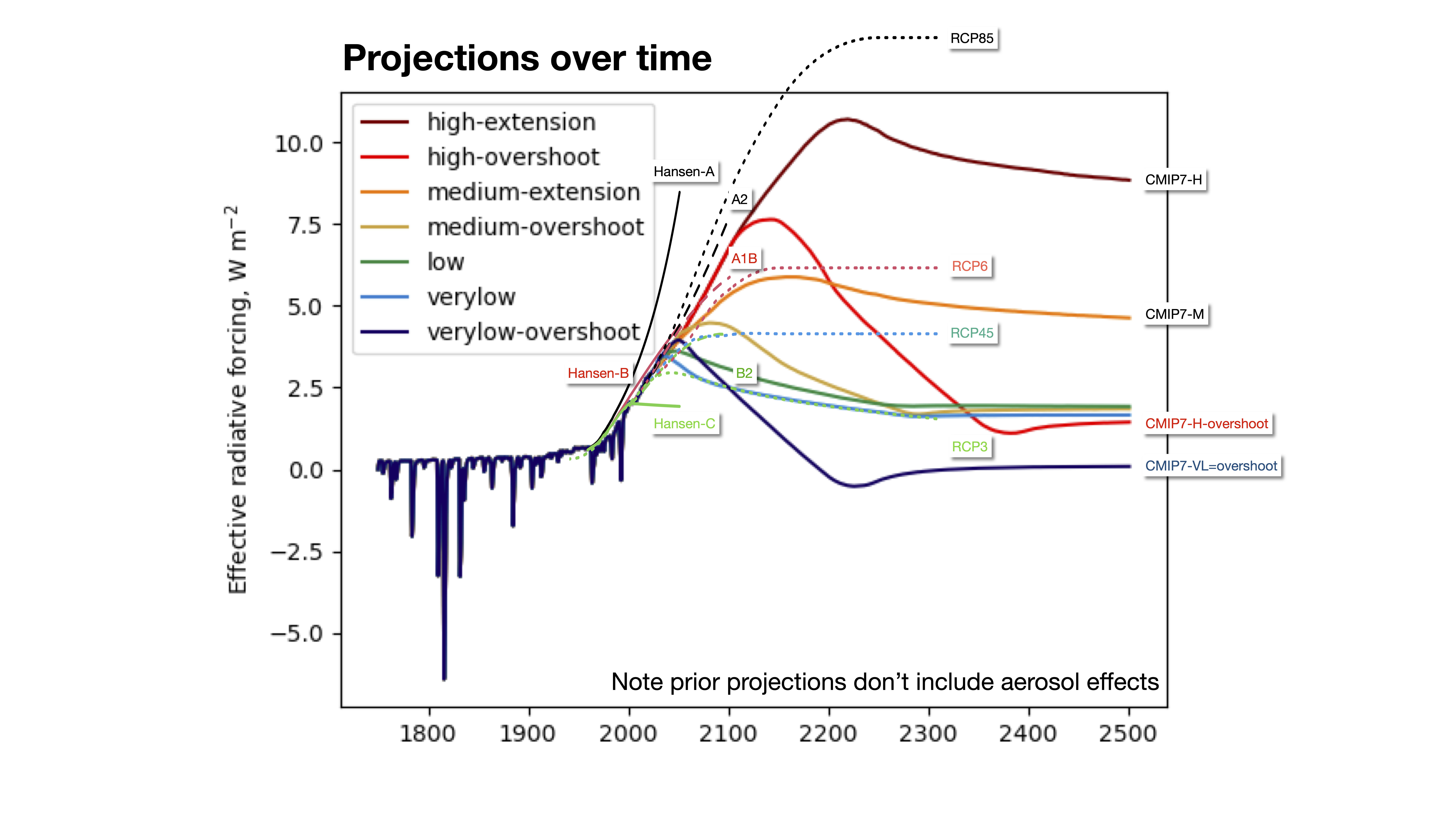
People (hi Roger!) acting as if the publication of new CMIP7 scenarios is some huge policy shift or an admission that previous scenarios are no longer ‘official’ are just bull-shitting. This is something that was planned for and expected for literally years. Previous scenario sets were used in previous rounds, a new set will be used for the new round – that is all there is to it.
Oh noes!
The supposed focus of the ire are the high end scenarios of RCP85 (CMIP5) and SSP5-85 (in CMIP6). The reasons why these were set up in the first place (back in 2007!) was that IPCC wanted to span what had appeared in the literature before then – going beyond (in sophistication) what the (CMIP3) SRES projections had done. But the IAM folks involved decided (correctly) that they didn’t have the time to start from scratch, and so they decided to split up the task – come up with a spread that covered 99% of published scenarios with ‘representative’ concentration pathways (RCPs – gettit?) for the climate models to use quickly (in CMIP5), and back-fill plausible socio-economic pathways later (to be used in CMIP6). Thus the CMIP5 models (which were run in 2007-9 or so) used the RCPs (including RCP85 – which was so-called because it reached 8.5 W/m2 of direct radiative forcing from GHGs in 2100).
For climate modellers, the reasons why the pathways are the way they are is a secondary concern – if they were only to be given CO2 levels (and other GHGs etc.), the basic need is just for a low, middle and high scenario that encompass our most ambitious climate policy pathways, a worst case scenario (‘Burn it all!’), and something in the middle. When it came time for CMIP6 (2016-2019 or so), the SSPs (that had been promised a decade earlier) were ready, and so they were used. But for the purposes of the climate modellers, the drivers underlying the SSPs were not really that relevant. A climate model really doesn’t care how cooperative or antagonistic regional economic blocks are – it just responds to the resulting emissions. That there is a need for high end scenarios should be obvious – where are the tipping points in the system? what are the impacts of a 2ºC warmer world? what about 3ºC or 4ºC? Are these worth avoiding perhaps? Having seen these results, the answer (IMO) is definitely yes!
In the last few years, a number of people have pointed out that assumptions underlying the highest SSPs don’t look as plausible as they used to seem (this is also true of the lowest projections, but people seem less bothered by that). Note this is many years after all the models that were ever going to use them were run. But this is less of an issue that some people portray. Climate impacts rely on a chain of calculations – a specific set of emissions, a resulting concentration pathway, and a modelled sensitivity. Similar impacts can arise with lower emissions, but greater carbon cycle feedbacks and higher sensitivities, and given that each of these steps are quite uncertain, it is not really worthwhile for climate models (or modelers) to get too attached the specific storylines the IAM folks put together. Hence the collective shrug from climate modelers around the RCP85 ‘dialogue’ in the last couple of years.
Let me give two examples why high end scenarios are important: Impacts on ice sheets are a very important part of the climate change and have yet to be fully integrated into the standard climate models. So independent efforts with ice sheet models were set up using the output from the CMIP5 and CMIP6 models – they used two scenarios, RCP85 and RCP26 to bracket possibilities in ISMIP6 (Seroussi et al, 2020). Interestingly, they found that, particularly for Greenland, that none of the models had melt rates as high as observed even with RCP85 forcing. Thus for a situation where the (ice sheet) models are insufficiently sensitive, a higher than expected forcing might give you a more likely outcome.
A second example is the use of ‘global warming levels’ in the last IPCC assessment. These were averages of the models when they reached particular temperature levels (2ºC, 3ºC, 4ºC etc.), but for that to work, enough models had to reach those temperatures in order to make an average – and in practice for 3ºC and 4ºC, this was only possible with SSP5-85 scenarios. Other assessments used the higher signal-to-noise ratios in the high end scenarios to estimate sensitivities across many systems that would have been noisier and more uncertain if that was not available. How the models got there is basically irrelevant. The new high end runs will also be used for this (note that H gets to 8.5 W/m2 only about 20 years after RCP85).
Note that even the harshest critics of RCP85 will admit (in academic circles at least) that these are legitimate uses. However, some of the more stupid commentaries equate the mere mention of RCP85/SSP585 with scientific misconduct, claiming that counting the number of times the ‘naughty’ words of RCP85 appear in publications or assessments is a damning indictment of the entire field’s integrity. This is so dumb and lazy that I find it hard to credit.
But wait!
The funny thing is that there are real issues with the way this whole endeavor has grown up. First, because CMIP is the only (serious) climate projection game in town, as climate change has become more salient, CMIP projections have been used to inform a far wider array of science than was imagined back in 2007. Not all of those uses are optimal. For instance, the ERA5 reanalysis still uses CMIP5 projections of solar forcing from 2008 which didn’t turn out to be so good at matching what actually happened. Consultants and banks have used CMIP6 projections as if they were real predictions, and the adaptation community have often assumed that specific CMIP6 pathways are the most likely outcomes.
All of these misuses are compounded by the fact that it appears to need a decade to update these pathways in the light of new science and societal decisions and changes. This is way too long – annual updates of the process should be achievable if funders prioritized it.
And finally, there are of course far more scenarios that would be interesting to explore in climate models (policy specific scenarios, delta scenarios (where only one thing changes at a time), in-between scenarios, annually updated scenarios etc.) than can possibly be performed given existing computational capacity. This is (right now) prohibitive, but at the rate that faster, more efficient machine-learning emulators are advancing, it might not be for much longer.
A serious critique of the climate modeling enterprise would be focused on these issues (for instance), rather than tilting at RCPs.
References
- D. van Vuuren, B. O'Neill, C. Tebaldi, L. Chini, P. Friedlingstein, T. Hasegawa, K. Riahi, B. Sanderson, B. Govindasamy, N. Bauer, V. Eyring, C. Fall, K. Frieler, M. Gidden, L. Gohar, A. Jones, A. King, R. Knutti, E. Kriegler, P. Lawrence, C. Lennard, J. Lowe, C. Mathison, S. Mehmood, L. Prado, Q. Zhang, S. Rose, A. Ruane, C. Schleussner, R. Seferian, J. Sillmann, C. Smith, A. Sörensson, S. Panickal, K. Tachiiri, N. Vaughan, S. Vishwanathan, T. Yokohata, and T. Ziehn, "The Scenario Model Intercomparison Project for CMIP7 (ScenarioMIP-CMIP7) ", 2025. http://dx.doi.org/10.5194/egusphere-2024-3765
- J. Hansen, I. Fung, A. Lacis, D. Rind, S. Lebedeff, R. Ruedy, G. Russell, and P. Stone, "Global climate changes as forecast by Goddard Institute for Space Studies three‐dimensional model", Journal of Geophysical Research: Atmospheres, vol. 93, pp. 9341-9364, 1988. http://dx.doi.org/10.1029/JD093iD08p09341
- H. Seroussi, S. Nowicki, A.J. Payne, H. Goelzer, W.H. Lipscomb, A. Abe-Ouchi, C. Agosta, T. Albrecht, X. Asay-Davis, A. Barthel, R. Calov, R. Cullather, C. Dumas, B.K. Galton-Fenzi, R. Gladstone, N.R. Golledge, J.M. Gregory, R. Greve, T. Hattermann, M.J. Hoffman, A. Humbert, P. Huybrechts, N.C. Jourdain, T. Kleiner, E. Larour, G.R. Leguy, D.P. Lowry, C.M. Little, M. Morlighem, F. Pattyn, T. Pelle, S.F. Price, A. Quiquet, R. Reese, N. Schlegel, A. Shepherd, E. Simon, R.S. Smith, F. Straneo, S. Sun, L.D. Trusel, J. Van Breedam, R.S.W. van de Wal, R. Winkelmann, C. Zhao, T. Zhang, and T. Zwinger, "ISMIP6 Antarctica: a multi-model ensemble of the Antarctic ice sheet evolution over the 21st century", The Cryosphere, vol. 14, pp. 3033-3070, 2020. http://dx.doi.org/10.5194/tc-14-3033-2020

Gavin — agree with the substantive point that scenario updating is routine and the RCP8.5 framing is being used in bad faith by people who know better. Two related concerns that I think deserve more attention than they’re getting:
First, the artificial end dates. Extending out to 2150 helps, but 2150 is still roughly where peak warming occurs under current-policy emissions. The committed sea level rise, ice sheet response, and ocean heat redistribution all run for centuries to millennia past the modeling horizon. Zickfeld et al. show CO₂ and temperature staying elevated for centuries after emissions stop; Clark et al. (2016) extend that to multi-millennial sea level commitments of meters to tens of meters depending on cumulative emissions. The framing convention of ending at 2100 (or now 2150) implicitly communicates to non-specialists that this is a 21st-century problem, when most of the impact integral happens after that.
Second, the CDR dependence in the low scenarios. The CMIP7 low scenarios — the ones aligned with current international agreements — only get to their temperature endpoints by assuming substantial CDR deployment at scales far beyond anything currently achievable. The medium scenario stays emissions-positive and doesn’t depend on this assumption, but the low scenarios carry the same baggage that AR6’s 1.5°C-compatible pathways did. None of this is visible in the headline temperature numbers reported to the public. The risk is communicating that there’s a science-validated path to limiting warming when the path requires technology deployment that doesn’t currently exist at the required scale.
Between the tipping points you raise and the longer-term emphasis above, the medium scenario is alarming enough on its own — a ~2.8°C 2100 endpoint that continues rising past 2150, with sea level and ice sheet response committed for centuries beyond that. The retirement of the high-end scenarios doesn’t change that picture.
Neither of these is a critique of the science or the modeling process — the scenarios are doing what they’re designed to do, and the choices about horizon and CDR are defensible within the modeling community. The problem is on the communication side. When journalists, consultants, and the public absorb “medium scenario, 2.8°C by 2100” and “low scenario, well below 2°C,” the horizon truncation and the embedded technology assumptions become invisible. The serious critique of the enterprise isn’t about RCP8.5 retirement; it’s about how the scenarios that remain in use get translated for non-specialist audiences.
Dean
Hello Dean,
You will be happy with CIMP7 end dates because if go to 2500.
About CDR, I agree with you. It’s a big problem on the communication side : by design scenarios HL, ML and L leads to the same goal : 1.5°C. The layman will conclude that whatever we do before 2070 we have the same result : 1.5°C.
Authors say “ML and HL scenario assumptions risk exceeding limits of prudent use of sequestration capacity” and “challenge current estimates of geophysical feasibility”.
“However, they are included […] to ultimately serve as narratives for interactive CDR deployment experiments in Earth System Models (for example, in CDRMIP), and scenarios in which the limits of CDR are challenged are useful for identifying where Earth System Models are unable to deliver the scenario negative emissions rates (for example if bioenergy yields in the ESM are lower than the IAM estimates).”
As you note above, there are obviously good reasons to have a high end scenario. I don’t recall anyone saying otherwise, actually. What is a pity is that when politicians, lobbyists and the occasional blogger (Hi ATTP) defended the description of RCP 8.5 as ‘business as usual,’ despite the explicit statements of the developers of RCP 8.5, and when literally thousands of papers were published using it as a base case, corrective statements like what you write here did not appear in a timely fashion.
As I was writing about this either before or at the same time as Roger, I hope you’ll forgive me beating on this dead horse one more time.
But let’s raise a glass to RCP 8.5, which served to alert people in time to start the corrective policies that helped send it to its deserved place of rest in the archives. And I hope we all get to work on doing the same to RCP 6.5 in its turn.
Hi Tom,
RCP6.5 will be retired at the same time as RCP8.5. The new set of emission scenario’s is meant to replace the old set (though of course the model calculations still have to be done, so the process of retirement still takes time.
It’s just that the highest of the new scenarios is less high, and the lowest less low, compared to the current SSP’s.
Hi Bart! It’s been ages since I’ve seen you pop up in the climate conversation. How are you and your family?
Yes, cutting off the fat tails is finally happening on both ends. Not before time. But I still want to see more action. Guess we’ll have to wait until Trump leaves town before any work gets done in the USA. But good things are happening elsewhere.
RCP8.5’s warming projection was more accurate than Thomas Fuller’s lukewarmist prediction.
Fuller predicted a global temperature trend of less than 0.2°C/decade. RCP8.5’s post-2005 projection exceeded 0.2°C/decade. Observed global warming more closely followed RCP8.5 than 0.2°C/decade. Hence why RCP8.5 correctly projected 1.5°C of global warming being reached by 2030 instead of by 2040 (relative to the pre-industrial baseline of 1850-1900).
An admission of error for lukewarmism has never been made, though, and likely never will. But lukewarmism still should have been retired long before RCP8.5 was replaced.
Sources on this below:
I would say it was the 7th iteration. The first attempt also counts as an iteration.
We don’t speak of CMIP4
Why not actively promote enhancing albedo, hydrating, and greening up the tropics. It’s ground zero for solar irradiation. Billions live there mercilessly broiled by the totally insane heat.
I also talk about this subject at https://substack.com/home/post/p-198538383. I will note that Roger does NOT qualify as one of the harsh critics who “will admit (in academic circles at least) that these are legitimate uses”…
If that “Roger” is me–>
There are plenty of legitimate scientific uses for exploratory, extreme scenarios, as I’ve explained many times, dating back at least to our 2000 book on Prediction and directly wrt RCP8.5 in ERL, and pretty much in every public discussion I have on climate scenarios.
And our critcism is not “harsh” but, as the fullness of time has shown, accurate and fair.
I read https://rogerpielkejr.substack.com/p/no-rcp85-did-not-become-implausible where you said “RCP8.5 — and indeed all of the RCP and SSP scenarios — had a single point of failure in its assumption of a return-to-coal. This assumption alone settles the question of plausibility. A scenario requiring five times proven coal reserves is not plausible by any standard.4”, went to reference 4: “The new HIGH “what if?” scenario in the ScenarioMIP ensemble continues to employ the return-to-coal hypothesis, as acknowledged by its creators:….”
That only refers to the HIGH scenario for fossil fuels (I’m guessing not just coal), and not what you said:”and indeed all of the RCP and SSP scenarios — had a single point of failure in its assumption of a return-to-coal.”
So then I went to “The Scenario Model Intercomparison Project for CMIP7 (ScenarioMIP-CMIP7)” at https://gmd.copernicus.org/articles/19/2627/2026/ and again I can’t find anything that backs up your “return-to-coal.” statement. Where do I read about the “return-to-coal.” for all the other scenarios? Was it for older CMIP scenarios?
Great question – The ScenarioMIP paper refers to the “return to coal” theory in this sentence, with appropriate references: “Clearly, the cumulative amount of fossil fuel use in the High emission scenario is considerably larger than the estimated total reserves (known deposits that are extractable at current prices and technologies) (Bauer et al., 2016; Rogner, 1997).”
To learn more about the theory, and why it is flawed, and certainly should not have been the single basis for RCPs and SSPs, see this: https://www.rff.org/publications/working-papers/evaluating-the-learning-by-doing-theory-of-long-run-oil-gas-and-coal-economics/
OK, nothing that you just wrote or that document backs up what you said:”and indeed all of the RCP and SSP scenarios — had a single point of failure in its assumption of a return-to-coal.”
Dr. Gavin Schmidt: “People (hi Roger!) acting as if the publication of new CMIP7 scenarios is some huge policy shift or an admission that previous scenarios are no longer ‘official’ are just bull-shitting. This is something that was planned for and expected for literally years. Previous scenario sets were used in previous rounds, a new set will be used for the new round – that is all there is to it.“
A high forcing scenario like RCP8.5 is useful and informative. That’s been repeatedly explained to Dr. Roger Pielke, Jr. and his collaborators. But Dr. Pielke ignores that point. Similarly so for related points that were explained to him:
1) A central point of RCP8.5 is to help model climate responses to high forcing. Hence why the “8.5” in RCP8.5 refers to projected forcing by 2100.
2) There are non-RCP8.5 ways to achieve RCP8.5’s high forcing.
3) Observed forcing exceeds RCP8.5’s projected forcing, though it’s unclear how long that will last.
4) Observed global warming more closely followed RCP8.5 than a linear extrapolation of ~0.2°C/decade. Hence why RCP8.5 correctly projected 1.5°C of global warming being reached by 2030 instead of by 2040 (relative to the pre-industrial baseline of 1850-1900).
5) The high forcing of RCP8.5 makes it useful for goals such as achieving a high signal-to-noise ratio and modeling the climate response to high temperature thresholds.
Below are sources on these points.
Gavin: “So independent efforts with ice sheet models were set up using the output from the CMIP5 and CMIP6 models – they used two scenarios, RCP85 and RCP26 to bracket possibilities in ISMIP6 (Seroussi et al, 2020). Interestingly, they found that, particularly for Greenland, that none of the models had melt rates as high as observed even with RCP85 forcing. Thus for a situation where the (ice sheet) models are insufficiently sensitive, a higher than expected forcing might give you a more likely outcome.”
To me, this theme plus this theme https://m.youtube.com/watch?v=FI24IJOAyLc – the risk of extreme methane emissions from thawing permafrost, thawing subsea clathrates, thawing subglacial clathrates etc. are the most important.
First this study: “The last two abrupt warmings at the onset of our present warm interglacial period, interrupted by the Younger Dryas cooling event, were investigated at high temporal resolution from the North Greenland Ice Core Project ice core. The deuterium excess, a proxy of Greenland precipitation moisture source, switched mode within 1 to 3 years over these transitions and initiated a more gradual change (over 50 years) of the Greenland air temperature, as recorded by stable water isotopes. The onsets of both abrupt Greenland warmings were slightly preceded by decreasing Greenland dust deposition, reflecting the wetting of Asian deserts. A northern shift of the Intertropical Convergence Zone could be the trigger of these abrupt shifts of Northern Hemisphere atmospheric circulation, resulting in changes of 2 to 4 kelvin in Greenland moisture source temperature from one year to the next.” https://www.researchgate.net/publication/5288829_High-Resolution_Greenland_Ice_Core_Data_Show_Abrupt_Climate_Change_Happens_in_Few_Years . This points to the fact that there is persistant uncertainty in our possible knowledge concerning the future development of deglaciation processes in both Greenland and Antarctica. The same goes for permafrost warming/thawing etc.
To me, the main problem with most climate modelling so far is, that it tends to look away from the big picture. It seems no to consider this fundamental problem: Since our *climate gas emissions since at least around 1960 are rising around fifteen times faster than the fastest known from the whole geological/paleoclimatological history* (which to my knowledge was 252 m. yrs ago just before the end permian extinction event and was caused by the volcanism producing the large igneous province called the Siberian Traps. This volcanism burned enormous carbon-rich sediments of coal, oil and gas and thus made the atmospheric CO2 level go as high as maybe over 2000 ppmv). This fact ought to tell us, that the global physical experiment we are “conducting” with our climate must be very difficult to model, since any model has to be calibrated against past climate developments, *but we don’t know of any past climate developments where the levels of climate gasses were rising *anywhere near so fast* as they have been rising since around 1960.* Thus the unknown factors are much larger than the climate modellers seem to imply, when they fx. predict the sea-level rise until 2100 in numbers down to one centimeter, albeit with a statistical margin of safety up to plus/minus thirty centimeters or so. To me, this is pure statistical nonsense. It has no meaning to say fx. we expect the sea-level to rise 68 cm plus/minus 32 cm. It leaves a false impression of exact predictions, and why do that? The only reasonable thing would be to say that we, under these emission scenarios, can expect between 0,6 and 1,5 meters of sea level rise, maybe even some more, because there are a lot of things we don’t know.
But: such as the political development is now, especially in the US, where we are witnessing a new kind of what I call scientific analfabetization, fascisation/”liberalist”-totalitarian/oligarchic systemic undermining of democracy and freedom of speech (some figures around the current “secretary of war” – Hegseth – recently even proposed to roll back female suffrage, which tells you how extreme this tendency is…) etc., it is of course very understandable for scientific researchers to end up in a very defensive position. Careers etc. are at stake. Meaning fx. you can end up only being arguing very anxiously restrained against dropping all pessimistic heating scenarios completely. I think this easily ends in the trap which the historian Timothy Snyder calls “obeying in advance”: you end up learning the climate deniers/ignorants and the fossil fuel lobbying oligarchs how to suppress science.
The “optimistic bias” is inherent in all future outlooks being produced by mainstream/neoclassical economic theory, and since this kind of economic theory de facto since around 1970 is the only accepted in politics almost anywhere in the world (in fact since around 1930 – even stalinist economic theory believes in eternal economic growth and have long ago left any kind of critical pretenses behind), even the rising amount of scientificly well-founded warnings from climate and ecosystems science have fallen on deaf ears among 99 pct. of the elites, delegitimized and defamated as “doomism” etc. Today they are almost completely suppressed in the mainstream media: the norm now is leaving any unpleasant reality completely behind except for the eternal warnings anywhere, in all camps, about “the evil enemy” from within and outside, against which we have to accelerate the arms race, the surveillance apparatuses etc.: the schizophrenic combination of megalomaniac-optimist growth visions and enemy paranoia is everywhere, realism not so much. Since science doesn’t exist in splendid isolation, it is being influenced by this poisonous societal atmosphere, which I call liberalist-totalitarian.
I think history tells us, that it is very important to avoid any kind of obeying in advance.
This is why scientists are not good risk managers. The concept of risk within science is that a v.narrow assessment might be slightly less narrow. It in no sense at all considers whether (outside of specified assumptions and models) the assessment is totally awry.
In simple terms in these situations the only suitable action is one framed with the Precautionary Principle in mind.
What an utter load of rubbish Charles.
I am guessing you use the same logic with your religious beliefs as well? So you believe in God because if you don’t and you are wrong then the results would be catastrophic. So the Christian God obviously. But need a bet each way would be wise, so Allah as well. And Thor, Odin, Marduk, Anu?
The problem with the precautionary principle is there is a limit to what we can do. Yes, we can stop all use of sequestered carbon, and we could do it in a couple of years – it would just cost billions of lives. Or we could do it in 100 years and it would cost trillions of dollars and millions of lives. Everything is a trade off.
I follow the precautionary principle., I look at the trend in deaths and costs from natural disasters and decide the safest approach is to have this trend continue as long as possible, so I keep using my 6l V8 to convert sequestered carbon into useful fertiliser
Except you cannot trade off risks where you can’t bound the loss. First rule of risk analysis. That’s why smart people don’t play Russian roulette. That is precisely why models are so important, why tipping points pose such a problem and why the luck warmers are wrong.
Totally agree Ray, science and research is the key. The precautionary principle, by definition, applies when we can’t fully quantify the risk. From the first sentence of the wiki definition
“approach to innovations with potential for causing harm when extensive scientific knowledge on the matter is lacking”
Charles is saying scientists are wrong for wanting to do science, we should use the precautionary principle – hence my jump to religion
Except that the precautionary principle is anything but religion. It is essential when risks cannot be bounded. The proper response is then to direct resources to better understand those risks, so that finite bounds can be imposed. Unfortunately, that isn’t happening, because the BAU crowd is afraid of what we might find. The precautionary principle is important because it penalizes the BAU crowd, forcing them to support research where it needs to occur.
Sometimes science experiments are the only way forward.
Re. “Except you cannot trade off risks where you can’t bound the loss.” That’s pretty much Pascal’s whole idea here since we’re essentially discussing Pascal’s Wager. If the loss is simply too great to survive in any positive fashion, it has to be recognized as something to deal with.
In that same vein and speaking of religion, let’s all pray our wonderful leaders around the world keep this fact in mind and keep their fingers off the Armageddon button.
jgn: let’s all pray our wonderful leaders around the world keep this fact in mind and keep their fingers off the Armageddon button.
MS: Belarus is preparing to attack Ukraine from the north; Putin is moving tactical nuclear arms into Belarus, and NATO has now warned Belarus to stay out of it.
Ukraine’s disruption of Russia’s peteroleum products production is now so extensive Putin has just banned the export of all petroleum products.
Ukraine now has air supremacy over its own territory, and it has air superiority over western Russia.
I agree! Now the latest news that both the Thwaites glacier and it’s neighbour, the Pine Island glacier in Antarctica are about to collapse https://m.youtube.com/watch?v=Bz-AKBbxAR8&pp=ugUHEgVlbi1HQtIHCQlTAqO1ajebQw%3D%3D tells us that big things can happen very fast, which again underlines the importance of the precautionary principle.
Unfortunately the leading principle in capitalist economic thinking is nearly the exact opposite of precautionary: you could call it “the optimistic gambling principle”, which led fx. to the sinking of the Titanic and a whole lot of “volatility” at the stock exchanges. Trump is exactly the extreme type of market gambler, now using his ceaseless messaging around the war with Iran for personal/family gain, probably via some form of insider trading, furthered by the fast shifting ups and downs of crude oil prices etc.
Karsten,
So a prediction is proof that things can happen very fast????
Awesome logic there
Things have happened very fast in the past. Two independent studies of sea level rise during the last interglacial, one in the Caribbean, one on the west coast of Australia, found a relatively rapid rise of around 8m – when the sea level was already about 2m above present levels. The time resolution over 110 kyr ago isn’t that great, but the geological indicator was the drowning of shallow-water corals because they couldn’t grow upward fast enough to keep up with the rising sea level. There must be one or more mechanisms that allow this to happen during a warm interglacial. It looks like we’re soon going to get a live demonstration.
KW, what exactly are you trying to imply with your abstract sarcasm? Do you by “prediction” mean the facts of measured accelerating melting in the recent years in Antarctica and Greenland? Or fx. this: https://www.researchgate.net/publication/5288829_High-Resolution_Greenland_Ice_Core_Data_Show_Abrupt_Climate_Change_Happens_in_Few_Years ( https://epic.awi.de/id/eprint/17919/1/Ste2007b.pdf )? Maybe my wording wasn’t precise enough, but you don’t seem as interested in the serious subject at hand as in just mocking me – whatever reason you may have for that. I know very well that my english isn’t perfect, but serious discussion requieres a minimum of willingness to try to understand what others say.
So…If I predict that setting up winter camp in the middle of an avalanche zone will lead to getting hit by a fast-traveling avalanche with some higher probability than non-avalanche zones that is “:bad logic”?
Um, OK.
The reason for the Antarctic prediction is the fact ice shelf removal is knocking out the last physical holding pins other than friction of the ice base on a geological downslope That creates an avalanche zone of another order of magnitude from a little mountain avalanche entirely.
Oh, and re. your trolling statement elsewhere carbon dioxide actually reduces the nutritional content of food plants rather significantly under most conditions (easily googled or ask AI). That doesn’t fit any normal definition of an agricultural fertilizer to me, but your reality obviously varies.
jgnfld,
Your counter example is completely meaningless. You say not to camp in a high risk zone – I learnt that 50 years ago and makes perfect sense. That’s because we have seen the results many times before. I was taught not to camp in dry creek beds even though there was no likelihood of local rain.
Karsten says that a prediction of imminent catastrophic collapse “tells us that big things can happen very fast”
No it doesn’t! It is a prediction, it does not tell us anything
For most people, it doesn’t take much more experience than they already have to know that unanchored ice on a downslope can slip fairly rapidly once static friction is overcome.
Obviously your reality varies.
A quick note re: “However, some of the more stupid commentaries equate the mere mention of RCP85/SSP585 with scientific misconduct, claiming that counting the number of times the ‘naughty’ words of RCP85 appear in publications or assessments is a damning indictment of the entire field’s integrity. This is so dumb and lazy that I find it hard to credit.”
https://x.com/matthewgburgess/status/2057192401907945872
Beneath all the heated rhetoric, I don’t think most academics on various sides of the scenarios issue are actually that far apart. For example, I think your “But wait!” section is pretty spot on above (and echoes things we’ve called for in our various scenario papers).
Uhm, wouldn’t be the only result of this proposed combination of incorrect Greenland ice melt rates in models with implausible high RCP8.5 forcing be that the confidence in the output is lower than necessary?
Is there any expected benefit of that combination of two known sources of high uncertainty?
Spoken like a man who doesn’t understand the purposes of the scenarios at all!
You are correct, I really do not see the purpose of this intentional accumulation of model flaws.
The idea to somehow correct one error by allowing for another seems mathematically very questionable. In science generally huge effort is made to reduce errors and uncertainty.
What happens in your opinion to the confidence in the outcome for this idea?
Maybe GS should reduce the resolution too, so he won’t need all that expensive computer time.
(That’s essentially what Rahmstorf suggested when he preferred CMIP5 results over CMIP6 ones and no one here raised any objections)
Scenarios are not models. They are more like Monte Carlo trials, but climate simulations take to long to run thousands of simulations, so you probe the models’ responses in the midrange and extremes. This isn’t prediction. It’s sensitivity mapping.
Re. “The idea to somehow correct one error by allowing for another seems mathematically very questionable. In science generally huge effort is made to reduce errors and uncertainty.”
Let’s say I have scenario A which is correlated with 20% of the variance in some output and scenario B which is correlated with 20% of that variance. Assuming A and B are uncorrelated (independent) or at minimum have a known and measured nonzero covariance is it “mathematically suspect” to say that the combination of A & B is likely a better full description of possible outputs than either one alone?
Hint: The answer is “No”.
Multiple independent lines of evidence are the bedrock of observational sciences. Even when–or more specifically _especially_ when–each method doesn’t totally agree.
Re. independence: Should scenarios A & B be highly correlated, little to no additional prediction will be gained using A, B, or both. That covariance will limit prediction but that is why experts check for and control for such things using a whole toolkit of NON “mathematically suspect methods dating back a century now in many cases. See multiple regression analysis, principal components analysis/factor analysis (or even canonical correlation analysis though good, interpretable solutions are hard to find with that one!), partitioning of variance analysis, covariance analysis, path analysis, mediated variable analysis and many other methods for these sorts of scenarios.
You go in circles.
The problem of accumulating unrealistic parameters still is that the calculated outcome has lityle in common with the real world. Bad global climate scenarios do not all of the sudden allow for a better knowledge about the real world!
They mislead!
Scientists call that error progression, modelers GIGO
https://en.wikipedia.org/wiki/Garbage_in,_garbage_out
It makes no sense whatsoever to invent and model scenarios with intentionally bad parameters and trends!
The fact that you even want to dispute this is alarming in itself.
This webpage is full of graphs without confidence intervals, assemble averages including implausible scenarios and presentations of “screened statistical results”..
jgnfld says Multiple independent lines of evidence are the bedrock of observational sciences.
Which then excludes CMIP7 scenarios. And all that came before.
Yebo Kando,
The goal of the scenarios is NOT to have a better knowledge of the world, but rather a better knowledge of the models AND of their sensitivities. It is the models where contact with the real world is important.
Oh, you really want to go in another circle..
just look one article back, some of these colorful lines on the graphs relate to RCP8.5 and similar, so implausible assumptions were and are used to distort the comparison between modeled scenarios and real world. What is missing there btw is a clear discussion of uncertainty – just like I remarked here.
It’s noted elsewhere that:
1) Observed forcing exceeds RCP8.5’s projected forcing, though it’s unclear how long that will last.
2)) Observed global warming more closely followed RCP8.5 than a linear extrapolation of ~0.2°C/decade. Hence why RCP8.5 correctly projected 1.5°C of global warming being reached by 2030 instead of by 2040 [relative to the pre-industrial baseline of 1850-1900].
This undercuts critiques from Dr. Matt Burgess, Dr. Roger Pielke Jr., Dr. Justin Ritchie, etc. on the utility of RCP8.5. Dr. Burgess had an exchange pertinent to that:
Dr. Burgess’ response doesn’t really work. For example, it doesn’t address RCP8.5 being informative for temperature trend projections through at least 2030, and likely for other multidecadal time periods that end before 2100. With respect to Dr. Burgess’ question: by 2100, RCP8.5 implies around 5 Watts per square meter (W m-2) of forcing above where we are now. Aerosol forcing could give about 1 W m-2 of that. Extrapolating current greenhouse gas forcing gives another about 3 to 4 W m-2, since we’ve had around 0.6 or 0.7 W m-2 over the past 14 years.
Below are sources on these points:
MAGA rag the Bezos Post (formerly the Washington Post) has elevated Pielke’s grotesque dishonesty on this to their editorial page.
Not surprising, really, since the Post has for decades promoted global warming denial in its editorial pages, and has normalized, sanitized and legitimized the fossil fuel industry’s bought-and-paid-for stooges by falsely branding them as “skeptics”.
The scenarios are fine. The framing is not. The arrogance on all sides is unchanged.
Gavin, thank you for the clear technical post. I agree that swapping scenario sets for a new CMIP round is normal, not a scandal, and that RCP8.5 remains physically plausible for the century if carbon cycle feedbacks and societal inertia are accounted for.
But two deeper problems are not addressed here, and they are not technical—they are cultural.
First. The low scenarios in CMIP7, like those in AR6, depend on CDR at scales that do not currently exist and may never exist. That is not a minor uncertainty. That is a structural assumption baked into “policy-relevant” pathways. When those pathways are communicated to the public and policymakers as the 1.5°C or 2°C futures, the CDR assumption is almost always elided. That is not science. That is wish fulfillment dressed in GCM clothing.
Second, and more fundamentally. The modern climate science establishment operates with the same unexamined sense of authority that John Locke once invoked to “subdue the earth”—later manifest destiny, then industrial capitalism, then the technocratic confidence that we can model our way out of a crisis created by that same mindset. Five centuries of slavery, colonial wealth extraction, world wars, and now planetary boundary overshoot, all justified by some claimed right to manage, predict, and control.
The CMIP process is not immune to this. The arrogance is quieter now—expressed in overconfidence in multi-century model integrations, in CDR fairy dust, in the casual dismissal of RCP8.5 as “implausible” by people who have never run a coupled carbon-climate model, and in the implicit assumption that this generation of scientists is not repeat the errors of the last 500 years.
Nature does not care about our scenarios. Nature will find balance. It always does. The question is whether that balance includes a stable Holocene-like state for human civilization, or a hothouse trajectory with meters of sea level rise over millennia. The models are tools, not oracles. And the people running them are not exempt from the critique we would apply to any other powerful institution: who authorized you to subdue the earth with equations?
This is not science’s finest hour. It is just the latest chapter in a very old story of masculine, imperial, technocratic, divine arrogance and superiority. More polite, peer-reviewed. Still wrong in the same fundamental ways that brought us to this point in Earth history.
Mankind: thy name is Vanity.
Most voters still see climate disruption & related issues as a low priority or as a non-issue. The details of climate modelling will never interest them; all they are interested in is their pay packet and job security, and (possibly) their kids’ future.
When people finally understand what we are up against, they might, perhaps, start to act. But we are not at that point yet – we’re not even close.
And anyone who thinks we can motivate the apathetic by offering hope or proffering solutions is deluded. As a civilisation – as a species – we have our backs to the wall. This is the fight of our lives. The laws of physics take no prisoners and care nothing for human politics. We are about to be downsized.
Surely it’s time for more effective outreach. Outreach and education may or may not work; but without it, failure is certain.
https://newptc75.medium.com/human-nature-and-the-climate-041b9273653e
Graham, most of what you say is correct. But “as a species” is one of those not-so-scientific exaggerations that doesn’t really help. IIRC humans went through a period of very low population (a few thousands or tens of thousands ??) at one early point, but here we are. Clever apes indeed.
Of course it would be better if we drastically “downsized” because women were empowered and made the rational self-interested choice of limiting their offspring. But climate, nuclear war, AI-designed viruses… whatever… are not going to completely eliminate humans.
So, outreach and education need to be very carefully focused, and distanced from the natural inclinations of academic discourse. Not only does it not help; as pointed out here, it is dishonestly used by the opposition.
Of course, I’ve been saying this for a long time, but if RC is any evidence, the psychological need to say more when less works better is very powerful
I wonder if this next (still only possible, but more probable than not) super el Nino might possibly change a few minds?
Graham, you’re right that the public isn’t acting. But calling them ‘deluded’ for caring about their pay packet is just blaming the customer. That’s not strategy. That’s burnout wearing a superiority complex.
You need Sarah Wilson. She agrees we can’t offer ‘hope,’ so she offers something better: permission to live fully anyway. Her Substack/TEDx doesn’t just scream about the 2-tonne target; it answers the question you can’t — ‘How do I show up to this fight without burning out or hating my neighbors?’
Search ‘Sarah Wilson TEDx societal collapse’ (Editor’s Pick). It’s 15 minutes of brutal honesty without the ‘activist lecture’ tone. Or go here: https://sarahwilson.substack.com/
Sarah is the voice for those who know the ship is sinking but refuse to spend their last moments yelling at the passengers for being wet.
She also has something difficult but necessary to say to men. Not because men are all stupid, but because the myth that we need to own, trademark, or lead the revolution is actually holding us back. She asks: what if humility was the real work?
“Men, this revolution will not be incentivised. We can’t trademark, podcast, or ‘start up’ our way out of this… shall we try humility?”
https://sarahwilson.substack.com/p/blokes-for-the-love-of-gaia-dont
As Sarah says: catch up.
For those interested in hearing from the author of the new CMIP7 scenarios, listen to our recent Climate Chat interview with Detlef van Vuuren:
https://www.youtube.com/live/MYWokv0Byas
The main issue with RCP8.5 is not the science but communication and emphasis. This is a GHG CONCENTRATION pathway – the clue is in the name. In multiple places this has been (falsely) equated with man-made emissions. In the early 21st century it was understandable to highlight that humanity had agency in what would happen in the future e.g. bending the curve of cumulative GHGs in the atmosphere. So a focus on emissions was understandable. It can be seen as a good project management strategy: “Look what we’ve done! By reducing FFs we’ve taken the worst case scenario off the table.” Unfortunately, it is not playing out that way e.g. the UN special reports on 1.5degC and 2degC and redrawing of future climate impacts. As well as the label “BAU emissions”, in my view somehow the fact that this was also a potential scenario if bad consequences occurred should have also been included in the labeling of RCP8.5 e.g. ECS higher than expected, SO2 and particulate “cooling” greater than modeled, natural carbon sinks failing, positive feedbacks (clouds?), tipping points being triggered etc. RCP8.5 could have then acted as a catch all for things being missed or under-estimated in the science and models. This would also (to some extent) address the issue of poor communication of risk in the science (covered in other comments here) and the “long tail” in ECS estimates which has been under-played in multiple IPCC reports when considering the seriousness of the consequences of higher ECS values (low probability but high cost)
Just so you’re aware:
https://www.nytimes.com/2026/05/26/climate/emissions-worst-case-scenario-rcp.html?unlocked_article_code=1.lVA.Gj3H.Atw9I9HsDMiJ&smid=nytcore-ios-share
This is how the New York Times legitimizes global warming denial:
Why Scientists Retired the Dire Climate Scenario After a Decade
New York Times
May 26 2026
“While global warming is still a threat, the decision to back away from a worst-case outlook raises questions about whether some RISKS HAVE BEEN OVERSTATED.” (Emphasis added.)
https://www.nytimes.com/2026/05/26/climate/emissions-worst-case-scenario-rcp.html
After finally reviewing the CMIP7 ScenarioMIP proposal (Van Vuuren et al., 2026), online reports, and the RealClimate commentary on it, several fundamental concerns emerge regarding the framework’s design, underlying assumptions, and practical utility.
1. Misalignment of the RealClimate Commentary with the Core Paper
The RealClimate article appears to focus on peripheral disagreements and social conflicts within the scenario development community, rather than engaging with the substantive technical content or scientific justifications presented in the ScenarioMIP paper itself. This focus on interpersonal critique detracts from a necessary discussion of the framework’s physical and structural limitations.
2. Physically Unrealizable Foundational Assumptions
Several of the core assumptions guiding the construction of the new scenarios appear physically flawed or incompatible with real-world constraints. The proposed pathways, particularly for high emissions or large-scale mitigation, do not seem to offer a plausible trajectory from the current global state (“you cannot get there from here”). The framework lacks a clear mechanism for transitioning from present conditions to the postulated future states without invoking what appear to be discontinuous or improbable changes in technology, policy, or socio-economic structures.
3. Excessive and Inefficient Scenario Proliferation
The proposal to map seven distinct scenarios is arguably both unrealistic and unnecessary. This level of proliferation risks being self-defeating, as it may diffuse research focus and require an inefficient allocation of computational resources without a clearly defined or valuable outcome. A smaller, more carefully chosen set of contrasting pathways would likely be more effective for understanding core climate sensitivities and uncertainties.
4. Implausible Reliance on Carbon Dioxide Removal (CDR)
The assumptions regarding Carbon Dioxide Removal (CDR) in the low-emission scenarios lead to futures that violate established physical or thermodynamic constraints as currently understood. The ScenarioMIP paper itself acknowledges these concerns, noting that some scenarios “challenge current estimates of geophysical feasibility” and may push the “limits of prudent use of sequestration capacity.” However, these scenarios are still included, seemingly as “narratives” for ESM experiments, a justification that does not address their foundational implausibility for real-world policy guidance.
5. Thermodynamic Incompatibility of Net-Zero without Economic Degrowth
The expectation of achieving net-zero emissions through technological substitution alone, without a corresponding and equivalent reduction in aggregate economic activity, resource consumption, or global population, appears thermodynamically impossible. The laws of thermodynamics place absolute limits on energy and material transformations. Any scenario that assumes continued growth in these metrics while reaching net-zero through largely unproven CDR or negative-emission technologies ignores these fundamental physical constraints.
6. Unlikely Policy Relevance Given Historical Precedent
The entire concept of constructing ever more detailed scenarios to inform policy outcomes is called into question by the recent historical record of policy failures. The period following the Paris Agreement and the Kyoto Protocol, operating through the UNFCCC process, has demonstrated an inability to achieve the deep, rapid, and globally coordinated emissions reductions that even the medium-range scenarios assume. It is therefore unlikely that the CMIP7 framework will achieve any more success in influencing policy than its predecessors.
An Alternative Framework
Getting the science right and clearly communicating that to the public in an understandable manner should be a priority goal. A two-scenario framework—High and Medium, run with large initial-condition ensembles—would provide more interpretable and actionable information for both scientific understanding and policy assessment, while avoiding the speculative and physically questionable lower pathways that consume resources without offering plausible guidance.
Conclusion: A Reduced Set of Plausible Outcomes
Given the above points, only two emission trajectories appear plausible as actual futures from the current standpoint: a High-emission scenario (characterized by policy failure and continued growth) or a Medium-emission scenario (representing a continuation of current, inadequate policies and trends).
The other scenarios—the very low, low-to-negative, and high-to-low pathways—are so fundamentally flawed or contingent on unrealistic assumptions that further exploration constitutes an inefficient allocation of computational resources. Such exploration would be better deferred until such time—likely decades from now, if ever—as the global community demonstrates a genuine and effective will to address the core energy and emissions dilemma.
Agree, but sometimes that sort AI content is just boring. Its almost like the AI likes the sound of its own voice. The AI could have just said “the emissions pathways are theoretical constructs and meeting them will be challenging in terms of politics, motivations and available funds and resources. ” Then discussed in detail the viability of things like DAC and CCS.
This is good, Joke. There are real threats to medium emission scenarios–inattention to the power demands of data centers, faster development in poor countries (something we should all hope for despite the very real consequences), continuation of very poor policy in the US with potential contagion to other countries. I’m probably forgetting a few.
There are also reasons for hope–modular nuclear power can be plugged into those data centers. We might actually wake up and fund other energy sources than coal for the developing world. A chance of administrations in the US could reverse some of the damage Trump is doing.
So we’ll see. In the meantime, it would help scenario writers–whether two or seven–if we could nail down TCR and ECS to a finer degree. I would argue that should be our focus.
I appreciate the constructive response. It would help, all those things.
I am a contrarian on the data center power problem. I say use the data center power problem to get more renewable power generation built. Require that new data center permits include a requirement for adding power generation capacity to the grid and that the new power generation capacity must be renewable.
When the data center market collapses, we still have all the new renewable power.
I see two power problems with data centers. One is the enormous amount of new electrical generation required to keep them all going and expanding. As I can see from the efforts of my local utility, the requirement that they draw power full time means that renewables can’t really provide all the energy, nor is battery storage large enough. In practice, the near term needs will be met with extra fossil fuel generation. In the intermediate term, nuclear power would be a good match (at least until the next meltdown accident) since both data centers and nuclear plants will be too expensive to turn off.
The other power problem is too much power in the hands of a few chief technocrats, along with their acolytes and their finance partners. As trillions of dollars are being invested in all of this, it will be very difficult to stop. That’s enough money to buy many politicians, and throw elections against the ones who can’t be bought.
I agree on every points.
The IEA scenarios form a framework of 3 technically and economically plausibles scenario
– Currents policies scenario, CPS 2025 : -0.04% / year
– Stated policies scenario, STEPS 2025 : -1.0% / year
– All pledges scenario, APS 2024 : -4.2% / year
That’ enough
Thanks for the feedback and data iännis
It is more than enough.
To put things in context, a flashback from Jonathan Magnolia:
As an honest broker used to say, another blast from the past:
https://bsky.app/profile/jgilligan.org/post/3mmtn75xcb223
Contrarians will contrarian.
[Response: Indeed. – gavin]
Response: Indeed.. while Shills will shill.
“It is difficult to get a man to understand something, when his salary depends upon his not understanding it.”
Upton Sinclair 1934
Leading us to the truism the more things “appear” to change the more they stay exactly the same as they have always been. Whereupon, to be or not to be CMIP7 is the question when none of them matter in the least.
Vintage 2008:
https://www.nature.com/articles/452531a
I will let readers click on the link to see who wrote that.
https://www.nature.com/articles/452531a
The ones that knew long ago figured out that depletion would win out before the scenarios came true. Recall the old TOD blog and now the POB blog that supplanted it. We are doing real-time analysis as it unfolds — OPEC, drilling productivity, etc.
Willard says
And even today, if we eliminate RCP 8.5, all the remaining RCPs badly underestimate actual emissions
If Willard, Jonathan Magnolia Gilligan and thousands of others could get past their blind spots, those logs in thy eyes, such realizations would show them how bad the whole CMIP RCP SSP IAM systems have always been and remain so.
Inaccurate. Incompetent. Implausible. And wrong. Not fit for any purpose.
Hopefully one day a new generation will arrive and start over from scratch to reintroduce basic science to the mix.
As a relative newcomer, I predicted/estimated, in 2017 that we might hit 1.5C by 2025 and that 2C by 2028 was not implausible.
What I now observe is that we (strong)y) under-estimate non-linearity. This applies both to emissions and causality. Wildfires is one. Extreme variability of methane and temperature response.
Why are people using 100 year time horizons for “reported” CO2 equivalents? Projections that extend to 2100 or beyond are mathematical niceties, but really, are they relevant to a climate emergency?
UN sec gen’l called it, “the emperor has no clothes”: Code Red. Repeatedly! To me CMIP5 and 6 did not examine the ecological horrors of short lived ghg’s.
Add in ENSO for a couple of extra degrees and we’re talking Cat 7 hurricanes.
Is methane a “Climate Culprit”? Examining the very short term, it appears that 80% of emissions occur from 15% of the time: “warm and moist”, these are hourly occurrences, not monthly or annually? Are we simulating these, accurately? Not that I have found.
I hope I’m wrong. We have to maintain the concern on reducing our personal consumption, driving, flying, foods from distance lands, “less meat, more feet”.
These are critical conversations, thank you.
All good thinking. You find a safe sane space to hang out here https://sarahwilson.substack.com/
And follow Hansen’s book unfolding here https://jimehansen.substack.com/p/chapter-26-living-in-jersey-learning
Roger Bryenton,
♣ I’m not sure of your concerns about CH4 emissions being measured in 100-yr CO2(equivalent). The measure that counts is the atmospheric burden of CH4 which accounts both for all emissions (man-made emissions as well as natural ones, including tose invoked by rising temperature) and for its oxidation. When it comes to climate scenarios, the consideration is the climate forcing resulting from these GHGs in the atmosphere and not some short-hand of CO2 equivalency. Note the graph in the OP above plots ERF (which are inputs into the exercise, not a part of the actual modelling.)
♣ And to continue my display of not-surety, I’m not sure how to make sense of your “Climate Culprit” designation of methane, specifically the 15% & 80% figures and the “hourly” designation for “warm & moist.” I would assume the fossil fuel leakage today being monitored by satellite is part of this but I’m not familiar with those sorts of numbers.
The IEA’s Global Methane Tracker reports point to some low-hanging-fruit their chums in the coal/oil/gas industries are ignoring – “Around 70% of methane emissions from the fossil fuel sector could be avoided with existing technologies, often at a low cost.” – although maybe they started to wake-up to the situation as atmospheric CH4 has been rising a little-less strongly of late. Suggesting 70% of the FF industry’s CH4 emissions “could be avoided” begins to be significant (so potentially 70% x a third = 20% of man-made CH4 emissions which is today sustaining 0.5W/m^2 of AGW) although the IEA report does then talk of “no net cost” as the leakage would presumably be replaced by selling the unleaked methane.
And if some here are thinking this leakage blather is all-well-&-good but the closure of the FF industry should be our goal (and that is true), abandoned FF sites do continue to leak methane.
♣ There is reason for calls from the “UN sec gen’l” of Code Red and “the emperor has no clothes” and maybe there were, but was this being levelled at the climate science community or at governments around the world who are ignoring that science? I would suggest it is the latter and not the former!! The suggestion that the WCRP’s CMIP process is being called-out by the UN Sec Gen seems entirely misplaced.
“Note the graph in the OP above plots ERF (which are inputs into the exercise, not a part of the actual modelling”
Effective Radiative Forcing (ERF) is definitely model diagnosed, including uncertainty. Something like ±20% for the same inputs. Can be sampled from CMIP6 parameter space. This does not appear to be depicted in the headpost, but it’s relatively minor in the context of other unknowns.
Table 5 in
https://gmd.copernicus.org/articles/17/8569/2024/gmd-17-8569-2024.pdf
±20% can matter (or not) depending on what question is being asked of the models.
slightly OT:
I would really really like a discussion about the Foster and Rahmstorf publication from this year, in which a current warming rate of 0.35 – 0.45 K/decade has been found. This after creating a de-noised “core trend” with influences from solar irradiation variation, volcanoes and ENSO having been removed.
This high value has been attacked on grounds of removing the ENSO effect being too weak, thus leading to a too high warming rate.
I consider this an important topic, because it is essential for warming expectations. If F&Rs value holds water, this could be an even stronger argument in the political arena to speed up decarbonization measures.
Is this what you were looking for?
https://www.realclimate.org/index.php/archives/2026/03/how-robust-is-our-accelerometer/
“Did I mention…volcanic emissions of water vapor as well as sulfates?” — Gavin
I previously posited polar amplification through supercooled stratospheric water vapor emissions of the shallow submarine Hunga Tonga eruption potentially explaining the 0.2C pulsed warming that my simplistic model detected over 2022-2023 time span.
I used multivariable linear regression to subtract the global influence of localized oscillation modes from sea surface temperatures, and directly detected the underlying anthropogenic warming trend plus other forcing such as volcanic emissions, including Pinatubo and possibly several other eruptions as well.
I was actually looking for Hansen’s aerosol termination shock, but what I found instead was apparently Hunga Tonga.
Last time I participated here, atmospheric models showing net cooling after Hunga Tonga did not consider polar amplification from supercooled water vapor.
Nor did they explain why I detected a pulsed warming signature, even as other research showed the southern ocean warming in 2022, and the Antarctic sea ice relatively declining through the southern winters for several years in a row before apparently recovering somewhat last year.
The existing atmospheric models of Hunga Tonga do not explain the actual temperature and sea ice measurements, with a net cooling modeled response not validating against those measurements.
Lacking the means for rigorous independent investigation myself, I repeatedly requested that climate scientists with expertise and resources investigate my findings and hypothesis, but in the interim I’ve not seen any evidence that anyone did.
Meanwhile, my own circumstances worsened as my housing situation destabilized, and I’ve been unable to update my spreadsheet or regenerate plots to see if my own projections of future modeled/compensated SST response continued to accurately reflect actual measurements. Hopefully I’ve stabilized enough to resume my investigation, but I also have new health issues, and the process of rebuilding my computers has stalled while I address those health issues.
Another layperson friend pointed me to research showing that the salty water vapor of Hunga Tonga helped catalyze the reaction of its methane emissions to breakdown products, but gave no indication of the net effect of that methane, or the net effect of the salty vapor that seems might have so far confounded the experts in some respects.
Apologies for possibly rehashing topics that have already been discussed at length while I was away, but I’d very much like to know:
1) Did anyone see any revision of atmospheric modeling of Hunga Tonga that takes into account the potential for polar amplification, which we already know is historically poorly modeled for lack of accurate estimates of the proportion of supercooled stratospheric water vapor, given the difficulty of taking accurate atmospheric measurements in such remote and hostile polar environments?
2) Has anyone managed to account for that currently unmodeled 0.2C warming spike in 2023, aside from cherry-picking some subset of CMIP6 ensemble models/parameters that encompass that spike inside the error bars? AFAIK Gavin and Zeke never did produce a satisfactory accounting from the collection of solar activity, ENSO, albedo, etc and never fully encapsulated 2023. AFAIK the ‘ocean heat wave’ hypothesis never caught on either, despite prior super El Niño following prolonged La Niña having been established as a historical precedent at least twice before. 2023 was not a super El Niño AFAIK and turned out to be milder than global temperatures indicated. My model that compensates for El Niño consequently did not reproduce the extraordinary 2023 warming spike because of that modest 2023 El Niño.
3) Has any other root cause analysis finally put to bed the mystery of 2023 warming spike, whether or not that analysis includes my own entirely amateurish regression modeling of SST that is based in my electrical engineering experience, and completely lacking scientific rigor of its own? This question burns in my mind as a conundrum, since AFAIK that 2023 warming spike is one of only two known significant remaining modeling shortcomings, with the second one being polar amplification, which is longstanding, and potentially also the root cause of the other.
Thank you for indulging my questions, and doubly thanks for any enlightenment this august group of experts can shed on my admittedly ignorant and perhaps seemingly presumptuous contributions.
For reference, here is the link to my most comprehensive ‘analysis’ (such as it is) of my polar amplification hypothesis.
https://x.com/cheryl_josie/status/1932239972993782036
Here is a link to my reply re: Peter Carter’s post about recently developed evidence of the Antarctic glacier retreat, showing that others also noticed it began in 2022, immediately after Hunga Tonga.
https://x.com/cheryl_josie/status/2033520500614574453
Here is the link to my most recent status. My last working computer went offline during renovations and has remained offline since while finishing up the work. I haven’t updated since the end of 2025.
https://x.com/cheryl_josie/status/2004515360645808561
Another reason to keep the high scenarios are necessary model updates. Example: Trees may not store as much carbon as previously thought – Many of the models estimate the uptake using the levels of photosynthesis, rather than actual wood growth. More detailed measurements at four sites showed wood growth was restricted to periods of low aridity and temperature, which are becoming rarer as the global rise in temperature makes heatwaves and droughts more common. https://earthclimate.eu/2026/06/21/trees-may-not-store-as-much-carbon-as-previously-thought/