The mystery of why the last million or so years of glacial variability are so different to what came before just got more mysterious…
It’s easy to understand why the ice ages have such a hold on our imaginations. Putting aside the cavemen, woolly mammoths, and sabre-toothed tigers of popular culture, the scientific questions around the pacing of the glacial cycles, their magnitude, variability, and impacts are truly profound.
Despite huge strides in understanding the ice ages – from the ground-breaking work of Hayes, Imbrie and Shackleton (1974) that demonstrated the skill of the Milankovitch model in the 1970s, the paradigm-busting results from the Greenland Ice Cores in the 1990s, the discovery of the Heinrich events, etc., there remain plenty of real and abiding mysteries including:
- Why are the 100kyr cycles so strong?
- What are the details of the carbon feedbacks on glacial-interglacial cycles?
- What triggered the ice ages in the first place? (i.e. why did the impact of Milankovitch cycles get much larger over the last 2.5 million years?)
- Why didn’t humans develop agriculture in the last interglacial?
- What triggers the Dansgaard-Oeschgar oscillations?
- and… what caused the change from lower magnitude 40kyr cycles to 100kyr cycles across the Mid-Pleistocene Transition (MPT)?
We have good evidence from the deep Antarctic ice cores of the coupling between CO2 and temperature over the last 800kyrs and from ocean sediment proxies, we have reasonable estimates of the coupling between CO2 and temperature over the long cooling during the Cenozoic (the last 65 million years). But, until now, we haven’t been able to really examine that intervening period – the early Pleistocene.
Theories, of course, abound. The obvious one is that the long term declines in CO2 crossed a threshold that allowed for larger ice volumes that had more resonance with the 100kyr cycles. Another is that the early ice advances (which were more spread out but less voluminous) scraped all the soils off the rocks and that subsequent ice sheets were less mobile. I think most folks expected the data (when it arrived) to basically confirm what people expected.
But sometimes the observations don’t confirm your preconceived notions. The nice thing about science is that scientists (ideally) tend to get excited at this point (instead of, say, trying to deny the new information). So what has just happened?
Two new papers, Marks-Peterson et al. (2025) (direct link) and Shackleton et al. (2025) (direct link) in Nature this week report on analyses of very old Antarctic ice. These samples come from the “blue ice” in the Allan Hills in Antarctica where multi-million year old ice surfaces after having been deposited and transported over large distances. This is quite distinct from deep drilling in places where you hope the ice has not moved much, and while it doesn’t have the nice stratigraphy of the cores, you can sample snapshots of the atmosphere over a much longer time – in this case, almost 3 million years – albeit with coarser dating.
There are two main measurements presented. The first are the GHG concentrations in the air bubbles trapped in the ice (Fig. 1), and the second is a record of mean ocean temperature inferred from the ratio of noble gases in the air bubbles (Fig. 2).
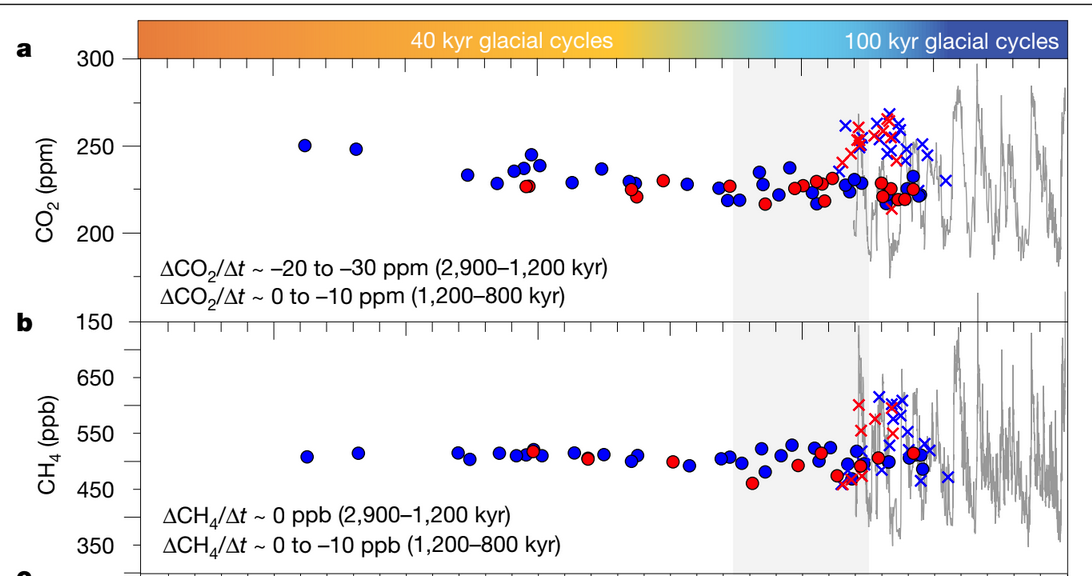
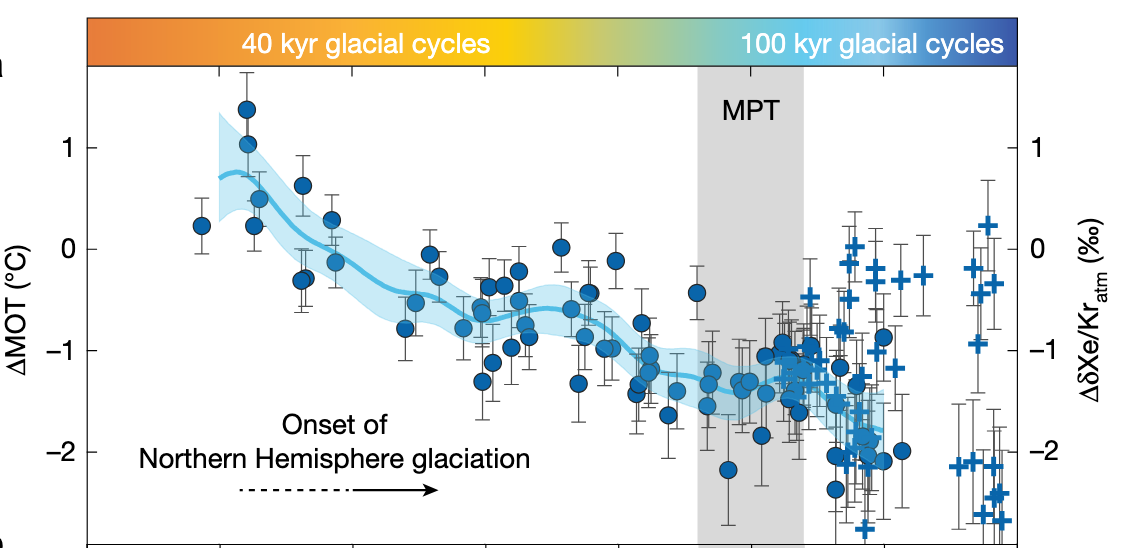
The first and most dramatic (or rather, non-dramatic) result, is that CO2 levels appear to have barely changed (on average) over this key period – dropping only 20-30ppm over the onset period. That isn’t nothing, but it’s only about 0.45-0.7 W/m2 in forcing, and would lead to around 1ºC in global surface cooling. The CH4 levels might have been expected to fall too, but they seem to be static. [Note that this method is not sampling the glacial/interglacial variations which are apparent in the more recent records]. The second, and somewhat confounding, result is that the global ocean seems to have cooled by about 2ºC over the same time period (with the global surface temperature change would have been larger).
So we have a conundrum. The onset of NH glaciation did happen as the planet cooled (as might be expected), but the first guess for what caused that cooling (long term trends in CO2 and/or CH4) does not appear to work.
How might this be resolved?
There are always multiple potential ways out of a conundrum: subsequent analyses might find an issue with the observations, there might be a hyper-sensitivity to the small CO2 changes at this time (but why?), there might be something else driving the change (volcanism? dust aerosols?), or… what? None of these possibilities are obvious winners, and of course, they are not mutually exclusive. Eric Wolff (direct link) in his commentary seems to think that the ocean is doing the driving, but I think that might be backwards.
The funny thing is that paleo-climatologists have been wanting these old ice analyses for a long time – with the anticipation that they would help answer these questions. But they seem to be posing many more questions than they have answered.
Broader issues
One thing this shows is that scientists can’t be complacent. As we’ve seen with surprising climate events even over the last few years (2023, Antarctic sea ice, the increases in the Earth’s Energy Imbalance), the more you look at the planet (or even the universe) the more surprising things you find. Science is an active search for deeper understanding – and we are not done yet.
Final thought
At face value, these results seem to suggest that CO2 declines were not the dominant/only cause of the cooling at the onset of the ice ages, despite expectations. Some of the usual suspects are certainly going to claim (fallaciously) that this means that CO2 can’t be the cause of anything. This is obviously a stupid argument so feel free to judge anyone that makes it.
Nonetheless,…
There are more things in heaven and earth, Horatio, than are dreamt of in your philosophy.
References
- J.D. Hays, J. Imbrie, and N.J. Shackleton, "Variations in the Earth's Orbit: Pacemaker of the Ice Ages", Science, vol. 194, pp. 1121-1132, 1976. http://dx.doi.org/10.1126/science.194.4270.1121
- H. Heinrich, "Origin and Consequences of Cyclic Ice Rafting in the Northeast Atlantic Ocean During the Past 130,000 Years", Quaternary Research, vol. 29, pp. 142-152, 1988. http://dx.doi.org/10.1016/0033-5894(88)90057-9
- J. Marks-Peterson, S. Shackleton, J. Higgins, J. Severinghaus, Y. Yan, C. Buizert, M. Kalk, R. Beaudette, V. Hishamunda, D. Eves, A. Carter, A. Kurbatov, J. Epifanio, J. Morgan, I. Nesbitt, M. Bender, and E. Brook, "Broadly stable atmospheric CO2 and CH4 levels over the past 3 million years", Nature, vol. 651, pp. 647-652, 2026. http://dx.doi.org/10.1038/s41586-025-10032-y
- S. Shackleton, V. Hishamunda, Y. Yan, A. Carter, J. Morgan, J. Severinghaus, S. Aarons, J. Marks-Peterson, J. Epifanio, C. Buizert, E. Brook, A.V. Kurbatov, M.L. Bender, and J. Higgins, "Global ocean heat content over the past 3 million years", Nature, vol. 651, pp. 653-657, 2026. http://dx.doi.org/10.1038/s41586-026-10116-3
- E.W. Wolff, "Climate snapshots trapped in ancient ice tell a surprising story", Nature, vol. 651, pp. 592-593, 2026. http://dx.doi.org/10.1038/d41586-026-00636-3

Thanks for this, I am in the Pleistocene is fascinating because of the cavemen, woolly mammoths and sabertooth tigers camp, but those drew me to the climate science explores that world.
“But sometimes the observations don’t confirm your preconceived notions. The nice thing about science is that scientists (ideally) tend to get excited at this point”
That reminds me in general that climate science unknowns and the twists are fascinating, but also scary because we can’t tell what is going to happen. In particular I went the the monthly SciCafe talks at the American Museum of Natural History this March, and the presenter was Christopher Piecuch from Woods Hole. He discussed how he thought he made a major advance in AMOC research, but when other factors were included in the analysis it was not useful information. In front of a crowd and under the life-sized blue whale model, he sheepishly admitted to having to ask for the paper to be retracted.
Anyone in the NYC area, I recommend the AMNH’s SciCafe science talks. They are interesting and they serve cocktails invented to match the topic of the talk.
Joseph O’Sullivan: “ the American Museum of Natural Historyunder the life-sized blue whale model,”
Model? In Canada we mount the actual blue whale skeletons … ;-)
When I wrote life-sized I meant 100 feet long. Top this Canada ;-b lol https://www.amnh.org/exhibitions/permanent/ocean-life/blue-whale
It’s a matter of judgment, of course, what you think the ‘topper’ is, but while Big Blue is 9 feet shorter than the AMNH at ‘only’ 85 feet, she is the Real Thing, after all.
https://beatymuseum.ubc.ca/exhibitions/permanent-exhibitions/blue-whale-display/blue-whale-project/
Joseph O’Sullivan: When I wrote life-sized I meant 100 feet long. Top this Canada ;-b lol
Fighting words. But you may have hoisted yourself with your own petard: I didn’t question “life-sized”, but I questioned the “model:
P: ” Model? In Canada we mount the actual blue whale skeletons … ;-)”
And ours are “life-sized” because they are REAL, real blue whale skeletons, instead of your cheap plastic knockoffs: https://www.mun.ca/csf/the-blue-whale/
“ Top [our plastic model] Canada ;-b lol “, eh? ;-)
There’s a recent new one that is now hanging in the atrium of the recently-opened science research building here at Memorial University in St. John’s.
https://www.mun.ca/csf/the-blue-whale/
Obviously, due to low CO2 levels.
Duh.
I wonder if geomagnetic polarity reversals might correspond to lower temperatures, or is this a dumb question?
https://website.whoi.edu/deeptow/wp-content/uploads/sites/66/2023/08/h68.jpg
[Response: People have looked into it and not found anything dramatic in the climate record that lines up with them, but there is one new thing that I should have mentioned as a possibility – e.g https://www.nature.com/articles/s41598-026-36926-z?fromPaywallRec=false Opher et al (2026) and https://agupubs.onlinelibrary.wiley.com/doi/10.1029/2024GL110174 Miller et al. (2024)<… – gavin]
Gavin, makes sense. Too few and not aligned reversals. Ok. But that cloud thing seems kind of questionable too. I mean wouldn’t they have to be pretty regular (though they’re not precise)? And fewer than previous but more intense? Hmm.
Anyway, I’ve found that the way I sometimes solve problems is through the process of elimination. Instead of trying to find the positive answer I eliminate the negatives. Saying what it’s not. I’m not saying anything you don’t already know though. Just putting that out.
Thinking about it a bit more and exposing more of my WAG ignorance. I’m wondering If an orbiting interstellar cloud of substance or a big enough comet or even a solid body came along every hundred thousand years at some angle to the ecliptic if it could temporarily throw off earths orbit or axial tilt just enough to cause the glaciation? I’d think since the last glaciation wasn’t that long ago something like that would still be visible?
Or perhaps if something within the sun itself happens around every hundred thousand years that might cause it to temporarily lose a bit of gravity which then causes a bit of a long wobble and the glaciations which then return to the coplanar because of momentum?
Or perhaps it’s something internal to the earth causing a temporary blockage of heat? Maybe a harder section of mantle or crust? Or (and this really sounds dumb) the heartbeat of the earth?
RR,
The general consensus since about 1970 has been that the ice ages are modulated by Milankovic cycles–regular variations in the Earth’s orbital eccentricity, axial tilt, and precession of the equinoxes. This was first proposed by Milutin Milanković in the 1930s.
https://en.wikipedia.org/wiki/Milankovitch_cycles
Ah, yes. I think I’ve heard of them a time or two. Just trying to think of something else in addition.
Ron R another cycle like some sort of geological cycle, operating in parallel with the milankovich cycle and with the same periodicity and timing would be an incredible coincidence. But stranger things have happened I suppose.
I do like Piotrs suggestion which seems to basically be an established explanation although hes added a few extra ideas of his own. Its evidence based.
Nigel, Maybe you’re right, but,
There are more things in heaven and earth, Horatio, than are dreamt of in your philosophy.
Gavin, there might be something else driving the change (volcanism? dust aerosols?), or… what?
I’m just wondering about the frequency of super volcanos.
On longer time scales, however, eruptions may follow global cycles. A number of studies have found that eruptions over thepast few million years show cycles in the Milankovitch frequency band (e.g., ∼23,000 to ∼100,000 years; Paterne et al.1990, Paterne and Guichard 1993, Glazner et al. 1999). These pulses of volcanic activity seem to correlate with changes in climate, sea level, and glacier advance and retreat (Hardarson and Fitton 1991, Sigvaldason et al. 1992, Zielinski et al. 1994,1996b, McGuire et al. 1997, Glazner et al. 1999). Several mechanisms involving loading and unloading of magma chambers by fluctuating ice sheets and sea levels have been proposed (e.g.,Rampino et al. 1979, McGuire et al. 1997).
Generally, it is accepted that the supereruptions are very rare with a recurrence interval of ~ 50,000-100,000 years (Rampino 2002;Mason et al. 2004), but uncertainties of such calculations depend on the global identification of eruptions and new findings of supereruptions can change the estimates.
Sorry, forgot the link.
https://www.researchgate.net/publication/222827939_Supereruptions_as_a_Threat_to_Civilizations_on_Earth-like_Planets
Iow, these volcanoes, if aligned with Milankovitch cycles, were the terrestrial and secondary downstream result of them rather than the primary cause (the tilt of the earth). The distinction.
Space dust was also not Milankovitch. These are just hypotheses of what caused the cold. The point it’s trying to discover what caused them. Even though the sulfates from volcanos are said to have been not enough or long lived enough one wonders if they were enough below a certain threshold to throw the earth into a colder state.
Just “spitballing” (a new word?). Anyway…
rather than the primary cause (the tilt of the earth)
Alright, sorry for the paraphrase. Three distinct orbital cycles.
Can you talk about the Boron -CO2 part of Figure 3 in Marks-Peterson, et al?
“These modest changes in atmospheric CO2 are similar to alkenone (Fig.3 and Extended Data Fig.8) and model-based reconstructions (Extended Data Fig.9) but appear to be systematically lower CO2 than boron-based reconstructions (Fig.3 and Extended Data Fig.8)”
Interesting indeed. Considering the 100 kyr Milankovitch cycle I think the important observation is that the tendency through every one of the ice ages since 1 myr BP (the 100 kyr ice ages) is that the ice volume through shorter ups and downs in the ice volume (stadials and interstadials etc., see the discussion of definitions here https://agupubs.onlinelibrary.wiley.com/doi/full/10.1002/2015RG000482 ) grows and grows for around 100 kyrs, after which it rather suddenly slumps to the interglacial volume level.
This points to a factor which Gavin didn’t mention (? or did I overlook/misinterpret something?): the enormous ice sheets and seaice-covered parts of the oceans heavily influence the climate themselves because of the albedo effect and what that means for the positioning of the jetstreams, pressure systems, storm tracks, regional distribution of precipitation etc. One hypothesis is that one important factor in the ice sheet decay is that the ice sheets at last grow too big for sufficient precipitation to reach their inner parts, so they can’t continue their growth. Another factor here is that the originally warm-based inner parts of the ice sheets after some time become cold-based (polar glaciers), frozen to the bed, because the snow falling in the inner parts gradually becomes colder, so to speak “transporting the cold” down into the ice while the layers are being buried one year after the other. This could tend to result in periodic surging in parts of the ice sheets when the pressure from the thickest parts overwhelm the frozen friction at the base holding back the inner deformation in the ice sheet. Fx. there seems to have been an ice stream in the Baltic sea from time to time surging westwards towards south-eastern Denmark (where you find rock fragments/blocks originating from the bedrock in the Åland isles between Sweden and Finland fx.)
The combination of these factors with the slow increase in summer insolation at 65 degrees N could be the main mechanism leading to the rather fast decrease of the big ice sheets when they grow “too big”. There is a kind of internal dynamics in the ice sheets at play here, I think.
As to what causes the seas to cool more than expected from the diminishing CO2 level, maybe the gradual growth and cooling (averaged over long time-spans) of the Antarctic ice sheet could be a factor? Of course there could also be problems with the proxy data: how accurate are the CO2 data when the ice is so old and has been transported over very large distances? “These samples come from the “blue ice” in the Allan Hills in Antarctica where multi-million year old ice surfaces after having been deposited and transported over large distances” as Gavin writes. Could contact with surface air, wind-blown snow/ice crystals etc. over long timespans influence the results by contaminating the old ice with fragments of a younger origin? Seems plausible to me.
A reminder: the last ice age is to us in Europe: the Weichselian https://en.wikipedia.org/wiki/Weichselian_glaciation , to people in the US the Wisconsinian https://en.wikipedia.org/wiki/Wisconsin_glaciation ). The main stadial/interstadial fluctuation (fx. Brørup/Odderade etc.) during the ice ages can also be shown to correlate with changes in the summer insolation at 65 degrees N, which is another strengthening of the Milankovitch hypothesis. See fx. “Our results imply that summer insolation played an important role in modulating the occurrence of stadial-interstadial oscillations and highlight the relevance of insolation in triggering abrupt climate changes” https://www.nature.com/articles/s43247-023-00908-0 .
The new papers raise an interesting question about the scope of the CO₂–temperature relationship. The EPICA record covering the last 800,000 years — well within the post-MPT period — shows a strong CO₂–temperature correlation (R = 0.84) whose OLS regression slope converges to within 1% of the Judd et al. 2024 Cenozoic regression (8.3 vs 8.2°C per doubling). Two entirely independent archives, different timescales, essentially the same slope.
The new Allan Hills results suggest the pre-MPT period is more complex — consistent with Judd’s own “Mesozoic Conundrum” observation that CO₂ and temperature decouple in certain intervals. Your closing warning about the fallacious skeptic inference is well placed. The new results tell us something genuinely interesting about the MPT. They don’t tell us CO₂ is innocent.
I’ve placed these fits alongside the modern instrumental record and SSP2-4.5 projection on common axes here: https://justdean.substack.com/notes
To Gavin’s closing point about usual suspects cherry picking CO2 and temperature records — the diagram I referenced above may be relevant here. When you place the modern instrumental record and SSP2-4.5 projection on the same CO₂–temperature axes as the Pleistocene cloud and the Judd Cenozoic regression, the 3-4°C swings along near-constant CO₂ concentrations that characterize the glacial cycles become visible for what they are: natural variability within a constrained envelope, driven by orbital forcing and ice-albedo feedbacks. They are the physics expressing itself through mechanisms other than CO₂.
The modern trajectory is something else entirely. It departs from the 1850 hinge point — where all three records converge — into CO₂-temperature space with no precedent in 66 million years, at a rate with no analog in the paleoclimate record. The pre-MPT puzzle tells us CO₂ isn’t the only knob. The modern trajectory tells us it’s the knob being turned right now, faster than the Earth system has ever experienced. Those are compatible observations, not contradictory ones.
Dean Rovang: “the 3-4°C swings along near-constant CO₂ concentrations that characterize the glacial cycles driven by orbital forcing and ice-albedo feedbacks. […] the physics expressing itself through mechanisms other than CO₂.”
You may be overstating the relative importance of these “mechanisms other than CO₂”, by implying that if CO₂ concentrations were “near-constant” then “the mechanisms other than CO₂” are “nearly” entirely responsible for the swings in T. But they are not “near-constant” -as Fig. 1 shows (e.g. CO2 varied between 190 and 290 ppm) and both CO2 and Ch4 are very well correlated with T. With T being more sensitive to GHGs at their lower range – quite a bit of the T swings can be explained by coinciding swings in CO2 and CH4.
DR The pre-MPT puzzle tells us CO₂ isn’t the only knob
Except to be a knob, you have to be driver, not merely a feedback. And, other than the weak orbital driver, you didn’t show any drivers.
Piotr — fair correction on the language. The full glacial-interglacial CO₂ range of 180-280 ppm is substantial and the correlation with temperature across that range is strong and well established. “Near-constant CO₂” was imprecise.
What I should have said is that within narrow CO₂ windows, temperature varies by 3-5°C depending on orbital phase, ice sheet configuration, and ocean circulation. A simple bin analysis of the EPICA record shows temperature spreads of 2-5°C within 10-ppm CO₂ bins, peaking at ~5°C in the 240-260 ppm transition zone where the system passes through on both the way into and out of glacial cycles under different boundary conditions. That spread is real, systematic, and physically meaningful — it reflects orbital forcing, ice-albedo feedbacks, and ocean circulation doing substantial work independently of CO₂.
The broader point stands: CO₂ is strongly correlated with temperature across the full record, and it is the primary knob being turned today. But the spread within narrow bins confirms it isn’t operating alone — which is compatible with everything Judd and Tierney say, and with Gavin’s puzzle about the pre-MPT period.
Dean Rovang: “That spread is real, systematic, and physically meaningful — it reflects orbital forcing, ice-albedo feedbacks, and ocean circulation doing substantial work independently of CO₂.”
I still have the problem with the language, and it is not pure semantics, but indicates a different way of thinking: if CO2 is in a feedback with T, and ice-albedo is in a feedback with T – then I would not say that the ice-albedo “works independently of CO₂” – quite the opposite – they amplify each other through their effects on T.
Also, I would not put it in the same line forcings (orbital) and feedbacks – different role in the climate.
And I would not put changes in the ocean circulation next to the feedbacks – at different times scales they could be a climate forcing (creation of AMOC following the closure by the Panama isthmus cooling the N. hemisphere), feedbacks (positive or negative?) or just a result of other factors being at play.
On a flip side – to the sentence about feedbacks I would add one – water cycle (water vapour and cloud albedo) with T,
The timing and relative contribution to T of the 4 feedbacks may change during different stages of a glacial cycle – might perhaps explain the striking asymmetry – the warming is rapid, while the cooling phase is ~ 5-10 times longer, and uneven, with T “bumps” along the long way down.
Re: Dean Rovang
Another reason to stay away from the phrase of “working independently of CO₂” is that it opens itself to the misuse by the deniers, who would say:
“ if most of the T change in Mid-Pleistocene was caused by factors “working INDEPENDENTLY of CO₂” , then why are we obsessing about CO2 today”?
And it’s not a hypothetical – one of our resident “anything-but-CO2” deniers blamed “up to 40 % of the planet’s land degradation” onto “an artificial fixation and overemphasis [on the role of a] trace gas”:
“ This is a profound forcing to climates and puts our communities at risk. It’s hard to imagine denying or actively minimizing the consequences to realclimates due to an artificial fixation and overemphasis on the outputs of trace gas and aerosol forced model estimates.” (c) JCM
And the answer to this and other deniers is that these factors being feedbacks – do NOT “work independently of CO₂“, but in fact amplify the effects of CO2.
And if they amplified the effect of CO2 on T when CO2 was a feedback during glacial cycles, then they would also amplify the effect of CO2 today, when CO2 is now a dominant forcing of AGW.
In other words – the natural feedbacks (ice albedo, water vapour/clouds):
– amplify the sensitivity of the climate to human emissions of CO2 increase, and therefore increase to the importance of CO2 to the future climate,
– make the mitigation of CO2 the most (only?) effective way to mitigate AGW – as ice albedo and water cycle feedbacks would make the consequences of our action or inaction on CO2 concentration much larger than they would be if we only dealt with the direct effect of CO2 itself.
I.e., conclusion very opposite to the deniers’ claim of “an artificial fixation on and overemphasis of, [a] trace gas”
in Re to Piotr, 24 Mar 2026 at 2:45 PM,
https://www.realclimate.org/index.php/archives/2026/03/the-puzzling-pleistocene/#comment-846523
Hallo Piotr,
As far as I know, under the “profound forcing”, JCM meant human interferences with terrestrial vegetation, soil deterioration and disruptions to hydrological regimes.
I am aware of your opinion that these interferences play a negligible role, however, your present post could be read the way that e.g. forest clearing or wetland draining is a “feedback amplifying the effect of CO2”.
I do not see any reason why these human activities should depend on anthropogenic CO2 emissions. In this respect, I still believe that JCM’s assertion (that they represent independent forcings) was correct.
Greetings
Tomáš
Tomas Kalisz: “ I am aware of your opinion that these interferences play a negligible role”
then you are aware that I used JCM’s own source to show him that it is negligible,
In contrast to the said JCM – who blamed the massive destruction of Earths on … the climate scientists and their “ an artificial fixation on and overemphasis of, [a] trace gas” – based on his unquantified feeling these non_GHG interference had “profound effect “.
TK: “ however, your present post could be read the way that e.g. forest clearing or wetland draining is a “feedback amplifying the effect of CO2”
Why on earth would you read it this way?
TK I still believe that JCM’s assertion (that they represent independent forcings) was correct.
There could be millions of things that could possibly affect climate. Heck, you passing gas after eating dairy product could represent an “independent forcing”. And despite Multitrolls compliments lavished on JCM – neither of them, nor anybody, is able to understand all of them.
And that’s why science prioritizes its efforts – it quantifies the effects and identifies for further study only those factors that could have a “profound effect”. And in the context of policy recommendations – the triage is even more strict – only these factors that are profound _drivers_ of the AGW are what matters to the mitigation of the said AGW.
So the onus of proof of showing that evaporation from land is such a “profound driver”, and therefore justifying JCM’s attacks on climate science for not spending much time on his favourite “profound driver” – human changes in evaporation – is on you.
in Re to Piotr, 29 Mar 2026 at 12:38 PM,
https://www.realclimate.org/index.php/archives/2026/03/the-puzzling-pleistocene/#comment-846708
Hallo Piotr,
Thank you very much for your comment.
The assertion that I objected in your post is “.. these factors being feedbacks – do NOT “work independently of CO₂“, but in fact amplify the effects of CO2”.
As far as I know, JCM never put in doubt the generally accepted mechanism of glacial cycles, wherein the influence of changing insolation on global mean surface temperature is further enhanced by changes in atmospheric CO2 concentration, lapse rate changes, changes in atmospheric water vapour concentration and changes in cloud cover, wherein all these secondary changes are driven by the initial change in global mean surface temperature (GMST).
He addressed an entirely different aspect of forcing and feedback mechanisms driving Earth climate, namely the circumstance that humans influence the lapse rate, atmospheric water vapour concentration and cloud cover also directly, through their interferences with land hydrological regimes. In this case, anthropogenic emissions of non-condensing greenhouse gases (GHG) are not involved in the resulting climate changes, and JCM is correct that anthropogenic interferences with terrestrial hydrological regimes (that occur e.g. through land drainage, deforestation and/or soil degradation) do indeed represent another forcing, independent of GHG.
I think that inferring from the results of modelling experiment published by Lague et al
https://iopscience.iop.org/article/10.1088/1748-9326/acdbe1
that human influence on Earth climate through interferences with land hydrology are negligible and therefore do not deserve thorough scientific research may be premature, for at least the following reasons:
(i) although the difference 8 K in the GMST between the two extreme states (the “desert land” and the “swamp land”) of terrestrial hydrological regime obtained from the CESM model used by Lague et al looks moderate, we have no comparison with other models yet,
(ii) we also lack knowledge in which extent anthropogenic interferences with ecosystems changed land hydrology during the Holocene,
(iii) although changes in terrestrial hydrological regimes can, besides the direct influence on GMST, change also climate sensitivity towards GHG forcing, we even do not know yet if the possible effects of “continental desiccation” on climate sensitivity is positive (enhancing) or negative (attenuating).
An indirect hint that human interferences with land hydrology may not be negligible may perhaps be the observation that during the era of detailed Earth gravity field observation by satellite probes, anthropogenic contribution to sea level rise due to water extraction from underground aquifers may be comparable with or even higher than the contribution from ice melting:
https://www.science.org/doi/10.1126/sciadv.adx0298
In this respect, I think that sidelining the research of the relationships between land hydrological regimes and global climate or focusing solely on one direction thereof may be a risky approach.
Greetings
Tomáš
Tomas Kalisz: ” The assertion that I objected in your post is “.. these factors being feedbacks – do NOT “work independently of CO₂“, but in fact amplify the effects of CO2”.
And I have already dealt with your “objection” in the post you … are supposedly replying to.
Any factor can be a forcing and a feedback. But IF the forcing effect is INSIGNIFICANTLY SMALL compared to its feedback effect, then it is intellectually DISHONEST to discuss the former AS IF it they were of a comparable importance to the latter. That’s classic: missing the forest for a tree fallacy.
And neither you nor your JCM have been able to prove that it wasn’t a fallacy – that the human increases in evaporation can provide any SIGNIFICANT reduction in AGW – quite the contrary – I have shown the opposite – how absurdly technically and societally difficult/cost-ineffective attempts to mitigate AGW via increasing evaporation would have been:
– using JCM own source (Lague et al.) – partick and I have shown that even such a dramatic societal sacrifice as abandoning all agriculture would have reduced AGW by … a fraction of a fraction of 0.3K
– using your Sahara irrigation scheme I have shown that it would require building and operating MILLIONS of industrial desalination plant and pumping system to spread the desalinated water over 5 mln km2, WITHOUT any significant GHG emissions, so after hundreds of years in operation – the AGW would be smaller ….by a fraction of 0.3K, compared to AGW without your scheme.
In other words – you and your JCM both failed to show ANY significant potential to mitigate AGW via increasing the evaporation, much less proving much more extreme claims of JCM that it is a “ profound forcing” compared to “ artificial fixation and overemphasis” of the role of a “trace gas”{CO2] (c) JCM.
P.S.I won’t waste time to comment on the rest of the long post you based on your initial fallacy – as they say: “garbage understanding of how science works in – Tomas’s posts out”.
In Re to Piotr, 31 MAR 2026 AŤ 2:51 PM,
https://www.realclimate.org/index.php/archives/2026/03/the-puzzling-pleistocene/#comment-846747
Hallo Piotr,
Although dismissing someone’s reasoning for his opinion as not deserving any attention due to (alleged) fallacy in the opinion itself seems to be an interesting rhetorical figure, I am fine with your decision to not comment on the substance of my post. There is no such obligation, you could have also simply ignored the post in its entirety.
Greetings
Tomáš
Tomas Kalisz: Although dismissing someone’s reasoning for his opinion as not deserving any attention due to (alleged) fallacy in the opinion itself seems to be an interesting rhetorical figure,
Aga-baga? What you try to discredit as “an interesting rhetorical figure” is the very core of any productive discussion:
I have used FALSIFIABLE reasoning to explain to you that your and JCM’s years of posts and thousands of pages of texts have been based on the initial failure to ask yourselves the most basic question any decent scientist would ask themselves – is the effect I have discovered likely SIGNIFICANT compared to known forcings, and if the answer were “yes”, double and triple check, because “you must not fool yourself–and you are the easiest person to fool.”.
And if you failed to do so, and went publicly with your idea – and somebody else has shown that the effect is NOT significant, then you and JCM – either have to disprove their proof, or acknowledge that you were wrong, and stop bringing up your failed idea as if it was still valid.
Neither you nor JCM could falsify my argument – saying that I “allegedly” proven my point is not such falsification nor is portraying my falsifiable argument as an empty “rhetorical figure”. Nor either of you was able to admit it
And in case of JCM – to apologise to climate modellers for his blaming “ up to 40% of land degraded ” on …. climate modellers who ignored his (and your) failed idea of mitigation AGW by increasing evaporation as “artificial fixation and overemphasis on the [effect of] trace gas [Co2]“.
And since you called my proof “alleged” – here it is again, for everybody to see its “alleggedness”:
================= Piotr Mar 31: ===================
Any factor can be a forcing and a feedback. But IF the forcing effect is INSIGNIFICANTLY SMALL compared to the feedback effect, then it is intellectually dishonest to discuss the former AS IF it they were of a comparable importance to the latter. That’s classic: missing the forest for a tree fallacy.
And neither you nor your JCM have been able to prove that it wasn’t a fallacy – that the human increases in evaporation can provide any SIGNIFICANT reduction in AGW – quite the contrary – I have shown the opposite – how absurdly technically and societally difficult/cost-ineffective attempts to mitigate AGW via increasing evaporation would have been:
– using JCM own source (Lague et al.) – partick and I have shown that even such a dramatic societal sacrifice as abandoning all agriculture would have reduced AGW by … a fraction of a fraction of 0.3K
– using your Sahara irrigation scheme I have shown that it would require building and operating MILLIONS of industrial desalination plant and pumping system to spread the desalinated water over 5 mln km2, WITHOUT any significant GHG emissions, so after hundreds of years in operation – the AGW would be smaller ….by a fraction of 0.3K, compared to AGW without your scheme.
In other words – you and your JCM both failed to show ANY significant potential to mitigate AGW via increasing the evaporation, much less proving more extreme claims of JCM that it is a “ profound forcing” when compared with “artificial fixation and overemphasis” of the role of a “trace gas”{CO2] (c) JCM.
==============================================
in Re to Piotr, 2 Apr 2026 at 8:15 PM,
https://www.realclimate.org/index.php/archives/2026/03/the-puzzling-pleistocene/#comment-846774
Hallo Piotr,
In my post of 31 Mar 2026 at 9:06 AM,
https://www.realclimate.org/index.php/archives/2026/03/the-puzzling-pleistocene/#comment-846745 ,
I tried to repeat under bullet points (i)-(iii) the reasons why I do not see your arguments for your opinion (that the influence of human interferences with terrestrial hydrological regimes on earth global climate is negligible) convincing.
You commented thereon as follows:
“P.S.I won’t waste time to comment on the rest of the long post you based on your initial fallacy – as they say: “garbage understanding of how science works in – Tomas’s posts out”.”
Do you really think that a such approach “is the very core of any productive discussion”?
Greetings
Tomáš
Tomas Kalisz Apr. 4: “ I tried to repeat under bullet points (i)-(iii) the reasons why I do not see your arguments ”
As has been explained to you many times:
i) I have shown the fallacy of your and JCM claims WITHIN YOUR OWN ARGUMENTS: I used YOUR OWN SOURCE (Lague et al.) to show that humans can’t increase evaporation enough to reduce AGW in any meaningful way.
In response – both of you threw your own source under the bus – JCM attacking it (and by extension all climate modelling) as “ imaginary process mechanisms [using] rules about how things ought to be ” (c) JCM; and now you – questioning the value of Lague results. by saying it … is not been confirmed by other (nonexistent) models.
And if you didn’t trust Lague et al – why both of you had used it when you thought that it supports your claims?
ii) : TK we also lack knowledge in which extent anthropogenic interferences with ecosystems changed land hydrology during the Holocene,
We don’t need to – since the effect would be a TINY FRACTION of the maximum range of 8K (=the difference between such extreme end points as all continents being deserts and all continents being swamps). Any human influence would be a tiny fraction of this range – e.g. even such an extreme case as creating ALL Earths croplands by deforestation, had warmed the Earth by a fraction of a fraction of 0.3K if any at all (if we included irrigation of crops).
(iii) although changes in terrestrial hydrological regimes can change also climate sensitivity towards GHG forcing
Irrelevant to my point you are supposedly replying to – to mitigate AGW only your ability to mitigate forcing is what counts – water vapour doesn’t, since it is passive feedback that just follows the changes in temperature DRIVEN by changes in GHGs.
So out of your advertised “3 points” – NONE withstood any scrutiny.
TK: “ Do you really think that a such approach “is the very core of any productive discussion”?
“the very core of any productive discussion” is making falsifiable arguments and challenging the points of the opponent. Not wasting my time on your post that do neither, is just saving my time being wasted, It’s NOT a “discussion”, it’s refusal of unproductive, futile, discussion:
“What can be asserted without (falsifiable) evidence can also be dismissed without evidence.”
in Re to Piotr, 6 Apr 2026 at 6:37 PM,
https://www.realclimate.org/index.php/archives/2026/03/the-puzzling-pleistocene/#comment-846852
Hallo Piotr,
Thank you for treating my points (i)-(iii) as falsifiable arguments and investing your time and effort therein, although you insist in your opinion that they did not deserve it.
Let me react to your comments:
(i) I have not said that I do not agree with Lague et al, I only said that your “tiny fraction” argument would be stronger if we knew the spread of the difference in global mean surface temperature (GMST) between the “swamp land Earth” and the “desert land Earth” across multiplicity of climate models, not only for CESM. Presently, nobody knows if it is 6-10 K, 7-20 K, 5-15 K or e.g. -8 – 28 K.
(ii) The stronger is your argument (i), the stronger might be also your argument (ii). I think, however, that it applies only if my argument (iii) is moot.
(iii) I am not sure if I understood you correctly. Do you think that the forcing is only what matters for the resulting level of warming?
So far, I thought that the resulting warming is forcing multiplied by climate sensitivity to that forcing – in other words, the product of both.
If so, I would expect that the warming may change if we change the forcing or if the climate sensitivity. In other words, not necessarily only if we change the forcing.
That is why I think that answering the question whether (and if so how) climate sensitivity depends on water availability for evaporation from the land may be important not only for climate science but also for practical climate policies.
Greetings
Tomáš
Tomas Kalisz: Thank you investing your time and effort therein, although you insist in your opinion that they did not deserve it.
Your word: “insists” implies irrational insistence against the fact and logic. Mine is the opposite – it stems from a falsifiable argument: “garbage assumptions in, garbage conclusions out”.
As for “non-deserving reading” – it referred to your text based on your assumptions. My reminding you why your assumptions are faulty – does not vindicate your lengthy “garbage out” your produced from these faulty assumptions.
TK “ (i) Presently, nobody knows if it is 6-10 K, 7-20 K, 5-15 K or e.g. -8 – 28 K.”
This is an “argument from incredulity” fallacy. It hopes the uncertainty is your friend –
that maybe it’s not 8K but 28K No rationale, not mechanisms to justify that belief and no explanation why Lague et al. would got it so spectacularly wrong.
Furthermore, even if it was the incredible 28 – then even such dramatic response as abandoning all agriculture and turning all the croplands into swamps would be still
a fraction of a fraction of 1K. I.e. still nowhere near enough to call the potential effects of GHG mitigation “artificially overemphasized” even for such an massive (thus unrealistic) intervention as abandoning of agriculture.
TK: (ii) The stronger is your argument (i), the stronger might be also your argument (ii)”
I think, however, that it applies only if my argument (iii) is moot.
Unfortunately your argument (iii) IS moot:
TK (iii) Do you think that the forcing is only what matters for the resulting level of warming?
For the subject of the discussion, which is mi9ation of AGW – YES – forcing is the only that matter and that you can change. As such, water feedback makes the changes in GHGs not LESS important (as JCM’s: “artificial overemphasis on a trace gas” implies), but MORE important – if we lower T by reducing GHGs the passive water feedback makes the cooling larger, and if we increase T by our failure to reduce GHGs – then the water feedback makes resulting AGW worse, than it would have been in the absence of water feedback.
So since all your three assumptions are faulty, then whatever you speculated on the belief that all three are right – does not deserve our time “Faulty assumptions in, multiple pages of garbage out”.
In Re to Piotr, 8 APR 2026 AT 2:27 PM,
https://www.realclimate.org/index.php/archives/2026/03/the-puzzling-pleistocene/#comment-846923
Hallo Piotr,
Your objection against my point (iii) is based on an assumption that the sum of water feedbacks is fixed. I do not think thať it is a suitable argument against the opinion that these feedbacks may depend on water availability for evaporation from the land.
Greetings
Tomáš
Tomas Kalisz: “ Your objection against my point (iii) is based on an assumption that the sum of water feedbacks is fixed.
Only in your head. _My_ falsification of your point (ii) was based on a logical argument,
NOT on some uncertain “assumption”, And certainly not on “ the assumption that the sum of water feedbacks is fixed.“. Here is it again:
====
you: “(iii) Do you think that the forcing is only what matters for the resulting level of warming?”
me: “For the subject of the discussion, which is mi9ation of AGW – YES – forcing is the only that matter and that you can change”
===
The tall tales told by JCM, notwithstanding – humans CAN’T change this feedback in any meaningful way, whether it is fixed or unfixed, other than by reducing GHG conc..
I.e. the anathema to your intellectual guru, the “anything-but-GHGs” denier JCM, blaming massive destruction of Earth’s ecosystems on climate scientists and their “ artificial fixation and overemphasis [of a] trace gas [GHGs]”
I can see why Multi-troll would shower JCM with praise (to use him in his anti-climate science narrative), but what’s your deal?
in re to Piotr, 12 Apr 2026 at 7:05 PM,
https://www.realclimate.org/index.php/archives/2026/03/the-puzzling-pleistocene/#comment-847001
in re to Piotr, 12 Apr 2026 at 7:05 PM,
https://www.realclimate.org/index.php/archives/2026/03/the-puzzling-pleistocene/#comment-847001
Hallo Piotr,
I strive to understand your arguments, to see if I can accept them. I still perceive two discrepancies.
1) Who restricts the subject of (Real Climate?) discussion, the way that it perhaps should primarily or solely deal with anthropogenic global warming (AGW) mitigation?
I think the scope of this discussion forum is climate science in broader sense – in other words, our understanding how Earth climate works. My concern is that a gap in this general knowledge (e.g. with respect to the yet unclear relationship between water availability for evaporation from the land and climate sensitivity to radiative forcings) may hamper also our understanding to the AGW (and proper perception of possible means for its mitigation, too).
2) I suggest that research focused on clarification of this unknown relationship may be desirable. Oppositely, you seem to be sure that such research does not make a sense because “humans CAN’T change (water) feedback in any meaningful way, whether it is fixed or unfixed, other than by reducing GHG conc”.
Personally, I do not see any support for this certainty. How can you assert that humans cannot change water feedback(s) to radiative forcings, by their interferences with land hydrological regimes (and/or that they have not changed these feedbacks by such interferences with land water cycle during the entire Holocene), when nobody studied the above mentioned unknown relationship yet?
As far as I know, nobody knows yet if increasing water availability for evaporation from the land increases or decreases climate sensitivity to changes in atmospheric CO2 concentration. The same lack of knowledge seems to apply for the relationships between water availability for evaporation from the land and individual water feedbacks to CO2 concentration changes – water vapour feedback, lapse rate feedback and/or cloud feedback.
For these reasons, I still consider JCM’s doubts about completeness of our understanding to Earth climate and to mechanisms of the AGW as justified and your arguments against him as not convincing.
Greetings
Tomáš
Thomas Kalisz “Who restricts the subject of (Real Climate?) discussion, the way that it perhaps should primarily or solely deal with anthropogenic global warming (AGW) mitigation?
Societal responsibility of science to prioritize its efforts on the issues that threaten the very survival of the human civilization. When the forest is on fire, the smell of the roses shouldn’t be the primary concern of scientists.
Particularly when the claims of the “anything-but-fire” deniers are used by the industrial arsonist making trillions on setting the forests on fire to distract the society from their responsibility, and from the urgency of fighting the fire they are making their profits on.
in Re to Piotr, 29 Apr 2026 at 5:11 PM,
https://www.realclimate.org/index.php/archives/2026/03/the-puzzling-pleistocene/#comment-847414
Hallo Piotr,
Thank you for your response!
To be honest, I still perceive therein the discrepancy that I already tried to address:
How can you arbitrarily, without any research in the respective direction, decide that an unresolved scientific question is unimportant?
I think that a such arbitrary decision any time includes a risk assessment (although it may be made unconsciously). In the present case, it appears that you see the risk of wasting some precious scientific resources on the proposed research as much higher than the risk that on the basis of a false arbitrary assessment, the unresolved question, potentially hampering the progress in further climate research, will further remain omitted.
I think that although it is well possible that your arbitrary decision was correct, the only reliable way how to find out (if it really was) may consist in filling the objected knowledge gap. Personally, I see the potential risks arising from the lack of knowledge in the present case as much higher than the costs of studying the open problem.
Greetings
Tomáš
Tomas, Who restricts the scope of discussion? Ever hear of the adage “My house, my rules?” The folks who run the shop here are climate scientists and they have the right to herd the cats into avenues they feel are important and relevant. Also, in the past, discussions often bogged down in internecine warfare when the people strayed too far into the policy realm. Don’t like it? There is software out there to help you start your own blog.
in Re to Ray Ladbury, 30 Apr 2026 at 6:03 AM,
https://www.realclimate.org/index.php/archives/2026/03/the-puzzling-pleistocene/#comment-847425
Dear Ray,
Your questions as well as your well-meant advice raises my feeling that you might have omitted the preceding exchange between me and Piotr.
To summarize it shortly, I pleaded for a modelling experiment aiming to clarify if (and how) climate sensitivity towards radiative forcings changes when we change water availability for evaporation from the land. Piotr objects that a such research is useless, asserting that we cannot use this knowledge for mitigating the anthropogenic global warming (AGW).
It was, actually, Piotr who asserted (8 Apr 2026 at 2:27 PM,
https://www.realclimate.org/index.php/archives/2026/03/the-puzzling-pleistocene/#comment-846923 )
that “the subject of the discussion (is mitigation of) AGW”.
Greetings
Tomáš
Tomas Kalisz “How can you arbitrarily, without any research in the respective direction, decide that an unresolved scientific question is unimportant?”
Huh? “Arbitrarily, without any research “??? My _falsifiable_ argument is BASED on the elementary scale analysis – we know what are the natural water fluxes, what’s the residence time of water vapour in atm. and we know
from literature you waterboys brought up yourself – Lague et al. – what’s the maximum theoretical range of their effect on GMST.
And based on that – we showed that we simple CAN’T increase evaporation nowhere enough to reduce AGW in any meaningful way – as patrick and me have shown – even such a monumental action as abandoning all agriculture would have reduced AGW by …. a fraction of a fraction of 0.3K !
And even this demands that we …. miraculously find somewhere enough ground water to convert all croplands on Earth into swamps, and continue to do so forever (the moment we stop, the pent-up heating comes with a full force).
The onus of proof that the your water schemes COULD work – is on YOU, not on us. Yet neither you, your JCM, nor Data cheering JCM on – have been able to challenge this analysis: you have never owned up to your baseless claims – if anything the contrary: you continue attacking your opponents and by extension climate scientists:
– you claiming that your ideas have been rejected on the basis of “arbitrary, without any research decision”
– JCM goes further:
– attacks climate modelling by dismissing it as
““ imaginary process mechanisms [using] rules about how things ought to be ” (c) JCM July 2024.
– and blames climate scientists for “ up to 40 % of the planet’s land degradation” because of “an artificial fixation and overemphasis [on the role of a] trace gas”:
“ This is a profound forcing to climates and puts our communities at risk. It’s hard to imagine denying or actively minimizing the consequences to realclimates due to an artificial fixation and overemphasis on the outputs of trace gas and aerosol forced model estimates.” (c) JCM
All the above has been explained to you MANY times, yet you keep coming back, and maliciously misrepresent your opponent’s actions, and repeat the same many times falsified claims, as if they have never been challenged (“ arbitrary decision [made] without any research (c) TK).
A classic method of anything-but-GHGs deniers and sealioning trolls*.
—-
Wikipedia: “Sealioning a type of trolling or harassment that consists of pursuing people with relentless requests for evidence, often tangential or previously addressed, while maintaining a pretense of civility and sincerity”
—–
in Re to Piotr, 1 May 2026 at 5:17 PM,
https://www.realclimate.org/index.php/archives/2026/03/the-puzzling-pleistocene/#comment-847493
Hallo Piotr,
I would like to remind you that my proposal pertained to the relationship between water availability for evaporation from the land (on one hand) and climate sensitivity towards changing atmospheric CO2 concentration (on the other hand).
Asserting that it is a resolved problem because Lague et al. already studied another question related to land hydrological regimes (namely the relationship between water availability for evaporation and global mean surface temperature at constant atmospheric CO2 concentration) is effectively an arbitrary denial of my proposal, not a reasoning why the proposal does not make sense.
Greetings
Tomáš
Tomas Kalisz: “ Asserting that it is a resolved problem because Lague et al. already studied another question related to land hydrological regimes (namely the relationship between water availability for evaporation and global mean surface temperature at constant atmospheric CO2 concentration) is effectively an arbitrary denial of my proposal”
Could you be any _more_ intellectually dishonest?
It was YOU who used YOUR and JCM’s source, Lague et al., to obtain YOUR estimate of the resulting AGW reduction, “0.3K”, of YOUR proposal of irrigation of Sahara.
In response, I used YOUR Numbers YOU derived from YOUR source (Lague at al) – and applied them to the estimate of the likely COSTS of your proposal:
======
” a 1000-FOLD increase in global desalination, i.e. building about 20 MILLION of new industrial desalination plants, costing probably $ trillions annually, and continue to operate them for THOUSANDS of years to ultimately approach …. a mere a 0.3K net reduction in AGW, and even that assuming that building and operating these many millions of desalination plants, pumping all this water over thousands of km and spread over 5 mln km2 – can happen without ANY GHG emissions ….”
======
The idiocy of your scheme so obvious that even your waterboy guru, JCM – didn’t want to have anything to do it – stating on record that he has never supported your scheme.
Even you, unable to challenge my numbers – first dismissed the calculation of likely costs as not important to evaluating the validity of your scheme,
and when pressed on that, you were forced to admit that it wasn’t feasible. Later you went as far as scolding me for bringing up the proposal as something that you no longer supported.
Then, you waited, counting that people will forget these discussions,
to … come back now, as if nothing happened, lecturing ME that the Lague source YOU used to quantify the AGW effect of your Sahara proposal is … NOT applicable to quantifying the AGW effect. And to pose as a victim here, decrying my: “ arbitrary denial of my proposal”, based on “arbitrary, without any research decision”.
I.e. presenting a diagnostic pattern of sealioning troll:
Wikipedia: “Sealioning a type of trolling or harassment that consists of pursuing people with relentless requests for evidence, often tangential or previously addressed, while maintaining a pretense of civility and sincerity”
in Re to Piotr, 4 May 2026 at 11:55 AM,
https://www.realclimate.org/index.php/archives/2026/03/the-puzzling-pleistocene/#comment-847570
Hallo Piotr,
Neither the article published by Lague et al. nor your dispute of my “Sahara irrigation” thought experiment pertain to climate sensitivity.
Consequently, your entire post is totally out of topic that I strived to address.
Please chill and if you want to discuss, read what I actually wrote before you reply.
Greetings
Tomáš
Tomas Kalisz: 4 May: “Neither the article published by Lague et al. nor your dispute of my “Sahara irrigation” thought experiment pertain to climate sensitivity”
[ Note to the normal reader – I apologize for the excessive use of capitalization – the hope is that when I capitalize the important words it _might_ get through the thick skull of Tomas.]
Tomas, any proposal for research demands doing the preliminary HOMEWORK by the proponent:
– you review the existing information,
– you formulate a proper testable hypothesis and
– then do a scale-analysis PROVING that testing this hypothesis deserves the time and resources of the scientists you demand to use on your “feelings” and “beliefs”.
You, Tomas Kalisz, has done NEITHER of these three, quite the contrary – you have been ignoring or actively trying to discredit with pejorative language [“arbitrary denial” without any research] – my falsifiable scale-analysis showing that NOTHING USEFUL is likely to come out of your proposed modelling.
And in contrast to your opening claim – the Lague et al. results and your failed Sahara irrigation scheme are not only pertinent, but CRUCIAL to evaluate your proposal – they show that water cycle today and in the foreseeable future CAN’T be a forcing of T (we can’t possibly change the water cycle directly ENOUGH to make any noticeable effect on AGW).
INSTEAD, it is a mere PASSIVE feedback, amplifying the AGW effects of the ACTUAL forcings of T – main being our changes in GHGs.
Therefore, as it has been explained to you MANY TIMES – there is NO NEW INSIGHT in quantifying the role of one or another PASSIVE FEEDBACKS – we have known ALREADY for decades that water feedback is important, and therefore we include it IMPLICITLY in our models. And since the water cycle is already there, and will automatically influence the AGW results – there is NOTHING NEW to be learned from the fact that out of, let’s say, 2C AGW,
0.5C came directly from the increase in GHG concentration, and 1C came indirectly from that increase in T caused by GHGs via altering water cycle.
Nor will be there any useful information if in the future climate (say, AGW=3C) direct GHG effect will become, say, 0.75C, but water cycle would increase to 1.5C). No useful insight here since your “changed sensitivity of the climate” to water cycle is ALREADY INCORPORATED in the climate models
.
And now, Tomas go away or we shall mock you a second time. (Fetchez la vache!)
in Re to Piotr, 5 May 2026 at 2:24 PM,
https://www.realclimate.org/index.php/archives/2026/03/the-puzzling-pleistocene/#comment-847653
Hallo Piotr,
Thank you for your reply and for detailed explanation of your persisting objections.
I, however, respectfully disagree with your evaluation of my proposal, for at least the following reasons.
1) My review of existing information was quite thorough, and I am now pretty sure that there is no study explicitly addressing the relationship between water availability for evaporation from the land and climate sensitivity to various radiative forcings. I agree that this relationship is implicitly comprised in climate models, however, it remains hidden therein because nobody tried yet to extract therefrom the respective knowledge in a comprehensible and practically useful form. I think that in absence of the knowledge if landscape drying enhances the global warming or attenuates it, an important piece of the puzzle that should inform science-based climate policies is still missing.
2) With respect to your scale-analysis, I would rather say that I failed to convince you that from relatively weak direct effect of changes in land hydrological regime on global mean surface temperature (suggested by the results of Lague et al.), you can hardly draw any reliable conclusion regarding the influence of land hydrological regime on climate sensitivity.
I am aware that my failure to grasp your evidence for the contrary (that I still see illogical) may be well caused by my dullness, however, I would be definitely more willing to accept this explanation for our mutual disagreement if I knew that you have never erred in all your climate science disputes that you entered here on Real Climate during the last three years.
3) As regards the formulation of a testable hypothesis, I supposed that the influence of water availability for evaporation from the land on climate sensitivity could be tested in the modelling setup successfully applied by Lague et al., by comparing the results of a standard experiment (e.g. sudden atmospheric CO2 doubling) for their “desert land” and “swamp land” model Earths. Nevertheless, during preparation of this response to your objections, it came to my mind that a such comparison may not be as straightforward as I thought originally.
As the “desert land Earth” differs from the “swamp land Earth” in the global mean surface temperature (GMST) corresponding to the respective steady state (“radiative equilibrium”), I think that it can be reasonably expected that both steady states will differ e.g. in the extent of ice sheets, of the sea ice and, therefore, in their albedo.
The study comparing climate sensitivities of these extreme cases for CO2 doubling, or any other similar standard test (transient climate response for gradual CO2 increase?) would thus provide the responses that will reflect not only the difference in water availability for evaporation from the land, but also all further differences in albedo, ice thermal capacity etc. necessarily included in both starting states. Although such a comparison might be interesting as well, I am not sure it will help resolve the original question about the role of the land hydrological regime in climate sensitivity.
I must therefore admit that at least in this aspect, your scepticism indeed revealed my limits of a layman trying to speak to scientists. Although I think that it puts in doubts rather my simplicist picture how the perceived problem could be solved than the generic arguments why we need the yet missing information, I would like to thank you that you helped recognize this weakness in my proposal. I still hope that an expert will once find a way how to resolve the yet open problem properly.
Greetings
Tomáš
Tomas Kalisz: “ Hallo Piotr, Thank you for your reply and for detailed explanation ”
Stop thanking me and READ the damn post you are thanking me for. I mean read with comprehension, not just merely scan for words or sentences you can anchor your “respective disagreement”. The reason why “ there is no study explicitly addressing the relationship between water availability for evaporation from the land and climate sensitivity and the reason why the climate scientist ignore you “pleas” to waste their research effort and resources on your idée fixe – is that based on what we already know – it is a DEAD END, for the reasons that have been repeatedly explained to you in painful detail, in plain language, including the post to which you are “replying” now.
Apparently, all for naught – each time you respond by profusely thanking for the detailed explanation and then … ignore everything that has been explained to you, and repeat your long-falsified claims as if they have never been challenged.
So if you really believe that you are a climatic idiot savant – who without any relevant climatic education, on your own, has been able to discover something all the professional climate scientists missed or deliberately refused to consider – then put your money where your mouth is: do even a simplified climate model to prove that the climate science world got it wrong and you, Tomas Kalisz, got it right. The onus of proof is on you
For the reasons WHY you are unlikely to succeed – see my post to which you are “replying”
=========================== Piotr 5 May 2026 at 2:24 PM ===================
Tomas, any proposal for research demands doing the preliminary HOMEWORK by the proponent:
– you review the existing information,
– you formulate a proper testable hypothesis and
– then do a scale-analysis PROVING that testing this hypothesis deserves the time and resources of the scientists you demand to use on your “feelings” and “beliefs”.
You, Tomas Kalisz, has done NONE of these three, quite the contrary
– you have been ignoring or actively trying to discredit the sources that constrained the possible changes in the water cycle (see your attempts to discredit your own source (Lague et al) that your fellow anything but Carbon denier JCM brought up, as a paper supporting your case and dismissing my quantitative criticism of your own claims made within your own assumptions, and your and JCM inability to prove that water availability can be significant forcing of AGW – as …. “arbitrary denial” of your and JCM ideas.
And in contrast to your claim – the Lague et al. results and your failed Sahara irrigation scheme are not only pertinent, but CRUCIAL to evaluate your proposal – they show that water cycle today and in the foreseeable future CAN’T be a forcing of T (we can’t possibly change the water cycle directly ENOUGH to make any noticeable effect on AGW).
INSTEAD, it is a mere PASSIVE feedback, amplifying the AGW effects of the ACTUAL forcings of T – main being our changes in GHGs.
Therefore, as it has been explained to you MANY TIMES – there is NO NEW INSIGHT in quantifying the role of one or another PASSIVE FEEDBACKS – we have known ALREADY for decades that water feedback is important, and therefore we include it IMPLICITLY in our models. And since the water cycle is already there, and will automatically influence the AGW results – there is NOTHING NEW to be learned from the fact that out of, let’s say, 2C AGW,
0.5C came directly from the increase in GHG concentration, and 1C came indirectly from that increase in T caused by GHGs via altering water cycle.
Nor will be there any useful information if in the future climate (say, AGW=3C) direct GHG effect will become, say, 0.75C, but water cycle would increase to 1.5C). No useful insight here since your “changed sensitivity of the climate” to water cycle is ALREADY INCORPORATED in the climate models
========= end of quote ====
See also:
Wikipedia: “Sealioning is a type of trolling or harassment that consists of pursuing people with relentless requests for evidence, often tangential or previously addressed, while maintaining a pretense of civility and sincerity”
The new papers raise an interesting question about the scope of the CO₂–temperature relationship. The EPICA record covering the last 800,000 years — well within the post-MPT period — shows a strong CO₂–temperature correlation (R = 0.84) whose OLS regression slope converges to within 1% of the Judd et al. 2024 Cenozoic regression (8.3 vs 8.2°C per doubling). Two entirely independent archives, different timescales, essentially the same slope.
The new Allan Hills results suggest the pre-MPT period is more complex — consistent with Judd’s own observation that CO₂ and temperature decouple in certain intervals. Your closing warning about the fallacious skeptic inference is well placed. The new results tell us something genuinely interesting about the MPT. They don’t tell us CO₂ is innocent.
Something that might be relevant?
Nature 461, 1110-1113 (22 October 2009)
Atmospheric carbon dioxide through the Eocene–Oligocene climate transition
Paul N. Pearson, Gavin L. Foster, Bridget S. Wade
“Geological and geochemical evidence indicates that the Antarctic ice sheet formed during the Eocene–Oligocene transition 33.5–34.0 million years ago. Modelling studies suggest that such ice-sheet formation might have been triggered when atmospheric carbon dioxide levels fell below a critical threshold of ~750 p.p.m.v. During maximum ice-sheet growth, pCO2 was between 450 and 1,500 p.p.m.v., with a central estimate of 760 p.p.m.v.”
CO2 was more than double what it is now. The climate was mild. The plant life on land was lush. The pH of the oceans was lower than now and the carbonate-secreting plankton thrived..
Over 100 years ago Svante Arrhenius calculated what the geochemists found:
“The latest glacial hypothesis is announced by Prof. T. C. Chamberlin of Chicago, who finds the cause of refrigeration is the depletion of the air of its carbon dioxide. It is well known that the atmosphere would be incapable of holding sufficient heat to support life if it were depleted of its carbon dioxide, its water vapor, and its dust particles. These three components of the air act as conservers of the radiant energy received from the sun by the earth. The slow giving up of the heat derived by the earth from the sun keeps the surface air at a medium temperature. If, however, the above-named three elements were removed from the air, and especially the carbon dioxide, then radiation would keep pace with absorption, thus producing permanent, glacial conditions.
Doctor Arrhenius, as quoted by Chamberlin, is authority for the statement that a reduction of 45 to 48 per cent of the present amount of carbon dioxide in the air would bring on glacial conditions and that an INCREASE of 2.5 to 3 times its value would restore the MILD temperatures of Tertiary time over the Northern Hemisphere. (Journal of Geology, vol. 5.) The cause of the depletion is ascribed to the enormous degradation of granitic rocks which would occur during the exposure of great land surfaces. The depletion would be furthered by the storing up of carbon dioxide through the agency of plant and animal life. The gradual exhaustion of the carbon dioxide from the air would bring on a period of cold, which would last until the carbon dioxide balance had been restored.”
Result? 2.5 X 280 ppm = 700 ppm. 3.0 X 280 ppm = 840. AVERAGE: 770 ppm.
Ken Towe: “ CO2 was more than double what it is now. The climate was mild. The plant life on land was lush.
Apples and orangutans, my dear Towe. The further back in time the less representative is the past to the present – different geology, different ocean circulation, different planetary albedo, different concentration of non-CO2 GHGs, different biology, heck, even smaller Sun As a result, Earth climate 35 mln years ago offers us few lessons for today if any. Much more applicable are the recent data from the last 100,000s of years this thread is about – (hint Pleistocene wasn’t 35 mln yrs ago)
And in those much more representative time-scale an increase in CO2 by 100 ppm translated into the global temperature correlated with 4-8 C warming. And if you haven’t noticed we are already, about 150 ppm about the preindustrial period when “ the climate was mild. and the plant life on land was lush” and the only thing that has protected was inertia – it takes some time for the full effects to manifest.
So whoever convinced you, Ken Towe, that when we increase atm. Co2 by 500 ppm – the Earth
will become the land of milk and honey – played a cruel, cruel, joke on you.
Fool you once, shame on them. Swallow their lies and spread them .hundreds(?) of times -shame on whom, Ken?
KT: Result? 2.5 X 280 ppm = 700 ppm. 3.0 X 280 ppm = 840. AVERAGE: 770 ppm.
BPL: Except that we know from ice cores the average was 1 x avg(180, 280) or AVERAGE 230 ppm.
Gavin: “At face value, these results seem to suggest that CO2 declines were not the dominant/only cause of the cooling at the onset of the ice ages, despite expectations.”
These expectations would be justifiable only if CO2 was the only factor. It is not – there are at least 3 other positive feedbacks that all contribute to the changing temperature – even if we ignore the CH4 one, there are still positive feedbacks of ice/snow albedo changes with T, and water cycle changes with T. There is no reason to “expect” that these two negligible, the same way there is no reason to expect that the today’s warming rate to be limited to the warming from CO2 and CH4 increases alone, as if the ice-albedo and water-cycle feedback didn’t operate today. They do exist and they do amplify the warming expected from the CO2 and CH4 increases alone:
– you warm the Earth with extra CO2 (and CH4), and this increased temperature causes additional warming by reducing the albedo due to melted ice/snow AND by additional warming from the changed by higher T water cycle: the warmer (by CO2) atmosphere – needs to accumulate MORE water vapour before it crosses the 100% saturation and may, provided the presence of CCNs (aerosols functioning as cloud condensation nuclei), form clouds and rain – which means higher avg. absolute humidity – thus stronger warming from more water vapour, and less cooling by the fewer and/or higher clouds.
If I recall correctly, the CERES data papers have shown that in the last two decades – the warming from the decreasing cloud albedo was more (twice?) the warming than the increase in CO2 over the same time.
So since we don’t expect that the effect of Co2 on T NOT be amplified by the ice-albedo and water cycle feedbacks today – WHY would we “expect” differently that for the mid Pleistocene cooling?
Gavin: “ What triggered the ice ages in the first place? (i.e. why did the impact of Milankovitch cycles get much larger over the last 2.5 million years?)”
I think for this question we may have a plausible answer – it may have been the effect of the reorganization of the global thermohaline circulation, caused by the Panama isthmus closing off the exchange of surface waters between Caribbean and East Pacific shortly beforehand (around 3 mln yrs ago)
There have been the two consequences of this closing off:
1. The previous “Gulf Stream” no longer partly diverted to Pacific, but instead going full strength north-eastward toward Europe and Arctic.
2. The water it carries got saltier – as closing the Panama isthmus meant that the you don’t lose salinity to the Pacific via the Gulf of Mexico to Pacific branch, AND you also export fresh water from the Gulf to the Pacific leaving the salt behind in the Caribbean/Gulf of Mexico – as water evaporates in the Gulf it is carried by the north-easterly trade winds and dumped into the Eastern Pacific – with the isthmus in place – the less salty water can no longer return.
As a result of these two – shortly before 2.5 mln years – the much stronger and saltier Gulf Stream flows north, and when it gets there – it loses it heat in the high Arctic, so when it circulates back to Greenland its cold and salty – both of which makes it denser – hence huge volumes of cold and salty water sink east /south off Greenland, driving the global Thermohaline Circulation (THC) from there, instead of it being driven before 2.5 mln years mainly from the Antarctica.
As deep ocean fills with N.Atlantic Deep Water (NADW) – the deep ocean waters worldwide drop by about 5C. Colder water dissolves more CO2 from air, so when it sinks it removes extra CO2 from atm. This causes cooling T – which then is amplified by the ice albedo feedback (most of the Greenland Ice Sheet formed 2.7-3 million years ago). All this put the Earth climate in a precarious position where small differences in the solar radiation in summer around 65deg N – can trigger massive changes – the glacial cycles:
a Milankovic decrease in solar radiation at 65N in summer increases ice and snow there -> lowering the T, which creates more snow and ice next summer and so on and on. The same drop in temperature starts the 3 other positive feedbacks: CO2 and T, CH4 and T and water cycle (water vapour + clouds) and T- all working together with ice albedo feedback to amplify with each cycle the Earths cooling.
Later as the feedbacks run their course – a small warming in summer at 65N triggers the deglaciation as the all 4 feedbacks now amplify each other in the opposite direction.
But it works only if the system is close to the edge – before the cooling 2.5 mln years ago it wasn’t
– there was not enough snow and ice in summer for Milankovic to trigger the ice albedo feedbacks in the Northern hemisphere, while Antarctica with most of the ice at few km altitude was so cold that even during the warmer summers it would still not melt, while the expansion of sea-ice during cold periods was constrained by Antarctica being isolated from the rest of the world by the circum-antarctic winds and currents.
So this may well have been what triggered the ice ages in the first place and this is why the impact of Milankovic cycles get much larger over the last 2.5 million years.
While the positions of the continents is little changed over the last 3 million years, their changing positions in the order of tens of kms(?), is it possible that such a tiny change could impact climate or ice accumulation enough to cause that extra MPT ocean cooling. I would have added changing ocean currents but that would be a bit obvious if, say, the routes into the Arctic Ocean had changed enough through that period to effectively switch off/on currents significantly. Although saying that the strength of the AMOC could be a bit of a player in ice age dynamics.
Transcribing Fig 1 and Fig 2 y axis tick marks, labels, and numbers as per original published work would be a useful addition to this blog post.
pgeo – “Transcribing Fig 1 and Fig 2 y axis tick marks, labels, and numbers as per original published work would be a useful addition”
Well, Gavin’s Fig.1 and 2 are crops of two top panels of the 4-panel Fig.2 in Marks- Peterson, so the tick numbers present only under the bottom, cropped away, panel couldn’t be easily included.
But let’s not make a mountain out of a molehill:
– Vertical axes of Fig.1 and Fig.2 – both DO have “tick marks, labels, and numbers”
– Horizontal axes – don’t need a label – it’s obviously “time”; they DO have ticks (minor every 100ky and major 500 ky), and the numbers can be easily inferred – age=0 at the right end.
Not exactly rocket, I mean, Coupled Atmosphere-Ocean General Circulation Models science … ;-)
—-
P.S. Ironically it is “the original published work” in direct links that might be confusing as it displays age numbers WRONG (offset to the right), at least on my laptop. (The originals in Nature display correctly).
“here might be a hyper-sensitivity to the small CO2 changes at this time (but why?)”
The why might be small ice cap instability. It has been argued for a long time (Brooks 1949?) that a “small” polar ice cap can’t be stable. Either it melts or it expands. This is a “feature” of 2D models of climate, where there is either no ice cap or one of sized determined by other parameters.
The three dimensional world is more complex, of course. Small ice caps on mountains are common. Orbital variability and seasonal patterns complicate everything.
If SICI was the reason for the Arctic ice cap formation, I suspect that it would look exactly like this. A small cooling trend caused the ice and snow cover to grow rapidly once a certain threshold was passed.
https://doi.org/10.1175/1520-0469(1984)041%3C3390:TSICII%3E2.0.CO;2
If this is the answer to the freezing of the Arctic, what is the threshold for melting the Arctic?
Very interesting.
I keep asking about the recovery of ice over the freezing months… I believe we’ve hit a minimum maximum extent for the last two years. I haven’t seen anyone with specific expertise offer an answer.
My first amateur guess would be the incursion of water vapor during those months to bring the March value down far enough. That might trigger a rapid enough melting to allow enough of an increase in the thermal energy accumulated during the maximum insolation months, which I don’t believe is happening yet.
But maybe we have been seeing the beginnings of that, with the disruptions of the jet stream/polar vortex?
Joseph O’Sullivan: When I wrote life-sized I meant 100 feet long. Top this Canada ;-b lol
Fighting words. But you may have hoisted yourself with your own petard: I didn’t question “life-sized”, but I questioned the “model:
P: ” Model? In Canada we mount the actual blue whale skeletons … ;-)”
And ours are “life-sized” because they are REAL, real blue whale skeletons, instead of your cheap plastic knockoffs: https://www.mun.ca/csf/the-blue-whale/
“ Top [our plastic model] Canada ;-b lol “, eh? ;-)
Gavin,
when I followed you direct links to check the original of the figure you posted – the numbers on the x-axis of their figures are … skewed to the right
– All 3 figs in the direct link to Shackleton
– Fig 1c and Fig 2 in the direct link to Marks-Peterson
I downloaded pdfs through my institution for a comparison – and their numbers seem are OK.
I wonder whether it is a problem with these two direct links – only on my laptop, or other people using your direct links have the same problem?
Looking at the MOT one (too little post-MPT CO2 data to compare with it), the uncertainty bounds in temperature look too small (bimodal, with error bars that don’t overlap), unless you’re looking at glacial and interglacial samples, which would mean that you’re looking at much shorter cycles than 100ka. Or that the age-dating precision is much poorer than 10%. The high crosses look like they belong with the pre-1.5Ma dots. Could it simply be modern atmospheric contamination? I presume that although there are reversals, overall the shallower stuff is younger.
Scratch that last sentence. It would have to be the other way round. Old samples with their “age” contaminated with modern atmosphere.
https://www.science.org/toc/science/387/6737
“Distinct roles for precession, obliquity, and eccentricity in Pleistocene 100-kyr glacial cycles”
Stephen Barker, et al
Was this paper mentioned? From February
“the onset of deglaciation most likely driven by peak summer intensification (i.e., precession) in combination with rising obliquity, whereas obliquity alone is responsible for glacial inception”
Finale
Here https://drtomharris.substack.com/p/what-can-3-million-year-old-air-bubbles one can embrace real climate science communication and explanations to their hearts content and actually come to understand the complexities of these papers much better.
5 Stars