The missing piece at the Wegman hearing
It's not often that blogs come up in congressional hearings, but RealClimate was mentioned yesterday in the Energy and Commerce hearings on the 'Hockey Stick' affair. Of course, it was only to accuse us of being part of tight-knit social network of climate scientists, but still, the public recognition is nice.
There is much that could be said about the hearings (and no doubt will be) and many of the participants (Tom Karl, Tom Crowley, Hans von Storch, Gerry North) did a good job in articulating the big picture on climate change independently of the 'hockey stick' study as we've highlighted before. But it seems to us that there was a missing element in the discussions. That element was the direct implication of the critique that was the principal focus of Wegman's testimony and that was mentioned periodically throughout the day.
Wegman had been tasked solely to evaluate whether the McIntyre and McKitrick (2005) (MM05) criticism of Mann, Bradley and Hughes (1998) (MBH) had statistical merit. That is, was their narrow point on the impacts of centering on the first principal component (PC) correct? He was pointedly not asked whether it made any difference to the final MBH reconstruction and so he did not attempt to evaluate that. Since no one has ever disputed MM05's arithmetic (only their inferences), he along with the everyone else found that, yes, centering conventions make a difference to the first PC. This was acknowledged way back when and so should not come as a surprise. From this, Wegman concluded that more statisticians should be consulted in paleo-climate work. Actually, on this point most people would agree - both fields benefit from examining the different kinds of problems that arise in climate data than in standard statistical problems and coming up with novel solutions, and like most good ideas it has already been thought of. For instance, NCAR has run a program on statistical climatology for years and the head of that program (Doug Nychka) was directly consulted for the Wahl and Ammann (2006) paper for instance.
But, and this is where the missing piece comes in, no-one (with sole and impressive exception of Hans von Storch during the Q&A) went on to mention what the effect of the PC centering changes would have had on the final reconstruction - that is, after all the N. American PCs had been put in with the other data and used to make the hemispheric mean temperature estimate. Beacuse, let's face it, it was the final reconstruction that got everyone's attention.Von Storch got it absolutely right - it would make no practical difference at all.
This is what MBH would have looked like using centered PC analysis:
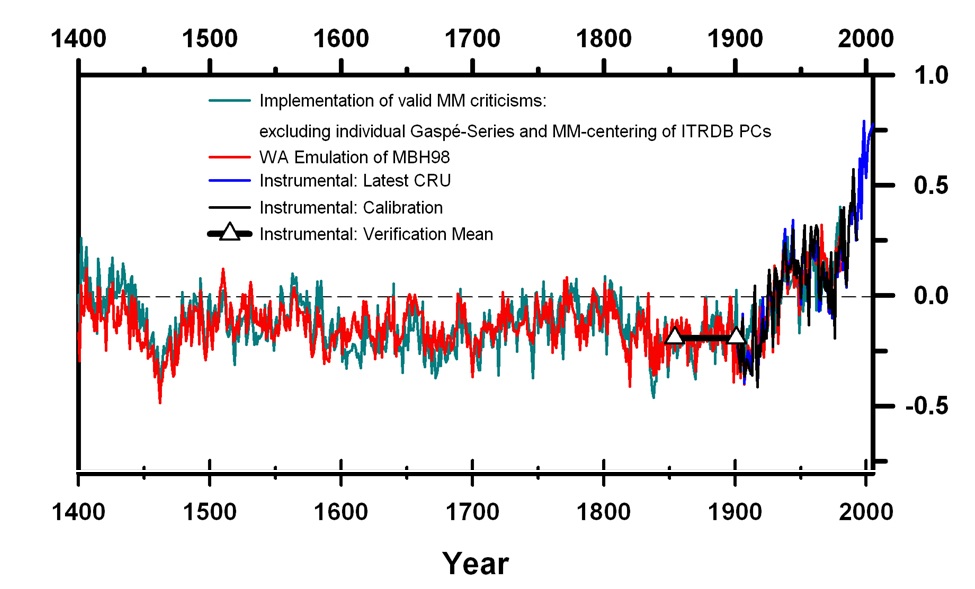
Red is the original MBH emulation and green is the calculation using centered PC analysis (and additionally removing one of the less well replicated tree ring series). (Calculations are from Wahl and Amman (2006), after their fig. 5d). Pretty much the same variability and the same 'hockey stick'. We'd be very surprised if anyone thought that this would have made any difference to either the conclusions or the subsequent use of the MBH results.
In fact, it's even more simple, Throw out that PC analysis step completely, what do you get?
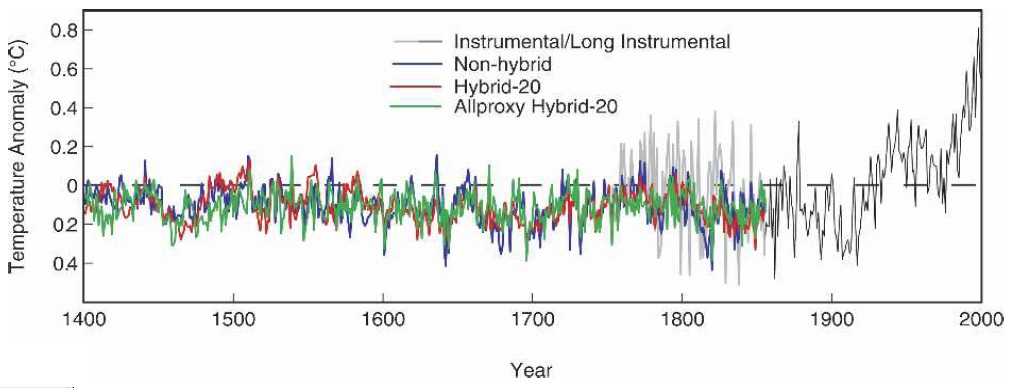
Again, red is the original MBH98 multiproxy+PC analysis, green is if the raw data are used directly (with no PC analysis at all). (This comes from Rutherford et al (2005) and uses a different methodology - RegEM - to calibrate paleoclimate proxy data against the modern instrumental record, but that doesn't make any difference for this point).
Why doesn't it make any difference? It's because the PC analysis was used to encapsulate all of the statistically relevant information in the N. American tree ring network and so whatever patterns are in there they will always influence the final reconstruction.
So what would have happened to the MBH results if Wegman and his colleagues had been consulted on PC centering conventions at the time? Absolutely nothing.
Can we all get on with something more interesting now?

19 July 2006 at 8:55 PM
Can we all get on with something more interesting now?
Sure, like when the United States will become one nation under science again?
19 July 2006 at 9:26 PM
Can we all get on with something more interesting now?
Yes, let’s examine the multitudinous alternative hypotheses and testable results by the handful of skeptical climate scientists out there.
All their results that explain the warming as natural. All their data. Let’s audit it.
Lets begin.
Any time now.
Discuss all the data they collected.
Anyone?
Hello?
Best,
D
19 July 2006 at 9:41 PM
I would appreciate it if you would post larger chart images, or link to larger versions.
These are unreadable. I cannot evaluate your point, therefore.
Thank you,
Joel
[Response:Sorry. Should be ok now. -gavin]
19 July 2006 at 9:41 PM
I’d like to put that on my resume, i.e. that I’m … “part of a tight-knit social network of climate scientists,”
… along with other things I’ve done: prairie landscaping, paleontology studies, parenting, hydrologic modeler, bird/butterfly watching, EX-river forecaster, environmentalist, troublemaker, …
19 July 2006 at 10:32 PM
Wegman et al did look at both MBH 98 and MBH 99. But I recall that MBH 99 specifically warned about added uncertainty going back beyond 1400 because of sparse data. That caveat is rarely mentioned.
A couple other minor observations: Wegman mentioned (offhandedly) something about CO2 sinking because it is heavier, and when asked if he thought GW was important, acknowledged that we had warmed about 2 degrees F since 1850 but offered that most people couldn’t notice the difference between 72 and 74 degrees. North responded well to both points.
19 July 2006 at 11:30 PM
From a political point of view it is extremely unfortunate, one might say pathetic, that with the signs of global warming all around us (e.g., persistent heat waves, melting polar ice caps, rapidly retreating glaciers, etc.) the Congress is still stuck debating the merits of the global warming science. Given the emergency we are facing as a species, we need to be on square #15: discussing how high should a carbon tax be, how to save the rainforest, how to save the oceans, how to get those SUVs off the road, what are the merits of geoengineering, how to ensure that people get the income they need in a low carbon economy, etc. The hearing amounted to Nero playing the violin while Rome burned. But the hearing was worse, because at least Nero did not play while humanity was the verge of extinction.
19 July 2006 at 11:30 PM
Here’s what Wegman said about CO2 density, I typed that as I heard it.
http://scienceblogs.com/intersection/2006/07/the_hockey_stick_debate_as_a_f.php#comment-173926
Didn’t North’s “Blockhead” method result — a chart simply averaging all the proxies without any treatment — also confirm the published pattern?
I didn’t manage to type any of that, but I remember he said they did that to find out which proxies contributed any odd bumps, and noticed that the Medieval period bump disappeared — because some areas of the world were warmer and others were colder during that period. He made the point that climatologists look at overall climate because CO2 is well mixed.
It was fascinating to hear the chairman reiterate he represents a coal mining state several times. Yo, voters!
19 July 2006 at 11:47 PM
Do you have any graphs showing the results of following the North et al NAS committee’s recommendations on proxies, such as not using bristlecones?
[Response: Read Wahl and Ammann (2006)… - gavin]
20 July 2006 at 12:25 AM
We all know it but are completely helpless to stop it. The AGW debate is being effectively swiftboated. Rep Barton can trot out endless rounds of these studies and people such as yourself can refute them until the cows come home but the fact remains that to the general public that knows anything about global warming, Hockey Stick = AGW. The main problem is that the contrary data does not have to be true. Lies and innuendo are good enough.
Refute the Hockey Stick and you refute AGW plain and simple in classic swiftboat style. I still maintian that nothing effective, trancending economic issues, will ever be done until/if something destructive and disasterous that is clearly and irrefutably linked to AGW occurs to the US or some other first world country. Until then nothing, other than the research that builds our knowledge, will be done while money is the primary focus.
BTW Nero did not poor accelerant on the flames of Rome while he fiddled so actually he is one up on us.
20 July 2006 at 12:43 AM
I had the impression the most interesting part of the MBH “hockey stick” was the part before the charts presented in this post - years 1000-1400. Does a version of these charts exist that shows the impact of fixing the centering and other issues on perception of the Medieval Warming Period?
[Response: I’ll try and find one… - gavin]
20 July 2006 at 12:58 AM
This is a quick thank-you note addressed to the RealClimate people for your efforts to dissiminate your knowledge to the wider public.
20 July 2006 at 1:02 AM
From Mr Wegman’s printed testimony:
“Because of this apparent isolation, we decided to attempt to understand the paleoclimate community by exploring the social network of authorships in temperature reconstruction.”
“Because of these close connections, independent studies may not be as independent as they might appear on the surface. Although we have no direct data on the functioning of peer review within the paleoclimate community, but with 35 years of experience with peer review in both journals as well as evaluation of research proposals, peer review may not have been as independent as would generally be desirable.”
“The MBH98/99 work has been sufficiently politicized that this community can hardly reassess their public positions without losing credibility.”
–Now here, we have genuine exhibits of bad methodology and unsupported conjecture.
Where did these non sequiturs come from, and who ordered them to be in there? In a report that begins by “circumscribing the substance” to “an independent verification by statisticians of the critiques of the statistical methodology…”?
Anyway, as it was foretold, here it is: Our lobbied House Representatives are going after an old study that is already superseded, and they are ignoring all the other data. You scientists are being slandered, dissed, and dismissed.
–Report by Lee A. Arnold, Society for the Long-Term Modeling of the Anti-Science Crooks in Congress, and Their “Social Network”
20 July 2006 at 5:01 AM
Re #1:
Do you know what happened last time, when a whole nation was put at sciences hands: Soviet Union.
It was one of the biggest social engineering projects available and brought great loss to all of the people living in it. The last thing I want is politics and science to merge, it would be disasterous for science and a new religion for politics.
Natural Science must be an open independent field to evaluate nature and not a thing to influence governments to base their policies on.
Instead, you should focus to persuade people to follow your belief of an environmental-friendly lifestyle. If you cannot, then perhaps your ideas aren’t so good as you thought.
For the rest, I have still to see a warming that is unprecedent. Why are there even different numbers for past data. A warming of 2C down to a warming of +0.24 °C per century. Which is true, the first or the latter? Why are there even such vague expressions on past warming?
20 July 2006 at 5:22 AM
I suggest petitioning Congress for a bill. Although tradition encrusts the Brits, their Parliament now allows journalists, to cope with global warming’s heat wave, attendance in shirtsleeves. Our 535 rule-makers, surely more forward-looking, ought to allow jpurnalists in the coming heat waves to appear bare-assed nekkid. Or how will one lighten up the fog-bank on the Potomac? John Quincy Adams regularly introduced a petiion to discuss slavery every session for years. Regularly the House tabled it. But the topic was by thius and other means kept alive. Congress’s refusal to discuss led to the ultimate violence. Belts of arable land will shrink. Either with forethought and discussion the world’s population will also shrink humanely or some very real nastiness and naughtiness will ensue in a generation or two.
20 July 2006 at 10:08 AM
The Center for American Progress has kicked off a campaign for American energy independence called Kick the Oil Habit. Find out more and take the pledge at www.KickTheOilHabit.org and watch Mark Pike and his buddies try to drive across the US using only ethanol - their video blog is available on You Tube. We need your help - you can make a difference - contribute to the collective genius (and bring a friend). Thanks!
20 July 2006 at 10:12 AM
Max,
You need to educate yourself in science. “I have still to see a warming that is unprecedent”? First, this sentence is grammatically incorrect. Second, what do you base your precedent on? Relying on your personal experience alone to evaluate nature is naive. I have relatives who smoked like a chimney and who lived to be 90 something, then died in a car accident. Does this discount medical findings that smoking causes lung cancer? And, by the way if you have yet to feel global warming, you haven’t been very observant. I am 37 years old and the winters I experienced in my childhood were far colder than those I’ve experienced in the last 10 years. And the death, en masse, of coral reefs from waters that are now TOO warm for them [which you can learn about from just watching TV] is again warming you can experience in your life time from just paying attention.
20 July 2006 at 10:19 AM
After reading about the methods for compositing proxy networks ad infinitum, the reader might be left with the impression that the compositing methods justify the result. However, one must be reminded that traditional dendroclimatology methods are not very good at all for reconstructing the magnitude of climate variation at the centennial time scale. In my opinion, what we need are more novel ways to develop (i.e., detrend, such as RCS methods) and interpret (i.e., what climate variables have the most functional relationship with growth?) tree-ring chronologies. Lets move the discussion from the uncertainity in compositing methods to the uncertainty in the underlying proxies.
20 July 2006 at 11:41 AM
Things may not be as grim as some of the above posts would indicate. Besides the oil and coal companies, there are other important financial interests in play on the issue of AGW. Business Week has had a number of articles in recent months on how the insurance industry and the electrical power industry have accepted the reality of global warming and are adjusting plans accordingly. I recall one report from a meeting of electrical power company executives in which they were virtually unanimous in their opintion that some form of carbon tax would be imposed within the next few years. They simply cannot afford to ignore the reality described by the data before them.
20 July 2006 at 12:07 PM
Does anybody know if there is a way to watch the hearing now that it is over? I know that they had a “webcast” up while it was going on and I had hoped they would have the full file online to watch once it was finished. However, this does not seem to be the case.
20 July 2006 at 12:49 PM
Re: #13: “Do you know what happened last time, when a whole nation was put at sciences hands: Soviet Union.
It was one of the biggest social engineering projects available and brought great loss to all of the people living in it. The last thing I want is politics and science to merge, it would be disasterous for science and a new religion for politics.”
Something I actually know of, because I obtained and published a document in 1991, originating from the Soviet Academy of Sciences, summarizing research carried out by that institution. The research was led by KGB Gen. Anatolii Kuntsevich. It described in general terms the profound damage to public health in the USSR caused by the use of chlor-organic compounds such as dioxins and furans. The document was signed by three notables, including the Chairman of the KGB, Kryuchkov. It was adddressed to Gorbachev.
If anyone here reads Russian and has access to a Slavic languages periodicals library see Nezavisimaya Gazeta for November 11, 1991.
The situation in the USSR was completely different from the one that obtains in the West, and yet strangely similar. The SU was run not by scientists but by the Central Committee of the CPSU, with a parallel power source in the KGB. The country was environmentally ravaged, since the Party was all-powerful and could do what it liked with the environment in most cases (there were exceptions, notably in the plan to divert the courses of Siberian rivers).
In the West we have representative government, not the dictatorship of one party, and yet the controlling group here is most certainly not scientists, as you’re finding out when you try to think up practical political strategies for stopping the onrush of climate change.
Do many scientists think that all that is necessary to change fundamental social and economic behavior is to present rational evidence and conclusions? Something more basic is required. The Montreal Protocol of 1987 suggests what that might be.
20 July 2006 at 1:19 PM
re 18. Ron wrote … They simply cannot afford to ignore the reality described by the data before them. …
Then I read:
—
“The four-day heat wave, caused by a high-pressure system to the south pumping in hot air from Mexico, resulted in heat advisories being posted in the South, Midwest and Northeast United States.
Record temperatures were also set in Stockton, California (110 degrees) and Salt Lake City, Utah (103 degrees).
“A heatwave like this usually comes about once a year,” said a spokesman for the National Weather Service. …
http://www.terradaily.com/reports/US_Simmers_As_Record_Temperatures_Reap_Transport_Chaos_999.html
—
Does anyone believe that a heatwave like this usually comes about once a year in the US, besides the spokesman for the National Weather Service?
20 July 2006 at 1:31 PM
Wegman’s Figure 4 appears to disagree with Wahl & Amman’s 5d, reproduced above, over the period from ~1800 on. Any speculation as to why? Presumably it involves non-exclusion of M&M criticisms deemed invalid, but which and why do they matter?
[Response: Wegman’s graph is mislabelled. It is PC1 of the N. American network, not the full MBH reconstruction. See here. - gavin]
[Response: Update: I should have been clearer. The figure is from the earlier posting and shows the PC1 (and PC4 with centered PCA). Actually, I should have linked to figure 4.3 in the full Wegman report which is correctly described. - gavin]
20 July 2006 at 1:46 PM
“…but still, the public recognition is nice.” Yeah!
In my college poli sci course the prof told us (re candidates): positive publicity is best; negative publicity, 2nd best; and no publicity, the worst.
So now that more people have been made aware of RC, let them come here & see for themselves, & come to their own intelligent conclusions about “is GW real.” Please leave contrarian biases and motives at the door for a brief moment.
20 July 2006 at 1:50 PM
Also, I say: Don’t miss the forest for the tree rings. It’s hot today!
20 July 2006 at 2:12 PM
22 — Wegman’s Figure 4 … is mislabelled. It is PC1 of the N. American network, not the full MBH reconstruction…
That’s a rather devastating mistake. I wonder if they’ll try to correct it.
20 July 2006 at 2:18 PM
“Response to #22: Wegman’s graph is mislabelled. It is PC1 of the N. American network, not the full MBH reconstruction. See here. - gavin”
would it be possible to ask that the testimony document be corrected ?
I can see this figure picked up by the “contrarians” and trotted out
as the definitive shoot-down of MBH98.
20 July 2006 at 3:25 PM
Re 1, 13, and 20, and the role of science and scientists in government policy.
Many of us who read this site would like scientists to have more influence on our government’s policies. We should recognize two things: 1) they don’t; 2) the very idea terrifies many people and clearly provokes all kinds of attacks. The Wegman hearings, even if you don’t see them as an attack, is clearly the vehicle of attacks, like the WSJ editorials that some Congressman read, so quickly, into the record.
So use the first fact to counter the second. Please. How does one scientific paper, actually just one graph from one paper, get to be the subject of a hearing in the United States Congress? Folks are afraid of Mann + MBH99 + IPCC + RC + its audience, that this “clique” is going to influence energy policy. They certainly haven’t yet. They won’t get close to influencing it, because they don’t have power. Congressman Barton does. The President of the United States and the United States Congress (and their social networks) do.
20 July 2006 at 4:02 PM
Re #22,
Gavin,
Wegman explicitely says for Fig 4.3 in his report that the graph showing the difference between decentered/centered methods is about the PC1 of the N.American network.
He also comments on the relevance of bristlecone pines in the N.American PC1, with and without the methodological differences, on page 81.
20 July 2006 at 4:36 PM
You’ve got to admire the power of the imagery in Figure 7 of Wegman’s testimony. Dr. Mann lurking menacingly like a spider at the heart of the web.
Do we know who proposed the idea of tacking the social network analysis to this investigation? The testimony is vague, only saying “we decided” to do it. It seems rather an odd thing to just independently decide to do, when your task is otherwise so carefully circumscribed (as noted, they abstained from examining what effect the PC centering changes would have had on the final reconstruction, presumably because they were not tasked to do that).
20 July 2006 at 4:53 PM
But I thought President Bush said we’d base policy on ’sound science.’
Or did he mean “sounds like science?”
Thanks for the site guys, it’s a great resource.
20 July 2006 at 5:18 PM
According to your policy here you do this: “The discussion here is restricted to scientific topics and will not get involved in any political or economic implications of the science.”
So why are there so many political and policy oriented statements and discussions going on here? One would think this to be a political blog, as most do.
[Response: We try to keep politics out of it, but we are not always successful… - gavin]
20 July 2006 at 5:40 PM
Re 29, from George Landis: ” . . . So why are there so many political and policy oriented statements and discussions going on here?”
A valid question, and as a faithful reader and sometime commenter I readily admit to writing on the politics and policy of climate. My excuse is that it is difficult not to when a piece of the science is investigated by two congressional committees.
But note that the eight contributors restrict themselves pretty well (I would say amazingly well) to questions of the science. It is commenters like me who can’t help edging into policy questions.
20 July 2006 at 6:06 PM
George Landis pondered: “So why are there so many political and policy oriented statements and discussions going on here? One would think this to be a political blog, as most do.”
Wealthy and powerful individuals and corporations who stand to become astronomically more wealthy and powerful from the use of fossil fuels — particularly in the “peak oil” era of increasing demand and declining supply — do not want humanity to reduce the use of fossil fuels in response to anthropogenic global warming, so they politicize the subject and attack the science, for example by recruiting United States Senators to proclaim that global warming is a “hoax” and recruiting United States Congressmen to attack the work of climate scientists.
Ideally, there would be nothing “political” about dealing with anthropogenic global warming, no more than there would be anything “political” about dealing with a large asteroid or comet heading directly for a collision with the Earth. But unfortunately those who seek to forestall any significant reduction in the use of fossil fuels, in the interest of their own enormous financial gain, have thoroughly politicized the issue, and made it difficult to discuss it without some reference to the hostile political environment that they have deliberately created around it.
20 July 2006 at 7:40 PM
Re:#33
Now that’s a nice science post!
20 July 2006 at 8:28 PM
Business is become the New Religion. And just as rational science once fell afoul of the Old Religion, so now. These modern hierophants simply will not abide discussion of their superior position as thought-leaders. But business was born in ancient times of rationalism, and science is its parent; I can’t see this “I Am The Word” posturing from Washington and General Motors to continue for very long. It’s just silly and thinking people will see that ere the end. Hopefully well before the entire Greenland ice sheet makes its way to the sea.
20 July 2006 at 10:02 PM
More ad hominem for the WSJ and Peggy Noonan. In her world it’s the scientists who are guilty of politics:
The Heat Is On
On global warming, the media’s continuing power, Ralph Reed–and revisiting last week’s column.
Thursday, July 20, 2006 12:01 a.m. EDT
During the past week’s heat wave–it hit 100 degrees in New York City Monday–I got thinking, again, of how sad and frustrating it is that the world’s greatest scientists cannot gather, discuss the question of global warming, pore over all the data from every angle, study meteorological patterns and temperature histories, and come to a believable conclusion on these questions: Is global warming real or not? If it is real, is it necessarily dangerous? What exactly are the dangers? Is global warming as dangerous as, say, global cooling would be? Are we better off with an Earth that is getting hotter or, what with the modern realities of heating homes and offices, and the world energy crisis, and the need to conserve, does global heating have, in fact, some potential side benefits, and can those benefits be broadened and deepened? Also, if global warning is real, what must–must–the inhabitants of the Earth do to meet its challenges? And then what should they do to meet them?
You would think the world’s greatest scientists could do this, in good faith and with complete honesty and a rigorous desire to discover the truth. And yet they can’t. Because science too, like other great institutions, is poisoned by politics. Scientists have ideologies. They are politicized.
All too many of them could be expected to enter this work not as seekers for truth but agents for a point of view who are eager to use whatever data can be agreed upon to buttress their point of view.
And so, in the end, every report from every group of scientists is treated as a political document. And no one knows what to believe. So no consensus on what to do can emerge.
If global warming is real, and if it is new, and if it is caused not by nature and her cycles but man and his rapacity, and if it in fact endangers mankind, scientists will probably one day blame The People for doing nothing.
But I think The People will have a greater claim to blame the scientists, for refusing to be honest, for operating in cliques and holding to ideologies. For failing to be trustworthy.
20 July 2006 at 11:38 PM
That’s a bunch of nonsense. The scientific community has come to a consensus, you just don’t want to believe it, so you and people on the right resort to making up garbage about how science has been taken over by politics, liberals, etc. The fault lies mainly with the people spreading disinformation, like republican politicians and the oil industry. However, it’s not the scientists’ fault if dumb people listen to the propaganda instead of investigating the facts. If you believe Rush Limbaugh over real scientists, it’s no one’s fault but your own.
21 July 2006 at 12:25 AM
Interesting timing. This has nothing to do with the cngressional hearings, but today I found out that a world-class, white, western geoscientist has decided to move to China, because it offers him less political interference, more reliable funding, and better instrumentation than working in the US, Europe, or Australia.
21 July 2006 at 2:10 AM
I always found that “Environmentalists/scientists are just a bunch of Communists” accusation highly amusing. My response is always: “Have you EVER seen pictures of Eastern Europe from when the Soviets [Communists] were in charge?”
Communism wasn’t based on science, it was based on “economic science” and very typical utopian political thought processes of the kind that has often led to political and social disasters. Without impugning the honor and valuable work of economists, equating the work of economists with “traditional” scientists is clearly a logical fallacy and a misplaced insult.
State of the art [18th century] theories in natural science, economic science and poltical science known to scientists and thinkers like Tom Jefferson and Ben Franklin were critical to the formulation of the US Constitution and helped guide early American principles of governance.
Scientists have been conducting their side of the debate using “the unwritten rules of scientific discussion and argument.” While there are skeptics who adhere to those rules of the “debate”, many others are conducting their side of the debate using “the unwritten rules of legal argument”. The purpose of scientific argument is to establish what is likely true. The purpose of legal argument is to establish who gets the money or power. In a legal debate, “truth” can be decided by a “vote”. In science, “truth” is always provisional. In legal debate, precendent is revered and protected where discovery of error is a matter of great shame. In a science debate, everything “known” is open for ridicule and actually showing previous belief to be erroneous is often greeted with laughter - as in “wow - we were STUPID to think THAT”.
So, for a Congressional Committee to use “legal” arguments to undermine a scientific finding is not really a surprise. And refuting “legal” arguments using the rules of scientific argument is time consuming, tedious and highly frustrating. That’s why maintaining “scientific” discipline in the face of such tactics is very important.
It also is important to focus the discussion into the REAL political realm. Legitimate political debate focuses on what policies will lead to “success” [as defined by the electorate]. Finding the right policy can be a challenging, highly complicated process even when everyone is playing on the same “team”. Policies that advance the long term goals of the electorate require “good” political, economic and natural scientific theory and information. The natural tendency in the face of uncertainty is to maintain the status quo or make simple tweaks. Forging a consensus for a radical departure in policy based on complicated theory and data is hard, slow work especially when the costs and consequences are seemingly or actually high.
21 July 2006 at 7:04 AM
re 37.
Mark,
I was warned by my supervisors and directors for National Weather Service (NWS) that climate change science was too political, liberal, etc. Maybe attitudes toward research on climate change and hydrologic modeling changed after I left the NWS North Center River Forecast Center in 2005. I don’t know anyone close enough in NWS anymore to talk to in order to find that out. While I worked there, no one would say anything about climate change or global warming. I couldn’t help speaking up about how climate change affects hydrology so they got rid of me. It was not just my supervisor and NWS directors that wanted me out, as I was told later by my supervisor, but also John Mahoney, a NOAA administrator and head of the US Climate Change Science Program.
My supervisor carried that out in July, 2005. As I see things now, the reason for an absence of will by the public to slow greenhouse gas emissions lies with government officials allowing disinformation on global warming to continue to be accepted by the public. Agencies in the US have failed in seeing to it that accurate information and education on global warming reaches the public. Otherwise it would have been well known by the public that the scientific community reached consensus on global warming many years ago.
21 July 2006 at 9:59 AM
The last line of the Wegman report caught my eye. I quote it below in full:
“The most conclusive finding is that the 20th century is the most anomalous interval in the entire period of analysis, including significant positive extremes in the proxy records.”
I’m just joe public but I’d interpret that as meaning:
More ‘anomolous’ [Deviating from the normal or common order, form, or rule] than the ’significant positive extremes in the proxy records’ [i.e. the medieval warming period and Little Ice Age period].
My reading of that is the Wegman report is saying:
a) There is Climate Change/warming
b) It is more significant than the other unusually significant periods of climate change that we have seen before, in the past thousand years.
If anything, I see that line as backing the central notion of the Mann report.
[Response: Wegman is just paraphrasing Osborn and Briffa (2006) (which we discussed http://www.realclimate.org/index.php/archives/2006/02/a-new-take-on-an-old-millennium/ ) - gavin]
21 July 2006 at 10:52 AM
I notice in the press today that a new congressional hearing by another House Committee (Mr. Davis’)is happening next week. It also quoted one of the invitee scientists as saying that today is 8-10 degrees warmer than 1000s of years ago. I cannot see that in even Mann’s extreme scenarios, anyone know what that is about?
http://news.yahoo.com/s/ap/20060720/ap_on_sc/congress_global_warming_3
[Response: That happened yesterday, and the 8 to 10 degrees (F) remark was in relation to the ice ages (20,000 years ago) - which is an interesting number of course - but not relevant to the temperature reconstructions of the last millennium. - gavin]
21 July 2006 at 11:47 AM
OK, thanks, I thought perhaps Jim Hansen made that comment, since he used to think extreme climate scenarios are useful in provoking political action.
[Response: No he didn’t. I suggest you actually read Hansen’s actual remarks, rather than someone else’s partisan pseudo-interpretation: http://www.columbia.edu/~jeh1/hansen_timebomb.pdf - gavin]
21 July 2006 at 12:33 PM
Can someone give me link to some theories as to what was happening in the tropics during the glacial epochs. (Either here at RC or elsewhere) Thanks!
21 July 2006 at 12:44 PM
re: 42
I can almost bet you that “8-10 degrees 20,000 years ago” was a result of pulling an alarm point from the Discovery Channel show “Global Warming all you need to Know” which aired Monday. Right in the first segment of that show there was a cynical moment. As an illustration of the ‘terrible melting’ now taking place, the speaker was standing in melt water of a glacier. He said “things are a LOT warmer here than they were 20,000 years ago.” No context was supplied! I screamed at the TV: “Yes, the Earth was in full glaciation then; this is the interglacial!” That was a dishonest moment for that show.
21 July 2006 at 1:02 PM
RE #36
Mark, I assume your post is a quote of Peggy Noonan, right? In any case, I cannot tell you how sad it makes me. It illustrates perfectly the chasm of world view between the scientific community and today’s political conservatives. It calls to mind John Deanâ??s quote of Barry Goldwater from a conversation they had in 1994. Goldwater asked, “John, where in the h**l is the conservative movement headed in this country?” Dean replied, “Barry, I don’t know, but I’m going to try and find out.” The result was Dean’s recent book, “Conservatives Without Conscience.” (Having been a Goldwater precinct captain in 1964, I sympathize with his question.)
First, ask yourself why someone would become a scientist. Is it because of a lust for power? For money? Nonsense! For most, it is because of a deep curiosity about some aspect of the world and how it works. They are driven by the need to understand and explain things. Getting to that point requires intellectual discipline to master their field and to avoid having their work distorted by personal bias. But personal discipline alone won’t suffice, so a second level of discipline is imposed by peer review. If you have an idea or have achieved some result, you have to write it up in the most rigorous way you can, then submit it for publication. If it passes the initial screening and is published, then hundreds of highly competent people in your field will go through it carefully, trying to pick it apart, to find where you may have erred. To be effective at all in science requires both intelligence and intellectual honesty in seeking a description of provisional truth.
By contrast, political conservatives represented by Imhof, Barton, Noonan, Limbaugh, et al, see the world entirely through ideological lenses, with power and money as dominant core values. So when an idea or a scientific result surfaces that is in conflict with their ideological goals, they assume it must have emerged from a conflicting ideology, i.e., “liberalism!” They cannot comprehend the possibility of non-ideological, objective truth (albeit, for the scientist, provisional.) Everything is reduced to politics and “inconvenient truths”, whatever their merits, are countered by political attack. What better illustration than the attempt to blame the whole AGW issue on a “small, in-bred group of paleo-climatologists.” The scientific consensus, of course, extends vastly further than paleo-climatologists, even if the description were accurate.
Global warming will continue its relentless march, so eventually the chasm of understanding will be bridged, perhaps by the business community, which cannot base its decisions on ideology.
21 July 2006 at 1:26 PM
Re #31, AGW by definition includes a human element, which brings in the need for human scientific inquiry (both on the cause & effect side). I know the social/behavioral sciences are not as scientifically “hard” as the physical sciences, mainly because people/societies/cultures are a lot more complex & there’s this self-reflexivity about them (sort of like an endless hall of mirrors).
So, that means that perspectives from poli sci, econ, sociol, anthro, psych should all be considered when studying AGW holistically. And I think you could bring in the humanities, since AGW is also a moral issue.
Many who contribute to this site (such as myself) are not physical scientists, though we want to learn more about the physical science side of AGW. We can only offer other comments & ideas, and for the most part these are not even rigorously within the human sciences domain either. So, just take them as hypotheses. RC & scientists did not bring politics into AGW — AGW is political/economic/cultural/social/psychological, as well as physical, by its very nature.
The issue of AGW is important enough that we must thrash it around and hammer out ideas about it, no matter how “unscientific” they may seem. We need to grasp AGW at a level that includes, but goes beyond the physical sciences.
As for the above critiques on “communism,” I would add that the Marxian conflict or critical perspective in the social sciences asks, “Who benefits?” I personally don’t follow that perspective because it is economic (social) deterministic. But the question is a good one to keep in mind.
BTW, I personally find fault with both communism & capitalism — both of which are concomitants of industrialization. We need to move on to a better world for all. By refusing to address & solve AGW we are not only risking our material support system, but political & economic freedoms & stability, as well. Think of solutions (such as the idea in the UK of carbon rationing — see http://www.marklynas.org/wind/message/3236.html ) as innoculations against possible social chaos and material degradation.
21 July 2006 at 2:13 PM
Good hypothesis, Ron (#45). It’s important to understand mindsets, as well as motivations (for one, because mindsets can even block people’s realization of their ultimate goals). You are right. People do have a tendency to think in binary oppositions (check out Levi-Strauss’s structuralism), which can help us think, but also can obfusticate deeper, more complex thinking & knowledge.
That’s why I would suggest keeping the mind as open as possible. So I tend to fall back on: supposing the scientists are right & we do address AGW (or fail to address it). Supposing the denialists are right and we do address AGW (or fail to address it). Since my own experience has been economic improvement through efficiency & conservation (with an increased standard of living), I would say, even if the denialists are right, we should act as if they are not & address AGW. And in so doing ameliorate many other problems.
Unfortunately, it seems economists are dead wrong — there are no soley economically motivated, rational, Spock-like people to heed this message. There’s other stuff going on in our psyches - like these limiting mindsets, and tangled up motivations & (who knows) subconscious horror stories.
21 July 2006 at 2:22 PM
Year by year we are marching forward onto ‘thin ice’ while the politicians protect their special interests. The endless debating of Global Warming (GW) or not will put us in a position where we have passed the point of no return. When the Arctic Tundra Methane stock releases reach a high rate, it will probably precede Ocean releases of Methane by a few years. When the oceans warming trend continues to the point the vast deposits of Methane Ice stored in the cold waters reverts to gas, we will see a REAL spike in GW and as the saying goes, “Games over over Man”.
21 July 2006 at 2:44 PM
Re 45
John, I found the comment to be more stupid than dishonest. Whether it is warmer today than 20,000 years ago is really irrelevant. I took it to be a minor glitch that should have been caught in editing. Overall, I thought the program was good.
21 July 2006 at 4:20 PM
Once again, Lynn V. has a wonderful insight (# 47, # 48). Yes, RC is a science site, but the “A” in “AGW” does indeed stand for anthroprogenic. So while RC focuses appropriately on the the physical science of climate, the sciences of people attitudes, motivations, and behavior are not only important, but necessary if we want to change course.
I will never tire of Lynn reminding us that rather than imposing cost or hardship, conservation and efficiency actually make you wealthier. But I must admit that my favorite post from Lynn, in replying to Crichton’s book, was that we should move to clean energy out of a “STATE OF LOVE”.
21 July 2006 at 4:58 PM
Re: 13 & 39
The old Soviet Union was an ideological state that filtered and twisted science to support it’s idealogy (q.v. Lysenko). In that regard it was remarkably similar to the present US.
21 July 2006 at 7:08 PM
James (#49): have you considered the increase in OH in your scenario? http://www.igac.noaa.gov/newsletter/21/oh_modeling.php
Also, can you provide links on the amount of methane, rate of release, and change in rate of release? Thanks.
21 July 2006 at 10:53 PM
Re#44 Here are some references (abstracts are, I think, available for free at the Science web site (www.sciencemag.org):
Tropical Climate at the Last Glacial Maximum Inferred from Glacier Mass-Balance Modeling
Steven W. Hostetler and Peter U. Clark
Science 1 December 2000 290: 1747-1750
Early Local Last Glacial Maximum in the Tropical Andes
Jacqueline A. Smith, Geoffrey O. Seltzer, Daniel L. Farber, Donald T. Rodbell, and Robert C. Finkel
Science 29 April 2005 308: 678-681
Near-Synchronous Interhemispheric Termination of the Last Glacial Maximum in Mid-Latitudes
Joerg M. Schaefer, George H. Denton, David J. A. Barrell, Susan Ivy-Ochs, Peter W. Kubik, Bjorn G. Andersen, Fred M. Phillips, Thomas V. Lowell, and Christian Schlüchter
Science 9 June 2006 312: 1510-1513
Early Warming of Tropical South America at the Last Glacial-Interglacial Transition
G. O. Seltzer, D. T. Rodbell, P. A. Baker, S. C. Fritz, P. M. Tapia, H. D. Rowe, and R. B. Dunbar
Science 31 May 2002 296: 1685-1686
The Role of Ocean-Atmosphere Interactions in Tropical Cooling During the Last Glacial Maximum
Andrew B. G. Bush and S. George H. Philander
Science 27 February 1998 279: 1341-1344
Rapid Changes in the Hydrologic Cycle of the Tropical Atlantic During the Last Glacial
Larry C. Peterson, Gerald H. Haug, Konrad A. Hughen, and Ursula Röhl
Science 8 December 2000 290: 1947-1951
22 July 2006 at 12:40 AM
From 2002 until this year, NASAâ??s mission statement, prominently featured in its budget and planning documents, read: â??To understand and protect our home planet; to explore the universe and search for life; to inspire the next generation of explorers … as only NASA can.â??
In early February, the statement was quietly altered, with the phrase â??to understand and protect our home planetâ?? deleted. In this yearâ??s budget and planning documents, the agencyâ??s mission is â??to pioneer the future in space exploration, scientific discovery and aeronautics research.â??
http://www.nytimes.com/2006/07/22/science/22nasa.html?ei=5094&en=7a71420a9103fea3&hp=&ex=1153627200&adxnnl=1&partner=homepage&adxnnlx=1153543120-I5g0T4aFitiKrXZazUNXdw
I have a hard time having any hope. Sorry that this is off topic.
22 July 2006 at 1:43 AM
This is somewhat interesting regarding Sen. Inhofe basically refuting all of global warming and saying that Al Gore is “full of crap”.
http://thinkprogress.org/2006/07/21/inhofe-gore/
This guy needs to stick to politics and let the scientists sort it out. His whole idea of the medieval warm period being warmer than now.. hasn’t that been totally refuted???
22 July 2006 at 2:18 AM
No he didn’t. I suggest you actually read Hansen’s actual remarks, rather than someone else’s partisan pseudo-interpretation
Hansen’s measured remarks are actually encouraging reading. Thanks. I expected his words — given his notorious remarks about sea level change — to have had a Chicken Little tone. Instead, he made the prospect of curtailing disaster seem not only possible but likely.
22 July 2006 at 4:48 AM
I was thinking that people focus too much on what will happen to the climate, plants and wild life and that this is not the right approach. No politician or CEO that take themselves seriously will pay attention to that. Maybe someone should rather focus on financial impacts of climate change. That might make a difference.
22 July 2006 at 5:53 AM
So, I have to ask: when we have two seemingly reputable scientists who disagree, how do we know who’s right?
http://www.opinionjournal.com/extra/?id=110008220
This guy has been writing for WSJ, once a month or so, trying to discredit Global Warming. Since he’s a Professor of Atmospheric Sciences at MIT, people tend not to believe me, when I tell them he doesn’t know what he’s talking about.
[Response: Ah, but he does know what he’s talking about. It’s just that he uses his knowledge to confuse rather than enlighten. You have to parse what he writes very carefully to see how he gives the impression of saying something without actually saying it. If it was just one scientist versus another, then your friends would be right - you wouldn’t be able to work out who was right. However, it’s more like all the other scientists against one, and then, it’s much clearer where ‘truth’ is likely to be. So point to statements by the National Academies of all G8 countries, point to the NAS 2001 report - on which Lindzen was an author, point to the IPCC - possibly the most well reviewed scientific document in history, and point to critiques of Lindzen’s statements here and elsewhere to see if they really stand up to scrutiny. -gavin]
22 July 2006 at 6:45 AM
In respect to cp’s comment in #58, it might help to clarify thinking a little if we withdrew ourselves a bit and looked upon our ilk as a natural process which as been continuing for 200 thousand years. Within that stream, knowing and planning by talking are natural processes needed for that essential natural process, eating. To take one more step in the natural process of walking into the next instant, the natural process of believing or trusting contributes. Some will believe that 535 rule-makers can make plans for the planet. Some will not and will seek out ways of rule-making in which they can believe more. There is no use, I believe, in not being very cautious in thinking, talking and doing.
22 July 2006 at 11:00 AM
Re: 45, John, there were lots of hyperbolic and fearmongering moments in the Disovery Channel show. Hansen had his share of hyperbole: “99.9% of scientists say that we basically understand what is going on, - the science is overwhelming” Right after that, the show discusses the Hadley model, with animated natural and anthropogenic lines progressing across a time chart, and the anthro rising with the temperature and the natural not as much. IPCC diagnostic studies document lots of errors in the models, one of them, Roesch (2006) shows that model to have a globally averaged, annual positive surface albedo bias, note this is a bias against natural solar forcing.
Eyeballing the chart (at 800% zoom), it looks like the UKMO-HadCM3 has a surface albedo for the period studied of 0.132. This is better than the all models average of 0.14, but still significantly higher that the satelite observations of 0.124 and 0.121. Apply surface solar fluxes to the errors of 0.008-0.011, we get globally averaged flux errors 1.33-1.8W/m^2. This is larger than the current globally averaged flux into the ocean for even the warmest recent years. (less that 1W/m^2 per Hansen)
Do you really think 99.9% of scientists, or Hansen for that matter, thinks that in the nonlinear climate system, we can accurately attribute a net flux into the oceans of less than 1 W/m^2 with an error in a key relevant component larger than that? Presumably, in order to attribute, this figure between natural (most likely solar) and anthropogenic, even qualitatively, we would like to accuracy to be at least with 0.1 to 0.15 W/m^2. We are an order of magnitude away from that, even with a better than average model.
Note, both figures are fluxes at the surface. The Roesch paper was also discussed in this other thread. http://www.realclimate.org/index.php/archives/2006/07/the-discovery-of-global-warming-update/#comment-15709
Without premature use of models not yet ready for meaningful attibutions studes, the hockeystick is just as supportive of natural warming due to historically high levels of solar activity, as it is of anthropogenic warming. With solar attribution, the likelyhood based on both the solar conveyor theory, and Solanki’s study of the paleo records, that the solar activity will lessen in the first half of this century.
Roesch (2006) http://www-pcmdi.llnl.gov/ipcc/abstract.php?ipcc_publication_id=36
22 July 2006 at 11:10 AM
I have always found Dr. Lindzen’s critiques and analysis to be very objective and thought provoking, unlike Dr. Hansen’s or Dr. Pilke’s etc. I hope some of you actually read the Wall Street Journal, Ms. Oreskes had a letter to the editor today railing about Lindzen in a “how dare he question my work” type attitude. After all, she says, my work was peer reviewed in “Science” the leading peer reviewed science journal in the U.S. (and as we all know selects articles for sales value like Newsweek and brought us the famous Korean stem cell fraud scandal, which was also peer reviewed).
She also identified herself as an “historian”, I think some thought her to be a scientist due to her background, but she has given that up it seems. She violates one of the cardinal rules of the scientific method (objectivity towards the outcome of an hypothesis), by stating that she never said the science was settled in her study, but then goes on at the end of the letter to challenge the business community to take action immediately to stop it. Very odd for a scientist, but understandable for an historian, who needs very little other than their own opinions to determine proof and fact.
And BTW, I did read that Hansen said that, it is here:
http://www.sciam.com/media/pdf/hansen.pdf
Look near the top of page 30, I can’t understand why people try to deny he said it, or maybe I can, given the politics of this issue.
[Response: Just a problem of your reading comprehension then… And your characterisation of the Oreskes study is way off base. She asked the question whether there was evidence in the published literature for the existence of a scientific consensus, and in taking a reasonably large sample and not being able to find a single contrary peer reviewed article, she correctly deduced that there can’t be much of a ‘contrary’ literature. No surprise there. - gavin]
22 July 2006 at 12:25 PM
RE# 51
I too enjoy, at times, the wisdom of Lynn. And, I too struggle to conserve my energy use and practice other eco-habits out of a spirit of love.
But, the modern American lifestyle and a warmer climate are not helping me save energy. My home has been invaded by blinking green lights my teenage son and we have purchased along with electric stuff. Maybe 7 percent of our electric bill goes into standby power and some of that power demand (air conditioner) is inelastic, at least by the rules my family has set down.
Cutting energy consumption, in much of America, is not an end in itself and we all must understand that fact.
Electric current is not the problem. It is how that current is generated that we have to keep clearly in focus.
I live in Northern Virginia and my electricity is delivered by a Virginia power company but only through its wires. The actual kilowatts come from any plant in what is called the PJM or the Pennsylvania-Jersey-Maryland Interconnect, the power control area for 51 million people in 13 states and the District of Columbia.
The electricity essentially is dispatched from PJM regardless of the state in which it was generated. PJM insures that there is enough power to meet expected customer electricity demand at all times plus an additional reserve margin above the peak demand is ready and deliverable in the control area.
PJM determines the power demand for the next day and invites power stations to bid electricity at a price to serve that demand. The lowest bids get invited into the power grid first then more expensive power is committed until the projected demand is covered by power generators now contractually obligated to feed electricity into the grid.
How does PJM dispatch electricity over the day?
Conventional nuclear or fossil fuel power plants are called on first because of their relative low cost to operate and ability to deliver power into the grid at all times and are called base load plants. Others plants operate as “spinning” reserves waiting to be called on by PJM as the load increases during the day. They are backed off as the load decreases at the end of the day. Most natural gas combined cycle plants operate in this manner because they have higher operating costs and can deliver energy quicker when called on by PJM. PJM insures the lowest cost electricity is dispatched first, insures the reliability of the electric grid and monitors the market to prevent market powers/manipulation.
On July 17, PJM customers set an official record for peak electricity use of 139,746 megawatts (one megawatt of electricity is enough to power 800 to 1,000 homes). Since PJM territory partners have about 165, 000 megawatts of power generating capacity on hand, PJM had no difficulty meeting the demand. So, PJM used 85 percent of its generating capacity in a market territory expanding in population and experiencing longer, hotter summers.
If every PJM customer used 10 or 20 percent less energy, the same mix of power plants would still be put into service and those are primarily nuclear and coal plants and some hydro. Natural gas plants would be used if needed but their higher fuel costs would push up the floor price of electricity for that day. Wind would have the chance to bid its services as would solar (at least when the sun shines).
The PJM Interconnection is not unique. Electricity deregulation caused the formation of other independent system operators (ISO) that pool generation and dispatch lowest cost power to their territory customers. New England, New York, California and the Midwest also operate under ISO control.
Yes to electricity and petroleum conservation. But, there is a lot more behind that golden door than the public is aware and policy makers are willing to sort out.
Nuclear and coal plants are the machines that drive the American economy — like it or not. As coal and nuclear plants age, — and believe it, a huge number are already past normal retirement age - they will not easily be replaced by cleaner, lower CO2-emitting plants because that fuel is becoming scarce (unless you like the idea of importing liquid natural gas from Algerian ports). New coal plant plans and construction are now the first option of the power industry.
Wow, we are failing our children; all of whom we profess to LOVE.
22 July 2006 at 1:31 PM
RE: 50 Ron Taylor,
I am not anwhere so forgiving. If it was a glitch, then it is utter incompetence. And if the point itself was “irrelevant” as you claim, why have that person tromping through the ice melt to make that comment as the lead ‘fact’ of the show??
I doubt it was a glitch. It is a piece of misinformation scripted and left in the final cut, and it gives Brokaw plausable deniability; after all it is TRUE that things were a lot colder 20,000 years ago! But the impression left behind is that ‘there is something VERY wrong, things should not be melting like this.’
Remember, this is a “consumer level” show on Discovery; it moves very fast, and all the “average person” gets from that moment, right at the top of the show, is that ‘the ice is melting all around me and the water is raising the sea and it was a lot colder up here just a little while ago.”
I have at least 10 other points in that show that made me snarl, I just don’t have time to address them now. I taped the show and will parse later.
Sorry to be off-topic a little, but all back and forth on AGW, including the Wegman hearing and the upcoming IPCC report are ‘of a piece’, no?
22 July 2006 at 1:40 PM
If you pull an ostriches head out of the sand, will it attack you?
22 July 2006 at 1:51 PM
RE: 61 Martin Lewitt
“the Hadley model, with animated natural and anthropogenic lines progressing across a time chart, and the anthro rising with the temperature and the natural not as much.”
You’ve pointed to the one item that got my attention as potentially significant. If that thing is actually fair, then it is persuasive for AGW. As part of the ‘loyal opposition’ to the AGW consensus, but not as knowledgeable as you obviously are, I need to pursue the validity of that “divergence” graph. I have a tape of the show; I have not been to the Discovery Channel website to see if the chart and its animation and data/basis are there.
You’ve provided an excellent critical contention against it with your incisive objection and supporting links…so thank you. I’ll go down that street.
22 July 2006 at 2:20 PM
>43, 62, George Landis
Read this, from Hansen. I agree you haven’t understood it. He wrote there:
“Summary opinion re scenarios. Emphasis on extreme scenarios may have been appropriate at one time, when the public and decision-makers were relatively unaware of the global warming issue, and energy sources such as â��synfuelsâ��, shale oil and tar sands were receiving strong consideration.”
Now, read this page I’ve excerpted below (or at least read the snippet I copied here for you) — please. The scenarios were from the energy industry and government — assuming using all the coal, synfuels, shale oil and tar sands. Hansen calls them ‘extreme’ — he didn’t originate the assumptions, he started working out what could happen if that much fossil fuel was burned up in the last few decades. That was when he and other people first started looking at the consequences. The consequences were, yes, extreme.
Gavin means, I think, that comprehension requires context. You need to know, or find out, what Hansen’s talking about to know what he meant.
I used Google, looked for information about, in Hansen’s words, a “time, when … energy sources such as ’synfuels’, shale oil and tar sands were receiving strong consideration” and I found: Results …about 295 for energy projection synfuel tar
This all may be from years before you were born; we can’t assume you know the context. We can try to help you look it up.
Here’s just one example from 1982 — back when energy use was predicted to go up, and up, and up, as Hansen describes:
http://sedac.ciesin.columbia.edu/mva/ERMUM/ERMINTRO.html
“One of the major issues in long-term energy analysis is the magnitude of energy supply. The model has two classes of energy supply …. The second class, which includes unconventional oil, unconventional gas, coal, … is considered resource unconstrained. That is, the amount of the resource, relative to potential demand is sufficiently large that for practical purposes, resource size alone does not constrain the rate of production.
“….
“Shale oil and tar sands.
“… unconventional sources of oil. There is far less controversy surrounding resource estimates for shale oil and tar sands. These sources are known to be in massive global supply. … in a full accounting of energy demand.”
I hope this is helpful. You can ask your school librarian or public library reference desk for help locating more of the relevant energy predictions from the 1950s, 1960s and 1970s — before 300 baud modems — mostly only available in paper form. There are reference indexes for books and magazines at the library.
Don’t give up. You can understand this stuff, in context, by looking for it.
22 July 2006 at 2:28 PM
“scientific community has come to a consensus, you just don’t want to believe it”
I should have put the clip in quotes. That was Noonan speaking after my intro. She can’t handle the truth and clearly doesn’t know what the story is.
22 July 2006 at 2:46 PM
RE # 63 -
John McCormick gives a good quick overview of how electricity gets to all our computers (and AC, lights, etc). It’s also a great place to show how well efficiency and renewables can help. Start with the 7 percent of his bill going to standby. Cutting that in half in all PJM’s 51 million customers cuts baseload by more than 4,000 megawatts (MW). That’s about 4 large (1,000 MW) power plants. Energy efficiency technology has improved in all the big use categories: lighting, refrigeration, and air conditioning, but implementation lags. Simple insulation alone reduces energy demand in summer and winter, plus it makes us more comfortable.
Solar is intermittent, but it supplies power when demand is highest, a perfect fit. This reduces the need for those expensive peaking plants, and the gas that they burn.
The choices are ours to make. They are individual choices, but good policy can steer us to better choices, through efficiency R&D, information, standards, and (dare I say it) tax policy.
And if you think it’s just me, (and Lynn, and Amory Lovins at RMI, etc) talking efficiency, read this testimony by a Walmart executive in those other House hearings on Thursday:
http://reform.house.gov/UploadedFiles/Wal-Mart%20-%20Rubens%20Testimony.pdf
Walmart’s goals include:
To be supplied by 100 percent by renewable energy.
To create zero waste.
Walmart!
22 July 2006 at 2:54 PM
Re 61: Martin. A common misconception is that a climate model must confidently generate the energy balance of the earth to within 1 W/m2 before we can even begin to use it to discuss the sensitivity of the climate to a perturbation of 1 W/m2 in the forcing. Suppose that we are interested in the response to a perturbation of 0.1 W/m2; do we need a model with this level of accuracy in its energy fluxes before we can trust the model? Or 0.01 W/m2? Where does this end? It might have occured to you that scientists who use models in discussions of climate sensitivity must have thought about and rejected precisely the idea upon which your comment is based. Why do we reject this argument?
Sometimes an equation is worth a thousand words:
S(1-a) = A + BT.
The left hand side is the absorbed solar flux and the right hand side the outgoing infrared flux. S is the incident solar flux averaged over the Earth, a is the planetary albedo, T is the temperature, while A and B are constants obtained by linearizing the infrared flux’s dependence on temperature. Increasing carbon dioxide increases A; water vapor feedback decreases B, etc. The sensitivity of T to a perturbation dS in the solar flux S is dT = (dS)(1-a)/B. If the albedo is actually a + da, then the sensitivity is instead dT =(dS)(1- a - da)/B. This is a small difference in sensitivity if the albedo error is relatively small, even though the sensitivity of T itself to the error da, which is -(da)S/B, might be comparable to the temperature change (dS)(1-a)/B that one is interested in! I hope this makes sense to you. This linear equation may seem naive, but it is not a good idea to worry about nonlinearity until one has a good grasp of this simplest linear energy balance perspective.
As a secondary comment on your remarks, you quote numbers that evidently refer to surface albedos, but it is the planetary albedo, not the surface albedo, that is most closely related to climate sensitivity (see Ray’s Nov 2005 piece: A busy week for water vapor). A model that has too large a planetary albedo will have a surface that is too cold on average (holding everything else fixed) even if it has too small a surface albedo.
22 July 2006 at 5:49 PM
Re: 71, Isaac, I wasn’t talking about sensitivity, other than to point out that the positive albedo biases of the AR4 models reduces their sensitivity to solar.
A model, however, does need to balance the energy budget to less than 1W/m^2 to get the climate commitment right, in a climate such as ours where the net heat flux into the oceans is also less than 1W/m^2. A model that is throwing away over 1W/m^2 of solar via globally averaged annual albedo bias at the surface, and yet still “correctly” balances the energy budget, reproduces the temperatures well, demostrates a realistic level of unrealized climate commitment, must be making compensating errors elsewhere. You are right, that the compensating error may be in the planetary albedo. But the compensating errors may be in other feedback mechanisms or forcings, or given the variance in model sensitivities to CO2, it is likely to be in increased sensitivity to CO2 in at least some of the models.
In a non-linear system, it would be surprising if the compensating errors, left the model in a state useful for attribution, climate commitment or credible predictions.
22 July 2006 at 6:29 PM
>43, 62, 68
Oh. You don’t have a problem with reading comprehension, you have bunk sources
.
I notice belatedly that ’s one of Inhofe attack PR pieces, debunked at Scientific American:
http://blog.sciam.com/index.php?title=half_baked_smears_against_climatologists&more=1&c=1&tb=1&pb=1
“Incorporating a strategy hatched by the committee’s new communications director, Marc Morano” — formerly with Rush Limbaugh, an early Swift Boat propagandizer, who sent them the press release personally. Proud of himself.:
http://blog.sciam.com/index.php?title=senator_inhofe_s_pet_weasel&more=1&c=1&tb=1&pb=1
22 July 2006 at 7:29 PM
RE #70
Mark, I am heartened by your optimism.
I want to reiterate the central point in #63. Granted, not all US electric customers are dependant upon a conglomorate of electric power generators to supply power to blinking green lighted electronic stuff. But, Northern Virginians are locked into receiving the cheapest power available to our centrally dispached power control system; the PJM (see #63 for explanation of PJM).
When I am forced to go deeper in debt (and sooner than I can really afford) to replace my leaking electric water heater it will be the most efficient available. Good news. It will also be powered by the cheapest kilowatt-hour of electricity the PJM can make available to my local power distributor. That means my efficient water heater will very likely be using a majority of electricity produced in coal-burning power plants. Bad news.
That is the dark side of electricity deregulation.
The electric utility commission, in states that deregulated electricity, has little to no power to command what plants will be built where. Those non-utility plants are electron factories owned by investors, i.e., stock holders.
Electric utility deregulation is the deep pot hole Amory Lovins and others have yet to map a detour around. Some electric distributors offer packages of renewable energy to eco-conscious customers. The reality of that green option is that the power came from whatever sent that electron into the wires.
If I wanted only solar power 24/7, my night time reading would be done under an oil lamp.
Please excuse the details. Nothing in life is perfect. Why did we expect utility deregulation would open the gates for renewable energy?
Dereg put a premium on the lowest cost kiowatt-hour of electric power.
And, that is making electric power conservation a difficult investment for homeowners and apartment managers who would do it for climate change reasons. Their capital investment would not shut down that low cost coal plant.
22 July 2006 at 7:56 PM
Re #64
John, I agree that Brokaw’s statement about Patagonia being much warmer than 20,000 years ago was misinformation. It does not even come close to describing the seriousness of the situation. Try this Science Daily report from NASA-JPL for a much fuller picture.
http://www.sciencedaily.com/releases/2003/10/031017074133.htm
22 July 2006 at 11:42 PM
The statistical arguments against MBH98 have never been convincing. What matters is the amount of variance explained (or how many PCs are significant), not how the shape of the first PC will change by centering. This discussed elsewhere on this site, the data are freely available…
It is therefore unbelievable how much airtime the “controversy” has got.
In my opinion what is needed is not more discussion of statistics, but more proxy records. And records of differing type. Especially for the first half of the last millenium.
And also, better understanding is needed of the uncertainities associated with climate reconstructions for each type of proxy (see #17 above).
Pherhaps, these hearings will lead to congress increasing funding for paleoclimatic research. Or maybe they will just be happy with this theatre-of-the-absurd.
23 July 2006 at 12:09 AM
I lived in Alaska for two years with no electricity or running water. I read by Coleman lantern and rejected avgas from helicopter operations in the area. It’s not for the faint of heart.
http://www.amazon.com/gp/product/0595219977/ref=lpr_g_1/102-6157309-8846513?s=books&v=glance&n=283155
23 July 2006 at 3:26 AM
RE: 64 Ron Taylor,
No, the misinformation is not, as you stated, that the situation is worse than implied. Specifically and impactfully, it was a dishonest comparison. I guess I’d call it disinformation.
The show was emphatically about “Global Warming” which absolutely has the connotation of AGW, rapid recent warming over the last 150 years.
Meanwhile, the comparison, fired off casually and rapidly, was between now, at an up-swing fluctuation of an interglacial, with 20,000 years ago, earth in the grip of a strong glaciation. The difference in conditions, obvious to us but not to the “consumer” of pop-science on Discovery, is necessarily extreme. Therefore you have both plausible deniability and the ability to enthuse the speaker with passion, and the clear implication that that passionate statement referred to scary, rapid change from AGW in the very recent last few decades.
Why didn’t Brokaw have his speaker say instead “Wow, it’s a lot colder here now than it was 8000 years ago when hottest point of this interglacial struck. You should have seen the water running off this glacier back then.”?
My contention, not proven, is that because to say the honest thing “Wow, it’s warmer here than it was 80 years ago, but that’s just the normal ebb and flow of this glacier during an interglacial” would not support the advocacy of the program.
Meanwhile the link you sent me to has no science by itself; it is a synopsis of the well known Rignot study. That study is not linked, although there is a link to NASA at the bottom.
Have you vetted the Rignot study to get satisfaction that a comparison of surface topographical information could actually be joined with space shuttle data in a useful way? I’d be more interested in a new set of shuttle data taken under intensely controlled identical conditions to the 2000 mission and a comparison of the two.
23 July 2006 at 10:38 AM
Look near the top of page 30, I can’t understand why people try to deny he said it, or maybe I can, given the politics of this issue.
Hansen said that the former emphasis on extreme outcomes may have helped bring about attention etc. You cannot make that mean that Hansen is currently encouraging emphasis on extreme scenarios. Particularly when so much of the work you’re quoting from is encouraging a realistic and measured approach to the problem.
Technically, you have turned a sentence in the subjunctive mood about an action in the past and turned it into a statement in the declarative mood about a present action. If he’d written, “Those tracks may have been made by a lion”, that wouldn’t mean that there was a lion outside now. And it certainly wouldn’t mean that he’s set a lion loose to make the tracks.
23 July 2006 at 1:04 PM
The statistical arguments against MBH98 have never been convincing. What matters is the amount of variance explained (or how many PCs are significant), not how the shape of the first PC will change by centering. This discussed elsewhere on this site, the data are freely available…
Indeed.
Download http://www.climate2003.com/pdfs/2004GL012750.pdf and take a gander at figure 1. The upper plot in figure 1 is one of hockey-sticks that M&M “mined” from red noise. The lower plot is MBH’s hockey-stick. They look remarkably similar, right? But look at the Y-axis scales — there’s nearly an order of magnitude of difference in the Y-axis ranges for the two plots. ‘Nuff said.
23 July 2006 at 3:00 PM
Re: #76
“…more proxy records. And records of differing type. Especially for the first half of the last millenium.
And also, better understanding is needed of the uncertainities associated with climate reconstructions for each type of proxy (see #17 above).”
Exactly right!
23 July 2006 at 3:54 PM
Re 78
No, I have not vetted the Rignot study. That would be beyond my level of knowledge. I depend on the experts at RC for that sort of thing. However, I am not aware of any published work that has discredited Rignot’s results.
I could draw on my small-town roots in the rural Midwest to tell you that I believe you misunderstand the likely reaction of the average viewer to the 20,000 year reference. I can easily picture those people asking, “So what in the bleep does that have to do with us?” They would have no frame of reference to give meaning to such a time span.
Then I went back and reviewed the Patagonia part at the beginning of the Discovery Channel program. I realized that you had really misrepresented what was said. Here is the section in question.
Tom Brokaw: In the last seven years, these glaciers (in Patagonia) have lost 10% of their mass.
Switch to (scientist) Stephan Harrison: 20,000 years ago, this valley was much more covered in ice than it is now. The reason why we think climate change is so significant now, though, is that it is happening at a historically fast rate.
Assuming Brokaw’s factual statement is accurate, it seems quite meaningful. Harrison somewhat clumsily tosses in the 20,000 year reference, but then neutralizes it by explaining that it is the rapid change of recent years that is of concern. That is also relevant to the subject at hand.
I will have no further posts on this topic.
23 July 2006 at 4:36 PM
Re: #80
For what it’s worth, one should note that M&M’s paper is actually doi:10.1029/2004GL021750, not the number given in the link. Another goof from the careful analysts, M&M??
23 July 2006 at 6:07 PM
I think the House Energy Committee chairman on his website gave away the real purpose of this push — taking control of the actual research done by agencies away from the scientists and giving it to political managers.
Wegman, as quoted by Barton, on what statisticans do:
http://energycommerce.house.gov/108/News/07182006_1995.htm
“With clinical trials for drugs and devices to be approved for human use by the FDA, review and consultation with statisticians is expected. Indeed, it is standard practice to include statisticians in the application-for-approval process. …”
New England Journal of Medicine:
http://content.nejm.org/cgi/content/full/353/10/969
FDA Standards — Good Enough for Government Work?
Jerry Avorn, M.D.
“…there is one area of biomedicine in which the government allows — even defends — a minimal standard that would be unacceptable anywhere else in research. It is the set of evidentiary requirements maintained by the Food and Drug Administration (FDA) for the approval of new drugs.”
23 July 2006 at 6:10 PM
re 74:
1. If you buy a solar/electric hot water system, it will only use off-peak, cheaper electricity, since all the daytime water heating will come from the sun.
2. The reason that coal is the cheapest power source is that it does not include the cost of global warming. If coal had to pay into a compensaton scheme, then nuclear, hydro, and renewable might be cheaper.
23 July 2006 at 8:46 PM
For what it’s worth, one should note that M&M’s paper is actually doi:10.1029/2004GL021750, not the number given in the link. Another goof from the careful analysts, M&M??
I’m not a professional climatologist or statistician (not by a long-shot), but I’ve used SVD/eigenvector techniques fairly extensively in acoustic signal processing work. I find it hard to believe that anyone would put a singular vector with a small associated singular value on the same “numerical footing” as a singular vector with a large associated singular value.
How did a blooper like that get past the reviewer? (If I tried a stunt like that at a project review meeting, I’d leave the meeting sporting a brand-new posterior orifice!)
23 July 2006 at 11:17 PM
Re: #84″With clinical trials for drugs and devices to be approved for human use by the FDA, review and consultation with statisticians is expected. Indeed, it is standard practice to include statisticians in the application-for-approval process. …”
The required (or expected) involvement of a statistician in biomedical research (i.e., in preparing grant proposals and papers for submission) is relatively new (past decade or two)and is consequence of the fact that, historically, most biomedical scientists had little or no training in statistics - as a result, the quality of statistical analysis in journal articles and preliminary data for grant proposals was pretty bad. So, funding agencies and journal editorial boards had to beef up the quality of submitted work by requiring better statistical analysis (some biomedical journals include a statistician in peer review).
It is my impression that rigorous statistical analysis has long been the rule in the physical and natural sciences (at least in some fields of biology, though not all.
24 July 2006 at 9:03 AM
Re #84 and #87:
It is important to keep in mind that all statistics is not the same. In biomedical applications, it is possible to visualize a drug trial or something similar in terms of simple models involving sampling from an urn with different colored balls. That means it is relatively easy to isolate the statistical aspect of the subject from those aspects which require an understanding of content. So a statistician aiding such a study need not be a biologist to contribute.
As far as I can tell, statistics in observational climatology arises in the context of time series. That subject is a bit murky, and it is not so clear what type of statistical model one should use. For example, consider the discussions in RC of white noise vs. red noise. It seems to me that a thorough understanding of the subject matter would be much more important.
It is also important to note that not all statisticians are the same. In a complex situation in climatology I would be most comfortable with someone who had both a deep understanding of the science and also was capable of going back to first principles to be able to analyze just how to model the problem statistically, rather than someone who would just choose from one of a standard set of statistical sets. I don’t mean to downplay the difficulty of statistics, but from my personal experience, at least, I think it is considerably easier for a good climatologist to master statistics than for a good statistician to master climatology. I doubt that a statistician who doesn’t know the basics of climatology can contribute much to that subject.
Even in biostatistics, disputes can aise between scientists and (some) statisticians. This was highlighted in reports in the NY Times on the effect of supplements on bone fractures in women. In a large double blind study, the effect on the total population was not statistically significant, meaning that any differences could have happened just by chance. That means that subject to various assumptions, which themselves can’t be established by statistics, there was a chance greater than a certain level, often 5 percent, that there was in fact no effect and the differences were due just to random variation in selecting the samples. But it happened that women who adhered strictly to the regimen and also older women did show a significant (in the same sense) effect. The hard nosed statisticians objected, as they almost reflexively will in such a case, that you can’t look at subgroups after the test. There are two objections. First you can’t be sure the subgroups were randomized even if the whole group was. The second is that if you look at enough subgroups, you are very likely to find at least one that shows an effect. (ESP studies typically suffer from this type of problem.) Both these objections are purely statistical and not based on substance. But it seems to me the second objection is not so strong that it should override all other considerations. At the very least, if you find the effect in a relevant subgroup, it should suggest further studies. Also, the study population was not divided into a large number of subgroups. In particular, one of the subgroups, women over 60, would be a natural group to consider on substantive grounds.
Note by the way that about one in twenty studies found significant by the 5 percent significance level will in fact be wrong. Just how do you wrap your head around something like that? Perhaps I am wrong, but it has always seemed to me that practical use of statistics requires faith in some unprovable assumptions and the advantage a good statistician might have is that, understanding the theory behind it all, he/she may be more aware of that fact.
24 July 2006 at 12:24 PM
Off topic, but on a topic many have been discussing:
How do we fight the proposed coal power plants built without carbon capture and storage?
It makes sense for us to write our newspapers, and contact our legislators, pointing out the advantage of a system like in California, where utilities are required in making plans to assume an ever increasing carbon tax. It makes sense to point out that increased costs of mitigation of greenhouse gases and adapting to (or just plain losing out to) climate change will swamp the small savings in electricity costs.
Other arguments? Other people to argue with, besides newspapers and legislators?
Is there any format here or elsewhere to discuss these kinds of questions?
I will post this question on my blog and perhaps people can respond there.
24 July 2006 at 1:02 PM
Re: John in #74, restructuring doesn’t necessarily put a premium on the cheapest generation (it would if markets were truly competitive, but they’re not), but rather incents generators to maximize the difference between the cheapest baseload generators (coal, nuclear) and the most expensive generators (natural gas), as the price is set by the marginal, or most expensive, generator. Their profit is the difference between the two.
Even within this framework, states like NJ are able to mandate that large amounts of renewables be part of the mix (20% by 2020 in NJ case), with further mandates for increasing amounts of solar. NJ and MD are also part of the Regional Greenhouse Gas Initiative which caps carbon dioxide pollution from power plants (10% cut by 2020).
You can definitely knock fossil fuel plants offline. In CA, they’re doing this through a “loading order” of efficiency first, renewables second, and combined-cycle natural gas third, both to meet daily power needs, and for energy planning purposes. Maine and Rhode Island (both restructured) are also moving in this general direction by putting least-cost efficiency before new power plants, and mandating that the utilities do energy planning instead of just payign for more supply. Reducing demand changes the economics of energy and makes it unlikely you’ll get that new coal plant.
Green power options are also real in that you’re not paying more just for the electrons, but the premium is for the social and environmental benefit associated with the type of clean power. These voluntary programs help build the market for clean energy.
24 July 2006 at 4:24 PM
RE #63, there are still lots & lots of things people can do to reduce their GHGs. I know an architect near Chicago who built a passive solar home — shrub-covered birms & small windows & garage on the north, large window/sliding doors on south, letting sun shine on the brown tile floor, absorbing heat. He also did lots of other things, insulation, foam insulated window shutters, deciduous shade trees on the south to cool the place in summer, and a small shed for a highly efficient gas house heater/water heater combo (when it’s not heating the house, it can heating water. The extra 5% he paid for his house, which uses a tiny fraction of the energy of other houses, paid for itself in about 15 years, & is going on to save money.
I have my TV & VCR on a strip, which I turn off, unless I’m recording something. Same with my computer — the strip goes off when not in use. I just feel blessed I’m on 100% wind power.
In the south, there are other ideas to reduce cooling costs (I think U of AZ school of architecture is into that).
The big problem is that most ideas for reducing GHGs are really small (but add up), & perhaps require more work & attention to ferret out & implement. But that shouldn’t stop such a great nation as ours (unless we go barton & throw up our hands in hopelessness).
24 July 2006 at 4:52 PM
Anyone care to comment on a new study re methane from ocean hydrates perhaps going almost entirely into the atmosphere if they warm (rather than a large part dissolving into other stuff).
See: http://www.climateark.org/articles/reader.asp?linkid=58603
Perhaps “hockey” is a bit too tame nowadays; maybe a “J” or shepherd’s crook shape may prove to be more accurate. But by the time the science is in on it, we probably won’t be able to stop, much less reverse, it.
Barton should be investingating the runaway tipping point of no return. He might do better getting a few scientists on his side…& alerting the public about this real possibility of “hysteresis” with all his negative publicity.
24 July 2006 at 8:37 PM
Just a wee bit off-topic… but the LA Times has just published an op-ed written by Naomi Oreskes, author of the Science journal article BEYOND THE IVORY TOWER: The Scientific Consensus on Climate Change.
You can read a “fair use” (no hassles with registration) copy of Naomi’s op-ed at: http://www.commondreams.org/views06/0724-28.htm
24 July 2006 at 10:14 PM
Lynn’s comment about a passive solar home reminded me that in the 1960s a high school in England (St. Helens? Eccles? - somewhere between Liverpool and Manchester) was built to rely on heat produced by the lights and all the bodies. Initially it had a heating system but after a few years it was taken out as it had never been used. On cold mornings, the lights were turned on to warm the place up. Admittedly that area does not get anything like as cold as many places in the US but materials such as glass have improved a lot since then.
24 July 2006 at 11:42 PM
RE: 78
No, you misrepresented my interpretation of the 20,000 year comment. It serves no honest purpose. On the other hand, it serves as plausible deniability for the claimant (that’s what the 20,000 is for, if they are ever challenged, not for the public, who, yes, will not notice the number), but enables dramatic emphasis for the speaker in making the contrast between solid ice and current receding glacier. As I said before, I’d love to see that very spot where Harrison was standing 8000 years ago, a more fair contrast date, and see how alarmed he’d be. My objection stands.
It’s not too easy finding facts about the glaciers’ history. I did find this link:
http://pubs.usgs.gov/pp/p1386i/chile-arg/wet/past.html
which may indicate glaciers HAVE died recently, not (as Tom intimated) ‘having survived since the last ice age’. I am not sure this study refers to the same glaciers as Harrison has been studying.
From that link:
“The chronology of Holocene moraines in front of Glaciares [sic] Upsala and Tyndall has been established by Aniya and Sato (1995a, b). The moraines were deposited around 3.6 ka, 2.3 ka, 1.4 ka, and 250 years before present. (In the Lakes District, Mercer’s (1976) dating of the oldest moraine is different, 4.6-4.2 ka, and the third one is not found.’
What is meant by “moraine being laid down”? Doesn’t that mean a glacier that did not survive, and it’s melting occurred during the Holocene, leaving a moraine?
Also, in another paragraph on the work of Caldenius, a picture seems to be created of massive ice caps during the big glaciations, certainly, but also empty moraines during the Holocene.
Certainly anyone better than I at interpreting this study please explain deeper.
I don’t see how this study supports Brokaw’s claim of ‘glaciers surviving’. Also, why chose that particular thought, which is then contrasted with his alarm-voice claim that they have recently lost 10% mass? Is the intimation that now they are now, for the first time since the last ice age, in threat of being lost.
Also, the claim about the speed of retreat of the Patagonian glaciers? I wonder where the science is to support that it is significantly swifter than normal.
It is so typical for glaciers to wax and wane in cycles, how was it determined that this one particular retreat is extraordinarily fast?
25 July 2006 at 1:05 AM
RE #93 reference to Naomi Oreskes’ Global Warming– Signed, Sealed, and Delivered
Seems pretty on topic to me. However, I’ve been critically mulling over some of Lindzen’s theories, and taking a cue from his pondering, perhaps this season we have exchanged heat waves in lieu of the potent display of kinetic hurricanes.
Indeed, Oreskes does a fine job of making her point… Thanks for calling out the article.
Also, in the same section, the LA times has another article in the opinion section about California’s right to regulate CO2 emissions, “Global Warming on Trial: The Supreme Court is right to weigh in on the globe’s hottest issue”. (I think you can get to it without registering in the opinion section).
After reading some international law, I can see how important it is to some interests that co2 is not classified as a pollutant both domestically and abroad.
25 July 2006 at 8:36 AM
Okay, I’ve neatened up the discussion of planet temperatures on my website and added a link to a paper which discusses what “optical thickness” means, with mathematical definitions and a worked example using Beer’s Law. This paper is much smaller than the planet temperatures one, about two pages, so I’d appreciate if someone knowledgeable could take a look at it and tell me if I screwed up anywhere. The URL is:
http://members.aol.com/bpl1960/Optical.html
Thanks in advance.
-BPL
25 July 2006 at 9:25 AM
Since I’ve just written about it at tedious length (here and subsequently), I can’t resist the temptation to point out that Leonard Evens’ characterisation (in post #87) of what NHST tells us is incorrect: