by Stefan Rahmstorf, Michael Mann, Rasmus Benestad, Gavin Schmidt, and William Connolley
On Monday August 29, Hurricane Katrina ravaged New Orleans, Louisiana and Missisippi, leaving a trail of destruction in her wake. It will be some time until the full toll of this hurricane can be assessed, but the devastating human and environmental impacts are already obvious.
Katrina was the most feared of all meteorological events, a major hurricane making landfall in a highly-populated low-lying region. In the wake of this devastation, many have questioned whether global warming may have contributed to this disaster. Could New Orleans be the first major U.S. city ravaged by human-caused climate change?
[lang_fr]
by Stefan Rahmstorf, Michael Mann, Rasmus Benestad, Gavin Schmidt, and William Connolley (traduit par Claire Rollion Bard)
Le lundi 29 août, l’ouragan Katrina a ravagé la Nouvelle-Orléans, la Louisiane et le Mississipi, laissant une traînée de destruction dans son sillage. Il va se passer du temps avant que le bilan total de cet ouragan soit estimé, mais les impacts environnementaux et humains sont déjà apparents.
Katrina était le plus craint des évènements météorologiques, un ouragan majeur laissant un terrain vide dans une région très peuplée de faible élévation. Dans le sillage de sa dévastation, beaucoup se sont demandés si le réchauffement global pouvait avoir contribué à ce désastre. La Nouvelle-Orléans pourrait-elle être la première ville majeure des Etats-Unis à être ravagée par le changement climatique causé par les humains ?
(suite…)
[\lang_fr]
[lang_es]Traducción disponible aqui (gracias a Mario Cuellar).[/lang_es]
The correct answer–the one we have indeed provided in previous posts (Storms & Global Warming II, Some recent updates and Storms and Climate Change) –is that there is no way to prove that Katrina either was, or was not, affected by global warming. For a single event, regardless of how extreme, such attribution is fundamentally impossible. We only have one Earth, and it will follow only one of an infinite number of possible weather sequences. It is impossible to know whether or not this event would have taken place if we had not increased the concentration of greenhouse gases in the atmosphere as much as we have. Weather events will always result from a combination of deterministic factors (including greenhouse gas forcing or slow natural climate cycles) and stochastic factors (pure chance).
Due to this semi-random nature of weather, it is wrong to blame any one event such as Katrina specifically on global warming – and of course it is just as indefensible to blame Katrina on a long-term natural cycle in the climate.
Yet this is not the right way to frame the question. As we have also pointed out in previous posts, we can indeed draw some important conclusions about the links between hurricane activity and global warming in a statistical sense. The situation is analogous to rolling loaded dice: one could, if one was so inclined, construct a set of dice where sixes occur twice as often as normal. But if you were to roll a six using these dice, you could not blame it specifically on the fact that the dice had been loaded. Half of the sixes would have occurred anyway, even with normal dice. Loading the dice simply doubled the odds. In the same manner, while we cannot draw firm conclusions about one single hurricane, we can draw some conclusions about hurricanes more generally. In particular, the available scientific evidence indicates that it is likely that global warming will make – and possibly already is making – those hurricanes that form more destructive than they otherwise would have been.
The key connection is that between sea surface temperatures (we abbreviate this as SST) and the power of hurricanes. Without going into technical details about the dynamics and thermodynamics involved in tropical storms and hurricanes (an excellent discussion of this can be found here), the basic connection between the two is actually fairly simple: warm water, and the instability in the lower atmosphere that is created by it, is the energy source of hurricanes. This is why they only arise in the tropics and during the season when SSTs are highest (June to November in the tropical North Atlantic).
SST is not the only influence on hurricane formation. Strong shear in atmospheric winds (that is, changes in wind strength and direction with height in the atmosphere above the surface), for example, inhibits development of the highly organized structure that is required for a hurricane to form. In the case of Atlantic hurricanes, the El Nino/Southern Oscillation tends to influence the vertical wind shear, and thus, in turn, the number of hurricanes that tend to form in a given year. Many other features of the process of hurricane development and strengthening, however, are closely linked to SST.
Hurricane forecast models (the same ones that were used to predict Katrina’s path) indicate a tendency for more intense (but not overall more frequent) hurricanes when they are run for climate change scenarios (Fig. 1).
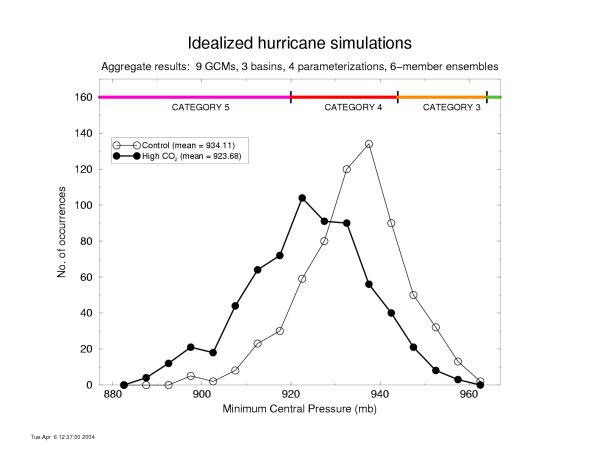
Figure 1. Model Simulation of Trend in Hurricanes (from Knutson et al, 2004)
In the particular simulation shown above, the frequency of the strongest (category 5) hurricanes roughly triples in the anthropogenic climate change scenario relative to the control. This suggests that hurricanes may indeed become more destructive (1) as tropical SSTs warm due to anthropogenic impacts.

But what about the past? What do the observations of the last century actually show? Some past studies (e.g. Goldenberg et al, 2001) assert that there is no evidence of any long-term increase in statistical measures of tropical Atlantic hurricane activity, despite the ongoing global warming. These studies, however, have focused on the frequency of all tropical storms and hurricanes (lumping the weak ones in with the strong ones) rather than a measure of changes in the intensity of the storms. As we have discussed elsewhere on this site, statistical measures that focus on trends in the strongest category storms, maximum hurricane winds, and changes in minimum central pressures, suggest a systematic increase in the intensities of those storms that form. This finding is consistent with the model simulations.
A recent study in Nature by Emanuel (2005) examined, for the first time, a statistical measure of the power dissipation associated with past hurricane activity (i.e., the “Power Dissipation Index” or “PDI”–Fig. 2). Emanuel found a close correlation between increases in this measure of hurricane activity (which is likely a better measure of the destructive potential of the storms than previously used measures) and rising tropical North Atlantic SST, consistent with basic theoretical expectations. As tropical SSTs have increased in past decades, so has the intrinsic destructive potential of hurricanes.
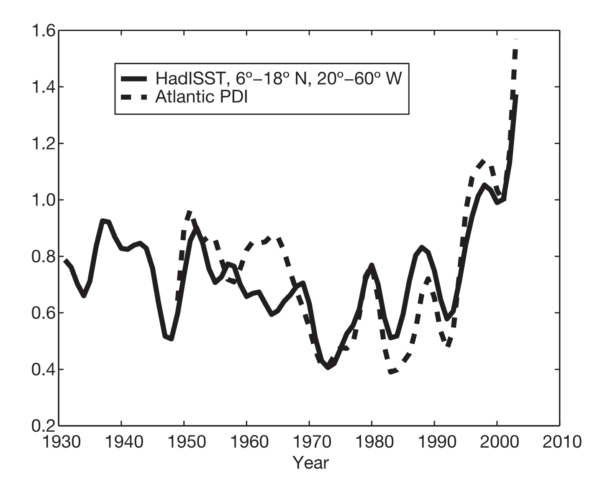
Figure 2. Measure of total power dissipated annually by tropical cyclones in the North Atlantic (the power dissipation index “PDI”) compared to September tropical North Atlantic SST (from Emanuel, 2005)
The key question then becomes this: Why has SST increased in the tropics? Is this increase due to global warming (which is almost certainly in large part due to human impacts on climate)? Or is this increase part of a natural cycle?
It has been asserted (for example, by the NOAA National Hurricane Center) that the recent upturn in hurricane activity is due to a natural cycle, e.g. the so-called Atlantic Multidecadal Oscillation (“AMO”). The new results by Emanuel (Fig. 2) argue against this hypothesis being the sole explanation: the recent increase in SST (at least for September as shown in the Figure) is well outside the range of any past oscillations. Emanuel therefore concludes in his paper that “the large upswing in the last decade is unprecedented, and probably reflects the effect of global warming.” However, caution is always warranted with very new scientific results until they have been thoroughly discussed by the community and either supported or challenged by further analyses. Previous analysis of the AMO and natural oscillation modes in the Atlantic (Delworth and Mann, 2000; Kerr, 2000) suggest that the amplitude of natural SST variations averaged over the tropics is about 0.1-0.2 ºC, so a swing from the coldest to warmest phase could explain up to ~0.4 ºC warming.
What about the alternative hypothesis: the contribution of anthropogenic greenhouse gases to tropical SST warming? How strong do we expect this to be? One way to estimate this is to use climate models. Driven by anthropogenic forcings, these show a warming of tropical SST in the Atlantic of about 0.2 – 0.5 ºC. Globally, SST has increased by ~0.6 ºC in the past hundred years. This mostly reflects the response to global radiative forcings, which are dominated by anthropogenic forcing over the 20th Century. Regional modes of variability, such as the AMO, largely cancel out and make a very small contribution in the global mean SST changes.

Thus, we can conclude that both a natural cycle (the AMO) and anthropogenic forcing could have made roughly equally large contributions to the warming of the tropical Atlantic over the past decades, with an exact attribution impossible so far. The observed warming is likely the result of a combined effect: data strongly suggest that the AMO has been in a warming phase for the past two or three decades, and we also know that at the same time anthropogenic global warming is ongoing.
Finally, then, we come back to Katrina. This storm was a weak (category 1) hurricane when crossing Florida, and only gained force later over the warm waters of the Gulf of Mexico. So the question to ask here is: why is the Gulf of Mexico so hot at present – how much of this could be attributed to global warming, and how much to natural variability? More detailed analysis of the SST changes in the relevant regions, and comparisons with model predictions, will probably shed more light on this question in the future. At present, however, the available scientific evidence suggests that it would be premature to assert that the recent anomalous behavior can be attributed entirely to a natural cycle.
But ultimately the answer to what caused Katrina is of little practical value. Katrina is in the past. Far more important is learning something for the future, as this could help reduce the risk of further tragedies. Better protection against hurricanes will be an obvious discussion point over the coming months, to which as climatologists we are not particularly qualified to contribute. But climate science can help us understand how human actions influence climate. The current evidence strongly suggests that:
(a) hurricanes tend to become more destructive as ocean temperatures rise, and
(b) an unchecked rise in greenhouse gas concentrations will very likely increase ocean temperatures further, ultimately overwhelming any natural oscillations.
Scenarios for future global warming show tropical SST rising by a few degrees, not just tenths of a degree (see e.g. results from the Hadley Centre model and the implications for hurricanes shown in Fig. 1 above). That is the important message from science. What we need to discuss is not what caused Katrina, but the likelyhood that global warming will make hurricanes even worse in future.
_____________________
1. By ‘destructive’ we refer only to the intrinsic ability of the storm to do damage to its environment due to its strength. The potential increases that we discuss apply only to this intrinsic meteorological measure. We are not taking into account the potential for increased destruction (and cost) due to increasing population or human infrastructure.
References:
Delworth, T.L., Mann, M.E., Observed and Simulated Multidecadal Variability in the Northern Hemisphere, Climate Dynamics, 16, 661-676, 2000.
Emanuel, K. (2005), Increasing destructiveness of tropical cyclones over the past 30 years, Nature, online publication; published online 31 July 2005 | doi: 10.1038/nature03906
Goldenberg, S.B., C.W. Landsea, A.M. Mestas-Nuñez, and W.M. Gray. The recent increase in Atlantic hurricane activity. Causes and implications. Science, 293:474-479 (2001).
Kerr, R.A., 2000, A North Atlantic climate pacemaker for the centuries: Science, v. 288, p. 1984-1986.
Knutson, T. K., and R. E. Tuleya, 2004: Impact of CO2-induced warming on simulated hurricane intensity and precipitation: Sensitivity to the choice of climate model and convective parameterization. Journal of Climate, 17(18), 3477-3495.
[lang_fr]
La réponse correcte — celle que nous avons fournie dans les articles précédents (Storms & Global Warming II, Some recent updates and Storms and climate change) — est qu’il n’y a aucune manière de prouver que Katrina était ou n’était pas affectée par le réchauffement global. Pour un seul événement, sans regarder à quel point il est extrême, une telle attribution est fondamentalement impossible. Nous avons seulement une Terre et elle suivra seulement une des infinies possibilités de séquence du temps. Il est impossible de savoir si cet événement aurait eu lieu ou pas si nous n’avions pas eu d’augmentation de la concentration de gaz à effet de serre dans l’atmosphère autant que nous avons. Les évènements du temps résultent toujours d’une combinaison de facteurs déterminants (incluant le forçage des gaz à effet de serre ou les cycles lents naturels du climat) et de facteurs stochastiques (pure chance).
Dû au semi-hasard de la nature du temps, nous avons tort d’imputer un seul événement tel que Katrina au réchauffement global – et, bien sûr, il est juste indéfendable de blâmer Katrina d’un cycle naturel à long terme dans le climat.
Néanmoins, ce n’est pas la bonne manière d’encadrer la question. Comme nous l’avons indiqué dans des articles précédents, nous pouvons en effet dessiner quelques conclusions importantes sur les liens entre l’activité des ouragans et le réchauffement global dans un sens statistique. La situation est analogue à faire rouler un dé pipé : on peut, si on a l’envie, construire un ensemble de dés où les 6 sortent deux fois plus souvent que la normale. Mais si on voulait tirer un six avec ces dés, on ne pourrait pas les blâmer spécifiquement sur le fait que les dés ont été pipés. La moitié des 6 seront tirés de toute façon, même avec un dé normal. Charger les dés a doublé simplement les impairs. De la même manière, bien que nous ne puissions pas tirer des conclusions fermes sur un seul ouragan, on peut tirer certaines conclusions sur des ouragans plus généralement. En particulier, la documentation scientifique à disposition indique qu’il est possible que le réchauffement global fera – et l’a peut-être déjà fait – que ces ouragans ont une forme plus destructive qu’ils auraient eu sinon.
Le lien clé est celui entre les températures des eaux de la mer de surface (abréviation TES – SST en anglais) et la puissance des ouragans. Sans aller trop loin dans les détails techniques sur la dynamique et la thermodynamique impliquées dans les tempêtes tropicales et les ouragans ( une excellent discussion de cela peut être trouvée ici), le lien fondamental entre les deux est assez simple : l’eau chaude, et l’instabilité dans la basse atmosphère que cela crée, est la source d’énergie des ouragans. C’est pourquoi ils surviennent seulement dans les tropiques et durant la saison où les TESs sont les plus élevées (Juin à Novembre dans l’Atlantique Nord tropical).
La TES n’est pas la seule influence sur la formation des ouragans. Un fort cisaillement dans les vents atmosphériques (c’est-à-dire, des changements dans la force du vent et la direction avec la hauteur d’atmosphère au-dessus de la surface), par exemple limite le développement de la structure hautement organisée qui est requise pour la formation d’un ouragan. Dans le cas des ouragans de l’Atlantique, l’ El Niño/Oscillation Australe a tendance à influencer le cisaillement vertical du vent et ainsi, en retour, le nombre d’ouragans qui se forment en une année donnée. Beaucoup d’autres caractéristiques du processus du développement des ouragans et leur force sont, cependant, étroitement liées à la TES.
Les modèles de prévision météorologique des ouragans (les mêmes qui ont été utilisés pour prédire le passage de Katrina) indiquent une tendance pour des ouragans plus intenses (mais, dans l’ensemble, pas plus fréquents) quand ils simulent pour des scénarii de changement climatique (Fig. 1).
Figure 1. Simulation d’un modèle de tendance pour les ouragans (d’après Knutson et al., 2004)
Dans la simulation particulière montrée ci-dessus, la fréquence des ouragans les plus forts (catégorie 5) triplent grosso modo dans un scénario de changement anthropique du climat. Cela suggère que les ouragans pourraient, en effet, devenir plus destructifs (1) puisque les TESs tropicales se réchauffent à cause des impacts anthropiques.
Mais qu’en est-il du passé ? Que montrent vraiment les observations du dernier siècle ? Certaines études du passé (par exemple, Goldenberg et al., 2001) soutiennent qu’il n’y a aucune évidence d’une augmentation à long terme dans les mesures statistiques de l’activité des ouragans de l’Atlantique tropical, malgré le réchauffement global en cours. Ces études cependant se sont focalisées sur la fréquence de tous les ouragans et tempêtes tropicaux (réunissant les faibles et les forts) plutôt que de mesurer des changements dans l’intensité des tempêtes. Comme nous l’avons discuté auparavant sur ce site, les mesures statistiques qui se focalisent sur des tendances dans les tempêtes de catégorie la pus forte, le maximum des vents des ouragans, et des changements dans le minimum des pressions centrales, suggèrent une augmentation systématique dans les intensités des tempêtes qui se forment. Cette conclusion est cohérente avec les simulations des modèles.
Une étude récente dans Nature par Emanuel (2005) a examiné, pour la première fois, une mesure statistique de la dissipation de la puissance associée à l’activité des ouragans passés (i.e. “Indice de Dissipation de la Puissance” ou “IDP” — Fig. 2). Emanuel a trouvé une étroite relation entre l’augmentation dans la mesure de l’activité de l’ouragan (qui est susceptible d’être une meilleure mesure du potentiel destructif des tempêtes que les mesures précédemment utilisées) et la hausse de la TES de l’Atlantique Nord tropical, ce qui est cohérent avec les attentes théoriques. Comme les TESs tropicales ont augmenté durant les dernières décennies, alors le potentiel destructif intrinsèque des ouragans l’a fait aussi.
Figure 2. Mesure de la puissance totale dissipée annuellement par les cyclones tropicaux (Indice de Dissipation de Puissance “IDP”) comparée à la TES de Septembre de l’Atlantique Nord tropical (d’après Emanuel, 2005)
La question clé devient alors : pourquoi la TES a t-elle augmenté dans les tropiques ? Est-ce que cette augmentation est due au réchauffement global (qui est presque certainement en grande partie dû à l’impact humain sur le climat) ? Ou est-ce que cette augmentation fait partie d’un cycle naturel ?
Il a été affirmé (par exemple, par le NOAA National Hurricane Center) que la récente reprise dans l’activité des ouragans est due à une cycle naturel, nommé Atlantic Multidecadal Oscillation (“AMO”). Les nouveaux résultats d’Emanuel (Fig. 2) argumentent contre cette hypothèse comme seule explication : l’augmentation récente de la TES (au moins pour Septembre comme montré dans la figure) est bien en dehors de la gamme des oscillations passées. Emanuel conclut donc dans cet article que “la large hausse dans la dernière décennie est sans précédent, et probablement reflète l’effet du réchauffement global”. Cependant, la prudence est toujours de mise avec des résultats scientifiques très nouveaux jusqu’à ce qu’ils aient été complètement discutés par la communauté et soit supportés, soit affaiblis par des analyses supplémentaires. Des analyses précédentes du AMO et des modes d’oscillations naturelles dans l’Atlantique (Delworth and Mann, 2000 ; Kerr, 2000) suggèrent que l’amplitude des variations naturelles de la SST moyennée sur les tropiques est d’environ 0,1 – 0,2 °C, donc un basculement de la phase la plus froide à la phase la plus chaude peut expliquer jusqu’à 0,4 °C de réchauffement.
Qu’en est-il de l’hypothèse alternative : la contribution des gaz à effet de serre anthropiques au réchauffement de la TES tropicale ? A quelle force s’attend-on ? Une manière d’estimer cela est d’utiliser des modèles climatiques. Diriger par des forçages anthropiques, cela montre un réchauffement de la TES tropicale dans l’Atlantique d’environ 0,2 – 0,5 °C. Globalement, la TES a augmenté d’environ 0,6 °C dans les derniers 100 ans. Cela reflète principalement la réponse à des forçages radiatifs globaux qui sont dominés par le forçage anthropique au cours du XXe siècle. Les modes régionaux de variabilité, comme l’AMO, se neutralisent largement et font une faible contribution dans les changements globaux de TES moyenne.
Ainsi, nous pouvons conclure qu’à la fois un cycle naturel (l’AMO) et le forçage anthropique pourrait avoir fait grosso modo également de larges contributions au réchauffement de l’Atlantique tropical au cours des dernières décennies, avec une attribution exacte impossible jusqu’ici. Le réchauffement observé est probablement le résultat d’un effet combiné : des données suggèrent fortement que l’AMO a été dans une phase de réchauffement pour les deux ou trois dernières décennies, et nous savons aussi qu’au même moment le réchauffement anthropique global est en cours.
Alors, finalement, nous retournons à Katrina. Cette tempête était un faible ouragan (catégorie 1) quand elle a croisé la Floride, et a gagné de la force plus tard au-dessus des eaux chaudes du Golfe du Mexique. La question a posé alors ici est : pourquoi le Golfe du Mexique est si chaud actuellement – combien de cela peut être attribué au réchauffement global et combien à la variabilité naturelle ? Des analyses plus détaillées des changements de la TES dans les régions en question, et des comparaisons avec les prédictions des modèles, apporteront probablement de la lumière sur cette question dans l’avenir. À présent, cependant, la documentation scientifique disponible suggère qu’il serait prématuré d’affirmer que le récent comportement anormal peut être attribué entièrement à un cycle naturel.
Mais, en fin de compte, la réponse à ce qui a causé Katrina est d’une valeur pratique faible. Katrina est dans le passé. Beaucoup plus important est d’apprendre quelque chose pour le futur, puisque cela pourrait nous aider à réduire le risque de tragédies supplémentaires. Une meilleure protection contre les ouragans sera un point de discussion évident dans les mois à venir, auquel, en tant que climatologues, nous ne sommes pas particulièrement qualifiés pour contribuer. Mais la science du climat peut nous aider à comprendre comment les actions humaines influencent le climat. La documentation actuelle suggère fortement que :
(a) les ouragans ont tendance à devenir plus destructifs quand les températures de l’océan augmentent, et
(b) une hausse incontrôlée dans les concentrations des gaz à effet de serre sera fortement susceptible d’augmenter plus les températures de l’océan, surpassant en fin de compte toutes oscillations naturelles.
Les scénarii pour un réchauffement global futur montrent une TES tropicale augmentant de quelques degrés, pas juste des dixièmes de degré (voir par exemple, résultats du modèle du Hadley Centre et les implications montrées pour les ouragans fig. 1). C’est le message important de la science. Ce dont nous avons besoin de discuter n’est pas ce qui a causé Katrina, mais la probabilité qu’un réchauffement climatique fera des ouragans même pires dans le futur.
1. Par “destructif” nous nous référons à la capacité intrinsèque des tempêtes de faire des dommages à l’environnement à cause de sa force. L’augmentation potentielle dont nous discutons s’applique seulement à cette mesure météorologique intrinsèque. Nous ne prenons pas en compte le potentiel pour une destruction accrue (et un coût) due à une population en hausse ou à l’infrastructure humaine.
Références :
Delworth, T.L., Mann, M.E., Observed and Simulated Multidecadal Variability in the Northern Hemisphere, Climate Dynamics, 16, 661-676, 2000.
Emanuel, K. (2005), Increasing destructiveness of tropical cyclones over the past 30 years, Nature, online publication; published online 31 July 2005 | doi: 10.1038/nature03906
Goldenberg, S.B., C.W. Landsea, A.M. Mestas-Nuñez, and W.M. Gray. The recent increase in Atlantic hurricane activity. Causes and implications. Science, 293:474-479 (2001).
Kerr, R.A., 2000, A North Atlantic climate pacemaker for the centuries: Science, v. 288, p. 1984-1986.
Knutson, T.K., and R.E. Tuleya, 2004: Impact of CO2-induced warming on simulated hurricane intensity and precipitation: Sensitivity to the choice of the climate model and convective parametization. Journal of Climate, 17 (18), 3477-3495.
[\lang_fr]
The authors of this article discuss frequency and intensity of hurricanes. Another important element is the size. It was reported that Katrina was highly unusal for a combination of high intensity and large size. The slow movement inland added to the forces which breached the levees and flooded New Orleans.
A fine article.
Sheer — very nice in lingerie.
Shear — not conducive to hurricanes.
[Response: Thanx, fixed. – stefan]
very interesting, glad you keep this blog going!
Excellent work again! Thank you for writing this. It is very helpful, especially the analogy of loading the dice. Ana
Of course, statistics wouldn’t work with just one statistic. Scientists look “forward” at how various forcings are likely impact the climate in various ways, but would it be possible to work “backwards” like forensic scientists and “deconstruct” one particular climate event, such as Katrina, with whatever we do know–sort of “peel away” the most likely various factors that created Katrina. I think they did that with the 2003 heatwave in Europe, and figured about half of the deaths could likely be attributed to GW.
We know there has been some natural SST warming and we know there has been GW contributing to SST warming. Could we “peel away” the most likely portion of that overall warming caused by GW, then figure how destructive Katrina would have been, and subtract that from how destructive Katrina actually was to figure the likely (above 50%, or even 20% certainty) contribution of AGW to Katrina’s destructiveness? Or at least come up with some high-end/low-end range? Something like we are about 50% certain that GW contributed, say, 2 to 5% of Katrina’s intensity.
Then, of course, that additional 2-5% of intensity caused by GW would have done much more damage than the first 2-5% of intensity — it may have been the straw that broke the camel’s back or blew off someone’s roof, or demolished their home.
[Response: The study you refer to about the European heat wave was also based not on analysing the single event, but on the statistics of such events in general. Basic idea: if GW has doubled the chance of such a heatwave, you could attribute half the casualties to GW in a statistical sense. Like rolling a six with the loaded dice, and if this earns you $100, attributing $50 to luck and $50 to the dice being loaded.
But still your suggestion is a reasonable one, I think there is some scope for further study of Katrina. One could, for example, rerun the forecast models that computed Katrina’s development with half a degree cooler SST, say, as a rough-and-imperfect estimate of the potential impact of this extra warming. But ultimately I think studies like the one by Knutson et al. shown in Fig. 1 are more useful than working on a single case study where a lot of random chance is involved. – stefan]
What might be interesting would be to do simulations of Katrina’s strength, if SST had been 0.2 to 0.5 C lower.
For judging the impact of past decisions on climate action in terms of their effect on Katrina, this constitutes a base line, the difference not ever having emitted any CO2 would have made.
This could be expanded by looking at what difference recent decisions on climate change action would have made, such as for example signing onto Kyoto in 2000, followed by emissions reductions putting the signing nations onto a path to meet Kyoto.
The result of that particular calculation is likely to come up with an effect equivalent to something like 0.0001 C, 0.001 mph in maximum wind speed or 0.001% in increased rain intensity or size, but it would be nice to see that beefed up a bit.
Sometimes, the near term damage reduction potential from climate action is heavily oversold, when it should be clear that this is a long term issue with virtually all the pay-off of any action today and over the next two decades to be found later this century.
In reply to Lynn, I’d also find it useful, if there was some focus on modelling the positive aspects of climate change. More deaths from heat waves can be modelled just as well as fewer deaths from extreme cold.
While there is a good theoretical case for greater damage from tropical storms, there is evidence that mid latitude storms may have decreased in intensity compared to the Middle ages, and a good theoretical case that they should decline in intensity due to global warming.
More carbon dioxide should mean more heat stress resistance in plants, as they shouldn’t have to breathe as hard to suck CO2 out of the air, and should mean higher yields. On the other hand, CO2 dissolving in the oceans would be expected to attack coral reefs.
I think a balanced view requires looking at both the positive and negative impacts.
I also know that the majority of economic models indicates relatively small net economic damage in 2100 (1-5% of global GDP), with a large fraction of that damage, in some modells virtually all the damage, concentrated in tropical nations.
Not everything is easily measured in economic terms. Attempts to include the value of coral reefs or the stress on species forced to migrate or losing habitat, in the cost benefit analysis, do not lend themselves to consensus, as value decisions come into it.
And even economics is much less of a hard science than climate studies.
My own view on the economics is that a doubling of CO2 concentrations will have a small net positive effect, as I put greater faith in adaptation than I think is represented in the majority of economic models.
[Response: You are right on one point: starting to implement climate protection measures in the year 2000 would have no measurable effect by 2005. And nobody has ever claimed it would – at least I have seen no such claim. But I have seen dozens of polemical statements like yours – that Kyoto makes only 0.001 ºC of difference by then etc. – written by people who do not want to take responsibility for the future consequences of their actions. This is a completely moot point. Kyoto or any other measures are not designed to make a difference within 5 years, which is obviously impossible given the timescales of the system. There is a world of difference, however, between having 2 ºC warming by 2100 (which is the policy goal of the European Union) or having 4 ºC or 5 ºC or even more warming then, and this is what we can decide.
Concerning the European heat wave of 2003: it caused ~30,000 casualties and thus was the most severe natural desaster in European history. There have not been any cold spells or storms that have even remotely caused a similar number of casualties. Hence, there is no way a reduction in the number of cold spells could balance the lives lost in 2003. It does get very cold in Europe – e.g. in Norway. But this causes no desaster, because it has always been so cold, and people are adapted to it. The heat wave, on the other hand, was something unprecedented in human memory here, that’s why society was not prepared and it caused such a heavy toll.
What I am trying to say: a warm climate is no worse than a cold climate. But large and rapid change is the problem, because new things happen that we and our infrastructure are not adapted to. Take sea level. Nothing is better about the current sea level, compared to a sea level three metres higher (a likely long-term outcome of unmitigated global warming). The only problem is that many of our cities are built near the current sea level.
I’m afraid your optimism about net positive effects of climate change is quite unrealistic. -stefan]
Further to the comments by Heiko (#6) on the economics of [climate change-related] environmental catastrophes, at least from an economist’s perspective, but opposite my perspective on my own standard of living:
http://money.cnn.com/2005/08/30/news/economy/katrina_cost/index.htm?cnn=yes
From the article:
J.P. Morgan senior economist Anthony Chan agrees that higher energy prices will curb both regional and national economic growth in the near-term.
“I think a 0.2 percent decline in economic growth due Katrina’s impact on oil and the regional economy is a realistic assumption,” Chan said. Longer-term, Chan believes hurricanes tend to stimulate overall growth.
Said Chan, “Preliminary estimates indicate 60 percent damage to downtown New Orleans. Plenty of cleanup work and rebuilding will follow in all the areas. That means over the next 12 months, there will be lots of job creation which is good for the economy.”
Prof. Doug Woodward, with the Division of Research at the Moore School of Business at the University of South Carolina, has researched the economic impact of hurricanes.
“On a personal level, the loss of life is tragic. But looking at the economic impact, our research shows that hurricanes tend to become god-given work projects,” Woodward said.
Disasters are good for the economy, he said. Within six months, he expects to see a construction boom and job creation offset the short-term negatives such as loss of business activity, loss of wealth in the form of housing, infrastructure, agriculture and tourism revenue in the Gulf Coast states.
In a note late Tuesday, Standard & Poor’s estimates that Katrina could “shave a few points off our forecast of 3.7 percent growth.”
Among the industries affected, trade, tourism, agriculture, and construction (Florida’s largest industries), as well as Louisiana’s energy-related industries will be hurt in the third-quarter, the firm said.
“At the same time, repairs to hurricane-related damage in Florida, Mississippi, Louisiana, and other regions affected by the storm should boost GDP in subsequent quarters,” S&P analysts wrote in the note.
“Natural disasters bring in a lot of money from the outside to help in the rebuilding,” he said. “The rebuilding boom will generate incomes. Insurance money and federal relief money will pour in. This happened very quickly in Florida last year,” Woodward said. “Give it a year. We’ll see positive economy results maybe by the third-quarter of next year.”
http://www.enn.com/today.html?id=8684
I wish politicians would read RealClimate before making assertions such as this one!
Great article. However, you haven’t mentioned the increases in sea levels associated with climate change. On their own, aren’t they likely to increase the vulnerability of low-lying regions to storm events even if climate change has no impact upon storm severity or frequency?
RE #7 & “hurricanes tend to stimulate overall growth” — that’s because “goods” and “bads” are lumped together. We could then claim toxic pollution in our water is a great stimulant to the growth of the medical industry (and it is), and, afterall, a human life is only worth about $10 in chemicals, so the net loss from those weaklings who die before they amass gigantic medical bills is not much (unless it’s your loved one).
And GW shouldn’t affect our diamonds & gold very much, only those very cheap things like food.
Guys- Overall a good article. One quick comment. You write that Emanuel’s study shows a trend in the “intrinsic destructive potential of hurricanes”. Isn’t an appropriate metric of “destructive potential” actual destruction? If the PDI is a good metric for understanding “destructiveness” (as it is in the title of Emanuel’s paper, which probably was chosen by Nature, not Emanuel), shouldn’t we expect to see some statistical correlation between the PDI (e.g., in the Atlantic) and actual measures of destruction (e.g., in the US) over a period of many decades? If this smells like a set up, it is. I’d urge caution in associating an abstract climate index, such as the PDI, with variables describing societal impacts, like destruction, until you’ve seen the science that demonstrates that such a linkage exists. Finally, for another perspective on hurricanes and global warming, pretty consistent with that written here, see:
http://sciencepolicy.colorado.edu/admin/publication_files/resourse-1766-2005.36.pdf
I’d be interested in hearing if (and where, exactly) any of the RC folks disagree with the review presented in this peer-reviewed paper. Thanks!
[Response:Roger – I would presume that PDI is a statistically far more stable measure than actual destruction, which varies wildly according to the vagaries of the actual track, and other circumstances… had someone spent a bit more money on levees, Katrina’s actual damage would have been far less. This seems obvious: have I misunderstood your question? – William]
Re #5 & 6:
I think too much emphasis is being placed on the fractions of a degree difference in SST and wondering whether a little change in temperature would have made a difference as well as wondering whether GW made Katrina stronger. If the temperature was the main determinant, then all the hurricanes should be Category 5 this year. Katrina was close to a “perfect storm” in that other factors such as moisture, stability and wind pattern were more significant in determining its strength. The Hurricane Center should be able to give a better idea what the main factors were. In addition it was made perfect by hitting the most vulnerable part of the “belly”. It could have caused flooding more rapidly by making landfall a little more westerly. The tragedy is that the authorities were not prepared in spite of indicating they planned 2 years ago.
“The discussion here is restricted to scientific topics and will not get involved in any political or economic implications of the science.”
There is a lot of work covering the economics of climate change, as well as adapation and mitigation. You don’t seem to be covering these issues?
Economics is a science, it’s certainly rather complex, as the misunderstandings of said science evident in comments #7 and #10 show.
Without going into excruciating detail, economists are not saying that hurricanes are making us better off, or that there’d be no costs attributable to climate change, if GDP in the year 2100 were 99% composed of reconstructing housing after hurricanes.
Re #11: The warm water does seem to be important. Remember that it’s a relatively late season development, so earlier hurricanes didn’t get the full impact. Also, Katrina’s path and speed resulted in it having what looks to be an unusual amount of dwell time in the upper Gulf. So, we should be able to see an obvious effect on other hurricanes that spend much time in that area. Probably it’s a good thing that hurricanes occurring much later than now tend to track into the Atlantic/East Coast.
Re: #12,
I do not think SSTs can be overemphasised, since it is from the seas that hurricanes obtain their energy. If SSTs were even an extra tenth (or even hundredth) of a degree warmer, it would increase the energy of the storm enough to increase the number of people killed and the damage done to property by the storm.
Sure, wind shear and other factors play a part in the setup of these storms, but these other factors do not contribute much to the overall energy of the storm, at least not nearly to the extent that SSTs contribute.
Dear Heiko (#14 at this time),
Thanks for not going into excruciating detail, but I’m curious about what you are suggesting I don’t understand (or Lynn for that matter). You posted statements that economics doesn’t account very well or objectively for various kinds of costs (e.g., damage to coral reefs, harm to tropical or poor countries, etc). I agreed and posted quotes from some real, working economists indicating that GDP (their usual metric) is positively stimulated by disasters. My comment was that those changes in GDP don’t correlate positively with changes in my quality of life. What am I missing?
To me its simple and scary. More heat equals more powerful storms. In my heart, that little voice of truth says that more of this is to come. I have to note that I stay up late worrying for our future. The sad truth is we cannot really know the effects of higher sea surface temperatures other than to have proof that they provide a nice comfy atmosphere for more destructive storms. As a somewhat educated layperson trying to raise awareness in my own little corner of the net im starting to find that at least some denizens of this planet are waking up to this.
We have so far to go though.
Thank you for running this blog. God Bless. And keep it up!
The current Landsea/Trenberth/Emanuel discussion has been parsed by many to mean that Landsea claims that the number of hurricanes is constant, and Trenberth is claiming that their intensity should increase as global warming heats the ocean surface. Emanuel appears to have constructed a figure of merit that confirms both sides of the furious agreement.
However, there is a simple logical fallacy in this reconciliation. If we are talking about hurricanes and not just tropical disturbances, a certain proportion of tropical storms will move up to hurricane status if Trenberth is right, and that indeed is what Emanuel has shown. Therefore, at some point, either someone is eliding tropical storms into hurricanes or someone else is making a false statement.
[Response:True, and one must be careful to say whether one refers to hurricanes (with windspeed above a certain threshold) or just tropical cyclones. -rasmus]
Katrina’s origins were so close to inhabited islands that it is likely an excellent hurricane to analyze. The relation with heat and destruction seems clear, with Andrew at the beginning of the then warmest year in history (1998), and Katrina at now what may surely be the warmest year in history for the Northern Hemisphere. Furiously destructive Hurricanes are not the only indicator of AGW, in context of those Hurricanes cycles in the past, or rather in contrast with past high intensity hurricane seasons, we now experience all time high temperatures raging everywhere in the world, 1 meter a day rainfalls, severe droughts on 4 distinct continents, many glaciers going or gone everywhere , and a good chunk of the Arctic Ocean permanent ice melted. Those just claiming that Katrina is part of a “normal” cycle, must somehow show that all these other distant but simultaneous temperature related changes have nothing to do with the Gulf of Mexico, or show that all other world wide warming cycles occurred at the same time as preceding Atlantic Multidecadal Oscillations, I doubt that “normal” cycle hurricane theorists can demonstrate that glaciers have melted to the extent that they have today, replenish themselves again only to achieve today’s all time low ice volumes. The problem is Global, the symptoms are local, and they vary according to highly individualized environments, however the common thread is Global Warming.
Excuse me if I’m being simple-minded here, but before we apply all of this incredibly complicated, speculatory science to analyzing Katrina, doesn’t it make sense to compare it with the historical record. Any simple glance at Hurricane records show that this is not the first time in history such hurricanes have occured. 1931 was an incredibly destructive year. In 2000 there was not a single land-fall. There is little solid historical evidence that hurricanes are increasing in number or destructiveness. This seems more telling than uncertain infinitely complex computer models, I just believe we can’t let speculative science get in the way of more simple logic. If hurricanes like this have hit with some regularity in the past (which they have), is it not jumping the gun a little to slap down a global-warming tag on it. I am not denying global warming in anyway, just I think it is best to always check speculation with a little more sober look into fact.
[Response: Have a look at Fig. 2 of the post – this is the sober data you want, not speculation. -stefan]
Steve,
economists would not regard the quarterly changes in GDP discussed in the article as the most appropriate metric for judging the economic damage from a hurricane, in particular because GDP is a proxy for production, rather than assets.
Economists do consider quality of life issues, though there is no consensus on how best to deal with them in cost benefit analyses.
As a severe weather meteorologist, I can’t stress enough how important articles like this are. Whenever extreme weather occurs, the public inevitably tries, on some level, to put the event into some type of global context. So a tornado touches down, devastating a community, or a hurricane like Katrina does the unthinkable and the inevitable questions come up: “is this El-Nino?”, “Is this global warming?”, “Is this normal?”, … All of these questions are valid and merit discussion, but the problem is that there is simply no way to answer them, short of a blithe, yes, these things are normal and as tragic as they are, they may happen again, and yes, there might be an impact from global warming or something else, but I can’t say exactly what they are.
Having the folks at RealClimate present the current state of the science and basically state what we in the meteorology community already find on a day-to-day basis is very gratifying. Keep up the good work.
RE #21, Okay, let’s take the Galveston cat 4? hurricane of 1900. Maybe some scientist could do a rough estimate of how much wmore intense it would have been with GW & the added increase in SST due to GW (though there might not be enough info on that hurricane).
Another question:
If hurricanes are to increase in intensity, then at some future point will we have to add another number, like category 6 (or are there constraints that make it beyond physical possibilities)?
Regarding #11,
Mr. Pielke, the referenced pdf shows an article in press (Dec. 2005) on Hurricanes and Global Warming, Bulletin of the American Meteorological Society. The authors shown in the article include yourself, the NOAA professionals listed below, and two others with the Tropical Prediction Center in Miami, FL.
NOAA professionals:
Christopher Landsea, Research Meteorologist
NOAA AOML/Hurricane Research Division
Miami, Florida
Jim Laver, Director
Climate Prediction Center
NOAA/ National Weather Service
National Centers for Environmental Predicion
Camp Springs, Maryland
Questions:
Are the statements in the pdf article (Accepted 27 August 2005) in agreement with NOAA’s policy on climate change? Did Mr. John Mahoney of NOAA give his approval to the content of the article?
[Response:
One would hope that science articles would be judged on quality, rather than conformity with policy. Does NOAA even have a “policy” on climate change? – William]
Re 23
What could also be done would be too look at all hurricanes making landfall in the 20th century, and then modelling the effect of 21st century sea water temperatures on them.
In the 20th century 3 category 5 hurricanes made landfall in the United States, tripling that would mean 9 cat 5 hurricanes, but that should be the risk for year 2100 SST’s.
So, maybe 6-7 cat 5 hurricanes in a business as usual scenario for the 21st century, and with concerted climate action over most of the 21st century, that could be reduced I guess by 1 landfalling cat 5 hurricane, which would be avoided, likely, sometime between 2050 and 2100 (and of course it would be nice to have that firmed up a bit, maybe including a glancing look at the near term effects of climate action to quantify how close to negligible they’d be).
The 2100 cut-off is somewhat arbitrary, more cat 5 hurricanes could be avoided in the 22nd century, but also most of the climate action for that could occur late. It’s the big lag times in energy and climate systems, which, I think, make consideration of impacts 50-100 years out particularly appropriate.
A great article. Stefan comments at one point:
“What I am trying to say: a warm climate is no worse than a cold climate. But large and rapid change is the problem, because new things happen that we and our infrastructure are not adapted to.”
This is a pivotal point. We frequently hear that “it used to be warmer and the dinosaurs liked it just fine.” That’s great, but we now have 6 billion humans hanging on to the planet, many pretty marginally. It’s not that a “warmed planet” will be “inferior” to today’s planet, but what happens to those 6 billion people during the transition?
What is missing? Your article concludes with the very strong statements:
“The current evidence strongly suggests that:
(a) hurricanes tend to become more destructive as ocean temperatures rise, and
(b) an unchecked rise in greenhouse gas concentrations will very likely increase ocean temperatures further, ultimately overwhelming any natural oscillations.”
However, after carefully re-reading the article, I can’t see where this “evidence” comes from. The nearest to evidence for (a) might be your Figures 1 and 2. Figure 1 indicates that more CO2 will lead to an increase in hurricane intensity. However, this result is derived from a predictive computer model and not evidence. In any case, you state “this SUGGESTS that hurricanes MAY indeed become more destructive” – which clearly does not represent “strong evidence”.
Figure 2 shows an apparent correlation between a “power dissipation index” (PDI) and North Atlantic SST. There is no explanation of what PDI is other than that it is “LIKELY a better measure of the destructive potential of the storms than previously used measures”. The term “likely” can not sensibly be transposed to “strong evidence”. From here we are led to the statement: “as tropical SSTs have increased in past decades, so has the intrinsic destructive potential of hurricanes”. A more convincing conclusion from the graph is that “as tropical SSTs have increased in past decades, so has the PDI”. It seems the reader is meant to have faith that an increase in PDI represents an increase in destructive potential, as no justification for this connection is presented.
In relation to the findings of Emmanuel (2005), you state: “caution is always warranted with very new scientific results until they have been thoroughly discussed by the community and either supported or challenged by further analyses”. This is a sensible statement, but one that does not appear to correlate with your strong final conclusions.
Conclusion (b) bears no relation to evidence presented in your article and appears to be based either on opinion or on the results of other studies not referred to or referenced here.
Don’t assume I aim to discredit your conclusions. As a scientist, I just don’t see how they derive from the information provided in the article.
[Response: Concerning (a) – there is a lot of evidence for hurricanes tending to become more destructive with increasing SST. E.g. the fact that they arise only over warm SST (>27 ºC) to begin with. Also, if you follow the hurricane forecasts of the National Hurricane Center on the web, you will see that SST is one of the key factors routinely used with every hurricane to forecast whether it will strengthen or weaken. E.g., on Friday, 26 August the 11.30 a.m. Katrina discussion read: “STEADY INTENSIFICATION TO NEAR CATEGORY FOUR STRENGTH BY 72 HOURS APPEARS TO BE IN ORDER GIVEN THE VERY WARM GULF WATERS BENEATH THE HURRICANE…” As you know, unfortunately this forecast was correct.
Concerning the power dissipation index: this is the wind speed cubed, integrated over the surface area covered by the hurricane and over time. It is simply an integral measure of the strength of the hurricane. You could have also used the wind speed. But to a physicist, power dissipation is a more sensible measure, partly because there is conservation laws for energy (not for wind speed), and partly because any damage caused to structures is more closely related to the power transferred to them, rather than to wind speed itself.
The evidence for conclusion (b) – that global warming will make SST warmer – was indeed not discussed in this post but in many others on our site. This is simply the standard evidence for rising CO2 concentration leading to global warming. You could turn to the IPCC reports if you are interested in this evidence, or e.g. to one of my own articles which summarises the evidence briefly at the outset. -stefan]
An engineer, Dan, on another blog — http://www.marklynas.org/wind/message/1930.html — has put this forth (I edited it for brevity), & I think I did read about the thermohaline circulation slowing down somewhat. Could you RealClimate scientists comment on Dan’s points:
***************
“…GW affects the Gulf area in hurricane formation on 2 grounds. First there may be local heating and second higher latitude heating may help augment the decadal cycles being cited as the reason for the increased frequency. Both GW related aspects increase heat retention by the Gulf and therefore hurricane intensity.
First,…the Gulf of Mexico…is very shallow with 38 percent of the ocean less than 20 meters deep. Because of this shallow depth, the earth’s heat imbalance can raise the temperature of this area faster and distribute that heat throughout the region.
…I calculated that the earth’s heat imbalance of 0.85 W/m2…can raise the temperature of the first meter of ocean by a degree in about 2 months if all the heat was totally contained in that first meter.
Since 20 meters is not a great depth, and if we assume the heat imbalance of 0.85 W/m2 went to heat just that shallow area, then it would take 2 years for the heat imbalance to raise the shallow ocean area an extra degree. The heat form the Gulf of Mexico is distributed world wide and even warms Europe. We are talking about the heat imbalance and if the long-term average flow rate of the current remained the same, then we would still have an imbalance with more heat being concentrated in the Gulf waters due to GW.
Second, weather events concerning the decadal cycles which place us in a hurricane season I believe are due in part to GW if the thermohaline circulation is being reduced which would slow the Gulf Stream down (flow rate out) and therefore prevent the escape of heat from the Gulf region.
…Increases in temperatures of the higher latitudes would also decrease density because warmer water is less dense. Since both ice melt and higher temperatures are happening, then density will be lower and this slows the Gulf Stream and adds to the decadal weather event which keeps more heat in the Gulf. In other words, the weather aspect of hurricanes is further aided by GW.
I read where the heat influx out of the Gulf region has a magnitude of 1.4 billion megawatts. So, that heat has to go somewhere and evaporation is an easier way for this to happen than just the water increasing in temperature. So this heat energy goes into evaporation and mechanical energy in the form of a hurricane.
…The Gulf of Mexico is one gigantic solar collector and the Gulf Stream is how the heat from that solar collector is distributed to Europe and elsewhere. Our distribution loop got clogged with low density water and we had a backup of heat until our heater over heated and blew off steam in the form evaporating ocean water which made a swirling cloud called a hurricane.
Does this mean Europe will have a cooler winter if we have a strong hurricane season?
I made many assumptions and I apologize to those who know more about the science. Nevertheless, I would love someone more qualified than I am with the science to add or subtract from what I said to add more clarity.
***************
If Dan is right on at least part of this, then are there perhaps other GW-induced factors that go into hurricanes, perhaps even go into the decadal cycle which goes into hurricanes, aside from SST? Of course, sea rise would make coastal land more vulnerable & hurricanes more destructive (I think “destructive” is a fine term for our anthropocentric focus here).
Thank you. I appreciate this blog very much and I think you are doing a very good job.
Kirstin
I think the term destructive power (footnote 1) could use more discussion.
It was reported that Katrina was highly unusal for a combination of high intensity and large size.
I would like to see Katrina ranked with hurricanes of the past according to size and total power. For example, Katrina’s size could be represented by the amount of land area (square miles) which experienced catgory 4 wind speeds. I would also like to see a scale that would include size and wind speed parameters, for ranking total power of hurricane for the U.S.
My guess is that Katrina and Andrew were the most powerful, combined wind speed and size, hurricanes to hit the U.S. of the last three centuries, or longer.
Re: #24. I had no contact with anyone in NOAA other than my co-authors, with whom I worked on this paper just like I would anyone else, irrespective of their employer. I doubt that NOAA has a policy on climate change, and I wouldn’t co-author a paper whose publication required approval by a government official. Hope this clarifies.
Re: 31 Yes, that helps. Thank you.
There is NO DOUBT A CONNECTION.
It would help if you could explain a step in the logic of this piece.
Higher temperatures mean higher energy levels, but in thermodynamics, it is the difference in temperatures that determines how much power a system outputs. For instance, a system with a heat sourec at 100 degrees and a heat sink at 50 degrees will produce more power than a system with a heat source at 120 degrees and a heat sink at 110 degrees even though the second system has higher temperatures.
So, it would help me if you could explain the temperature difference that drives hurricane systems and how GW is expected to increase that temperature difference. (Or if I am wrong about this, explain why temperature differences are not important.)
Thanks.
[Response: Much of the power for the hurricanes comes from latent heat: the condensation of atmospheric moisture as air parcels are raised. Warmer air leads to more moisture (roughly exponentially), so no T diff would be needed – William]
[Response:The amount of latent heat release depends on details such as the water vapour concentration of the ascending air parcels coming in at the bottom of the storm and of those that emerge at the top. The amount of saturation water vapour is determined by the Calusius-Clapeyron equation (assuming local thermal equilibrium): e_s = 10^(11.40 – 2353/T), where T is the temperature in degrees Kelvin (absolute temperature). Freezing temperature (0C= 32F= 273.155K) produces a satiration vapour pressure of 611Pa. It is well known that the temperature diminishes rapidly with height (and the pressure drops as well, hence the need for a cabin-pressure system in airoplanes). The cold temperature you refer to, is to a large part determined by the height of the cloud tops in the hurricanes. Cold (T~ 210K) rarified air is not capable of holding much moisture, and a difference of a few degrees does not matter much there (T=210K -> 1.6Pa; T=220K -> 5.1Pa). A change in the temperature at the warm end, however, has a much stronger impact on the water content of the incoming air parcels ascended into the storm (T=295K -> 2653Pa; T=305K -> 4844Pa). (Besides, the air at surface level is more dense than aloft). -rasmus]
I just ran across this http://www.nhc.noaa.gov/pastdec.shtml that says that there have bean no increase in hurricanes that comes in on the mainland of US. If I remember correctly I have read a statement somewhere that there have bean an increase of strong hurricanes over the Atlantic, do you have any numbers of that? And the reason why more havenâ??t struck US is it just pure luck?
Re 5:
I think a study that looks at the probability of Hurricane Katrina having had the same destructive potential with, say, 0.5 degree C cooler SSTs would be really great. I agree with Stefan’s response that looking at the future is far more important – the future, after all, is the reason for reducing emissions now. When I look at reports in the media, and public perception in general,however, any evidence that global warming is real and is already making extreme weather and, hence, terrible suffering more likely today is far, far more powerful than the most terrifying prediction for 2100. The Hadley Centre study on the European heat wave was widely reported and I am sure changed some people’s minds. Public polls show that most people in the UK (and US?) accept that climate change will threaten future generations, but most are in denial about it affecting their lives, and people’s willingness to take action is directly linked to whether they think climate change will affect their own generation.
Re 6:
Heiko Gerhauser states in 6 that mid-latitude storms may have decreased since the middle ages and could be expected to decline with global warming. I don’t know about trends since the Middle Ages. I do know that British storms have doubled over 50 years, according to the Hadley Centre [see: http://news.bbc.co.uk/1/hi/sci/tech/3307447.stm%5D. Hadley Centre climate forecasts are for more high-intensity storms in Britain as global warming intensifies – Scotland has just had the strongest storm in living memory this January, which subsequently hit Scandinavia after increasing its wind-speeds over the North Sea (so it’s not just us, it seems).
[Response: Does climate change only affect “future generations”? I am middle-aged and expect to still be around in 2050. And the life expectancy of children born today goes beyond 2100. “Future generations” sounds abstract – but climate change will strongly affect the lives of my generation and of our children. And most people care a lot about the kind of future their children will have. -stefan]
Re 36
I suppose this thread shows again how difficult it is to keep politics out of the discussion (“politics” in this context = preferences for how climate change should be dealt with, and a consequent desire to present information in a way to sway the public towards that preference).
The probability calculation Almuth proposes is tailor made for influencing the public towards “greater” action, while a calculation that looked at say the impact of Kyoto in 2020 on the wind speed of a second Katrina, compared that to the variability introduced by natural cycles and emphasised that this was based on models, while there had been no conclusive trend in tropical cyclone wind speeds so far, would be made with a different kind of advocacy in mind (Pielke et al’s paper is very clearly going in this direction).
One measure makes the impact of climate change action look near term, large and certain, while the other emphasises how small, far out in the future and uncertain the benefits of any climate change action would be.
On British storms, the link is messed up, because of the bracket at the end, just in case anybody else has trouble with it.
Maybe the climate experts on this site could address the subject of mid latitude storms in a bit more detail.
I gather that the main reason to expect them to decline is the lower pole-equator temperature difference that climate change would bring with it, and that this is the main driving force for mid-latitude storms, while SST are the most important variable for tropical storms.
IPCC in their 2001 report mention pressure changes, as does the Hadley Centre, but I am not clear whether this amounts to merely a shifting around of where stronger storms occur, or a sufficient case to argue that the competing effect of the lower pole-equator temperature difference would be overcome.
Re 6
I know that the true argument for acting relates to what’ll happen beyond 2050, and that said action must be continued through much of the 21st century to have much effect, and you say this clearly.
But, there are plenty of people who do not realise this, and when they watch a certain recently released movie on the subject, or hear about the German environment minister linking Kyoto and Katrina, they are easily misled into thinking otherwise.
Current climate disasters are much better for convincing the public than projections, though they shouldn’t be.
I know that the “Kyoto will only do so little” argument can be stretched too far, to the point of suggesting climate action won’t do anything in any case, and I do see your viewpoint there (though I think you do needlessly brush an ad hominem in the process of stating that viewpoint).
But, you also know that whenever a major climate related disaster happens, the media will ask scientists whether it’s related to global warming, and that these disasters will be used to justify Kyoto, and that the immediacy of the benefit can easily be overstressed to the point where many people do believe that Bush’s refusal to sign Kyoto directly caused Katrina or at least made it noticeably worse.
I think it is entirely appropriate to address that misconception.
On your other point, I know that a major issue is how well and quickly we can adapt to the changing climate. As you say it makes little difference whether sea level is 3 m higher or lower, but if cities are built next to the present shore line, adaptation has a cost.
I just don’t share your opinion that the cost of adaptation would be high enough to off-set the benefits, or at least to off-set them by enough that much climate change action now is a good investment.
As you don’t include the economics of climate change on your site, I think we can leave it at that difference of opinion without having to sling insults suggesting lower motives.
I also happen to disagree on the specific example of adaptation you chose to highlight.
High summer temperatures are exceedingly easy to adapt to nowadays, which is why people are so happy to move to the South of the US, or to take a summer holiday in Spain. Climate change so far is equivalent to something like moving 100 km South in terms of maximum summer temperatures, with decades to adapt.
The way to deal with this is air conditioning. That works near immediately, and is useful also in the present climate, though it is energy intensive and therefore currently contributes to CO2 emissions.
I’d bet that the death toll estimate is based on a year on year comparison and mostly relates to elderly people already close to death. To claim that the increase in summer maximum temperatures in Europe is too rapid for adaptation, and therefore responsible for increased death, is a very weak argument, much, much weaker than that sea level rise will be too rapid for adaptation to have low costs.
[Response: Quick response to two of your points.
First, what the german environment minister actually wrote in his much-villified article published on Tuesday 30th was very much down the line of our post. He wrote that no individual storm can directly be linked to global warming, but that climate change is making extreme events more likely. He used this to argue for climate protection measures, finishing his article by stating that the international community should stretch out their hands to the US with a proposal for the future of an international climate policy.
Second, you state that the casualties from the European heat wave were mostly “elderly people already close to death”. Nice one. And as you will know, another standard skeptics argument. Why not check the facts, before you publish such claims on the web? In France, the mortality rate during the heat wave was statistically significantly increased in all age groups above 45 (my age). See Schär and Jendritzky, Nature 2004. -stefan]
A paper examining the increase in temperature of the world’s oceans over the last 50 years or so:
http://www.nodc.noaa.gov/OC5/PDF/PAPERS/grlheat05.pdf
(I figured that it could be a benefit for the discussion on this thread.)
With regard to the economic cost-benefit analyses of global warming, or of a climate treaty to brake it, it should be pointed out that economists must ignore the alternate new pathways that the economy will doubtless take under the vibrancy of capitalism, because these do not presently exist. And in the other column, they also also ignore the nonmonetized ecosystem services (clean water, clean air, disease suppression, etc.) provided to us by nature right now. We can’t even predict the present economy with much certainty, so coming up with cost-benefits under the new conditions, while a valuable academic exercise, is almost certainly useless. You can argue that Katrina is likely to stimulate the GDP through rebuilding, and that would be true, but so what. This is an old schoolyard truism usually known as the “broken-window argument”: go break a window, raise the GDP. You are not increasing the total welfare, only getting it back to what it was. And of course not tallying the incalculable suffering of the meantime. We may never know whether Katrina is attributable to warming, but the politics of it is clear: it is of the magnitude which might be imagined in a climate catastrophe. Anyone who doesn’t take pause at this, should be put under the sober care of a qualified psychiatrist. (I offer this last remark, of course, as a strictly scientific observation.)
With regard to Williams answer to Terry (#34), I believe that Terry is correct that it is temperature differences that are fundamental, and not, for the most part, the temperature itself, as Emanuel has discussed in a series of important papers on the maximum intensity that hurricanes can attain. It is the temperature difference between the ocean surface and that of the upper level outflow that is crucial. From this perspective one can see that the issue of hurricane intensity is linked with that of trends in upper tropospheric temperatures. We should all hope that the models and data analyses which suggest that the tropics stays very close to a moist adiabat as it warms are correct. If not, and the upper troposphere warms less rapidly than the surface, the temperature difference relevant for hurricane strength will increase that much faster.
[Response: This is an interesting point, which deserves better discussion that I can do. I’m sticking with my view for the moment, bolstered by the fact that everyone seems to correlate hurricanes against SST and I’ve never seen anyone correlating them against upper temps. I’m not sure which KE papers you mean. In http://wind.mit.edu/~emanuel/anthro2.htm he says “everywhere we have looked, the change in hurricane energy consumption follows very closely the change in tropical sea surface temperature” – William]
The solution is to tax large gas-hog vehicles that do not deliver things to our industrial systems. The tax should be related to the miles per gallon of the vehicle. It should be a non-linear tax. I drove a 25 HP VW as my first car. I had to draft Greyhound busses to get to 65MPH. I made friends with the drivers, and they stopped turning off a bank of their spark plugs and producing a large back fire to get me to stop drafting them. We need to incentives more efficient means of transportation. We need to provide safe lanes for Bicycles users. We need to provide lanes for small efficient vehicles. China and India are making efficient 2,3 & 4 wheel means of travel.
Many employees and their employers should be incentivized to allow them to communicate to work. Home owners should be allowed to have production machines in their own homes. Schools should be incenivized to allow students to communicate to school. Travel waste time and wealth. The internet moves at the speed of light and costs only a few cents per gigabit of information that is transferred.
Let me know what you think.
We should incentivise every one to save energy by communicating to work over the internet if they can. Companies should allow workers to make things in their homes or to live near their place of work. Commuters see many other workers going the other way on their commutes to work. Incentivise them to exchange their homes. Tax the gas hog vehicles off the roads.
Just a brief note: Great site; finally a quality resource for those who debate the professional naysayers (such as those found on sci.environment). Keep up the good work.
I’m not completely agree with the William’s response to #34.
The vapour latent heat remains latent if you haven’t a cold sink.
I think that, for mid’s latitudes storms, this cold sink is given by polar air masses.
With GW there is a reduction of T gradient between equator and poles , so this types of storms should be diminished.
For a hurricane it’s not the same phenomenon.
The cold sink is the upper troposhere (by radiative loss to space).
The condensation of vapour in this cold sink gives more energy to the hurricane.
With GW the T gradient between lower an upper troposphere will be more important than to day.
Maybe it’s an explanation, with SST increasing, to the future average strength of hurricanes.
Kerry Emanuel has a freshly-updated page on his MIT site explaining his findings in some detail: http://wind.mit.edu/~emanuel/anthro2.htm . There’s also a public-access link to his Nature letter and supplementary material.
Re #s 34 and 40: I would appreciate some additional information on this.
[Response: So would I. Thanks for the KE link – useful. I’ve written this, which doesn’t appear here because its only my speculation – William]
Re: 37. Here is how we conclude our BAMS paper: “But a great irony here is that invoking the modulation of future hurricanes to justify energy policies to mitigate climate change may prove counterproductive. Not only does this provide a great opening for criticism of the underlying scientific reasoning, it leads to advocacy of policies that simply will not be effective with respect to addressing future hurricane impacts. There are much, much better ways to deal with the threat of hurricanes than with energy policies (e.g., Pielke and Pielke 1997). There are also much, much better ways to justify climate mitigation policies than with hurricanes (e.g., Rayner 2004).”
http://sciencepolicy.colorado.edu/admin/publication_files/resourse-1766-2005.36.pdf
Guys- I’m going to be a bother and follow up on the request in #11. After reading your post, Kerry Emanuel’s website I feel strongly that there is a strong consensus on hurricanes and global warming in the scientific community (in spite of media reports and advocacy statements to the contrary). It would therefore be useful to your readers and other observers, and scientifically productive to the community, if you would offer your comments on our peer-reviewed reviewed paper forthcoming in BAMS. Are there conclusions ior intermpretations in that paper that you would disagree with? Overlooked literature that would change the conclusions? If so what specifically are then points of disagreement and on what basis would you disagree? Science advances by engaging each other in the open. I’ll have to admit some disappointment that you’ve written two reviews of this topic without acknowledging that this peer-reviewed paper exists. So here I am bothering you again. If we are wrong in important respects, then let us know! Thanks. Here again is the link:
http://sciencepolicy.colorado.edu/admin/publication_files/resourse-1766-2005.36.pdf
[Response: Roger, Speaking for myself, I agree with much of what is contained within your paper, as I also agreed with much of what Trenberth said when this issue surfaced earlier this year. Yet much of the commentary at the time and now has focussed on rather semantic interpretations of what words like ‘linked’, ‘connected’ or ‘significant’ mean. Some people have assumed that they mean ‘directly caused by’ and have then set up a straw man of specific attributions which are easy to criticise. There is no fundamental contradiction between the potential connections in a statistical sense discussed here between GW and hurricanes and your statements regarding the causes of accelarating cost of such disasters and their (limited, and possibly counter-productive) relevance for moving the GHG-emission control issue forward in the policy realm. Such connections may not be ‘significant’ in an economic impact sense (which is how I parse your paper), but may well prove to be significant in a purely physical climatic sense. Thus I don’t agree that it is ‘premature’ to discuss such links, despite the fact that these links are not the first order control on hurricane damage. It should be possible to discuss such issues without immediately having those discussions projected onto the highly politicized debate concerning approrpiate policy responses. -gavin]
[Response:Roger, I am glad you see a consensus. Do you know that Goldenberg and yourself are the two scientific witnesses cited by the german news magazine Der Spiegel yesterday under the headline that the increase in hurricane activity “has nothing to do with global warming”? This definite conclusion is directly associated with a quote from you in the text. I know how the media often distort, and I don’t know what you told them, but perhaps this calls for a letter from you to correct this?
Concerning your disappointment for not being cited: remember your paper is not yet published. We cannot always be aware of all forthcoming papers – and even if we are, we often wait with citing them until they are published.
-stefan]
Re 37
I didn’t comment on what Trittin actually said or didn’t say, but merely on the need to correct a misperception among members of the public. I’ll leave assignment of who’s to blame for that misperception to others.
My institution doesn’t have an on-line subscription to Nature, I expected the kind of finding you cite and it doesn’t contradict what I said.
Re 45
Kerry Emanuel’s page is excellent, and adds considerably to the article published above, I particularly liked FAQ number 9, as a succinct summary of the science.
Re: Gavin’s reponse to #47
Thanks much Gavin for these comments. Just a few reactions.
1. We (you and our BAMS paper) seem to be in violent agreement about the possibility of global warming resulting in a demonstrable, statistical influence on the behavior of hurricanes. I also think that Trenberth’s paper is consistent, and Emanuel as well — hence my claims for consensus on this issue.
2. We didn’t say that it was “premature to discuss such links” but rather we stated “claims of linkages between global warming and hurricane impacts are premature for three reasons.” What we mean by premature is that there is no evidence in the literature to support a claim that global warming has resulted in demonstrable effects on hurricane impacts, whether they are measured in terms of economics or otherwise. As we state, Emanuel’s paper is suggestive of a linkage with the observed behavior of storms, but effects have not been observed in the impact record. Additional research, we note, may yet overturn this conclusion.
3. You write, “It should be possible to discuss such issues without immediately having those discussions projected onto the highly politicized debate concerning approrpiate policy responses.” In an ideal world this might be this case, but that is not our world. The reactions to Katrina in over the past week illustrate that any statement by scientists on hurricanes and global warming carries with it political significance. We need to accept this and discuss our science accordingly (i.e., we need to carefully place the science into policy context). And of course we’ve discussed this before.
Thanks!
[Response: “…but effects have not been observed in the impact record”. I recommend Kerry Emanuel’s consideration of why this is the case. He writes: “the data of landfalling hurricanes in the U.S. is less than a tenth of a percent of the data for global hurricanes over their whole lifetimes”, and shows that from such a small subset of data and given the amount of natural variability, there is no way you would be able to detect a trend by now. To get enough signal/noise to detect a trend, you need to consider all hurricane data, not just those landfalling in the US. -stefan]
RE #37, GW actions have many many other immediate & future benefits: they prevent/reduce many other environmental harms (local air pollution, acid rain, ground & water pollution, etc.), they are good for the health (e.g., cycling & walking), they reduce crime (cycling, walking), they reduce our implication in foreign conflicts & tax money to protect oil supplies, they save money without lowering productivity (even increasing it), they save businesses from folding & households from going into hock. We should be doing these (which I have mentioned in earlier posts under other topics on RealClimate), even without GW, but it was the idea of my GW contributions to African droughts that first moved me to start down this wonderful, healthful, money-saving, living standard raising path. NO REGRETS. With 100% wind energy from Green Mountain, we have now reduced our GHGs more than 1/2, maybe more than 3/4 from our 1990 emissions (also counting water & products, which entail GHGs in their production).
I would hope Katrina would inspire others to start down that wonderful path, even if doing so doesn’t have a big impact on reducing future Katrinas.