


Global warming is turning 35! Not only has the current spate of global warming been going on for about 35 years now, but also the term “global warming” will have its 35th anniversary next week. On 8 August 1975, Wally Broecker published his paper “Are we on the brink of a pronounced global warming?” in the journal Science. That appears to be the first use of the term “global warming” in the scientific literature (at least it’s the first of over 10,000 papers for this search term according to the ISI database of journal articles).
In this paper, Broecker correctly predicted “that the present cooling trend will, within a decade or so, give way to a pronounced warming induced by carbon dioxide”, and that “by early in the next century [carbon dioxide] will have driven the mean planetary temperature beyond the limits experienced during the last 1000 years”. He predicted an overall 20th Century global warming of 0.8ºC due to CO2 and worried about the consequences for agriculture and sea level.
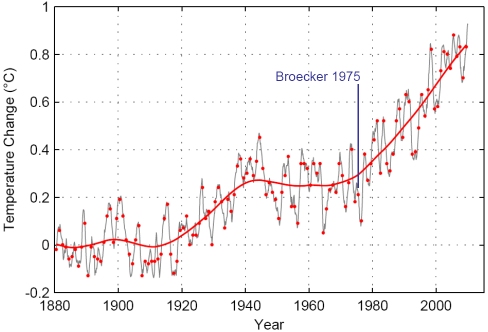
Global temperature up to June 2010 according to the NASA GISS data. Grey line is the 12-month running average, red dots are annual-mean values. The thick red line is a non-linear trend line. Broecker of course did not have these data available, not even up to 1975, since this global compilation was only put together in the late 1970s (Hansen et al. 1981). He had to rely on more limited meteorological data.
To those who even today claim that global warming is not predictable, the anniversary of Broecker’s paper is a reminder that global warming was actually predicted before it became evident in the global temperature records over a decade later (when Jim Hansen in 1988 famously stated that “global warming is here”).
Broecker is one of the great climatologists of the 20th Century: few would match his record of 400 scientific papers, a full sixty of which have over 100 citations each! Interestingly, his “global warming” paper is not amongst those highly-cited ones, with “only” 79 citations to date. Broecker is most famous for his extensive work on paleoclimate and ocean geochemistry.
It is very instructive to see how Broecker arrived at his predictions back in 1975 – not least because even today, many lay people incorrectly assume that we attribute global warming to CO2 basically because temperature and CO2 levels have both gone up and thus correlate. Broecker came to his prediction at a time when CO2 had been going up but temperatures had been going down for decades – but Broecker (like most other climate scientists at the time, and today) understood the basic physics of the issue.
Basically his prediction involved just three simple steps that in essence are still used today.
Step 1: Predict future emissions
Broecker simply assumed a growth in fossil fuel CO2 emissions of 3% per year from 1975 onwards. With that, he arrived at cumulative fossil CO2 emissions of 1.67 trillion tons by the year 2010 (see his Table 1). Not bad: the actual emissions turned out to be about 1.3 trillion tons (Canadell et al, PNAS 2007 – estimate extended to 2010 by me).
A shortcoming, from the modern point of view, is that Broecker did not include other anthropogenic greenhouse gases or aerosol particles in his calculations. He does however discuss aerosols, which he calls “dust”. In fact, the first sentence of the abstract (quoted above) in full starts with an if-statement:
If man-made dust is unimportant as a major cause of climate change, then a strong case can be made that the present cooling trend will, within a decade or so, give way to a pronounced warming induced by carbon dioxide.
That is a nod to the discussion about aerosol-induced cooling in the early 1970s. Broecker rightly writes:
It is difficult to determine the significance of the next most important climatic effect induced by man, “dust”, because of uncertainties with regard to the amount, the optical properties and the distribution of man-made particles,
citing a number of papers by Steve Schneider and others. Because he cannot quantify it, he leaves out this effect. Here luck was on Broecker’s side: the warming by other greenhouse gases and the cooling by aerosols largely cancel today, so considering only CO2 leads to almost the same radiative forcing as considering all anthropogenic effects on climate (see IPCC AR4, Fig. SPM.2).
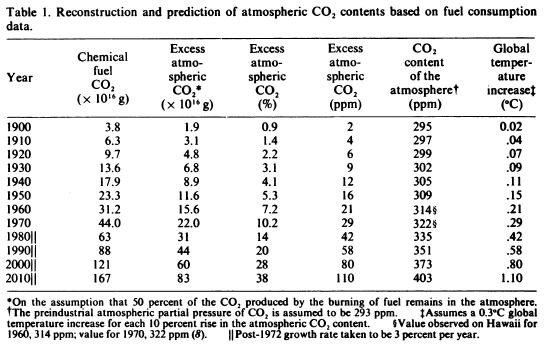
Table 1 of Broecker (1975)
Step 2: Predict future concentrations
To go from the amount of CO2 emitted to the actual increase in the atmosphere, one needs to know what fraction of the emissions remains in the air: the “airborne fraction”. Broecker simply assumed, based on past data of emissions and CO2 concentrations (Keeling’s Mauna Loa curve), that the airborne fraction is a constant 50%. I.e., about half of our fossil fuel emissions accumulates in the atmosphere. That is still a good assumption today, if you look at the observed CO2 increase as fraction of fossil fuel emissions. Broecker calculated that about 35% of the emissions is taken up by the ocean and the other 15% by the biosphere (again not far from modern values, see Canadell et al.). On this basis he argued that if the ocean is the main sink, the airborne fraction would remain almost constant for the decades to come (his calculations extend to the year 2010).
Thus, with a 3% increase in emissions per year and 50% of that remaining airborne, it is easy to compute the increase in CO2 concentrations. He obtains an increase from 295 to 403 ppm from 1900 to 2010. The actual value in 2010 is 390 ppm, a little lower than Broecker estimated because his forecast cumulative emissions were a little too high.
Step 3: Compute the global temperature response
Now we come to the temperature response to increased CO2 concentration. Broecker writes:
The response of the global temperature to the atmospheric CO2 content is not linear. As the CO2 content of the atmosphere rises, the absorption of infrared radiation will “saturate” over an ever greater portion of the band. Rasool and Schneider point out that the temperature increases as the logarithm of the atmospheric CO2 concentration.
Based on this logarithmic relationship (still valid today) Broecker assumes a climate sensitivity of 0.3ºC warming for each 10% increase in CO2 concentration, which amounts to 2.2ºC warming for CO2 doubling. This is based on early calculations by Manabe and Wetherald. Broecker writes:
Although surprises may yet be in store for us when larger computers and better knowledge of cloud physics allow the next stage of modeling to be accomplished, the magnitude of the CO2 effect has probably been pinned down to within a factor of 2 to 4.
The AR4 gives the uncertainty range of climate sensitivity as 2-4.5ºC warming for CO2 doubling, so there still is about a factor of 2 uncertainty and Broecker used a value near the very low end of this uncertainty range. Modern estimates are not only based on model calculations but also on paleoclimatic and modern data; the AR4 lists 13 studies that constrain climate sensitivity in its table 9.3.
In Broecker’s paper the warming calculated with the help of climate sensitivity happens instantaneously. Today we know that the climate system responds with a time lag due to ocean thermal inertia. By neglecting this, Broecker overestimated the warming at any given time; accounting for thermal inertia would have reduced his warming estimate by about a third (see AR4 Fig. SPM.5). But again he was lucky: picking ~2ºC rather than the more likely ~3ºC climate sensitivity compensates roughly for this, so his 20th-Century warming of 0.8ºC is almost spot on (the actual estimate being closer to 0.7ºC, see Fig. above). (A modern version of this back-of-envelope warming calculation is found e.g. in our book Our Threatened Oceans, p.82.)
Natural Variability
Broecker was not the first to predict CO2-induced warming. In 1965, an expert report to US President Lyndon B. Johnson had warned: “By the year 2000, the increase in carbon dioxide will be close to 25%. This may be sufficient to produce measurable and perhaps marked changes in climate.” And in 1972, a more specific prediction similar to Broecker’s was published by the eminent atmospheric scientist J.S. Sawyer in Nature (for a history in a nutshell, see my newspaper column here).
The innovation of Broecker’s article – apart from introducing the term “global warming” – was in combining estimates of CO2 warming with natural variability. His main thesis was that a natural climatic cooling
has, over the last three decades, more than compensated for the warming effect produced by the CO2 [….] The present natural cooling will, however, bottom out during the next decade or so. Once this happens, the CO2 effect will tend to become a significant factor and by the first decade of the next century we may experience global temperatures warmer than any in the last 1000 years.
The latter turned out to be correct. The idea that the small cooling from the 1940s to 1970s is due to natural variability still cannot be ruled out, although more likely this is a smaller part of the explanation and the cooling is primarily due to the “dust” neglected by Broecker, i.e. due to the rise of anthropogenic aerosol pollution (Taylor and Penner, 1994). However, the way Broecker estimated and even predicted natural variability has not stood the test of time. He used data from the Camp Century ice core in Greenland, arguing that these “may give a picture of the natural fluctuations in global temperature over the last 1000 years”. Ironically, Broecker’s own later work on Atlantic ocean circulation changes showed that Greenland is likely even less representative of global temperature changes than most other places on Earth, it being strongly affected by variability in ocean heat transport (see our recent post on the Younger Dryas, or Broecker’s latest book The Great Ocean Conveyor). However, Broecker was right to conclude that the buildup of CO2 would sooner or later overwhelm such natural climate variations.
Overall, Broecker’s paper (together with that of Sawyer) shows that valid predictions of global warming were published in the 1970s in the top journals Science and Nature, and warming has been proceeding almost exactly as predicted for at least 35 years now. Some important aspects were not understood back then, like the role of greenhouse gases other than CO2, of aerosol particles and of ocean heat storage. That the predictions were almost spot-on involved an element of luck, since the neglected processes do not all affect the result in the same direction but partly cancel. Nevertheless, the basic fact that rising CO2 would cause a “pronounced global warming”, as Broecker put it, was well understood in the 1970s. In a 1979 TV interview, Steve Schneider rightly described this as a consensus amongst experts, with controversy remaining about the exact magnitude and effects.
Reference
BROECKER WS, 1975: CLIMATIC CHANGE – ARE WE ON BRINK OF A PRONOUNCED GLOBAL WARMING?
SCIENCE Volume 189, Pages 460-463.

Re #20–Callendar’s initial publication on CO2/climate theory was the paper Lou Grinzo cites, “On The Artificial Production Of Carbon Dioxide. . .” The year was 1938.
You can access the paper via Lou’s link, or if that doesn’t work, Google “pale wiki climate,” which should get you to the collection of “classic global warming science.” There are about 20 papers available there, nicely indexed, so you can pick papers from Fourier 1824 right up to Hanson (IIRC.) I’ve done articles on the first 6, and have one on Plass in process–at least, it’s “in process” whenever I can free up some time to actually work on it.
There is also a discussion of Callendar 1938 in my article, linked at #22 above.
Regarding Soylent Green — spoiler alert to anyone who hasn’t seen it! — what most people remember is the final moments of the film when Charlton Heston’s character discovers that “Soylent Green is people!”, specifically, the ground-up corpses of people who have voluntarily ended their lives by going to one of the public suicide centers.
But the really shocking point in the film is what causes Edward G. Robinson’s character to go to a suicide center: he and a small group of other scientists get their hands on an ocean survey conducted by the Soylent Corporation, which has been harvesting phytoplankton — the last remaining lifeform on Earth other than humans, all other species having been driven to extinction — to make the “food product” Soylent Red.
As they study the Soylent Corporation’s survey, they realize what it shows: that the phytoplankton too is at last dying off, and will shortly become extinct, leaving human beings as the only thing living on Earth — and the only thing left to eat.
Which is what sends Robinson’s character off to the suicide center, to enjoy a chemically-induced euphoria, watch a ten-minute 3D IMAX movie of the long-vanished natural beauties of the Earth, and be “put to sleep”.
The article referenced by Ben in #5 also states: “All this reinforces a theory advanced in 1861 that decreases in carbon dioxide explain the growth and advance of glaciers at various intervals in the earth’s history. Dr. Plass finds the theory plausible“. This refers to the work of Tyndall, who at that time was making the first connections/speculations between atmospheric composition and large scale climate variations. Note also that this NYT writer was on top of this–Plass’ full article on the topic didn’t come out until 1956, where he describes a climate sensitivity of 3.6 to 3.8 deg C. The NYT article was based on a conference presentation which apparently was the basis of Plass’ 1956 paper.
Re # 50 Every time I read ANY thread on Yahoo, no matter what topic, my faith in humanity suffers. To go there is like visiting a circle of Hell.
I studied “Environmental Change” – a course on human-induced global warming, basically – under the late Prof. Kenneth Hare at University of Toronto in about 1980. (Talk about a revelation!) I’m pretty sure we were reading scientific papers that pre-dated 1975. I might even still have them in a box someplace.
“The present natural cooling will, however, bottom out during the next decade or so. Once this happens, the CO2 effect will tend to become a significant factor and by the first decade of the next century we may experience global temperatures warmer than any in the last 1000 years.”
“The latter turned out to be correct.”
I’m sorry, but I thought the temperatures of the last decade of the 20th century did not exceed the MWP? Yes?
[Response: No. But this is very definitely off topic. – gavin]
Credit where it’s due, he made a good prediction at a time when it did not seem obvious. This is why I am not a “denialist” (one of the reasons.) If I remember correctly, Steve Schneider at the time was still saying there was not enough evidence to substantiate a prediction (was he transitioning from a “cooler” to a “warmer”?)
In the table, the predicted increase for 2010 1.1C since 1900 (did I read the table correctly?) The observed increase is 0.8C. If you adjust his model to get the correct amount, what does it predict for the next 30 years? Just curious, as there are lots of predictions already out there for the next 30 years, but his has a track record worth building on.
Yes, I remember being taught about the oncoming Ice Age – and trying to imagine New York City being encroached upon by Glaciers, as I learned about Geophysics and Oceanography, in the late 1970’s early 1980’s; so, at least at first, Global Warming was a surpirse – but not at all a hard sell.
I lived in or around Omaha, NE., USA, in the mid 70’s and again in the late 80’s early 90’s; and it was impossible NOT to notice the changing climate. Though it was common to climb out a high window, to unblock the drifted shut door to our house, in 1978; in the later [eriod, the usual precipitation had changed over to mostly freezing rain – with drifted snow becomming very, very rare.
The OED lists a 1952 _San Antonio Express_ usage of the term global warming: “Scientists who are studying global warming trends point out that not a single iceberg was sighted last year south of Parallel 46” (April 28, 1952: 2, 5).
[Response: Love that dictionary. The OED are actually very keen to have updates to their ‘earliest use’ cites, so if people can find earlier examples, they should send them along. – gavin]
I would like to add my voice to those commending Stefan on an excellent post. Fascinating.
Stefan and Gavin, I was wondering whether or not you were considering speaking to the findings presented in this new paper by Lin et al. (2010)?
http://www.atmos-chem-phys.net/10/1923/2010/acp-10-1923-2010.html
They conclude that:
“The climate feedbacks are obtained based on the constraints of the TOA radiation imbalance and surface temperature measurements of the present climate. In this study, the TOA imbalance value of 0.85 W/m2 is used. Note that this imbalance value has large uncertainties. Based on this value, a positive climate feedback with a feedback coefficient ranging from −1.3 to −1.0 W/m2/K is found. The range of feedback coefficient is determined by climate system memory. The longer the memory, the stronger the positive feedback. The estimated time constant of the climate is large (70~120 years) mainly owing to the deep ocean heat transport, implying that the system may be not in an equilibrium state under the external forcing during the industrial era. For the doubled-CO2 climate (or 3.7 W/m2 forcing), the estimated global warming would be 3.1 K if the current estimate of 0.85 W/m2 TOA net radiative heating could be confirmed. With accurate long-term measurements of TOA radiation, the analysis method suggested by this study provides a great potential in the estimations of middle-range climate sensitivity.”
Hat Tip to poster “Ned” at SkepticalScience.
Thank you, Stephan. And also the comments related to eveen earleir papers. Before this the earliest I was aware of was the Charney et al. 1979 NRC/NAS report:
http://books.nap.edu/openbook.php?record_id=12181&page=R1
The question of the causes of the mid 20th century (brief and mild) cooling is interesting. First, here is a graphic demonstrating it:
http://www.ncdc.noaa.gov/img/climate/research/2009/decadal-global-temps-1880s-2000s.gif
Now most of the variation of the last 13 decades happens to be nicely explained just by CO2 alone, the other forcings (approximately) canceling each other out. So with quite a simple climate model:
https://www.realclimate.org/index.php/archives/2010/03/unforced-variations-3/comment-page-12/#comment-168530
in which the first formula is missing a rgith parenthesis and should read
AE(d) = k(lnCO2(d-1) – lnCO2(1870s)) – GTA(1880s)
just that does quite well but there are clearly unexplained wobbles above and below; the mid 20th century century cooling is one of those wobbles.
So in the second table there is a contribution from the Atlantic Multidecadal Ossicllation (AMO) has a index of internal variability. This helps to explain most of the wobbling, but not all of course. However, the AMO is based on North Atlantic SSTs and so is affected by nonlinear aspects of forcings which changes those SSTs. In particular, some contribution from CO2 leaks in as the forcings due to CO2 is not linearly increasing over the 13 decades. But also whatever changes in aerosol contributions will leak in as well. So the wobbles in the AMO are partly due to those other contributions.
The net of all this is that the AMO, for the linked simple model, explains almost all of the variance not explained by CO2 alone; it is not just an index of internal variability, although I opine, without actually knowing, it is mostly that with some additions or subtractions due to other causes.
An explanation different than just CO2+AMO for the warming from about the 1910s to through the 1940s is given in
http://webcache.googleusercontent.com/search?q=cache:cTkJPW3J9UoJ:https://tamino.wordpress.com/2008/10/19/volcanic-lull/
when at the same time the AMO was increasing. I opine that this increase was partly due to that same lull in volcano aerosols.
re # 52 — yes, the phytoplankton die off in Soylent Green. By an odd coincidence, there’s a story in today’s LA Times:
http://www.latimes.com/news/science/la-sci-phytoplankton-20100729,0,6579046.story
“…Since 1950, phytoplankton biomass has shrunk about 40%. Scientists had known the population was shrinking, but the long-term nature of that reduction came as a surprise.”
On the bright side, NYC is nowhere near as crowded as they show it in Soylent Green (where the city has a population of 40 million and looks like Kolkata).
Re: response to #10 by Eric
What location in the interior of BC shows a rise of 3C in the last 50 years ?
[Response: This is from Environment Canada. – gavin]
Hi All,
Yes, nice post and many insightful comments.
A bit OT, but SecularAnimist (52) mentions phytoplankton – I just read today (an AP article: http://www.msnbc.msn.com/id/38451744/ns/us_news-environment/) that phytoplankton numbers have declined by 40% since 1950. The methods included measurements of ocean turbidity, so it’s a proxy measure for a very difficult-to-conduct population survey of phytoplankton species. The method seems to be valid however. May be premature, but the decline is attributed to AGW. Talk about canaries…
How I love to reminisce. As recently as 1982, I was still distracted, listening to my generators instructor talk about how PCBs were no more dangerous than a peanut butter sandwich, and preparing a report on acid rain, soon to be astonished on how the local Edison could lie through their teeth about a study they funded.
Jim Hansen’s congressional testimony was a seminal event that I remember clearly, and when my professional organization, IEEE, printed a cover story in 1999 on global warming in their Spectrum Magazine, I was sure we were on the right path. The last 11 years or so have taken a decidedly unexpected turn.
Climate change was a subject like x population control, racism, or y, one that polite people just didn’t want to talk about.
Propaganda can defy reality, change the world, for a while. But reality always wins by shaking and destroying the foundation that the propaganda was built on. Although we might win a battle or two, we can’t win a war against nature,
A minor point: If US readers follow the link for “Our Threatened Oceans”, they will find a further link for purchasing the book from Amazon UK. You can also get it, at lower cost, from Amazon US and other sources (although Amazon UK has the advantage of availability of Goon Show reissues with your order, providing a bit of much-needed sanity in these difficult times, which may make the trans-oceanic postage worthwhile).
Dan King:
Of course thermo is involved in how the atmosphere interacts with radiation etc, but those are low level details. What we get are the IR forcing (one way to think of it is the average back IR radiation from the sky to the ground -or at fixed global temperature the decrease in IR radiation to space as a function of CO2. Using Gavins formula you get about 4watt/M**2 per doubling. The (near) logarithmic dependence comes from the fact that the absorption line shapes fall off exponentially as the frequency varies from the line centers -so the effective width of the line varies are the LOG of concentration. The change in either the backradiation -or the shielding effect of IR to space as a function of CO2 concentration, is actually a weak effect -roughly a 1% change per doubling. If it weren’t for the fact that our planets biosphere/cryosphere is quite sensitive to small changes in temperature (a 1% change in absolute tempeature is almost 3C) GW wouldn’t be a big deal. But a 1% change in the planets temperature can have a major impact.
I’ve known about GW since the 60’s. I was a voracious reader of astronomy and weather books as a teenager. The basic idea has been known to those with an interest in how the planet functions for quite a long while.
I knew of the possibility of anthropogenic global warming when I was still in high school, around year 9 to year 11 (year 12 aka matriculation for most students, is the last year of school before university, if that’s a help for non-Australian readers). That puts it around 1979 to 1981 for me.
Obviously I couldn’t “know” it was true at the time, for AGW had no track-record with a statistically significant signal, and I was a high-school student, not a seasoned scientist! However, in 1988 there was a greenhouse Conference and workshops for scientists, as well as seminars for the public. By then I knew that CSIRO and many other more famous organisations/universities had their climate scientists stating that global warming was baked in, even if some doubts remained about the magnitude of change in all major climate indicators. The natural conservatism of scientists suggested to me that the bottom line may well be much worse than officially reported.
I suppose I knew about the natural Greenhouse effect (eg Venus) and how it worked in the 70’s, via magazines such as New Scientist, Scientific American (thank G-D it existed), and from Astronomy books, as someone else has mentioned. But 1988 would be not the “Ah hah!” moment, more like the “Oh Nooo!!” moment in disaster movies etc.
These days I feel it is so likely as not worth debating with anyone over the odds. A bet on anthropogenic global cooling, or even just global cooling, for the next 20 years or so would be a suckers bet. I just couldn’t take the money from someone so disabled as that.
Thanks a lot RealClimate for this worthy information.One must admire Wally Broecker’s predictions, of atmospheric CO2, made 35 years back.
Check the news timeline from Google Labs
http://newstimeline.googlelabs.com/
I found an interesting 1968 news story:
http://news.google.com/newspapers?id=3MkLAAAAIBAJ&sjid=UVYDAAAAIBAJ&pg=7247,2505197&dq=global+warming
This only searches Time Magazine and a few other publications, but results surprise.
Kudos to RealClimate and all of climate science for the persistence of effort. But shouldn’t we also note the passing decades while society has ignored this science? I suspect this is more of a testament to the power of public relations.
Google Search is a tremendously powerful tool for online research. Google engineers devised a way to display search results in a timeline layout. This is a great way of visualizing a search term across time. You will see a list of news stories for the time section you choose. Then you can see your report displayed over days, months or years.
“An easy first search is to enter “Global Warming” or “Climate Change” over a year range and see just how far back the story of global warming goes. I found global warming news stories in 1967, 1968 and 69 and beyond. The timeline display shows a handful of news stories for each year. Each with the top news headlines as a hotspot to click for further information. It was startling to see global warming news stories published so long ago. And alarming to see a 1988 news story with much the same phrasing as global warming news story today. ”
One can see a attitudinal change in media coverage with Time Magazine and others – with the sudden rise of the phrases of other scientists, doubt and skepticism.
Google Timeline reveals triumph of denialism – at http://www.theboywhodeniedwolf.com/2009/04/google-timeline-reveals-triumph-of-denialism.html
It’s interesting to search out the earliest usage of ‘global warming’ but we shouldn’t get too sidetracked by where the precise phrase first appeared. The hypothesis of anthropogenic global warming was first articulated clearly in 1938 in this paper (abstract if PDF doesn’t work) by Callendar. In this paper Callendar,
1) Proposes that CO2 is increasing in the atmosphere and will not only lead to coming global warming, but is already.
2) Discusses measurements of increases in CO2 in the free air. He notes that CO2 is increasing and will continue to do so in the coming century and beyond
3) He discusses the infrared absoprtion by CO2 and water vapor, and is fully aware of the Planck distribution of Earth-like radiation which peaks near 10 um, and is negligible at shorter wavelengths than ~4 um. He is also aware of where CO2 strongly absorbs. He notes on pp. 225, “To return to the absorption by carbon dioxide, the three primary bands given by this gas are at 2.4 to 3.0 um, 4 to 4.6 um, and 13 to 16 um, the latter being much the most important for atmospheric conditions because very little low temperature radiation is carried on the small bands.” He also notes previous measurements noting strong CO2 absorption near 15 um, and further notes that CO2 could absorb away from the primary bands
4) He discusses in length the relationship between CO2 and “sky radiation” (the downwards radiation to the surface). While he seems to not quite understand the primary importance of the top of the atmosphere energy budget, he is well familiar that a quantiative treatment of the effects of CO2 requires consideration of the the vertical thermal structure of the atmosphere, and treats the atmosphere as a number of layers that extend vertically. Callendar notes, “…increase of carbon dioxide causes the radiation to be concentrated from the lowest air layers, whilst the amount from the cold upper layers is still further screened off, the net effect being a small increase in the total sky radiation” which accurately characterizes the fact that the atmsophere becomes brighter in the IR when viewed from the perspective of the surface. Callendar thus understands that one aspect of increasing CO2 is to reduce the height of the “effective radiating level” (from the view of the surface).
5) Callendar notes that the radiative effect of CO2 is stronger in the Arctic due to the absence of water vapor, but incorrectly points out that the actual temperature change realized will be roughly uniform over the globe (he is apparently unaware of the ice-albedo feedback).
6) He doesn’t stop here. Callendar then goes into a detailed account of observed trends in surface temperatures over many locations over the globe, primarily relying on the Smithsonian publication “World Weather records,” and examining about 200 records. He even classifies records by their level of exposure to the urban heat island effect (he doesn’t use this term, but categorizes by small island/ocean/rural, small towns, and large towns). Callendar notes positive temperature anomalies in most records.
7) In this publication Callendar noted that the warming that is observed and that would continue from CO2 could be benefitial, and also that “In any case the return of
the deadly glaciers should be delayed indefinitely.”
This is the earliest most comprehensive, single paper articulating the relationship between CO2, radiative transfer, measurements of CO2, and measurements of temperature and connecting the dots to form the skeleton of what we are worried about over 70 years later. There was certainly earlier efforts which discussed the importance of atmospheric absorption by gases to climate, but such work (like that of Arrhenius) were not concerned with anthropogenic global warming or only speculated that it might be of importance in the deep future, and for that matter did not engage in the observational aspect of CO2-temperature relationships that Callendar attempted. Arrhenius’ 1896 publication has several pages devoted to a translation of previous work by Hogbom noting that CO2 variations were likely quite large in the past, but to Hogbom crustal processes were of much more importance than fossil fuel combustion could be. For the most part, this research, among others before Callendar, was focused on the causes of the glacial-interglacial cycles.
Speculation of anthropogenic warming and geo-enginnering the climate via combustion of fossil fuels is traceable bacj before Callendar, to at least 1899 in this paper by Nils Eckholm. Eckholm recognizes the influence of ‘carbonic acid’ for the climate, and remarks that it is essential for life. He doesn’t quite understand that the rise in CO2 will influence climate over the next few decades to centuries, but the focus has at least shifted to anthropogenic warming and the future– though it is still not until Callendar (1938) to examine this connection in detail. He notes here, “But here we find a remarkable circumstance that has hitherto been unexampled in the history of the earth. This is the influence of Man on climate.”
His conclusing paragraph is,
“In fact, we have seen that the present burning of pit-coal is so
great that in one year it gives back to the atmosphere about 1/1000 of its
present store of carbonic acid. If this continues for some thousand
years it- will undoubtedly cause a very obvious rise of the mean
temperature of the earth. Also Man will no doubt be able to increase
the supply of carbonic acid also by digging of deep fountains pouring
out carbonic acid. Further, it might perhaps be possible for Man to
diminish or regulate the consumption of carbonic acid by protecting the
weathering layers of silicates from the influence of the air and by ruling
the growth of plants according to his wants and purposes. Thus it
seems possible that Man will be able efficaciously to regulate the future
climate of the earth and consequently prevent the arrival of a new Ice
Age. By such means also the deterioration of the climate of the
northern and Arctic regions, depending on the decrease of the obliquity
of the ecliptic, may be counteracted. It is too early to judge of how far
Man might be capable of thus regulating the futnre climate. But
already the view of such a possibility seems to me so grand that I
cannot help thinking that it will afford to Mankind hitherto unforeseen
means of evolution.”
I could use some help with http://dotearth.blogs.nytimes.com/
Please go there and make comments, RC.
Why did not the scientists looked at the data and declared global warming 70 years ago?
http://www.woodfortrees.org/plot/hadcrut3vgl/from:1910/to:1940/compress:12/plot/hadcrut3vgl/from:1910/to:1940/trend
35 years is too short. It should be 100 (it started in 1910)
I wrote: “… this foundational paper that first introduced the term ‘global warming’ also exemplifies the tension between the use of that term versus the use of ‘climate change’ … in its very title.”
Secular animist replied:
What “tension”?
Global warming causes the climate to change. Seems pretty straightforward to me.
If you look at the discussion of this subject both in the popular press and the scientific literature, people go back and forth between using the terms “global warming” and “climate change.” I don’t think that’s some nefarious plot; I think it’s genuine uncertainty about the tradeoff between simplicity/clarity versus comprehensiveness. Overall, the effect of increased CO2 is to warm the globe but the ultimate impacts of that go beyond just palpable “warmth” to include things like changes in precipitation, ocean circulation, etc.
I just thought it was kind of neat that the (or a) pioneering paper in 1975 that was the first to introduce the term “global warming” apparently also reflects (in its very title) the terminological ambiguity that we continue to experience today. This isn’t a big issue; it’s trivial compared to the substance of the paper. But apparently right from the start even Wally Broecker couldn’t make up his mind whether it’s better to call this phenomenon “climatic change” or “global warming” … so he went with both!
#72–great summary of some of the early “classics” in the field–and a great “pre-response” to Girma’s #74!
One slight clarification–the last block quote is from Ekholm 1901. (The attribution of the pronouns “he” and “his” may be a little unclear to some readers, but Chris means Ekholm.)
For those who like a good slug of biography with their science, I’ve done a web article on Ekholm too, in addition to the one on Callendar linked upthread. If the moderators will indulge me, I’ll link all 6 articles currently up:
Callendar
Ekholm
Arrhenius
Tyndall
Pouillet
Fourier
(This would also be a good time to acknowledge again my appreciation of past interest and assistance in this project on the part of RC readers! And BTW, corrections and emendations are welcome.)
However, I didn’t actually come by to plug myself, but rather to note that the 2009 “State of the Climate” report is now out:
http://www.ncdc.noaa.gov/bams-state-of-the-climate/2009.php
The CBC story on this headlined the quote that global warming is “undeniable”–evidently not true in the most literal sense, though I’d contend it is “undeniable for the fair-minded.” :-(
J(75): Good summary of the “CC vs. GW” terminology situation.
I find it fascinating and frustrating that the self-professed skeptics seem to get so much mileage out of claiming that “now they’re calling it climate change!” (One somewhat prominent “skeptic” is a local TV weatherman who writes letters to the local paper taking cheap shots at scientists and their work. I’ve seen him use this tired old attack.) If anything, I think CC is far more unsettling than GW, and on my site I was even calling it “climate chaos” for a while, as a way to emphasize the uncertainty involved as well as all the “it’s worse than we thought” discoveries that were popping up in the news. That usage didn’t catch on, despite my efforts and some other people using it; perhaps it’s “too alarmist”.
for those interested, we have a brief audio interview from 2006 with Dr. Broecker on our site here:
http://www.artistascitizen.org/projects/1/
eric, thanks for your earlier response; I wasn’t aware that central BC had warmed that much recently. Here in Calgary AB (and all of central and southern Alberta) we haven’t warmed much at all in the last 100 years:
http://www.abll.ca/charts/Meteorology/Temperature
Ft McMurray (tars sands area) can also be shown on the chart and the warming in more Northern regions is evident.
I am still curious about why I can’t grow a decent vegetable garden even though we are losing our glaciers and ice caps.
Any recommendations on reading about sources of variation at a regional scale?
#5
Ben says:
28 July 2010 at 9:23 AM
“… 4 per cent…”
A large percentage of the populace doesn’t understand the difference between a relative scale, like Celsius or Fahrenheit, and an absolute scale, like Kelvin. In fact, most don’t know what Kelvin (or Rankine, heaven forbid) is. So, I think there might be some merit in framing the amount of change per doubling of CO2 as about 1 percent. It isn’t entirely accurate or precise for a number of reasons, but it sounds plausible to a layman, puts it in the right ballpark, and gives a point from which to build. This side-steps a common sticking point that occurs when people hear that doubling a gas that used to make up 0.0287 percent of our atmosphere, which is imperceptible as far as they are concerned, will have a ~3 degree C (~5.4 degree F) effect, which is quite perceptible within their frame of reference. Using one percent keeps the perceived level of the gas and its effects in the same category of that’s-not-much. It’s a starting point to get someone on to the bunny slope.
Sorry, but there are things which can not be explained very accurately in three easy steps, the average person won’t go beyond three steps, and most of us live in democracies where the average people get to decide what the group does.
In perhaps related news:
http://www.nature.com/nature/journal/v466/n7306/edsumm/e100729-03.html
Utterly astonishing.
Hank Roberts wrote: “In perhaps related news … Utterly astonishing.”
I guess it’s getting near time to start making that yummy Soylent Green.
phytoplankton declining. Yipes! Oxygen declining!
Hank Roberts,
Fascinating.
For those without access to the Nature article, here is synopsis
http://dalnews.dal.ca/2010/07/28/photoplank.html
I puzzled over why phytoplankton would be in decline because of temperature; they are found in waters warm and cold. Seems an answer could be that there is less overturn in the oceans, and so less nutrients are brought up from the bottom.
So, just thinking, but if the overturn of the oceans is in a general decline, that would have a large effect on the rate of changes at the surface, for temperature, acidity, and others. There would be less buffering in general.
In light of recent comments, I encourage reading Wally Broecker’s new book “The Great Ocean Conveyor”.
In another anniversary, I was just RealClimates’ 12000000th visitor
[Response: Cool! – gavin]
Jim’s Response at #7:
What about what’s happening in the heads of scientists who go fruit-loop to garner attention? Correction at RC wiki in case someone who can edit is watching: the link to the rebuttal to Rancourt’s ravings, “Ode to a theory unsung and conspiratorial”, should be
http://iji2.wordpress.com/2008/07/13/ode-to-a-theory-unsung-and-conspiratorial/
Someone who wants me to believe me the denial side has a case sent me a link to Rancourt’s latest video. My response: Just because he’s on the left of politics doesn’t exclude the possibility he’s a fruit loop (but leftist anarchists will I’m sure appreciate the assumption that their every pronouncement is authoritative).
Meanwhile AMSU-A keeps maintaining 2010 as a record year for near-surface temperature.
Not all of Nature Journal 466 mentioned above is bad news;
http://www.nature.com/news/2010/100721/full/news.2010.366.html?s=news_rss
http://www.nature.com/nature/journal/v466/n7305/full/nature09210.html
The authors are the same for last year’s Science magazine; The Dynamics of Phenotypic Change and the Shrinking Sheep of St. Kilda, Science 24 July 2009, which prompted Gavin to write a follow-on post to “The Sheep Albedo Feedback”, titled “Science at the bleating edge”.
Another “pioneering discussion” maybe necessary to include rodents into the ruminant radiation budget. After all — increasing numbers and size matters… don’t forget the yellow belly which is exposed when sunning.
35 years huh.
Wonder how long it will take them to accept it.
I just finished writing a post on possible ways to avoid Climate Change”.
Click on
http://www.suhasinisakhare.com/index.php?option=com_content&view=article&id=130:can-we-aviod-climate-change&catid=15:politics&Itemid=23
Would be great to get feedback.
Thanks,
Suhasini
Here’s a public-access copy of the Broecker paper:
http://blogs.ei.columbia.edu/climate/files/2009/10/broeckerglobalwarming75.pdf
Wallace Broecker needs defending at
http://dotearth.blogs.nytimes.com/2010/07/29/lessons-from-two-important-climate-forecasts/
where a super-denialist has Comment #1. Still waiting for Comment 2 to appear.
Andy Revkin is also celebrating the 35th anniversary/birthday. 1. Brad Smith repeats all of the old long since debunked nonsense stuff that it gets boring to debunk again. I put in a comment that isn’t up yet debunking part of it and then I got bored and pasted. Pastes don’t work there, so I expect to see only part of what I intended to say. Does anybody have a software to get around anti-pasters for Mac OS 10.6?
Dear Gentlemen, congratulations to your 35th birthday! The deniers have a new iPhone application that is 5 times more extensive than John Cook’s excellent app.
http://itunes.apple.com/us/app/our-climate/id371849150
Will you debunk the application and show that the deniers are just deniers and that they keep on denying?
How accurate is the headline, “Controlling Soot Might Quickly Reverse a Century of Global Warming” on wired.com?
http://www.wired.com/wiredscience/2010/07/soot-control/
[Response: Exaggerated. BC controls make sense from a health and climate point of view, so there is nothing wrong in principle. But depending on exactly what you did (how are organic carbon aerosols changed at the same time, the impact of biomass burning) you could get different size net effects. In terms of attribution, BC is something like 20% of the net positive forcing, and so, you’d expect something like that in terms of reducing the global warming signal. (there are issues related to indirect effects, efficacy and time scales that make that a little uncertain though). -gavin]
Pardon my ignorance. Does anyone know whether the kinetic energy of a falling or disintegrating glacier or ice sheet is included in the equations for modeling melting ice? Many millions of tons of ice, elevated a mile or more. Or the energy of the falling water draining through the ice? Do the melting equations include this enormous energy, which will ultimately be heat and contribute to the melting?
A link will be appreciated.
catman306 asks above in comment now #94 about kinetic energy of falling ice.
Here’s a comparison. The latent heat of fusion for ice to water transition is 334 kJ/kg. That is, melting 1 kg of ice with no temperature change takes 334 kJ.
The gravitational potential energy of a kilogram of ice is about 10 J per meter. So melting the kilogram of ice involves the energy obtain by having it fall about 34 kilometers.
The kinetic energy of falling ice is, I suggest, negligible by comparison with the other forces at work here.
Someone tell me if I have these figures wrong…
Scopus has an interesting breakdown of global warming (article, title, abstract or keyword) vis-a-vis the top 50 source journals, authors, year, affiliation and subject.
16,049 articles since 1975.
How many more papers will it take to convince the ‘sceptics’ of the reality of AGW?
As ever keep up the great work. There are many who are listening.
Geoff Beacon says: 30 July 2010 at 3:24 AM
How accurate is the headline, “Controlling Soot Might Quickly Reverse a Century of Global Warming” on wired.com?
A one-shot deal, the devil is in the fine print, like kids’ juice boxes touting “Real Juice!” Once you’ve undone one century of warming you’re fresh out of soot, permanently, so that leaves the remaining upcoming centuries to deal with.
No “Get out of jail free” card on this game board, sadly.
“Wonder how long it will take them to accept it.”
Let’s hope it’s not like the Catholic church and Copernicus. That only took, what, nearly 300 years?
#96
For some reason the full link didn’t post.
http://www.scopus.com/results/results.url?sort=plf-f&src=s&st1=global+warming&nlo=&nlr=&nls=&sid=jZnfJbC2lsvGoAJcBXJA9XX%3a210&sot=b&sdt=b&sl=66&s=TITLE-ABS-KEY%28global+warming%29+AND+DOCTYPE%28ar%29+AND+PUBYEAR+AFT+1974&cl=t&offset=1&origin=resultslist&ss=plf-f&ws=r-f&ps=r-f&cs=r-f&cc=100&txGid=jZnfJbC2lsvGoAJcBXJA9XX%3a23
Jim Ryan wrote: “How many more papers will it take to convince the ’sceptics’ of the reality of AGW?”
There will never be enough to counter the many, many “papers” that have convinced them that global warming is a hoax.
You know — the little green & gray “papers” with pictures of dead presidents on them.