Global warming is turning 35! Not only has the current spate of global warming been going on for about 35 years now, but also the term “global warming” will have its 35th anniversary next week. On 8 August 1975, Wally Broecker published his paper “Are we on the brink of a pronounced global warming?” in the journal Science. That appears to be the first use of the term “global warming” in the scientific literature (at least it’s the first of over 10,000 papers for this search term according to the ISI database of journal articles).
In this paper, Broecker correctly predicted “that the present cooling trend will, within a decade or so, give way to a pronounced warming induced by carbon dioxide”, and that “by early in the next century [carbon dioxide] will have driven the mean planetary temperature beyond the limits experienced during the last 1000 years”. He predicted an overall 20th Century global warming of 0.8ºC due to CO2 and worried about the consequences for agriculture and sea level.
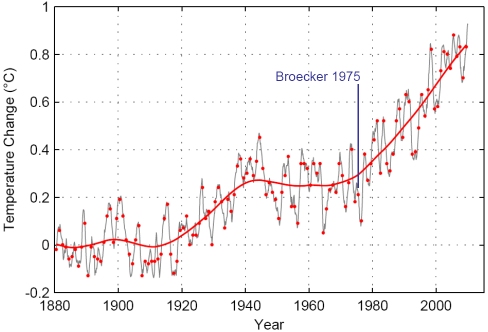
Global temperature up to June 2010 according to the NASA GISS data. Grey line is the 12-month running average, red dots are annual-mean values. The thick red line is a non-linear trend line. Broecker of course did not have these data available, not even up to 1975, since this global compilation was only put together in the late 1970s (Hansen et al. 1981). He had to rely on more limited meteorological data.
To those who even today claim that global warming is not predictable, the anniversary of Broecker’s paper is a reminder that global warming was actually predicted before it became evident in the global temperature records over a decade later (when Jim Hansen in 1988 famously stated that “global warming is here”).
Broecker is one of the great climatologists of the 20th Century: few would match his record of 400 scientific papers, a full sixty of which have over 100 citations each! Interestingly, his “global warming” paper is not amongst those highly-cited ones, with “only” 79 citations to date. Broecker is most famous for his extensive work on paleoclimate and ocean geochemistry.
It is very instructive to see how Broecker arrived at his predictions back in 1975 – not least because even today, many lay people incorrectly assume that we attribute global warming to CO2 basically because temperature and CO2 levels have both gone up and thus correlate. Broecker came to his prediction at a time when CO2 had been going up but temperatures had been going down for decades – but Broecker (like most other climate scientists at the time, and today) understood the basic physics of the issue.
Basically his prediction involved just three simple steps that in essence are still used today.
Step 1: Predict future emissions
Broecker simply assumed a growth in fossil fuel CO2 emissions of 3% per year from 1975 onwards. With that, he arrived at cumulative fossil CO2 emissions of 1.67 trillion tons by the year 2010 (see his Table 1). Not bad: the actual emissions turned out to be about 1.3 trillion tons (Canadell et al, PNAS 2007 – estimate extended to 2010 by me).
A shortcoming, from the modern point of view, is that Broecker did not include other anthropogenic greenhouse gases or aerosol particles in his calculations. He does however discuss aerosols, which he calls “dust”. In fact, the first sentence of the abstract (quoted above) in full starts with an if-statement:
If man-made dust is unimportant as a major cause of climate change, then a strong case can be made that the present cooling trend will, within a decade or so, give way to a pronounced warming induced by carbon dioxide.
That is a nod to the discussion about aerosol-induced cooling in the early 1970s. Broecker rightly writes:
It is difficult to determine the significance of the next most important climatic effect induced by man, “dust”, because of uncertainties with regard to the amount, the optical properties and the distribution of man-made particles,
citing a number of papers by Steve Schneider and others. Because he cannot quantify it, he leaves out this effect. Here luck was on Broecker’s side: the warming by other greenhouse gases and the cooling by aerosols largely cancel today, so considering only CO2 leads to almost the same radiative forcing as considering all anthropogenic effects on climate (see IPCC AR4, Fig. SPM.2).
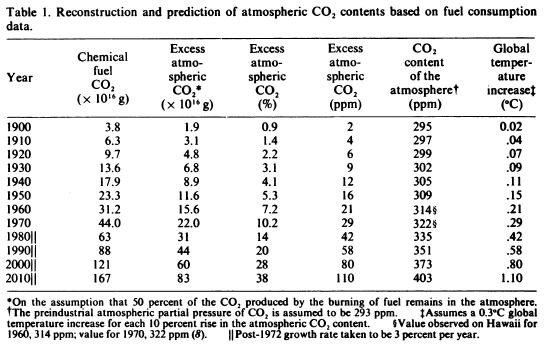
Table 1 of Broecker (1975)
Step 2: Predict future concentrations
To go from the amount of CO2 emitted to the actual increase in the atmosphere, one needs to know what fraction of the emissions remains in the air: the “airborne fraction”. Broecker simply assumed, based on past data of emissions and CO2 concentrations (Keeling’s Mauna Loa curve), that the airborne fraction is a constant 50%. I.e., about half of our fossil fuel emissions accumulates in the atmosphere. That is still a good assumption today, if you look at the observed CO2 increase as fraction of fossil fuel emissions. Broecker calculated that about 35% of the emissions is taken up by the ocean and the other 15% by the biosphere (again not far from modern values, see Canadell et al.). On this basis he argued that if the ocean is the main sink, the airborne fraction would remain almost constant for the decades to come (his calculations extend to the year 2010).
Thus, with a 3% increase in emissions per year and 50% of that remaining airborne, it is easy to compute the increase in CO2 concentrations. He obtains an increase from 295 to 403 ppm from 1900 to 2010. The actual value in 2010 is 390 ppm, a little lower than Broecker estimated because his forecast cumulative emissions were a little too high.
Step 3: Compute the global temperature response
Now we come to the temperature response to increased CO2 concentration. Broecker writes:
The response of the global temperature to the atmospheric CO2 content is not linear. As the CO2 content of the atmosphere rises, the absorption of infrared radiation will “saturate” over an ever greater portion of the band. Rasool and Schneider point out that the temperature increases as the logarithm of the atmospheric CO2 concentration.
Based on this logarithmic relationship (still valid today) Broecker assumes a climate sensitivity of 0.3ºC warming for each 10% increase in CO2 concentration, which amounts to 2.2ºC warming for CO2 doubling. This is based on early calculations by Manabe and Wetherald. Broecker writes:
Although surprises may yet be in store for us when larger computers and better knowledge of cloud physics allow the next stage of modeling to be accomplished, the magnitude of the CO2 effect has probably been pinned down to within a factor of 2 to 4.
The AR4 gives the uncertainty range of climate sensitivity as 2-4.5ºC warming for CO2 doubling, so there still is about a factor of 2 uncertainty and Broecker used a value near the very low end of this uncertainty range. Modern estimates are not only based on model calculations but also on paleoclimatic and modern data; the AR4 lists 13 studies that constrain climate sensitivity in its table 9.3.
In Broecker’s paper the warming calculated with the help of climate sensitivity happens instantaneously. Today we know that the climate system responds with a time lag due to ocean thermal inertia. By neglecting this, Broecker overestimated the warming at any given time; accounting for thermal inertia would have reduced his warming estimate by about a third (see AR4 Fig. SPM.5). But again he was lucky: picking ~2ºC rather than the more likely ~3ºC climate sensitivity compensates roughly for this, so his 20th-Century warming of 0.8ºC is almost spot on (the actual estimate being closer to 0.7ºC, see Fig. above). (A modern version of this back-of-envelope warming calculation is found e.g. in our book Our Threatened Oceans, p.82.)
Natural Variability
Broecker was not the first to predict CO2-induced warming. In 1965, an expert report to US President Lyndon B. Johnson had warned: “By the year 2000, the increase in carbon dioxide will be close to 25%. This may be sufficient to produce measurable and perhaps marked changes in climate.” And in 1972, a more specific prediction similar to Broecker’s was published by the eminent atmospheric scientist J.S. Sawyer in Nature (for a history in a nutshell, see my newspaper column here).
The innovation of Broecker’s article – apart from introducing the term “global warming” – was in combining estimates of CO2 warming with natural variability. His main thesis was that a natural climatic cooling
has, over the last three decades, more than compensated for the warming effect produced by the CO2 [….] The present natural cooling will, however, bottom out during the next decade or so. Once this happens, the CO2 effect will tend to become a significant factor and by the first decade of the next century we may experience global temperatures warmer than any in the last 1000 years.
The latter turned out to be correct. The idea that the small cooling from the 1940s to 1970s is due to natural variability still cannot be ruled out, although more likely this is a smaller part of the explanation and the cooling is primarily due to the “dust” neglected by Broecker, i.e. due to the rise of anthropogenic aerosol pollution (Taylor and Penner, 1994). However, the way Broecker estimated and even predicted natural variability has not stood the test of time. He used data from the Camp Century ice core in Greenland, arguing that these “may give a picture of the natural fluctuations in global temperature over the last 1000 years”. Ironically, Broecker’s own later work on Atlantic ocean circulation changes showed that Greenland is likely even less representative of global temperature changes than most other places on Earth, it being strongly affected by variability in ocean heat transport (see our recent post on the Younger Dryas, or Broecker’s latest book The Great Ocean Conveyor). However, Broecker was right to conclude that the buildup of CO2 would sooner or later overwhelm such natural climate variations.
Overall, Broecker’s paper (together with that of Sawyer) shows that valid predictions of global warming were published in the 1970s in the top journals Science and Nature, and warming has been proceeding almost exactly as predicted for at least 35 years now. Some important aspects were not understood back then, like the role of greenhouse gases other than CO2, of aerosol particles and of ocean heat storage. That the predictions were almost spot-on involved an element of luck, since the neglected processes do not all affect the result in the same direction but partly cancel. Nevertheless, the basic fact that rising CO2 would cause a “pronounced global warming”, as Broecker put it, was well understood in the 1970s. In a 1979 TV interview, Steve Schneider rightly described this as a consensus amongst experts, with controversy remaining about the exact magnitude and effects.
Reference
BROECKER WS, 1975: CLIMATIC CHANGE – ARE WE ON BRINK OF A PRONOUNCED GLOBAL WARMING?
SCIENCE Volume 189, Pages 460-463.

Lynn,
This guy depends on eyeballing the charts, rather than reading the statistical analysis in the papers. He’s seeing what he wants to see.
If any list member might be interested in reading the primer-chapter on global warming I’ve drafted for my book on sea level rise, please let me know off-list at huntjanin@aol.com.
Two other draft chapters are also available – one discussing the IPCC, the other on why sea level rise is important.
Lynn 143, Doug 145, BPL 151:
My quick reading of the American “Thinker” blog science, and the Skeptical Science and Science of Doom rebuttals resulted in the 4 sentence summary below. I think this is about right but I’d be happy to hear if I totally misinterpreted the Skeptical Science and Science of Doom pieces.
It looks to me like Gary Thompson claimed that the models make a specific claim (namely that the OLR should decrease) that was contradicted by the data and that he had therefore “disproven AGW.” But, as the Skeptical Science and Science of Doom commentaries point out the models don’t actually make the prediction claimed by Gary Thompson consequently his argument is simply false. To know what the models predict requires fine scale vertical temperature and humidity profiles which are obtained from modeling. Thompson ignored all this and consequently his claim is just another Wizard of Oz character (i.e. a straw man) .
This is the fundamental problem with “blog science”. Nonsense gets “published” and it is very difficult to sort it out unless you’re an expert in the field. That’s why sites like RC, Science of Doom, Skeptical Science are so valuable. Now Thompson appears to be a reasonable character. If he is as reasonable as he appears to be he will flesh out his claims and try to publish them in a legitimate climate science journal.
How much did we spend on the present and what would have happened if we hadn’t spent a dime on the whole shebang?
Spanish National Meteorogical Agency: Under a “medium emissions” scenario, Spain would get 3-6C (5-11 degrees Fahrenheit) hotter and lose 70-85% of its rainfall this century: http://bit.ly/Spa2100
Welcome back, ReCAPTCHA.
When G Rowatt (#154) asked “what would have happened if we hadn’t spent a dime on the whole shebang” — the shebang being the scientific study of global warming, one presumes? — ReCAPTCHA immediately came up with this answer:
“sleeping charring”
I thought we had left ‘global warming’ in the past and substituted ‘climate change in its place,simply averageing out global temperatures and saying they are rising tells us nothing and oversimplifies a complex situation[as with recent arctic/european cooling [gives amunition to the climate sceptics].
#150–
You are welcome, John. (And thanks for all that you are doing on an ongoing basis!)
You are certainly right about the burn rates, as you put it–IIRC, Arrhenius–and perhaps even Callendar?–did not envision the exponential growth in emissions actually observed.
Also, though, neither man had experienced the “ecological revolution”–the shift in paradigm which made many more of us aware of how deeply linked apparently disparate natural phenomena can be–especially in the biological sphere. If you just look at first-order effects of warming, it may not “look” too bad.
Certainly, I fairly regularly encounter folks online whose imagination of GW pretty much stops with the immediate effect of a couple of degrees–that just seems like a negligible amount to them. Who cares (they think) if it’s 32 C instead of just 30? They don’t stop to think about (for example) how far geographically that might shift climate zones, and how easy or hard it might be for vegetation to follow.
And it’s a whole different conceptual framework again to ask about predator/prey relationships, temporal shifts in migration, fruiting or hibernation patterns, or even (shifting back to the meteorological sphere) second-order effects such as changes in precipitation.
Certainly Arrhenius was NOT lacking in imagination–if you know his story at all, that’s an understatement monumental enough to be funny!–nor was Callendar. But one can’t expect even such exceptional minds to anticipate everything the next couple of generations come up with. We live in a very different conceptual space today than did people of the early 20th century.
(Hmm, is Captcha hinting I’ve gone on too long? “yield: pettifog”!)
#157 donald moore
Global warming causes climate change and it is very complex. I don’t think anyone here is for oversimplifying anything?
“Things should be made as simple as possible, but not any simpler”
Einstein
The denialist side loves to oversimplify though. I asked someone on Revkin’s blog two days ago if he thought it was warming or cooling. Here was his reply:
“JD Probably a little warmer. So what. If there are any issues 100 years from now, they will be geoengineered away.”
Now that’s an oversimplification?
—
Fee & Dividend: Our best chance – Learn the Issue – Sign the Petition
A Climate Minute: The Natural Cycle – The Greenhouse Effect – History of Climate Science – Arctic Ice Melt
Nagraj Adve (#138):
Ramanathan and Feng equate stabilization at constant concentration with “commitment”. That “committed” warming is larger than the case of eventual zero emission. See the article here Climate Change Commitment II by Gavin on 2 June 2010.
It is a big challenge to achieve eventual zero emission, of course.
I have a question for big Joe Romm. It is widely accepted in the science community that we had 7,000ppm of co2 in the atmosphere during the time of the dinosaurs. We now have 385ppm.
First question: Where did all of that co2 go? Did the oceans absorb most of it? If so, why are we worrying about 385ppm, which is such a smaller number. Also, there is an argument that we are adding co2 at a very fast rate. I think this is probably false. Consider that dinosaur excrement gave off massive amounts of methane, which may have triggered carbon sinks to release massive amounts of co2.
2. Carbon Dioxide has existed on earth for billions of years. It took scientists centuries to figure out how fire worked. Many believed that a chemical known as “phlogiston” was released. Mr. Romm, I think you should consider the reprecussions of a sustained drop in global temperatures over a period of several years. If this happens, you will be shown no mercy, and rightfully so. It is hard for me to believe that you have so much confidence in global warming theory considering that it is a vastly more complex issue than how “fire” is created.
[Response: Good point, I’ve made a note of that.–Jim]
Conclusion:
I want everyone to remember that average co2 levels throughout earth’s history are higher than the level we are at today. We had 7,000ppm of co2 and now…385. This is a tremendous difference and it is important to remember that this was achieved by nature, not man. Nature put a ton of co2 into the atmosphere and nature removed it. I will leave everyone with a question:
Since the earth was able to remove massive amounts of co2, why then, can it not remove a much smaller amount? Are we to believe that the earth cannot do something it has already done, and on a much smaller scale?
Cheers,
Dr. Shooshmon
[edit – no games please]
Dear Dr. Shooshmon,
I agree wholeheartedly with your comment on the levels of co2 on earth. What I so not understand is why people are convinced global warming is manmade if the levels of co2 and global temperature have been long before people were around.
[Response: “Dr. Shooshmon” is not even even sure which blog he is at. The answer to your question is simple: the fact that other physical causes of climate change do exist, have operated in the past, and will do so in the future, does not negate the very solidly supported conclusion that greenhouse gases, varying in the range of concentrations they have over the recent past and present, can also do so. Start reading.–Jim]
shooshmon@161 — Recent evidence has made me very skeptical indeed of claims of CO2 concentrations much exceeding 1000 ppm at any time in the past nearly 4 billion years.
As for eliminating CO2, weatherizing rock has removed CO2 faster than new sources supplied for most of the past 45 million years or so. For or current dilema and the time scales involved, do read David Archer’s “The Long Thaw”.
shooshman
– The age of the Dinosaurs was the Mesozoic (higher CO2 amount, but probably nowhere near 7000 ppm), not the early Paleozoic (for which, 7000 ppm is an upper-end estimate)
(also for your interest, the sun gets significantly brighter over 100s of millions of years; there is continental drift and orogenies and erosion, biological evolution; even the coriolis effect, the tides, and the periods of the Milankovitch cycles change over 100s of millions of years)
– Different processes become omore or less important on different time scales. Natural processes (if we don’t get to it first) almost certainly will absorb anthropogenic CO2 emissions, but they won’t do so overnight.
When some amount of CO2 is dumped into the atmosphere from fossil fuels, it increases the total C of the atmosphere + biomass and soil + upper ocean + rest of ocean. The amount in the atmosphere decreases as it spreads out to these other reservoirs, but this spreading occurs on different timescales – it happens relatively quickly between the atmosphere and upper ocean; hence the rate of CO2 increase in the atmosphere has been significantly less than 100 % of the ongoing anthropogenic emission rate. This by itself can’t remove all the additional CO2 from the atmosphere, and it is limited by the supply of ions to the water…
(from dissolution of carbonate minerals (buffers pH) and chemical weathering (I presume that also increases pH) – the later supplies ions to feed the formation of carbonate minerals and is thus required for inorganic C geologic sequestration, but both increase the amount of CO2 the water can hold (I think for a given partial pressure, etc … I don’t know all the details of that but I have a general understanding sufficient for this comment; dissolved CaCO3 is Ca ions and CO3 ions, the later reacts with dissolved CO2 to form HCO3 ions (bicarbonate); the supply of Ca ions from chemical weathering allows CaCO3 precipitation with net removal of CO2 from air)
…; the spreading of CO2 from the upper ocean to the deeper ocean takes CO2 out of both the upper ocean and atmosphere (as CO2 is removed from the atmosphere), but the oceanic overturning required takes on the order of 1000 years.
(There can also be some spreading of CO2 into biomass+soil, but the effect is also limited – biomass+soil C won’t simply increase until the atmospheric level returns to a previous value.)
And then their’s the timescale of carbonate mineral dissolution that allows the ocean to hold more inorganic C while buffering the pH – hence, short term massive fluxes of CO2 into the atmosphere from other than the ocean itself will perturb the pH of the water for a time.
The timescale of removal of inorganic C from the whole atmosphere+ocean takes even longer, though it is fast enough to account for the variation in CO2 on the geologic timescales you refered to (it’s rate also responds to climate, with the ability (depending on geography and CO2 itself and probably some other things) to act as a negative feedback (with possible exceptions, such as glacial enhancement of chemical weathering) (and to stabilize the atmospheric+ocean+surface organi C amount, to an equilibrium value depending in part on fluctuations in geologic emission) – this negative feedback could help stabilize the climate on long timescales but is typically ineffective on shorter timescales – it was not able to prevent the ice age – interglacial variations, for example).
Of course, there are also shorter-term climate feedbacks on the C cycles to consider.
Bottom line – the Earth in some millions of years’ time from now probably won’t look drastically different one way or another based on human actions over the next few hundred years…
(? – butterfly effects and, very hopefully, ongoing existence of human civilization, aside – there is of course the recovery time from an extinction event if it gets that bad, afterwhich the result might be broadly similar, or not, but different in details, of course (the biological climate might stay similar even if the specifics of biological weather are completely different …))
… but that’s not the primary concern for policymaking or even scientific study of AGW/ACC.
Are we to believe that the earth cannot do something it has already done
– yes, of course, adding more greenhouse gases to the atmosphere should cause warming, and this would affect ecosystems, etc.
Maybe I’m being too generous here…but my impression was that “Dr.” Shoosmon’s long post was pure parody…and a cracking good parody of a denialist, at that! I found his (now edited) closing to be his way of letting us know that his tongue was firmly in cheek.
The damn CAPTCHA keeps putting letters and numbers over each other in ways that prevent me from getting it right. I’ve lost at least a dozen posts in the last few days. You need to fix this.
[Response: Use the audio version. Or alert us to specific posts and we can rescue them from the spam bin. – gavin]
Broecker’s paper may have been published in 1975, but you now how it is: We scienctists keep published “old news”.
If you look at the graph, the temperature kept going up from 1971-1974. No wonder Broecker “predicted” global warming. When I was a child in the early 1970s, I remember climatologist predicted a new ice age. It was based on the same graph. Apparently, one can predict whatever one likes. Or, the climate cannot be predicted upfront. What concerns me: I recently read about the plateauing of the T-graph since 1998. Is it true? If so, how can that be reconciled with the ongoing increase of CO2?
Dr P. Borger, biologist
[Response: Your memory isn’t quite accurate. Please read up on the facts of the matter. There’s an explanation of the 1970’s cooling myth here and the ‘global warming has stopped’ myth here]
@Chris : Indeed most depressing “Happy Birthday” ever.
But thanks realclimate for the perseverance. One day we’ll start having breakthroughs, like a positive Black Swan appearing out of nothing, in areas we didn’t expect, unpredictable like the fall of the USSR or the rise of the internet and most likely driven mostly by complex bottom-up forces instead of pure top-down actions (although both are needed).
Dr. P. Borger (@168) wrote:
“If you look at the graph, the temperature kept going up from 1971-1974. No wonder Broecker “predicted” global warming. When I was a child in the early 1970s, I remember climatologist predicted a new ice age. It was based on the same graph. ”
As Gavin said, your memory is a bit off here, Dr. Borger. You will note that the graph in question is credited to NASA GISS–ie., Gistemp. Obviously, this isn’t “the same graph” used by Broecker or for that matter by Kukla & Matthews or Rasool & Schneider. But perhaps you may have been thinking that the years since 1975 belong to the same dataset appropriately updated?
If so, I’m afraid you are quite mistaken. The Gistemp home page explains the history:
The basic GISS temperature analysis scheme was defined in the late 1970s by James Hansen when a method of estimating global temperature change was needed for comparison with one-dimensional global climate models. Prior temperature analyses, most notably those of Murray Mitchell, covered only 20-90°N latitudes. . . Our first published results [were] (Hansen et al. 1981). . .
So you see, the very dataset from which the present graph is drawn did not exist in 1975, much less earlier in the 70s, when concern about possible cooling was more current.
Re 169 Pieter – good climate/energy policy would actually encourage that. Bottom up responds to top down.
reCAPTCHA: Undine mercy.25
Barton Paul Levenson says: 5 August 2010 at 5:37 AM
The damn CAPTCHA keeps putting letters and numbers over each other in ways that prevent me from getting it right. I’ve lost at least a dozen posts in the last few days. You need to fix this.
BPL, for me using Firefox at least if I get it wrong I can hit the “back” button on the browser and my comment reappears along with a new challenge.
(this post survived the process, conducted as an experiment)
[Response: And of course, compose all comments in your text editor (Notepad etc), then copy/paste, takes only a couple extra seconds.–Jim]
Or highlight & copy in the editor window prior to attempting Captcha. It has always worked for me, provided I remember the step!
And if the proffered Captcha sample is ambiguous, click the little circling arrows (above the loudspeaker icon) and it’ll give you another; continue til one is readable; or the loudspeaker will read it out loud.
Dr. Shooshmon (#161):
1) Joe Romm is of about average size (and thus rarely goes by “Big Joe Romm” as you assert).
2) Joe’s website is Climate Progress. This is RealClimate. They are two different climate change blogs.
3) As the link below shows, it is not accepted by anyone, no matter how widely, that there was 7,000 ppm of CO2 during the time of the dinosaurs. As the graph below indicates, the high estimates peak just over 2000 ppm during this time (220 to 65 million years ago), with the average of the four graphs being closer to 1000 ppm.
http://en.wikipedia.org/wiki/File:Phanerozoic_Carbon_Dioxide.png
4) 7,000 ppm is conjecture by one of these four sources going back half a billion years, soon after complex life had formed, and 100 million years before plants and then other life forms evolved onto land.
5) The annual average concentration of CO2 is now 390, not 385 ppm. With methane and nitrous oxide, the CO2 equivalency is over 430 ppm.
6) The human burning of fossil fuels contributes 100 to 130 times the CO2 that volcanoes, the next largest source, contribute in an average year.
6) You write “Mr. Romm” but Joe has his PhD in physics from MIT, making him also a Dr.
7) You write “Consider that dinosaur excrement gave off massive amounts of methane, which may have triggered carbon sinks to release massive amounts of co2.”
One negative feedback that may have absorbed much of the CO2 spike from the PETM 55 million years ago was the formation of the Himalayas with all that new rock to absorb CO2 through weathering. Maybe our biggest hope this time is the Himalayan-sized heap of steaming dinosaur excrement in your comment.
Oh, and Happy Birthday and this is a great post. Nobel Prize winner Svante Arrhenius estimated a 9 degree Fahrenheit increase in temperature if CO2 doubled from pre-industrial 280 to 560 ppm in a now-famous paper he published in 1896. (Because he wrote in an even cooler than now Sweden, Arrhenius thought of global warming as a positive.)
I respect the German comments and their relatively (to our) far-sighted government adopting plans to address global warming in 1985.
The corresponding year in the U.S. and the rest of the world is 1988, when Hansen testified to Congress during a heat wave. (How does he orchestrate things like that and the Pinatubo eruption? How high do his connections go?) Also that was when the IPCC was formed. The U.S. had a very significant heat wave that summer that drove the point home, with the massive Yellowstone fire, etc.
The theory was in place from Arrhenius, Keeling and all the others mentioned here, with Broecker convinced by 1975 and Schneider by 1979, but anyone paying attention should have been convinced by 1988, with CO2 greenhouse effects overcoming aerosol effects beginning around 1975.
Of course as with Newton’s apple, Shooshmon’s stepping into dinosaur excrement alerted him to global warming in 499,997,990 BC.
Re #63, and Eric’s response to #10 (temperatures in North America)
Even if British Columbia would show a temperature increase in recent decades, for the whole of the US there is a flat curve for the period 1901-2000, with a trend value of 0.10 degrees F per decade. See monitoring data at http://www.ncdc.noaa.gov
NASA satellite pictures: Numerous forest fires in British Columbia. Double climate whammy: pine beetle survives soft winter, summer extremely dry and hot: http://bit.ly/BCfire
Moscow never reached 37C in 130 years of measurements, now 5th time in 12 days. Visibility 500 metre due to fires: http://bit.ly/HydMet
Over at SkepticalScience various folks have been digging into the cellar to find still-drinkable bottles of uncertainty made of mangled and then fermented interpretations of GCMs mostly produced in unsanitary conditions. Turns out almost everything’s gone to vinegar, quite undrinkable and refused forthwith if served and no wonder.
However, there are still some dusty bottles labeled “Clouds,” with vintages stretching back years.
Is there any chance that RealClimate could pull out a corkscrew, open some of these bottles and treat us to a sampling of where the issue of clouds and GCMs stands today? A flight with some expert comments would go down nicely at this point.
I find in reading those sites that say that climate problems are a myth that their evidence is very sparse and inconclusive. Recently I read Book 1 of the free e-book series “In Search of Utopia” (http://andgulliverreturns.info), it blasts their lack of evidence relative to several myths. The book, actually the last half of the book, takes on the skeptics in global warming, overpopulation, lack of fresh water, lack of food, and other areas where people deny the evidence. I strongly suggest that anyone wanting to see the whole picture read the book, at least the last half. There is also up to date information at:http://www.newscientist.com/article/dn11462-climate-change-a-guide-for-the-perplexed.html
The strange thing on this is we know it for past 35 years and we are doing almost nothing about it. When every day people change their habits and think environmentally friendly, why politicians don’t do the same? Whom they want to save? The Economy? To sell cool fresh unpolluted air and clean and healthy water or even food could be a good business…
if comments are still open for this I was interested by the contribtution of non CO2 greenhouse gas and aerosols. You say they cancel out but how long will this continue? What is the time in the atmosphere of these gases compared to aerosols? How long will aersols cancel them out if air pollution is reduced?