Eric Steig
Last July (2012), I heard from a colleagues working at the edge of the Greenland ice sheet, and from another colleague working up at the Summit. Both were independently writing to report the exceptional conditions they were witnessing. The first was that the bridge over the Watson river by the town of Kangerlussuaq, on the west coast of Greenland, was being breached by the high volumes of meltwater coming down from the ice sheet. The second was that there was a new melt layer forming at the highest point of the ice sheet, where it very rarely melts.
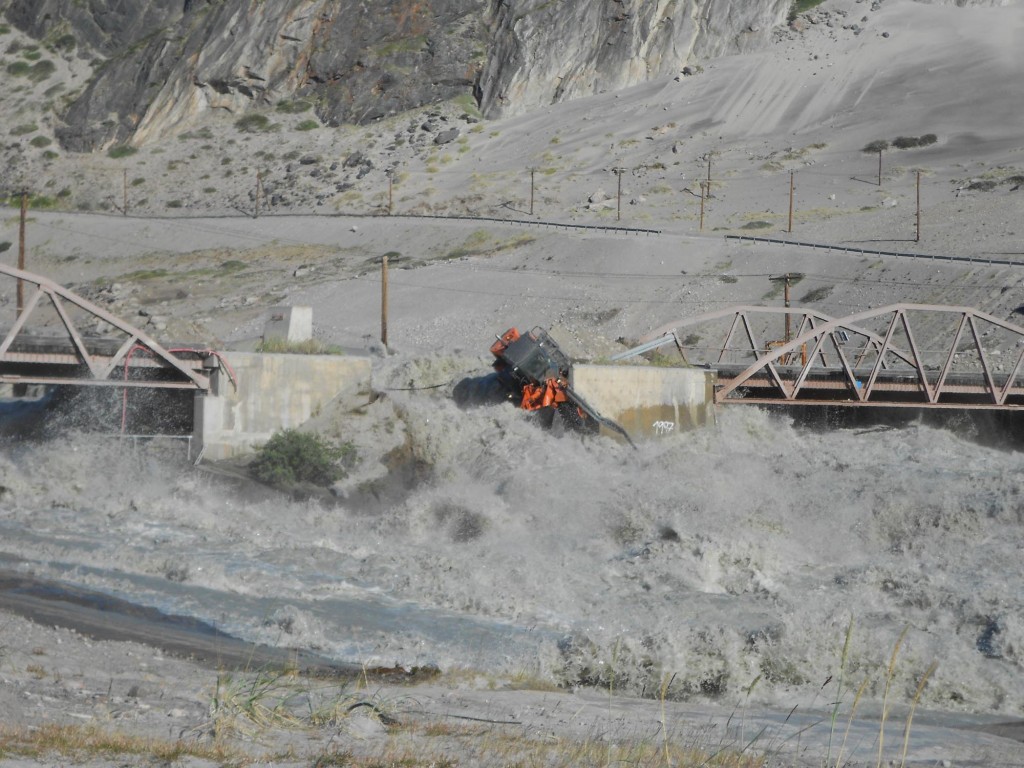
A front loader being swept off a bridge into the Watson River, Kangerlussuaq, Greenland, in July 2012. Fortunately, nobody was in it at the time. Photo: K. Choquette
I’ve been remiss in not writing about these observations until now. I’m prompted to do so by the publication in Nature today (January 23, 2013) of another new finding about Greenland melt. This paper isn’t about the modern climate, but about the climate of the last interglacial period. It has relevance to the modern situation though, a point to which I’ll return at the end of this post.
The new paper in Nature, Eemian interglacial reconstructed from a Greenland folded ice core (NEEM Community Members, (2013)) is the culmination of many years of work in Greenland led by Dorethe Dahl-Jensen and her team from the Centre for Ice and Climate at the Niels Bohr institute in Copenhagen, with substantial involvement of scientists from around Europe, the U.S., China, Japan, and Canada.*
The big news is that this group has managed to obtain and use the information in ice from the Eemian — the peak of the last interglacial period, about 125,000 years ago — in Greenland. Getting usable Eemian ice from Greenland has been a Holy Grail of ice core research for the better part of two decades. We thought, back in the early 1990s, that we had obtained Eemian ice in the GISP2 and GRIP ice cores drilled near the ice sheet summit. It turned out that the lowermost part — anything older than 100,000 years — was messed up by ice flow, making it impossible to learn anything much about climate from it. The Danish group then led a project further to the north at “North GRIP” that, based on radar-echo-sounding data, should have had an intact Eemian period. But the temperature at the base at NGRIP was higher than expected, and the Eemian ice had melted away.
The latest attempt was the “North Eemian” (NEEM) site in northeast Greenland. Here too, the initial results were disappointing. As at GISP2 and GRIP, there are folds in the ice, and some of the layers containing the ice of Eemian age are repeated several times. However, in this case the folds are very large, and there are continuous sections that are not scrambled; they are just a bit out of order. It took significant work, but the group has unfolded the data from the folded layers and it is now evident that the goal of the NEEM project– having an interpretable section of Eemian ice — has succeeded after all.
The findings are spectacular. In the Eemian ice, there is clear evidence of significant melting of what would then have been snow at the surface. The amount of air trapped in the ice undergoes rapid fluctuations, resulting from the fact that ice that melts and then refreezes generally winds up with fewer air bubbles in it than the original porous snow. There are also strong fluctuations observed in soluble gases such as N2O whereas variations in the oxygen isotope concentration — both in the molecular oxygen (O2) in the air and in the ice (H2O) itself — are small. The isotope concentration of the O2 can be matched to that in undisturbed ice from the same time period in ice cores from Antarctica, providing a way to date the ice, showing unambiguously that non-disturbed layers are preserved from the peak of the Eemian period, about 125,000 years ago.
Qualitatively, the evidence for melt in the NEEM Eemian ice shows that it was warm at the time. Obviously. But more interestingly, the last year of the NEEM project was 2012, and researchers were able to witness first hand what the formation of melt layers mean at NEEM in terms of the ambient conditions. In July 2012, the NEEM saw above-freezing temperatures for six consecutive days (10 to 15 July), with rain events on 11 and 13 July. When the water refroze, it formed several distinct, clear layers of ice (which we call a “melt layers”) between 5 and about 60 cm down in the snow, about 1 cm thick. This is a rare event. It was so warm over Greenland in that week that a significant melt layer also formed up at the Summit; in fact, the entire surface of the ice sheet was melting.
That hasn’t happened — not once — in the entire satellite record (see Jason Box’s excellent blog, meltfactor.org for more on this, and Marco Tedesco's paper.). In fact, examination of melt layer records from ice cores at Summit shows that a melt layer like the one that formed in 2012 was the most significant Greenland melt event since at least the late 19th century. If you drill about 100 m down into the ice and recover an ice core, you invariably find that layer, shown in the photo below (the bright line at which the person’s thumb is pointing).
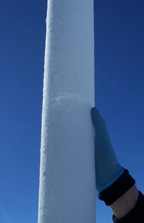 .Greenland ice core from ~80 m depth. E. Steig photo.
According to a recent paper on the 2012 melt by Nghiem et al., in Geophysical Research Letters, the 19th century event dates to 1889. One has to go back about 700 years to find the next such event, and overall, these are about once-in-250 year events over the last 4000 years. Prior to that, they occur more frequently — about once per century during the mid Holocene “climatic optimum”, when it was on average much warmer than present in Greenland in summer, due to the peak in Northern Hemisphere insolation due to changes in the earth’s orbit (Milankovitch forcing). Even during the mid-Holocene, though, there is no evidence from the ice cores that there was sufficient melting to create such strong anomalies in the air content and trace gas concentrations in the ice, as was observed in the Eemian in the NEEM ice. Thus, it was even warmer during Eemian than during the mid Holocene.
How much warmer was it? Jason Box estimates from satellite data that the temperature in July 2012 at high elevations over the Greenland ice sheet was a full 10°C (18°F) warmer than the daily average of the 2000′s decade; 1 standard deviation is about 3°C, so this is about a 3-sigma event. If, as the NEEM researchers estimate, the same sort of temperatures were required to produce the EEM melt layers, it suggests that during the EEM in Greenland it was also about 10°C warmer than present in the summer — but not just once per century, but much more often, perhaps every summer. I’m interpreting a bit here: the NEEM group doesn’t actually use the presence of melt layers per se to estimate the summer temperature; rather, they use the observation that the δ18O values of the ice at this time are >>-33 ‰. δ18O is a proxy for temperature in Greenland ice, and the NEEM paper uses this to estimate that the temperature must have been about 8°C (+/-4°C) warmer than present. Not coincidentally, the δ18O values of the snow and rain that fell in July 2012 was also >-33 ‰.
None of this should be interpreted to suggest that we are in “Eemian-like” conditions just yet. After all, there has only been one Eemian-like melt event observed in modern times, and the extremely warm summer of 2012 clearly involved anomalous weather conditions — a particular pattern of pressure anomalies over the northern high latitudes (Marco Tedesco's paper) that may also partly account for the exceptional low sea ice cover that year. The 2012 event, however, gives us a flavor of what the future is likely to bring. It will be very interesting to watch the satellite imagery over Greenland in the next decade and beyond.
What are the implications for the Greenland ice sheet? Possibly, that it is less sensitive to climate warming than some of the higher-end estimates suggest (e.g. Cuffey and Marshall (2000) suggested Greenland could have contributed > ~4 m to EEM sea level), though very much in line with more recent estimates (e.g. Pfeffer et al. (2008)). The estimated temperature change of ~8°C is quite a bit warmer than most previous estimates which are more in the range of 2-5°C (though the uncertainty estimates clearly overlap). Thus, whatever the contribution of mass loss from the Greenland ice sheet to the huge (4-8 m) rise in sea level of the Eemian, it occurred under very strong temperature forcing.
The presence of Eemian ice at the NEEM site itself places constraints on the ice sheet configuration. It obviously rules out any configuration in which this area of the Greenland ice sheet was gone. That typically occurs in ice-sheet model simulations that involve more than about 2 m of sea-level-equivalent mass loss. Thus, the NEEM ice core record suggests both that temperatures may have been warmer than once thought, and and that the ice sheet mass loss was unlikely to have been >2 m of sea level.
The new data from the NEEM ice core may also point to a lower limit on the magnitude of the Eemian sea level contribution from Greenland. Evidently, it can become very warm indeed over Greenland — much warmer than most previous modeling exercises have considered. Combined climate/ice sheet model estimates in which the Greenland surface temperature was as high during the Eemian as indicated by the NEEM ice core record suggest that loss of less than about 1 m sea level equivalent is very unlikely (e.g. Robinson et al. (2011).
There are caveats of course — the new data is just from one site, and estimates of the total ice loss don’t provide information about the rate at which that loss occurred. Still the new data show that Greenland, while evidently contributing significantly to Eemian sea level, cannot have contributed more than half the total — despite the strong forcing. This once again points to Antarctica as the major source of Eemian sea level rise. There are only about 3 m of sea level rise available from West Antarctica, and it remains unclear whether all of West Antarctica may have collapsed. On that subject, look for some more exciting ice core news in the near future, from a core at Roosevelt Island by a New Zealand led team.
Note: There is a nice summary of the implications of the paper on the Nature web site, though note that I’m pretty sure I didn’t say — or didn’t mean to say! — that “We are in a similar climate regime as the world was in the early Eemian,” as I am quoted. A key difference is that CO2 was not as high as today, but insolation forcing was much higher. So the analogy only goes so far. See the paper by van de Berg et al. Significant contribution of insolation to Eemian melting of the Greenland ice sheet for an in-depth discussion about these differences.
Update: The http://www.greenlandmelting.com/ website looks like a great resource for those interesting in following the modern melt progression in Greenland.
*There was also significant logistical support from the U.S. Air National Guard, who contract with the National Science Foundation to supply C130 Transport plane support for these kinds of projects.
References
- . , "Eemian interglacial reconstructed from a Greenland folded ice core", Nature, vol. 493, pp. 489-494, 2013. http://dx.doi.org/10.1038/nature11789
- M. Tedesco, X. Fettweis, T. Mote, J. Wahr, P. Alexander, J. Box, and B. Wouters, "Evidence and analysis of 2012 Greenland records from spaceborne observations, a regional climate model and reanalysis data", 2012. http://dx.doi.org/10.5194/tcd-6-4939-2012
- K.M. Cuffey, and S.J. Marshall, "Substantial contribution to sea-level rise during the last interglacial from the Greenland ice sheet", Nature, vol. 404, pp. 591-594, 2000. http://dx.doi.org/10.1038/35007053
- W.T. Pfeffer, J.T. Harper, and S. O'Neel, "Kinematic Constraints on Glacier Contributions to 21st-Century Sea-Level Rise", Science, vol. 321, pp. 1340-1343, 2008. http://dx.doi.org/10.1126/science.1159099
- A. Robinson, R. Calov, and A. Ganopolski, "Greenland ice sheet model parameters constrained using simulations of the Eemian Interglacial", Climate of the Past, vol. 7, pp. 381-396, 2011. http://dx.doi.org/10.5194/cp-7-381-2011
- W.J. van de Berg, M. van den Broeke, J. Ettema, E. van Meijgaard, and F. Kaspar, "Significant contribution of insolation to Eemian melting of the Greenland ice sheet", Nature Geoscience, vol. 4, pp. 679-683, 2011. http://dx.doi.org/10.1038/ngeo1245
Eric,
Thanks for the great article! Great addition to the Northern Hemispheric records…
P.S. The group in Wisconsin-Madison (led by Elizabeth Colville and Anders Carlson I think) has a couple-year-old paper looking at the presence or absence of Greenland ice in the last interglacial through the determination of sediment sources discharged from southern Greenland. They came to the same conclusions that Greenland couldn’t have caused more than maybe 2 m of sea level. But that means Antarctica had to contribute a significant fraction.
Eric, a big remaining issue seems to be the potential effect of warming currents on the outlet glaciers. Are you aware of any research characterizing those during the Eemian?
Also, re the 1889 event you say it’s found “invariably,” but by that do you mean that it’s found in all the cores? My understanding had been otherwise.
I have a few more questions but will read ref. 4 first.
Erratum: Pfeffer et al. (2008) isn’t more recent that Cuffey & Marshall (2010).
[Response: Cuffey and Marsall was actually 2000; now corrected. The melt layer I referred to is in every core I’ve ever seen. –eric]
Oops, I meant ref. 6.
Just to add, AFAICT ref. 5 doesn’t address currents.
Thank you!
Eric,
Very nice. One question. If Greenland could not contribute more than 2m to SLR, and there is only 3m of potential SLR present in WAIS, does that mean that East Antarctica was a major contributor?
[Response: Yes. Unless of course one takes the low-end estimates of SLR at the Eemian, and uses the high-end estimates of the WAIS and Greenland ice sheets. Then you can just balance it without East Antarctica.–eric]
Can someone explain to me how the surface elevation is derived from the data? I am not clear how this esitmate is made.
[Response: Air content data mostly. From the paper:
Before surface melt began between 128.5 and 126.7 kyr BP, the air content at the depositional site had a stable level of 85 ml kg−1 compared to the present level of 97.5 ml kg−1. When corrected for changing local summer insolation, the air content difference suggests a surface elevation at the depositional site 540 ± 300 m higher at the onset of the Eemian (128 kyr BP) than the surface elevation at NEEM today.
The paper goes on to discuss the corrections for ice flow, which are significant, because the ice at the bottom flowed from a site that was higher. So the actual elevation change they estimate is about 200 m (with a big plus/minus of 350 m!). -eric]
Great article, Eric. Thank you.
What really baffles me is in the Milankovitch cycles, Antarctica seems to respond stronger to Arctic summer insolation (peaking in the Eemian) rather than to its own summer insolation (which was at a minimum during the Eemian).
And during the glacial periods, when Milankovitch cycles minimize summer insolation over the Arctic and maximize summer insolation over the Southern Hemisphere, Antarctica is gaining ice mass.
Is there a logical explanation for why Antarctica seems to respond opposite from what its own summer insolation suggests ?
[Response: Classic answer to this is CO2. MOre complex answer is that it ain’t just summer insolation intensity, but actually the radiation balance, which actually does peak locally (in Southern Hemisphere) at the right time. See Huybers and Denton, 2008, “Antarctic temperature at orbital timescales controlled by local summer duration”. However, the magnitude of observed change isn’t fully explained either way. So this is still an open question.–eric]
Thanks Eric for this detailed, yet accessible explanation of the findings and implications. But I am not sure if this is good news or bad news, regarding the stability of West and East Antarctica. I guess from an adaptation perspective, a steady & more predictable SLR contribution from Greenland is preferable than a much-harder to predict, potentially faster contribution from Antarctica. :/
Just a small detail I noticed. You say that Greenland “is less sensitive to climate warming than some of the higher-end estimates suggest … though very much in line with more recent estimates (e.g. Pfeffer et al. (2008)).”
However, Pfeffer et al 2008 do not assess the possible contribution from the Eemian-period, or even Eemian-type conditions. They only assess the potential contribution over the 21th century. Even a much slower rate of mass loss from Greenland could potentially yield several meters of SLR over centuries, I suppose.
[Response: Agreed. My point in citing Pfeffer et al is simply that they do not believe the sensitivity can be as high as some (e.g. Hansen) have implied. But you are right that it’s a bit apples and oranges, because even low sensitivity could give you lots of melt if you have enough time. This is almost ceratinly what happened during Marine Isotope Stage 11 (~400,000 years ago), when it wasn’t any warmer than today (probably), yet the entire ice sheet may well have been gone. (you can read about stage 11 in Greenland here, where we are discussing a paper by Anne de Vernal and Claude Hillaire-Marcel, here–eric]
Another question, less basic : Do Antarctic ice cores also show melting events similar to what is found in the Greenland cores over the Holocene?
[Response: Nope. Too cold in most places. And the warmer places where there have been cores drilled (e.g. Antarctic Peninsula) don’t have ice of that (Eemian) age. Wait to see results from Fletcher Peninsula (on the Ant. Penin) though, currently being drilled by a British team. We may see very interesting things there.—eric]
Greenland Ice Cores Reveal Warm Climate of the Past
http://www.sciencedaily.com/releases/2013/01/130123133612.htm
adds a little, especially the graphic.
Thanks for reporting on this really important paper.
It seems very significant that the +6-7C for 127-121ky matches extremely clsely +6C for Antarctica from Sime’s paper http://www.nature.com/nature/journal/v462/n7271/full/nature08564.html.
This to me, does seem to be highly indicative a global temperature rise at that time (+3C using 2:1), not purely a local insolation effect.
Also I wonder what the implications for Arctic sea ice at such temperatures ?
It would seem there would be a very dramatic reduction given the level of temperature sensitivity that has been observed recently.
Justin Gillis at NYT touched on this issue a bit the other day, with article in Science Times and Green Blog there and while the concept of polar cities is gaining traction year by year, now comes this — vprivate email ….re Richard Alley mentioned in GILLIS temps rise article tells me today THIS: — danny
http://pcillu101.blogspot.com
Dear Danny,
I presume that you are familiar with this one? Not an assessed result
yet, just one paper
Sincerely,
http://www.pnas.org/content/early/2010/04/26/0913352107.abstract
An adaptability limit to climate change due to heat stress —
Steven C. Sherwood, and Matthew Huber
I just finished reading “The Whole Story of Climate” by E. Kirsten Peters. She shows the ice core temperature curves for the past 400,000 years and says to notice the sudden jagged lurches up and down. She says that the climate acts like a drunk walking down the street. It can fall in any direction at any time, so you can’t predict it just because you know that CO2 is increasing.
What is your take on E. Kirsten Peters? Are there reasons for those sudden changes or is it purely chaos? E. Kirsten Peters seems sometimes to be slightly denialist but then not. I think she may have a point that there could be a lot of chaos involved, but there could instead be reasons for lurches that we cannot find because “the trail has gone cold.”
E. Kirsten Peters says that some of the lurches happen as fast as 3 years from hot to cold or cold to hot. So we have been lucky, but she also says that agriculture, especially rice farming, supplied just enough CO2 to prevent a slide into major glaciation. That seems to be a contradiction of her other statement. So maybe we can engineer a stable climate. But at the end of the book, she says that we should learn to live with instability.
???
[Response: Haven’t read the book, but my impression from write-ups about it is that she falls into the confused trap of thinking “other things affect climate, so CO2 can’t be important”. That’s just plain silly. The analogy with a drunk in the street is fine for natural climate variability, but the relevant point would then be that there is a car about to run him down, which rather changes the situation. –eric]
Two typos:
1. “about climate form it” to “about climate from it”.
2. “Eeemian” to “Eemian”
[Response: Thanks; fixed! –eric]
Another important caveat worth mentioning is that the warming during the Eemian occurred over many centuries, with global surface temp likely no more than 1 degree C above pre-industrial.
We are seeing significant changes in Greenland ice melt with ~0.8C rise in just a few decades.
The more I learn about the Eemian, the more I shudder.
Nice commentary on the new NEEM results Eric! However, if you look at Born & Nisancioglu, TC, 2012 you will notice that 4m of Greenland ice melt during EEM does not require a significant lowering of the ice surface at the NEEM ice core site. Unlike previous model studies we find that the northern most part of the Greenland ice sheet is particularly sensitive to a warm interglacial climate.
http://www.the-cryosphere.net/6/1239/2012/tc-6-1239-2012.html
[Response: Thanks Kerim. That’s really interesting, and probably deserves another post.–eric]
Steve Brown –
Actually, I see this as fairly good news, in that is shows that rapid collapse of the GIS is unlikely. A response based on in-situ melting would at least have the virtue of being slow on human timescales.
On the other hand, it does point a finger at the WAIS as a bigger source of variability.
And all of these studies are looking at the results of orbital forcing, not CO2-forcing. My impression (anyone feel free to correct) is that orbital forcing means more sunlight – basically higher daytime temperatures and warmer summers. GHG forcing is more about higher nighttime/winter temperatures, with polar amplification. This does mean that prior interglacials are not a perfect analog for current warming.
Thank you for an excellent post. I am reading the article, and this is really good reference.
Andrew Dodds – It may be some good news for the estimate of the Greenland sea-level contribution, but there is good evidence that there was 6-9m of sea level rise around the Eemian climatic optimum in tandem with a +1C global average surface temp. The slight warming from the increase in N. Hemisphere insolation was amplified by the ice-albedo feedback loop. We are getting similar ice-albedo feedback warming from GHG forcing with at least +2C coming our way in the next century and only the thermal inertia of the ice-caps to act as a buffer.
Will any of those who are not among the banned wander over to Tony’s place and point (gently of course) to the creative editing that leads his readers astray?
[Response: Who? ;) –eric]
Eric, good write up. I would like to point out, however, that a study of ours reached the same conclusions reached by the NEEM project, which we published in 2011 in the journal Science (Colville et al., 2011, Science, v. 333, p. 620-623). Using marine sediment archives, we showed that a substantial Greenland Ice Sheet had to persist through the last interglaciation, contributing only 1.6-2.2 m to the sea level high stand of >4 m. From this data, we concluded that the Antarctic Ice Sheet had to contribute >1 m to the high stand (after accounting for ocean thermal expansion and Arctic ice cap contributions). It is reassuring to see that a later study using an entirely different geologic archive has arrived at the same conclusions as our study.
[Response: Indeed. I did not mean to imply that this was a “first”. It is merely a “first” with ice core data. –eric]
> [Response: Who? ;) –eric]
You had to ask! Someone there just invited the whole gang here to help explain your papers.
I haven’t read the article yet, so forgive my ignorance. The rebound of the earth’s crust under Greenland was surely taken into account by these researchers when figuring melt volumes. That means that the more agressive melting likely under future higher temps and the lack of time for rebound may result in lower ice sheet elevations than seen during the Eemian despite equal melting, thus leading to more melt?
Though the temperature difference between winter and summer would be greater under the NH solar-forced Eemian Greeland melting regime. Meaning what? Less melting today even though average yearly temps in Greenland may eventually be equal to the Eemian’s? You’re post today is very interesting, but I don’t have the knowledge to fill in the gaps.
Edward Greisch @14 — I know E. Kirsten Peters. While she has written some highly entertaining detective stories, I fear her (quite good) understanding of geology has not carried over to a particularly good book on climate. In particular, I’ll state that she doesn’t seem to understand D-O events including just how localized to the far north those were.
[Response: Indeed, the rapid warming D-O events centered on the N. Atlantic region are often assumed (or prentended) to be global (which is totally wrong) by people trying to make claims without learning anything first. Don Easterbrook comes to mind. –eric]
Another typo? “I’m prompted to do so by the publication in Nature today (January 23, 2012) of another new finding about Greenland melt. “
[Response: That would explain my cheques bouncing! –eric]
Puzzling over “A key difference is that CO2 was not as high as today, but insolation forcing was much higher.”
What might this mean, more or less melt should be expected? More summer insolation means less in winter; so, you might expect more extreme temperature differences between winter and summer. More CO2 means less differences between summer and winter, as well as less diurnal differences. I’m thinking insolation and CO2 work on different functions, and it probably would not be possible to categorically say one is more or less. Under higher insolation conditions, summertime highs could lead to more frequent melt events without drastically changing the mean annual temperature.
I don’t suppose it is possible to detect differences in O18 within a year. If not, it may be difficult to tell the difference between generally warmer conditions, or just very warm summers. Is there a bias in how much precipitation falls in winter versus summer?
Just puzzling.
[Response: Please read the paper, or at least the abstract below. The key point is that direct solar radiation can provide lots of heat to surface, without the ambient air temperature being high. Go outside on a calm, cold, but very sunny day, and you’ll get a sense of this. It turns out that these sorts of details matter. Here’s another sort of striking comparison, to illustrate the point about insolation. CO2 forcing today is only ~2 W/m^2. Insolation forcing at the peak of the Eemian was ~40 W/m^2 in midsummer.
Abstract from van de Berg et al.:
During the Eemian interglacial period, 130,000 to 114,000 years ago, the volume of the Greenland ice sheet was about 30–60% smaller than the present-day volume. Summer temperatures in the Arctic region were about 2–4 K higher than today, leading to the suggestion that Eemian conditions could be considered an analogue for future warming, particularly for the future stability of the Greenland ice sheet. However, Northern Hemisphere insolation was much higher during the Eemian than today, which could affect the reliability of this analogy. Here we use a high-resolution regional climate model with a realistic ice-sheet surface representation to assess the surface mass balance of the Greenland ice sheet during the Eemian. Our simulations show that Eemian climate led to an 83% lower surface mass balance, compared with the preindustrial simulation. Our sensitivity experiments show that only about 55% of this change in surface mass balance can be attributed to higher ambient temperatures, with the remaining 45% caused by higher insolation and associated nonlinear feedbacks. We show that temperature–melt relations are dependent on changes in insolation. Hence, we suggest that projections of future Greenland ice loss on the basis of Eemian temperature–melt relations may overestimate the future vulnerability of the ice sheet.
–eric]
Eli ‘the most esalted’ Rabitt asked: “Will any of those who are not among the banned…”. Went there anyway. Won’t repeat the garbage sent here in the science site.
Eric writes, inline #27:
“CO2 forcing today is only ~2 W/m^2. Insolation forcing at the peak of the Eemian was ~40 W/m^2 in midsummer.”
But averaged over the globe this difference is much smaller, or zero, right? What would that mean for (regional) ocean temps then and now, and for their potential impact on GIS melting?
Picking up on Chris G’s comment….
I am curious whether whether ice core temperature estimates can be biassed high (perhaps significantly) due to higher amounts of summer vs winter precipitation.
This is particularly important in interglacials where the orbital configuration provides the greatest potential difference both between temperatures and hydrological cycle comparing summer to winter.
What are the assumptions used regarding the relative amount of summer and winter precipitation ?
One clarification: the abstract said 8 C warmer than the average of the last millennium. That average is significantly different than the present temperature (say over the last decade). Their baseline is going to look a lot more like what we take to be pre-industrial.
Ignoring the interesting issues related to surface temperature energy transfer compared to radiative transfer from insolation (which ought to account for albedo effects before comparing 2 W/m^2 with 40 W/m^2), a naive approach would be to adjust the temperature difference for the lapse rate from 8 C to 7 C and divide by 2 to account for Arctic amplification to get 3.5 C as the comparable global average warming above pre-industrial. Since BAU takes us well beyond that level of warming, feeling sanguine about future ice mass loss in response to these findings seems unsupported.
Prof. Steig writes:
” CO2 forcing today is only ~2 W/m^2. Insolation forcing at the peak of the Eemian was ~40 W/m^2 in midsummer. ”
Is it not true that the 2W/m^2 CO2 forcing operates _all the time_ including in winter and at night ? What are the integrated effects of the Eemian insolation forcing as compared to current CO2 forcing over the entire year ? I have a rudimentary calculation for this, but I would appreciate detail.
sidd
[Response: Yes, of course. The mean annual change in insolation at the Eemian is tiny (haven’t looked it up but probably less 0.5 W/m^2). But we’re talking about melting, which is a summertime phenom, so the comparison I made is the most relevant one. Again, take a look at the paper I linked to in Nature Geosci. about insolation vs. temperature on ice surface mass balance..–eric]
Not discussed is that during the Eemian and Holocene, climate/weather was subject to much lower forcing then currently. And, during the Eemian and Holocene the level of forcing did not change as rapidly as ice sheet forcing has changed has over the last 30 years. With ongoing loss of Arctic sea ice, GIS forcing is likely to increase even more rapidly over the next 30 years.
Changes in atmospheric circulation patterns resulting from changes in Arctic Sea Ice were likely a major factor in the 2012 GIS Melt Event. Unless there is an abrupt recovery of Arctic Sea Ice resulting in global atmospheric circulation patterns reverting to patterns typical of the Holocene, major Greenland melt events are likely the new normal. However, because high rates of forcing increase the number of extreme events, the GIS could see a large number of large melt events long before the average temperature approaches that of the Eemian.
On Jan 23, 2013, as North America suffered intense cold, Ilulissat, Greenland was 41F. The day before it was 43F. The day before, it was 39F. The day before, it was 39F. Do I need to go on? For the most part these are not records, but mostly the records for these dates were set in the last 5 years. The 2007 sea ice melt was a sea change for the climate of Greenland. Record warmth, with the new records being broken every few years is the new normal for Greenland.
Eric Steig wrote:
” the rapid warming D-O events centered on the N. Atlantic region are often assumed (or prentended) to be global (which is totally wrong) by people trying to make claims without learning anything first. Don Easterbrook comes to mind.”
Didn’t Easterbrook provide evidence that supported his assertion of more widespread temperature increases from his own work with PNW glaciation? I am very curious what evidence you have that supports the statement that he is “totally wrong.”
[Response: Start here perhaps: https://www.realclimate.org/index.php/archives/2006/11/revealed-secrets-of-abrupt-climate-shifts/ –eric]
Eric, I am not trying to disparage the work of the team; I think it is a huge accomplishment. I’m simply trying to fill some holes in my understanding. And yes, I am familiar with the sensation of being warmed by the sun on a cold day, and, as Chris Dudley notes, I’m also aware that the magnitude of the effect is greatly affected by the albedo of the clothes I’m wearing.
Lennart van der Linde, cumfy, and Chris Dudley have already stated part of what was in my mind.
Other thoughts:
On insolation and surface melt. I was wondering about 18O ratios, which is influenced by temperature of the atmosphere, and if, as you say, the surface can be warmed without greatly affecting the atmosphere, then we are talking about different things. Also, I’ve not yet read where surface melt is directly linked to ice sheet mass loss.
If we are at 2 W/m^2 forcing currently, I think it is safe to say we will be somewhere more than that by the time we quit adding CO2 to the atmosphere. I’m more worried about where we are going than where we are, and I’m a little perturbed by the comparison of the insolation forcing unadjusted for ice albedo with the current forcing rather than probable future forcing. We are talking about potential future ice mass loss after all.
Glacial outflow. It is my understanding that warmer ice is less viscous than colder ice. I think you don’t have to go very many meters down to reach a level where the temperature stays pretty consistently correlated with the surface yearly average. So, I’m wondering if being slightly warmer year round might have more of an effect than being very warm in one season. I don’t know if winter would be any colder or not during periods of high summer insolation.
Precipitation bias. I don’t have access to the original article; so, I can’t tell if this was ferreted out with the climate model they used. For myself, I’m not going to guess whether there is a cool bias or a warm bias, but I do think it would be remarkable if the region received a uniform (or it least symmetric with hot and cold seasons) distribution of precipitation during a year. I doubt that a bias would be extreme enough to push the actual value outside of their confidence interval, but if it could be estimated, it would be interesting to know if the probability function were skewed toward the high or the low end.
Having said all that, this seems like a nice solid piece that is compatible with Greenland being more stable than Antarctica, or at least the WAIS. That seems to be the growing consensus.
Since this paper first came to notice by press release and Nature‘s online notice I’ve been looking at the headlines and stories in the larger media, gauging the reaction. There’s quite the spread of headlines on this story, many are quite extreme in the sense the headlines are communicating (though deliberate choice of words) that ice melt isn’t important anymore.
Combine these stories with today’s press release from the RCN:
http://www.eurekalert.org/pub_releases/2013-01/trco-gwl012513.php? , which taken out of context says there’s nothing to worry about, and those entities who want to scuttle any effort by the US government to take action on climate change have plenty of fodder the next few years by which to confuse the electorate.
Communicating science to the general public is difficult enough, given the audience’s lack of specialized language in the subject field, but stories about ice melt seem especially prone to confusing, and exaggerated, headlines. Maybe this is because most people can identify with “ice” versus more esoteric topics (cosmic rays, chaos, sulfates, etc.), and so media outlets run with stories about “ice”. I do know that popular communication on this topic is a mess.
GREENLAND
By ANKER WEIDICK
With a section on
LANDSAT IMAGES OF GREENLAND
By RICHARD S . WILLIAMS, Jr., and JANE G. FERRIGNO
SATELLITE IMAGE ATLAS OF GLACIERS OF THE WORLD
Edited by RICHARD S. WILLIAMS, Jr., and JANE G. FERRIGNO
U.S.GEOLOGICAL SURVEY PROFESSIONAL PAPER 1386 – C
http://pubs.usgs.gov/pp/p1386c/p1386c.pdf
was certainly worth looking through.
I found it helpful to compare the bedrock elevations:
http://nsidc.org/data/atlas/news/bedrock_elevation.html
Here is some nice stuff from Box and the usual suspects again
http://www.arctic.noaa.gov/reportcard/greenland_ice_sheet.html
I see that melting season is longer (27-45 days longer in S and NW Greenland), not so much just in full summer anymore
And I note that we have an empirical test coming up of Gregoire et al. (Nature, 487, 2012) seeing that ELA has exceeded saddle altitude at 67N
Fig 5.13 and Fig 5.14 ought to be compared with Gregoire Fig 3
I wonder if Gregoire et al. thought they would live to see this test ?
sidd
[Response: I’m not so sure the saddle you refer to is comparable in nature to the saddle across Hudson’s Bay that Gregoire et al. were modeling. Still, it is an interesting point. –eric]
Eric writes, inline @32:
“The mean annual change in insolation at the Eemian is tiny (haven’t looked it up but probably less 0.5 W/m^2). But we’re talking about melting, which is a summertime phenom, so the comparison I made is the most relevant one.”
Yes, but how about the potential influence of the oceans under strong CO2-forcing, such as today? Couldn’t that make up, at least in part, for the much smaller insolation? For example by melting arctic sea ice, by enhancing calving (as far as that goes) and by letting warmer air above the ocean reach GIS?
This seems to be the line of reasoning of Jim Hansen to explain how the higher Eemian insolation could today be compensated by higher global mean CO2 forcing still reaching GIS. How plausible is this reasoning?
[Response: All those processes are happening in reality, so Hansen is not wrong. I’m by no means saying that CO2 forcing can’t and won’t result in Greenland ice sheet mass loss. It probably has already, and certainly will in the next century. I’m merely saying that because the forcing (insolation vs. CO2) is very different, the Eemian really cannot be used as a direct analog. –eric]
What about the ocean thermal expansion during this period with +8°C ?
“The sea-level rise is about 0.1 meters per Celsius degree change in temperature for the top well-mixed 500 meters at the surface of the oceans. This mixing probably has a time constant for absorbing heat from the atmosphere of about a decade.
•The lower average depth of 3300 meters probably has a time constant for absorbing heat from the top layer of about 1000 years; heating it by one Celsius degree would raise the sea level by about 0.6 meters.”
http://www.roperld.com/science/sealevelvstemperature.htm
What about ocean thermal expansion during this period ?
+ 8°C in the Arctic, what does it means for global average temperature and for ocean thermal expansion ? +3 °C ?
3°C x 0.6 meters/°C = 1.8 meters. +4°C ? 2.4 meters.
Global sea leveal rise: + 4 – 6 meters
Greenland contribution: +2 meters (2013 study)
Expansion: +1.8 meters (or 2.4 meters)
Moutain glaciers: ?
Antarctica: ?
“The sea-level rise is about 0.1 meters per Celsius degree change in temperature for the top well-mixed 500 meters at the surface of the oceans. This mixing probably has a time constant for absorbing heat from the atmosphere of about a decade.
•The lower average depth of 3300 meters probably has a time constant for absorbing heat from the top layer of about 1000 years; heating it by one Celsius degree would raise the sea level by about 0.6 meters.”
http://www.roperld.com/science/sealevelvstemperature.htm
Does the article take into account the impact of contemporary anthropogenic soot on the albedo of Greenland and the Arctic? Isn’t anthropogenic soot half of the current warming problem in the Arctic?
Elisabeth (#41),
The global average temperature during the Eemian was similar to the pre-Anthropocene millennium though global average sea surface temperatures may have been slightly higher. The +8 C discussed here is for the extreme North, not the whole globe. http://en.wikipedia.org/wiki/Eemian
Prof. Steig: Fig 3 in Gregoire refers to the separation of the Laurentide and Cordilleran domes, not the domes around Hudson Bay, which are discussed later, but I agree that GRIS is not directly comparable to either. Nevertheless, it is interesting to note that just before separation of the two domes in Gregoire Fig. 3, saddle is dropping at 100m/yr over the last century. Fig. 5.14 in Box shows about 10 times smaller rate of altitude loss so we would be at the very beginning of the putative saddle collapse process.
It would be interesting to rerun the Gregoire model for GRIS with Glimmer-CISM for ice and MAR for forcing according to regional reconstruction, as in Tedesco, and see what happens.
sidd
gaa! Now I slip an order of mag. The correct statement is
“Fig. 5.14 in Box shows about 100 times smaller rate of altitude loss so we would be at the very beginning of the putative saddle collapse process.”
sidd
all rite, i officially cannot count. The Box graf shows 1m/10yr drop in altitude. The Gregoire paper shows 100m/yr over the last century of saddle collapse. That is _three orders_ of magnitude, not one or two.
Moderattors, please feel free to delete my first, incorrect, “correction.”
sidd
DarkSnowProject.org say
Is this relevant to the Greenland melt?
I think the answer to that question is the rationale for the DarkSnowProject’s existence
Box is looking for funding to collect and analyze the data.
I think the answer to that question is the rationale for the DarkSnowProject’s existence
Box is looking for funding to collect and analyze the data