France has a per capita carbon emission of 1.64 tonnes, compared to 2.67 tonnes for the U.K and 5.61 tonnes for the US. So, if anybody has earned the right to rest on their laurels and pontificate to the rest of the developed world about what they should be doing, you’d think it would be France. Far from it, under the leadership of Nicolas Sarkozy, France has embarked on an ambitious program of deeper carbon reductions. In introducing the measures, Sarkozy said "The guiding principle is that the cost to the climate — the carbon cost — will be integrated into planning of all major public projects, and into all deliberations affecting the public." These measures include: a commitment that all new buildings would be net energy producers by 2020, incandescent lighting would be banned by 2010, buyers of efficient vehicles would be subsidized, drivers of inefficient vehicles would be penalized, and road construction would be severely curtailed in favor of expanded rail travel using state-of-the-art French TGV technology. A carbon tax is also being seriously contemplated. These proposals are the result of an intensive months-long series of discussions with scientists and stakeholders such as environmental nongovernmental organizations, industry representatives, and labor union representatives. The process, known as Le Grenelle de l’Environnement, was described here by Nature (subscription required) and a summary of some of Sarkozy’s proposed actions was reported in the press here.
All the same, there has been some pushback from a vocal pair of highly decorated French academicians, Claude Allègre being the most prominent and noisiest of the two. In recent years, Vincent Courtillot has emerged as a reliable sidekick to Allègre — a Dupont to his Dupond — helping to propagate Allègre’s claims and adding a few of his own. Both are members of the Académie des Sciences, and Allègre has been awarded both the Crafoord Prize and Bowie Medal. Allègre has an impressive list of publications relating to the Earth’s interior, and besides that was Minister for Education, Research and Technology in the Jospin government. Courtillot — currently director of the Institut de Physique du Globe de Paris (IPGP) — has had a distinguished record of research on fundamental aspects of geomagnetism and is currently President of the Geomagnetism and Paleomagnetism Section of the American Geophysical Union. Their views were amply (some would say more than amply) represented at a symposium on the IPCC report, held last Spring at the Academie (See the issue "Evolution des Climats" of La Lettre de l’Académie des sciences, and press reports in Le Figaro, Le Monde, and Liberation). What does all this mean? Are the opinions of Allègre and Courtillot founded on some special profound insight that has escaped the notice of the community of scientists who have devoted entire careers to studying climate? Let’s take a look.
[NDT : les passages en italique sont en français dans le texte original]
Les émissions de carbone en France s’élèvent à 1,64 tonne par personne, contre 2,67 tonnes au Royaume Uni et 5,61 tonnes aux Etats Unis. Si un pays peut se targuer d’être vertueux, et faire la leçon aux autres pays développés, vous pourriez penser que ce serait la France. Loin de là, sous l’impulsion de Nicolas Sarkozy, la France s’est lancée dans un programme ambitieux de réduction des émissions de carbone. En présentant ces mesures, M. Sarkozy a déclaré : « Premier principe : tous les grands projets publics, toutes les décisions publiques seront désormais arbitrées en intégrant leur coût pour le climat, leur ‘coût en carbone’. » Ces mesures comprennent : l’engagement que tous les bâtiments construits en 2020 soient des producteurs nets d’énergie, l’interdiction des ampoules à incandescence à partir de 2010, des aides pour les acheteurs de véhicules les moins polluants, les conducteurs de véhicules les plus polluants étant au contraire taxés, et la construction de routes sera limitée pour favoriser les transports ferroviaires avec la technologie de pointe française du TGV ! Une taxe carbone est également envisagée. Ces propositions sont le fruit d’une intense série de discussions entre scientifiques et représentants de la société civile, dont des représentants d’organisations non-gouvernementales écologistes, d’organisations patronales et de syndicats. Ce processus, connu sous le nom de Grenelle de l’Environnement, a été décrit brièvement dans Nature ici (accès avec souscription), et un résumé par la presse des propositions d’actions de Sarkozy est ici.
Cependant, il y a une certaine résistance de la part d’un tandem bruyant de deux membres très décorés de l’Académie des Sciences française, Claude Allègre étant le plus médiatisé et tapageur des deux. Au cours des dernières années, Vincent Courtillot est apparu comme le fidèle compère d’Allègre –le Dupont de Dupond–, l’aidant à diffuser ses thèses, et en ajoutant aussi des personnelles. Tous deux sont membres de l’Académie des Sciences, et Allègre a reçu à la fois le prix Crafoord et la médaille Bowie. Allègre a une liste impressionnante d’articles ayant sujet à la Terre interne, et fut de plus le Ministre de l’Education Nationale, de la Recherche et de la Technologie sous le gouvernement Jospin. Courtillot –actuellement directeur de l’Institut de Physique du Globe de Paris (IPGP)– a un passé reconnu en recherche fondamentale sur le géomagnétisme, et est actuellement le président de la Section de Géomagnétisme et Paléomagnétisme de l’American Geophysical Union. Leurs opinions ont été largement (certains diraient même plus que largement) exprimées lors d’un colloque sur le rapport du GIEC tenu au printemps dernier à l’Académie (voir le numéro spécial “Evolution des Climats” de la Lettre de l’Académie des Sciences, ainsi que les rapports du Figaro, du Monde et de Libération). Qu’est-ce-que tout cela signifie ? Est-ce que les opinions d’Allègre et Courtillot sont fondées sur une profonde clairvoyance qui aurait échappé à la communauté de scientifiques qui ont consacré leur carrière entière à étudier le climat ? Voyons cela.
When an active scientist of the distinction of Allègre or Courtillot speaks out, the voice has a special claim on our attention, no matter how implausible the claims may seem. It would be a mistake, however, to accept the proclamations of such luminaries on the basis of authority; one must examine the arguments on their merits. Allègre does not publish his arguments on climate in the peer-reviewed scientific literature, so we have to turn to his popular writings and public statements to get a glimpse of what these arguments are. A treasure trove of Allegrisms (Allegrories? Allegrations?) can be conveniently found in a little opus humbly entitled Ma vérité sur la planète (Plon/Fayard:Paris 2007). Many of the things said here merely parrot standard discredited skeptics’ arguments without adding anything new: For example, Allègre at several junctures repeats the old fallacy of confusing unpredictability of weather with the problem of determining how climate responds to changes in radiative forcing: "I have difficulty believing that one could predict with precision the temperatures that will occur a century from now, when we can’t even predict what they will be one week from now." (p.89) He also repeats the fallacy that the lead-lag relation between CO2 and temperature in Antarctic ice cores proves that temperature causes CO2 variations rather than vice-versa — a tired and thoroughly discredited argument (look here for a summary of the rebuttals) . There is little more to say about such arguments, save that Allègre’s willingness to repeat them shows either a remarkable gullibility or a disturbing lack of scientific integrity.
Elsewhere, though, Allègre breaks new ground with regard to passing off nonsense as scientific argument. Here are a few examples.
- Allègre claims that the disappearance of the glaciers on Kilimanjaro is due to moisture supply changes arising from tectonic uplift, and has nothing to do with global warming. This claim appeared over a year ago in Allègre’s column in L’Express, and was discussed in an earlier RealClimate post on Allègre. Essentially, Allègre failed to understand that the tectonic events referred to in the Science paper he cited affected the African climate millions of years ago, whereas the present Kilimanjaro glacier didn’t even come into existence until around 10,000 years ago. The erroneous claim about Kilimanjaro is repeated in Ma vérité sur la planète (p.120), despite ample time and opportunity to correct the mistake. So much for vérité ("his" or otherwise).
- Allègre says that "common sense" casts doubt on the idea that CO2 could have such a controlling effect on climate, because its concentration is only 300 parts per million (p.104). This "common sense" flies in the face of over a century of meticulous physics going back to the time of Tyndall, which shows precisely why certain trace gases have such a strong influence on infrared absorption by the Earth’s atmosphere.
- Allègre says we "know nothing" (p.109) about the Dansgaard-Oeschger events and other form of millennial variability appearing in the ice-core record. From this statement, I think you are supposed to infer that since we "know nothing" about the events it could well be that the current warming is just the latest warm phase of such a thing. To be sure, there’s a great deal still to be learned about millennial variability, but the phenomenon has been the subject of several hundred peer-reviewed scientific papers, dozens of conferences, and a major study by the US National Academy of Sciences. We know enough about the pattern of such events and the mechanisms involved to essentially rule out the possibility that the recent warming is a related form of natural variability. We also know enough to worry about the possibility that climate change due to greenhouse gas increases could trigger massive ocean circulation shifts of the sort that were involved in past millennial variability.
- Allègre says that under an increase of CO2 there would be no warming at the equator, whereas the predicted warming at the equator is in fact only somewhat below the global mean warming. He states correctly that the warming is strongest at the poles, but states without support that a 10ºC warming would be no big deal (p.122). This is quite a startling statement, given that a much more moderate warming has already caused substantial loss of Arctic sea ice. Part of his misconception may come from the fact that he thinks that the temperatures at "the poles" range from "-30 to -60ºC." (p.122) If that were really true, there would be no open water in the Arctic at the time of the sea ice minimum. It is easily verified that this is not the case, and indeed the Arctic commonly gets up to 0ºC in the summer, and sometimes more.
- Ignoring the numerous independent studies of the instrumental record of the past century, he says the Phil Jones analysis of this data has been "put seriously in doubt" (p.100). And by what means? A comparison of Jones’ global mean data with an unpublished analysis of the average of a limited number of hand-picked European stations — presented as the epitome of the Geophysicists’ incomparable expertise at time-series analysis! More on this when we come to discuss Courtillot.
- Helpfully, Allègre advises modellers that "It is necessary to avoid basing predictions of future climate on a global mean whose status is vague." (p.106) Evidently he is unaware that general circulation models have been simulating geographical variations of future wind and temperature changes at least since the 1970’s, and that maps of such changes have been included in every IPCC report going back to the very first. Oh, but I forget. Elsewhere Allègre states that "nobody reads" the IPCC reports (p.115). Evidently, this statement applies to at least one person.
- Continuing his display of ignorance of the modelling enterprise, Allègre wonders why modellers put CO2 in their models, and concludes that it is only because they happen to know how it has varied over the centuries. Could a century of meticulous laboratory and field work documenting the radiative effect of CO2 perhaps have something to do with modellers’ preoccupation with this gas? Evidently not in Allègre’s universe. But there’s more: "Because one doesn’t well understand how clouds form, one neglects them! Because one has not mastered the role of aerosols and dust, one neglects them!" (p.104) This is not at all true. Clouds, aerosols and dust (as well as solar irradiance variations and volcanic eruptions) are all included in modern models. Models that leave out the influence of the CO2 rise fail to reproduce the warming of the past 30 years, and it is precisely for this reason that CO2 is confirmed as the prime culprit in global warming.
- Allègre makes a number of false or misleading statements concerning the contents of the IPCC Fourth Assessment report. He claims that this report (contrary to French media coverage) "considerably toned down" its conclusions compared to previous reports (p.119). By way of evidence, Allègre states "For a doubling of CO2 emissions the temperature of the globe will rise between 2 and 4.5ºC in a century. The previous report said between 1.5 and 6ºC." (p.119) First of all, the IPCC statements on climate sensitivity refer to a doubling of CO2 concentration, not CO2 emissions, but let’s give Allègre the benefit of the doubt and assume this is just another instance of sloppy writing rather than true misunderstanding. Even so, Allègre is mixing up his apples with his pommes de terre in this statement. Though the climate sensitivity range narrowed from 1.5-4.5ºC previously to 2-4.5ºC now, reducing the likelihood of low climate sensitivity, the range of predictions for 2100 remain largely unchanged (and are moreover not strictly comparable between the reports given changes in the way "likelihood" is estimated). In a similar vein, Allègre claims that the IPCC reduced its forecast of sea level rise, which is not the case.
- And there’s more. He says that IPCC has "modified, though not completely abandoned, its argument concerning 20th century temperature rise." (p.119) This evidently refers to Allègre’s belief that one of IPCC’s main arguments has been that CO2 must be responsible for temperature rise because (ben voilà!) they both go up! It’s hard for IPCC to abandon an argument it never made, and in any event the Fourth Assessment Report probably devotes more space to discussing the twentieth century temperature record, using more techniques, than any earlier report. And yes it does (pan to shot of Galileo here, speaking through clenched teeth as he bows before the inquisition) still go up (and by essentially the same amount as previously estimated). Continuing the theme of abandonment, Allègre says that the IPCC has "abandoned" its argument regarding the implications of ice-core CO2 and temperature variations. Actually, not. There is no change in the way IPCC interpreted the Vostok isotope and CO2 curve, which appears both in the 2001 and 2007 reports (the latter with Epica extensions into earlier times). The discussion appears in Chapter 6 of the Fourth Assessment Report (p 444 fig 6.3), but how could Allègre be expected to know that? Nobody reads the IPCC reports, right?
Misconceptions and misrepresentations of the sort given above are liberally supplemented with the usual arsenal of innuendo and quote-mining. Because Christopher Landsea (extravagantly compared to Galileo!) chose to make a scene by resigning from the IPCC, the whole process is deemed to not allow dissent — conveniently ignoring that Lindzen happily stayed on the IPCC Third Assessment Report. An entirely reasonable and uncontroversial statement by Dennis Hartmann on modelling uncertainties is twisted to imply that modellers think we can’t simulate anything with sufficient precision to draw conclusions about future warming (p.105). Quotes on the possible necessity of adaptation measures from MIT’s Ron Prinn and Columbia’s Wally Broecker are used to imply that these two notables favor adaptation over CO2 emissions reduction (p.126). And on the subject of adaptation vs. mitigation, some of Allègre’s statements are downright bizarre: He says that we have nothing to fear from global warming. After all, we adapted to the ozone hole, didn’t we? We adapted to acid rain, didn’t we? (p.127) Well, no actually, we did nothing of the sort. We "adapted" to the ozone hole by passing the Montreal Protocol to control CFC emissions. We "adapted" to acid rain by passing pollution control measures which reduced sulfate emissions. If this is "adaptation," I guess I can just say: ‘d’accord!’ Let’s just "adapt" to global warming by reducing CO2 emissions!
What is to be said of such claims? I couldn’t put it better than Allègre himself: "… une imposture intellectuelle, une escroquerie!" (p.107)
Whatever agenda Allègre is pursuing in his public pronouncements on global warming, it would seem to be very little informed by his scientific expertise. Through his litany of errors, misconceptions and misrepresentations, he has abdicated any claim to be taken seriously as a scientist when he speaks about climate change. And lest Lomborg and similar eco-Pollyannas draw too much comfort from Allègre’s support, let us note that, at the end of the day, Allègre still calls for a 20% reduction in CO2 emissions over the next 20 years. Many of us who wouldn’t touch Allègre’s arguments with a 10 foot baguette would be quite happy if such a plan were enacted in the United States, at least as a first step towards ultimate deeper reductions.
So much for Allègre. Now what of M. Courtilllot? Fortunately, we need not go into nearly so much detail, since almost all of the arguments presented in the Academie debate (see his article in La Lettre de l’Académie des sciences) mirror those given in Allègre’s book. Still, the man manages to add a few wrinkles of his own. For example he confidently declares that the glacial-interglacial CO2 variations are "simply" explained by the effects of temperature on CO2 solubility. He is evidently unaware that this simple mechanism was in fact quite simply evaluated years ago by Wally Broecker — like Allègre, a Crafoord prize winner — and found to be woefully insufficient (see Martin, Archer and Lea, Paleoceanography 2005, for a recent treatment of the subject).
Remember the graph of European temperature in Ma vérité which was supposed to put Phil Jones’ analysis of the instrumental record "seriously in doubt?" Well, it reappears in Courtillot amply decorated with a lot of new verbiage: climate scientists spend all their time modelling and hardly any looking at data; geophysicists are uniquely qualified to look at time series because they do it all the time and anyway they invented most of this stuff in the first place; nobody ever cross-checks or verifies Phil Jones’ work. And patati, and patata, none of which holds a glimmer of truth. But, having declared all this the brave geophysicists of the IPGP decide to take a look for themselves by averaging together a few tens of European weather stations (with a few distant ones from the Urals thrown in for good measure) and ben voilà, how Courtillot is "astonished" that the curve doesn’t look at all like what they were taught it should look like! (Courtillot is evidently a man easily astonished, and equally easily surprised, since these words appear with stunning regularity in his article.)
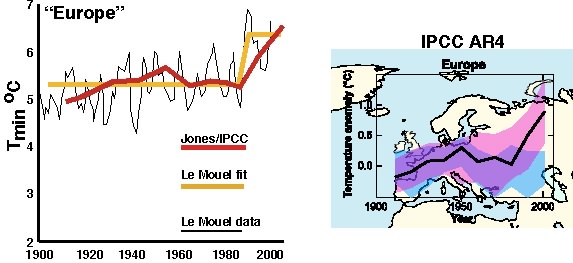
The analysis which evidently shocked Courtillot like a coup de foudre was presented at the Academie debate by Le Mouël (himself an Academician, and holder of the Fleming Medal). A video of his talk is here. Dear reader, I urge you to take a look at this video for yourself and see if you can make any more sense of it than I could, amidst all the mislabeled graphs, bizarre choices of what to compare to what, and missing information about crucial aspects of the data handling. I have done my best to convey what I think is the essence of the argument Le Mouël is trying to make, but it isn’t easy. In the left panel below I reproduce the only graph in which Le Mouël attempts a direct comparison between his data and the Phil Jones analysis which appeared in the IPCC report; it was redrawn by tracing over a freeze-frame of Le Mouël’s presentation. The graph is labeled "European Average" in the presentation, but the data (thin black line) which Le Mouël compares to Jones’ European analysis (red line) is actually from Denmark. Moreover, Le Mouël’s data seems to be monthly (or maybe daily) minima. Why one would want to compare Danish temperature minima with all-Europe temperature means is beyond me, but in the end what Le Mouël is making a big noise about is his claim that the yellow curve fit describes the data better than Phil Jones’ curve. Given the variability, there is really no objective reason to prefer one over the other, but the distinction between the two fits is largely immaterial. What you can take home from Le Mouël’s analysis is that, in Europe, a marked temperature rise does not set in until the 1980’s. Sound familiar? It should, because that is more or less what the IPCC says, pointing out further that natural variability cannot explain the recent warming. This can be seen well in the right panel, taken from the Fourth Assessment report. The blue shaded region is the ensemble of simulations forced by natural variabiity, while the pink shaded region includes anthropogenic forcing. Only the latter reproduces the rise at the end of the record.
The point of a lot of this fiddling with temperature curves is that the Sun must be doing something to control all these fluctuations. That brings us to radiative forcing, and Courtillot and company have had some problems with this issue, since they have a hard time making it look like CO2 is a small forcing and solar variability is a big forcing. One botched attempt at this was to claim that cloud fluctuations swamp CO2; Courtillot claims that clouds cause 80 Watts per square meter of radiative forcing, so that a mere 3% change in cloud cover would cause 2.4 Watts per square meter radiative forcing, which would be comparable to greenhouse gas forcing changes to date. To get this figure, though, Courtillot evidently assumed that all the Earth’s albedo is due to clouds, and moreover neglected the cloud greenhouse effect. When properly calculated, the net cloud radiative forcing is more like 20 Watts per square meter, so a 3% change gives you only 0.6 Watts per square meter, well below the greenhouse gas radiative forcing to date, to say nothing of what is in store for the future.
This flub is nothing compared to the trouble Courtillot’s collaborator Le Mouël got into during the debates, when he was trying to show that the 1 Watt per square meter variation in the Solar irradiance over the solar cycle is fully half the greenhouse gas forcing. Well, there is the little matter that Le Mouël forgot to take into account the sphericity of the Earth (which means divide the solar irradiance by 4) or its reflectivity (which means take 70% of the result). As the Le Monde reporter archly noted, Le Mouël’s calculation assumes a black flat Earth, but, "Hélas! La Terre est ronde" (zut alors!). Le Mouël seems eager to follow in Allègre’s geometrically-challenged footsteps: In a 1988 book (12 clés pour la géologie, Belin:Paris), Allègre confidently stated that the pole to equator temperature gradient was due to snow albedo and atmospheric absorption, making no mention of the role of the Earth’s spherical geometry, which is far and away the dominant factor (and the reason there’s ice at the poles to make a high albedo). Messieurs, here’s a little hint: What does the "G" stand for in "IPGP?"
The round Earth having robbed him of his 1 Watt per square meter –which in any event is mostly averaged out over the relatively short solar cycle leaving a miniscule tenth of a Watt variation between cycles — Courtillot grasps at the possibility some unknown and unquantified nonlinear mechanism for turning the very high frequency solar variability into a century scale trend.
There is also a bit of nattering about Moberg’s take on the Hockey stick, the supposed considerable warmth of the Medieval Warm Period, and some supposed millennial solar variability which supposedly accounts for why the present warming sort of looks like Moberg’s take on the Medieval Warm. Even leaving aside evidence that Moberg’s method exaggerates variability (see Mann, Rutherford, Wahl and Ammann 2005, available here), the "blame the Sun" mantra falls apart because neither the Sun nor cosmic rays have been exhibiting any trend that could conceivably account for the recent warming, as we have discussed in many places on RealClimate (most recently here).
With regard to climate, Courtillot’s main claim to fame is not found in his article in La Lettre. For that we have to look to a paper recently published in EPSL, which claims that climate variations are closely tied to the geomagnetic field. How convincing is this work? That will be the subject of Part II.
Quand un scientifique actif aussi distingué qu’Allègre ou Courtillot s’exprime, sa parole capte notre attention, quelle que soit sa pertinence. Ce serait néanmoins une erreur d’accepter les affirmations de tels phares uniquement à cause de leur renommée; on doit contrôler les arguments sur leurs mérites. Allègre ne publie pas ses idées sur le climat dans la littérature scientifique, de sorte que nous devons nous contenter de ses écrits de vulgarisation et déclarations publiques afin d’avoir un aperçu de ces arguments. Un trésor de ces allègreries (allègritudes ?, allègrations ?) est facilement accessible dans un petit ouvrage humblement intitulé Ma vérité sur la planète (Plon/Fayard, Paris, 2007). Beaucoup de choses que l’on y trouve ne sont que rabâchage d’arguments standard de sceptiques, arguments complétement discrédités auxquels il n’apporte rien de neuf. Par exemple : il répète à plusieurs endroits l’erreur classique de confondre le caractère imprévisible de la météorologie avec la détermination de la réponse du climat au forçage radiatif : « J’ai peine à croire qu’on puisse prédire avec précision le temps qu’il fera dans un siècle alors qu’on ne peut pas prévoir celui qu’il fera dans une semaine » (p.89). Il répète également le raisonnement faux que les relations de phase entre CO2 et température mesurés dans les carottes de glace de l’Antarctique prouvent que c’est la température qui est responsable des variations de CO2 plutôt que l’inverse – un raisonnement éculé et largement discrédité (lire ici un résumé des contre-arguments). Il y a peu de choses à ajouter sur ces arguments, sauf que la capacité d’Allègre à les répéter indique soit une remaquable crédulité, soit un inquiétant manque d’intégrité scientifique.
Ailleurs, pourtant, Allègre excelle dans l’art de servir des balivernes comme arguments scientifiques. En voici quelques exemples.
- Allègre affirme que la disparition des glaciers du Kilimandjaro est due à un changement des apports de vapeur d’eau causé par le soulèvement tectonique, et n’a rien à voir avec le réchauffement global. Cette affirmation est apparue il y a un peu plus d’un an dans la chronique d’Allègre dans l’Express, et a été discutée dans un article précédent de RealClimate au sujet d’Allègre. Pour l’essentiel, Allègre passe à côté du fait que les événements tectoniques dontil est question dans l’article cité de Science ont modifié le climat africain il y a plusieurs millions d’années, alors même que le glacier actuel du kilimandjaro est apparu il y a seulement 10 000 ans. Cette affirmation erronée au sujet du Kilimandjaro est répétée dans Ma vérité sur la planète (p.120), bien qu’il ait eu suffisamment de temps et d’opportunités pour corriger cette erreur. Autant pour la ‘vérité‘ (la sienne ou une autre).
- Allègre soutient que le ‘bon sens’ permet de mettre en doute l’idée que le CO2 puisse autant contrôler le climat parce que sa concentration est seulement de 300 parties par million (p.104). Ce ‘bon sens’ bouscule plus d’un siècle de physique méticuleuse qui remonte à l’époque de Tyndall et qui montre précisément pourquoi certains gaz à l’état de trace influencent si fortement l’absorption des infra-rouges par l’atmosphère.
- Allègre dit qu’on ne « sait rien » (p.109) sur les événements de Dansgaard-Oeschger et autre type de variabilité millénaire existant dans les carottes de glace. De cette affirmation, je suppose que nous sommes censés déduire que, comme on ne « sait rien » sur ces événements, il se pourrait bien que le réchauffement actuel soit juste la dernière phase de l’un d’eux. Bien sûr, il y a encore beaucoup de choses à apprendre sur la variabilité millénaire, mais ce phénomène a fait l’objet de plusieurs centaines de publications scientifiques, douzaines de conférences, ainsi qu’une synthèse majeure par l’Académie des Sciences américaine. Nous en savons assez sur la structure de ces événements et leurs mécanismes pour tout écarter la possibilité que le réchauffement récent provienne simplement de ce type de variabilité naturelle. Nous en savons également assez pour nous inquiéter de la possibilité que le changement climatique dû à l’augmentation des gaz à effet de serre puisse déclencher un de ces changements majeurs de la circulation océanique qui ont participé à la variabilité millénaire dans le passé.
- Allègre annonce qu’avec une augmentation du CO2 il ne devrait pas y avoir de réchauffement à l’équateur, alors que le réchauffement prédit à l’équateur n’est que légèrement inférieur à la moyenne globale. Il affirme correctement que le réchauffement est plus fort aux pôles, mais aussi, et sans justification, qu’un réchauffement de 10ºC serait sans importance (p.122). C’est une affirmation plutôt surprenante puisqu’un réchauffement bien plus faible est déjà responsable d’une disparition notable de la glace de mer en Arctique. Cette conception erronée pourrait provenir en partie du fait qu’il pense que la température « aux pôles » varie entre « -30 et -60ºC » (p.122). Si c’était vrai, il n’y aurait pas d’eau libre en Arctique pendant le minimum de couverture de glace de mer. Il est facile de vérifier que ce n’est pas le cas, et en fait l’Arctique monte souvent jusqu’à 0ºC, et parfois au-delà.
- Ignorant les nombreuses études indépendantes des mesures sur le dernier siècle, il soutient que l’analyse de Phil Jones de ces données a été « fortement mise en doute » (p.100). Et par quel moyen ? Par une comparaison entre les données globales de Phil Jones et une analyse non publiée des moyennes d’un petit nombre de stations européennes – présentée comme l’archétype de l’expertise incomparable des Géophysiciens en analyse de séries temporelles ! Nous y reviendrons à propos de Courtillot.
- Très obligeamment, Allègre conseille aux modélisateurs : « Il faut donc éviter de fonder les prédictions du climat futur sur une moyenne mondiale dont la situation est floue. » (p.106). Visiblement il n’est pas au courant que, depuis au moins les années 70, les modèles de circulation générale simulent des champs spatialisés des prévisions de vent et de température, et que des cartes de ces changements ont été incluses dans tous les rapports du GIEC depuis le premier. Oh, mais j’oubliais. Ailleurs, Allègre assène que « personne ne lit » (p.115) les rapports du GIEC. Visiblement, cette déclaration s’applique au moins à une personne.
- Continuant d’étaler son ignorance de la modélisation, Allègre se demande pourquoi les modélisateurs ont inclus le CO2 dans leurs modèles, et en conclut que c’est uniquement parce qu’ils connaissent ses variations sur les derniers siècles. Est-ce-qu’un siècle de travail méticuleux en laboratoire et sur le terrain passé à documenter l’effet radiatif du CO2 aurait peut-être à voir avec l’attrait des modélisateurs pour ce gaz ? Visiblement pas dans l’univers d’Allègre. Mais il y a mieux : « Comme on ne sait pas bien comment se forment les nuages, on les néglige ! Comme on maîtrise mal le rôle des aérosols et des poussières, on les néglige ! » (p.104) C’est complètement faux. Nuages, aérosols et poussières (comme variations de l’irradiance solaire et éruptions volcaniques) sont tous pris en compte par les modèles actuels. Les modèles qui négligent l’influence de l’augmentation du CO2 n’arrivent pas à reproduire le réchauffement des derniers trente ans, et c’est précisément pour cette raison que le CO2 a été confirmé comme le responsable principal du réchauffement global.
- Allègre fait un certain nombre de déclarations fausses ou fallacieuses sur le contenu du Quatrième Rapport d’Evaluation du GIEC. Il assure, contrairement aux médias français, que ce rapport « est beaucoup plus modéré que les précédents. » (p.119) Ainsi, Allègre assure que « Pour un doublement des émissions de CO2 , la température du globe augmenterait de 2 à 4,5ºC en un siècle. Le précédent rapport disait entre 1,5 et 6ºC. » (p.119) En premier lieu, les déclarations du GIEC sur la sensibilité climatique font référence à un doublement de la concentration en CO2, pas de ses émissions, mais laissons à Allègre le bénéfice du doute et supposons qu’il ne s’agit que d’une autre coquille et pas d’une véritable incompréhension. Tout de même, Allègre mélange ici des pommes et des frites. Même si la fourchette de la sensibilité climatique a été réduite, passant de 1,5 – 4,5ºC à 2 – 4,5ºC, ce qui diminue ainsi la probabilité d’une faible sensibilité, la fourchette des prévisions pour l’année 2100 n’a presque pas changé (de plus la définition probabiliste de cette fourchette a varié entre les rapports, elles ne sont donc pas directement comparables). Dans la même veine, Allègre assure que le GIEC a réduit ses prévisions de hausse du niveau marin, ce qui n’est pas le cas (voir ici).
- Mais il y a mieux. Il dit que le GIEC « modère sans encore l’abandonner l’argument d’évolution de la température depuis le XIXe siècle. » (p.119) Ceci correspond évidemment à la croyance d’Allègre que l’un des principaux arguments du GIEC est que le CO2 doit être responsable de l’augmentation de température parce que (ben voilà !) tous deux augmentent ! Il est difficile au GIEC d’abandonner un argument qui n’a jamais été le sien, et en tout cas le Quatrième Rapport d’Evaluation fait probablement plus de place à la discussion des enregistrements de température sur le 20e siècle, en utilisant plus de techniques, qu’aucun des rapports précédents. Et pourtant (on pense ici à Galilée, parlant en serrant les dents tout en s’inclinant devant l’Inquisition) elle augmente bien (et en suivant pratiquement les prévisions). Poursuivant sur le thème du renoncement supposé du GIEC, Allègre assure que celui-ci a « abandonné » son argumentation basée sur les variations de CO2 et de température enregistrées par les glace. Rien de tout cela. Il n’y a pas eu de changement d’interprétation par le GIEC des courbes isotopiques et du CO2 de Vostok, interprétation qui apparait dans les deux rapports de 2001 et 2007 (avec, dans ce dernier, l’extension d’EPICA à des périodes plus anciennes). Cette discussion se trouve au chapitre 6 du Quatrième Rapport d’Evaluation (p.444, figure 6.3), mais comment pourrait-on s’attendre à ce qu’Allègre sache cela, puisque personne ne lit le rapport du GIEC, n’est-ce-pas ?
De telles idées fausses et déformations de la réalité comme celles exposées ci-dessus sont généreusement accompagnées de l’arsenal habituel d’insinuations et de citations abusives. Parce que Christopher Landsea (comparé de manière extravagante à Galilée !) a choisi de faire toute une scène de sa démission du GIEC, le processus dans son ensemble est jugé opposé à toute dissidence – ignorant de manière opportune que Lindzen lui est resté tranquillement tout au long du Troisième Rapport d’Evaluation du GIEC. Une affirmation de Dennis Hartmann, tout à fait justifiée et incontestable, sur les incertitudes de la modélisation est détournée afin d’insinuer que les modélisateurs ne croient pas possible d’obtenir suffisamment de précision pour tirer des conclusions sur le réchauffement futur (p.105). Des citations sur la possible nécessité de mesures d’adaptation, venant de Ron Prinn du MIT et de Wally Broecker de Columbia, sont utilisées afin d’insinuer que ces deux célébrités favorisent l’adaptation sur la réduction des émissions de CO2 (p.126). Et sur le sujet de l’adaptation par rapport à l’atténuation, certaines affirmations d’Allègre sont franchement saugrenues : il soutient que nous n’avons rien à craindre du réchauffement global. Après tout, nous nous sommes adaptés au trou d’ozone, n’est-ce pas ? Nous nous sommes adaptés aux pluies acides, n’est-ce pas ? (p.127) Et bien, non en fait, nous n’avons rien fait de tout cela. Nous nous sommes ‘adaptés’ au trou d’ozone en adoptant le protocole de Montréal pour contrôler les émissions de CFC. Nous nous sommes ‘adaptés’ aux pluies acides en adoptant des mesures de contrôle des rejets soufrés. Si c’est ça ‘s’adapter’, je pense que je peux juste dire : « D’accord ! ‘Adaptons’-nous au réchauffement global en réduisant les émissions de CO2 ! »
Que peut-on dire de toutes ces affirmations ? Je ne pourrais le faire mieux qu’Allègre lui-même : «…une imposture intellectuelle, une escroquerie ! » (p.107)
Quel que soit le plan d’Allègre dans ses annonces publiques, celles-ci semblent peu fondées sur son expertise scientifique. Avec sa litanie d’erreurs, d’idées fausses et de déformations de la réalité, il a renoncé à toute prétention d’être considéré sérieusement en tant que scientifique lorsqu’il parle du changement climatique. Et si même Lomborg et autres éco-polyannas bénéficient trop du soutien d’Allègre, notons que, au final, Allègre appelle quand même à une réduction de 20% des émissions de CO2 sur les vingt prochaines années. Nombre d’entre nous qui se refuseraient à toucher aux arguments d’Allègre, même avec un bâton de 3 m, seraient très heureux si un tel plan était mis en oeuvre aux Etats Unis, au moins comme un premier pas vers des réductions plus drastiques.
Voici donc pour Allègre. Maintenant que dire au sujet de M. Courtillot ? Heureusement il ne nous est pas nécessaire d’aller si loin dans les détails, car pratiquement tous les arguments présentés au débat à l’Académie (voir son article dans La Lettre de l’Académie des sciences) reflètent ceux du livre d’Allègre. Pourtant, notre homme parvient à ajouter quelques marques de son cru. Par exemple il déclare, sûr de lui, que les variations glaciaires-interglaciaires du CO2 sont « tout simplement » dues à l’effet de la température sur la solubilité du CO2. Il n’est donc pas au courant que ce mécanisme de base a été évalué il y a bien des années par Wally Broecker –comme Allègre, un détenteur du prix Crafoord– et a été estimé vraiment insuffisant (voir Martin, Archer et Lea, Paleoceanography 2005, pour un récent bilan sur ce sujet).
Vous vous souvenez du graphe de la température européenne dans Ma Vérité, qui devait remettre « fortement en doute » l’analyse de Phil Jones des enregistrements de température ? Et bien il réapparait avec Courtillot très enrichi par de nouveaux verbiages : les scientifiques du climat passent tout leur temps à modéliser et pratiquement pas à observer; les géophysiciens sont les seuls qualifiés à étudier les séries temporelles car ils le font sans arrêt et de toute façon ils ont pratiquement tout inventé en premier dans ce domaine; personne n’a jamais contrôlé ou vérifié le travail de Phil Jones. Et patati, et patata, rien de tout cela n’ayant une once de vérité. Mais, après avoir déclaré tout cela, les braves géophysiciens de l’IPGP décidèrent de regarder par eux-mêmes en moyennant quelques dizaines de stations météorologiques européennes (additionnées de quelques stations éloignées en Oural pour faire bonne mesure), et ben voilà, Courtillot est “étonné” que la courbe ne ressemble pas à ce qu’on leur avait appris ! (Courtillot est visiblement quelqu’un de facilement étonné, et autant surpris, car ces mots apparaissent avec une régularité stupéfiante dans son article).
Cette analyse, qui frappa Courtillot d’un vrai ‘coup de foudre‘, fut présentée lors du débat à l’Académie par Le Mouël (lui-même académicien, et détenteur de la médaille Fleming). Une vidéo de cette présentation se trouve ici. Cher lecteur, je vous presse de regarder cette vidéo afin de voir si vous pouvez en tirer plus de sens que je ne l’ai pu, parmi tous les graphes mal annotés, les choix étranges des comparaisons, et les informations qui manquent sur certains aspects cruciaux du traitement des données. J’ai fait de mon mieux pour présenter ce que je pense être l’essence de l’argumentation de Le Mouël, mais ce n’est pas facile. Sur la partie gauche de l’image ci-dessous j’ai reproduit le seul graphe dans lequel Le Mouël tente une comparaison directe entre ses données et l’analyse de Phil Jones parue dans le rapport du GIEC; ce graphe a été décalqué sur un des plans de la vidéo de la présentation. Le graphe est titré “Moyenne de l’Europe” dans la présentation, mais les données (courbe noire) que Le Mouël compare à l’analyse européenne de Phil Jones (trait rouge) sont en fait celles du Danemark. De plus, les données de Le Mouël semblent correspondre à des minima mensuels (ou journaliers peut-être). Pourquoi voudrait-on comparer les minima de température au Danemark avec la moyenne de température de toute l’Europe, cela me dépasse, mais finalement ce dont Le Mouël fait grand bruit c’est l’affirmation que la courbe jaune est une meilleure approximation des données que la courbe de Phil Jones. En considérant la variabilité, il n’y a vraiment pas de raison objective de préférer l’une à l’autre, la distinction entre les deux approximations est complètement irréelle. Le message de l’analyse de Le Mouël est qu’en Europe une augmentation marquée de la température n’apparaît pas avant les années 80. Déjà entendu quelque part ? Vous devriez, car ceci correspond plus ou moins à ce que dit le GIEC, qui conclut de plus que la variabilité naturelle ne peut expliquer le réchauffement récent. Ceci est bien visible sur le graphe de droite tiré du Quatrième Rapport d’Evaluation du GIEC. La zone ombrée en bleu correspond à un ensemble de simulations forcées par la variabilité naturelle, tandis que celle en rose inclut aussi le forçage anthropique. Seule cette dernière reproduit l’augmentation de la fin de l’enregistrement. Bien loin de bousculer les conventions, Le Mouël a en fait montré qu’une simple moyenne d’un jeu limité de données confirme largement l’analyse de Phil Jones – une ‘prouesse’, si l’on réalise qu’en considérant une région aussi petite que l’Europe, la tendance anthropogénique est bien plus difficile à distinguer de la variabilité naturelle due à la circulation.
Le but de tout ce trafic avec les courbes de température est que le soleil doit en être pour quelque chose dans ces fluctuations. Ce qui nous amène au forçage radiatif, où Courtillot et consorts ont eu quelques problèmes sur ce point, car il leur a été très difficile de faire passer le CO2 pour un forçage mineur et la variabilité solaire pour un forçage majeur. Un essai baclé dans ce sens a été de prétendre que les variations des nuages surpassaient le CO2 : Courtillot prétend que les nuages sont responsables d’un forçage radiatif de 80 watts par mètre carré, de sorte qu’un changement aussi faible que 3% de la couverture nuageuse induirait un forçage radiatif de 2,4 watts par mètre carré, comparable à celui actuel des gaz à effet de serre. Mais pour obtenir ce chiffre, Courtillot a évidemment supposé que l’albédo terrestre est entièrement dû aux nuages, et de plus il a négligé l’effet de serre des nuages. Calculé correctement, le forçage radiatif net des nuages est plutôt de 20 watts par mètre carré, de sorte qu’une variation de 3% donne seulement 0,6 watts par mètre carré, très inférieur au forçage radiatif actuel des gaz à effet de serre, sans même parler de celui qui nous attend.
Cette gaffe n’est rien en comparaison de la difficulté éprouvée pendant les débats par Le Mouël, qui collabore avec Courtillot, lorsqu’il essaya de montrer que la variation de 1 watt par mètre carré de l’irradiance solaire au cours d’un cycle solaire représente vraiment la moitié du forçage des gaz à effet de serre. Bon, il y a un détail que Le Mouël oublie de prendre en compte, c’est la sphéricité de la Terre (ce qui implique de diviser l’irradiance solaire par 4) ou sa réflectance (ce qui implique de prendre 70% du résultat). Comme le reporter du Monde le soulignait malicieusement, le calcul de Le Mouël suppose une Terre noire et plate, mais “Hélas! La Terre est ronde” (zut alors !). Le Mouël semble ainsi suivre avec ferveur Allègre dans ses mauvais pas en géométrie : dans un livre de 1988 (12 clés pour la géologie, Belin/Paris), Allègre affirme sûr de lui que le gradient de température entre les pôles et l’équateur est dû à l’albédo de la neige et à l’absorption de l’atmosphère, ne faisant aucune mention du rôle de la géométrie sphérique de la Terre, qui est de loin le facteur dominant (et la raison de la présence aux pôles de glace avec un albédo élevé). Messieurs, voici un indice : que veut dire le ‘G’ de ‘IPGP’ ?
La rotondité de la Terre l’ayant privé de son 1 watt par mètre carré –qui de toute façon est pratiquement moyenné au cours d’un cycle solaire et ne laisse qu’un dixième de watt par mètre carré entre les cycles– Courtillot se raccrocha à la possibilité d’un mécanisme non linéaire, inconnu et non quantifié, pour transformer la variabilité solaire haute fréquence en une tendance sur un siècle.
Il y a également quelques bavardages sur la position de Moberg sur la ‘crosse de hockey’, la prétendue période très chaude de l’Optimum Médiéval, et une supposée variabilité solaire millénaire qui devrait expliquer pourquoi le réchauffement récent correspond plus ou moins à l’explication de Moberg de l’Optimum Médiéval. Mises à part quelques indications que la méthode utilisée par Moberg surestime la variabilité (voir Mann, Rutherford, Wahl et Ammann 2005, disponible ici), le mantra du “C’est la faute au soleil” s’effondre puisque ni le soleil ni les rayons cosmiques ne montrent de tendance pouvant expliquer le réchauffement des dernières décennies, comme nous en avons discuté à plusieurs reprises sur RealClimate (le plus récemment ici).
Pour ce qui est du climat, les faits de gloire de Courtillot ne se trouvent pas dans son article de La Lettre de l’Académie. Pour cela nous devons nous tourner vers un article récemment publié dans EPSL, article qui prétend que les changements climatiques sont étroitement liés au champ géomagnétique. Ce travail est-il convaincant ? Ce sera le sujet de la seconde partie.
With regard to the nuclear power discussion: the immediate and urgent problem is that, per the IPCC, in order to avoid the worst outcomes of global warming and climate change, worldwide carbon emissions must peak and begin a rapid decline within seven or eight years.
It is difficult to see how any plausible expansion of nuclear electricity generation can make a significant contribution to that urgent need.
And indeed, although wind and solar electrical generation are already growing very rapidly (30 to 40 percent per year), because they are currently a very small part of the world’s electricity supply they are also likely to only modestly reduce the expected growth in emissions from electricity generation in that seven to eight year time frame.
And while electricity generation is certainly a major source of carbon emissions it is not the only one — emissions from the mostly petroleum-fueled transport sector, as well as from animal agriculture, are also major components of the problem. Electrification of the transport sector is another long-term project.
The challenging fact is that the only way to meet the goal of stopping and reducing the growth of emissions within seven to eight years is for humanity to use less energy. Quite a lot less energy.
Which makes it very interesting that virtually all of the discussion of solutions on this site, and other forums where intelligent and well-informed people comment on this issue, is focused on various reduced-carbon supply-side technologies, and very little discussion addresses the much more urgent need for reducing energy use through conservation and efficiency.
Ref 85 Nick Barnes says “If Cryosphere Today reports a 2008 minimum area of more than 4.01 million square kilometres, I’ll pay you 50 euros. If Cryosphere Today reports a 2008 minimum area of less than 4.01 million square kilometres, you’ll pay me 50 euros.
Do we have a bet?” We could have a bet, but not with money. This implies exchange of snail mail addresses, etc. However, what I suggest is a mea culpa, mea culpa, mea maxima culpa message on RC. With the figures you present, if you win I will post such a message. If I win, you post the message. I will give you the benefit of equal to 4.01. How is that?
Ref 97 Jim Galasyn writes “Is there a particular reason why you suspect September 2007/8 to be the inflection point?”. Please read my 89 “One year, the trend will reverse, but not necessarily next summer.” As you probably realise the data is very “noisy”. It is going to be tough to be exact when the reversal starts. I suspect that when we look back from about 2014, we will be able to see when the reversal actually started. I have no idea how rapid the reversal will be. It depends on solar cycle 24.
[Response: An increase in solar forcing going into cycle 24 is going to make the ice regrow? You are posting on the right thread. – gavin]
Re #94 (Karen Street) “Re Greenpeace: I can’t find it in Science, so it must be in Nature, to which I no longer subscribe. Robert May talked about the benefits that accrued from a discussion on transgenic crops??, even though the discussion occurred after people from Greenpeace knowingly lied (it might have been knowingly made statements they knew to be untrue).”
So, you don’t actually know which publication it was in, what the topic of the discussion was, or (I assume, since you don’t tell us) what the alleged lies were? And you’re relying on one person – eminent scientist though he is – to tell us what was in the minds of the Greenpeace people concerned (how does he know they “knowingly lied”?), without actually checking whether they might have anything to say in response? Excuse me if I’m somewhat underwhelmed – I thought you must have clear documentary evidence that Greenpeace is systematically dishonest or reckless in what it says.
“Adopting the probably conservative resource estimate of 20 million [metric] tonnes … A resource of this magnitude could sustain four times the present rate of generation for 80 years.”
Given that, according to the IPCC, nuclear power accounted for 16% of global electricity generation (note: not energy production) in 2005, while demand for energy is rising fast, this doesn’t suggest it is anything near a complete solution for AGW, even if all this uranium could be extracted at reasonable cost and energy expenditure. And are China and India, both without much uranium but with lots of cheap coal, really going to be keen to make themselves dependent on an imported resource?
RE #100 (Secular Animist) “The challenging fact is that the only way to meet the goal of stopping and reducing the growth of emissions within seven to eight years is for humanity to use less energy. Quite a lot less energy.
Which makes it very interesting that virtually all of the discussion of solutions on this site, and other forums where intelligent and well-informed people comment on this issue, is focused on various reduced-carbon supply-side technologies, and very little discussion addresses the much more urgent need for reducing energy use through conservation and efficiency.”
Well said. The same was true at a recent conference on the “post-carbon society” I attended in Brussels, even though the conference focus was, supposedly, on the “demand and social sides” of the issues.
#98 appeared after I posted. That report is odd because it concentrates on light water reactors and almost completely ignores the rather more sensible heavy water designs (because CANDU is a Canadian design perhaps?) – which can burn natural Uranium instead of enriched (solves problem 3) and also nuclear waste (solves problem 4). Also, I live in France where it is widely known that our electricity is cheaper precisely because it is mostly from nuclear power, which doesn’t square with the reports’ conclusions about nuclear being more expensive than coal (so much for problem 1). In fact new reactors have not been built because of 3 mile island and Chernobyl, not because of cost. Most concerns could be solved by the advent of Thorium fuel (solves problems 1,2,3,4) which the report doesn’t even mention. As for safety, I worry more about the safety of chemical and petrochemical plants which have hugely worse safety and pollution records than nuclear plants. What a cockeyed report – grade F – redo it properly.
It seems that “common sense” has replaced patritotism as the last refuge of scoundrels judging by Allegre’s comments about the non-importance of CO2 re global warming. Presumably, Allegre would not
object to having a few crystals of cynanide in his coffee as “common sense” would dictate that such a small quantity could cause no harm. I find it almost incomprehensible that a “scientist” could peddle such arguments, but I guess it shows the catotonic level to which some contrarians have sunk (eg. the fable about a Chinese fleet sailing around the North Pole in the 1400s. Keep up the good work.
RE Comment to #103
[Response: An increase in solar forcing going into cycle 24 is going to make the ice regrow? You are posting on the right thread. – gavin]
I think what Jim’s referring to is that the next solar cycle is late. It’s significantly late. And there is a significant disagreement as to what to expect from a late cycle start. See:
http://www.swpc.noaa.gov/SolarCycle/SC24/PressRelease.html
for more details. The community is evenly split on whether it will be a moderately strong or moderately weak cycle, but either way, it is expected to be weaker than had been predicted during Cycle 23.
[Response: Regardless of whether 24 is big or small, solar forcing will be growing for the next 5 or so years, not decreasing (we are already at a minimum!). There is zero chance of this making sea ice regrow. – gavin]
In France, by 2020, all newly built homes are to produce more energy than they consume
http://scienceblogs.com/islandofdoubt/2007/10/the_french_beat_us_again.php#more
Speaking of the next solar cycle, and peripherally of models, here’s a story from march 2006
http://www.space.com/scienceastronomy/060306_solar_cycle.html
Compare that to the NOAA release in Apr 2007:
http://www.swpc.noaa.gov/SolarCycle/SC24/PressRelease.html
It seems that as of April of this year, the “new and improved” model that accurately modeled solar trends over the last 8 cycles isn’t accepted as being able to predict the next one.
Which is just a reminder that while a model can match historical data, it doesn’t mean that it’s accurate in predicting future conditions.
Re #96: [The wind stops blowing at night???]
Well, yes, as a matter of fact it does. Particularly in this area (east side of the Sierra Nevada), where the typical pattern is calm to light breeze until after noon, then moderate to strong winds until 10 PM or so. Of course this varies depending on local conditions, but in my experience most areas have a daily pattern of this sort.
RE: the response to 108
[Response: Regardless of whether 24 is big or small, solar forcing will be growing for the next 5 or so years, not decreasing (we are already at a minimum!). There is zero chance of this making sea ice regrow. – gavin]
While true technically over the very near term, it could have significant impact on the icepack development throughout the entire cycle, especially when compared to what have been very strong solar cycles over the past century. If cycle 24 is weak and cycle 25 is also weak, the solar forcing function that has been apparent over the last 200 years or so could be disappearing.
Re #107: [Presumably, Allegre would not
object to having a few crystals of cynanide in his coffee as “common sense” would dictate that such a small quantity could cause no harm.]
Ever eaten an almond, or swallowed an apple seed? These, and many other plants, contain small quantities of cyanide.
This is another example of the linear dose response fallacy. The assumption is that if a large quantity of something causes harm, then a small quantity causes a proportionally smaller harm, even if that harm is below the threshold of detection. In the real world, though, we can find many examples where the response is not linear: low doses cause no harm, and may even confer a benefit, as with some vitamins & minerals, or even exposure to sunlight.
RE #106 [JamesG] “That report is odd because it concentrates on light water reactors and almost completely ignores the rather more sensible heavy water designs (because CANDU is a Canadian design perhaps?) – which can burn natural Uranium instead of enriched (solves problem 3) and also nuclear waste (solves problem 4).”
CANDU reactors produce both plutonium and tritium, both of considerable proliferation concern. And although they can use the waste from some other reactors as fuel, they still produce nuclear waste of their own. They take longer and cost more to build than most designs.
“Most concerns could be solved by the advent of Thorium fuel (solves problems 1,2,3,4) which the report doesn’t even mention.”
If thorium is such a wonderful fuel, one has to ask why no-one is yet using it. And potential thorium reactors have their own proliferation problems.
91. emissions attribution would depend on context. for example, a law suit brought against a company for failing to reduce embodied and embedded emissions within goods it places on market and services delivered into market may not necessarily be concerned with geographical labels for physical points of emissions. emissions liability may encompass both direct and direct-by-proxy emissions. thus, if a company imports goods made in another country, the company placing the goods on market (depending on jurisdictional framework) may be the liability carrier.
Timo, Re 92. It would appear that you are a believer in Disney’s first law: Wishing will make it so.
I have worked enough with technology that I am not such a technological optimist. Some things (e.g. space travel) are hard. Some (e.g. faster than light space travel) are impossible.
Moreover, given the complacency toward the problems we face and the (exponential) pace at which they are worsening. I see no reason for optimism re: the fate of human civilization.
People who use one dimensional models should think twice before making flat earth jokes .
[Response: People who can’t understand the difference between legitimate simplifications that preserve essential physics and geometric errors that introduce factors of four mistakes in energy conservation shouldn’t be so eager to parade their ignorance in public. –raypierre]
Re #64 Per: No, that was tongue-in-cheek. Deserts are deserts for a reason. It was just meant to visualise order of magnitude. That said, trying to roll back desertification in areas affected by is a very worthwhile effort.
> what is so technically difficult about nuclear waste
Transuranic elements. You can look it up in the nuclear engineering journals — check the requirements for getting a PhD in the field.
In the eighth bullet point you have:
the climate sensitivity range narrowed from 1.5-4.5ºC previously to 2-4.5ºC now
Shouldn’t this say 1.5-6ºC previously (as it is quoted earlier in the same point)?
[Response: No. The difference is in that the first number is the sensitivity to 2xCO2 at equilibrium, while the second range is the expected temperature range at 2100 given all the scenarios. The latter is much more uncertain than the former. – gavin]
Re tamino: “Good luck, it sounds like you’ve got quite a challenge. Unfortunately, denialists make it *easy* for their adherents; you really don’t have to study hard, think hard, or know anything, to buy into their arguments. In some cases you actually have to be *ignorant* (like believing that red noise makes hockey sticks). It’s all too easy and comfortable to accept their drivel.”
I think the real problem is that people of certain political views (and not just one) want to fit the world into a political narrative that they have invested too much of their self in to back out.
As far as convincing him that red noise doesn’t make hockey sticks, it shouldn’t be too hard. He has read Carslaw’s book on Fourier series within the past decade. It’s not like when my grandmother sat me down and required me to explain my dissertation to her. (“I’ve never been able to understand what your father does with his, and I won’t let that happen again….”)
Re the solar forcing theory of Jim Cripwell and dean_1230, does this theory account for the rapid recent departure from linearity shown in the “Northern Hemisphere Sea Ice Anomaly” graph?
Don’t you find that sudden downward slope the least bit worrying?
Ray, Re 114.
so far, nothing exceptional, and although the IPCC predicts
“For the next two decades a warming of about 0.2°C per decade is projected for a range of SRES emissions scenarios.”
please see:
Smith, Doug M., Stephen Cusack, Andrew W. Colman, Chris K. Folland, Glen R. Harris, and James M. Murphy, 2007. Improved Surface Temperature Prediction for the Coming Decade from a Global Climate Model. Science Vol. 317, No 5839, pp. 796-799, August 10, 2007, online http://www.precaution.org/lib/warmer_after_2009.070810.pdf
“…It is very likely that the climate will warm
over the coming century in response to
changes in radiative forcing arising from anthropogenic
emissions of greenhouse gases and
aerosols (1). There is, however, particular interest
in the coming decade, which represents a
key planning horizon for infrastructure upgrades,
insurance, energy policy, and business development.
On this time scale, climate could be dominated
by internal variability (2) arising from
unforced natural changes in the climate system…”
Explained: “Although average global temperatures have been relatively flat in recent years, the model says they will start rising again next year.”
Just wait and see.
Further, please see:
Wöppelmann, G., B. Martin Miguez, M.-N. Bouin, and Z. Altamimi, 2007. Geocentric sea-level trend estimates from GPS analyses at relevant tide gauges world-wide. Global and Planetary Change Vol. 57, No 3-4, pp. 396-406, June 2007, online
http://ff.org/centers/csspp/library/co2weekly/20070809/20070809_06.pdf
“…The results show a reduced dispersion of the estimated sea-level trends after application of the GPS corrections. They reveal that the reference frame implementation is now achieved within the millimetre accuracy on a weekly basis. Regardless of the application, whether local or global, we have shown that GPS data analysis has reached the maturity to provide useful information to separate land motion from oceanic processes recorded by the tide gauges or to correct these latter. ….We obtain a value of 1.31 ± 0.30 mm/yr, a value which appears to resolve the ‘sea level enigma’…”
It seems to me, Climatology is not at all settled the way certain scientists try to argue.
I see no (exponential) pace at which our problems are worsening.
I do know scepticism prevails, but only optimism is the way to win the problems.
red noise does not make hockey sticks
Ahhh… but *cherry-picked* red-noise can! All you have to do is generate red-noise ensembles until you get a hockey-stick-shaped leading principal component with an associated singular value magnitude of 0.02 or so. Throw out the rest of the data and voila! A red-noise hockey-stick!
Gavin comment (108)
Regardless of whether 24 is big or small, solar forcing will be growing for the next 5 or so years, not decreasing (we are already at a minimum!). There is zero chance of this making sea ice regrow.
Of course, but would you say for example that a delayed effect of the ending cycle 23 weaker than previous 21 and 22 has zero chance of contributing to a sea ice recover ?
That is : is there any reason to believe direct and indirect effects of solar forcing are instantaneous, whereas direct and indirect effects of CO2 forcing are not (because of thermal inertia of oceans) ?
[Response: Actually the long term solar trends averaging over the cycles are likely to have some small impact – but given that those trends in recent decades are an order of magnitude (at best) smaller than GHG trends, it’s unlikely to be detectable. But any short term predictions for sea ice (i.e. over less than a solar cycle or two) doesn’t have anything to do with that – and that was what Jim was taking about. – gavin]
(Of course, Rasmus or any other RC contributor may answer my questions).
Ref 121 Jim Galasyn writes “Don’t you find that sudden downward slope the least bit worrying?” Not in the least. The world got warmer at the end of the 20th century. So it is to be expected that odd things will happen. Like the 2005 hurricane season in the North Atlantic. This has been followed by two seasons of abnormally low hurricane activity. The sudden decrease of ice in the summer of 2007 will be seen to be just such a one time only affair.
[Response: Again. Please think about your statements. The long term average
hurricanetropical storm number is 10 per season, and we had 14 this year – this is not abnormally low – unless of course you think that 2005 is now ‘normal’ (let’s hope not!). – gavin]Ref 108 Gavin writes “Regardless of whether 24 is big or small, solar forcing will be growing for the next 5 or so years, not decreasing (we are already at a minimum!). There is zero chance of this making sea ice regrow.” We obviously have different ideas as to how the sun may affect the earth’s climate. The key is not the sunspot activity per se, but the activity at the maximum of the sunspot cycle. Yes, the sun is blank right now, and has been virtually so for some months, but this does not mean a cold earth. We dont really understand the physics, but whatever it is that makes the maximum sunspot number to be low, also makes the earth cold. What the sunspot number will be at the maximum of solar cycle 24, indicates how rapidly the earth is cooling.
re: 125. Gavin, per nhc.noaa.gov there were 8 tropical storms and 5 hurricanes this past season in the Atlantic. Still well above the average for tropical “named” storms, of course.
[Response: Thanks. I mis-spoke. – gavin]
Hank, I live in Berkeley, where a number of transuranic elements were created. It’s the creation of transuranic elements that leads to maximum exposure to radioactivity due to nuclear waste 300,000 years from now. More information please! The word transuranic does not alone explain why nuclear waste is so difficult.
Re #99 Interestingly, I read this report through a different lens than did you, though I would guess that the report was considerably more pessimistic in 2003 than it would be today.
Actually, the report envisioned by the InterAcademy Council report, Lighting the Way, differs from the MIT and other similar reports. The report, as I understand it, wishes to change public opinion:
Estimates of electricity costs differ, here is a more recent one from EPRI. All estimates for all power plants will be out of date next year as the cost of construction continues to rise. I think that it’s fair to assume that most readers would like to see a GHG policy that raises the cost of coal to make it less attractive than other options. According to EPRI, that occurs at as little as $10/metric tonne CO2 for nuclear, and as little as $45/tCO2 for wind. Also, re #106, I think that nuclear is probably cheaper than coal in countries that don’t have large coal reserves, also it depends on whether you calculate costs over 30? years of amortization, or the life of the nuclear power plant — since these last many decades, the price/kWh for new nuclear over its lifetime may be cheaper than new coal even in the US.
Re safety: The next sentence after the ten-fold reduction in the MIT report is this:
Re proliferation: I believe that many people would like to see no increase in the number of countries reprocessing unless some way of preventing the use of weapons usable (not weapons grade) plutonium.
Re waste: Again, the reprocessing option is unattractive. But are the problems technical or societal? Does nuclear waste have to have a solution today for technical or societal reasons?–a permanent solution is better than dry cask only so that people will feel solutions exist?
Re #101, same author, it is important that efficiency be mandated and otherwise encouraged. Two friends in lower elementary and I just returned from distributing CFLs at a senior center, and we will visit another tomorrow.
#104 Nuclear is not even close to being the only solution needed. I’m sorry if I gave the impression that I believed that. Where I live, solar is being heavily funded, also the local lab is researching both cellulosic biofuels and better solar through nano. Also better windows, etc. Re China and India, the fuel cost for nuclear is considerably less than construction costs, and considerably less than the oil they are importing. It is not my impression that most world legislators are particularly concerned about uranium costs and source as they are about the same for oil.
There was a discussion of thorium reactors, one version of which is used in India. There is more thorium than uranium, and according to Socolow at the 2007 AAAS meeting, there is more U+Th than coal (measured in units of electricity potential).
Karen, I’ve read your work in the Daily Planet and other places.
Gavin’s said this isn’t the right forum to go on about nuclear.
This may help on the current approach to safe handling of transuranics, it’s the most recent standard I know of.
Note I’m just another reader here, not an expert in anything.:
http://www.efcog.org/wg/sa/docs/minutes/archive/2007%20Conference/SAWG_Website_Info/papers/Haz-Woody-Stand-DOE-TRU.pdf
“ABSTRACT The DOE Office of Environmental Management (EM) observed through onsite assessments and a review of site-specific lessons learned that transuranic (TRU) waste operations could benefit from standardization….. This paper recounts the efforts by the DOE and its contractors to bring consistency to the safety analysis process …. These efforts culminated in the preparation of DOE-STD-5506-2007, which was released in May 2007.”
My point’s simply that people saying it’s simple need to read up.
In #130 Hank says-“I’m just another reader here, not an expert in anything.”
Adam was a gardener, Joseph, a carpenter,Lincoln a railsplitter, Faraday a bookbinder’s apprentice…..well you get the point.
Raypierre’s original post says:
“Allègre says that under an increase of CO2 there would be no warming at the equator, whereas the predicted warming at the equator is in fact only somewhat below the global mean warming. He states correctly that the warming is strongest at the poles, but states without support that a 10ºC warming would be no big deal (p.122). This is quite a startling statement,……..”
It sure startled me!.This sounds like something out of ‘Alice in Wonderland’. 10 degrees C is a very big deal, especially considering that the average difference for the planet(the global mean), between the last ice age and now,is about +6C. It doesn’t take a large difference to radically change global climate. It’s hard to comprehend why a reputable scientist like Allegre can make such obvious incorrect statements.
Allègre says that under an increase of CO2 there would be no warming at the equator, whereas the predicted warming at the equator is in fact only somewhat below the global mean warming. He states correctly that the warming is strongest at the poles, but states without support that a 10ºC warming would be no big deal (p.122). This is quite a startling statement
Re. #65, Jim Cripwell, did you read the articles Hank and others pointed you to? Do you still not understand the difference between area and volume? As for your 2008 bet, don’t you know the difference between weather and climate? The 2008 figure will be weather. The trend is climate. I think a lot of people here would be happy to bet you that in ten years times, the trend will show that 2007 was not simply an anomaly but was a clear indication of a big increase in the trend.
re #28,
This may not be a direct answer to your question but there has been quite a bit of study of the affects of global warming on the biosphere, here is a link that might get you started on some of it:
http://evolution.berkeley.edu/evolibrary/news/060701_warming
Jim Cripwell @102: OK, whuffies it is. Can we have a volunteer to wake us up, when September ends?
Re. #92, Timo Hämeranta, see #101.
Re. Jim Cripwell, #127:
Well it’s certainly clear that you don’t! :-)
The talk of environmental groups using propaganda reminds me of the false balance in the popular press. Just because one side is being disingenuous it doesn’t mean their opponents are doing the same thing.
Greenpeace out of the major environmental groups does push the envelope, but on the global warming issue they don’t push clearly false positions. Greenpeace is probably the most extreme of the major enviro groups, so they are used to make a strawman argument that Grteenpeace represents all environmentalists.
As far as the nuclear issue goes, to summarize enviro groups’ position the problems are with disposal of waste that will be toxic for hundreds of thousands of years, indeed a threat longer than humans existed. The other is transporting fuel and waste over unprotected roads and railways. After 9/11 the issues of terrorist attacks on unprotected nuclear facilities and conversion of civilian nuclear energy into military programs (like Iran, North Korea, Pakistan, India, Israel) are also important.
Presumed roots of Allègre’s vehement opposition to Climate Change were once disclosed by an oceanographist (Bruno Voituriez) : Allègre used to be heading research in what used to be the queen of disciplins at the time : geophysics. But together with rising climate concerns and the need to understand the earth’s climate mechanisms, arose the need to understand the role of oceans, which was widely unknown at the time. Therefore lots of research credits usually dedicated to geophysics went to his rival and traditionnally disregarded discipline, oceanography…
Could Courtillot, also a geophysicist, be Allègre’s companion of misfortune, and animated by the same feelings ?
By the way, I attended the IPCC event at the French academy of sciences mentioned in the article. I left the conference convinced that this body (the French academy of sciences) was full of logorrheic dinosaurs using science to fulfil the needs of their over-inflated ego.
I think a lot of people here would be happy to bet you that in ten years times, the trend will show that 2007 was not simply an anomaly but was a clear indication of a big increase in the trend
A ridiculous assertion and I’ve got $500 to bet you are wrong. All we have to do is define “increase in the trend”. Or did you mean to say “a clear indication of the trend”? That’s possible, but you are suggesting 2007 suggests a tipping point. Is there any literature to support that wild contention?
Re #111 (James) “Re #96: [The wind stops blowing at night???]
Well, yes, as a matter of fact it does. Particularly in this area (east side of the Sierra Nevada), where the typical pattern is calm to light breeze until after noon, then moderate to strong winds until 10 PM or so. Of course this varies depending on local conditions, but in my experience most areas have a daily pattern of this sort.”
Such daily patterns are one reason why the unreliability of wind, and other renewable sources, is less of a drawback (requires less backup capacity) than is often claimed. See for example:
Sinden, G. (2007) “Characteristics of the UK wind resource: Long-term patterns and relationship to electricity demand”
Energy Policy 35,1,112-127
Timo writes:
[[Current solutions and new inventions will solve the problems arising in near future, i.e. before 2030.
Myles Allen correctly stated recently in Science how futile are 50 or 100 yr scenarios, and something like “our grandchildren will solve their problems”, i.e. after 2030.
I do agree. Human ingenuity will solve all the problems ahead.
Our Future is Bright.]]
Yes, and nuclear power will provide energy too cheap to meter. Space travel will be common and cheap by the year 2000, and there will be a base on the moon and manned expeditions to Mars. Everybody will own a flying car. And a small pill will provide all the nutrition of a full meal.
Russell Seitz posts:
[[People who use one dimensional models should think twice before making flat earth jokes .]]
Take that, Suki Manabe!
I really enjoyed this article. It’s enlightening to read that efforts are being made by France to improve global warming conditions. I hope the USA will soon follow. I added a quiz question from this article to the “Safe Guard the Earth Quiz” on http://www.mystudiyo.com/. The quiz link is http://www.mystudiyo.com/activity.php?act=526
Joe Duck @139: I’ve got $500 to bet you are wrong.
After my exchange with Jim Cripwell earlier in this thread, I have 50 euros ready to bet. Come up with a reasonable bet, with an unambiguous result, at even odds, and I’ll think about it.
Is there any literature to support that wild contention
There’s a lot of literature about the albedo feedback, which is certainly one mechanism for 2005/6/7 to have formed a tipping point.
It doesn’t seem possible to get anyone to bet that arctic sea ice in the next few decades will resemble that in the last few. There are some who appear to believe it, but none who will put his money where his mouth is.
101 – SecularAnimist
You make the mistake of extrapolating from current trends, as though they cannot be changed.
It is certainly true that at current rates of growth renewable sources of energy generation (wind, solar et al) cannot hope to lead to a decline in carbon diioxide emissions. However, can you honestly say that they have been pursued with vigour? With the urgency that our predicament demands?
Even the best countries in this regard, such as Germany, have relied primarily on arms-length methods to encourage renewables growth, in their case by insisting an excess is paid for electricity delivered to the grid from renewable sources. This falls a long way short of what could be achieved were the full weight of the German state thrown behind efforts to reduce GHG emissions.
It brings to mind stories of the approach towards the Second World War. British industrialists resisted demands that their factories were turned over to armaments production, arguing that the government could tax their profits from producing vacuum cleaners to pay for the war effort. Clearly this fell far short of the measures ultimately taken to reconfigure the whole economy onto a war footing.
We face the challenge of converting nearly all of the energy infrastructure of the entire world to a very low carbon basis. The faster the better. So we need solutions that are robust, fast, scalable and global. Cheap would help.
Nuclear is neither a fast nor a global solution. The consequences for nuclear proliferation of having nuclear powere plants in every country of the world… and it takes a long time to build and comission a nuclear power plant.
Energy efficiency is also problematic as a solution. There was an excellent letter in the Guardian on this topic. They wrote:
As elderly but committed environmentalists we dutifully turn our thermostat down every time we are told to (Letters, October 30). We are currently shivering at seven degrees. Do you think it might be more helpful if someone could recommend a specific temperature?
Peter and Vera Hall
Allestree, Derby
Most of the people who are ever going to take energy efficiency seriously, are already doing everything they can. With what net result? It’s true that you could design devices to be inherently more efficient, but you then suffer from the counter-intuitive feedback effect, whereby increasing energy efficiency leads to an increase in energy usage.
The scale of the problem is so large that there is no single cure that would be sufficient, but I think that the key focus and challenge has to be on beginning the task of installing renewable electricity generation capacity that is perhaps three times current electricity generation, so that it can also be used for surface transport and space heating.
This is going to take nothing less than the lion’s share of the world’s manufacturing capacity, no?
There are no corners that can be cut on this one, unless we are prepared to accept impacts such as Greenland melt.
[Response: Energy efficiency is not primarily a matter of turning the thermostat down. Ask Amory Lovins whether he is shivering in the dark. His house in the Rockies is so well insulated that he didn’t need a furnace anymore. He estimates that on the very coldest days, he’s about 50 watts short of what’s needed to keep the temperature comfortable without a sweater — and he can make up the difference needed basically by playing ball with his dog, so as to keep the dog’s energy output up a bit. –raypierre]
Ref 134. Just one thought. We are allowed to keep our fingers crossed behind our backs when one of us hits the “Post” button.
Ref 132 Dave writes “As for your 2008 bet, don’t you know the difference between weather and climate?” As I explained many weeks ago, I come to RC to learn. And I acknowledge that there are many things I am ignorant of. When this thread started, #26, we were talking about a “tipping point”. Now I am convinced that tipping points are a figment of the imagination, so I am totally and utterly ignorant of their characteristics. I simply dont know whether a tipping point is a weather related phenomenon or a climate related one. If tipping points are weather related, then presumably my discussion was in order. If, however, tipping points are climate related, that is a different matter. Do we have to wait the mandatory 30 years until the “sweet spot” arrives before we can conclude that this year’s ice melt was a tipping point? Or how many years do we have to wait for data, before we can come to a definitive conclusion?
Regarding the hurricane season, the Accumulated Cyclone Energy index is well below average for the year. The ACE index accounts for storm strength and duration and is a more comprehensive measure of hurricane activity than the number of named storms or hurricanes.
RE #145 (Timothy) I agree with most of what you say, and your WW2 analogy is spot on, but there’s surely something you’ve missed here:
“Most of the people who are ever going to take energy efficiency seriously, are already doing everything they can. With what net result? It’s true that you could design devices to be inherently more efficient, but you then suffer from the counter-intuitive feedback effect, whereby increasing energy efficiency leads to an increase in energy usage.”
Energy derived from carbon-intensive sources has to become much more expensive – at a rate at least matching the rate at which efficicency improves. This could be done at a national level by setting an annual national CO2 (or CO2 and other GHG) emissions ceiling, and giving everyone an equal share of GHG credits. When you buy carbon-intensive energy, or services directly using emissions-producing technology (notably transport), you use some of your quota. If you have extra left over, you can sell it; if you go over, you have to buy extra. Industry has to buy quota, they of course pass on the cost to their customers – when you buy most goods, you don’t have to pay GHG credits, because their cost is embedded in the price. At international level, all (!) that have to be agreed are the global ceiling, how it should be divided between states, and how the agreement should be enforced.
Jim Cripwell says in 147,
“Tipping points,” or more properly, “critical thresholds” are a well-known characteristic of nonlinear systems. For a good, non-technical introduction, check out Gleick’s Chaos.
The planet’s climate would be an unusual nonlinear system indeed if it didn’t have some of these.