This is Hansen et al’s end of year summary for 2009 (with a couple of minor edits). Update: A final version of this text is available here.
If It’s That Warm, How Come It’s So Damned Cold?
by James Hansen, Reto Ruedy, Makiko Sato, and Ken Lo
The past year, 2009, tied as the second warmest year in the 130 years of global instrumental temperature records, in the surface temperature analysis of the NASA Goddard Institute for Space Studies (GISS). The Southern Hemisphere set a record as the warmest year for that half of the world. Global mean temperature, as shown in Figure 1a, was 0.57°C (1.0°F) warmer than climatology (the 1951-1980 base period). Southern Hemisphere mean temperature, as shown in Figure 1b, was 0.49°C (0.88°F) warmer than in the period of climatology.
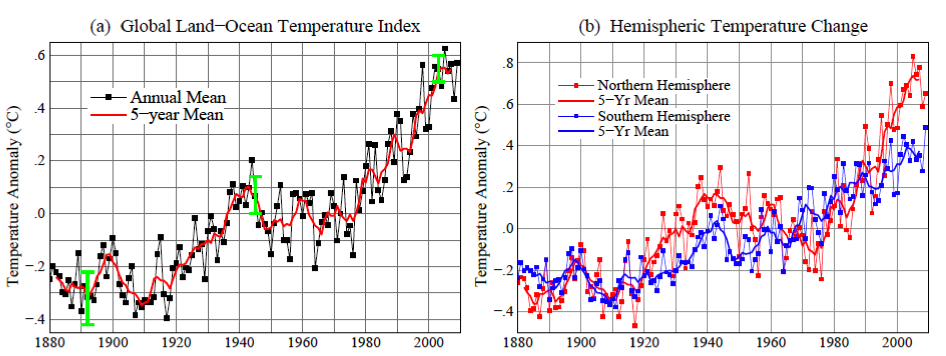
Figure 1. (a) GISS analysis of global surface temperature change. Green vertical bar is estimated 95 percent confidence range (two standard deviations) for annual temperature change. (b) Hemispheric temperature change in GISS analysis. (Base period is 1951-1980. This base period is fixed consistently in GISS temperature analysis papers – see References. Base period 1961-1990 is used for comparison with published HadCRUT analyses in Figures 3 and 4.)
The global record warm year, in the period of near-global instrumental measurements (since the late 1800s), was 2005. Sometimes it is asserted that 1998 was the warmest year. The origin of this confusion is discussed below. There is a high degree of interannual (year‐to‐year) and decadal variability in both global and hemispheric temperatures. Underlying this variability, however, is a long‐term warming trend that has become strong and persistent over the past three decades. The long‐term trends are more apparent when temperature is averaged over several years. The 60‐month (5‐year) and 132 month (11‐year) running mean temperatures are shown in Figure 2 for the globe and the hemispheres. The 5‐year mean is sufficient to reduce the effect of the El Niño – La Niña cycles of tropical climate. The 11‐year mean minimizes the effect of solar variability – the brightness of the sun varies by a measurable amount over the sunspot cycle, which is typically of 10‐12 year duration.
C’est le résumé pour 2009 de Hansen et collaborateurs’, (avec quelques modifications mineures).
“Si ça se réchauffe tant, bon sang, pourquoi fait-il si froid?”
par James Hansen, Reto Ruedy, Makiko Sato, and Ken Lo (Traduction par Xavier Pétillon)
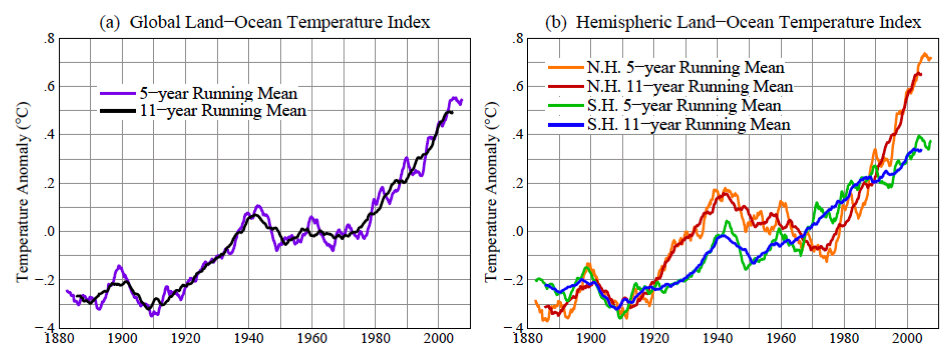
Figure 2. 60‐month (5‐year) and 132 month (11‐year) running mean temperatures in the GISS analysis of (a) global and (b) hemispheric surface temperature change. (Base period is 1951‐1980.)
There is a contradiction between the observed continued warming trend and popular perceptions about climate trends. Frequent statements include: “There has been global cooling over the past decade.” “Global warming stopped in 1998.” “1998 is the warmest year in the record.” Such statements have been repeated so often that most of the public seems to accept them as being true. However, based on our data, such statements are not correct. The origin of this contradiction probably lies in part in differences between the GISS and HadCRUT temperature analyses (HadCRUT is the joint Hadley Centre/University of East Anglia Climatic Research Unit temperature analysis). Indeed, HadCRUT finds 1998 to be the warmest year in their record. In addition, popular belief that the world is cooling is reinforced by cold weather anomalies in the United States in the summer of 2009 and cold anomalies in much of the Northern Hemisphere in December 2009. Here we first show the main reason for the difference between the GISS and HadCRUT analyses. Then we examine the 2009 regional temperature anomalies in the context of global temperatures.
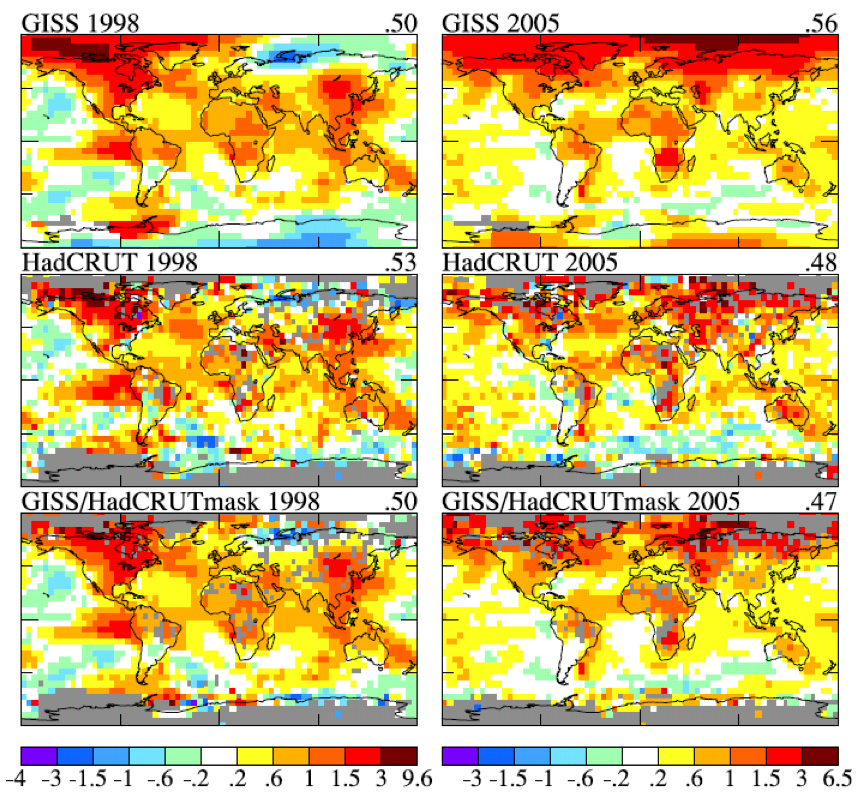
Figure 3. Temperature anomalies in 1998 (left column) and 2005 (right column). Top row is GISS analysis, middle row is HadCRUT analysis, and bottom row is the GISS analysis masked to the same area and resolution as the HadCRUT analysis. [Base period is 1961‐1990.]
Figure 3 shows maps of GISS and HadCRUT 1998 and 2005 temperature anomalies relative to base period 1961‐1990 (the base period used by HadCRUT). The temperature anomalies are at a 5 degree‐by‐5 degree resolution for the GISS data to match that in the HadCRUT analysis. In the lower two maps we display the GISS data masked to the same area and resolution as the HadCRUT analysis. The “masked” GISS data let us quantify the extent to which the difference between the GISS and HadCRUT analyses is due to the data interpolation and extrapolation that occurs in the GISS analysis. The GISS analysis assigns a temperature anomaly to many gridboxes that do not contain measurement data, specifically all gridboxes located within 1200 km of one or more stations that do have defined temperature anomalies.
The rationale for this aspect of the GISS analysis is based on the fact that temperature anomaly patterns tend to be large scale. For example, if it is an unusually cold winter in New York, it is probably unusually cold in Philadelphia too. This fact suggests that it may be better to assign a temperature anomaly based on the nearest stations for a gridbox that contains no observing stations, rather than excluding that gridbox from the global analysis. Tests of this assumption are described in our papers referenced below.
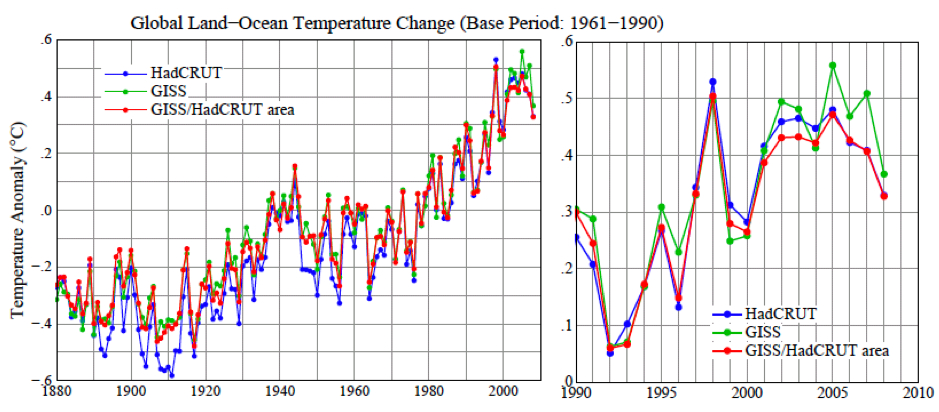
Figure 4. Global surface temperature anomalies relative to 1961‐1990 base period for three cases: HadCRUT, GISS, and GISS anomalies limited to the HadCRUT area. [To obtain consistent time series for the HadCRUT and GISS global means, monthly results were averaged over regions with defined temperature anomalies within four latitude zones (90N‐25N, 25N‐Equator, Equator‐25S, 25S‐90S); the global average then weights these zones by the true area of the full zones, and the annual means are based on those monthly global means.]
Figure 4 shows time series of global temperature for the GISS and HadCRUT analyses, as well as for the GISS analysis masked to the HadCRUT data region. This figure reveals that the differences that have developed between the GISS and HadCRUT global temperatures during the past few decades are due primarily to the extension of the GISS analysis into regions that are excluded from the HadCRUT analysis. The GISS and HadCRUT results are similar during this period, when the analyses are limited to exactly the same area. The GISS analysis also finds 1998 as the warmest year, if analysis is limited to the masked area. The question then becomes: how valid are the extrapolations and interpolation in the GISS analysis? If the temperature anomaly scale is adjusted such that the global mean anomaly is zero, the patterns of warm and cool regions have realistic‐looking meteorological patterns, providing qualitative support for the data extensions. However, we would like a quantitative measure of the uncertainty in our estimate of the global temperature anomaly caused by the fact that the spatial distribution of measurements is incomplete. One way to estimate that uncertainty, or possible error, can be obtained via use of the complete time series of global surface temperature data generated by a global climate model that has been demonstrated to have realistic spatial and temporal variability of surface temperature. We can sample this data set at only the locations where measurement stations exist, use this sub‐sample of data to estimate global temperature change with the GISS analysis method, and compare the result with the “perfect” knowledge of global temperature provided by the data at all gridpoints.
| 1880‐1900 | 1900‐1950 | 1960‐2008 | |
|---|---|---|---|
| Meteorological Stations | 0.2 | 0.15 | 0.08 |
| Land‐Ocean Index | 0.08 | 0.05 | 0.05 |
Table 1. Two‐sigma error estimate versus period for meteorological stations and land‐ocean index.
Table 1 shows the derived error due to incomplete coverage of stations. As expected, the error was larger at early dates when station coverage was poorer. Also the error is much larger when data are available only from meteorological stations, without ship or satellite measurements for ocean areas. In recent decades the 2‐sigma uncertainty (95 percent confidence of being within that range, ~2‐3 percent chance of being outside that range in a specific direction) has been about 0.05°C. The incomplete coverage of stations is the primary cause of uncertainty in comparing nearby years, for which the effect of more systematic errors such as urban warming is small.
Additional sources of error become important when comparing temperature anomalies separated by longer periods. The most well‐known source of long‐term error is “urban warming”, human‐made local warming caused by energy use and alterations of the natural environment. Various other errors affecting the estimates of long‐term temperature change are described comprehensively in a large number of papers by Tom Karl and his associates at the NOAA National Climate Data Center. The GISS temperature analysis corrects for urban effects by adjusting the long‐term trends of urban stations to be consistent with the trends at nearby rural stations, with urban locations identified either by population or satellite‐observed night lights. In a paper in preparation we demonstrate that the population and night light approaches yield similar results on global average. The additional error caused by factors other than incomplete spatial coverage is estimated to be of the order of 0.1°C on time scales of several decades to a century, this estimate necessarily being partly subjective. The estimated total uncertainty in global mean temperature anomaly with land and ocean data included thus is similar to the error estimate in the first line of Table 1, i.e., the error due to limited spatial coverage when only meteorological stations are included.
Now let’s consider whether we can specify a rank among the recent global annual temperatures, i.e., which year is warmest, second warmest, etc. Figure 1a shows 2009 as the second warmest year, but it is so close to 1998, 2002, 2003, 2006, and 2007 that we must declare these years as being in a virtual tie as the second warmest year. The maximum difference among these in the GISS analysis is ~0.03°C (2009 being the warmest among those years and 2006 the coolest). This range is approximately equal to our 1‐sigma uncertainty of ~0.025°C, which is the reason for stating that these five years are tied for second warmest.
The year 2005 is 0.061°C warmer than 1998 in our analysis. So how certain are we that 2005 was warmer than 1998? Given the standard deviation of ~0.025°C for the estimated error, we can estimate the probability that 1998 was warmer than 2005 as follows. The chance that 1998 is 0.025°C warmer than our estimated value is about (1 – 0.68)/2 = 0.16. The chance that 2005 is 0.025°C cooler than our estimate is also 0.16. The probability of both of these is ~0.03 (3 percent). Integrating over the tail of the distribution and accounting for the 2005‐1998 temperature difference being 0.61°C alters the estimate in opposite directions. For the moment let us just say that the chance that 1998 is warmer than 2005, given our temperature analysis, is at most no more than about 10 percent. Therefore, we can say with a reasonable degree of confidence that 2005 is the warmest year in the period of instrumental data.
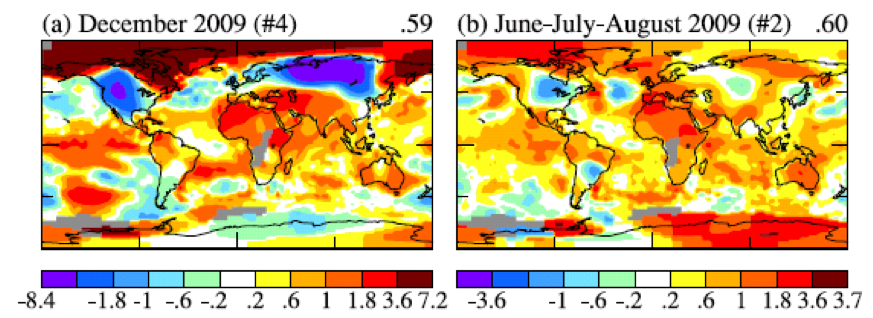
Figure 5. (a) global map of December 2009 anomaly, (b) global map of Jun‐Jul‐Aug 2009 anomaly. #4 and #2 indicate that December 2009 and JJA are the 4th and 2nd warmest globally for those periods.
What about the claim that the Earth’s surface has been cooling over the past decade? That issue can be addressed with a far higher degree of confidence, because the error due to incomplete spatial coverage of measurements becomes much smaller when averaged over several years. The 2‐sigma error in the 5‐year running‐mean temperature anomaly shown in Figure 2, is about a factor of two smaller than the annual mean uncertainty, thus 0.02‐0.03°C. Given that the change of 5‐year‐mean global temperature anomaly is about 0.2°C over the past decade, we can conclude that the world has become warmer over the past decade, not cooler.
Why are some people so readily convinced of a false conclusion, that the world is really experiencing a cooling trend? That gullibility probably has a lot to do with regional short‐term temperature fluctuations, which are an order of magnitude larger than global average annual anomalies. Yet many lay people do understand the distinction between regional short‐term anomalies and global trends. For example, here is comment posted by “frogbandit” at 8:38p.m. 1/6/2010 on City Bright blog:
“I wonder about the people who use cold weather to say that the globe is cooling. It forgets that global warming has a global component and that its a trend, not an everyday thing. I hear people down in the lower 48 say its really cold this winter. That ain’t true so far up here in Alaska. Bethel, Alaska, had a brown Christmas. Here in Anchorage, the temperature today is 31[ºF]. I can’t say based on the fact Anchorage and Bethel are warm so far this winter that we have global warming. That would be a really dumb argument to think my weather pattern is being experienced even in the rest of the United States, much less globally.”
What frogbandit is saying is illustrated by the global map of temperature anomalies in December 2009 (Figure 5a). There were strong negative temperature anomalies at middle latitudes in the Northern Hemisphere, as great as ‐8°C in Siberia, averaged over the month. But the temperature anomaly in the Arctic was as great as +7°C. The cold December perhaps reaffirmed an impression gained by Americans from the unusually cool 2009 summer. There was a large region in the United States and Canada in June‐July‐August with a negative temperature anomaly greater than 1°C, the largest negative anomaly on the planet.
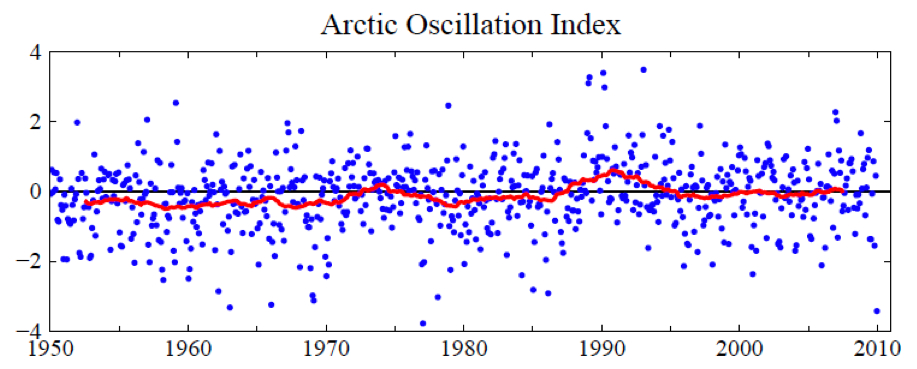
Figure 6. Arctic Oscillation (AO) Index. Positive values of the AO index indicate high low pressure in the polar region and thus a tendency for strong zonal winds that minimize cold air outbreaks to middle latitudes. Blue dots are monthly means and the red curve is the 60‐month (5‐year) running mean.
How do these large regional temperature anomalies stack up against an expectation of, and the reality of, global warming? How unusual are these regional negative fluctuations? Do they have any relationship to global warming? Do they contradict global warming?
It is obvious that in December 2009 there was an unusual exchange of polar and mid‐latitude air in the Northern Hemisphere. Arctic air rushed into both North America and Eurasia, and, of course, it was replaced in the polar region by air from middle latitudes. The degree to which Arctic air penetrates into middle latitudes is related to the Arctic Oscillation (AO) index, which is defined by surface atmospheric pressure patterns and is plotted in Figure 6. When the AO index is positive surface pressure is high low in the polar region. This helps the middle latitude jet stream to blow strongly and consistently from west to east, thus keeping cold Arctic air locked in the polar region. When the AO index is negative there tends to be low high pressure in the polar region, weaker zonal winds, and greater movement of frigid polar air into middle latitudes.
Figure 6 shows that December 2009 was the most extreme negative Arctic Oscillation since the 1970s. Although there were ten cases between the early 1960s and mid 1980s with an AO index more extreme than ‐2.5, there were no such extreme cases since then until last month. It is no wonder that the public has become accustomed to the absence of extreme blasts of cold air.
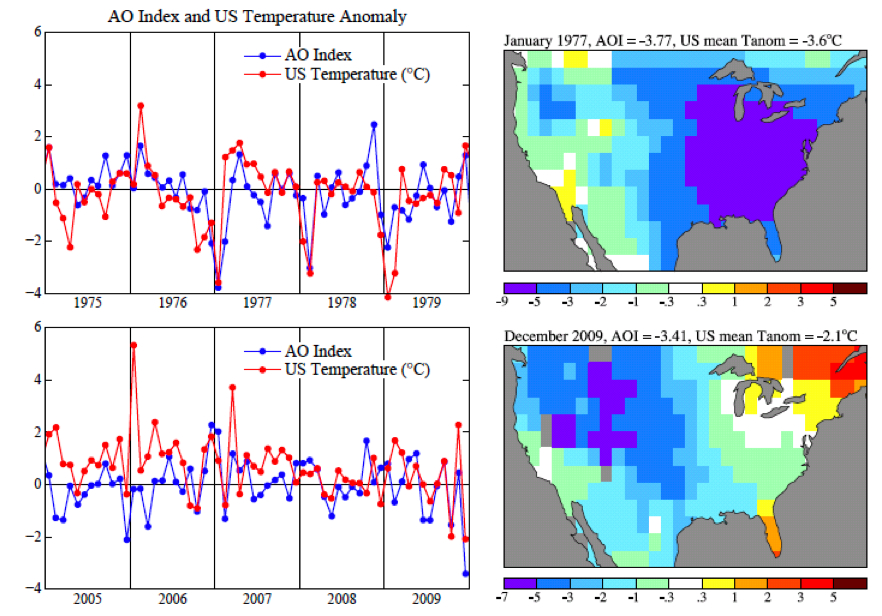
Figure 7. Temperature anomaly from GISS analysis and AO index from NOAA National Weather Service Climate Prediction Center. United States mean refers to the 48 contiguous states.
Figure 7 shows the AO index with greater temporal resolution for two 5‐year periods. It is obvious that there is a high degree of correlation of the AO index with temperature in the United States, with any possible lag between index and temperature anomaly less than the monthly temporal resolution. Large negative anomalies, when they occur, are usually in a winter month. Note that the January 1977 temperature anomaly, mainly located in the Eastern United States, was considerably stronger than the December 2009 anomaly. [There is nothing magic about a 31 day window that coincides with a calendar month, and it could be misleading. It may be more informative to look at a 30‐day running mean and at the Dec‐Jan‐Feb means for the AO index and temperature anomalies.]
The AO index is not so much an explanation for climate anomaly patterns as it is a simple statement of the situation. However, John (Mike) Wallace and colleagues have been able to use the AO description to aid consideration of how the patterns may change as greenhouse gases increase. A number of papers, by Wallace, David Thompson, and others, as well as by Drew Shindell and others at GISS, have pointed out that increasing carbon dioxide causes the stratosphere to cool, in turn causing on average a stronger jet stream and thus a tendency for a more positive Arctic Oscillation. Overall, Figure 6 shows a tendency in the expected sense. The AO is not the only factor that might alter the frequency of Arctic cold air outbreaks. For example, what is the effect of reduced Arctic sea ice on weather patterns? There is not enough empirical evidence since the rapid ice melt of 2007. We conclude only that December 2009 was a highly anomalous month and that its unusual AO can be described as the “cause” of the extreme December weather.
We do not find a basis for expecting frequent repeat occurrences. On the contrary. Figure 6 does show that month‐to‐month fluctuations of the AO are much larger than its long term trend. But temperature change can be caused by greenhouse gases and global warming independent of Arctic Oscillation dynamical effects.
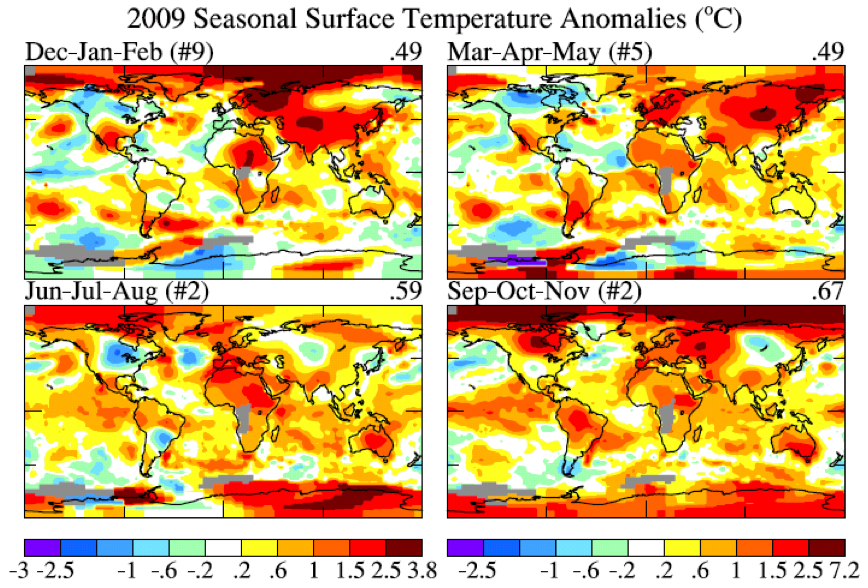
Figure 8. Global maps 4 season temperature anomalies for ~2009. (Note that Dec is December 2008. Base period is 1951‐1980.)
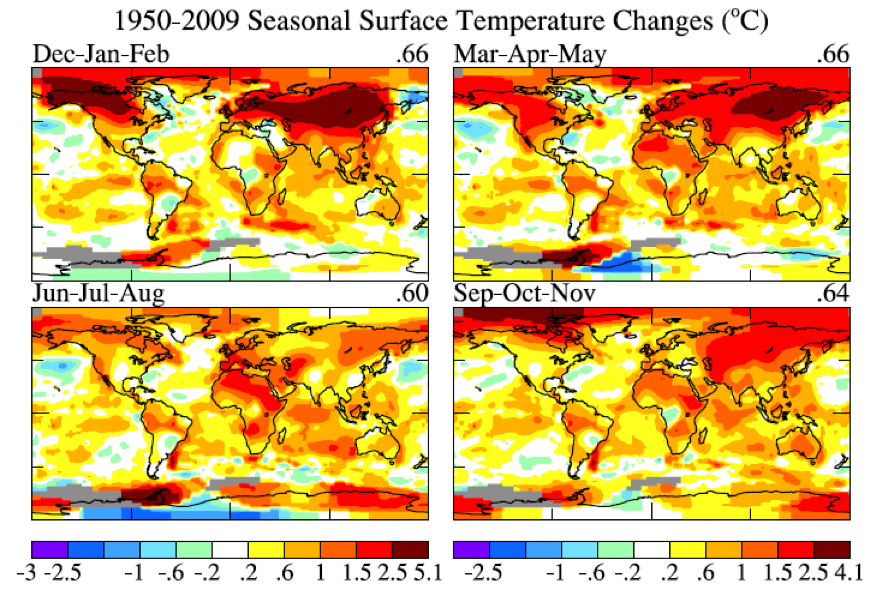
Figure 9. Global maps 4 season temperature anomaly trends for period 1950‐2009.
So let’s look at recent regional temperature anomalies and temperature trends. Figure 8 shows seasonal temperature anomalies for the past year and Figure 9 shows seasonal temperature change since 1950 based on local linear trends. The temperature scales are identical in Figures 8 and 9. The outstanding characteristic in comparing these two figures is that the magnitude of the 60 year change is similar to the magnitude of seasonal anomalies. What this is telling us is that the climate dice are already strongly loaded. The perceptive person who has been around since the 1950s should be able to notice that seasonal mean temperatures are usually greater than they were in the 1950s, although there are still occasional cold seasons.
The magnitude of monthly temperature anomalies is typically 1.5 to 2 times greater than the magnitude of seasonal anomalies. So it is not yet quite so easy to see global warming if one’s figure of merit is monthly mean temperature. And, of course, daily weather fluctuations are much larger than the impact of the global warming trend. The bottom line is this: there is no global cooling trend. For the time being, until humanity brings its greenhouse gas emissions under control, we can expect each decade to be warmer than the preceding one. Weather fluctuations certainly exceed local temperature changes over the past half century. But the perceptive person should be able to see that climate is warming on decadal time scales.
This information needs to be combined with the conclusion that global warming of 1‐2°C has enormous implications for humanity. But that discussion is beyond the scope of this note.
References:
Hansen, J.E., and S. Lebedeff, 1987: Global trends of measured surface air temperature. J. Geophys. Res., 92, 13345‐13372.
Hansen, J., R. Ruedy, J. Glascoe, and Mki. Sato, 1999: GISS analysis of surface temperature change. J. Geophys. Res., 104, 30997‐31022.
Hansen, J.E., R. Ruedy, Mki. Sato, M. Imhoff, W. Lawrence, D. Easterling, T. Peterson, and T. Karl, 2001: A closer look at United States and global surface temperature change. J. Geophys. Res., 106, 23947‐23963.
Hansen, J., Mki. Sato, R. Ruedy, K. Lo, D.W. Lea, and M. Medina‐Elizade, 2006: Global temperature change. Proc. Natl. Acad. Sci., 103, 14288‐14293.
L’année passée, 2009, passe pour être la seconde année la plus chaude depuis 130 ans d’enregistrements instrumentaux de la température globale, dans l’analyse de température de surface par l’Institut Goddard pour les études spatiales de la NASA (GISS). L’hémisphère sud bat un record comme le plus chaud pour cette moitié du monde. La température globale moyenne, comme montré dans l’illustration 1a, fut plus chaude de 0,57°C (1°F) que la période climatologique (période de base 1951-1980). L’hémisphère sud, comme montré dans l’illustration 1b, fut plus chaud de 0,49°C (0,88°F) que la période climatologique.

Illustration 1: (a) analyse du GISS pour les changements de la température globale de surface. La barre verticale verte est l’estimation à l’intervalle de confiance de 95% (deux écarts-type) pour le changement annuel de température. (b) Changement des
températures des hémisphères dans l’analyse du GISS. (Période de base 1951-1980. Cette période de base est est systématiquement fixée pour tous les articles du GISS concernant l’analyse de la température – voir les références. La période de base 1961-1990 est utilisée pour les comparaisons avec les analyses publiées du HadCRUT dans les illustrations 3 et 4).
L’enregistrement de l’année globalement la plus chaude, dans la période d’utilisation des mesures instrumentales globales (depuis la fin du XIXème siècle) était 2005. Il est quelques fois avancé que 1998 était la plus chaude. L’origine de cette confusion est discutée ci-après. Il y a un fort degré de variabilité interannuelle (année par année) et décénnale à la fois dans les températures globales et hémisphériques. Sous-tendant cette variabilité, néanmoins, on trouve une tendance au réchauffement de long terme qui devient plus fort et persistant [tenace] au cours des trois dernières décennies. Les tendances de long terme sont plus apparentes quand les températures sont moyennées sur plusieurs années. Les températures en moyennes mobiles sur 60 mois (5 ans) et 132 mois (11 ans) sont montrées dans la figure 2 pour le globe et les hémisphères. La moyenne sur 5 ans est suffisante pour réduire l’effet du cycle climatique tropical El Niño-El Niña. La moyenne sur 11 ans minimise l’effet de la variabilité solaire – la luminosité solaire varie significativement pendant le cycle de tâches solaires, qui est généralement d’une durée de l’ordre de 10-12 ans.

Illustration 2: Températures en moyennes mobiles sur 60 (5 ans) et 132 (11 ans) mois dans l’analyse du GISS pour les changements de température de surface (a) globale et (b) des hémisphères.(période de base 1951-1980).
Il y a une contradiction entre la tendance observée et continue au réchauffement et la perception populaire des tendances climatiques. Ce type de perception inclut fréquemment ces assertions « Il y a eu un refroidissement global ces dernières 10 années. » « Le réchauffement global s’est arrêté en 1998. » « 1998 est l’année la plus chaude jamais enregistrée. » De telles déclarations ont été répétées si souvent que la plupart des gens les acceptent comme vraies. Néanmoins, selon nos données, ces déclarations ne sont pas correctes.
L’origine de la contradiction se trouve probablement pour partie dans la différence entre les analyses du GISS et du HadCRUT (HadCRUT est une association entre le centre Hadley et l’unité de recherche sur l’analyse de température de l’université de East-Anglia). En effet, le HadCRUT a trouvé que 1998 était l’année la plus chaude enregistrée. De plus, les croyances populaires en un refroidissement sont renforcées par des anomalies froides aux USA à l’été 2009 et dans l’hémisphère nord en décembre 2009.
Nous montrerons d’abord les principales raisons des différences entre les analyses du GISS et du HadCRUT. Nous examinerons ensuite les anomalies régionales de 2009 dans le contexte des températures globales.

Illustration 3: Anomalies de températures en 1998 (colonne de gauche) et 2005 (colonne de droite). Le rang du haut est l’analyse du GISS, celui du milieu est l’analyse du HadCRUT et le rang du bas est l’analyse du GISS masquée [ndt : calée] sur les mêmes zones et résolution que l’analyse du HadCRUT. (La période de base est 1961-1990.)
L’illustration 3 montre les cartes des anomalies de températures du GISS et HadCRUT en 1998 et 2005 relativement à la période 1961-1990 (la période de base usuelle du HadCRUT). Les anomalies de températures sont dans une résolution de 5 en 5 degrés géographiques pour les données du GISS afin qu’elles correspondent à celles de l’analyse du HadCRUT. Dans les deux cartes du bas, nous montrons les données du GISS sous le même masque en termes de répartition géographique et de résolution que celui du HadCRUT. Les données du GISS « sous masque » nous permettent de quantifier la manière dont les différences entre les analyses du GISS et du HadCRUT sont dues à l’interpolation et l’extrapolation des données utilisées dans l’analyse du GISS. Cette analyse affecte
à de nombreuses cases [des modèles] une anomalie de température qui ne contiennent pas de données mesurées, spécifiquement dans des cases qui se trouvent à moins de 1200 km d’une ou plusieurs stations qui ont défini une anomalie de température.
La raison de cet aspect de l’analyse du GISS est basée sur le fait que le schéma d’une anomalie de température tend à se produire à grande échelle. Par exemple, s’il y a un hiver anormalement froid à New-York, il est probablement anormalement froid à Philadelphie aussi. Ce fait suggère qu’il peut être préférable d’affecter une anomalie de température basée sur les stations les plus proches de la case qui n’a aucune observation que d’exclure la case de l’analyse globale. Des tests de cette assertion sont décrits dans nos articles référencés plus bas.

Illustration 4: Anomalies de la température de surface globale relativement à la période de base 1961-1990 pour trois cas : HadCRUT, GISS et anomalies du GISS limitées à l’aire HadCRUT. [Pour obtenir des séries temporelles cohérentes pour les moyennes globales du HadCRUT et du GISS, les résultats mensuels ont été moyennés par régions avec des anomalies de températures définies à l’intérieur de 4 zones de latitudes (90N-25N, 25N-équateur, équateur-25S, 25S-90S) ; la moyenne globale pondère ainsi ces zones en fonction de la vraie surface de ces zones entières, et les moyennes annuelles sont basées sur ces moyennes mensuelles globales.]
L’illustration 4 montre des séries temporelles de température globale pour les analyses du GISS et du HadCRUT, aussi bien que pour l’analyse du GISS masquée sur les régions de données du HadCRUT. Cette illustration révèle que les différences qui se sont développées entre les températures globales du GISS et du HadCRUT ces dernières décennies sont principalement dues à l’extension de l’analyse du GISS à des régions exclues de l’analyse du HadCRUT. Les résultats du GISS et de HadCRUT sont similaires durant
cette période quand les analyses sont circonscrites exactement aux mêmes aires. L’analyse du GISS trouve aussi 1998 comme année la plus chaude, si l’analyse est limité aux données sous le même masque. La question devient alors : quelle est la valeur des interpolations et des extrapolations dans l’analyse du GISS ? Si l’échelle des anomalies de température est ajustée telle que l’anomalie de la moyenne globale est de zéro, alors les schémas des régions chaudes et froides ont un aspect cohérent avec les schémas météorologiques, apportant ainsi un support qualitatif pour l’extension des données. Néanmoins, nous aimerions une mesure quantitative sur l’incertitude de notre estimation pour l’anomalie de la température globale causée par le fait d’une distribution spatiale des mesures incomplète.
Une manière d’estimer cette incertitude, ou possible erreur, peut être d’utiliser les séries temporelles complètes générées par un modèle de climat global ayant déjà fait ses preuves d’une variabilité spatiale et temporelle des températures de surface réaliste. Nous pouvons échantillonner ce jeu de données seulement aux endroits où des stations de mesure existent, et utiliser ce sous-ensemble de données pour estimer le changement de la température globale avec l’analyse du GISS, puis comparer le résultat avec la connaissance « parfaite » de la température globale que nous avons avec les données de chacune des cases.
| 1880-1900 | 1900-1950 | 1960-2008 | |
|---|---|---|---|
| Stations météorologiques | 0.2 | 0.15 | 0.08 |
| Index « Land-Ocean » | 0.08 | 0.05 | 0.05 |
Tableau 1. Estimation de l’erreur à deux écart-type par période pour les stations météorologiques et l’index « Land-ocean ».
Le tableau 1 montre l’erreur dérivée due à la couverture incomplète des stations. Comme attendu, l’erreur est plus importante aux dates anciennes quand la couverture en stations était plus pauvre. Mais aussi, l’erreur est plus grande quand les données sont disponibles seulement depuis les stations météorologiques, sans mesure depuis des bateaux ou satellites pour les aires océaniques. Dans les décennies récentes, l’incertitude à 2 écarts-type (intervalle de confiance à 95% d’être à l’intérieur de ces valeurs, 2 à 3 % d’être en dehors d’un côté ou de l’autre) a été de 0,05°C. La couverture incomplètes des stations est la première cause d’incertitude pour les années récentes, pour lesquelles les erreurs plus systématiques sont petites, comme le réchauffement urbain.
Des sources additionnelles d’erreurs deviennent importantes quand on compare des anomalies de températures séparées par des périodes plus longues. La source d’erreur de long terme la plus connue est « le réchauffement urbain », un réchauffement local d’origine humaine causé par l’utilisation de l’énergie et les altérations de l’environnement naturel. D’autres erreurs variées, qui affectent les estimations des changements de températures sur le long terme, sont décrites de manière complète dans un grand
nombre d’articles par Tom Karl et ses associés du Centre national de données sur le climat (NCDC) de la NOAA. L’analyse du GISS pour la température corrige l’effet urbain en ajustant les tendances de long terme des stations urbaines de manière cohérente avec les stations rurales des alentours, et en identifiant les densités urbaines par leur population ou par l’observation par les satellites des lumières nocturnes. Dans un article en préparation, nous démontrons que les approches par la population et par les lumières nocturnes donne des résultats similaires sur la moyenne globale. Les erreurs additionnelles causées par des facteurs autres que
la couverture spatiale incomplète est estimée comme étant de l’ordre de 0,1°C sur des échelles de temps de plusieurs décennies à un siècle, cette estimation étant nécessairement partiellement subjective. L’incertitude totale dans les anomalies de température globale moyenne, avec les données « terre et océans » ainsi incluses, est équivalente à l’erreur estimée dans la première ligne du
tableau 1, i.e. l’erreur due à une couverture spatiale limitée quand seules les stations météorologiques sont incluses.
Maintenant, voyons voir si nous pouvons préciser un rang entre les températures annuelles globales récentes, i.e. quelle année est la plus chaude, la seconde plus chaude, etc. L’illustration 1a montre l’année 2009 comme la seconde plus chaude, mais si proche de 1998, 2002, 2003 et 2007 que nous devons considérer toutes ces années comme étant virtuellement la seconde année la plus chaude. La différence maximale entre elles dans l’analyse du GISS est de ~0,03°C (2009 étant la plus chaude et 2003 la plus froide). Cet écart est approximativement égal à notre incertitude à un écart-type de ~0,025°C, ce qui est la raison pour établir que ces années sont toutes la seconde année la plus chaude.
L’année 2005 est plus chaude de 0,061°C que 1998 dans notre analyse. Donc, comment sommes-nous certains que 2005 est plus chaude que 1998 ? Étant donné l’écart-type de ~0,025°C pour l’erreur estimée, nous pouvons estimer la probabilité que 1998 était plus chaude que 2005 comme suit. La chance que 1998 soit 0,025°C plus chaude que notre valeur estimée est d’environ (1-0,68)/2=0,16. La chance que 2005 soit 0,025°C plus froide que notre estimation est aussi de 0,16. La probabilité que ces deux évènements se produisent ensemble est de ~0,03 (3 pourcent). Intégrer la queue de distribution et compter une différence de température entre 2005 et 1998 de 0,61°C change l’estimation dans des directions opposées. Pour le moment, disons juste que la chance pour que 1998 soit plus chaude que 2005, étant donnée notre analyse des températures, est au plus de l’ordre de 10 pourcent. Par conséquent, nous pouvons dire avec un degré raisonnable de confiance que 2005 est l’année la plus chaude dans la période de mesures instrumentales.

Illustration 5. (a) Carte globale de l’anomalie de décembre 2009, (b) carte globale de l’anomalie de juin-juillet-août 2009. #4 et #2 indiquent que décembre 2009 en juin-juillet-août sont les quatrième et deuxième périodes globalement plus chaudes de ce laps de temps.
Que dire à propos de la déclaration comme quoi la surface de la Terre se rafraîchit depuis 10 ans ? Cette question peut être traitée avec beaucoup de confiance, car l’erreur due à une couverture spatiale insuffisante des mesures devient encore plus faible quand on moyenne sur plusieurs années. L’incertitude à deux écarts-type dans la moyenne sur 5 ans de l’anomalie de température montrée dans l’illustration 2, est plus petite d’un facteur 2 que l’incertitude moyenne annuelle, ainsi 0,02-0,03°C. Étant donné que le changement d’une moyenne sur 5 ans de l’anomalie de température est d’environ 0,2°C sur la dernière décennie, nous pouvons conclure que le monde est devenu plus chaud, et non plus froid, depuis la dernière décennie.
Pourquoi des gens sont-ils convaincus d’une conclusion erronée, que le monde est vraiment en train de se refroidir ? Cette naïveté a certainement beaucoup à voir avec les variations régionales de court terme de la température, qui sont d’un plus grand ordre de grandeur que les anomalies annuelles des températures. Même des personnes non averties sont capables de comprendre la différence entre les anomalies locales [ndt : régionales] de court terme et la tendance globale. Par exemple, voici un commentaire posté par « frogbandit » à 20h38 le 6 janvier 2010 le blog de City Bright :
« Je m’étonne de ces gens qui utilisent une météo quotidienne froide pour dire que la Terre se refroidit. On oublie que le réchauffement global a des composantes globales et que c’est une tendance, pas une chose quotidienne. J’entends des gens, au sud que la latitude 48, dire qu’il fait vraiment froid cet hiver. Ce n’est pas si vrai que ça, ici, en Alaska. Bethel, en Alaska, a eu un Noël brun. Ici, à Anchorage, la température d’aujourd’hui est de 31°F [ndt : soient 3°C]. En me basant sur le fait que Bethel et Anchorage sont si chauds cet hiver, je ne peux pas dire que nous avons un réchauffement climatique. Ce serait vraiment un argument idiot de penser que mon schéma de température est répété dans le reste des Etats-Unis, plus ou moins globalement. »
Ce que ‘frogbandit’ dit est illustré par la carte globale des anomalies de températures en décembre 2009 (illustration 5a). Il y a eu de forte anomalies négatives de températures dans les latitudes moyennes de l’hémisphère nord, pas moins de 8°C en Sibérie, moyenné sur le mois. Mais l’anomalie de température en Arctique était, elle, aussi forte que +7°C.
Le décembre froid confirme peut-être une impression acquise par les américains depuis l’été inhabituellement froid de 2009. Il y avait des régions étendues des USA et du Canada en juin-juillet-août avec une anomalie négative de température supérieure à 1°C, la plus grande anomalie sur la planète.

Illustration 6. L’index de l’Oscillation Arctique (AO). Les valeurs positives de l’Index AO indiquent une zone de haute pression sur les régions polaires et ainsi, une tendance à de forts vents zonaux qui minimisent la circulation d’air froid aux latitudes moyennes. Les point bleus sont des moyennes mensuelles et la courbe rouge est la moyenne mobile sur 60 mois (5 ans).
Comment ces larges anomalies régionales de températures se confrontent-elles aux attentes et à la réalité du réchauffement climatique? Ces fluctuations négatives régionales sont-elles inhabituelles? Sont-elles liées avec le réchauffement climatique? Le contredisent-elles?
Il est évident qu’il y a eu en décembre 2009 un échange inhabituel d’air entre le pôle et les latitudes moyennes de l’hémisphère nord. L’air arctique s’est engouffré à la fois sur l’Amérique du nord et l’Eurasie, et, bien sûr, a été remplacé dans ces régions polaires par l’air des latitudes moyennes. La force avec laquelle l’air arctique a pénétré dans les latitudes moyennes est relié avec l’index AO, défini par des schémas de pression atmosphérique de surface et représenté dans l’illustration 6. Quand l’index AO est positif, la pression de surface est élevée dans les régions polaires. Cela permet au jet stream des latitudes moyennes de souffler fortement et constamment d’ouest en est, bloquant ainsi l’air froid au pôle. Quand l’index AO est négatif, il y a une tendance aux basses pressions dans les régions polaires, un vent zonal plus faible, et de plus grands mouvements d’air glacé vers les latitudes moyennes.
L’illustration 6 montre que décembre 2009 a vu la valeur de l’index AO la plus extrêmement négative depuis les années 70. Malgré le fait qu’il y ait eu une dizaine de cas d’index AO aussi extrêmes que -2,5 entre les années 60 et les années 80, il n’y a rien eu d’aussi extrême que le mois dernier. Ce n’est pas étonnant que les gens aient été accoutumés à une absence de ces coups de froid extrêmes.

Illustration 7. Anomalie de températures issu de l’analyse du GISS et Index AO du NWSCPC de la NOAA. La moyenne pour les Etats-Unis fait référence aux 48 états contigus.
L’illustration 7 montre l’index AO avec une résolution temporelle plus grande pour deux périodes de 5 ans. Il est évident qu’il y a un fort degré de corrélation entre l’index AO et les températures des Etats-Unis, avec un décalage possible entre l’index et les anomalies de températures inférieur à la résolution termporelle mensuelle. Les anomalies largement négatives, quand elles arrivent, sont souvent pendant les mois d’hiver. Il faut noter que l’anomalie de températures de janvier 1977, principalement située dans les états de l’est, fut considérablement plus forte que celle de décembre 2009. [cela n’a rien de magique quand une fenêtre de 31 jours coincide avec les jours calendaires du mois, et cela peut être trompeur. Il serait plus informatif de regarder la moyenne mobile sur 30 jours et la moyenne de l’index AO et des températures sur décembre-janvier-février.]
L’index AO n’est pas tant une explication pour ces schémas d’anomalies climatiques qu’un simple état de fait de la situation. Cependant, John (Mike) Wallace et ses collègues ont été capable d’utiliser la description de l’index AO pour aider à comprendre comment ces schémas peuvent changer en cas d’augmentation de gaz à effet de serre. Un certain nombre d’articles, par Wallace, David Thompson et d’autres, aussi bien que par Drew Shindell et d’autres au GISS,
ont montré que l’augmentation de gaz carbonique refroidit la stratosphère, ce qui cause en moyenne un jet stream plus puissant, et ainsi une tendance pour une oscillation arctique (AO) plus positive.
Globalement, l’illustration 6 montre une tendance selon le sens attendu. L’AO n’est pas le seul facteur qui altère la fréquence des épisodes d’air froid de l’Arctique. Par exemple, quel est l’effet d’une glace de mer réduite sur le schéma climatologique? Il n’y a pas assez de preuves empiriques depuis la fonte rapide de la glace de 2007. Nous pouvons seulement conclure que décembre 2009 était un mois hautement anormal et que cette oscillation arctique inhabituelle peut décrire la « cause » du climat extrême de décembre.
Nous n’avons pas trouvé de base pour nous attendre à de fréquentes répétitions de ce phénomène. Tout au contraire. L’illustration 6 montre que les fluctuations mois-par-mois de l’AO sont plus étendues que la tendance de long terme. Mais les changements de températures peuvent être causés par les gaz à effet de serre et le réchauffement global être indépendant des effets dynamiques de l’Oscillation Arctique.

Illustration 8. Carte globale des anomalies de températures pour les 4 saisons pour ~2009. (noter que Dec est décembre 2008. La période de base est 1951-1980.)

Illustration 9. Carte globale des tendances des anomalies de températures pour les 4 saisons pour la période 1950-2009.
Maintenant, regardons les anomalies de températures régionales récentes et les tendances des températures. L’illustration 8 montre les anomalies de températures saisonnières pour l’année passée et l’illustration 9 montre les changements des anomalies de températures depuis 1950 basés sur une tendance linéaire locale. Les échelles de températures sont les mêmes sur les illustrations 8 et 9. La caractéristique remarquable quand on compare ces deux illustrations est que la magnitude des changements sur 60 ans est similaire à la magnitude des anomalies saisonnières. Ce que cela nous raconte, c’est que les dés climatiques sont déjà sérieusement lancés. La personne perspicace qui est là depuis les années 50 sera capable de noter que les températures moyennes saisonnières sont actuellement plus élevées que celles des années 50, bien qu’il y ait encore occasionnellement des saisons froides.
La magnitude des anomalies mensuelles de températures est couramment 1,5 à 2 fois plus grande que la magnitude des anomalies saisonnières. Du coup, ce n’est pas encore si facile de voir le réchauffement global si sa principale illustration est la température moyenne mensuelle. Et, bien sûr, les fluctuations du temps au quotidien sont bien plus importantes que l’impact de la tendance globale du réchauffement.
Les bases sont celles-ci : il n’y a pas de tendance au refroidissement global.
A l’heure actuelle, jusqu’à ce que l’humanité mette ses émissions de gaz à effet de serre sous contrôle, nous pouvons nous attendre à ce que chaque décennie soit plus chaude que la précédente. Les fluctuations du temps qu’il fait excèdent certainement les changements locaux de températures du dernier demi-siècle. Mais la personne perspicace verra bien que le climat se réchauffe à l’échelle des décennies.
Cette information a encore besoin d’être mise en relation avec la conclusion qu’un réchauffement global de 1 à 2°C a d’énormes implications pour l’humanité. Mais cette discussion est au-delà de la portée de cet article.
Références:
Hansen, J.E., and S. Lebedeff, 1987: Global trends of measured surface air temperature. J. Geophys. Res., 92, 13345-13372.
Hansen, J., R. Ruedy, J. Glascoe, and Mki. Sato, 1999: GISS analysis of surface temperature change. J. Geophys. Res., 104, 30997-31022.
Hansen, J.E., R. Ruedy, Mki. Sato, M. Imhoff, W. Lawrence, D. Easterling, T. Peterson, and T. Karl, 2001: A closer look at United States and global surface temperature change. J. Geophys. Res., 106, 23947-23963.
Hansen, J., Mki. Sato, R. Ruedy, K. Lo, D.W. Lea, and M. Medina-Elizade, 2006: Global temperature change. Proc. Natl. Acad. Sci., 103, 14288-14293.
Walt, you seem to be saying that you yourself are the only person who knows a lot of stuff. But I can’t figure out what you think you know that’s unusual.
Does it have something to do with the topic? Or are you looking for an economic or policy blog?
What are you trying to say? Can you say it simply? Cite to some source, or show your work if it’s your own work?
Re: #851
Hank,
I can say it simply and I have said it simply:
The game is over. We lost. What’s the new game?
[Response:
Not a game, regardless of how you view or phrase it. And nobody’s “lost” anything–Jim]
Walt Bennett: No matter how much we spend we cannot reduce China’s or India’s emissions.
BPL: Agree with our allies on a carbon-intensity tariff.
Geoengineering solution: Crush massive amounts of dolomite or whatever it is CO2 combines with when weathering happens, and spread it all over the place. Have dedicated, mobile machines to do this, piloted by people with experience in those environments. If we pour a massive amount of funding into such a project (once agriculture has already started to fail and people are finally motivated), and massively switch to renewables, we might just preserve human civilization.
But, like Walt, I doubt it’s going to happen. I think we’re in for a huge population crash and a thousand-year dark ages. I only disagree with him that it’s **impossible** to find a way out and implement it. I just think it’s very, very unlikely that we will.
“However: We’re still going to burn most of our oil and much of our coal.”
Wrong.
And the only reason why it could even be possibly right is if people refuse to follow guidelines unless there’s government mandate and law to back it up.
But you’re going to complain to your congresscritter if you hear of any laws done aren’t you.
Walt, I think it is very likely we’ll break 450 ppmv of CO2. However, I also think that the interval in which we will do so will present us with opportunities for making fundamental changes that could postpone reaching that level. Unlike climate, Peak Oil is not a crisis that people can ignore. We will be utterly remaking our energy infrastructure. The question is whether we will be relying on coal or on renewables and perhaps nukes. Keeping the heat on wrt climate could tip the balance of that decision. That is why the coal barons are so worried. Indeed, I think there is a possibility of turning Petroleum interests into Energy interests (ala Mr. Pickens), and thereby splitting them from coal interests.
In the meantime while this plays out, James Hansen’s latest paper in which he suggests we concentrate efforts on ghgs other than CO2 has merit–at least while we wait for rectal haberdashery to go out of style.
“But if you isolate just the last four years, many things have been learned about the carbon cycle and climate sensitivity which were not as well known then.”
However, if you check the last four years with the last four when we had such a strong solar activity minimum, you’ll find that one thing you have learned is that CO2’s effect is likely above 3C increase per doubling.
Funny how the things we don’t know become, for some people, a reason to deny a problem needs a solution.
Looks like Phil Jones has finally broken ranks. “”statistically insignificant” warming since at least 1860. Debate not closed on the MWP which he concedes may have been comparable.
He challenges people to make their own datasets! that is not the way science is done, and we cant reproduce hadCRUT as the MET have only released 80% of the SST data anyway. So Gavin, time to release ALL your data and methodology?
[Response: Something tells me you show up late to parties–Jim]
801: Walt Wrote: “Re: #801 Here’s what I want to know, John:
By 2015 will humankind be emitting more or less CO2 than it does today, per annum? ”
That isn’t the point and you know it. You’ve written over and over that “the needle hasn’t moved”, etc. I claim that the US-China wind power race constitutes movement. If my claim that by 2015 the US will have 100 GW of installed wind power capacity proves correct, the US will be well on its way to a low carbon future. DOE projects that the US will get 20% of its electricity by 2030. If we start building nuclear plants it isn’t unimaginable that the US would not be burning coal in 2050. In 2008 US CO2 production was almost 3% below our 1991 CO2 production. This constitutes movement.
John@858, My, that is an awfully creative reading of Jone’s answers. I’m wondering if you are similarly creative in your interpretations of other aspects of reality. What Jones says is that there have been other periods where warming has been significant. Uh, yeah, and… The current warming epoch has lasted 35 years, significantly longer than the other periods.
He says there is debate over the global nature of the MWP. Yup, as evidenced by posts here at RC and posters at multiple conferences. The fact remains that there is no convincing evidence that this period was global and strong evidence to suggest that even if it was global, MWP temperatures were well below those of the present.
John: “He challenges people to make their own datasets! that is not the way science is done,…”
Um, yeah, that is exactly how science is done. You get the data. You crunch it in a reasonable way and you validate it. Then you use the data and theory to make predictions and validate them. Scientific method in a nutshell.
Here’s an idea, John. Why don’t you go to the Start Here button and learn what the science really says so you won’t make a fool of yourself again. ‘Kay?
Re: #852
Jim,
OK, how about this? We lost the war, and it’s because we never really fought it.
Now, what’s the next move?
And Jim: We are going past 450 ppm and you know it as well as you know your name.
[Response:“The difficulty with prediction is that it involves the future”–Niels Bohr.
“It ain’t over ’till it’s over”–Yogi Berra.
Jim]
Re: #853
Bart,
If you think China will allow a concerted economic policy to dictate to them how they grow their energy apparatus:
I strongly disagree, and I mean strongly.
And who has the political will for that?
And is the U.S. even committed to its own reductions? What has Obama promised, a 20% reduction in 2005 levels by 2020? Under any scenario we know of, will that accomplish anything useful?
I suspect you have more faith in things unseen than is warranted.
Re: #854
Bart! I appreciate the candor, I truly do.
With any luck we can start a trend.
And by the way I do not think it is impossible to solve AGW.
What I have said, most vehemently, is that the current solutions businessis a fraud, and that the people who meet for these climate summits are perpetuating a vicious lie, that a global agreement can be reached, can be implemented and can avoid calamitous warming. No, no and most definitely no.
Once we accept that plain reality, we can – at last – start looking for the much, much better ideas we will need to actually have a chance to solve it.
I loved your out-of-the-box brainstorming. We need so much more of it.
Re: #855
CFU,
I appreciate that you are trying to come to grips with climate reality.
And I completely understand, I honestly do, why it is so difficult to accept my assertion that we will burn most of our oil (including shale and tar) and much of our coal.
On the other hand, you have to also understand inertia. I don’t know how old you are: I am 50. That affords a certain perspective that is generally unavailable to younger folks. You need to see a lot before you get a real sense of what is and isn’t likely to occur on mass scales.
And for sure there are many “older folk” (not that 50 is terribly old) who still do believe there will be a massive shift in human behavior before we burn through most of our oil and much of our coal.
They are simply and plainly wrong.
Just look at year-by-year numbers and you will see that they still go up and that the rate of growth is also still going up.
So, based on what logic would we assert that there will be a sudden reversal in that usage? Nothing that’s been tried til now has come close to accomplishing that.
We can and we should go right on investing in green technology, but the simple fact is that more people need more energy than these measures can, today, produce, so as energy needs increase, CO2 emissions, for the next couple of decades, will continue to increase.
Somewhere in there it will flatten. Ten years? Maybe. Nothing has happened as fast as we would like, so my hedge is that it’s more like 20. Now, we need to reduce reliance on fossil fuels. Trucks, jets, rockets, plastic…things that no alternative that we know of can replace their CO2 emissions. Getting green tech to the masses will be wickedly expensive. Most nations these days are running deficits. No significant tax policies have been passed in the U.S., for one, to encourage a private market shift.
Policy makers are either paralyzed or caught in a political system which grinds this issue to a halt.
That’s not subject to rapid change, either.
CFU, there is no avoiding the simple fact that we will emit enough CO2 to go past 450 ppm, and that also implies a massive dump of much more carbon into the world ocean, with its attendant knowns and unknowns and its ability to maintain the atmospheric equilibrium far into the future.
Just keep this simple process in mind:
a) Man at some point stops adding to atmospheric CO2 levels.
b) The world keeps warming.
c) A warming ocean gives up more of its CO2.
If we simply follow the science, we know, approximately, where we are and what we face.
Re: #856
Ray, this lazy man’s quickie from Wikipedia:
”
Optimistic estimations of peak production forecast the global decline will begin by 2020 or later…
”
So, we can easily maintain current rates of use and growth for the next decade. I expect that we will. And yes, as the level of available oil declines, refined oil will become more expensive. So at some point “market forces” will kick in. They always do.
It just won’t be in time.
And coal remains, for the U.S. and China, insanely cheap to produce compared to any alternative. That’s not changing real soon.
And as we warmers know, AGW did not cancel winter. It gets cold in our countries, and we will be burning coal to keep warm.
For a long, long time to come.
(We keep building new plants!)
ReL #857
CFU,
I completely agree that most of what we’ve learned in the last four years paints an even scarier picture than what we thought was true.
Two observations:
1) It hasn’t made a bit of difference;
2) It does confirm that science is about uncertainty, which makes it harder to say “we know” and get away with it.
And I have to also underscore that many advocates of AGW are very quick to staple the latest observation or hypothesis to AGW theory, which is a sure way to get burned.
In a policy debate as sticky as this, overselling is a major crime.
Re: #861
Jim!
That’s two inlines in a row. I’m excited! Can we have an actual debate on this sometime, somewhere? Give me a few weeks to get prepared?
We can state that the premise is: Atmospheric CO2 will surpass 450 ppm.
You can take the negative and I will take the positive.
I’m just an average guy. All I’ll bring with me are the actual observations of actual scientists and my own reading of human behavior, backed by statistics.
I am highly confident that I can make a strong case for the positive, using the words of people who I assume you hold in high regard, as do I.
[Response: I’m sure you can but why discuss it all when we’re all doomed? Wouldn’t it be easier and quicker just to kill ourselves, given that “we lost” and everything’s hopeless and all…–Jim]
By the way:
I’m having trouble coming up with a “Jim” who contributes to this site.
If the “Jim” with whom I’m corresponding is Dr. Hansen, allow me to reveal that my knees have suddenly gone weak.
You are (if that’s who I’m speaking to) one of my all-time heroes.
And what I’d really like to ask you, as I’ve been posting here and elsewhere:
How do you reconcile your previous statements about the lifetime of atmospheric CO2 levels with your recent assertions that we can (a) avoid 40 ppm (in a real-world scenario) and (b) how we can preside over a decline to 350 ppm.
I would also suspect that you have little time for a “warmer versus warmer” debate, but one thing is true:
If we did have that debate, I would be relying heavily on your own words and observations.
And I know it would be mighty difficult to say “We’ve locked in enough momentum to destabilize the ice sheets, so now we need a new plan” after your many years advocating that we can and must avoid that.
Man, if that’s really you: I hope you would win that debate. I hope I’m wrong.
I just don’t think so, and my hyper-rational mind insists that I go with that.
Walt Bennett:
Your negative rant is not getting much traction here. I am a bit more hopeful about the situation, but you say– “The game is over. We lost. What’s the new game?” Do you just enjoy the negativity? Lets try this, what do you think the new game is?
Steve
Re: #866
Jim,
I’m happy to defend myself from that assertion.
Feel free to name the time and place.
(You won’t find anything I’ve said to support the assertion that I am claiming anything like “everything’s hopeless.”)
[Response: Other than “it’s over” and “we lost” and “we lost the war” and that international treaties will not help, and that we are lying to ourselves, and that our efforts are ineffective, and that we’re making no progress, and that you have no confidence in various proposed plans of action–other than those you mean? You have an interesting concept of hope.–Jim]
Re: #867
Steve,
There is nothing remotely rant-like about my comments, so please stop using ad-hom, inflammatory language.
And if you thin this is “not much traction” then you’ve missed previous exchanges of this kind. Trust me, this is MAMMOTH traction compared to past experiences.
Re: #867
Steve wrote: “What do you think the new game is?”
Steve, I’ve touched on that. Allow me to admit that for all my gusto, I try to be humble here and there as well.
You won’t see me rattling off a list of answers to that question. I have no confidence in any assertion that “This is what we must do now” or any such thing.
All I am advocating for, at this time, is honesty. Just admitting what the science is telling us, and what we can observe about human behavior (there is a history to that, as well as there being a history to climate change itself).
But some of the forward-looking suggestions I have made include:
1. Admitting that nations will act, and spend, in their own national interest.
2. Admitting that global treaties will not solve this problem.
3. Engaging in research to understand likely rates of change, especially to sea levels.
4. Engaging in robust policy discussions about how to spend the nation’s wealth in response to the above. What will be most important is to choose policies which have the potential to “grow the economy” while also addressing practical, likely scenarios over the next several decades.
None of the above can happen until we stop lying about where we are and the ineffectiveness of current efforts.
Sadly.
I see Walt as argueing how to adapt in preparation for what he sees as unavaidable, while others are defending the possibility of prevention / mitigation to negate that unavoidability …. Walts search is what I’ve been interested in, the changes already evident dictate adaptation, but everyone seems to think [theoretical, possible, future] GHG reduction is “adaptation” – not – unless you’re talking very long term future of the species rather than short term adaptation to present reality for current and short term population [which must decline in any event]
Hansons projections seem reasonable to me, we and your children [I have none] are “in for it” – the political reality seems counter to any possibility of rapid GHG reduction on the necessary scale – the science seems to counter any feasible major mitigation possibilities – the focus of economics on growth = health/success along with the particular entrenched interests that profit from it, mean the growth necessary in alternates won’t/can’t be rapid enough …. what’s left?
Hopefully Gavin, et al will discover some critical uncertainty that lends itself to useful manipulation – meanwhile …. ?
Sometimes, it matters a lot how much you lose by. Giving up the “game” before the final whistle makes no sense however you look at it.
Even if the final result cannot be changed, we can close the margin and (straining the metaphor to breaking point) eventually win the series.
Oh, and “John”: you fail reading comprehension forever.
RE- Comment by Walt Bennett — 13 February 2010 @ 12:29 PM and — 13 February 2010 @ 12:35 PM:
Repeating the same negative comments in reaction to what anyone says qualifies as a rant, the most negative comment in my post was your quote, and you need to look up the meaning of ad hominem.
Your “new game” ideas may, or may not be any better than what is going on, but I don’t see how they would fare better in the current anti science disinformation campaign. Perhaps you can elaborate.
Steve
“873
flxible says:
13 February 2010 at 1:15 PM
I see Walt as argueing how to adapt in preparation for what he sees as unavaidable, while others are defending the possibility of prevention / mitigation to negate that unavoidability”
EVERYTHING is unavoidable if you don’t bother avoiding it.
It’s unavoidable that we’re all going to die one day.
Would Walt or you just advice we adapt to avoid death?
Or would we be better off doing something about it like, say, start developing medicine?
Two observations:
1) It has made a bit of difference;
2) It doesn’t confirm science is about not knowing anything just because we don’t know everything
3) It does demonstrate that you’d prefer to avoid any action and we’ll just continue and acknowledge that we’re the last generation or two who are going to live fat off the land. Bwahahahahahahaa.
(did I do your evil cackle right, Wally?)
“CFU, there is no avoiding the simple fact that we will emit enough CO2 to go past 450 ppm,”
And this means we should go hog wild and do BAU why?
“If you think China will allow a concerted economic policy to dictate to them how they grow their energy apparatus:”
They are: they’re producing much of the worlds apparatus for renewable energy.
We’ve already burned the easy stuff, so China isn’t going to get the free ride off future generations you managed, Wally. So they’re getting ahead in the next generation. Moving out of the stone age (coal) and into the technology age.
They agreed to Copenhagen, with the proviso that the west couldn’t just keep dumping production onto China whilst reaping the benefits.
The US didn’t.
The “leaders of the free world” are leading from behind.
And you’re cheering them on.
[Response:
Not a game, regardless of how you view or phrase it. And nobody’s “lost” anything–Jim]
Jim, someone has lost.
Walt’s lost the plot.
He may never find it again in this life…
Re: #870
Jim,
“You have a very unique concept of hope.”
Thanks. I take that as a sincere observation from which I do not shy away.
I’m happy to have that discussion as well.
I am doing what I can to position myself in favor of hope.
CFU:
EVERYTHING is unavoidable if you don’t bother avoiding it.
It’s unavoidable that we’re all going to die one day.
Would Walt or you just advise we adapt to avoid death?
Or would we be better off doing something about it like, say, start developing medicine?
It’s humanity as a body that’s not avoiding climate change [death], and science [medicine] is telling us it’s happening and why, I have no illusions that the species is or should be, an indispensible part of the whole – my solution to knowing that I’m going to die isn’t to start developing medicine to avoid the inevitable, but to modify my behaviour to lessen my personal contribution to accelerating that end, and lessen the need for heroic medical interventions – like useing known “natural nutricuticals” rather than manufactured drugs ….. physican, heal thyself :)
Re: #875
Steve,
Your belief that I am being “negative” is the core of your problem, and the key reason that you can’t at this moment seem to hear me.
Re: #876
CFU,
I agree that we need better medicine.
To do that we must start with a correct description of the problem.
Re: #878
There is actually a defensible answer to that, but that’s not what I was saying.
And before I elaborate on the rest of that post, please and this is my last request, keep your snark in your pocket. We can talk or you can flame, those are the choices.
Now: You said “go hog wild” by which I take it that you mean, go ahead, burn more and more carbon, go and have your fun while we incinerate the planet.
I paraphrase, with some color thrown in.
No, I advocate no such thing. I simply say to the people who are trying to tell us what to do: Please stop lying about our ability to avoid catastrophic sea level rise. Let us know the real facts so we can make intelligent policy choices.
I’ve been thinking about what some of those policy choices might be, and I have some, these are all on a national scale:
1. Commit to building many more dams to trap rainwater. The future planet will have less snow but more rain. Spread out over a continent, we should be able to trap enough water to flourish.
2. Create regulations for new building construction which mandate certain levels of energy efficiency. As a technology is demonstrated as cheap and effective, it becomes the minimum required standard for new construction.
3. Create regulations for efficiency levels for all appliances. Again: as a technology becomes cheap and effective, it becomes the minimum standard. We are close enough at this point to, for example, ban fluorescent light bulbs.
4. Encourage green growth, by which I mean trees and shrubbery, things which absorb a lot of heat and CO2, keeping the surrounding area cooler. As the planet warms, hot weather will get real hot, and shade will be important. We’re going to want mature trees, so we should start soon. I have no specific ideas for how to encourage this, but one example would be community planning boards insisting that new home developments and other parcels must preserve a certain amount of the trees present, or in cases where there are no trees, commit to planting a certain number.
5. Create policies which move people away from coastlines. Declare “no new or replacement construction” policies within certain distances from the shore line. If this is done correctly, migration can be smoother.
6. Of course, coastal cities are another story. A lot of study, planning, preparation and investment will be necessary to make sure that coastal cities can withstand sea level rise, which within 100 years could easily swamp them otherwise.
These ideas will help get the ball rolling on the subject of how nations might spend their climate change dollars.
Re: Item 1 above, my error. I meant “reservoirs”.
Mea culpa.
Item 3 above (having a good day, Walt?) I did of course mean, ban incandescent light bulbs.
I took the time to catch up with Dr. Hansen’s latest public comments, at least as of last year, in this 1:22 video from a lecture he gave at OSU:
http://www.youtube.com/watch?v=jarAWIGML5k
And I will say that Dr. Hansen is closer than ever to admitting the actual state of affairs. Almost every comment he made was couched in pessimism (and I’m being called the no-hope voice lol) “if government policies don’t change.”
In the Q&A segment he was asked why there is not a lot of talk about fee/rebate versus cap/trade when there seem to be so many advantages.
Dr. Hansen said in so many words that cap/trade is a fraud, and that he asked Al Gore why he supports Waxman/Markey. According to Dr. Hansen, Gore said that the train had left the station, to which Dr. Hansen replied:
“The problem is, the train that has left the station won’t work.”
1) but we’re tearing down dams that were reservoirs that silted up already; recharging aquifers is more effective and being done already
2) being done already
3) being done already
4) being done already
5) being done already
6) being done already
Click a few of those links I suggested earlier.
Good program. But do you have anything to suggest that’s new?
“Commit to building many more dams to trap rainwater. The future planet will have less snow but more rain. Spread out over a continent, we should be able to trap enough water to flourish.”
Right, no one has thought of that here in California and the West. Only the Yellowstone River is not dammed now.
Now all you need is to make Kansas attractive and move both coastal populations there. Sounds like fun. I realize yours is a work in progress, but anything is better than taxes to actually fix the carbon situation.
Re: #889
Hank,
Please direct me to the federal programs which are actively pursuing the above.
And if you do find them, then shame on them for burying these measures.
And by all means, Hank, feel free to contribute your own ideas.
Re: #890
Mark,
By now you know I meant reservoirs.
Hanks seems to think we’re at full speed on all of these.
I’d like to see a vast network of interconnected clean, fresh water reservoirs and transfer systems which can send water from where it falls to where its needed, and can help overflow from one reservoir fill up another that’s falling low.
And no matter what anybody says, today as we speak most rainwater finds its way to the sea, as does most waste water.
We can do a lot more to be self-sufficient hydrologically by the time the rivers run dry.
Unless Hank wants to reveal the secret government program that’s already got that covered.
And we’ve banned incandescent bulbs?
ANOTHER thing I missed, evidently.
Walt – see here re light bulbs. And for other measures you suggest, check around with local authorities, usually less influenced by lobbying than the feds – my local city bylaws include landscapeing requirements for new construction permits and prohibit the removal of trees until approved only because of safety considerations or disease – and we’re wrangling over metered water [user pay] right now, although [or because] our supply is from a snow capped glacier …. and all this in a temperate rain forest area – it all starts from the bottom
Walt: “To do that we must start with a correct description of the problem.”
Feel free to start with one.
You haven’t managed so far.
This may help:
http://www.ipcc.ch
I’m a bit limited in my time to participate right now, but I want to say something on behalf of Walt. I do not see his posts as negative, once they are understood; nor do I see them as rants.
He is simply saying that based on his understanding of the science and his observations of human nature and history, what we are trying now will not result in effective action until after it is too late to avoid disasterous consequences.
His reference to interia is spot on. In the U.S., for example, with our current ideological polarization in government, and with the power of big money in governmental decisions, it is going to be very hard and time consuming to transform our energy infrastructure. And, as he observed, this is something Hansen understands perfectly and has commented on numerous times.
I also agree that nations are going to approach the AGW problem independently, but with a measure of coordination and cooperation. Why? They do want to address the problem, but the relative national consequences of particular actions vary greatly from country to country. For example, I thought the response by China was understandable. For them, action to reduce greenhouse gases has buried within it the potential for dangerous social instability due to economic disruption. Where the danger frontiers lie, I do not know, but I am sure they are there.
That is why I felt a peculiar hope about the outcome of Copenhagen. I am more confident about the outcomes produced by nations honestly doing as much as they can in whatever ways they can, than I am about outcomes produced by an agreement that virtually everyone has no serious intention of actually implementing. That is not cynical, but a judgement concerning the political realities. Once countries gain some experience with this, then they may be more inclined to commit to honest agreements.
As a follow up to my comment about China, in spite of their refusal to commit to reduction targets, they are working furiously in implement solar and wind power, so much so that they have become the world’s largest producers of each. China’s highly educated (in science and engineering) leaders are well aware of the importance of addressing AGW, but in doing so they must weigh a delicate balance of social factors that they are not about to discuss with the rest of us.
Walt Bennett — See the graphics in IPCC AR4 WG1 chapter 10 which prognosticates that while global precipitation may well increase, most of it falls into the oceans and the majority of the land dries up.
I recommend (i) stop adding CO2 and (ii) removing much of the excess CO2.
Ron,
I understand Walt’s point. However, arguing that we must mitigate when there are no viable mitigation schemes at present doesn’t strike me as a winning hand.
Of course we need efforts there–and in alternative energy, and in development and in conservation. And of course we cannot expect China and other developing countries to give up on coal until they have something better. My answer is to work with them to find something better. However, it all starts with conservation and conservation starts with a rational pricing structure for energy.
Re: #894
flxible,
Of course I’m aware that we sporadically and disjointedly address each of these things.
My intent was to identify areas where a national commitment can help us prepare for the inevitable future of much higher sea levels, lower rivers, less snow, more rain and shifts in dry/wet regions.
There is no such national commitment today no matter what Hank says, and that is because there is no national commitment to even a “future world” mindset, other than a vague awareness that oil will one day run out.
I don’t know how a serious person can attempt to assert otherwise.