Climate change has become “that” topic – like evolution of species, plate tectonics, or AI where the public has heard so much about it that many think they know everything they need to know. Such confidence can be both a good and bad thing.
The upside is that the biggest global societal problem of our time, climate change, has become a part of the broader culture. The vast majority of the world agrees that something must be done to mitigate global warming – 69% of the world population is willing to contribute 1% of their income to climate mitigation, and 89% demand climate action from their governments and politicians. 62% of Americans feel a personal duty to reduce the effects of climate change. However, the downside is that most lack a sufficient foundation in the science of climate change which creates misconceptions, a lack of ability to discern pseudoscience, and an ill-founded surety about the realities of global warming. Misconceptions get in the way of understanding the science behind the predictions of climate change to the point where mitigation efforts are derailed or stalled. The consequence is that anthropogenic climate change, a phrase used to describe the change in climate attributable to human activity, becomes a political “belief” rather than accepted as scientific discourse.
The U.S. is among the most politically divided countries about anthropogenic climate change. Despite 61% of Americans regarding the scientific evidence supporting a warming Earth as solid, the current administration has successfully and systematically defunded most of its institutions providing the most scientifically sound information and educational materials about climate change. The damage to NASA, NOAA, NIH, and EPA is profound and is threatening the exalted status of the U.S. as a global leader in scientific research. Such misguidedness stems in part from “The vast majority of the world” (the tendency of individuals to underestimate the willingness of others to want to mitigate climate change), and in greater part from “climate modeling ignorance.”
One of the most pernicious misconceptions about climate change is the idea that climate models make projections for the next 100 years by simply extrapolating the globally averaged changes in weather patterns over the last 40 – 50 years into the future. This is an important misconception to correct because it goes to the core of the credibility of climate models in the mind of lay people who make political decisions about mitigating hazards of anthropogenic climate change. This misconception is an outgrowth from another one – that weather and climate are the same thing. Many lay people do not realize that both regional and global climate is determined by many factors beyond atmospheric chemistry and dynamics, including (but not limited to) ocean circulation, the thermal properties of both seawater and ice, the extent and volume of ice cover as well as Earth’s orbital parameters – are all part and parcel of climate models:
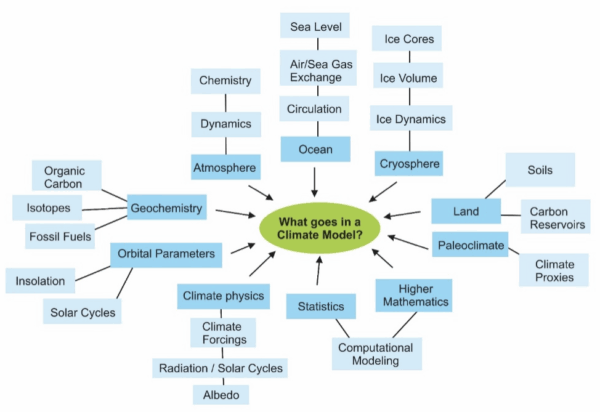
For example, “will it snow tomorrow?” is a ‘weather’ question, while “how do El Niño events in the tropical Pacific Ocean affect winters in West Michigan?” is a climate question. This distinction matters for making decisions about mitigating climate change because it fosters the understanding that teleconnections affect both global and regional climate, and that a persistent change related to global warming in the natural cyclicity of a distant interaction between ocean and atmosphere (El Niño in the tropical Pacific) can change what to expect in West Michigan in the next 50 or 100 years.
Another pervasive misconception is the confusion of Environmental Science with Climate Science. Two big questions arise: “what can a climatologist do that an environmental scientist cannot?” and “why does developing Climate Science programs in colleges distinct from environmental science matter for the lay person, the broader public?”
Nationally, while both Environmental Science and Climate Science programs are broadly
multidisciplinary and interrelated, they have important differences. Climate Science is a physical science focusing on the causes, direct effects, and changes in climate through all of Earth’s history including the Anthropocene (the “Human Era”) through computational models involving the chemistry and physics of climate change; while Environmental Science is a natural science broadly involving ecology, microbiology, soil science, conservation, restoration, natural resource management, entomology, pollution, water quality, and similar.
For example, pollution of a river system is a massive environmental problem. So is recycling waste. But neither are problems directly related to climate change. Similarly, availability of food or clean water is a sustainability question related more to human population growth, economics, politics, and environmental change than climate change; though of course the greater the human population, the greater the amount of greenhouse gasses emitted to the atmosphere which leads to climate warming. So, climate change affects and informs environmental change and sustainability but is only one aspect of those fields. The change in duration of the annual growth season or warmer temperatures shifting to higher latitudes will affect availability of food and water – these are sustainability issues.
Unfortunately, only a handful of colleges and universities across the United States have developed college majors specifically in Climate Science, most recently Grand Valley State University. However, academic programs specifically dedicated to Climate System Science are a new national trend – so new in fact that it is difficult to find information about the number of students enrolled or graduates produced annually nationwide.
What has this got to do with “climate modeling ignorance”?
Creating academic programs specifically focused on Climate System Science with a bend toward climate modeling is crucial at these times of swift and dangerous climate change. Lay people (the voting public) need to better understand the scientific basis for the causes and predictions related to anthropogenic climate change so humanity can make better informed decisions about mitigation efforts.
Not everyone can dedicate resources and time to majoring in Climate Science but growing a population of well-educated climate scientists will help create a more climate literate public. Individuals specialized in climate system science who understand the strengths and uncertainties associated with climate modeling can inform the broader public about anthropogenic climate change and more effective ways of countering and preventing its hazardous effects.
A Communications major minoring in Climate Science may pursue a career as a climate journalist or spokesperson. In essence, a student minoring or majoring in Climate Science becomes a person who fosters climate literacy in their communities. According to the Bureau of Labor Statistics, the average salary for climatologists is $94,570 annually, there were 10,500 people employed as climatologists in 2020, and the projected growth rate for climatologist jobs between 2020 and 2030 is 8%. According to ZipRecruiter, the average earnings for a climate scientist or climate change specialist is $111,343.
In summary, degrees in Climate Science and Environmental Science are distinct from one another by content and by job prospects they offer. The job prospects for climate scientists are numerous and varied because climatologists are urgently needed in a world where climate is changing fast and often times unpredictably.
References
- M.S. McCaffrey, and S.M. Buhr, "Clarifying Climate Confusion: Addressing Systemic Holes, Cognitive Gaps, and Misconceptions Through Climate Literacy", Physical Geography, vol. 29, pp. 512-528, 2008. http://dx.doi.org/10.2747/0272-3646.29.6.512
- P. Andre, T. Boneva, F. Chopra, and A. Falk, "Globally representative evidence on the actual and perceived support for climate action", Nature Climate Change, vol. 14, pp. 253-259, 2024. http://dx.doi.org/10.1038/s41558-024-01925-3
- A. Ziegler, "Political orientation, environmental values, and climate change beliefs and attitudes: An empirical cross country analysis", Energy Economics, vol. 63, pp. 144-153, 2017. http://dx.doi.org/10.1016/j.eneco.2017.01.022
- F. Lehner, and T.F. Stocker, "From local perception to global perspective", Nature Climate Change, vol. 5, pp. 731-734, 2015. http://dx.doi.org/10.1038/nclimate2660
- M. Maslin, and P. Austin, "Climate models at their limit?", Nature, vol. 486, pp. 183-184, 2012. http://dx.doi.org/10.1038/486183a
- D. Lombardi, and G.M. Sinatra, "College Students’ Perceptions About the Plausibility of Human-Induced Climate Change", Research in Science Education, vol. 42, pp. 201-217, 2010. http://dx.doi.org/10.1007/s11165-010-9196-z
- W. Fleming, A.L. Hayes, K.M. Crosman, and A. Bostrom, "Indiscriminate, Irrelevant, and Sometimes Wrong: Causal Misconceptions about Climate Change", Risk Analysis, vol. 41, pp. 157-178, 2020. http://dx.doi.org/10.1111/risa.13587
>> most lack a sufficient foundation in the science of climate change which creates misconceptions, a lack of ability to discern pseudoscience,
That’s why this forum is a great place to help to clear up misconceptions, but of course only if the experts actually engage in a meaningful way.
For myself I having a few topics here and found the answers here often lacking and sometimes completly off topic or even contradictionary (there was a lively discussion about the maximum possible impact of the Tonga-Hunga-event with very different answers if the temperature raise in 2023https://www.woodfortrees.org/plot/uah6/from:2022 , could be a result of it and no apparentfinal resolution)
For example to S. Rahmstorfs recent article I wrote:
https://www.realclimate.org/index.php/archives/2025/10/high-resolution-fingerprint-images-reveal-a-weakening-atlantic-ocean-circulation-amoc/#comments
Rahmstorf’s statement above
“””A recent paper by van Westen et al. (2025) has shown that the much-feared tipping point where the AMOC breaks down (first demonstrated in a simple box model in 1961) is also found in a high-resolution (eddy resolving) ocean model – destroying any hope that it might be an artifact of too coarse and simple models”””
Can be contrasted to his post here on Jan 26 2025
“””Of the 24 CMIP6 models, a full 23 underestimate the sea surface cooling in the ‘cold blob’. And most of the CMIP6 models even show a strengthening of the AMOC in the historic period, which past studies have shown to be linked to strong aerosol forcing in many of these models”””
Which seems to indicate that for CMIP6 models a very careful tuning is required to show his pattern.
Without that modern models seem not able to proof this cold blob. Perhaps we only see masterful tuning rather than underlying physics at work here, the assumption that these are not artefacts of the modeling seems contradicted by the apparent ease they can be switched on and off in modern models
Cycles in Atlantic are well studied and Artic patterns forming and weakening as a result have happened in the recent centuries without tripping any tipping points.
=> so far no answer at all, maybe hs research is really weak here, in January he advocated not useing CMIP6, but CMIP5 models for this.
G. Schmidt’s post
https://www.realclimate.org/index.php/archives/2025/05/predicted-arctic-sea-ice-trends-over-time/
has the following image with Schmidt’s comment
https://www.realclimate.org/images/cmip6_seaice.png
“””Actually, this isn’t bad. The CMIP6 ensemble mean for September area trends is now -11 %/decade (observed 13 %/decade) and the March trends are spot on. Note that the observed loss in ‘area’ is slightly larger than the trend in ‘extent’ (13 %/decade vs. 11 %/decade)”””
which does not seem to describe what is shown on the graph omitting very significant uncertanties for the CMIP6 ensemble mean rendering the models seemingly useless.
And I made basically the same point to E. Kelly’s recent post
https://www.realclimate.org/index.php/archives/2025/09/critique-of-chapter-6-extreme-weather-in-the-doe-review/
where I wrote:
>> models made accurate forecasts
Which ones? CMIP6 or the older ones? G. Schmidt showed they have different outputs and as a consequence of that Wiliam’s questions are quite justified and still lacking good answers.
A bunch of 4 year olds can scribble lines on a diagram making “forcasts” too, they are about as meaningless as bad models.
=> it seems that the commenters there did not realize what the areas around the essemble means represent (to be fair G. Schmidt did not discuss those)
There are significant differences between CMIP6 and older models, they simply cannot all be accurate!
(I am guessing all older models are not very good as they lack resolution and physics)
If models are not precise for arctic sea ice trends, they might not be good enough for the tropics/hurricane formation either.
And there is a longstanding critique to M. Mann-type proxy reconstructions, that the potential proxy selection bias needs to be expressed in a mathematical uncertainty for the results.
Right now it seems to me that each of those analyses does not included this and therefore implicitly assume that their proxies perfectly represent the climate and temperatre of the past without any uncertainty, which could at best only be true for one of those thousands recosntrucitosn usign differrent series.
And just to add one more topic, I am holding the firm belive that artic polar vortex anomalies (which are shown to correlate with solar and vulcanic, but so far NOT anthropogenic signals) contribute significantly to local extreme weather events, but I doubt it is modelled adequately in attribution studies as performed by F. Otto and others.
>> most lack a sufficient foundation in the science of climate change which creates misconceptions, a lack of ability to discern pseudoscience,
Some believe they do and a lack of dispersing their concerns is very telling!
Yebo Kandu: a concatenation of cluelessness.
Science does exist. Some people practice it, and observe it. YK is only interested in promoting his own point of view, without reference to reality.
Pointing to his own writings is not evidence 0f anything but a lack of objectivity and a surfeit of prejudice.
Why should ‘experts’ (whose blog this is, in an effort to promote knowledge rather than ignorance) ‘engage’ with arguments from people who are not themselves open to criticism?
Yup. But as noted the last time Yebo Kandu used this script, replies are not for the benefit of those like Yebo Kandu. They are beyond help. Replies are instead for the benefit of people those denialists try to disinform.
Hi Susan,
You’re answer to Yebo Kandu perfectly illustrates WHY the support of climate science is collapsing–Collapsing across the US and across the world. Because you provide no actual scientific rebuttal using scientific methods. But your response IS ripe with ad hominem. Look at your reply again:
“Yebo Kandu: A concatenation of cluelessness”.
How simple. How easy. How unscientific. How utterly predictable from the climate establishment. My guess is that there are a whole lot more people now unwilling to go with the “trust us, we’re scientists” meme anymore, especially in light of the devastatingly normal outcomes (as compared to historical trends) we’re having despite record warmth. It is painfully clear that as temperatures rise, so does human flourishing, and that’s a bitter pill to swallow for the climate science community.
So while the climate community will continue to weep, wail and gnash teeth about how “unscientific” America is heading, maybe, just maybe, America doesn’t really care because there is no actual science that is being performed in America by so called scientists. Americans may be smarter than you think. Just something to think about.
S: You’re answer to Yebo Kandu perfectly illustrates WHY the support of climate science is collapsing–Collapsing across the US and across the world. Because you provide no actual scientific rebuttal using scientific methods. But your response IS ripe with ad hominem. Look at your reply again:
BPL: Unlike you (unless you’re one of his sock-puppets), we’ve been here a long time and know YK has nothing to offer. So take your concern trolling and stuff it.
Nice try, Scott. What actually happened is Susan heard Yebo Kandu’s debunked script numerous times and the many scientific rebuttals of it. So she treats it no more seriously than seeing a flat Earther repeat the same script they’ve been debunked on several times. The fact that you can’t tell (or act like you can’t tell) Yebo Kandu is wrong reflects poorly on your level of understanding, just as it would on someone who can’t tell a flat Earther is wrong. Nor does your tone trolling work.
Based on your comment, I don’t think you’re interested in an “actual scientific rebuttal”; it’s just a pretense to suit your preferred ideologically-motivated narrative. But on the small chance that you are interested, then go read Susan’s linked comment below and the long thread of rebuttals above her comment. And try saying something cogent about those rebuttals. When you fail to, that’ll illustrate what I said about your position:
https://www.realclimate.org/index.php/archives/2025/09/critique-of-chapter-6-extreme-weather-in-the-doe-review/#comment-839323
Also, your reasoning is poor. ‘X occurred while humans flourished’ does not prevent X from being extremely harmful and something worth preventing. Vaccine denialists commit a similar distortion when they compare the number of vaccine-preventable deaths to the larger number of deaths from other causes. That’s the wrong comparison. One instead checks the benefit of an intervention like vaccines by comparing risk without the intervention vs. risk with the intervention. Similarly, one assesses harm from a phenomenon like anthropogenic climate change by assessing risk with the phenomenon vs. risk without the phenomenon. One does not do it by saying benefits from other factors (ex: improvements in sanitation, medicine, crop genetics, and technology) offset that risk and allowed humans to continue flourishing.
And one doesn’t do the ‘risk with vs. risk without’ comparison by comparing “to historical trends,” since there are obvious confounders such as changes in public health, sanitation, etc. with time. Yet that’s the incorrect comparison you did. Again your comparison is as bad as anti-vaxxers claiming vaccines didn’t work by comparing pre-vaccination vs. post-vaccination time-periods, without accounting for obvious confounders like more lax social distancing requirements, variants like Alpha and Delta with greater transmissibility and higher fatality rates, etc. If you want to see how to properly do the comparison, then read attribution studies. Though that would require you to be genuinely interested in the science, instead of just in your preferred ideological narrative.
Anyway, by your absurd reasoning, smoking-induced cancer is not important, nor increases in type 2 diabetes, nor… because those happened during improved human flourishing and have been offset by benefits elsewhere. Reason better, not in such an ideologically biased manner. Here’s how empty your reasoning sounds:
‘How utterly predictable from the public health establishment. My guess is that there are a whole lot more people now unwilling to go with the “trust us, we’re scientists” meme anymore, especially in light of the devastatingly normal outcomes (as compared to historical trends) we’re having despite record type 2 diabetes and heart disease. It is painfully clear that as type 2 diabetes, excess processed sugar intake, heart disease, and excess saturated fat intake rise, so does human flourishing, and that’s a bitter pill to swallow for the public health community.’
And in case you’re one of those saturated fat denialists (since that often overlaps with AGW denialism):
https://www.cochranelibrary.com/cdsr/doi/10.1002/14651858.CD011737.pub3/full
Atomsk’s Sanakan, well said. Scott has argued previously that climate change is a non issue because deaths related heatwaves and flooding have decreased. I’ve suggested this decreasing trend is because of medical advances etc,etc and we cant guarantee any of this will always be the case in the future especially as warming rates increase. And that countries like the USA are devoting more and more resources to health care which means less resources available for other things. So the smart solution is to fix problems that CAUSE a potential increase mortality rate. Scott talks about life flourishing on planet earth. I’ve pointed out life on planet earth has often got better because of PREVENTIVE measures.
He never acknowledges this and just repeats his views. Probably some ideological motive perhaps a dislike of governments getting involved in preventative programmes. I would bet money on that one.
Hi Atomsk,
I only have one question for you:
How do you define detection and emergence in regards to human health outcomes resulting from a changing climate?
Andrew Dessler has his version:
https://www.theclimatebrink.com/p/is-this-the-most-embarrassing-error
Even he admits that decades long trends over a historical baseline are what IPCC uses to determine the magnitude of effect of climate on outcomes.
PS. As a medical doctor studying climate change for nearly 20 years now, I got a kick out of your tobacco reference. Strange–Andrew used the same analogy. Wrong, but humorous.
Re: “I only have one question for you”
Nice try. You dodged the actual points, which were:
1) There’s evidence on Yebo Kandu’s long history of debunked claims. Susan is aware of that history. This justifies her comments on Yebo Kandu and undermines your objection to her comments. You should have been able to tell Yebo Kandu was wrong.
2) Your reasoning on causal attribution is faulty due to, for example, not accounting for time-varying confounders.
None of those points requires answering your question. Let me know when you actually have something cogent to say on those points. I’ve dealt with ideologically-motivated denialists long enough to not fall for their attempts to move the goalposts.
Re: “PS. As a medical doctor studying climate change for nearly 20 years now, I got a kick out of your tobacco reference. Strange–Andrew used the same analogy. Wrong, but humorous”
I can see through what you’re doing, as an immunologist whose dealt with various forms of ideologically-motivated science denialism for the better part of 2 decades, Your paranoid thought process is similar to what I’ve seen from AGW denialists, vaccine denialists, HIV/AIDS denialists, etc. Y’all just change the target of your denialist narrative, whether it’s the virology community, immunology community, climatology community, etc. In that respect you’re like the climate scientist Dr. Judith Curry, whose baseless paranoia about the climatology community parallels HIV/AIDS denialists’ baseless paranoia about the virology community. Hence why she adapts ludicrous talking points the HIV/AIDS denialist Dr. Henry Bauer applied to virologists, immunologists, infectious disease physicians, epidemiologists, etc.:
Re: “Even he admits that decades long trends over a historical baseline are what IPCC uses to determine the magnitude of effect of climate on outcomes.”
You’re disinforming again. I read Dr. Dessler’s *Climate Brink* post a while ago, including comments below it. If you’re the Scott commenting there, then you’re what Mal Adapted aptly called: “a relentless motivated obstructionist on TheClimateBrink.”
Anyway, Dr. Dessler there distinguished detection vs. attribution vs. emergence. Emergence is about magnitude of an effect relative to a historical baseline. But my critique of your claim was not about emergence. It was about attribution. My point was you don’t competently attribute anthropogenic impact because you, for instance, disregard time-varying confounders.
It’s as ridiculous as saying COVID-19 vaccines didn’t mitigate COVID-19 mortality because of the magnitude of the mortality change relative to an earlier baseline. For instance, by saying there were more reported COVID-19 deaths for the post-vaccination time-period vs. the pre-vaccination time-period. And by saying that without accounting for time-varying confounders such as less social distancing with time, later variants with higher intrinsic transmissibility and fatality rates (R0 and IFR, respectively), less mortality underreporting with time due to greater availability of tests, etc. Vaccine denialists reason that way, but sensible and informed people don’t reason that way for causal attribution. They instead check analyses that control for those confounders using unvaccinated control groups that come from similar conditions + time-periods as the vaccinated groups they compared to (ex: randomized controlled trials, cohort studies). Otherwise, one conflates attribution that reveals the causal impact of vaccines on COVID-19 mortality vs. emergence in post-vaccination total COVID-19 mortality relative to a pre-vaccination baseline.
Similarly, doing anthropogenic attribution for climate change impacts is not about checking for emergence. It’s about matters like controlling for time-varying confounders, such as changes in solar output, changes in public health infrastructure (if you’re looking at attributions for things like heat-related mortality), etc.
Re: “I only have one question for you:
How do you define detection and emergence in regards to human health outcomes resulting from a changing climate?”
Again, the point was on *attribution*, not on emergence nor on detection. You mess on anthropogenic *attribution* since you do things like not controlling for confounders. So your question was an irrelevant goalpost move.
Scott, if you’re really a medical doctor like you claim, then you need to improve your causal reasoning. Because I know the principles I just went over are explained to physicians in their training on causal reasoning, especially with respect to clinical trials, cohort studies, ecological analyses, etc. Yet you conveniently don’t apply those principles in your causal reasoning on climate science. As Dr. Gavin Schmidt aptly told about your reasoning:
Atomsk,
Do you mean like controlling for variables? I think that’s what you’re getting at. In retrospective observational trials we do a lot of that. But as they say, correlation may or may not equal causation. See my response to David to gain further understanding. Thanks and have a good day.
Re: “Do you mean like controlling for variables? I think that’s what you’re getting at. In retrospective observational trials we do a lot of that. But as they say, correlation may or may not equal causation. See my response to David to gain further understanding.“
Neither this reply nor your response to David address the points made. There’s no further understanding to be gained from you since you willfully distort distinctions between attribution vs. detection vs. emergence, misrepresent what people say, etc. The tactics you run on topics like time-varying confounding are not going to fool anyone sensible, no matter how many times you try them.
And your “correlation may or may not equal causation” point is vacuous. For instance, if you really are a physician, then you should know ‘Bradford Hill considerations‘ for inferring causation. Those don’t just rely on correlation, and they work well for anthropogenic climate change. There is, for example, plausibility in the form of an evidence-based mechanism by which greenhouse gas increases cause warming. Then there’s evidence-based mechanisms for how that warming causes other effects, such as increasing hurricane intensity. There’s also specificity since the vertical profile of temperature changes from the troposphere through the thermosphere and the horizontal temperature change across regions differs between greenhouse gas increases, increases in solar output, aerosol increases, etc. Hence anthropogenic fingerprints (Hegerl). And so on. You and your fellow denialists sidestep points like that to suit your preferred ideological narrative, similar to how you take advantage of time-varying confounding so as not to do attribution correctly. Anyway, it’s clear you’re not here in good faith, consistent with what Susan Anderson, Dr. Gavin Schmidt, Mal Adapted, etc. noted.
I just remembered you object to terms like ‘science denier’:
It makes no sense for you to make that statement while claiming to be a physician. A physician should know of HIV/AIDS denialism, vaccine denialism, COVID-19 denialism, germ theory denialism, evolution denialism, etc. (ex: Smith, WHO, Rosenau, da Fonseca). And a physician should understand using terms like ‘denialism’ does not imply that virology, immunology, microbiology, evolutionary biology, etc. have no position worth supporting. Parallel point applies to climatology: pointing out denialism there does not imply having no position worth supporting.
This is another illustration of the ideologically-motivated double standard you apply to climate science. If you don’t want denialism pointed out, then don’t engage in it. Pointing out denialism is a criticism, not an ad hominem fallacy.
Also, this:
1) It has not been warming gradually over the past few thousand years [Osman, IPCC].
2) The current rate of warming is around 25 times larger than the rate coming out of the Last Glacial Maximum, and larger than other rates over the past 2000 years. The impact of the larger trend is not necessarily the same as the impact of the smaller trends [Copernicus, PAGES 2k Consortium, Osman].
3) You still were not accounting for time-varying confounders. Hence why your reasoning is as bad as saying that human ingestion of fast food increased with time as human flourishing increased. That does not mean the fast food ingestion caused the flourishing since you have not accounted for time-varying confounding from other factors. Parallel point for what you’re trying to do with warming and human flourishing.
4) Your emotional response of ‘terror vs. no terror’ is irrelevant to what the scientific evidence on attribution and trends.
Not to mention the utter silence of the experts on here!
It speaks very loudly!
BTW I do claim one scientific achievement on here..
I believe I was the first mentioning that S. Rahmstorf’s posts this year on Arctic cold water simulation might be an artifact in older models (he seems now to think about that nowadays, but I find his discussion incomplete)
However, I can’t be the first here to recognize this problem, there are some real experts on here.
Is it really that simple that they hold back their knowledge in order “not to hurt the cause”, that would indicate a serious problem with scientific ethics.
While I certainly understand time is limited, I feel Figen should argue with me BECAUSE I have an agenda which is apparently different from his, it’s one of the best ways of scientific progress, which I think he also sees as the big reason we doing all this, not research grands.
YK: Is it really that simple that they hold back their knowledge in order “not to hurt the cause”, that would indicate a serious problem with scientific ethics.
BPL: And if your mother had wheels, she’d be a trolley.
Re: “Is it really that simple that they hold back their knowledge in order “not to hurt the cause”, that would indicate a serious problem with scientific ethics.“
Why should they engage and share their knowledge with you when you baselessly accuse them of fraud and of pseudoscience? You fail to provide evidence supporting your accusations and willfully evade evidence showing you’re wrong, no matter how many times it’s explained out to you. All so you can avoid honestly admitting to the accuracy and skill of model-based warming projections. Climate scientists are not obligated to engage with that sort of behavior.
And:
I find Yebo’s post to be more in tune with “Raising Climate Literacy” than your ad hominem attack. Please try harder, this is a site for science.
I
Dan Da Silva: “I find Yebo’s post to be more in tune with “Raising Climate Literacy” than your ad hominem attack.”
What can be asserted without evidence can also be dismissed without evidence.
Plonk.
Piotr: Yes, sciencey looks better than facts to people who prefer not to face said facts. But my comment (it took a moment to figure out to whom he was responding) was excessively sharp (imnsho, justifiably so) which resulted in tone policing. otoh, we now know where DDS comes from. Yuck!
However, in a world where reality is less important/effective than profits and ignorance, it is perhaps necessary to be stop enjoying/indulging in language which calls out the tone police. We need more people to realize how much danger we face and/or realize that making things less bad is better than wringing one’s hands and acting above it all. In that, I am guilty as charged.
One clever lie can sink a thousand facts. {quote not attributed this time]
Dear Dan,
what I find utterly astonishing is the complete lack of any current scientific arguments!
It is easy enough to ignore all the comments which are without anything scientific merrit and I am happy to have them have the “last word”.
I already commented that their lengthy, but empty posts might have way more impact than they think, bullying and insulting, but not addressing the point I made ..
I posted at length about my easiest misconception I could find (the text describing the image https://www.realclimate.org/images/cmip6_seaice.png apparently not considering the huge shown uncertainties, which seems to change significantly what the models can proof or not)
and so far did not get any meaningful scientific answer!
Instead there are rather long and very repetitive posts by Atomsk’s Sanakan even citing me with
“””Yebo Kando: “To claim that a wrong model would be skillful requires a mathematical treatment of known errors that has not happened here, so it is fraud.” “””
But not addressing this at all.
cited claims like
“””Hargreaves 2010: “Analysis of the Hansen forecast of 1988 does, however, give reasons to be hopeful that predictions from current climate models are skillful, “””
or
“”” Roger Pielke, Jr.: “In reality, climate science has not just accurately anticipated unfolding climate change, but has done so consistently for the past 50 years.” “””
seem very obvioulsy wrong when the fact that
CMIP6-models show significantly different results than older models having higher resolution
and corrected cloud physics
is not considered by them. Leaving not only my initial misconception unaddressed, but also adding another doubtul claim.
AS own posts clearly shows how he sidesteppes the questions I raise!
And all with the astonishing silence of the climate experts who founded this site, they must be aware or maybe even support this very strange behavior!
You don’t link to where the replies were made so it’s harder for others to see you’re disinforming. The link is here:
https://www.realclimate.org/index.php/archives/2025/11/raising-climate-literacy/#comment-841769
Atomsk: for those whose links don’t go to specific comment, it was this one:
Susan Anderson says – 3 Nov 2025 at 6:08 PM
While I have a some basic science literacy and common sense, along with great interest in and a good memory for voluminous readings about human history, weather, and toxic pollution, I am not a scientist but science adjacent. It is sad that my frequently off topic insertions are useful in a place where the best science should be front and center.
Oh noes.. another round of posts.
First note the posts itself are empty of any information, but there is progress.. Instead of more endless repetition if the same old same old just a link, I like it, please keep doing that instead!
I am not sure what they try to address there, G. Schmidt’s apparent non-adressing of the uncertainties visible in his Artic Sea ice chart (linked above many times, yet unanswered
Or
The problem I raised about CMIP6 models showing significantly different trends than older models
(which also shows that the attempt to side step this into other fields like astronomy where some models are good enough for some questions can be dismissed easily as irrelevant – the upgrades to CMIP6 changed the models)
Given the non-responsivness of AS so far (he wrote plenty, just made no valid argument), let’s word as stupid as I can for him:
If CMIP5 and older models were skillful and accurate, CMIP6 models were shown to be “accurater” and “skillfuller” .. if these are not valid words in the English language, maybe it is time to rework your premise, you already cited me with the relevant quote, but failed to address it in even the slightest way:
“””Yebo Kando: “To claim that a wrong model would be skillful requires a mathematical treatment of known errors that has not happened here, so it is fraud.” “””
And of course the is complete void about the visible uncertainty in G. Schmidt’ graph not addressed in his description of the graph – after all that observation by me is what started AS returning here sprouting his wisdom again.
Re: “The problem I raised about CMIP6 models showing significantly different trends than older models […]. If CMIP5 and older models were skillful and accurate, CMIP6 models were shown to be “accurater” and “skillfuller”“
Gibberish that doesn’t rebut the evidence that CMIP5 models and earlier made skillful predictions. That refutes your claim to the contrary:
Your disinformation on this was already debunked, but you never honestly acknowledge that, as per your denialism:
Neither you nor Dan DaSilva will have anything evidence-based and cogent to say. So your usual evidence-free disinformation is rejected. Published evidence confirms model-based warming projections were skillful, no matter how much you baselessly yell ‘fraud!’ to claim otherwise. Let folks know when you finally have evidence, or are capable of addressing the evidence cited to you. Because all you have so far is persistent denialism in the face of evidence, evidence that not even contrarians like Roger Pielke, Jr. still deny. You’re the equivalent of a flat Earther who baselessly yells it’s ‘fraud!’ to claim Earth is round, while they willfully ignore any study they’re cited showing evidence Earth is round.
Yebo Kando @29 Nov 2025 at 4:25 PM
YK: “Oh noes.. another round of posts. First note the posts itself are empty of any information, but there is progress.. Instead of more endless repetition if the same old same old just a link, I like it, please keep doing that instead!
I am not sure what they try to address there, G. Schmidt’s apparent non-adressing of the uncertainties visible in his Artic Sea ice chart (linked above many times, yet unanswered Or The problem I raised about CMIP6 models showing significantly different trends than older models”
I found AS’s comments in the link he posted full of information about why the models are still skillful, and it’s quite clear what he is addressing, because he quoted your own comments! Is there any part of AS’s response you disagree with? Since you are complaining others don’t make scientific comments, now is your chance to make a science based reply to As’s comment. Here’s his comments:
https://www.realclimate.org/index.php/archives/2025/11/raising-climate-literacy/#comment-841769
YK: “I am not sure what they try to address there, G. Schmidt’s apparent non-adressing of the uncertainties visible in his Artic Sea ice chart (linked above many times, yet unanswered”
I recall G Schmidts article on the latest sea ice predictions. I remember your comment, and I remember you accusing him of scientific fraud for not addressing the uncertainties. He did post a chart of the latest sea ice predictions, with the model spread hatched or shaded in. I recall you mentioning this chart and criticising it. I remember thinking you must mean the shaded area is the uncertainty and be complaining that he didn’t label the shaded area “model spread” or “uncertainty”.
I guess it would have helped to provide a label although it seems like a petty criticism at best. He’s written about modelling many times, with similar charts showing the model spread and discussed the spread in the articles so he might have just assumed people were familiar with that. I have been reading this website for about 10 years well before either you or AS started posting comments, and GS has been upfront about uncertainties. So accusing him of fraud is ridiculous.
Some people might suggest you are “projecting”. Wikipedia definition: In psychology, psychoanalysis, and psychotherapy, projection is the mental process in which an individual attributes their own internal thoughts, beliefs, emotions, experiences, and personality traits to another person or group.
N: “Is there any part of AS’s response you disagree with?”
Yes, of course as there is nothing new in it and I already explained his mistake many times, it won’t go away by him trying to out repeat himself! For example my objections in my last post right here (3 posts up)
We know that comparable CMIP6 models show different trends than older versions.
There have been multiple posts on this webpage how CMIP6 models give different results than older models (the last one I believe is G. Schmidt s with the missing uncertainty discussion)
And we have a pretty good idea that the higher resolution and corrected physics is the reason for the difference.
This makes the old models lacking and wrong, as I said many times!
You might as well use the drawings of 4-year olds rather than a wrong model, also lacking and after AS definition accurate and skillful, if it only compares well to a measurement trend in the real world.
Why do you pretend that I did write that multiple times?
It is actually alarming that wrong artefacts loaded models could be tuned to gie tuned to represent real world trends as it means they don’t represent physics, but the opinions of the tuners!
N: “I remember you accusing him of scientific fraud”
You misremember, that was not me!
N: “I remember thinking you must mean the shaded area is the uncertainty”
I think so too, now can you find a mention of said uncertainties in G. Schmidt’s statement about the model assembly mean describing that graph, because I do not see it.
“””Actually, this isn’t bad. The CMIP6 ensemble mean for September area trends is now -11 %/decade (observed 13 %/decade) and the March trends are spot on. “””
IMHO this statement would paint significantly different picture of the model accuracy if said uncertainties were included.
I picked both of these points, the clearly shown lacking of physics and inaccuracy of older models as well as the missing discussion of the uncertainties in G. Schmidt’s graph as rather trivial examples of where a sceptics opinion might differ from the consensus and I find the resulting discussion here absolutely shocking.. there is nothing complicated here and the repeated side-stepping and non-scientific behavior is really bad!
Can you agree on the fact that the CMIP6 models are significantly more accurate than their lower resolution predecessor which also contained flawed physics? (If yes, please explain to AS that any evaluation of older models must consider that.. the older analyses he keeps repeating so tirelessly do not)
Re: “There have been multiple posts on this webpage how CMIP6 models give different results than older models (the last one I believe is G. Schmidt s with the missing uncertainty discussion)
And we have a pretty good idea that the higher resolution and corrected physics is the reason for the difference.
This makes the old models lacking and wrong, as I said many times!“
False. It’s because the CMIP6 average overestimated climate sensitivity, both equilibrium climate sensitivity and the transient climate response (ECS and TCR, respectively). Earlier generations of models were more accurate on ECS and TCR. Dr. Gavin Schmidt explained this multiple times, so you’re willfully misrepresenting him. Screening CMIP6 models to match the TCR range of earlier model generations like CMIP5, results in CMIP6 hindcasts better matching observations, forecasts better matching subsequent warming, and better alignment with previous models. So it’s ludicrous for you to keep citing CMIP6 as rebutting earlier models being skillful at projecting warming and iTCR (i.e. the ratio of global warming vs. forcing).
I’ll cite evidence on this, something you never due given your ideologically-motivated denialism:
Re: “You might as well use the drawings of 4-year olds rather than a wrong model“
Same old fallacious reasoning from you that was debunked:
Climate model projections are not like the drawings of a four-year-old. For example, models accurately projected iTCR, something four-year-olds don’t do. And, as usual, you dodge the fact that the models’ warming projections were more accurate than the projections of your fellow denialists:
Re: “It is actually alarming that wrong artefacts loaded models could be tuned to gie tuned to represent real world trends as it means they don’t represent physics, but the opinions of the tuners!“
Another disingenuous fabrication of yours that you’ve been repeatedly corrected on. These are not hindcasts tuned to match past trends. These are forecasts of future trends. Modelers could not have tuned models to match that future data since that data did not exist yet. Seriously, actually read and address scientific papers, for once in your life:
Re: “N: “I remember you accusing him of scientific fraud”
You misremember, that was not me!“
It was you. Learn to tell the truth, for once:
You falsely and baselessly accused Dr. Gavin Schmidt of fraud, Yebo Kando. So either admit your accusation was wrong or finally develop the courage to defend it with evidence.
Yebo Kando @29 Nov 2025 at 11:13 PM
N: Is there any part of AS’s response you disagree with?
YK: Yes, of course as there is nothing new in it and I already explained his mistake many times, it won’t go away by him trying to out repeat himself! For example my objections in my last post right here (3 posts up)
N: I’m having trouble connection your objections to what AS said in his post. It seems disconnected. So please copy and paste whatever specific sentence or sentences you disagree with in his post and explain why you disagree. That’s how things are normally done in the world of science and everything else. This is the post:
https://www.realclimate.org/index.php/archives/2025/11/raising-climate-literacy/#comment-841769
YK: This makes the old models lacking and wrong, as I said many times!
N: The old arctic sea ice models didn’t predict the ice decline trend with great accuracy, but the article’s writers admitted accuracy was poor, and nobody denied this, so I don’t understand your point. AS explained why they are still skillful several times. Please copy and paste his explanation of this and explain where you disagree. The new CMIP6 models seem very skillful so again copy and paste any sentence you disagree with and explain why.
N: “I remember you accusing him of scientific fraud”
YK: You misremember, that was not me!
N: Refer to the comment you posted on The Endangerment Finding article at 9 Aug 2025 at 10:20 AM “To claim that a wrong model would be skillful requires a mathematical treatment of known errors that has not happened here, so it is fraud. (Back then they might claim they did not know what they were doing about low resolution or cloud errors, but that is not possible nowadays )”
N: This certainly suggests you are accusing the writers of this article (Gavin, Rasmus and others) of doing something fraudulent. Its hard to know who else you could be referring to. It appears to be a comment on modelling in general rather than just the arctic sea ice but the same principles apply. Accusing people of mistakes is one thing but accusations of fraud or lies raise things to another level and requires very good evidence which seemed a bit lacking.
YK: Actually, this isn’t bad. The CMIP6 ensemble mean for September area trends is now -11 %/decade (observed 13 %/decade) and the March trends are spot on. “””
IMHO this statement would paint significantly different picture of the model accuracy if said uncertainties were included.
N: Well I’m fairly clear the writer was saying that in the CMIP6 models the arctic sea ice decline was spot on the model ensemble mean. And it was. I suppose the writer could have mentioned there are still uncertainties around the overall result, and I suppose you could say the model spread is itself a form of uncertainty but it seems a bit pedantic having to repeat all that.
YB: there is nothing complicated here and the repeated side-stepping and non-scientific behavior is really bad!
N: I don’t think AS is side stepping. Perhaps someone else did. But have a look in a mirror: You have not directly addressed AS’s statements about why he thinks the models are skillful even if they don’t 100% accurately predicted everything. Maybe I’m old fashioned but I expect critics to copy and paste what people say sentence by sentence and address it specifically.
YB: Can you agree on the fact that the CMIP6 models are significantly more accurate than their lower resolution predecessor which also contained flawed physics?
N: Yes, but as people like AS explained several times, even the CMIP5 arctic sea ice models, (which this website fully conceded didn’t do a great job predicting sea ice decline) are still skillful and predicted other trends reasonably well. Just because something doesn’t have perfect physics on every element in the model, doesn’t necessarily make it useless. Especially if the problem with the physics is related to an element that has little impact on the climate change trend its predicting. I find myself repeating what AS has said but this is because YOU DONT SEEM TO GET IT!
N: So can you agree that just because a model does not have perfectly resolved physics on every element within the model, like the arctic sea ice models, this doesn’t necessarily mean the model is useless or lacks skill?
>> N: I’m having trouble connection your objections to what AS said in his post [..]
YK: You were also missing a point of discusion:
>> >>YK: can you find a mention of said uncertainties in G. Schmidt’s statement about the model assembly mean describing that graph, because I do not see it.
“””Actually, this isn’t bad. The CMIP6 ensemble mean for September area trends is now -11 %/decade (observed 13 %/decade) and the March trends are spot on. “””
IMHO this statement would paint significantly different picture of the model accuracy if said uncertainties were included.
N: “”
(no worries so far no one has commented on it besides Figen giving a general “there is nothing pseudoscientific about Gavin’s work or posts on this blog”, which of course does not help me with my misconception of this example, to me it seems obvious that G. Schmidt should mention and discuss the uncertainties you admitted seeing in the figure)
>> >>YK: “To claim that a wrong model would be skillful requires a mathematical treatment of known errors that has not happened here, so it is fraud. (Back then they might claim they did not know what they were doing about low resolution or cloud errors, but that is not possible nowadays )”
>> N: This certainly suggests you are accusing the writers of this article (Gavin, Rasmus and others) of doing something fraudulent.
Well, only if you assume that happened here, if so how would you call it?
Thanks to tireless AS, we have another iteration of this old topic.. there is really not much new to say here (as it is very obvious from his post)!
>> N: So please copy and paste whatever specific sentence or sentences you disagree with in his post
That is never far as he keeps repeating himself tirelessly, please feel free to apply the spirit of my post here to basically all his previous posts..
He wrote
>> AS “CMIP6 average overestimated climate sensitivity, both equilibrium climate sensitivity and the transient climate response (ECS and TCR, respectively). Earlier generations of models were more accurate on ECS and TCR.”
And I believe we all agree on this!? (AS, really no more need to keep repeating it .. just saying… you look uh very driven!)
So this means taking a CMIP6 model which shows both equilibrium climate sensitivity and the transient climate response, for example caused by a high CO2-climate sensitivity (too high for reality by CMIP6 evaluation),
If we would travel back in time undoing al the improvements in resolution and physics, the corresponding CMIP5 model could then match some of these numbers and trends.
And we are back to my comments:
YK: “To claim that a wrong model would be skillful requires a mathematical treatment of known errors.”
and
“And we have a pretty good idea that the higher resolution and corrected physics is the reason for the difference. This makes the old models lacking and wrong, as I said many times!“”
If we were okay with omitting details in resolution and physics without applying what we know without any doubt (that the parameters used in my example give non-realistic results in CMIP6 models), we can directly take a big step from the details in CMIP5 and work with scribbling of 4-year olds omitting all details about climate physics in the models!
We now know without any doubt that some CMIP5 models will give unrealistic results if the resolution and physics is corrected, they are NOT skillful or accurate, the old analyses are incomplete based on out nowadays knowledge!
Re: “If we were okay with omitting details in resolution and physics without applying what we know without any doubt (that the parameters used in my example give non-realistic results in CMIP6 models), we can directly take a big step from the details in CMIP5 and work with scribbling of 4-year olds omitting all details about climate physics in the models!”
Nope. For example, a 4-year-old’s scribblings don’t contain factors like positive water vapor feedback, while CMIP5 models do. Those factors were also included in climate models made dating back to the 1970s, allowing those models to skillfully project iTCR and global warming. That’s shown in sources already cited to you, such as Hausfather 2019, IPCC 2021, Supran 2023, Frame 2013, Lapenis 2020, etc. You’ve been repeatedly shown that if models are reasonably accurate on factors like water vapor feedback, the Planck feedback, etc., then they can make reasonably accurate projections of iTCR and global warming, without needing to be perfect on cloud physics, resolution, etc. Yet you continue to pretend otherwise, as per your ideologically-motivated denialism. Other instances of your pretense include:
– acting like cloud physics and resolution are “all details about climate physics”, as if factors like positive water feedback, Planck feedback, ice-albedo feedback, etc. are not aspects of climate physics
– willfully ignoring evidence cited to you on how improvements in modeling cloud physics reduces CMIP6 climate sensitivity, bringing it more in line with CMIP5 sensitivity (ex: Myers 2021, Zhu 2022)
– baselessly accusing Schmidt of fraud and then pretending you didn’t do that
You don’t address any of the published evidence cited to you that shows you’re wrong, and you cite no published evidence. Given that behavior, I doubt you’ve ever read and understood a climate science paper. It’s been clear for awhile that no amount of evidence/reasoning will ever get through to you, anymore than it would get through to a disingenuous flat Earther. So my responses are not for your benefit, but instead for those you’ try to disinform and those who come along later. You can return to your usual evidence-free garbled writing, tone trolling, denialism, etc.
Re: “I find Yebo’s post to be more in tune with “Raising Climate Literacy” than your ad hominem attack. Please try harder, this is a site for science.”
Then you’re wrong. Yebo’s post is their usual evidence-free, garbled text where they cite no published evidence for their claims and willfully ignore published evidence people previously cited them showing they’re wrong. That’s not climate literacy; that’s willful denialism and a lack of climate literacy. Susan Anderson is aware of that history, which is why she knows better than to take Yebo’s posts seriously. She is not engaged in an ad hominem fallacy just because she accurately states what Yebo is doing.
My prediction is that, like Yebo, you are not aiming for climate literacy, Dan DaSilva. So you won’t address the abundant published evidence that shows Yebo is wrong:
– https://www.realclimate.org/index.php/archives/2025/11/raising-climate-literacy/#comment-842484
– https://www.realclimate.org/index.php/archives/2025/11/raising-climate-literacy/#comment-842500
Try harder and do better. This is a site for evaluating published evidence, not for cheering on denialism by tone trolling and misidentifying instances of an ad hominem fallacy.
>> AS: “4-year-old’s scribblings don’t contain factors like positive water vapor feedback, while CMIP5 models do. Those factors were also included in climate models made dating back to the 1970s, allowing those models to skillfully project iTCR and global warming.”
Again, lets differentiate three cases
– CMIP6 models with (at this time) the highest resolution and best modeled physics
– older models lacking in resolution and physics, gradually worsening backwards in time
– 4-year-old’s scribblings basically without resolution or modeled physics (at least for the 4-year-olds I know)
and consider the example of a model with a high CO2-sensitivity giving unrealistic results with CMIP6 details, but better fits with reality for older models.
For such a model some old analyses AS cited very repeatedly concluded that these models were accurate and skillful, But of course we know better and without any doubt thanks to the CMPI6 results, the old models and their analyses are flawed as they lack the necessary resolution nd physics the CMIP6 models have.
If you want to base your conclusions on flawed models, I suggest to go to the extreme case of no physics and resolution, in the end there is only one version of wrong. Why you would do that or spend so much effort to defend such an obvious unscientific behavior is a real mystery!
And we are back to my comments:
YK: “To claim that a wrong model would be skillful requires a mathematical treatment of known errors.”
and
“And we have a pretty good idea that the higher resolution and corrected physics is the reason for the difference. This makes the old models lacking and wrong, as I said many times!“”
Still not addressed by AS, no matter how often he repeats himself!
We know that some models with high CO2-sensitivity giving unrealistic results using the best models we currently have. To claim such models all of the sudden becoem accurate and skillful when you reduce resolution and remove correct physics is just nonsense!
He even starts to repeats his insults, but they are still against forum policy!
>> tone trolling
I had to google that.. “A tone argument (also called tone policing) is a type of ad hominem aimed at the tone of an argument instead of its factual or logical content”,
Yeah I see that happening in this thread, actually Susan even apologized for it and then took that apology back..
>> S:”my comment (it took a moment to figure out to whom he was responding) was excessively sharp (imnsho, justifiably so)”
Really strange behavior!
– baselessly accusing Schmidt of fraud and then pretending you didn’t do that
You are wrong, if you knew that you are wrong when writing this, you are a liar!
Neither was my comment baseless (as can be read for example in my very first comment here), nor did I accuse Schmidt of fraud, Nigelj cited me with:
YK: “To claim that a wrong model would be skillful requires a mathematical treatment of known errors that has not happened here, so it is fraud.”
that is not limited to Schmidt or anybody!
I stand by this statement and assume that most honest scientists aggree with that!
Suppressing known errors falsifies the results of an experiment or simulation and is a most unethical grave sin for a scientist!
Re: “Again, lets differentiate three cases
– CMIP6 models with (at this time) the highest resolution and best modeled physics
[…]
We know that some models with high CO2-sensitivity giving unrealistic results using the best models we currently have. To claim such models all of the sudden becoem accurate and skillful when you reduce resolution and remove correct physics is just nonsense!“
You’re fabricating. For example, you were already shown that improving cloud physics for CMIP6 models reduces their sensitivity down to what’s shown for older models. Not that you would ever honestly care about evidence:
Re: “consider the example of a model with a high CO2-sensitivity giving unrealistic results with CMIP6 details, but better fits with reality for older models.“
You’re fabricating again. The older models fit better with the instrumental record, paleoclimate data, etc., as you were previously shown. Though you would never honestly engage with the evidence:
Re: “For such a model some old analyses AS cited very repeatedly concluded that these models were accurate and skillful, But of course we know better and without any doubt thanks to the CMPI6 results, the old models and their analyses are flawed as they lack the necessary resolution nd physics the CMIP6 models have.
If you want to base your conclusions on flawed models, I suggest to go to the extreme case of no physics and resolution, in the end there is only one version of wrong.“
Nirvana fallacy or the perfect solution fallacy, where you pretend that models need to be perfect to be reliable enough for use:
You’ve been called on this several times, but persist in it to disinform people. Again: climate models do not need to be perfect on cloud physics and resolution to make accurate predictions. You’ve already been cited papers showing that models accurately projected warming and iTCR (i.e. the ratio of warming vs. forcing), in virtue of get other aspects right, like positive water vapor feedback, the Planck feedback, etc. Yet you never honestly address those papers, such as Hausfather 2019, IPCC 2021, Supran 2023, Frame 2013, Lapenis 2020, etc.
Re: “Why you would do that or spend so much effort to defend such an obvious unscientific behavior is a real mystery!“
The unscientific behavior is your disingenuous use of the nirvana fallacy / the perfect solution fallacy. It’s obvious why you do that and why you spend so much effort sticking to it to disinform people.
Re: “And we are back to my comments:
YK: “To claim that a wrong model would be skillful requires a mathematical treatment of known errors.”
and
“And we have a pretty good idea that the higher resolution and corrected physics is the reason for the difference. This makes the old models lacking and wrong, as I said many times!“”
Still not addressed by AS, no matter how often he repeats himself!“
Addressed several times, despite you pretending otherwise. Models have been shown to be skillful using skill scores, something you willfully ignore:
Re: ““A tone argument (also called tone policing) is a type of ad hominem aimed at the tone of an argument instead of its factual or logical content”,
Yeah I see that happening in this thread“
Yes, you and Dan DaSilva are tone trolls using fallacious tone arguments.
Re: “– baselessly accusing Schmidt of fraud and then pretending you didn’t do that
You are wrong, if you knew that you are wrong when writing this, you are a liar!“
You baselessly and falsely accused Dr. Gavin Schmidt of fraud, as noted elsewhere. You did this in response to me quoting you a portion of Dr. Schmidt’s paper Hausfather 2019, in which the paper states that climate model projections made since the 1970s were skillful in projecting subsequent warming:
Re; YeboK and A’sS –
Earth system models simulate a complex, underdetermined system where processes such as clouds, convection, turbulent flux partitioning and surface-atmosphere interactions must be represented through parameterization. These create certain flexibility. Model skill in determining realclimates should be tested across multiple domains: temperatures, precipitation, winds, circulation patterns, radiative inputs and outputs, humidity profiles, and so on. Across model generations is an iterative forward-backward process that compares predictions to observations and progressively tightens parameterr constraints. To be scientifically informative this should not be an endless tuning. At some point it should be conceivable that if no parameter combination reproduces observations across domains the model is dropped. Additionally, worsening performance under tighter constraints signals structural deficiencies. True scientific informativeness, rather than serving as an instrument for policy justification, requires that it’s possible for a model to reveal the physical limits of its own representations. Conversely, if the use-case is simply to judge whether GMST should rise or not under increasing CO2, then complex ESMs are risky and expensive, so simpler 0-D or 1-D models from ages ago suffice.
Re: “If you want to base your conclusions on flawed models, I suggest to go to the extreme case of no physics and resolution, in the end there is only one version of wrong.”
All models are flawed, imperfect representations of the world. The only perfect representation of the world is the world itself; anything else is an imperfect simplification.
To put this another way:
You use the black-and-white thinking of the ‘perfect solution fallacy’ to leave only two options: right and wrong. That’s a false dichotomy. Model skill instead comes in degrees, not just a binary, such that model skill can be quantified in a skill score. CMIP5 and older models were more skillful than CMIP6 for projecting global surface warming and iTCR (the ratio of warming vs. forcing). CMIP6 skill improved when sensitivity was reduced by improving cloud physics, bringing CMIP6 results more in line with CMIP5 results.
Your discussion of CMIP6 contradicts you on degrees vs. a binary. You say CMIP6 models have improvements in resolution and cloud physics relative to CMIP5 models. Well, CMIP6 models are imperfect on resolution, cloud physics, etc. So further improvements can be made to CMIP6 models. That shows that this is not a binary where the only options are models being right or wrong. It’s instead a gradient along which models can improve.
An analogy for this is Newton’s model of gravity. We know that model breaks down in extreme cases where relativistic models instead are more accurate. But we still use the Newtonian model in non-extreme cases where it works reasonably well. We don’t just throw aside the model as being wrong since accuracy is a matter of degree, and the model is accurate enough in non-extreme cases. Similarly, we don’t throw out earlier climate models like those in the CMIP5 ensemble, just because of their limitations on cloud physics, resolution, etc. Those limitations don’t prevent CMIP5 and older models from being accurate enough on projecting global surface warming and iTCR.
Yebo Kando @ 1 Dec 2025 at 3:41 PM
YK: “We now know without any doubt that some CMIP5 models will give unrealistic results if the resolution and physics is corrected, they are NOT skillful or accurate”.
Yebo Kando appears to be claiming CMIP5 models lacked skill. However while they didn’t do a good job predicting sea ice decline they made several other good predictions. I would call that skill. The scientific community calls that skill. The following is a summary from a quick search with one of the AI tools, that looks at the strengths and weaknesses of those models, and concludes they are skillful.
If YK meant they lack skill at predicting sea ice decline he would be correct but he didn’t say that and his statements are clearly more general.
While CMIP5 models generally underestimated the observed rate of decline in Arctic sea ice area, they did show reasonable accuracy in predicting certain other large-scale climate trends and variables:
Global and Ocean Warming: The models generally performed well at forecasting ocean and land surface warming trends over the past few decades. They successfully simulated the overall positive trend in global mean surface temperature.
Arctic Amplification (General Trend): CMIP5 models were broadly consistent in simulating Arctic amplification (the phenomenon where the Arctic warms faster than the rest of the globe) as a general consequence of increasing greenhouse gas forcing, although some studies suggest they might have underestimated the magnitude of recent observed amplification.
Forced Response of Sea Ice: While the precise timing of an ice-free Arctic summer varied widely among models due to high internal variability and model biases, the models were capable of predicting the general forced response of sea ice to increasing greenhouse gas concentrations (i.e., a long-term decline), which is a key physical principle.
Precipitation (General Trend): Models from CMIP5 and CMIP6 agree that the Arctic region should see an increase in precipitation due to higher atmospheric water vapor content as the climate warms. The multi-model mean showed a significant increasing trend in precipitation, which was broadly consistent with some reanalysis data, though with some biases in seasonal amounts.
Wind Speed Changes: Selected CMIP5 models consistently projected changes in surface wind speeds in certain regions, such as an increase in the Southern Hemisphere mid-high latitudes and a decrease in the North Atlantic in a warmer climate.
The primary difficulty with Arctic sea ice in CMIP5 models stemmed from a combination of factors, including:
Biases in the mean state of sea ice (often simulating ice that was too thick).
Insufficiently accurate parameterizations of key processes like meltponds and cloud interactions.
A general underestimation of the sea ice’s sensitivity to global warming.
Despite these shortcomings in specific regional processes, the models demonstrated skill in capturing the broader, forced climate signals and related global variables.
Yebo Kando @ 1 Dec 2025 at 3:41 PM
YK: “We now know without any doubt that some CMIP5 models will give unrealistic results if the resolution and physics is corrected, they are NOT skillful or accurate”.
Nigelj says while they didn’t do a good job predicting sea ice decline they made several other good predictions. I would call that skill.
4 Dec 2025 at 2:28 PM
I call that luck.
Very expensive long delayed luck.
Ndv: Nigelj says while they didn’t do a good job predicting sea ice decline they made several other good predictions. I would call that skill. . . .
I call that luck. . . . Very expensive long delayed luck.
BPL: You can call it whatever you want, but no one agrees with you.
>> N: “Yebo Kando appears to be claiming CMIP5 models lacked skill.”
>> >>YK:”If we would travel back in time undoing al the improvements in resolution and physics, the corresponding CMIP5 model could then match some of these numbers and trends.” [Of real world measurements]
So this proves without doubt that older global climate models are not “just a little imprecise, but still good enough for the job” (to paraphrase one point AS is repeatedly repeating)
Older models have significant systematic deficiencies and the calculated results differ significantly from that of corrected models.
Any analysis not considering the effect of the changes is plain wrong!
(Same would be btw true if the next model generation might show systematic flaws for CMIP6 models, there was a comment on RC a while back that higher resolution yet changes model outputs again)
JCM:”At some point it should be conceivable that if no parameter combination reproduces observations across domains the model is dropped. Additionally, worsening performance under tighter constraints signals structural deficiencies.”
I do not think either is the case for current GCM! Several models produce results comparable to measurements!
To show that the older analyses of CMIP5 claiming skilllfulness and accuracy cited by AS are incomplete and wrong, I mentioned specifically high-sensitivity models which give unrealistic results during CMIP6 models.
While this indicates that better models might lead to a constrain of CO2-sensitivity, this is not what at least I discuss here.
My point is very simple actually:
Since considering more details (in resolution and physics) changes the results significantly, an undetailed model is not accurate and skillful no mater what the scientist back then thought about it, nowadays we know better! (And no amount of AS out repeating himself can ever change that!)
And the word “significantly” is a key here! The changes between model generations were relevant, older models are shown to be not good enough for the calculation of global warming trends – for TCR, a parameter brought up by AS, about 25% of initial CMIP6 models gave results outside the CMIP5 confidence range. (This is in sharp contrast to AS trivialities about always imperfect models everywhere)
N:”I call that luck”
I don’t think it is luck, but careful tuning which is responsible for those results
But there might be a lesson here:
Older models were used as supposedly accurate and skillful proof that high CO2 sensitivities can describe what we see in the real world. More detailed CMIP6 models throw a wrench at that idea indicating that the used parametrization went way beyond the skill of those models.
Maybe these models do not proof much after all.
D. Stanforth has an article arguing a similar way
https://aeon.co/essays/todays-complex-climate-models-arent-equivalent-to-reality
I believe one way to interpret his writing is that CGM are a way to check your parametrization, if the results are unrealistic you know they are not good, if they pass the GCM test they might be good or not, as shown by some high-CO2- sensitive models passing CMIP5 and older.
For them it turns out hat’s not a proof of anything as they failed the CMIP6 test..
Barton Paul Levenson says
5 Dec 2025 at 8:48 AM
Ndv: I call that luck. . . . Very expensive long delayed luck.
BPL: You can call it whatever you want, but no one agrees with you.
Ndv: The statement “a claim without evidence can be dismissed without evidence” is a core principle known as Hitchens’s Razor, which fits here like a glove.
Besides I know for a fact that there are many who agree with me. So there :P
YK: I don’t think it is luck, but careful tuning which is responsible for those results
BPL: No. The models are not “tuned.” Stop spreading lies.
re to YeboK: “I do not think either is the case for current GCM!”
It’s worthwhile to get on the same page of the meaning of skill in realclimate.org context. Review “Evaluating the Performance of Past Climate Model Projections”
https://agupubs.onlinelibrary.wiley.com/doi/10.1029/2019GL085378
We see how the 1970s vintage 1-D or energy balance models seem to have some of the best retrospective skill scores which seem to surpass even the state-of-the-art ensemble means. In that context I would classify simpler models as high skill and high ignorance as they rely heavily on assumption to arrive at global mean temperature variation. Skill in this context should not be confused for wisdom.
Flash forward to CMIP6 and the trend is decreasing raw ensemble skill score compared to the simpler approaches from 50 years ago, accompanied with explicit recommendation for the first time to actually screen out ensemble members when assessing skill.
Progressively now the ignorance of epistemic and structural uncertainties is reduced. In other words, at the expense of skill score we have improved scientific awareness; improved sampling of the things that are unknown (physically), or improved awareness of things that must be missing or misattributed. This reveals somewhat the struggle between improving scientific wisdom – which is mostly to do with revealing uncertainty in the things we thought we knew – vs providing tidy and persuasive policy oriented scientific presentations. It’s analogous to young people being so sure of themselves on a range of subjects and opinion, vs the maturity of older people with capacity to realize issues are more nuanced.
This was the reason I suggested complex ESMs are risky from a policy perspective. The only improvement possible with such initiatives is to reveal more potential issues with underlying assumptions, to reveal more about ignorance. In hindsight, it would be a miracle if tightening observational and physical constraints and increasing resolution actually improved skill scores for GMST variation in existing model structures, but progressively the opposite is occurring. CMIP6 teaches that if you want to fit sea ice or patterns of change better, it comes at the expense of sacrificing skill in GMST. On the bright side, this is the only way we can be driven to learn new things about what’s actually going on. We see similar dynamics in other complex fields, such as cosmology, where new constraints are revealing tensions and possible flaws in once-trusted model structures.
Re: “My point is very simple actually:
Since considering more details (in resolution and physics) changes the results significantly, an undetailed model is not accurate and skillful no mater what the scientist back then thought about it, nowadays we know better! (And no amount of AS out repeating himself can ever change that!)”
Like plenty of other denialists, you’re just repeating your evidence-free fabrications and willfully ignoring the cited published evidence that shows you’re wrong. Hence why Susan Anderson originally dismissed your trolling, Yebo Kandu. You never genuinely address the evidence-based points made to you, such as:
Also, Neurodivergent is likely a sockpuppet account of the multitroll. Their name is a play on what the multitroll’s previous sockpuppet account (Mo Yunus) said about themselves, they use a similar posting style and content as the multitroll, they showed up around the time the previous sockpuppet of the multitroll (Mo Yunus) left, etc.
Re: “I don’t think it is luck, but careful tuning which is responsible for those results”
It’s not tuning since this is not about hindcasting past data that was available at the time modelers made their projections. This is instead about forecasting future data that was not available at the time the projections were made. Modelers could not tune their projections to match data modelers did not yet have access to, since tuning requires being able to check whether the modeling matches the data. In other words: this is an out-of-sample test, not an in-sample test. For example, on projected global warming and projected iTCR:
You’ve had this explained to you over and over, Yebo Kandu, like flat Earthers have been corrected over and over on their willful disinformation. But like flat Earthers you continue to peddle the same disinformation anyway.
Yebo Kando has claimed several times now that CMPI5 climate models are not skillful. He is wrong and has been given a mountain of evidence above page.
But maybe its because he doesn’t understand the basic definition of skill (as JCM alludes to). YK seems to think it means whether a model is designed well in respect of the physics etc,etc, judging by his replies. Instead skill is “The ability to do something well” ( Oxford online Dictionary).
The purpose of models is primarily to make projections and predictions and the CMIP5 models did that reasonably well in regard to certain things so they obviously have some level of skill regardless of deficiencies in the models underlying physics. AS points out there are tests to make assessments of level of skill as objective as possible.
By analogy somebody may be physically far from perfect, and still rather good at playing tennis or whatever.
Alternatively YK is just another troll. Quite a high probability of that.
BPL: “No. The models are not “tuned.” Stop spreading lies.”
Well, no one can know everything, but may I suggest to spend at least 10s with a search engine, before writing a hate post (please consider this as a general rule and do not restrict yourself to learn a few facts when trying to insult me)? I suggest “tuning global climate models” as search term to save you some time ..
Really strange people are here.. but you have to somehow admire his confidence when he really has not the slightest idea.
N:”Instead skill is “The ability to do something well” ( Oxford online Dictionary).”
Let’s apply this to the example I was describing here in my last posts:
Does the output models with high CO2-sensitivity matches the global warming trends in the real world?
For some of those, the CMIP6 runs finds a clear “No!” to that question, while comparable runs in CMIP5 and older find “Yes!”.
Can we agree on this?
Therefore we conclude that CMIP5 and older runs did not evaluate models with high CO2-sensitivity well, by the very definition you cited they are not skillful in that aspect.
You also wrote they don’t seem very skillful for Arctic sea ice trends (G. Schmidt write about that too) and I doubt they would do a better job for the Tropical storm formation E. Kerry wrote about, as I think that behaviour of the nature in that region is more complex than the Arctic.
The same is of course true for the accuracy, as the more detailed CMIP6 models have been shown to calculate significantly different results, the additional accuracy clearly matters, old models don’t have it.
I see the evolution of the CMIP modeling following a similar evolution as we have seen with the global models like the GFS, ECMWF, and several others used for what everyone knows as weather forecasting. Whether it is looking at skill score evolution or limitations arising from using the models to look at smaller scales or singular aspects, global models will always in time be complimented by new models working on smaller scales, higher resolutions, more resolved time intervals, etc.
I think the global models used in climate change are impressive in their development speed and output accuracy for what the public and policy makers need. Smaller scale issues (such as arctic sea ice area, volume for example) will always require models developed with the needed focus. Referencing weather forecasting again, think how mesoscale models have been developed and deployed to better forecast thunderstorm (convective) development and evolution, to the point where individual thunderstorm cell development can be modeled on resolved scales beyond the ability of global models.
Much of the complaints voiced by non-climate scientist folks online or in the media seem more “tempest in a teapot,” arising from various common misunderstandings or other, shall I say, less than honorable, reasons. That’s my non-scientist perspective.
Yebo Kando @ 6 Dec 2025
Its easy to agree with your various statements that models get some things wrong and that some individual model runs lack accuracy in some respects. However my contention was merely that climate models do have skill, especially taken as a whole with regard to the model mean, and this includes the very old models. This was reinforced just today by this new article: “Comparing climate models with observations”
https://skepticalscience.com/comparing-models-with-obs.html
The models have obviously forecasted warming quite well and the chances of this happening by accident would IMO be one in a million. Therefore they have some skill. Since it appears obvious you repeatedly continue disagree with me and what the science community is saying that models do have skill, there’s no point in me continuing this discussion further.
N: “The models have obviously forecasted warming quite well and the chances of this happening by accident would IMO be one in a million. Therefore they have some skill.”
but you just aggeed to my observation:
YK: “Does the output models with high CO2-sensitivity matches the global warming trends in the real world?
For some of those, the CMIP6 runs finds a clear “No!” to that question, while comparable runs in CMIP5 and older find “Yes!”.”
This directly contradicts your sentence for high CO2-sensitivity runs, where CMIP6 models fund unralistic trends!
More importantly they passed the old skilfulness tests AS keep on citing so relentlessly. Your latest citation also does not address this!
And I aggree this is not an accident, but IMHO is the result of careful tuning of models and some of them you just aggreed that they have found to be unskilfull.
You could train 4-year olds to always skribble lines in an slightly increasing trend making very unskillful good looking curves!
YK: this is not an accident, but IMHO is the result of careful tuning of models
BPL: The models are not “tuned.” Quit spreading lies.
I said:
“Also, Neurodivergent is likely a sockpuppet account of the multitroll. Their name is a play on what the multitroll’s previous sockpuppet account (Mo Yunus) said about themselves, they use a similar posting style and content as the multitroll, they showed up around the time the previous sockpuppet of the multitroll (Mo Yunus) left, etc.”
Further support for that:
https://www.realclimate.org/index.php/archives/2025/12/unforced-variations-dec-2025/#comment-842795
BPL: No. The models are not “tuned.” Stop spreading lies.
You also seem stuck on autorepeating something wrong/irrelevant.
Here, let me help you:
Searching “tuning global climate models” on google scholar gives
About 436,000 results (0.12 sec)
Re: “BPL: No. The models are not “tuned.” Stop spreading lies.
You also seem stuck on autorepeating something wrong/irrelevant.
Here, let me help you:
Searching “tuning global climate models” on google scholar gives
About 436,000 results (0.12 sec)“
This is a great example of how you seek to disinform, Yebo Kandu, no matter how many times you’re debunked. You were already told that this cannot be tuning since tuning requires checking whether the modeling matches the data, but this is projection of future data that the modelers did not have access to. You were cited Hausfather 2019 on that. Here’s Hausfather explaining it multiple times:
So Barton Paul Levenson is right about you spreading lies, Yebo Kandu. You’re a persistent denier and willful disinformer.
Thank you for reading my article, though your post does not really address anything I have said. Instead you seem to want to point out isues you’ve had with previous posts and responses. I understand you are unhappy with the engagement of our hosts on this blog and that they give contradictory answers. I don’t know about that. But as a fellow scientist what I can tell you is that science is NOT about absolute answers, or evenconsistency. Scientists can entertain contradictory ideas and do so all the time. Science is not about finding truth but rather about quantifying uncertainty which is how I read the responses you seem to find objectionable.
Every answer, finding, conclusion will have uncertainties attached. The power of science is its ability to tell us how much uncertainty or insonsistency surrounds a finding so that we know any answer beyond those “error bars” are wrong. There is really no other way to understand nature.
Your answer was polite for which is a good start.
However, writing that science is about quantifying uncertainty after I cited specific examples which seem to be lacking in that regard leaves me flabbergasted.
A good start might be my citation of G. Schmidt, where he seems to completely ignore the uncertainty clearly visible in the graph he describes.
Also, I fail to how this is not relevant to your post about potential false/pseudoscienctific posts to the topic climate change (btw what really should be discussed first is the anthropogenic part to global warming, a much more specific sub-topic with rather limited progress over the last 50 decades.
Sorry Yebo Kando, there is nothing pseudoscientific about Gavin’s work or posts on this blog. It feels like you have an agenda, and I’m not going to engage with it further.
Well, it might just be misconception by me and I am happy if you or others could clear it up.
The facts seem easy enough in this case (see bellow)
As for my agenda, something seems very wrong in the posts/topics I mentioned above and global warming is a very important topic, so I want to find the correct information.
And like I said this seems spot on for your blog post and also the right place to discuss and clear up my misconceptions, I assumed when you wrote about pseudoscience and misconceptions you would have a drive to improve the understanding of people like me with facts?
Actually, that happened here to me (rarely) before, I got two fairly examples for that:
MarkR reacted to a question of mine pointing to https://iopscience.iop.org/article/10.1088/1674-4527/ac981c/meta
showing a significant error in the Connolly et al. paper in a discussion of TSI changes directly affecting global temperature.
Short, precise, very helpful destroying a misconception of mine (which I since then communicated to other btw, just like your article suggested)
And certainly MA Rodger very patiently correcting multiple misconceptions of mine about tropospheric temperature products (in the comments here https://www.realclimate.org/index.php/archives/2025/03/wmo-update-on-2023-4-anomalies/ )
There he also says something very interesting
“””Thus it is not inconceivable that a warming results after a delay of 12 months, even a strong warming.””” followed by “””Yet the general consensus””” of which I could not cares less,
the sins of that consensus towards M. E. proxy reconstructions seem quite obvious to me I say let’s focus on proven/disproven facts instead unfortunately that discussion also stopped there before this misconception could be cleared up, but I cannot really blame MA Rodgers here, his patience with me was outstanding!
As for agendas I am all up for a discussion who here could loose a significant amount of fame and private funding/salary/pension if their view on anthropogenic funding would turn out to be overstated or false!
(Certainly all of the people I mentioned above including you, but like Susan Anderson’s post empty of any arguments that seems off topic in a scientific forum)
>> there is nothing pseudoscientific about Gavin’s work or posts on this blog.
I suggested to start with this one as it seemed very clear what problem I see with his post, so I picked it an easy example, let me simplify it as much as I can:
The image https://www.realclimate.org/images/cmip6_seaice.png shows shaded areas which are the rather big uncertainty ranges of his model ensemble mean,
yet his description
“””Actually, this isn’t bad. The CMIP6 ensemble mean for September area trends is now -11 %/decade (observed 13 %/decade) and the March trends are spot on. Note that the observed loss in ‘area’ is slightly larger than the trend in ‘extent’ (13 %/decade vs. 11 %/decade)”””
(which is a direct quote from his post)
does not mention them.
So one seems to show uncertainty of the model ensemble mean (the graph) one does not (the description of the graph), could you please explain how that is not uh confused?
You said yourself that uncertainties are important and I think here including them would change his interpretation significantly.
Of course you can choose to engage as much as you want, alarmists not discussing problems with their science in public is a very common phenomena and speaks for itself, but this “misconception” will then happily say alive to haunt you, so do all the others.
Re: “It feels like you have an agenda”
And that feeling is accurate. Hence why they invented false claims to evade evidence on anthropogenic sea level rise acceleration:
https://www.realclimate.org/index.php/archives/2025/07/the-endangerment-of-the-endangerment-finding/#comment-837366
Same for their disinformation to avoid acknowledging accurate model-based warming projections:
https://www.realclimate.org/index.php/archives/2025/09/critique-of-chapter-6-extreme-weather-in-the-doe-review/#comment-839195
Figen,
There are many scientific disciplines that are considered multi-disciplinary. They are multi-disciplinary because they include strong components of each of the foundational sciences. For climate science this includes physics, chemistry, biology, and mathematics & statistics, and the other cross-displinary fields of geosciences and astronomy/astrophysics (the latter for the overriding role of the sun and tidal forces).
To provide solutions to the climate crisis, the disciplines of engineering starts to play a role, specifically chemical engineering and material sciences. This is essentially the problem domain of how to get rid of the excess CO2. And to understand fossil fuels and what will replace it, the dying field of petroleum engineering — note that Stanford University replaced their petroleum engineering department with the Department of Energy Resources Engineering .
And the scary part in all this is that computational fluid dynamics is barely scratched in typical physics curriculum. To find scientists that are fluent in this discipline. one often has to go to aersopace or mechanical engineer departments, not to mention computer science separtments.
A new chart =>
https://imagizer.imageshack.com/img922/6185/sauywu.jpg
Paul Pukite,
Totally agreed. We just couldn’t find a fluid dynamics course to add to our climate science curriculum at Grand Valley. Physics ddin’t have one, and neither did engineering. I actually have two degrees in engineering, so I put that hat on and my physics colleagues and I developed a course we called “Physical Climatology” which is half fluid dynamics and half climate modeling.
The problem is climate science has so many components – engineering beign an important one too. But Maors have to eb limited by credits and e already have 77 credits. So it became a balancing game.
Thank you for your comment!
You have a long history of tone trolling, willfully misrepresenting evidence on climate models, etc. So no reason for informed folks to take what you say seriously.
https://www.realclimate.org/index.php/archives/2025/09/critique-of-chapter-6-extreme-weather-in-the-doe-review/#comment-839204
I’m not sure who the”you” this comment is referring to.
I’m referring to Yebo Kando, the person you said this about:
“It feels like you have an agenda, and I’m not going to engage with it further.”
https://www.realclimate.org/index.php/archives/2025/11/raising-climate-literacy/#comment-841550
Thank you!
I think this might be the first time I agree with you! There is not need to take what I write seriously, it is quite obvious that I made and probably will make many mistakes, no question.. so also no need to endless repeat yourself with that or insult or mention my person at all (at least one of those is against forum policy btw)
Just stay with the science like most of the others here and help if you can, that example of G. Schmid’s post might be simple enough for you – otherwise your and Susan Anderson’s posts are easy identifiable as cheap attempts of distractions no one really needs.
Just allow the readers to think themselves, helpful input is always welcome.
How about two easy yes/no questions for you, since you have a long history to go completely off topic (please do not blame me for ignoring your irrelevant posts sometimes)
Are there larges areas of uncertainty marked of the graph I linked?
Does G. Schmid mention those uncertainties when he describes trends visible in those graphs?
Again, not interested in your usual denialism, bad faith, sealioning, tone trolling, etc. You’ve previously invented false claims to evade evidence on anthropogenic sea level rise acceleration:
https://www.realclimate.org/index.php/archives/2025/07/the-endangerment-of-the-endangerment-finding/#comment-837366
And disinformed to avoid acknowledging accurate model-based warming projections:
https://www.realclimate.org/index.php/archives/2025/09/critique-of-chapter-6-extreme-weather-in-the-doe-review/#comment-839195
In both cases you kept doing that, no matter how much evidence was cited showing you were wrong. No need to think you’d do any better in your current round of sealioning and fabrications about models.
>> Again, not interested in your usual denialism
If anything your long history of repeating posts seems to provide clear evidence that no one really cares what you are interested in.
I wrote back then about Atomsk’s Sanakan many writings with numerious repetitions and no straigth answers
“The posts [so] far seem non-responive”
and still mean it, back then he seemed very confused.
(see for example his current avoidance of the very straigth and easy yes/no questions)
But on of my main point was that older CMIP5, newer CMIP6 and 4 year olds with a crayon can make forecasts.
For at least two of them it has been shown that the physics and resolution of various parameters was lacking. It seems equally absurd to claim CMIP5 models were skillful as using drawing of 4-year olds to project climate trends.
What is needed first is an evaluation of the missing effects in older models.
He, Barton Paul Levenson and Susan Anderson seem to assume that te readers cannot see through this bahavior and I am very grateful to Scott and others over time to help putting and end to this! I actually do believe that this is vey harmful beavior to climate scicene and see no use of it besides elongating te debatte (which of course helps those at the meat pots)
>> evidence was cited showing you were wrong
claiming older models would have skill, when it has been shown without any doubt that they were lackign in resolution and physics is exactly the oposite of providing evidence!
But you are not answering my two easy questions foryou or advancing science in any way.
Re: “But on of my main point was that older CMIP5, newer CMIP6 and 4 year olds with a crayon can make forecasts.“
You were already debunked on this, despite you acting otherwise:
Re: “For at least two of them it has been shown that the physics and resolution of various parameters was lacking. It seems equally absurd to claim CMIP5 models were skillful as using drawing of 4-year olds to project climate trends.“
Again, you were already debunked on that disinformation of your’s:
Re: “claiming older models would have skill, when it has been shown without any doubt that they were lackign in resolution and physics is exactly the oposite of providing evidence!“
Same old disinformation from you that was debunked above, with your requisite garbled spelling. You really are a persistent denier, repeating the same disinformation on post after post, in the hopes of finding new people to fool:
Re: “For at least two of them it has been shown that the physics and resolution of various parameters was lacking. It seems equally absurd to claim CMIP5 models were skillful as using drawing of 4-year olds to project climate trends.“
How many times does this needs to be explained before it finally sinks in? Again, persistent denialist:
This is like trying to explain geoscience to a Flat Earther, who then responds with garbled sentences.
Atomsk’s Sanakan wrote
“”” Re: “claiming older models would have skill, when it has been shown without any doubt that they were lackign in resolution and physics is exactly the oposite of providing evidence!“
Same old disinformation from you that was debunked above, “””
So you seem to be saying that CMIP5 and CMIP6 models have the same resolution and the cloud aerosolphysics was not fixed for the CMIP6 models? You are very unique with that opinion and your links defintely do not provide any evidence for that, no matter how often you are repeating yourself.
Flawed models cannot be used any meaningful scientific argument and definitely should not be used in important questions like how much do humans contribute to global warming.
Your insults violate forum rules!
Regardless, the actual topic you are still evading is actually completely independent of this!
G. Schmidt posted this graph
The image https://www.realclimate.org/images/cmip6_seaice.png
and wrote about it
“””Actually, this isn’t bad. The CMIP6 ensemble mean for September area trends is now -11 %/decade (observed 13 %/decade) and the March trends are spot on. Note that the observed loss in ‘area’ is slightly larger than the trend in ‘extent’ (13 %/decade vs. 11 %/decade)”””
which does not seem to describe what is shown on the graph omitting very significant uncertanties for the CMIP6 ensemble mean rendering the models seemingly useless.
There are two easy questions about that:
Are there larges areas of uncertainty marked on the graph?
Does G. Schmid mention those uncertainties when he describes trends visible in those graphs?
Once you are done spinning, please come back to the topic you are posting on.
Re: “So you seem to be saying that CMIP5 and CMIP6 models have the same resolution and the cloud aerosolphysics was not fixed for the CMIP6 models?”
Disingenuous misrepresentation. What I actually said was climate models don’t need to be perfect on resolution and cloud-aerosol physics to accurately project global warming and implied TCR (i.e. warming per unit of forcing). Other factors are more dominant, such as the water vapor feedback. Being reasonably accurate on those factors allows for reasonably accurate projections. Similarly, an astronomical model on Earth’s orbit does not need to perfectly include the mass of every object in the universe. The mass of the Sun and the Earth are sufficient to predict the Earth’s orbit to reasonable accuracy.
Re: “You are very unique with that opinion and your links defintely do not provide any evidence for that, no matter how often you are repeating yourself.”
Goalpost move. The point of citing those papers was that they debunk your claim that model predictions were not skillful. I quoted where the papers quantified model skill in terms of a skill score. Since you can’t cogently address that point, you act as if the papers were cited for a different straw man you fabricated.
Re: “Flawed models cannot be used any meaningful scientific argument and definitely should not be used in important questions like how much do humans contribute to global warming.”
Nirvana fallacy. Models don’t need to be perfect to make accurate predictions, as noted in the above example of orbital mechanics. Models also don’t have to be perfect to be used for other purposes, such as causal attribution. For example, epidemiological models have imperfections such as not including all carcinogens. Yet epidemiological models are still appropriately used in causally attributing cancer risk to smoking and then quantifying that risk.
Re: “Your insults violate forum rules!”
Tone trolling. If you don’t want people to accurately describe your problematic claims and behavior, then stop engaging in it. Drop the ideologically-motivated, biased double-standard you apply to climate models, but which you conveniently don’t apply to models in another science fields.
Re: ”Regardless, the actual topic you are still evading is actually completely independent of this!”
Nope. It debunks the disinformation you said in your initial comment:
“where I wrote:
>> models made accurate forecasts
Which ones? CMIP6 or the older ones? G. Schmidt showed they have different outputs and as a consequence of that Wiliam’s questions are quite justified and still lacking good answers.
A bunch of 4 year olds can scribble lines on a diagram making “forcasts” too, they are about as meaningless as bad models.”
https://www.realclimate.org/index.php/archives/2025/11/raising-climate-literacy/#comment-841488
Thank you Dr. Mekik for a useful commentary and thanks to our RC hosts for posting her opinion here. Certainly raises several areas I need to personally reflect upon concerning my advocacy, particularly at the local and state level.
Thank you!
Wow! File under “Only wishing to observe the obvious…”
I check this sleepy morning and find a nice burst of assorted discussions arising as a result of what you’ve written and your interaction with comments. Makes me smile. :-) Thanks Dr.
:)
It is a funny point. Me personally I like to compare todays situation with medieval ages. Back then everyone was supposed to live by the bible, but basically no one could read it. Printing was not invented yet, there were few copies, they had to be in latin, people were poor, few could even read, and if so not latin. Knowledge of the bible was restricted to clerics. The church “educated” about god’s will in a way that was most favourable to its own interest.
We also know how it went on. Gutenberg invented printing and did the proper thing, print the bible in latin – useful for clerics, but no one else. Then Luther and others could not help but translating AND printing it, so that everyone could learn. It is fair to say that left a mark.
What would happen with climate science if people knew what is really in the models? I know, it is something coded in the back-end, usually not by the scientists publishing model behavior. Many times the latter are just as much detached from the physics, or should I say the interpretation of said physics, as anyone else. I know too many examples.
But what would happen if people really knew? Would model physics stand the test of scrutiny and public discourse?
Yes climate physics in climate modeling absolutely stands the test of scrutiny and public discourse – as long as the public is well educated an climate literate. That’s what peer review is all about. What “really” goes into climate models is no secret. Literally everyone who is interested can know every detail about it. There is NOTHING coded in the back-end. LOL. You just need to take a lot of classes in computing, coding, higher math, statistics, physics, chemstry and Earth science to understadn what climate models are calculating. That is why we are developing college climate science curriculum so everyone can understand.
Hi Figen,
When you say, “That’s what peer review is all about”, are you also referring to this article in Nature:
https://www.nature.com/articles/s41558-025-02399-7
Let’s look together at a statement: “Human health—especially loss of life, but also illness, disability and poor well-being—is one of the most visible categories of climate change impacts. However, most work on the health impacts of climate change has stopped a step short of end-to-end attribution, focusing on long-term trends in health outcomes and their relationship with temperature and precipitation, or on the health outcomes of specific extreme weather events3,4,5”
I would assume that Nature is peer reviewed, is it not? If it is, why did they use a reference that is not peer-reviewed, in a prestigious journal as Nature? (FYI it’s the Wellcome trust reference). The other 2 references were by the same author, Ebi, et. al. in 2017 and 2020, of which neither study is able to refute the very real and tangible fact that heat related deaths are decreasing, not increasing.
I would assume that a peer reviewer with even a modicum of curiosity would have taken the authors of this article to task for flying in the face of the observational data we already know about.
Not Nature. No, they would rather publish studies they know will be picked up and amplified by the media, and containing references untethered to reality. Nobody really knows this because nobody really looks at the references. I do.
This is likely part of the reason why catastrophic climate scenarios are now largely being ignored, not just by Trump, but most everyone else too. It’s hard to push a narrative that doesn’t seem to be panning out.
neither study is able to refute the very real and tangible fact that heat related deaths are decreasing, not increasing
Hmm.
https://jamanetwork.com/journals/jama/fullarticle/2822854
https://www.who.int/news-room/fact-sheets/detail/climate-change-heat-and-health
https://www.epa.gov/climate-indicators/climate-change-indicators-heat-related-deaths
Ron,
Thanks for being astute. I’m also aware of this JAMA study. Unfortunately, it is a really the past 3 years (2021 to 2024) that bring it above the background rate of around 0.22 heat deaths per 100K person-years. In other words, if you want to live by 3 year trends, you also get to die by 3 year trends. Would you be willing to bet that JAMA will publish a correction to this article 3 years from now when this trend has reversed? Don’t hold your breath.
The EPA study is what the JAMA authors used, so that is redundant as they both used CDC wonder data.
The who reference refers to Lancet countdown, in which the heat related deaths are actually a result of modelling, see the following:
https://lancetcountdown.org/explore-our-data/
Please see the caveat paragraph: “The analysis for heat-related mortality assumes the exposure-response function is constant. It does not capture changes in response to heat exposure that might happen over time, as a result of acclimation and adaptation. Not capturing these changes could result in an over-estimation of heat-related deaths in later calendar years. Annual average mortality rates are used, rather than daily mortality rates. Given baseline mortality can be higher in colder months, this may lead to an overestimation of overall mortalities.”
In other words, they’re guessing.
Now, please look at the following references:
https://ourworldindata.org/grapher/deaths-from-natural-disasters-by-type?time=earliest..2024&country=~All+disasters
Mortality from all natural disasters down 98% from 1931 and 2024. While mortality from extreme temperatures is up, overall mortality is down. Also, consider that when it comes to deaths from “extreme temperatures”, its about a 90/10 split cold vs. heat.
https://files.emdat.be/reports/2024_EMDAT_report.pdf
Extreme temp deaths down 49% in 2024 compared to 2004-2023 baseline. Wow!
https://www.jacc.org/doi/abs/10.1016/j.jacc.2024.03.425
Global CV deaths from extreme temps down over time.
https://ehjournal.biomedcentral.com/articles/10.1186/s12940-016-0102-7
Susceptibility to heat decreased over time.
https://journals.ametsoc.org/view/journals/wcas/13/1/wcas-d-20-0083.1.xml
Heat related mortality down.
Scott, what I conclude from the data you supplied is that you don’t know how to interpret data. Even by your own admission, extreme temperature deaths are rising. Moreover, in a world that now bristles with measuring devices and has satellites buzzing around monitoring weather, of course extreme weather deaths would be down. Economic losses, however are growing rapidly.
Is this you?
https://www.newyorker.com/cartoon/a16995
Ron,
I guess you didn’t see my response with my five references. I will list them again for you:
https://ourworldindata.org/grapher/deaths-from-natural-disasters-by-type?time=earliest..2024&country=~All+disasters
https://files.emdat.be/reports/2024_EMDAT_report.pdf
https://www.jacc.org/doi/abs/10.1016/j.jacc.2024.03.425
https://ehjournal.biomedcentral.com/articles/10.1186/s12940-016-0102-7
https://journals.ametsoc.org/view/journals/wcas/13/1/wcas-d-20-0083.1.xml
And I’ll add one more:
https://link.springer.com/article/10.1007/s10584-020-02825-z
This one finds no trend after controlling for population changes.
Please be aware that WHO articles like this one are not peer reviewed. Also note that the single reference WHO uses to state that heat related deaths come from a Lancet article that admits that they are doing educational guessing:
https://www.who.int/news-room/fact-sheets/detail/climate-change-heat-and-health
Lancet admits, “It does not capture changes in response to heat exposure that might happen over time, as a result of acclimation and adaptation. Not capturing these changes could result in an over-estimation of heat-related deaths in later calendar years”.
So, who are you going to believe Ron? 6 separate studies using direct observational instruments, or one single study using modeling that is unable to correct for adaptation?
Thanks and have a great day
Scott, anyone: Regarding the issue of heat-related deaths, how do you scientifically assess the following recent report in Lancet:
.
https://www.realclimate.org/index.php/archives/2025/11/unforced-variations-nov-2025/#comment-841497
Hi David,
The first one is from the Guardian, so it goes into the round file.
The second one is from Lancet planetary health.
Let me provide you some context. Please review the following link very closely:
https://ourworldindata.org/grapher/deaths-from-natural-disasters-by-type?time=earliest..2024&country=~All+disasters
Notice that deaths from all disasters is down 98% from 1931 to 2024. INTERESTINGLY, despite the exceeding low number of deaths in 2023 and 2024, somehow, some way they suddenly are almost all caused by temperature extremes!
Methinks something is a little fishy going on. Someone is putting a thumb on the scale! Either way, global overall mortality rates continue falling with time and technological advancements. There is literally no way to spin this into anything catastrophic.
See: https://vizhub.healthdata.org/gbd-compare/.
See also reality in action: https://files.emdat.be/reports/2024_EMDAT_report.pdf
Extreme temp related deaths down 49% in 2024 vs. 2004-2023 baseline!
I bet you don’t see that in Lancet, do you?
Scott, temperature deaths is tricky because in the first world we are increasingly using air conditioning (mainly) to ameliorate the temps. That’s adaptation. But it skews the data. It doesn’t mean that the temps have not risen, they have, which mitigation is trying to address. Just that, in the first world at least, we are adapting. As your quote says, “It does not capture changes in response to heat exposure that might happen over time, as a result of acclimation and adaptation.”
So you’re right that global disaster deaths have plummeted overall because we’ve made the world a safer place, but still heat-related deaths themselves are increasing, not decreasing so far. Those links I provided are valid AFAIK. If you disagree I’d suggest you publish your data.
Here’s some more.
https://www.who.int/news-room/fact-sheets/detail/climate-change-heat-and-health
https://ourworldindata.org/part-two-how-many-people-die-from-extreme-temperatures-and-how-could-this-change-in-the-future
This article (under ”What do these findings mean?)acknowledges that heat is increasing but that of deaths (in first world countries at least):
“Societal adaptation and/or socioeconomic development contributed, up to now, to a general decline in heat-related mortality.”
https://journals.plos.org/plosmedicine/article?id=10.1371/journal.pmed.1002617
Meaning that our use of air conditioning (adaptation) is skewing the data.
This comment from Our World in Data says:
“This trend does not mean that disasters have become less frequent, or less intense. It means the world today is much better at preventing deaths from disasters than in the past. This will become increasingly important in our response and adaptation to climate change.“
https://ourworldindata.org/century-disaster-deaths
Some people think that we should only employ adaptationist policies (increasing air conditioning use) and forget about mitigation, where we actually try to address the reason for the still fixable need for air conditioning (because we want to keep a few fatcats in the FF industry happy). I think that’s bass ackwards. But, hey, that’s me. People can row down the windows and wear gas masks in a car that’s leaking CO or you can actually FIX the problem.
Again though, if you disagree with the methodology of the Lancet article, I would suggest that you publish your findings
Hey there Scott, thank you for replying. A follow-up in response:
I think I understand what you’re driving at. But this what alarmed me going thru the Lancet report. Putting aside how the media writes as a separate issue and focusing on the report’s findings, my concern is best expressed by a succinct observation Gavin has already made in this thread:
“The issue is not how many deaths there are, but whether there are changes in those numbers as a function of temperature changes. i.e. it’s a question about the derivative, not the integral.”
An admittedly imperfect way I’d make the point I’m driving at would be if we were to talk about the change (decrease) in deaths from bacterial infections since the rise of antibiotics in the last 80-90 or so years and then try to tease out the steepening trend (increase) in deaths and adverse outcomes due to the rise of antibiotic-resistant infections (a rise attributed in part to mankind’s overuse/misuse of antibiotics).
The development and deployment of antibiotics made tremendous improvements to society via reductions of deaths, hospitalizations, etc. over the last 8-9 decades. The appearance, and subsequent increasing number and prevalence, of microbes resistant or immune to our arsenal is becoming a real negative impact on patient outcomes and is clearly demonstrable.
Do you have any thoughts on particularly Gavin’s or my l-o-n-g-e-r (dumber?) way of saying the same thing?
Hi David,
Thanks for the professional response. It’s refreshing to be able to discuss differing perspectives with other respectful, intelligent people.
In a nutshell, my entire professional life is filled with evaluating risks and benefits. Every day, many times per day. I am constantly considering the risk/benefit profile with every patient. Medication effects vs side effects. Surgical effects vs. complications. Risk planning, risk tolerance and outcome evaluations using up to date medical literature.
I live and breathe the question posed by Gavin all day, every day. That’s my job, for over 20 years.
Please consider the following regarding heat vs. cold related deaths:
https://www.thelancet.com/pdfs/journals/lanplh/PIIS2542-5196%2821%2900081-4.pdf?utm
Then consider this in regards to deaths from extreme temps:
https://files.emdat.be/reports/2024_EMDAT_report.pdf
In the Lancet article, there were about 283,000 fewer cold related deaths and 116,000 more heat deaths between the two periods. Granted, this study is a counterfactual modeling study, meaning it is already suspect due to confounding variable of adaptation. Even at that, net deaths from extreme temps decreased by about 167,000 between the two periods. That is not a net increase, it is a net decrease. This may also explain why the second EMDAT study shows a 49% decrease in extreme temp deaths.
Of course, as I’ve shown before, there are a multitude of studies showing that heat deaths are not in fact increasing at all but decreasing.
If you disagree with me on this point, that’s fine, but you’ll need to explain how to account for the increasing heat deaths in the face of the following:
Global life expectancy increasing (except during COVID):
https://ourworldindata.org/life-expectancy
Global crude death rate falling (except during COVID):
https://ourworldindata.org/grapher/crude-death-rate?tab=line
Global temp related deaths rank 30th out of 31 causes of death:
https://ourworldindata.org/causes-of-death
And global excess mortality returning to baseline after COVID:
https://ourworldindata.org/grapher/excess-mortality-p-scores-average-baseline
All of these are used to provide context for the claim that heat related deaths are increasing against a historical background. From this data, it appears that the claim can’t be substantiated. Thanks and have a good day.
Scott,
What is your source (peer reviewed refeernce) for this statement: “the very real and tangible fact that heat related deaths are decreasing, not increasing.”
Hi Figen, please see my response to Ron above. And thank you for asking me politely.
Hi Scott,
From that first link,
“In assessing the socioeconomic, behavioral, and physiological factors that affect thermal vulnerability, the precise roles of human adaptation, improved healthcare, and overall heat awareness is difficult to discern. Nevertheless, with more frequent and intense heat events likely to continue as a result of anthropogenic climate change, and an aging population around the world, collective human vulnerability to heat will likely continue to grow (Huber et al. 2017; Sanderson et al. 2017; Broadbent et al. 2020).”
It does not dispute (that I could see) that heat has been increasing. But it suggests that increasing awareness is responsible for the decrease in deaths in people 65 and over. It also says,
“Further, an increase in the number of heat events over the past decade across the United States may have contributed to the end of a decades-long downward trend in the estimated number of heat-related fatalities”.
The next link looks at the use of adaptation methods. It found that out of 9,183 papers on the subject only two found no connection between the use of air conditioning and lack of mortality. Later though it says,
“Where a decrease in mortality was seen, potential explanations included the introduction of heat health warning systems (HHWS), increased prevalence of air conditioning, improved urban design and living standards”
“As the climate has warmed, the use of air conditioning and heat warning systems/health messaging are also offered as hypotheses for decreased heat related mortality, where these interventions are present. There have also been substantial changes in building design over time.”
The Conclusion states,
“Adaptation to heat has implications for future planning, particularly in urban areas, with anticipated increases in temperature due to climate change.”
The third says,
“From 2000 to 2019, cold-related excess death ratios decreased, while heat-related ratios increased, resulting in an overall decline in temperature-related deaths.” demonstrating that overall deaths are down because cold related deaths are down. But again it says that heat related deaths are up. In it’s Conclusions it says,
“Effective mitigation and adaptation strategies are crucial, especially given the increasing heat-related cardiovascular deaths amid climate change.”
The next, while acknowledging that that year was below the average for heat deaths reported. Note these words,
“Other Asian countries also experienced severe heat waves and record-breaking temperatures in 2024,” … ” However, the actual human impact is likely underreported and not fully reflected in EM-DAT” … ” In the USA, preliminary estimates suggest 1,006 deaths, though this only includes data from the cities of Phoenix (Arizona) and Las Vegas (Nevada)” … “but final figures were not yet available at the time of reporting.”
“Effective mitigation and adaptation strategies are crucial, especially given the increasing heat-related cardiovascular deaths amid climate change.”
Couldn’t quite figure that next lin out. Seemed to include weather as every kind of weather event.
The next says that while first world nations were able to adapt to heat, still,
“The European heat wave of 2003 caused up to 70,000 fatalities (Robine et al. 2008). This shows that developed countries can also be severely affected by extreme events.”
That final link you provided says under Conclusions,
“Nonetheless, the study by Mitchell et al. (2016) attributed fatalities caused by extreme heat to anthropogenic global warming. In particular, that study showed that anthropogenic global warming increased the risk of heat-related fatality by 70% in Paris and by 20% in London. However, adaptation can mitigate the number of fatalities during such weather- and climate-related events.”
Not sure what you mean by one study. I see four studies referenced at the bottom.
I looked for that link from the Lancet. I’m sure it exists,, I just couldn’t find it. But it doesn’t mean that. they’re guessing. Your quote says,
“It does not capture changes in response to heat exposure that might happen over time, as a result of acclimation and adaptation.” Does not. They are assuming bau for now. Because of that it,
“could result in an over-estimation of heat-related deaths in later calendar years”. That’s because we don’t know the future or how much people will use adaptation measures.
Hi Ron. Regarding your comment, “I looked for that link from the Lancet. I’m sure it exists,, I just couldn’t find it.” in your 7 Nov 2025 at 12:39pm to Scott, I believe the Lancet report (in various ways) he invokes can be found for download at the following:
https://lancetcountdown.org/2025-report/
I realize Scott has retired from this discussion for the time being, but thought I’d pass it along if you’re still interested. Sorry I didn’t notice before just now.
S: Not Nature. No, they would rather publish studies they know will be picked up and amplified by the media, and containing references untethered to reality.
BPL: Gosh darn that most prestigious science journal in the world! They can’t be trusted like ignorant internet yahoos can.
BPL:
Look at the references. The Wellcome study is not peer reviewed. That’s a cold hard, fact, sir (or ma’am).
Barton,
Here is the link to the article referenced in the Nature journal article:
https://wellcomeopenresearch.org/documents/9-245/pdf
Please refer to the box on the upper left that states, “Not peer reviewed”. What does “Not peer reviewed” mean to you?
Scott
“Please refer to the box on the upper left that states, “Not peer reviewed”. What does “Not peer reviewed” mean to you?”
So is your problem that in an article that has 55 references ONE is not peer reviewed?
Scott, I will guarantee you that if you look at the style guide of any high-quality science journals, the references will have a style for reports produced by think-tanks, professional societies and national academies. These reports are usually synopses of existing work and expert opinion–not original scientific research. As such, they do not go through peer-review at journals. I can guarantee you that they are reviewed by subject-matter experts. This includes the Wellcome Trust, which has a long record of producing quality research.
It appears that your entire objection is to the organization. As such, you seem to have come up with a completely new logical fallacy–not ad hominem, but rather, ad ordinationem. Kudos!
Hi Ray,
Then by your own admission, journals should therefore not use the words “peer reviewed” as anything to be valued in the scientific research. Am I correct? Or am I only correct when the words “peer reviewed” only count for the article you want it to count?
In football: My touchdowns count, but yours don’t.
Is that fair to me?
RL: It appears that your entire objection is to the organization. As such, you seem to have come up with a completely new logical fallacy–not ad hominem, but rather, ad ordinationem. Kudos!.
Sorry, Ray, but it looks like Scott’s dishonest rhetoric has already been named “poisoning the well” (https://en.wikipedia.org/wiki/Poisoning_the_well). It’s an informal fallacy, a pre-emptive rhetorical move to induce readers to dismiss “ad hominem” any argument from anyone associated with the organization.
Ignorant, motivated obstructionists like Scott really can’t come up with anything new. Otherwise, you’re right as usual.
Profuse thanks to the moderator(s)!
Scott, spoken like a man who has never published anything and has no idea how science works. Peer review has a role, but it isn’t the only standard.. Maybe learn how science works before spouting off.
Again: Scott is a relentless motivated obstructionist on TheClimateBrink. He’s already declared himself impervious to evidence that climate change is catastrophic. Therefore, responding to his comments isn’t recommended.
Since I can’t resist, however: Scott compares global mortality from hot and cold weather. However he arrives at his conclusions, attribution analysis has estimated that 16,400 people died in Europe’s heat waves this summer, that would have survived if not for anthropogenic climate change (https://www.imperial.ac.uk/media/imperial-college/grantham-institute/public/publications/institute-reports-and-analytical-notes/Climate-change-tripled-heat-related-deaths-in-early-summer-European-heatwave.pdf). The families of those attributable victims may not be comforted to know that deaths due to cold weather have declined.
Mal, good descriptor:
“relentless motivated obstructionism” takes up a lot of space and time here. The hashing, response, rehashing, reresponse, rerehashing, rereresponse, on and on ad nauseam, is not a productive activity. To some extent, I categorize it as vanity posting. Perhaps ‘get a life’ is a useful response. Effective action does not result from these activities.
For qualifications of authorities, a CV/list of publications should establish that our hosts didn’t offer RealClimate as a forum for time wasting quibbles and nitpicking (and downright delusion and lies), but to share their knowledge and insights. We’re lucky to have them. They are not here to provide a forum for telling them what’s wrong with them. Those who do so should look in the mirror for the source of their accusations, which look like confessions to those of us able to look under the hood. It would be better to get on with trying to help ourselves (humanity, that is, and its future under these increasingly obvious threats).
HI Mal,
I am curious, what is it about large scale human outcomes that you have difficulty understanding? That is what public health studies are all about. That’s why trend lines over decades are all about. Climate science has wielded the heavy hammer in regards to trend lines over decades when it comes to warming temperatures for years (of which I agree that it has indeed warmed over decades BTW), but when it NOW comes to using the same style of science (large-scale, multidecadal data points), it is no longer acceptable to use, because, well, it shows that over decades, almost every parameter of human health outcomes has improved. This is an undeniable fact. It is so undeniable, it astounds me that we are even debating the fact that human flourishing is the highest right now as it has ever been recorded in history (with a blip for COVID in 2020/2021).
I’m not saying that heat wave deaths aren’t terrible, they are! But what about cold deaths (of which there are many more of BTW).
[Response: This is such a dumb argument. The issue is not how many deaths there are, but whether there are changes in those numbers as a function of temperature changes. i.e. it’s a question about the derivative, not the integral. If d(heat deaths)/d(T) is more positive than d(cold deaths)/d(T) is negative, then the net effect of temperature change is to cause more temperature-related deaths. And if you look at the temperature mortality curves (e.g. here), this appears to be true. Stop playing games. – gavin]
Heck, what about alcohol related traffic deaths? Those are horrible too, right? Why don’t we just make alcohol illegal?
When you focus on one single thing without looking at and considering the surrounding variables, you are doing yourself and the world around you a grave disservice! Thanks Mal and have a good day.
Re: “This is such a dumb argument. The issue is not how many deaths there are, but whether there are changes in those numbers as a function of temperature changes. i.e. it’s a question about the derivative, not the integral. If d(heat deaths)/d(T) is more positive than d(cold deaths)/d(T) is negative, then the net effect of temperature change is to cause more temperature-related deaths. And if you look at the temperature mortality curves (e.g. here), this appears to be true. Stop playing games. – gavin”
Exactly. It says a lot about the integrity and/or competency of contrarians like Scott that they run such as asinine argument. It’s been tedious to hear that nonsense from denialists for years:
Scott said: “I’m not saying that heat wave deaths aren’t terrible, they are! But what about cold deaths (of which there are many more of BTW).”
Adding to Gavins comments about it being a dumb argument.
From The Guardian: Extreme temperatures kill 5 million people a year with heat-related deaths rising, study finds
More people died of cold than heat in past 20 years but climate change is shifting the balance.
More than 5 million people die each year globally because of excessively hot or cold conditions, a 20-year study has found – and heat-related deaths are on the rise.
The study involving dozens of scientists around the world found that 9.4% of global deaths each year are attributable to heat or cold exposure, equivalent to 74 extra deaths per 100,000 people.
It’s prompted calls for better housing insulation and more solar-powered air conditioning, as well as warnings that climate change will increase temperature-linked deaths in the future.
Researchers analysed mortality and weather data from 750 locations in 43 countries between 2000 and 2019, and found the average daily temperature in these locations increased by 0.26C per decade.
The study found more people had died of cold than heat over the two-decade period. But heat-related deaths were increasing, while cold-linked deaths were dropping.
Monash University’s Prof Yuming Guo, one of the study’s lead researchers, said this trend would continue because of climate change, and total mortality rates may go up.
“In the future, cold-related mortality should continue to decrease, but because the heat-related mortality will continue to increase, that means there will be a break point,” Guo said.
He said in Europe there had already been an overall increase in the rate of deaths associated with temperatures.
“If we don’t take any action to mitigate climate change … more deaths will be caused.”
https://www.theguardian.com/world/2021/jul/08/extreme-temperatures-kill-5-million-people-a-year-with-heat-related-deaths-rising-study-finds#:~:text=The%20sun%20rises%20over%20Melbourne,linked%20deaths%20in%20the%20future.
————————————————
Have shown this study to Scott previously. But he ignores things: The Guardian: Prospect of warmer winters does not mean fewer deaths, study finds. New scientific study pours cold water on the theory that mortality rates will drop in winter months as the climate warms, reports Climate News Network.
Global warming is unlikely to mean that fewer people in northern latitudes will die from cold during the winter, according to a study by scientists in the US.
Despite arguments that an increase in death rates caused by global warming and increased summertime temperatures will be offset by a matching drop in mortality as winter temperatures also rise, the study cautions against assuming any such link as research suggests otherwise.
The study, carried out over several years, looked at temperature-related seasonal mortality rates, particularly among elder people, in a total of 39 cities – the majority in the US, and three in France.
It concludes: “Our findings suggest that reductions in cold-related mortality rates under a warming climate may be much smaller than some have assumed.”
The research, carried out by a team led by Professor Patrick Kinney, a specialist in public health at the Columbia University Earth Institute in the US, is published in the Environmental Research Letters journal.
“We found that excess winter mortality did not depend on seasonal temperature range and was no lower in warmer vs colder cities, suggesting that temperature is not a key driver of winter excess mortality,” the study says.
Although the researchers acknowledge that seasonal temperature patterns can have an effect on health, many other factors influence mortality rates in winter among elderly people.
Diseases such as influenza – often transmitted when younger generations of families meet up with their elders at family celebrations – play a far greater role in mortality than the cold.
“Most older people who die over the winter don’t die from cold – they die from complications related to ’flu and other respiratory diseases,” Kinney says.
Most previous studies investigating the links between temperature rises and death rates have focused on the impact of summer heat.
A prolonged heatwave across Europe in 2003 – which many scientists say can be attributed to climate change – is believed to have caused between 30,000 and 50,000 deaths. Elderly people in urban areas – often left stranded in their baking apartment blocks – were particularly badly hit.
https://www.theguardian.com/environment/2015/jun/26/prospect-of-warmer-winters-does-not-mean-fewer-deaths-study-finds#:~:text=10%20years%20old-,Prospect%20of%20warmer%20winters%20does%20not%20mean%20fewer%20deaths%2C%20study,smaller%20than%20some%20have%20assumed.%E2%80%9D
To all attempting to provide reasoned arguments against rising from the dead climate denial (thanks magats and enablers).
You will not succeed. Zombies don’t die. They’re here to provide distraction and/or primp in the psychic mirror*. Reality won’t break in until the floods/fires/toxins come to their dooryard. Then the insulation won’t help (look at Jamaica for what’s in store: https://www.theguardian.com/world/2025/nov/06/hurricane-melissa-jamaica-relief
* “mirror, mirror on the wall, who is fairest of them all”
Response: [This is such a dumb argument… Stop playing games. – gavin]
It’s gratifying to see him schooled by the headmaster, but Scott has no other reason to comment here. Assuming he’s not an AI agent or disinformation professional, but a volunteer culture warrior IRL who thinks AGW is primarily a collectivist stalking horse, he’s a paradigmatic victim of the Dunning-Kruger Effect (https://www.psychologytoday.com/us/basics/dunning-kruger-effect). He evinces unwarranted confidence that he knows more of climate science than 97% of those who do it for a living, emphatically including our host! Scott’s already declared himself impervious to any argument that AGW is a threat to life and property (https://www.theclimatebrink.com/p/climate-skeptics-have-new-favorite/comment/103237035):
There is no way, no how that you are going to convince me that we are living in “terrifying” times.
Note his use of “we”, disregarding the mortal terror of those whose lives are cut short by each new record-breaking extreme weather event. Climate realists recognize that lukewarmist rhetorical tactic. Scott simply won’t see any convincing casualty figures. He seems to think he’s an anti-collectivist champion, bringing the fight to the enemy on data-driven fora. He expects filtered facts and clumsy sophistry to ‘win’ against encyclopedic expertise. Admitting error would be admitting defeat. He’s here for purely narcissistic reasons, and is unlikely ever to see himself as others see him. I predict Gavin’s blunt rebuke will fail. Of course, I’d be happy to be shown wrong ;^).
Argumentum ad hominem? You bet your ass! Many more qualified experts than I have long since considered Scott’s arguments on their merits and resoundingly rejected them, as recently as today. I take issue with the man himself. Sue me.
Scott: – “This is likely part of the reason why catastrophic climate scenarios are now largely being ignored, not just by Trump, but most everyone else too. It’s hard to push a narrative that doesn’t seem to be panning out.”
Humans cannot adapt to temperatures above 52 °C (125.6 °F), as this is well above the temperature where the body’s ability to cool itself becomes impossible, leading to hyperthermia and potentially death. Prolonged exposure to temperatures above 40 °C (104 °F) is dangerous even with low humidity, and survival limits can be reached above 46.4 °C (115.5 °F), especially for older adults. While humans can adapt to heat through physiological and cultural means, there is a fundamental physiological limit to how much heat the human body can withstand.
A 2017 research paper, reported by The Conversation, suggested that Sydney and Melbourne are on course for 50 °C summer days by the 2040s if high GHG emissions continue. The article included:
https://theconversation.com/the-reality-of-living-with-50-temperatures-in-our-major-cities-85315
The all-time maximum temperature for Penrith, NSW, Australia, was 48.9 °C, recorded on 4 Jan 2020. On that day, Penrith was the hottest place on Earth and set a new record for the Sydney basin.
https://www.bom.gov.au/climate/current/month/nsw/archive/202001.sydney.shtml#recordsTmaxDailyHigh
Since 2017 paper was published the rate of GMST warming has accelerated to ~0.4 °C/decade most recently.
https://www.researchsquare.com/article/rs-6079807/v1
Thus, it seems to me 50 °C summer days may well arrive sooner.
One study is challenging our understanding of how humans cope with extreme heat:
https://www.abc.net.au/news/2024-09-02/deadly-heat-limits-tested-in-world-first-human-experiment/104242788
https://www.youtube.com/watch?v=poQklIrdEI8
A 2023 Nature Communications study paper applies physiological and biophysical principles for young and older adults, in sun or shade, to improve current estimates of survivability and introduce liveability (maximum safe, sustained activity) under current and future climates.
https://www.nature.com/articles/s41467-023-43121-5
If climate change mitigation efforts are not implemented or large-scale migration does not occur, a significant portion of humanity (i.e. billions of people) may face exposure to mean annual temperatures that are warmer than those experienced in almost any location today, within the next few decades.
https://globaia.org/habitability
Geoff Miell:
“ If climate change mitigation efforts are not implemented or large-scale migration does not occur, a significant portion of humanity (i.e. billions of people) may face exposure to mean annual temperatures that are warmer than those experienced in almost any location today, within the next few decades”.
Right. We need both mitigation AND adaptation. My God, it’s an insult to say only adaptation is necessary. What do they take us for?
“The UN Environment Emissions Gap Report 2018 amplifies
the reasons for concern. The report assesses that, despite
progress being made in reducing greenhouse gas emissions,
the mitigation ambition is still far from sufficient to limit
global warming to the targets of the Paris Agreement (UNEP,
2018). Continuation of mitigation efforts in line with the
current Nationally Determined Contributions (NDCs) would
lead to a global mean temperature rise of about 3.0°C to
3.2°C above preindustrial levels by the end of the century.
The ambition must be to roughly triple current efforts to get
the world on track towards achieving the goal of the Paris
Agreement of limiting global warming to well below 2°C and
increased around fivefold for a 1.5°C scenario (UNEP, 2018).
Next to urgent and unprecedented mitigation, the ambition
to adapt to the intensifying climate-related impacts also
needs to be strengthened and accelerated. While limiting
global warming through mitigation will be the most
critical factor in keeping the future adaptation challenge
manageable, the adaptation efforts needed even under the
1.5°C global warming scenario far surpass current levels and
are set to affect the poor and vulnerable most, particularly
in developing countries.”
https://unepccc.org/wp-content/uploads/2019/02/adaptation-gap-report-final-version.pdf
Geoff Miell, you’re quite right. Even middle ground warming scenarios could make significant areas of the planet too hot to survive. Scott assures us that global mortality rates have gone down due to advances in medicine and technology. So perhaps we can all live permanently inside next to our air conditioners, and robots can do the outside work. The huge costs of that and downgrading of quality of life apparently don’t matter to Scott. For Scott who is apparently a doctor, cure is better than prevention.
Wow! his is avery helpful post. I had not realized we are approaching the limits of habitability.
Ron R. (at 6 Nov 2025 at 2:08 PM): – “Right. We need both mitigation AND adaptation. My God, it’s an insult to say only adaptation is necessary. What do they take us for?”
Unfortunately, it seems to me there are limited adaptation strategies for lethal heat air temperature conditions:
1. Use active cooling technologies (e.g. effective, reliable, affordable to operate air conditioning); or if that’s not available then
2. Move to a cooler location.
The third option is to risk death.
I’d suggest perhaps most current air conditioning systems (at least in Australia) don’t seem to handle ambient air temperatures much beyond about 46 °C.
For example, the Daikin Cora series air con spec for outdoor operating range is:
Cooling: -10 to +46 °C
Heating: -15 to +18 °C
https://www.daikin.com.au/products/residential/split-system-air-conditioning/cora
Nigelj (at 6 Nov 2025 at 4:29 PM): – “So perhaps we can all live permanently inside next to our air conditioners, and robots can do the outside work.”
I’d suggest the crops and livestock in the fields won’t be air conditioned. So perhaps one may be cool enough in one’s air conditioned spaces, but one’s fridge and pantry may well be empty. What would one eat then?
https://www.csiro.au/en/news/all/articles/2025/october/heat-stress-agriculture-labour
Figen (at 7 Nov 2025 at 9:42 AM): – “Wow! his is avery helpful post. I had not realized we are approaching the limits of habitability.”
Thanks for your comments. I’d suggest most people aren’t aware we/humanity are approaching the limits of habitability and how little time is remaining to act effectively to avoid a worst-case scenario. You may find my Submission (#26) to the NSW Parliament Joint Select Committee on Net Zero Future re their inquiry into Emissions from the fossil fuel sector of interest, particularly:
Slide #17: What are the consequences for us?
Slide #18: Wet bulb temperature adaptability limit
Slide #19: Human Cost of Global Warming (unfortunately, the pdf document doesn’t animate the world map, but if you click on the link you can find the animated world map showing the expanding purple zones as the world warms from +1.5 to +4.4 °C GMST anomaly)
Slide #20: What’s REQUIRED to avoid civilisation collapse?
https://www.parliament.nsw.gov.au/lcdocs/submissions/91844/0026%20Geoff%20Miell.pdf
Thanks for finding all that, Geoff. This is what global warming means!
figen: I had not realized we are approaching the limits of habitability.
That’s part of the public perception problem: the tragic consequences of AGW are sneaking up on us! You’re surely aware of the rising hyperthermia-related death toll to date, correlated with the decadal trend of GMST (e.g. https://www.nature.com/articles/s41558-021-01058-x; https://www.nature.com/articles/s43017-024-00635-w. Free versions of both are available via Google Scholar). After the PNW heat dome of 2021 (https://www.nature.com/articles/s41467-023-36289-3.pdf), when up to a thousand people died in two states and two provinces while I huddled in my heat-pump-equipped MFH, I get nervous when I hear about “wet bulb” physiological limits.
The upshot is that for a growing subset of the global population, the limits of habitability without cooling refugia have already been exceeded, and GMST is still rising. More widely available artificial cooling will save some lives, but that entails yet more demand on energy and natural resources, and there are multitudes who must live and/or work outdoors. Areas like the Persian Gulf and Bangladesh may have to be abandoned, but climate-related mass displacement is already creating global security issues. IOW, it’s complicated!
I’m pleased to see information exchange is reciprocal on RC. Will you discuss the habitability issue in your course?
For clarity: “MFH” is an acronym for “manufactured home”.
Scott says: “This is likely part of the reason why catastrophic climate scenarios are now largely being ignored, not just by Trump, but most everyone else too. It’s hard to push a narrative that doesn’t seem to be panning out.”
Scott attacks the ‘CAGW’ straw man, or ‘catastrophic anthropogenic global warming’. It’s Scott erecting a vague target so that. by comparison, it looks like his position has more support than it actually has. The geologist and science journalist Peter Hadfield discusses that ‘CAGW’ straw man from 13:41 to 14:26 of this video. The science communicator Dave Farina also addresses it from 1:26:10 to 1:26:56 of this video. Dave there discusses this paper:
Atomsk’s Sanakan: Scott attacks the ‘CAGW’ straw man, or ‘catastrophic anthropogenic global warming’.
I acknowledge that ‘catastrophic AGW’ is a old dog whistle for sarcastic lukewarmists, but it sure looks to me like AGW is sufficiently catastrophic for growing numbers of people. I’m not the only climate realist who thinks so: for example, the word got past atmospheric and public-health specialist review when applied to the 2021 PNW heat dome (https://www.nature.com/articles/s41467-023-36289-3.pdf). I still plan to use it carefully, however, for the reasons you cite. Because by his own words, no casualty figures can ever be catastrophic enough for Scott and his culture-war confederates.
You really want me to give examples???
Held, Soden 2000:
Figure 1 is a nice depiction of the GHE, just because there are so many wrong depictions circulating. But then..
“The increase in opacity due to a doubling of CO2 causes Ze to rise by ≈150 meters. This results in a reduction in the effective temperature of the emission across the tropopause by ≈(6.5K/km) (150 m) ≈1 K, which converts to 4W/m2 using the Stefan-Boltzmann law”
Wrong! A classic 3.7W/m2 CO2 forcing is the sum of “fluxes” at the tropopause, roughly 2.4W/m2 less up and 1.3W/m2 more down. Similar things go for a 4W/m2 estimate. Within the troposphere Ze only rises about 90 meters.
Kiehl, Trenberth 1997 (and later iterations..)
“The estimate was based on their calculation of the clear-sky OLR in the 8–12-µm wavelength region of 99 W m-2 and an assumption that no such radiation can directly exit the atmosphere from the surface when clouds are present. Taking the observed global-mean cloudiness to be 62%, their value of 40 W m22 follows from rounding 99 x (1 – 0.62)”
This is a quote from Costa, Shine 2011 describing how KT97 came to their estimate of the atmospheric window. But since Trenberth 2011 endorsed that paper, we now it is accurate, plus there is a similar section in KT97. The problem is, it is wrong. The effective cloud cover, considering optical thickness and fractional cloud cover, is only about 30%. It is the same mistake John Clauser made btw.
Ternberth et al 2008:
“Wilber et al. (1999) estimate the broadband water emissivity as 0.9907”
No, the broadband (hemispheric!) emissivity of water is about 0.91(!!!). Wilber et al is a highly condensed case of incompetence, but that is another story. But also the Kiehl/Trenberth series has a lot of “moments”, so to say.
R. Benestad suggested this, here on this site:
“A bold proposal: One way to view the greenhouse effect is the vertical distance between the place where incoming energy is deposited and where the average outgoing heat loss takes place.”
This is what I like to call the “radiative osmosis” GHE concept, and it is wrong. Where, or at what altitude, solar energy is absorbed barely matters within the convective system. If you follow this idea, the oceans would equally generate a GHE, as they are far more transparent to SW- than to LW radiation.
G. Schmidt, equally on this site:
“This implies that there is a level in the atmosphere (called the effective radiating level) that must be at the effective radiating temperature (around 252K). This is around the mid-troposphere ~ 6km. Since increasing GHGs implies an increasing temperature gradient, the temperatures must therefore ‘pivot’ around this (fixed) level. i.e. everything below that level will warm, and everything above that level will cool.”
The issues with it have been discussed, so I can skip any further analysis. I guess the point I am trying to make is pretty clear. If the most well known climate scientists run into that much trouble, occasionally, not always, then we have a problem with climate literacy. And it is obviously not getting any better downstream..
More emphasis on Surface energy balance might help.
The unknown surface transmitted LW part is really just inferred. ~160 W/m2 avg solar energy going in (to surface) ~100 W/m2 turbulent fluxes upward. That leaves around 60 units to be accounted for by longwave radiation (net cooling upward flux) going somewhere.
A diagram showing 40 W/m2 transmitted (to space) seems to imply 20 W/m2 LW is being transferred from surface to atmosphere, perhaps based on the assumption that there is a discontinuity where surface and air-adjacent are slightly different temperature in climatological mean. It’s unclear whether that discontinuity is physically real or merely an artifact of a layered stepwise model structure
In any case, renewed emphasis on surface energy budgets restores foundational concepts in climatology, which was traditionally in service of agricultural users. The astrophysical planetary framework should not displace that wisdom, as doing so appears to have created major gaps in how issues in water and temperature management are conceptualized.
ES: Would model physics stand the test of scrutiny and public discourse?
BPL: They only have to stand the test of peer review and the scientific consensus. Public opinion has no effect on scientific findings.
ES: Would model physics stand the test of scrutiny and public discourse?
BPL: They only have to stand the test of peer review and the scientific consensus. Public opinion has no effect on scientific findings.
Sadly, scientific findings have little if any effect on public opinion, either. No science can withstand against ignorant scrutiny or privately-funded, government-sanctioned obscurantism. Frequent news media reports of increasingly catastrophic weather events may do more to secure a majority for collective decarbonization. Whatever it takes, only 2.3 million more votes are needed in 2028 than Vice President Harris received last year, i.e. 1.5% of the total vote. It doesn’t seem so hard when you put it in proportion!
“They only have to stand the test of peer review and the scientific consensus. Public opinion has no effect on scientific findings”
Sure, science is not democracy and it should not care about public opinion, neither by pandering to it, nor by trying to influence it. But the very same is true regarding “scientific consensus”, because it is still no democracy. The number of pivotal scientific findings going against the consensus is legion.
If peer review has any merits, if done properly, remains at question. Relevant, high quality science, like that of Einstein for instance, does not require peer review. In fact there were few enough scientists even understanding his work. Why would you possibly seek to surpress such excellence with gatekeepers of far lesser competence?
I think the core problem is the democratization of science, in the sense that we are measuring science by numbers, like head counts or budgets, and everyone can become a scientist, even with a 2-digit IQ. Sure then you will want set to a lower limit towards what may get published. But I think that is just masquarading the underlying problem. You should never stop a scientist from embarrassing himself.
And it does not work anyway, the limbo contest is in full action. Peer review and “consensus” do little to restrain it, it looks like they are rather promoting it. There are so many unbelievable examples, let me just name one: Liu et al 2015, Nature. The central claim of the paper is 49.9 was 40% less than 71.3. 24 “scientists” came to this conclusion, and the peer review of Nature said yep, that is correct. Limbo..
https://pubpeer.com/publications/89C2C14AFF0DA198B3660BBFE778E2
Actually Professor Mekik among the biggest misconceptions about climate change literacy is the belief by many that given positive attitudes and government funding humanity can successfully mitigate a changing climate. The belief that if we rapidly lower CO2 emissions toward zero by 2050 global temperatures can be kept below the 1.5-2.0 degree C threshold. The problem with that policy is the fact that we cannot complete the transition to renewable energy and EVs without using vehicles that run on fossil fuels, thereby adding CO2 in the process.
It is certainly an uphill climb, but it is not impossible. And I cannot imagine any benefit from doing nothing about climate change – and government funding matters a lot.
If we don’t transition, we’ll be emitting more fossil fuels and making the problem worse. Some mitigation is better than no mitigation.
If I need a life saving operation, having that operation might temporarily put me in more pain and hinder my mobility more than the affliction, but if the choice is between that and death, I’m having the operation.
KT: The problem with that policy is the fact that we cannot complete the transition to renewable energy and EVs without using vehicles that run on fossil fuels, thereby adding CO2 in the process.
BPL: Fewer and fewer vehicles will be fossil-fueled as the transition continues.
Exactly.. but during that time more CO2 will be added. It’s unavoidable.
BPL: Fewer and fewer vehicles will be fossil-fueled as the transition continues.
Ken Towe: Exactly.. but during that time more CO2 will be added. It’s unavoidable.
And your point would be …?
Deniers routinely use their “all or nothing” rhetorical setup – in which EITHER we reduce emissions to ZERO and IMMEDIATELY, or .if we can’t – then there is no point in doing anything: let’s abandon the transition and continue INCREASING our emissions. happily ever after..
Exactly! Obviously there’s a transition period! It’s silly to suggest it’s all immediately or nothing at all. Oh brother.
If KT is going to insist that it’s got to be punctuational change rather than the usual gradualist, let him make the change rather than just complaining about it. The rest of us are doing the best we can. ;^)
“Exactly.. but during that time more CO2 will be added. It’s unavoidable.”
So what? You are stating the obvious. What you miss is in the long run electrification reduces the rate emissions are added and we get to zero emissions.
KT ”Exactly.. but during that time more CO2 will be added. It’s unavoidable.”
Nigel: So what? You are stating the obvious.
Right. It’s like saying let’s just stay with the original models of everything we’ve invented because we didn’t transition from, for example, a wind-up phone to a smart phone in one fell swoop. Black and white tube tvs and later color tubes to a modern flat screen because in the interim we still used them. From a Model A to the Kia EV4 because we insisted that change has to be immediate or forget it.
Let’s go back to the Wright Flyer (first airplane) because we didn’t transition right now. to the Eviation Alice (had to look that one up :). Let’s go back to filthy coal and dirty, unbreathable skies because we didn’t make the change to solar and other alternative energies immediately.
Come on, KT. Give it up. We know there’s an evolutionary transition period for everything. As far as speed, we’re transitioning as fast as we can. And in the case of coal and oil, that’s with SIGNIFICANT opposition from those who stand to profit from it. Otherwise the world would likely be in a much better state than it is now.
Can you imagine intensive lobbying from the makers of wind-up phones?
(The preceding is not to imply that the final inventions I lay out are the final ones. As I say, it’s an evolutionary progress)
[“For the lurkers”: I’ll wax verbose once again, because I have time. I want to establish my qualifications to have an opinion first. Lots o’ links. I’ll make my points by the end, but y’all skip if TL;DR. You know you will 8^D! If you do, though, I’m likely to ghost your oblivious responses.]
Good post, Dr. Mekik. I support your proposal for a climate modeling curriculum, with reservations.
So, I have an MS in Environmental Science from 1983, and I don’t recall hearing much about climate except as a determinant of ecosystems. I’d enjoyed an undergrad Meteorology course, and would gladly have taken a graduate course in climate physics and modeling, as I’d covered the basic physics to that point. I then spent two years in a PhD program in Ecology and Evolution before finding an easier way to make a living. That science is as complex, and competitive, as it gets, and I didn’t want to work that hard .
I can’t say the lack of specific training impeded my understanding of Jim Hansen’s announcement five years later. I’d started as an IT (Unix) support contractor at Goddard Space Flight Center just before his Congressional appearance. As I recall, the Earth and Remote Sensing scientists I was working for talked about it for a few weeks, but most of them accepted his claims immediately. Hell, I was there mostly to play with fast computers, but it wasn’t rocket science*! Even GHW Bush and a bipartisan Congressional majority took AGW seriously (https://www.pbs.org/newshour/economy/george-h-w-bush-understood-that-markets-and-the-environment-werent-enemies).
Imagine my dismay when, within the next decade, the public sphere, including the new-born Internet, was flooded with epistemologically ludicrous climate-science denial, and all subsequent attempts to enact rational policy were ruthlessly squashed by petro-plutocratic propaganda and strong-arm politics (https://www.newyorker.com/news/daily-comment/kochland-examines-how-the-koch-brothers-made-their-fortune-and-the-influence-it-bought)! While to a non-DK-afflicted “educated lay” person** I might seem relatively well-informed, I didn’t make science my profession. That may be one reason my education hasn’t helped me persuade any physics-naive but “skeptical” (at a prudent, ‘common sense’ level) lay people that their information deficit has been filled with garbage: climate change is real, anthropogenic and tragic, and anyone telling them otherwise is taking advantage of their ignorance and ill-aimed distrust. I’m pretty sure my personality hasn’t helped, either 8^|.
Now I’m just an old guy who knows how Cassandra felt, except that the range of projected future climate disasters is reasonably constrained in time and magnitude, having held up well to peer review over the decades. Against that, there’s a 30+ year, multi-$billion disinformation industry, nurtured by carbon capitalists seeking to forestall collective interference with their trillion annual profits. With so much more-or-less specious falsehood flooding the public knowledge pool for so long, a few more climate-science literate individuals may not move the dial much. I’m a big fan, however, of John Nielsen-Gammon’s scientific meta-literacy proposal (https://web.archive.org/web/20130516120733/http://blog.chron.com/climateabyss/2013/02/scientific-meta-literacy/):
The solution to this problem is not scientific literacy, but what I call scientific meta-literacy. Forget that dream about enabling the public to independently evaluate scientific claims on their merits – that’s just not going to happen. Instead, enable the public to distinguish between reliable and unreliable sources of scientific information.
Point 1: even that’s a big ask, not just because the (IMHO ridiculously self-evident) losers in collective decarbonization have so much invested in mass deception, but perhaps because it’s merely boring [please don’t bother, z]. As Dr. Mekik notes, some opinion trends are meliorative, but too many Americans are still happy to be fooled. They need to be aware of how they’re being buried by torrents of pernicious nonsense on all channels, professionally crafted for the benefit of fossil fuel producers and investors (https://open-research-europe.ec.europa.eu/articles/4-169/v2). A curriculum in detecting bespoke bullshit might make more headway, and would include basic scientific meta-literacy.
Point 2: I wonder what enrollment would be? For now, my hopes, if I can call them that, are on news of increasingly catastrophic (to the victims, at least) weather disasters (e.g. https://www.the-independent.com/climate-change/category-6-hurricane-melissa-climate-change-b2857684.html) to put the vote for substantive climate policy over the top, sooner than we might expect given this year’s political reversals.
/wax off.
* Except literally.
** Part of being an “expert” is picking your audience ;^).
D’oh. To clarify:
Jim Hansen’s announcement five years later. was in 1988;
their trillion annual profits should be “their trillion-dollar annual profits”.
Do you happen to remember what the global average temperature was in 1988?
Berkeley Earth gave 14.49C for 1988. The average for 2024 was 15.10C. That’s a rise of more than 0.6C in 37 years.
Are you sure?
Global Temperature in 1988. Overview of Temperature Trends
In 1988, global temperatures were notably higher than in previous years. This year marked a significant point in climate discussions, as it was characterized by extreme weather events, including droughts and heatwaves in the United States.
Key Temperature Data. Temperature Increase: The average temperature in 1988 was approximately 0.5°C above the 1950–1980 average.
According to NASA.. the 1950-1980 average was 59°F…. 15°C.
I should know better, but: how is that relevant, Ken? We have machines to track that data for us, using any temperature scale we please. Our subject here is climate change. We’re interested in GMST’s rate of change over time. For simplicity without information loss, we work with anomalies: departures from the 1850-1900 average, i.e. the baseline.
You no doubt know all that, Ken. Do you think it’s somehow a weakness for the consensus? Lots of peer climate scientists, who are collectively way smarter than li’l old you, find that rate of warming at least somewhat alarming, you know. Do you think Drs. Muller, Hausfather, inter alia, are lying? Why are you so desperate to obstruct decarbonization that you’ll expose the same ignorant arguments, unmodified by expert correction, to public ridicule repeatedly.
Why do we talk about climate change, Ken? It’s because not only do increasingly severe weather disasters cost the world – yes, even you – more and more money to repair and adapt, but at least 100s of thousands of people have died who would all but certainly still be alive if not for that rate of increase to date. Yep, as climate scientists have long predicted, hotter heat waves, stronger hurricanes, etc. are showing up in global mortality data. You can verify the numbers are greater than zero yourself, applying your scientific meta-literacy. Do you have to? A single death is a tragedy, for the victim if no one else. Believe it or not, anthropogenic global warming to date is already a tragedy for more and more victims and their families around the world. How much certitude do you need to stop disinforming, Ken, and advocate capping the warming trend ASAP? How much aggregate tragedy is enough? WTF is wrong with you?
Thank you for reading my article and for your thoughtful comments. It is hard to disagree with you.
About enrollment, we just implemented our climate science major and minor at Grand Valley this fall, literally 3 months ago and we already have quite a few students enrolled. So there is hope and promise there.
Thanks Mal
Special thanks to Figen Mekik for clarity and responsiveness, as well as brevity when needed.
:)
Thanks Susan Anderson!
We proposed a BS in ‘Climate Science’ within the Dept of Atmospheric Sciences and when we had to defend it with our faculty senate, we were heavily questioned on why we needed another climate degree when there already ‘BS in Climate and Environmental Change’ (housed in the Dept of Biology) and BA in ‘Climate and Arctic Sustainability’. We used arguments similar to those noted in this blog.
I am happy to see this laid out clearly and plan to share this with my faculty and undergraduate advisors who also do not understand how to guide students to their desired path!
Thank you. Your comment is very kind and totally resonates with me. It was a similar situation for me which led me to articulating these ideas. There’s a big difference between climate studies and climate science.
Very interesting post thank you Figen.
I like the idea that you have come from an earth science background, I am always worried that the statistics and modelling done within climate science does not have enough input from fields that have grown up with such concepts. Just the mere idea that an ensemble mean of models is somehow more accurate than any individual run is so far from the truth and yet seems to be accepted as fact??? One thing I would stress that you teach is the proper understanding and handling of errors
Thank you for reading my article, and welcome to my world about quantifying errors. I’ve had a career in higher education well beyond a quarter century and if there is anything I want to leave behind in my students minds, it is the importance of the quantification of error.
I am however confused about your statement “Just the mere idea that an ensemble mean of models is somehow more accurate than any individual run is so far from the truth and yet seems to be accepted as fact??? ”
First, I don’t think anyone acepted modelign output as “fact.” There are ridiculously few facts in science. Each modelign output is ahypothesis that needs further testing, and that has smaller error bars as the model si fed with more accurate data. Remember errors are additive, they don’t cancel each other out. So the eroor margins of the daat going into the models adds to the error margin of its output.
That is one of the reasons modelres like to do “ensemble means.” Basically trying to reduce the error bar through taking the mean of repeated calculations.
Figen, I did not say that people accept modelling output as fact, I said people accept that averaging models improves accuracy as fact. This is true only if the modelling errors are random but the difference in model output are mostly to do with the model rather than random errors in the initial state. Averaging two systemically derived incorrect numbers does not make a more accurate number
Ah, noted. Thank you for clarifying Keith Woollard.
Keith, how are the model outputs “not random” if you have models which are randomly constructed?
Is it all a very intricate conspiracy?
KW: Averaging two systemically derived incorrect numbers does not make a more accurate number
BPL: Suppose one is higher than the target and one is lower?
in Re to Barton Paul Levenson, 5 Nov 2025 at 7:16 AM,
https://www.realclimate.org/index.php/archives/2025/11/raising-climate-literacy/#comment-841635
Hallo Barton Paul,
I think that the broad spread of model outputs (differences between results offered by different models) are primarily caused by imperfection of the individual models in their representation of the reality. It is my understanding that if so, all these imperfections can be seen rather as causes of a systematic error than of a random error. In other words, we can reasonably suppose that maximally one model in any assessed ensemble thereof can be right, and all others should be, actually, discarded.
If you, hypothetically, finally identify the right one and it will be, unfortunately, just that which gave the most extreme results, you will find out that the mean of all models (that you originally considered as the best available representation of the correct results and thus as the most reliable basis for your previous decisions) was in fact very far from the truth. In yet other words, I do not see any reason for the assumption that all the assessed models cannot be biased in the same direction.
I suppose that this is the core of the objection raised by Keith Woollard. By the way, I think that the same objection (against the assumption that the mean from results provided by multiplicity of models may be more reliable than results of any individual model of the assessed set thereof) raises also James Hansen.
Greetings
Tomáš
Keith, this may be a repeat… I’m not sure if I hit the post comment button or not. But it is brief:
If we assume the models are created independently, and not part of a conspiracy, why are their outputs not “random”.
KW: the mere idea that an ensemble mean of models is somehow more accurate than any individual run is so far from the truth
BPL: Yeah, the idea of “averaging” or “showing error bars” is so anti-science.
BPL: Well, he is actually sort of “correct” in one way, If one takes the average of, say, 50 runs of a probabilistic but fairly accurate model it is quite likely that one individual run will be more “accurate” than the ensemble mean. True.
True, but where he goes wrong is that he simply cannot predict WHICH run will be so “accurate” in advance whereas the ensemble mean is more likely to be closer the observed values than single randomly chosen runs. This follows kinda’ directly from the Central Limit Theorem which is well known to all scientists who have to deal with stats and error bars which is practically every single actual scientist.
Sorry, I have been away. I realise some may not look this far back in the comments but will persevere anyway and address some of the comments.
To Figen….. “modelres like to do “ensemble means.” Basically trying to reduce the error bar through taking the mean of repeated calculations.”
– no, absolutely incorrect and you need to understand this if you are going to teach an understanding of modelling. The reason you have an ensemble of model outputs that differ is that they use different values in different algorithms. They may also use different initial values but that is a relatively insignificant variable. The differing parameterisations of the models ARE NOT random, they are chosen by humans and reflect the users ideas. Even if they were chosen randomly between two controlled endpoints that STILL does not give you an improved ensemble – all that is doing is giving you a sensitivity analysis – that is typically called Monte Carlo analysis – it is not done to improve accuracy. Noise needs to be (pseudo) random for averaging to be beneficial, For example 100 people measuring a piece of wood with the same tape measure would give a more reliably accurate answer than one person. But that is not to say that one of those people didn’t get a more accurate answer than the ensemble (in reply to BPL’s first comment)
Zebra, created independently is not random, nor is it even close.
jgfld… close and much of what you say is correct. However a couple of issues. I have already address your “50 runs….” when I mentioned sensitivity analysis. I Assume you are suggesting minor random changes to either some parameter or some initial value – again it isn’t improving accuracy, it is only showing how that change affects the output. I absolutely agree that we cannot predict which run is most correct. This is always a problem – life would be so much simpler if we knew the answer before we did the research :-) However CLT doesn’t apply here as the samples are not independent.
And your second comment BPL… Nothing wrong with averaging, Already mentioned about pseudo random noise and there are many situations were it helps.
BUT
calling this “showing error bars” is a huge problem. Multiple model outputs ARE NOT error bars and ensemble displays do not necessarily encompass the range of possibilities.
And just for the record, the reason I have used pseudo random rather than the more correct random is that noise is not really random, it is just signal we don’t want. In signal processing, we talk about noise being random if it has frequency far outside our desired signal. In weather modelling, we might consider noise to be small temperature measurement inaccuracies or highly spatially varying barometric pressures. I am unsure what may be classed as pseudo random noise in climate modelling.
Keith, you just illustrated the point I was trying to make; I used quotation marks around “not random” for a reason. In my eternal (and perhaps hopeless) quest to reduce the confusion in these discussion, I try to get people to use precise language… that can be by providing a personal definition before the fact or referencing an authoritative source.
What you are doing is using your personal definitions, without acknowledging it. And you are also ignoring basic scientific principles.
The 100 people who are measuring the piece of wood could have large variations in various relevant areas… eyesight, mental capacity, education, and so on. So the outcome is not that different from what the different models produce in that it is deterministic.
It’s OK to call something pseudo-random if you are applying the concept of “randomness” from the quantum world, but you don’t get to pick and choose that label in the classical world just where it happens to be convenient for the point you are trying to make.
The range of choices for how the models are constructed is constrained by a level of consensus about the physics. Either you accept that consensus, or you are suggesting that there might be more “entities” we don’t know about. Not good science.
Thought experiment: Let’s give 100 of Figen’s students the interactive software that allows them to set parameters and so on. Are you saying that would not produce a pseudo-random set of outputs?
Yes, zebra, I can see that we could class the “100 students” idea as random in the sense of noise cancellation. In fact I had a fairly similar long paragraph written, but deleted before posting in an effort to be somewhat concise.
Basically it was in response to BPl and the error bar issue. The way to build error bars on a model (assuming the model is correct) is to come up with an agreed range for all parameters and then Monte Carlo through all permutations (effectively what you have said) This will likely give a Gaussian suite of model runs that you could generate an ensemble mean for, and the extrema could be thought of as the error range. I am not going to pretend to know how big that range may be.
If you did this for all the models it would give a range of expected outputs.
We would be talking about significant compute requirements
Je trouve qu’il est trop facile de traiter de “sceptiques” et parfois même de “négationnistes”, des scientifiques compétents en matière de climat (qui comprend diverses sciences) parfois de renommées internationales, parfois prix Nobel de physique ou de chimie. Pour lire les commentaires dans les deux camps, je me suis aperçu que les “climato-réalistes” scientifiques, ont souvent proposé un débat scientifique publique, et que cela leur est refusé depuis au moins 25 ans. Pourquoi ? Des scientifiques tels Robert B. Laughlin, Kary Mullis, John Clauser, Richard Lindsen, William Happer, John Christy, Judith Curry, Steven Koonin, Nir Shaviv, Brigitte Lanoe, Vincent Courtillot, François Gervais, Alain Préat, Franco Prodi, Roy W. Spencer, William van Wijngaarden, et de nombreux autres, seraient-ils tous des “complotistes”, ou des gens qui manquent de connaissances en climatologie ?
[Response: En effet, ils s’en fichent de connaissances en climatologie par-ce qu’ils abhorrent les solutions. Il y a aucune argument scientifique qui reste respectable. – gavin]
Gavin.. “Indeed, they don’t care about knowledge of climatology because they abhor solutions. There is no scientific argument that remains respectable.”
What solutions have any credibility…can be accomplished without seriously damaging all economies?
Remember what took place during the pandemic travel lockdowns when emissions were rapidly lowered.
Ken Towe your comments are just such a ridiculous apples and oranges comparison. Of course stopping air travel in a matter of months and people stuck at home, will hurt the economy. Its a huge sudden shock. This is very different to scaling down use of ICE cars over a 20 year period while also simultaneously replacing them with EVs. If anything this boosts the economy.
Ken, I’m trying to get a better handle on what appears to be a persistent theme in your comments here. So, if you’re willing, may we put aside the climate change science discussion for a bit and focus on economics (a subject more inline with my prior education and background)?
Your premise of certain serious (long-lasting?) economical distress for nations (due to the transformation of several business/industrial segments currently responsible for significant GHG emissions) seems based on an underlying assumption that financial impacts to people, business and governments are neither foreseeable or manageable. Thus resulting in an unavoidable and unacceptable level and duration of economic pain for individuals, business, and governments.
Is that an accurate reading sir? If not, will you please expand? And, can you provide some evidence in support? I think I understand why you are using the COVID pandemic as a corollary, but if you can expand on why you think that’s an appropriate example in support of your position, that is helpful.
David…Sorry to be late. The evidence is right before us: Eight billion people need to be fed and electric transportation isn’t doing it yet. Conventional vehicles require fossil fuels. It’s obvious that CO2 emissions must increase at least until the transition to renewables and EVs in close to completion. Do you understand now?
KT: Eight billion people need to be fed and electric transportation isn’t doing it yet. Conventional vehicles require fossil fuels. It’s obvious that CO2 emissions must increase at least until the transition to renewables and EVs in close to completion.
BPL: No matter how many ways you think of to say this, it will still be wrong.
KT: What solutions have any credibility…can be accomplished without seriously damaging all economies?
BPL: Replacing fossil fuels with renewable energy and eliminating clear-cutting of forests. Electrification of transport and industry. New forms of cement that don’t give off carbon dioxide when they set. More mass transit. Insulating buildings. Stuff like that.
What a catastrophe of determined fake skeptics cited here. A little exploration might be in order, if anybody thinks any of these people are more credible than the vast majority of scientists giving their life’s work to understanding and exploration of reality.
https://www.desmog.com/climate-disinformation-database/
https://skepticalscience.com/
Financial connections for some of the above here, with a little work:
https://www.opensecrets.org/
And some arbitrary choices from the massive information available to those with an open mind:
The social anatomy of climate change denial in the United States – https://www.nature.com/articles/s41598-023-50591-6
Looks like science, lies like propaganda. Inside a new wave of climate misinformation – https://www.anthropocenemagazine.org/2025/11/looks-like-science-lies-like-propaganda-inside-a-new-wave-of-climate-misinformation/
Bien dit à vous deux.
Jean-Pierre Demol: …Are scientists like Robert B. Laughlin, Kary Mullis, John Clauser, Richard Lindsen, William Happer, John Christy, Judith Curry, Steven Koonin, Nir Shaviv, Brigitte Lanoe, Vincent Courtillot, François Gervais, Alain Préat, Franco Prodi, Roy W. Spencer, William van Wijngaarden, and many others all “conspiracy theorists,” or simply people who lack knowledge of climatology?
What tone trolls conspicuously ignore is the documented investment of $billions in fossil fuel profits on manipulating the public’s attitudes toward climate change (https://open-research-europe.ec.europa.eu/articles/4-169/v2). It’s not fallacious to draw on prior knowledge of someone when addressing their nominally scientific arguments in public fora, when they persist in those arguments despite repeated rejection by their ostensible peers. Flaunting one’s scientific credentials does not confer innocence until proven guilty!
Having tracked climate-science denialism since 1988, I’m not familiar with all the names in that list, but I recognize several notorious pseudoskeptics, if not “conspiracy theorists” narrowly categorized. Given the reputations they each bring to their public criticisms of mainstream climate science, some have presumably acquired sufficient knowledge, i.e. “justified true belief”, for them to support their putative peers’ quantifiably lopsided consensus drawn from the same shared knowledge. Yet the soi-disant “skeptics'” claims have already been considered and repeatedly rejected by nearly all their alleged peers. Some of the names, e.g. Mullis (https://journals.sagepub.com/doi/full/10.1089/gen.39.09.01), are obviously unqualified to claim climate expertise, but evince the Dunning-Kruger Effect (whoo boy).
[Other listed names belabored on request. This is already too long, and I’m not done yet. MA]
Since the fundamentally collective nature of science virtually guarantees it’s the (pseudo)skeptics who are fooling themselves, their persistence is narcissistic at best. Genuine, “naive” skepticism is updated by verifiable evidence, and recognizes that people who study this stuff together for a living may know something the skeptic doesn’t. Assertive pseudoskepticism, OTOH, is unresponsive to reasoned, authoritative correction: “You cannot reason a person out of a position he did not reason himself into in the first place” (Swift).
In any case, the call for un débat scientifique publique is a transparent obstructionist ruse, exploiting popular ignorance of scientific culture and practice. The scientifically meta-literate know that the climate-science consensus is the outcome of 200 years of iterative debate among trained, mutually-disciplined professional skeptics (https://en.wikipedia.org/wiki/Scientific_skepticism) in scientific venues of record. One hopes genuine experts know better than to expose themselves in public to the unrestrained, dishonest rhetorical tactics of glib denialists (https://en.wikipedia.org/wiki/Brandolini's_law).
I’ll belabor the following denialists on M. Demol’s list unasked:
Christy and Spencer are Evangelical Christians and members of the “Cornwall Alliance for the Stewardship of Creation”. Spencer even signed the group’s published declaration of denial (“We deny…”) that their deity would allow “dangerous” climate change (https://cornwallalliance.org/evangelical-declaration-on-global-warming/). AFAICT, that’s a forthright repudiation of science’s commitment to follow the evidence where it leads. IOW, their empirically-based critics got nothin’!
Happer is an old cold warrior explicitly motivated by right-wing ideology, and is a favorite of Donald Trump’s (https://en.wikipedia.org/wiki/William_Happer). He’s a founder of the overtly right-wing CO2 coalition, which is at least partially funded by fossil-fuel profits (https://www.desmog.com/co2-coalition/). Consider the source, and follow the money!
Clauser won a Nobel Prize for Physics, and promptly joined Happer’s CO2 Coalition. His pseudoskeptical claims were examined by Gavin Schmidt two years ago (https://www.realclimate.org/index.php/archives/2023/11/clauser-ology-cloudy-with-a-chance-of-meatballs):
GS: At no point in his long and, by all accounts, successful, career has he ever published a paper on climate[1]. He has not penned an article, nor even a blog post or a tweet on the topic, and so any scientific basis for his opinions (if any) has been opaque… until recently. In the last few months he has given two interviews in which he goes into to detail about what he describes as a ‘missing element’ in climate science and what he imagines the consequences are for climate change. The first interview was for the Epoch Times (a far right-wing newspaper and media organization affiliated with Falun Gong).
And so on ad nauseum down the list. They all may have superficial “scientific” credentials, but their non-scientific agendas are discoverable.
Bonjour.
Vous en êtes encore à mentionner F. Gervais ou V. Courtillot… et pourquoi pas Claude Allègre pendant que vous y êtes !
Ces gens là n’ont jamais proposé aucun débat par publication interposé (le seul valable en science), mais uniquement un show par médiatique écrans interposés…
Et certains “scientifiques” que vous mentionnez sont également à l’origine du “magnifique” rapport sur le climat commandé par le ministère de l’énergie US…
Bref, il est dommage que vous ne répondiez jamais aux réponses…
“A Communications major minoring in Climate Science” is almost certainly learning very little science. Such a person would only be qualified to spread propaganda. Of course, that’s the real goal.
How many Communication majors, regardless of their minor, could derive Arrhenius’ estimate of climate sensitivity? I’m going with zero as a first-order estimate.
Sure JB, but deriving Arrhenius’ estimate of climate sensitivity is not one of the goals of a climate science minor. The over-arching goal of the minor is to provide the foundational principles of climate system science just enough for the students to learn that the scientific foundation of climate models is much more complicated than just statistical projections. If a communication major can understand the complexity of climate modeling and how errors propogate, they can inform the public of the scientific foundation to climate science – hence be and help create climate literate individuals.
The goal of a minor is not to create a climate scientist, but rather a climate literate person.
JB: Such a person would only be qualified to spread propaganda. Of course, that’s the real goal.
And how do you know this when the rest of us don’t? Are you saying we’re all dupes of Big Solar (Wind, Nuclear, Battery,…)? Well, if we can find RealClimate online, we can find everything you think you know. It turns out annual revenue from renewable energy investments is in the low $billions; Big Carbon’s pockets are much deeper: annual profits in the $trillions. You can look it up. They could buy us cheap! Are you sure you’re not the one who’s fooled?
Scratch a denier, expose a paranoid conspiracist.
Dr Mekik,
“Creating academic programs specifically focused on Climate System Science with a bend toward climate modeling is crucial at these times of swift and dangerous climate change. Lay people (the voting public) need to better understand the scientific basis for the causes and predictions related to anthropogenic climate change so humanity can make better informed decisions about mitigation efforts.”
I’m afraid I have to disagree with the concept. My input here has for a long time been oriented towards better communication with “the public” on the topic. And my primary experience in teaching (Physics) has not been with elite students at elite universities, but with the very diverse population of a community college. Some smart kids saving money, some fulfilling a requirement and enjoying a challenge, and many who even needed remedial classes on admission. But none likely to transfer to MIT.
By definition… “lay people”. And, I note that you mix in the idea of a Communications major minoring in Climate, which tells me that perhaps you have some sense of the inherent flaw in your suggestion.
As I often point out, and you seem to recognize to some extent, “lack of understanding” on climate is, at the most fundamental level, because of lack of education in the basics… not just of physics, but logic and scientific/quantitative reasoning in general. And of course, those who purvey misinformation are adept at exploiting this.
So perhaps you could expand on how you think immersion in the arcane universe of modelling, at the level necessary for studying climate, would be useful in engaging the current iteration of “my” long-ago students? I would think that that level of specialization would actually be a disadvantage.
I would suggest, rather, that you design courses for the hypothetical Communications major that deal with all the fundamental misconceptions as they apply to climate physics. And build some very game-like interactive models… they would be the “laboratory” component of the course.
In addition to zebra, 4 Nov 2025 at 8:37 AM,
https://www.realclimate.org/index.php/archives/2025/11/raising-climate-literacy/#comment-841546
Dear Professor Mekik,
Based on my experience from my country Czech Republic, I support “zebra”s idea that a useful approach for improving climate science literacy among students could be analysing the most frequent misconceptions circulating in popular media and in the public. As it is, unfortunately, my experience that these misconceptions are sometimes even created and spread by teachers and climate change mitigation activists, it may not be easy but the more desirable may be the improvement in this direction.
To bring a specific example, I was quite surprised when leaders of certain institute of the Academy of Sciences of the Czech Republic (that has “global change” in its title) asserted in a public debate that changes in latent heat flux cannot have any influence on global mean surface temperature (GMST) because the heat transported this way allegedly “remains in the climate system” and finally must return back to Earth surface. They asserted that their opponent (who taught that latent heat flux contributes to the circumstance that the present GMST is about 15 °C instead of about 30 °C that might be expected if it would have been regulated merely by radiative heat transport) is a pseudo-scientist because his view allegedly violates the law of energy conservation.
I think that it will be a significant achievement if better climate science education prevents further spreading such misinformation.
Best regards
Tomáš
Thank you!
Zebra,
I like your suggestions, I don’t know why you think we disagree or that my argument is flawed. There are simple versions of climate models, and even post-Covid, students who arrive in college with VERY POOR math skills are still teachable.
Math can be learned, fast too – it is just a matter of exposure and practice.
I am not sure what you mean by “arcane universe of modelling … would actually be a disadvantage.” I don’t think of modeling as arcane – there are levels of skill and compleity to it. In fact I am developing a course with colleagues in our college of computing where studnets will be writign code for “mini-models” focusedon one or two components in the figure in my article. Simple equations, simple codes. Like that.
Figen: students who arrive in college with VERY POOR math skills are still teachable.
Heh. When “new atheist” PZ Myers was asked by Edge.org to expound on the lofty question “What scientific concept would improve everybody’s cognitive toolkit”, he began by saying (https://www.edge.org/response-detail/11272):
As someone who just spent a term teaching freshman introductory biology, and will be doing it again in the coming months, I have to say that the first thing that leapt to my mind as an essential skill everyone should have was algebra.
Yes!
But sometimes students arrive without it. Gotta meet them where they are and educate them as much as possible.
While I was contracted to provide tech support at GSFC, my clients asked me to write a soil heat transfer subroutine (Fortran77), which I did drawing on my ecology and environmental science training. Simple equations, simple codes! Fun, and just challenging enough, but AFAIK my code never made it into my clients’ “global change” models. 45 years later, here I am, retired and spouting off on RC ;^D!
Figen, thanks for taking the time to reply to comments… a treat for the regulars here. OK, what I was trying to say:
My impression, which may have been incorrect, was that the goal was for graduates of your program to go out into the world and teach and communicate with regular folks, whether students filling a science or elective requirement at whatever level, the minor in climate, or journalists, or, in the worst possible case, politicians.
But someone who follows a course of study heavy on modeling is probably more invested in the math/computing aspect, rather than what I call the causal narrative, and/or practical things like the technologies of observation and measurement.
The thing is, people like to teach what they like to do, so such an individual is not necessarily suited to communicating with and engaging that Communications major. To keep it short, here’s an example of what I would consider an appropriate (and cheap) example of how to address the question of climate v weather:
-You have a physical lab consisting of a double pendulum, with a paper grid behind it.
-You have each member of a team make a video of the behavior at a particular initial displacement with their own phone, and create a written record of various displacements and loops and such.
-The team combines these and creates a qualitative description of the relationships.
-And this is important: You provide an existing interactive simulation for comparison and validation.
So, no difficult equations, no coding, not even a little algebra really needed. Just a visceral sense of how the details (the weather) relate to the global change in energy long term, and what the challenges of describing it might be like. (And it can’t hurt to let them do what they love… use their phones. Everyone has gotten an A in that prerequisite.)
But the emphasis as you proceed from there should be, as I said originally, dealing with the lack of generalized reasoning skills and knowledge, That’s where misconceptions and intentional misinformation do their damage. If you don’t understand/internalize Ockham’s Razor or Conservation of Energy, all the details don’t matter. But regular folks can learn those things, even if they aren’t very good at “math”.
Hi Zebra,
Your proposed way of addressing climate vs weather is were teaching only begins. But science is not about “visceral sense.” Our visceral senses are fallible and biased. And I cannot measure what stduents have learned with their visceral senses.
Math is an integral part of science. You can teach very foundationl principles without math, but all students end of doing with that is memorizing what the instructor presents. Math allows students to solve problems for themselves.
Theer are levels to math. A climate science minor isn’t required to take calculus, but they are required to take statistics and basic trigonometry and algebra.
I’m not a climate modeler by the way and when I say develop curriculum with a bend toward climate modeling, I am not suggesting our majors who graduate with a degree in climate science will be climate modelers. To become a climate modeler, you have to go to graduate school. What I am suggesting is undergraduates graduate with a deep understanding of all the components of climate models (like in my figure) so they can interpret the outputs accurately, scientifically. Climate modeling has a lot of computation but it aslo has a lot of physics and Earths science.
Lastly, one of my peeves is when people say something like they aren’t using the math they learned in school in life – trying to make it sound like they were taught unncessary things. The reality is using the math they were taught in their lives is a choice, and those who do not only lead more interesting lives but have a strong defense against developing dementia later in life, and their dementia is more manageable.
Figen,
Thanks for clarifying my misunderstanding about the design of your programs. It’s a worthwhile endeavor and I hope you are successful in implementing it.
Climate Science is a physical science focusing on the causes, direct effects, and changes in climate through all of Earth’s history including the Anthropocene (the “Human Era”) through computational models involving the chemistry and physics of climate change;
There is more to it than using climate models – analysis and interpretation of climate records is also a big part of climate science.
Of course, this is very true.
“Schematic illustrating fields and topics contributing to creation, modification, and usage of climate models. Contributing topics and fields are not exhaustive!”
I love that graphic. It shows that climate science is integrative and is not solely the esoteric domain of some myopically reductionist nutty professors. Education should definitely reflect that, IMO.
Back when I was a wide-eyed undergrad full of wonder, and before I became the jaded crank that I am today, I learned that there was a major in hydrology being offered at university. As it turned out, I couldn’t switch majors because it was for grad students only, because the department head had some rather snooty ideas about undergrads as a group. Peeves me to this day. Whatever. (BTW, I see now that the hydrology program has since been opened to undergrads.)
Anyway a science program that includes an undergrad major in climate scientists doesn’t seem like a bad idea to me.
In addition, college students in all majors are usually required to take electives in science. Why not a course or two of (forgive me) “science appreciation” that includes among other things, a heavy dose of meta-literacy at its core?
The overarching elephant in the room, however, is support:
Thank you and very good points!
Thanks Radge. The naive “lay” knowledge deficit is flooded with more-or-less sophisticated disinformation; unjustified false belief, if you will. Honest, garden-variety skepticism has to be nourished by flushing that mental space with justified true belief, including knowledge of the strategy and tactics of the biggest losers in collective decarbonization. Attacks on honest scientists must be seen to be motivated by politics and profit. How can that best be taught in college?
Excellent question. In my courses, I try to teach it through structured debates. Students say they learned more from debates than any other part of the course. :)
Thanks for your generous responses. Your class sounds like a success as you intended it, and I’m not casting shade on it. But are your students reading Gelbspan, Mayer, Oreskes, etc. on the disinformation campaign against collective intervention in fossil carbon producer profits? Does that come up in these debates?
Hmm, I meant to say throwing shade. I’m not doing that either!
I appreciate your comments Mal. Students are prett ingenious in finding resources, including those you mention because hefty grade points depend on it. And they are more aware of the disinformation campaigns than many posters on this blog, it seems. A solid generation of science-literate people are up and coming.
Just an addendum to my above comment. The hydrology department I referenced had two sides, a science emphasis and a policy/legal emphasis, perhaps easier to understand and implement since hardly anybody denies the technical, very present and critical, even existential, threats involving water.
And perhaps apropos of nothing in particular, it wasn’t so long ago that suggesting climatologists should spend more time communicating with the public, elicited barks and snarls as if someone was trying to steal their favorite bone. I would hope that there’s now a clearer understanding of where the real threats lie.
Thanks for stressing the need for quality climate literacy, beyond environmental education (see the article about the difference attached to this great post : https://www.linkedin.com/posts/david-wilgenbus-83bb43312_over-the-past-years-a-few-questions-keep-activity-7375912994985365504-nSv9/). This said, to address the key voters literacy point rightly made, the bulk of the effort should go in primary and secondary schools, not higher education. Organisations like the Office for Climate Education (https://oce.global), the Smithsonian (https://smithsoniansecondopinion.org/climate-change/teaching-resources-smithsonian-180964437/) or many others go a long way in providing quality scientific and pedagogical resources, training and capacity building for teachers and education institutions.
Internationally, the UN’s Greening Education Partnership (https://www.unesco.org/en/sustainable-development/education/greening-future), which groups more than 100 members states and 1700 stakeholders, aims at sharing best practice on climate literacy.
Last but not least, there is a vast literature in social sciences that demonstrated that knowing something is not enough to act upon it. There has to be a positive narrative that will lead to action (and votes !).
Thank you. All excellent points you are making. I agree.
Ken Towe your comments are just such a ridiculous apples and oranges comparison. Of course in the pandemic, stopping air travel in a matter of months and people stuck at home, will hurt the economy. Its a huge sudden shock. This is very different to scaling down use of ICE cars over a 20 year period while also simultaneously replacing them with EVs. If anything this boosts the economy.
Ending AGW is a political problem. It can’t be solved by doing science alone. The interests of fossil capital and the religious/totalitarian belief in endless, exponential growth stemming from the spontaneous illusion of enormous energy concentration in fossil fuels surely is the problem, because these societal forces have overwhelming power: they easily crush all scientific evidence by “flooding the zone with shit” as one well-known trumpian strategist has put it. Where he and his ilk stands politically both he and the world’s richest oligarch, Elon Musk have shown clearly by using the socalled “roman salute” invented around 1918/19 in the fascist movement started by Mussolini. This totalitarian political tendency stands for the dictatorship of big capital. Historically it’s roots are in the socalled “great war” which began in august 1914. It marked the transition of capitalism into *total imperial war* among the great powers about the control of the global resources, especially iron, coal, oil, land for agricultural production, and for manpower and markets. Since then this machine of total war has never stopped it’s expansion, and it has mainly been driven more and more by fossil fuels, especially oil. By now it has almost completely destroyed the power of democratic movements for mitigation of AGW, and mainly trough war propaganda and fascisation of societies by new forms of fascist and totalitarian propaganda, which began under the Reagan years after 1979/80, described in the book “Amusing ourselves to death” (1985).
The results concerning the attempts to stop AGW are very well described here: https://m.youtube.com/shorts/ED6wjkay5Es . In short: they have failed, they have been totally outmanouvered by the repressive “tolerance” of the “lukewarmers” combined with the enormous powers of the media industry, the military-industrial complexes and fossil capital. By now the AGW is racing past the 1,5 degree “goal” (guess who came up with the PR trick to call it a goal and not a limit…) towards the 2,0 degree “goal”, which will be passed in 2037 (in twelwe years from now), three degrees in 2060 and four degrees in 2083, according to this research: https://www.researchsquare.com/article/rs-6079807/v1 by Stefan Rahmstorf and Glen Foster. The CO2-level was already in 2020 the highest in at least 23 (twenty-three) million years https://pubs.geoscienceworld.org/gsa/geology/article/48/9/888/586769/A-23-m-y-record-of-low-atmospheric-CO2 . These figures will of course not even be mentioned at the COP 30, they and the whole scientific mountain range of data documenting AGW are treated as Copernicus, Galilei etc. was treated by the pope back in the late medieval times: as if what they tell us came from the devil.
Mankind is being controlled by it’s psychopaths, more than ever, whith the same old tricks, just on an industrial scale. The medieval dream of “homunculus” is today “developed” into artificial “intelligence”: a gigantic lying machinery, driven mainly by – surprise, surprise – fossil fuels…. Trump is preparing for war against Venezuela, a nation which – just by pure accident of course – has more oil reserves than the whole Middle East.
It isn’t rocket science to see what’s going on. But most people chose not to. We’ll have to fight on, but to me it’s clear that only much more than a miracle can save mankind from itself.
What makes you think that it’s all up to democracies?
https://www.reuters.com/sustainability/climate-energy/can-china-fill-vacuum-climate-leadership–ecmii-2025-11-04/
As previously reported, Chinese emissions are down in 2025–1% in the first half of the year. I’m very fond of the rule of law, and government by the people–but apparently you don’t need those things to manifest an aversion to climate-induced cultural suicide.
Addressing climate literacy in the US should happen as soon as kids can read, and be continued through graduation from 12th grade. New Jersey (which made history yesterday) did some good work there:
New Jersey requires climate change education. A year in [2023], here’s how it’s going – https://www.npr.org/2023/08/20/1191114786/new-jersey-requires-climate-change-education-a-year-in-heres-how-its-going
https://njclimateeducation.org/
https://www.nj.gov/education/climate/
Another excellent initiative is community gardens, particularly helpful in schools. I’ve also noticed that many schools have fields of solar panels (windmills would be good there too). This can attract youngsters who attend ‘shop’ and who are interested in engines and machines, and those who enjoy gardening, cooking, and the outdoors, along with getting their hands dirty. Some schools conduct field trips for things like measuring water quality.
— [change of subject]
Sometimes it’s hard not to get into the weeds in the endless argumentation about science and statistics which rage here. I am not qualified there, but have been science adjacent in a variety of roles, sometimes at the highest level (multiple Nobelists) since early childhood, so perforce have educated myself about science denial and the personalities and rationalisms of fake skepticism, and the temptation to fine tune at the expense of larger views. I know a lot about physicists, but as a math challenged individual cannot respond to those who attack me personally by reason of my lack of skills. I also love a good turn of phrase, and apologize if sometimes it gets a little too sharp. It’s hard not to be impatient with those who use their skills to divert and distract, especially those who cherry pick authorities whose motives and/or work are deeply suspect.
Here at RealClimate, remember our leaders have been at the point of the spear in the ‘wars’. This is a good list: https://ossfoundation.org/projects/environment/global-warming/myths/climategate/
I won’t dig out the links, but note that Mike Mann & others not named at this link were then part of the group. This forms one reason for my claim that Mann and Hansen are more in agreement than not:
– 2010/11 RealClimate – One Year Later
– 2010/07 EPA’s Basis for Denial of Petitions
– 2010/07 RealClimate – The Muir Russell report (online version)
– 2010/07 RealClimate – The Muir Russell report PDF
– 2010/06/04 RealClimate – Penn State Reports
– 2010/04/14 RealClimate – Second CRU inquiry reports (The Oxburgh Report)
– 2010/04/30 RealClimate – First CRU inquiry report released
– 2010/02/16 RealClimate – whatevergate/
– 2010/02/03 ESSC – Michael Mann’s statement on findings
– 2009/12/18 RealClimate – More Independent Views: Myles Allen and Ben Santer
– 2009/12/18 RealClimate – Kim Cobb’s View – Georgia Tech
– 2009/12/18 RealClimate – Jim Hansen’s Opinion on the Temperature Data
– 2009/12/15 Realclimate – Are the CRU Data suspect – An Objective Assessment
– 2009/12/02 RealClimate – The CRU Hack More Context
– 2009/11/23 RealClimate – The CRU Hack Context
– 2009/11/20 RealClimate – The CRU Hack
Note: the OSS links to each of these items at the end of the article (repeat: https://ossfoundation.org/projects/environment/global-warming/myths/climategate/
1. Early education promo here was not meant to denigrate higher education needs.
2. Spoke with windmill expert, turns out that is more problematic in terms of engineering, stress, size, wind (complex at ground level) and siting for smaller institutions. He suggested bigger sites. I had a little fun dreaming of windmills at stadiums and sports venues (what a hope).
I continue to recommend following the weather for those who can’t or won’t do the practical physics etc. Here’s my regular, where Jeff Masters, Bob Henson, and others talk about and collect data and scientific insights along with their primary focus on extreme weather, especially tropical.
https://yaleclimateconnections.org/topic/eye-on-the-storm/
Also, Climate Central which has developed support for attribution science and hired some of the best fires from the Trump administration (Zack Labe comes to mind, but he’s not the only one):
https://www.climatecentral.org/attribution-science
in Re to Susan Anderson, 5 Nov 2025 at 3:15 PM,
https://www.realclimate.org/index.php/archives/2025/11/raising-climate-literacy/#comment-841669
Dear Susan,
I have sought for the US climate literacy standards / requirements, and found one 18-page document from the year 2009
https://cdn.oceanservice.noaa.gov/oceanserviceprod/education/literacy/climate-literacy-2009.pdf
and one 52-page document from the year 2024
https://lunacreates.com/wp-content/uploads/2025/03/Climate-Literacy-Guide.pdf
It is an interesting comparison. From my point of view, the 2024 version comprises basically the same information as regards climate science as the 2009 document, only formulated in a more authoritative tone. While the 2009 document first only mildly admits that the anthropogenic climate change is caused by “greenhouse gas emissions and land use” and only in detailed explanations reveals that the land use anyway represents GHG emissions, the newer document from the very start strictly excludes any doubt that the present climate change could have any other cause than anthropogenic emissions of non-condensing greenhouse gases.
It is therefore quite remarkable that the 2024 version additionally asserts, for whatever reason, that its teaching is also in accordance with an “indigenous knowledge”.
Honestly, if some indigenous people contributed by their knowledge to this educational material, I would have expected rather something more holistic, like “although climate science has not studied these relationships yet, we believe that perturbations inflicted by human activities to natural ecosystems might have also somehow contributed to the observed climate change.”
Instead, the volume treats the poor ecosystems solely as victims of the damages caused by the climate change itself, without any other human contribution.
In a summary, the teaching of the 2024 document is very straightforward:
Stop anthropogenic emissions of greenhouse gases and restore their atmospheric concentrations back to their pre-industrial levels as soon as possible – you will save both the mankind as well as the nature.
Remarkable is also the rich artistic accompaniment of the volume that strongly resembles the Watchtower magazine. I really enjoyed smart descriptions of the pictures, like:
“Ecogenia, the first NGO in Greece to promote sustainability through civic service, is working to mobilize young people to accelerate localized climate action. Inspired in part by AmeriCorps, collaboration with the California Conservation Corps enabled both programs to build capacity for increased climate action.”
If this material will serve as the basis for climate literacy education, good luck with it.
Greetings
Tomáš
TK: I was featuring the state of New Jersey in a plea for public education in younger people’s education. You’re right, our political masters have refused to have real national standards for literacy (not just about climate); in fact, in red states they are outlawing fact- and science-based education.
I was taking a break from this truly bad situation to point up a positive example.
Thank you again Tomas for your incisive remarks.
The attention and framing has definitely shifted from place to planet. Where prior to 1992 what passed for so-called environmentalism was largely ecological and local: focused on land, water, species, and care. Now, as we know, the subject has been re-conceived as astrophysical and statistical – emphasizing radiative forcing and global mean temperature targets over community biophysical function and realclimates. In that transition, conservation stewardship lost its political visibility. Where it persists, such initiatives are now rebranded as “climate adaptation” in a frame engineered to attract funding. This climate adaptation theme is further minimized in favor of incentives that increasingly follow carbon metrics (mitigation theme), not ecological and humanitarian outcomes. Such programs target carbon counting over landscape integrity, soil fertility, or catchment stability, as if somehow such things passively fall into place. Perverse incentives rebrand conservation stewardship as carbon optimization schemes, displacing and absorbing local stewardship institutions into super-ministries of climate and all the nasty politics and flip-flopping that follow. Funding agencies require a “climate relevance” for grants and thus sideline projects lacking clear carbon accounting. Environmental teaching programs subordinate stewardship expertise to climate communication or carbon counting specialists. Biosystems are reduced to levers that regulate global atmospheric chemistry; functional ecologies are reduced to a carbon instrument; and numerical models erode older traditions of moral and relational responsibility to realplaces. There can be little dispute that super-ministries and transnational OECD and World Bank spending programs show huge rise in climate-labelled funding, while non climate-branded stewardship budgets in decline in real terms. The paradox is ever more money, teaching, and rhetoric dedicated for planet-saving, yet diminishing resources and education, and even active resistance towards the foundational principles that actually sustain our communities.
in Re to JCM, 7 Nov 2025 at 2:11 PM,
https://www.realclimate.org/index.php/archives/2025/11/raising-climate-literacy/#comment-841778
Hallo JCM,
I think that in efforts to protect and/or restore landscape integrity, soil fertility or catchment stability, conservationists like you must adapt to the mindset of the recipient (public / politicians / officials).
I think that it could be perhaps, somewhat paradoxically, easier with Trumpists, because they might be willing to abandon carbon counting as an unnecessary burden (and perhaps even enjoy it). If so, all you need may be convincing them also that strong healthy ecosystems will make America great again.
Your task may be tougher with progressives. I am quite afraid that they will insist in carbon counting under any circumstances. With them, your chance may perhaps consist in emphasizing that their preferred goal (carbon annihilation through carbon counting) is already done (“INHERENTLY COMPRISED”) in your stewardship projects, because they arise from the INDIGENOUS KNOWLEDGE (that nature is our mother). You only focus more (than ever before) on this EQUALLY IMPORTANT (so far somewhat neglected but now commendably promoted) aspect of their policy.
The same reality may look very different when observed from different angles :-)
Greetings
Tomáš
Greetings Tomáš. You stated “l think that it could be perhaps, somewhat paradoxically, easier with Trumpists, because they might be willing to abandon carbon counting as an unnecessary burden (and perhaps even enjoy it). If so, all you need may be convincing them also that strong healthy ecosystems will make America great again.”
I appreciate that’s your opinion. You’re just flat wrong and a bit naive about the motivations that drive MAGA . I live in a very pro-MAGA district, in a state that’s overall even more MAGA. I’m a lifelong Republican. I might not know that much, but I know my party and my nstate. Conservatives like me who respect the immense contributions of, and continued need for robust science, and who have given much time, money and even sweat working on protection and restoration projects thru the years are not exactly in ascendency these days.
The very real need for increased focus and new/increased action on healthy ecosystems, on AGW mitigation/adaptation, on land use, on protection of threatened/endangered animals and plants, etc. aren’t just difficult to bring about currently, they’re essentially impossible until Trump is gone from the scene. At least at larger scales.
We are trying to save what has not already been scaled down, postponed, or eliminated. Even on energy projects, almost every utility-scale renewable project that I am aware of that is not already in progress is either being held up in permitting hell by Trump’s folks, or has been postponed indefinitely (a couple have already just been outright cancelled).
Education of our state’s children is one area that we may be able to make some progress on in the areas I outlined. That’s why I was so pleased to read Figen’s commentary. She’s given me some things to consider. And that’s why I always read JCM’s and your comments, I find them usually interesting and sometimes instructive.
As I’m not a liberal, I will leave your comments about them to others.
in Re to David, 9 Nov 2025 at 10:35 PM,
https://www.realclimate.org/index.php/archives/2025/11/raising-climate-literacy/#comment-841849
Hallo David,
Thank you very much for your kind feedback and for correcting my naivety.
Hiigh appreciation to your continuing efforts.
Greetings
Tomáš
Hi again Tomáš. I owe you an apology sir. The portion of my reaction saying “you’re flat wrong and a bit naive” was needlessly pointed and rude on my part. The fault is mine for reacting to your sincere comment as I did.
Allow me to replace the above by just saying I question if that portion of your suggestion would work at present, given the internal political dynamics driving MAGA and my Party’s current leadership. At least in regards to larger scale projects.
in Re to David, 11 Nov 2025 at 12:22 AM,
https://www.realclimate.org/index.php/archives/2025/11/raising-climate-literacy/#comment-841898
Hallo David,
I have not perceived your straight evaluation of the poor prospects of my proposal as rude, because I do not doubt that you know your fellow citizens well.
Anyway, although I do not see any need for an apology, thank you very much therefor!
Greetings
Tomáš
David/Tomas, re maga Trumpists: It’s all about pitchforks. This article describes the phenomenon in a pithy way: https://www.theguardian.com/commentisfree/2025/oct/21/britain-nigel-farage-reform-council-voters …is everyone too angry to care [set in the UK, but the phenomenon is the same]
The idea that progressives and others on the ‘left’ are stubborn and ignorant is wrong. For example, my senators (Warren and Markey) have been fighting the good fight for a lifetime, and are science and climate literate.
In my estimation, most our all of these objections from the professional denialists are tempest in a teapot things. Something wasn’t worded perfectly, wasn’t construed in a way that they liked, a minor demonstrable error occurred and they make a huge TEMPEST out of them! Insisting that it throws the whole of climate science into question!
I looked it up, among the names this strategy is called, I like this one, hypercritical nitpicking.
Anyway. Whatever.
Let’s recap:
I’m told by Mal that I’m an “obstructionist” because I refuse to see the catastrophe that is all around us despite painfully obvious literature stating otherwise.
I’m told by Atomsk that while humans may be flourishing, the only reason why is the pesky variable of technology and adaptation, otherwise we’d be having a catastrophe.
I’m told by Barton to “stuff it” because I accurately pointed out the fact that ad hominem plays an oversized role in a blog that’s supposed to encourage scientific discussion.
I’m told by Atomsk that I’m ideologically motivated, and that my reasoning is poor because I noticed a trend between global warming and human flourishing, thus negating the entire purpose of the IPCC, an organization that has been established to derive meaning from historical trends using detection and emergence.
I’m told by Ray that I don’t know how to interpret data in light of heat related deaths decreasing over time, by providing links to several studies showing just that.
I’m told by Gavin that that I’m “playing games” and making a “dumb argument” by pointing out that the heat mortality curve makes it look like there is net increase mortality from heat after negating for cold related deaths, despite evidence to the contrary (hint: it’s about 9:1 cold:heat deaths in multiple studies Gavin).
See: https://www.thelancet.com/journals/lancet/article/PIIS0140-6736%2814%2962114-0/fulltext?utm
See: https://www.thelancet.com/journals/lanplh/article/PIIS2542-5196%2825%2900054-3/fulltext?utm
See: https://www.thelancet.com/pdfs/journals/lanplh/PIIS2542-5196%2821%2900081-4.pdf?utm_source
Mal and Atomsk don’t realize that are at odds with each other. It sounds like Mal and Atomsk need to have a debate on whether we are catastrophic right now or adapting to the catastrophe. For me the answer is simple: At what point in time would I like to live in? 1700’s? 1800’s? Nah, I’ll take right now.
As I have stated before, and will state again, I am merely trying to help you all gain perspective. Public opinion is going against you for reasons I have listed previously. You can choose to stick your head in the sand and continue to tell us to “stuff it”, or you can listen to professionals and experts outside your climate community who are trying to help you from potential embarrassment. I have no ill will toward anyone here, but I’m also experienced and have doctoral level expertise in these areas as a physician studying climate for almost 20 years. The momentum is shifting away from climate alarmism. I’m very sorry.
The people helping us ‘gain perspective’ are not those trying to derail the purpose of RealClimate, which is to inform and educate. An assumption of false superiority does not give anyone in this comment section authority to sit on high and pass judgment on real science and real reality, which is obvious and all around us. Unfortunately, our moderators are far too tolerant of these efforts.
The adamantine conviction that climate reality and science are either not real or dishonest has a certain zombie quality. Either that, or it is a deliberate effort to derail genuine discussions with honest visitors.
Unfortunately, this kind of trolling feeds on argument. It should be given the silent treatment.
This is RealClimate, not fake skeptic central. Asked and answered …
”Re: I’m told by Atomsk that while humans may be flourishing, the only reason why is the pesky variable of technology and adaptation, otherwise we’d be having a catastrophe.”
I didn’t say that. In fact, I called you on your ‘catastrophic AGW’ straw man. I don’t use terms like ‘catastrophe’ since denialists and contrarians like you abuse those terms. For example, by creating a false dichotomy between catastrophe vs. your position. That’s as ridiculous as the tobacco industry claiming that unless smoking meets their vague, flexible definition of ‘catastrophe’, then they’re right in their optimistic view on smoking’s effects. This is a great example of how you willfully and disingenuously misrepresent what people say to suit your ideological agenda.
Re: “I’m told by Atomsk that I’m ideologically motivated, and that my reasoning is poor because I noticed a trend between global warming and human flourishing, thus negating the entire purpose of the IPCC, an organization that has been established to derive meaning from historical trends using detection and emergence.”
Another disingenuous misrepresentation. I didn’t even mention the IPCC. What I said is that you distort attribution by doing things like conflating attribution with detection and emergence, not controlling for time-varying confounders, etc. It’s the same reasoning other science denialists use when they want to distort causal attribution to suit their ideological agenda. For instance, vaccine denialists who oppose vaccine mandates by distorting causal attribution of mortality benefits to vaccination. You’re distorting attribution in climate science to suit your policy preferences.
Try honestly representing what people say, for once.
Re: “For me the answer is simple: At what point in time would I like to live in? 1700’s? 1800’s? Nah, I’ll take right now.”
Another great illustration of your ideologically-motivated, poor reasoning. Causal attribution is a scientific question, not a question of personal preference about when one would want to live. But since you’re so driven by your policy preferences, you conflate those preferences with science. It’s like an anti-vaxxer so opposed to living under vaccine mandates that they conflate that with the scientific question of what effects vaccines cause. Sorry, but I’m not like you nor like vaccine denialists. When I would like to live is irrelevant to isolating the causal impact of anthropogenic climate change, just like whether I want to live under vaccine mandates is irrelevant to isolating the causal impact of vaccines.
Re: “Public opinion is going against you for reasons I have listed previously. ”
Baseless claim as empty as vaccine denialists saying the public is turning against immunologists, epidemiologists, physicians, etc. That is irrelevant to the evidence on vaccine’s impacts, just as your comment is irrelevant to the evidence on anthropogenic climate change. Non-expert’s views are not a barometer of accuracy in science. Again, as an immunologist, I can say that if you took the causal reasoning you apply to climate science and used it in clinical science, then you would not have gotten through medical school. Also, your tone trolling and concern trolling are still not working.
Re: “I’m told by Gavin that that I’m “playing games” and making a “dumb argument” by pointing out that the heat mortality curve makes it look like there is net increase mortality from heat after negating for cold related deaths, despite evidence to the contrary (hint: it’s about 9:1 cold:heat deaths in multiple studies Gavin).”
You don’t link back to what was originally said since that makes it easier for you to willfully misrepresent it. The point was that the causal impact from warming is about the net change in heat-related and cold-related deaths, not the gross amount of heat-related deaths relative to cold-related deaths.
So your position is as ridiculous as refusing to admit that x is greater than 0 in the following equation, because you’re focused on 90 being greater than 10:
x = (88 – 90) + (13 – 10)
Scott: “ the net increase mortality from heat after negating for cold related deaths, despite evidence to the contrary (hint: it’s about 9:1 cold:heat deaths:
See: https://www.thelancet.com/pdfs/journals/lanplh/PIIS2542-5196%2821%2900081-4.pdf?utm_source
Aaa, the famous paper 2021La ncet paper by Qi Zhao and … 80+ (?) authors, heavily promoted by Lomborg and his denier possie, as a proof the AGW is GOOD for us ….
Have you read your own source, Scott? If yes then you MUST KNOW HOW how “credible” are their methods and therefore that “9:1 cold:heat deaths”, right?
If, on the other, you don’t read your sources and just promote the lies fed to you by other deniers, then you have come to the right place – here on RC we have already covered the credibility of your source and its results before – e.g. in July 2023 in response your denier colleague Thomas W. Fuller
and then to some fellow named … “Scott” a month later:
Piotr 6 Aug 2023 at 9:31 PM
Since neither Thomas W. Fuller or that “Scott” replied to the critique of their source – let me quote some of these answers:
=== thread “Back to basics” 2023 =====
Scott: 1 Aug 2023 at 6:14 PM “Just getting started… ”
Piotr: Maybe before you just getting started, you check your sources and ask yourself about their methods, namely:
– do they CONTROL for non climatic factors,
– their correlations are not spurious
– that they offer plausible MECHANISM for the cause and effect
The devil of the epidemiological studies is in their methodology – we have discussed it In this very thread – eg. my post from July 12 2023 https://www.realclimate.org/index.php/archives/2023/07/back-to-basics/#comment-813103
on the infamous Lancet paper that became the cause célèbre of the climate deniers, who used it after Lomborg to “prove” that global warming saves lives!
=== Lancet Planet Health 2021;5: 415–25 ===
The paper models the excess mortality data from 2000-2019: cold causing =8.52% excess death, and heat causing =0.92%. However, I question how they assigned the excess deaths to cold or heat, and how they failed to control for the non-climatic confounding factors.
In that study, Qi Zhao et al. didn’t identify the heat or cold-related death based on any etiology of diseases – instead they simply …. fitted the temperature changes against the local mortality!
By this logic, if a war broke in the country – they would attribute the resulting deaths to …. cold or heat.
As result, they got some very “interesting results: for Eastern Europe, which had the lowest mean temperatures out of all regions in the study – and with winters that famously defeated both Napoleon and Hitler – that Lancet study calculated …. HEAT-associated-mortality in this region to be …. 5 TIMES the GLOBAL AVERAGE!
Conversely, the subSaharan Africa, with its oppressive heat and humidity – is according to our authors – a poster boy for deaths from … COLD – it has DOUBLE the global average for deaths from COLD. The Sub-Saharan Africa ! ;-) Yet such ABSURD results were not …. a problem for the author and not a peep on that from Lomborg, Thomas W. Fuller nor “Scott” – quite the opposite, they STILL present the results of that methodology as an unquestionable proof of their claims even after those problems have been shown to them.
So I guess these are SELECTIVE SKEPTICS – they are skeptical of ONLY those claims that run counter to their existing beliefs or theories. Those that in their mind confirm their beliefs – they swallow uncritically, hook, line, and sinker.
Ladies and Gentlemen – Thomas W. Fuller, Scott and Bjorn Lomborg!
As usual, we have an entertaining comment section with lots of sarcasm, insults, name calling, etc, starting with the first reply to the first comment! BWAHAHAHAHA!
How many Climate Science degrees do we need in the USA? I don’t see the need for very many. More people with brains should be working on actual solutions to AGW, don’t ya think?
It is also my opinion, that NOBODY should be awarded a degree in Climate Science if they cannot do a hand calculation, using basic thermal radiation principles, showing the warming that a doubling of CO2 in the atmosphere would produce. The calculation should include how each major layer of the atmosphere is impacted, and how each layer impacts the final result and should show all of the math involved. I guess I’ll have to do it myself one of these days and post it online so I can FINALLY get my Nobel Prize in Climate Science, that I will of course give credit for to President Trump, just like the recent Nobel Peace Prize recipient did. Was that cool or what? I think if this calculation were posted on the internet for all to see, it would make a meaningful impact on the number of people who believe AGW is real. That’s what you want, right?
FYI, Bill Gates, one of the smartest guys around, says don’t get too bent out of shape over climate change. Two sources on the same story – pick the source you like the most:
https://www.msn.com/en-us/news/world/bill-gates-claims-climate-change-won-t-destroy-humanity-after-all/ar-AA1Pn0Eu
https://www.theguardian.com/us-news/2025/oct/28/bill-gates-climate-crisis-pivot
On Bill Gates, this is more useful.
Scientists criticize ‘straw man’ arguments in Bill Gates climate memo. Tech billionaire relying on ‘false binary’ with call to focus less on emissions and more on aid for poor
https://www.theguardian.com/environment/2025/nov/06/bill-gates-climate-memo
Bill Gates made a lot of money being smart about some things. That does not make him (or Lomborg) credible on climate science or climate reality. Pick your successful billionaire is not a winning strategy for our future.
Look around you. Things are getting very real.
Hi Mr. Know it All,
You say “It is also my opinion, that NOBODY should be awarded a degree in Climate Science if they cannot do a hand calculation, using basic thermal radiation principles, showing the warming that a doubling of CO2 in the atmosphere would produce. ”
I could not agree with you more, and we do not award degrees to folks who can’t do that.
Yes Bill Gates has interesting ideas that I think need to be taken seriously if we are serious about mitigating climate change. It is not all black and white, BUT climate change has to be mitigated and fast. There’s no way around that for our colective well being and our futures.
I recently served as a panelist on the environmental and climatological hazards of AI. Like all things in life it isn’t all one thing. But what I learned in prepping for the panel discussion is less greenhouse gases are emitted using ChatGPT to write an essay than are emitted preparing and eating a hamburger.
Thank you for the reply! Do you have a link where can I see that hand calculation online?
I reviewed the course syllabus:
https://www.gvsu.edu/catalog/2025-2026/program/climate-science-major.htm
I would think for a BS in Climate Science you’d want a course specifically on Heat and Mass Transfer. For that, I think you would need a 3rd semester of Calculus, and a semester of Differential Equations. Might want a course in Thermodynamics as well.
I don’t post calculations and similar things online because then stduents find them. We are fighting AI as it is.
While I personally agree with your suggestions of thermydynamics and more math, we are restricted by how many credits a major can be. So we chose to go in a borad multidiciplinary way and give enough math and phycis foundation so that students will eb prepared to take the courses you mention in graduate school.
I wish we could ignore Bill Gates on the climate crisis. But he’s a billionaire, so we can’t. Money talks – and his essay denouncing ‘near-term emissions goals’ at Cop30 mostly argues the case for letting the ultra-rich off the hook – https://www.theguardian.com/commentisfree/2025/nov/08/bill-gates-climate-crisis-billionaire-essay-cop30
Also, fwiw, please be aware that Lomborg makes a loooot of money with his shtick.
Hi Susan. I wasn’t previously aware (or forgot) about the financial connection between Gates and Lomborg that you and others have talked about. Makes sense though. Oh fyi, I didn’t see that you had already posted the bit in the Guardian already in this thread (just wrote a comment about it in the Nov UV where I focused on and linked to the study Monbiot discussed.
David et al. – I was not implying a direct financial connection (of which I was unaware), only the overall income Lomborg derives from telling wealthy people what they want to hear, without respect for the truth. We’ll all get rich and fix it later is convenient but that does not make it true. Many other fake skeptics have financial ties, some of them quite direct, to big fossil and/or related profitable activities.
Susan, I didn’t say you were implying a direct financial connection. Your comment about Lomborg’s “shtick” income simply perked my curiosity, so I went digging and found essentially what Secular Animist did.
Susan Anderson wrote: “I wish we could ignore Bill Gates on the climate crisis. But he’s a billionaire, so we can’t … please be aware that Lomborg makes a loooot of money with his shtick”
Gates has funded Lomborg’s denialist “think tank” for years, to the tune of $3.5 MILLION …. so it is hardly suprising that Gates’ memo regurgitates Lomborgh’s shtick.
“Bill Gates’ charity has donated more than $3.5 million to a think tank run by the Danish academic and climate crisis denier Bjørn Lomborg … donations went to the Copenhagen Consensus Center, which … was created by Lomborg, who for years has argued in op-eds, lectures, and broadcast media that there are more important global issues to prioritize than climate change … Those views align closely with a controversial memo Gates recently published …”
https://www.desmog.com/2025/11/05/bill-gates-donated-climate-denier-bjorn-lomborg-copenhagen-consensus-center/
SA: Thanks for these specifics!
Hi Scott. I’m slow. I couldn’t figure out why you linked to those studies. I was going to ask you but I have a dog and she sent it before I was ready. :^/
Are you possibly implying (conflating) the idea that heat-related deaths are lower than they otherwise would have been (if some of us didn’t have adaptation measures in place) with the actual occurrence of those heating events? Saying that one (lower mortality) means the other (therefore accelerating heating events aren’t happening – i.e. climate change science is wrong)?
If so, you are aware that there’s oodles of evidence that the earth is warming, right? It’s just that we’re getting better at adapting to it. Your own links say that.
https://www.realclimate.org/index.php/archives/2025/11/raising-climate-literacy/#comment-841774
Even you say that (if I understand you correctly) when you speak of the “confounding variable of adaptation.”
I mention it when I say, “ That’s adaptation. But it skews the data.”
Because heat deaths are lower does not mean that the temperatures are falling.
Anyway, we as humans can adapt, but that leaves out the rest of the planet, as I’ve said before. There’s 10,000,000 or so species on this planet, not just one.
Hi Ron,
This will be my last comment for now. Yes, the earth is warming. And yes, heat deaths are down because of adaptation and mitigation (e.g. air conditioners). And yes, more heat deaths would be happening without air conditioners.
You might want to remind your colleagues that the Zhao study is the poster child for the WHO statement regarding heat deaths.
See here: https://www.who.int/news-room/fact-sheets/detail/climate-change-heat-and-health.
Scroll to the bottom and you’ll see it. Also if you click the lancet countdown link, they refer to it as well.
Ah, the irony is so rich….for your colleagues anyway.
But you’re different. For that, thank you.
Signing off…
Scott: – “This will be my last comment for now.”
Oh dear, what a pity you weren’t able to respond to my comments at:
https://www.realclimate.org/index.php/archives/2025/11/raising-climate-literacy/#comment-841708
Are my comments just too inconvenient for you to respond to?
Scott: – “Yes, the earth is warming. And yes, heat deaths are down because of adaptation and mitigation (e.g. air conditioners).”
Billions of people will not have access to affordable, effective air conditioners. Those many people will have only two choices:
1. Move to a cooler location; or
2. Stay and risk death due to increasingly more frequent lethal heat conditions.
I’d suggest the crops and livestock in the fields also won’t be air conditioned. Rising heat impacts food security by directly harming crops and livestock, disrupting supply chains, reducing farm worker productivity, and exacerbating existing inequalities. This leads to lower crop yields, higher food prices, and increased hunger, particularly for vulnerable populations.
How would one adapt to perhaps not having enough food to eat?
Geoff Miell: “How would one adapt to perhaps not having enough food to eat?”
You migrate to a country that still has enough food for its population, which is what I can see happening en-masse. The way we are going and if we don’t pull our finger out soon, I can see large parts of the tropics and sub-tropics becoming almost unlivable, stimulating a huge migration of people to places which still have a comfortable climate, such as Europe, which will make the small boats so-called crisis look like a pinprick. These people are not going to accept being told to turn around and go back home, and they will invade and fight for their survival if they have to. Good luck dealing with that, surviving might be worse than dying.
Adam Lea: – “You migrate to a country that still has enough food for its population, which is what I can see happening en-masse.”
And what if simultaneous crop failures occur in multiple major producing regions (breadbaskets) that threaten both local and global food security? The risk of multiple ‘breadbasket failure’ is projected to increase with an increasing global-warming level.
https://www.sciencedirect.com/science/article/abs/pii/S1877343522000690
Chatham House published in Sep 2021 a Research Paper by Daniel Quiggin et al. titled Climate change risk assessment 2021: The risks are compounding, and without immediate action the impacts will be devastating.The Summary on pages 2-3 included:
https://www.chathamhouse.org/2021/09/climate-change-risk-assessment-2021
Adam Lea says
12 Nov 2025 at 4:14 PM
Geoff Miell: “How would one adapt to perhaps not having enough food to eat?”
You migrate to a country that still has enough food for its population, which is what I can see happening en-masse.
I do not think that will happen. 1.8 Billion in the subcontinent are not going to walk all the way to Europe and then get miraculously be fed. loaves and fishes style.
The process of natural selection operates well to solve exponential growth problems of overpopulation above carrying capacity on a small and large scale. Organisms and species can die out by the billions in a very short period of time. Nothing will stop that when it’s time.
see Dr Albert explain the math and implications
https://www.youtube.com/watch?app=desktop&v=kZA9Hnp3aV4&t=962s
I get it, but
1) the WHO also cites other works that are non-Zhao which arrive at qualitatively the same conclusions as Zhao, namely that higher ambient (especially heat) temperatures are linked to increased mortality.
2) The temporal period Zhao covers is 2000-2019. But many of the climate-change-related trends since then are more recent or extending into the 2020s and find the same thing.
Thank you though for the kind words offered. Take care.
Or are you saying that no matter how high the temperatures get we humans can adapt to it, at least in the first world, (of course there’s the 3rd world to consider too, unless we’re fine with suffering in that quarter).
So the strategy seems to be to experimentally force the whole world to endure hotter conditions just so we can prolong ONE obsolete industry titan, its CEOs and executives? How selfish and short-sighted is that?
Ron R.: Anyway, we as humans can adapt, but that leaves out the rest of the planet, as I’ve said before. There’s 10,000,000 or so species on this planet, not just one.
Thanks, Ron. As climate realists are well aware, “adaptation” to climate change is going on right now: those people, cities, countries, and species that have the resources are adapting by repairing, rebuilding, and strengthening, or by abandoning and rebuilding elsewhere; the less adaptable are getting by on luck and the capricious mercy of the better-adapted; while those with the least capacity to adapt are simply dying.
Assuming Scott isn’t being paid by some carbon-capitalist sucker just to taunt us without restraint, that’s what makes him a lukewarmer: as long as he and the people he cares about are seemingly unaffected, the cost of AGW to anyone else, human or not, doesn’t register. He wants to keep on socializing his private emissions costs as he always has, happy to let people he’s never met pay with their homes and lives. He’s already told us he doesn’t want to see any freakin’ data: anyone calling for decarbonization by collective intervention in the otherwise-free energy market is trying to make him pay instead, and must have a broader political agenda. Of course he’s going to obfuscate, obstruct, and deny!
IOW, he’s a stereotypical lukewarmist disinformer. But what drives singly-named Scott to baldly challenge the epistemically unbeaten peer community of international climate science, as represented by RC and TCB? It’s presumably in response to feeling threatened, but AFAICT, it’s also a narcissistic personality thing, with a large dose of illusory superiority (https://en.wikipedia.org/wiki/Illusory_superiority). Again, personalities are like anuses: everybody’s got one, but it’s hard to see our own without a good mirror! IMO, Scott’s personality is the source of his Dunning-Kruger affliction: it’s a metacognitive-awareness deficit.
Again assuming Scott’s a real-life volunteer obstructionist, that’s about as far as I’ll go with amateur psychologizing. Falling back on Biblical metaphor: if Scott is David the shepherd boy, then his sling casts no deadly stones, and climate scientists are a whole army of Goliaths. Or how about the Black Knight (https://www.youtube.com/watch?v=zKhEw7nD9C4)? “None shall pass!”
Lastly, the words of Jerry Taylor, ex-professional Libertarian disinformer, obtain yet again (https://theintercept.com/2017/04/28/how-a-professional-climate-change-denier-discovered-the-lies-and-decided-to-fight-for-science/):
Just because the costs and the benefits are more or less going to be a wash, he [Taylor’s friend Jonathan Adler] said, that doesn’t mean that the losers in climate change are just going to have to suck it up so Exxon and Koch Industries can make a good chunk of money.
A word to the wise, no?
Mal, yeah, it’s simple AFAIC. Once again, we need both adaptation (thanks Exxon and Koch brothers!)and mitigation. We need to actually fix the problem or it’s just going to get worse. To expect the whole world to just adapt so that a few CEOs, executives and shareholders can make a killing now is really too much.
This is the only living planet in the entire universe that we know of, or at least are ever likely to travel to. For us, there is no Planet B.
https://m.media-amazon.com/images/I/71UaVEf3nWL.jpg
As the late Carl Sagan said in Pale Blue Dot
“The earth is where we make our stand”
I realized this is probably the best forum to ask for help with this, from our hosts and contributors. I am trying to use EdGCM or EzGCM in my class but I can’t access it. My email requests are going unanswered. Does anyone have any advice? I need for a course I am teaching.
Thanks!
As soon as I read the title of this post — “Raising climate literacy” — I knew that the comment thread would be VERY LONG and COMPLETELY DOMINATED by DENIALIST TROLLS.
And so it is.
In just this one comment thread, the DENIALIST TROLLS have “contributed” a greater volume of “content” to this site than all the scientists who run the site have published in a year.
It’s sad.
Hi Secular Animist,
You make a great point. I talk to a lot of confused students and their parents about climate change; and my fair share of denialists in real life. Some are genuinely uneducated and after some conversation can at least accept there is some science behind the projections that they need to learn about, and it is like talking to your doctor.
Sure at the end of the day it is your body which you have been living with your whole life and the decisions are yours to make, but the doc has scientific insights about your liver or whatever it is that can help you make the best decisions for yourself.
I take care of my elderly mom, and she has had physicians who understood her very little and kept telling me statistics, and she has had physicians who are what I would call true scientists who examined her carefully and found the right course of action for her specific conditions and preferences. My point is I learned from both types of physicians and although they can’t know mom the way I do, I don’t know squat about medicine. Their experience with geriatric care far surpasses mine. I have one mom I am caring for. They have 1000s of patients and medical science under their belts.
Climate Sci is like that too. You need to be educated in it at least a little to ask the right questions and tell apart pseudoscience from real science. You need to understand that your own cursory knowledge about climate modeling is just not enough. Most denialists can accept this actually.
But the propaganda driven denialists are different. They have an agenda, not just genuine curiosity and skepticism. So that makes me wonder, what outcome they want?
Like how do I benefit from determinedly NOT believing my mom’s doc?
Even oil companies are now investing in renewable energy and hiring climate scientists. What is all the denialist fighting about? Who benefits from it?
Figen: Even oil companies are now investing in renewable energy and hiring climate scientists. What is all the denialist fighting about? Who benefits from it?
While your questions may be rhetorical, the answers come from investigative journalists, historians of science and increasingly from social scientists: see Disinformation as an obstructionist strategy in climate change mitigation: a review of the scientific literature for a systemic understanding of the phenomenon (https://open-research-europe.ec.europa.eu/articles/4-169/v2). Who benefits?
– individual, family and corporate FF producers and investors, whom I’m calling “carbon capitalists”, i.e. those who’ve profited beyond all historical dreams of avarice by keeping the social cost of transferring all that geologic carbon to the atmosphere out of their accounting, and wish to continue doing so. Their own scientists told them about AGW before most consumers ever heard of it (https://www.science.org/doi/10.1126/science.abk0063)!
– Utilities and other energy providers, as well as any producers of goods and services heavily capitalized for FF energy who wish to avoid short-term transition costs. Energy providers with a long enough planning horizon, OTOH, are investing in nuclear or renewable energy, while producers of all other goods and services are electrifying what they can in response to market forces; their political impact either way is harder to document, but may be relatively minor.
– American voters who’ve socialized their personal carbon emissions on the “free” market all their lives, and however irrationally, fear having to internalize their marginal costs going forward, or even backward in reparation. They may be skeptical of collective action in general, with some historical justification. See last years’ election results.
– Politicians sustained in power by carbon capital, which far outspends all competing interests. AFAICT, the political power of carbon capital is the ultimate reason why in 2025, the US government is in the hands of aggressive science denialists. I remind readers again of what Jane Mayer, author of 2016’s Dark Money, wrote in the New Yorker in 2019 (https://www.newyorker.com/news/daily-comment/kochland-examines-how-the-koch-brothers-made-their-fortune-and-the-influence-it-bought):
If there is any lingering uncertainty that the Koch brothers are the primary sponsors of climate-change doubt in the United States, it ought to be put to rest by the publication of “Kochland: The Secret History of Koch Industries and Corporate Power in America,” by the business reporter Christopher Leonard. This seven-hundred-and-four-page tome doesn’t break much new political ground, but it shows the extraordinary behind-the-scenes influence that Charles and David Koch have exerted to cripple government action on climate change.
Dr. Mekik, your curriculum design sounds worthy, and I wish you every success. Still, the more Americans are aware of the dimensions of carbon capital’s influence on our politics, the faster we’ll decarbonize. IMHO, of course! Thanks for your indulgence 8^).
Thank you Mal Adapted. This is very helpful.
Jane Mayer’s Dark Money and her ongoing reporting at The New Yorker are for me the gold standard which expose the rot at the heart of the denialist industry (denial is just easier than fake skeptic, though one might insist on saying climate or science denial, the latter of which extends into medicine and other fields of knowledge). Before that was Chris Mooney’s Republican War on Science. Oreskes/Conway’s Merchants of Doubt came later. Another useful reference is Rachel Maddow’s Blowout, which is outstanding. Now we also have Adam Becker on AI evangelism.
In addition to DeSmog’s encyclopedic lists of fake skeptics/deniers, if one has the time and energy one can follow the money at Open Secrets.
“What is all the denialist fighting about? Who benefits from it?”
Trolls tend to be narcissists who simply get pleasure from manipulating people and causing them discomfort,
From the standpoint of basic psychology, denialism “refers to the refusal to accept established facts or realities, often as a defense mechanism to avoid uncomfortable truths.” (Thank you AI.) Inconvenient truths, but a response to cognitive dissonance as well. It’s easier for someone to get an idea into their head, even a bad one, than to get it out, like some zombie arguments, especially when bad ideas get a lot of social reinforcement– sort of like an energy budget for your brain I guess.
It has been a topic of conversation off and on here at RC since it’s inception. I wish I’d been diligent enough to track and compile all the material on the matter that has come up here (and elsewhere). It’s a layered rabbit hole down numerous areas of study.
“Like how do I benefit from determinedly NOT believing my mom’s doc?”
Transpose this question to the 17th century, when most of the “docs” were just bleeding the patients to death as a “cure” (bloodletting), because they did not know any better.
Does that help you understand?
I didn’t actually count for this one, but I’m pretty sure that this and every other thread is “completely dominated” by people foolishly answering the trolls.
The more words you write, the more the trolls are winning. They are the drug dealers, and people who keep responding to exactly the same logical, quantitative, and scientific fallacies and falsehoods….. over and over, and over and…….. exhibit all the symptoms of the addict.
They have power over you. That’s what their “payment” is.
It really would be nice to see actual scientific discussions on many of these topics, but maybe that’s too difficult?
Zebra, not that you asked, but (imo) any lasting resolution in response to your question rests solely with the hosts and what they want this site’s comment section to represent. I wish they’d ask for volunteers to help with the running of the site and maybe incorporate some changes to increase public use of what I consider a valuable site. I’d gladly help if I can; don’t care if my assignment is a tedious bore. I’ve gotten much from their posts thru the years! To repay that, to contribute even in the smallest way, would be my honor.
Now excuse me, I need to attend a “C.A.” meeting ;-)
David, you hardly need an invitation… always happy to hear from you.
But I just don’t get how people who are clearly educated and intelligent let themselves be so manipulated. It seems very much a form of “denialism” about the people with whom they are interacting; a fantasy.
Radge Havers just above uses the term narcissist, I say Authoritarian psychology or “middle-school”. I just read an article which reinforces the last… it’s about how kids are randomly inserting a nonsense term 6-7 primarily because it makes adults try to figure out what it means. It’s all the same… for these people, being wrong is a feature not a bug. It makes them feel more powerful if they claim your attention with nonsense.
My comment was primarily motivated by the “Dr” Scott stuff. What’s the point? Do people think this is a serious person wanting to have an actual discussion about science? My “zebra’s troll test” rarely needs more than 3 comments to figure out that more interaction is a waste of time.
And no, it doesn’t educate lurkers beyond the first time you point out the elementary flaw in the troll’s reasoning.
I don’t know how the moderators are supposed to fix this, but feel free to discuss the plan you would follow as the new RC Czar.
Z: Scott illustrates the root problem. He’s been here before (was it a decade or so ago?) endlessly distracting from the point. He is not as illiterate on the appearance and methodology of science as some, but that makes the endless call and response more deadening and more effective. It’s sad, because it is so wasteful of the excellent resource RealClimate should be.
I agree about the unhelpfulness of those who reply repeatedly and at length, who add to the problem.
Zebra, I don’t know how the moderators are supposed to fix this, but feel free to discuss the plan you would follow as the new RC Czar.
It might not make any difference, but I second this suggestion (fwiw) from Zebra. We need people with the politeness and humbleness of David. I for one am really tired of the stuffed shirts and endless venomous battles this site for some reason attracts. :-/
Again, for me, it’s simple, our atmosphere is as thin, comparably speaking, as the skin on an apple. Into that one, thin space, we are pouring hundreds of millions of years worth of (future) fossil fuels – tens of billions of tons every year – in a very short period of time. Cmon, it doesn’t take a rocket scientist to see that this is unsustainable.
———
”On the one hand, we can see how indescribably beautiful the planet that we have been is, but on the other hand, we can really, clearly see how fragile it is…. The atmosphere for instance…the atmosphere when viewed from space is paper thin, and to think that this paper thin layer is all that separates every living thing from the vacuum of space and all that protects us is really a sobering thought”. ~ Ron Garan, Astronaut
”For the first time in my life I saw the horizon as a curved line. It was accentuated by a thin seam of dark blue light—our atmosphere. Obviously this was not the ocean of air I had been told it was so many times in my life. I was terrified by its fragile appearance”. ~ Ulf Merbold, Astronaut
The denialists definitely like to exert power over people. I just don’t think that’s a sufficient reason to necessarily ignore them. There are many obvious reasons to respond to the denialists from informing fence sitters, for entertainment value, for mental stimulation of debate, to explore issues. I get a lot of learning out of detailed responses from people like AS and he confirms my own suspicions. Life is full of power relationships anyway so they need to be quite abusive or annoying before we walk away or we wouldn’t have a life.
Of course some people like KIA who are obviously just trying to be annoying are best ignored and you don’t want to spend time debunking denialists to the extent that it interferes in the rest of your life.
Zebra, I can’t sleep through a night anymore (a continuing effect of have been a 24/7 caregiver for several years for a now departed loved one), so might as well respond now:
1. On your observation about interaction with folks who appear on RC with clear motives unrelated to increasing understanding, I’ll speak only about myself.
It’s not exactly a pleasing thought, but there is more than a grain of truth in what you suggest. Addiction is not the correct description given the physiological and psychological underpinnings of that condition, but a unrealistic desire (a fantasy) to convince another fits better as I think about it this minute.
I could tell the likely outcome of my attempt to engage Dr. Scott by reading his comments to and about others before I engaged with my two comments. Something for me to reflect on going forward. Thanks (kinda, lol).
2. On operation of the RC site, I took the “czar” comment as humor. If that name was serious, I think you misunderstood.
My volunteering to help, to be given any assignment (even tedious) was motivated strongly and singularly by a desire to help, if help is wanted. Not to run things (God forbid lol). I am very grateful for RC, for what their posts have taught me thru the years, and the reason for this site. I’ve also become fond of the regulars here in RC comment land, for various reasons. Never ever read comments here until early 2024. Wish I had as I’ve since learned things from the others here for which I’m also thankful.
I have zero interest or qualifications to czar a website. Besides, it doesn’t appear our hosts have any interest in changes. So my providing a list of suggestions is a waste of everybody’s time. I’ll be quite content to use the site for its existing pluses.
David, “ Besides, it doesn’t appear our hosts have any interest in changes..”
I think it’s related to the effort to not give in to having to subscribe to comment on the internet that is seen almost everywhere now. It used to be that the internet was free and open and no commenting required you to identify yourself. But Fing trolls, like everything else (think sobriety checkpoints where everyone has to stop and be tested because a few people like to drive drunk) put a stop to that by being abusive or doing what a certain commenter (at least in a previous thread) did by merely changing his name, then continuing on as usual.
So now we can’t have anonymous comments anymore. If someone knows something, say a whistleblower, and they want to reveal it they now can’t say anything or they will be identified. This need to constantly identify yourself is really a double-edged sword.
https://www.wired.com/2014/12/disqus/
Maybe filter people by ip address? Or have an avatar type setup if they don’t want to give their name that can be anonymous but still allow the mods to block (suggestion by ai)? Still I guess they can use a VPN. Ask AI what can be done and it see what it suggests,
David
What you did with your questions was basically a zebra’s troll test. I too sometimes give it a try, even if I am pretty sure how it will turn out. (And maybe because it annoys them a little when I don’t get sucked in to their silliness.)
But they never do really answer the question, eh.
I hear people saying, “Just don’t respond to trolls” (note: I mean real trolls, not people with genuine questions). Yes but the long and short of it is, as long as this site allows them to make comments over and over, and if to a lurker they sound reasonable, people here have to respond. To not respond just gives the trolls fuel. It’s up to RC.
Ron R,
“to not respond gives the trolls fuel”
Ron, here’s what I wrote to David:
“Radge Havers just above uses the term narcissist, I say Authoritarian psychology or “middle-school”. I just read an article which reinforces the last… it’s about how kids are randomly inserting a nonsense term 6-7 primarily because it makes adults try to figure out what it means. It’s all the same… for these people, being wrong is a feature not a bug. It makes them feel more powerful if they claim your attention with nonsense.”
Meaning… The responses are the fuel!!
Now, I base this on what I consider well-established science. People have been studying these behaviors for a long time; it’s hardly controversial. If you don’t believe me, look it up.
And lurkers can see that these people are just repeating themselves over and over. As I said above, after the first debunking, there’s no need to keep responding. That just creates the illusion of a controversy that doesn’t actually exist.
Zebra: No, they never do manage to stick around and concede the point. ;-)
Ron: Thank you for the kind words. Our hosts appear content with things as they are. Which I’m content with. It’s a helluva good site. If they do one day ask for suggestions and/or volunteers, I’m confident a number of us regulars will step forward. :-)
Ron R: I’m not saying don’t provide logical answers to repeat offenders with dishonest posts (troll or other), I’m saying don’t amplify their comments, and don’t continue the conversation endlessly. It’s not the reply for lurkers that is the problem, it’s the reply to the reply to the reply to the reply which makes this comment section so wasteful. It also makes it difficult for said lurkers to discern the difference.
Susan Anderson says
it’s the reply to the reply to the reply to the reply which makes this comment section so wasteful. It also makes it difficult for said lurkers to discern the difference.
I took a quick moment and saw the 20 comments in this thread above were all made by regulars here, except for one post by another who wasn’t a troll or denier either. I think that says something.
sorry I’m getting quite angry about some of this these days, wanting a whole body of moves to suit everyone everywhere for example on how we handle the problem and I don’t buy meta crisis; it’s a poly crisis; and the one way we handle this is to change how everybody thinks.
well that isn’t going to make any difference, you know, because gathering 8,000 middle class people together to have a conversation or a COP meeting of 50,000 in Brazil about how the world would be better if everybody thought the way they do isn’t going to change the world. What it’s stating is how things should be. And then it’s trying to close the gap by working backwards. It’s saying if only everybody thought like this the world would be a better place. No. Wrong.
First of all, that’s not going to make any difference. And secondly, it’s a form of what you know, Homer called
lotus eating. It’s a withdrawal. You’re now with comfortable people who are comfortable like you are. And therefore, you can feel safe. Yeah. And I said this at a conference recently in Scandinavia. You couldn’t say any of these things if you went onto the streets of the town outside. And until you can have this conversation on the streets of people’s day-to-day lives, you’re not going to change the way that people think about the world. You’ve got to change what’s called the substrate, the dispositional state of the population. Yeah. And that doesn’t happen by people or a new breed of climate science graduates deciding how other people should think, even if they’re right. I’m trying to say whether they’re right or wrong, but it’s not the way you achieve change.
As it’s an example with the growth of populism, and I just come back from Washington, I might go back there in a couple of weeks time and be doing work in Germany lately. The reality is if if you’re educated, you’re aware of the problems the world is facing. You have views about that. You stop listening to the street stories. You think everything is a rational, logical decision. Actually, it isn’t even for you, but you think everybody else should be thinking like you. So, the solution to these problems is to tell other people why they’re wrong and why they should think like you. And that isn’t going to work. You’ve got to find resonance points in people’s day-to-day lives which will allow them to make those dispositional changes across the population at scale. Understanding the complexities and math of climate science is not a prerequisite for good choices of society and such changes to made.
People think about what do we want to make better in our corner of the world and that’s precisely the point of action. The spaces people know about and live in. Those spaces and the opportunities there are all different from each other. Indigenous communities around the world they’re deeply scientific too.. They just don’t use North Atlantic scientific language. I don’t say western, it’s North Atlantic. We need to be more specific. like they deal with day-to-day pragmatic issues or problems. And that’s the point about the dispositional state. If we’re trying to deal with climate change as a macro global problem it is a macro problem, but until we make it a micro problem, when and until people start to change at a local micro level, the positions aren’t going to enable us to make the big changes anyway.
Left brain logic theoretical global trends and complex systemic causes analysed by climate models and newly minted graduates is not going to obtain the engagement of people at a local level where the real sacrifices and changes have to be made and implemented. Its a social human problem not a scientific one seeking practical solutions that can work locally in families and communities.
I think you’re saying the issue has to matter to them for them to want to do anything about it, and if so you’re right.
T: I agree with much of what you write here. But predatory exploitation is worldwide, and threaded throughout history. What has exacerbated it is growing power and expansion, grabbed (as is normal throughout human history) by those without compassion or imagination beyond serving themselves and their narrow communities.
There was a world change (returning to the north Atlantic, though there were consequences elsewhere (Japan, China, India, middle east (partition: Israel/Palestine), and other outposts of former empire) after two world wars, when so much was destroyed that it had to be rebuilt from the ground up. The old power structure was undermined, and the design included more sharing. The arrival of Thatcher and Reagan re-enabled greed and exploitation, and put power back in the hands of the biggest predators. Reagan also legitimized lies; the truth and knowledge were made optional, to our cost.
My reading of history (which I do too much) finds islands of community few and far between. Fact is, good people give in too easily, while predators walk all over them. Throughout history greedy sociopathic leaders have cut through those of goodwill, exploiting our good nature. They bring weapons of mass destruction while those of good will bring casseroles.
True that.
Nicely put, Susan. You too, z.
Fans of “big history” books like Guns, Germs and Steel by J. Diamond, and Sapiens: a Brief History of Humankind by Y.N. Hariri, might enjoy another discussion of how early societies evolved social stratification and power structures: The Dawn of Everything by D. Graeber and D. Wengrow, published in 2021 (whereupon the first author suddenly became ill and died). Once I got past the initial, irritating strawman attacks on Diamond’s so-called “environmental determinism and inevitability narrative”, an (IMHO) egregious misinterpretation of GG&S, I found lots of fascinating facts and deep thinking.
David Graeber was an anthropologist, an anarchist, and a principal organizer of Occupy Wall Street, who had written a couple of other well-received books from that viewpoint. I’ve only read the one, but on a counterfactual timeline in which he still lives, I project he’d write more bestsellers. His gleeful challenges to “conventional” history will be missed by some, if not by me, as I consider myself ruefully wised up already. I kept reading however, and was glad I did.
Graeber’s co-author David Wengrow, an archeologist, is thoroughly acquainted with findings in the last few decades, that are generating new inferences. It seems a wide diversity of societies early in our cultural evolution, before and after the emergence of agriculture, appear not to have followed the conventional “march of civilization” before terminating one sparsely documented way or another, e.g. absorption by an aggressive foreign culture with a narcissistic, charismatic “big man” at its head. IOW, the current global power structure wasn’t inevitable, even if any other is counterfactual.
The authors don’t succeed in overturning Diamond’s “inevitability narrative”, however, because Diamond never told any such teleologically pre-determined story! Rather, Diamond’s theory, actually more like a descriptive overview of history in hindsight, is based on contingency: nothing that happened could be predicted beforehand, and only afterwards do we see that it couldn’t have happened in that place and time without everything that happened up to that time, somewhere. And crucially, where on the globe that place was, in relation to both ecologically adjacent and trade-accessible other places! In that way, cultural evolution is similar to Darwinian evolution à la S.J. Gould, although there are important differences.
susan says
My reading of history (which I do too much) finds islands of community few and far between.
I think that is a very poor reading of history. Communities are to be found everywhere and across time, even today. for example NYC is made up of Communities all different to each other.
Thatcher declared there is no society. The Coal Miners and those in social housing all over Britain were actively living in Communities. Thatcher and Reagan destroyed those communities then the Victorious State re-wrote History as usual. The same way the British rewrote the history of India and Jamaica, the Spanish central America and the Roman’s rewrote the history of the people of Europe, Africa and the Middle East, and white Americans rewrote their history too.
In 2025 people deny the true History. It’s been forgotten and buried in obscure academic journals and little read books. To be reframed as “socialism is evil”, therefore we must destroy Venezuela because it’s a living example of genuine Community values standing up and fighting against the greed and corruption of America / the world.
The power of the State and Empires is overwhelming for communities and tribes to withstand. Even Nature and the global climate are powerless against them.
in Re to Susan Anderson, 14 Nov 2025 at 12:45 PM,
https://www.realclimate.org/index.php/archives/2025/11/raising-climate-literacy/#comment-842015 ,
and 15 Nov 2025 at 2:49 PM,
https://www.realclimate.org/index.php/archives/2025/11/raising-climate-literacy/#comment-842065
Dear Ms. Anderson,
Before you further endorse “Thomas” in exchange for his praise of your “islands of community” and/or for sharing your criticism towards Ronald Reagan and Margaret Thatcher, I would like to remind you of the content produced by him in August, no longer than three months ago. It started very similarly as recently and very quickly turned into an avalanche of a genuine Gish galloping, in the best tradition of our Multitroll.
Alternatively, you can check only my short excerpt from his production that I posted on 15 Nov 2025 at 7:07 PM,
https://www.realclimate.org/index.php/archives/2025/11/raising-climate-literacy/#comment-842076
and consider if the “living example of genuine Community values” created by Comandante Maduro and his supporters in Venezuela and praised by “Thomas” on 15 Nov 2025 at 8:01 PM,
https://www.realclimate.org/index.php/archives/2025/11/raising-climate-literacy/#comment-842080 ,
does really fit your ideals.
Isn’t it strange that a few million people refused all the good offered to them by Maduro and rather decided to flee from his huge island of community values?
So far, I supposed that Dr. Schmidt saved us in the end of August from “Thomas” and his alleged “friends” like „Pedro Prieto” or “Thessalonia” by a general ban of IP addresses used by a multiplicity of fake accounts. Unfortunately, it appears that this ban has been either incomplete or temporary only.
Greetings
Tomáš
There appear to be more than one Thomas (some in the same body). I think I made it clear that I had a mixed reaction and wanted to acknowledge it was not 100% one way or t’other. People reveal themselves in their writings and I’m trying to avoid amplifying the endless back and forth.
That said, his response here is disingenuous: Venezuela is not socialist, it is authoritarian and a failed state. Stalin was not Marxist, he was in it for domination. As I noted before, there are fine examples of communitarian efforts throughout history, but they often lose to bullies. I stand by what I wrote.
SA,
There appear to be more than one Thomas
I figure there’s got to be more than one Thomas in the world. But I don’t know what metric Tomáš is using.
I saw another Ron R. here awhile back. Guess it was a coincidence. Can’t remember how long ago it was. I think years. I’ve been here on and off for many years though.
Susan: “there are fine examples of communitarian efforts throughout history, but they often lose to bullies ”
have you considered that this may not be a bug but a feature?
they lose to tyrants because they help them win – they make the societies more vulnerable to the tyrants -by attacking traditional morality and liberal democracy – create a value-vacuum filled by the tyrants with Communist rhetoric. And by attacking individuality in favour of the collective – providing ideological justification for the rule of Party and irs Glorious Leader – Stalin, Mao, Kim or Pol Pot,
Liberal democracy and market know the humans are not perfect and therefore put checks and balances, and try to harness the egoism of individuals for the common good (market). Communism assumes that people are (or at least should be) perfect. and ends up in bringing up the worst in us.
The only Communism is the real Communism – Bolshevik and Stalinist Russia, Maoist China, Kim’s Korea and Pol Pot’s Cambodia. Communism work only in the imagination of the utopian thinkers, and of wishful thinkers who never had to experience the life under Communism. I had.
Regarding Piotrs comments on the inherent failings of communist utopias. Hes right. I suggest read George Orwells books 1984 and especially Animal Farm. These are very entertaining and identify the problems with crystal clarity. This doesnt mean all socialist leaning ideas are bad. Public health systems, social security systems ets.etc, make sense.
in Re to Ron R., 18 Nov 2025 at 3:36 PM,
https://www.realclimate.org/index.php/archives/2025/11/raising-climate-literacy/#comment-842170
Dear Ron,
In my post of 15 Nov 2025 at 7:07 PM,
I tried to show that the present “Thomas” is almost surely identical with the entity of the same name flooding this website with its production in August 2025, along with many other fake accounts.
I cannot provide a proof “beyond any doubt”. I think, however, that praising the present regime in Venezuela as “a living example of genuine Community” and characterizing submissive behaviour of western countries (in case of the USA apparent particularly towards Russian aggression against Ukraine) as “warmongering”, are both fully in accordance with the attitude of “Pedro Prieto” whom “Thomas” in August assigned as his correspondence contact.
The same behaviour has been repeatedly shown also by other fake accounts, identified in the end of August as posting from a few common IP addresses. The Multitroll then tried to return as “Bernhard” and, even more recently and also almost surely, as “Mo Yunus”.
A lovely Community, and even more lovely values shared therein, indeed!
Greetings
Tomáš
in Re to Piotr, 19 Nov 2025 at 12:45 AM,
https://www.realclimate.org/index.php/archives/2025/11/raising-climate-literacy/#comment-842193
Dear Piotr,
I would like to add the most prominent mass murderer onto your list, because he was the very first who ordered terror and mass executions of randomly selected people in the name of Communism and for the bright future of mankind. He inspired all his followers.
It was certain Vladimir Ulyanov, also known as Lenin. I think that it is quite telling about Russia that conserved remnants of his dead body are still worshipped in a kind of a bizarre temple in the hearth of Moscow.
Greetings
Tomáš
Hi Tomáš. Ok, if all is as you say, probably the same person. Still, should be careful. If you don’t know for sure they are the same person someone innocent could be offended. I wouldn’t want someone I care about to be found guilty of something based on circumstantial evidence. Why I’ve never accepted jury duty.
I remember hearing a proverb (is that the right word?) of sorts once from somewhere. It’s been years so I, again, can’t remember. Could look it up but I’m too lazy to. Still, it made an impression.
It said something like, if you witness someone crazed looking go into a house with a knife, hear a scream, then see him exiting again in a hurry with the now bloody weapon, you enter the house and find a dead man slumped over a desk, the temptation to believe that the crazed looking man was the culprit could be overwhelming. But the thing is that you didn’t actually witness what transpired. Could be that he called his friend over to bring a knife, took it, and killed himself. And maybe the other guy seemed crazed because he had been trying to talk his friend out of it.
Really reaching, but it’s possible. I think this is public defender (not that I’m big on them) material.
Nigel: “This doesnt mean all socialist leaning ideas are bad. Public health systems, social security systems ets.etc, make sense.”
Most of OECD countries have those – does not make us Marxists (except in the eyes of Trump and MAGA). To not be a Marxist – you don’t have to do _everything_ opposite to them (otherwise if they said 2+2=4, what would you do … ;-) )
As for “1984” and “Animal Farm” – they are spot on. A rare case when somebody who wasn’t under communism yoke could really get it – speaks to Orwell’s brilliance that he was able to deduce the true nature of Communism from the relatively short contact with them during the civil war in Spain (and even then they couldn’t show fully what they are, because they didn’t have the complete control). So 1984 and Farm should be an obligatory reading to anybody having a romantic vision of that ideology. That and Solzhenitsyn. Or if that’s too long – try a short poem by Zbigniew Herbert – “The power of taste” – https://iphils.uj.edu.pl/~t.kowalski/power-of-taste.html
Ron R. “ I wouldn’t want someone I care about to be found guilty of something based on circumstantial evidence.”
Except we are not sentencing people to prison – so the standard of the proof is not “beyond any/reasonable doubt”, but “the preponderance of evidence”.
Particularly that “Thomas” is free to indicate where he radically DISAGREES with the
views and ideology of the Multitroll
After all – we detect Multitroll by the similarity of their arguments
Re Piotr: I wrote this before I saw your clarifying remarks here: https://www.realclimate.org/index.php/archives/2025/11/raising-climate-literacy/#comment-842213 (just above), but I’m posting it anyway:
What about collectivist traditions?
Some traditions are rooted in wisdom and/or experience, some bring “comfort and joy”, some are beautiful. Others may be a bit silly. Some are neutral. Some are mildly annoying. Some are bad. Some bring unnecessary pain and suffering. Some are based on ignorance or misunderstanding (PS blood-stained sheets are not a reliable indicator…). Some are misogynistic; some are misogyny on radioactive steroids. Some should be killed, abolished, wiped from the face of the Earth, incinerated and obliterated…
I am deeply individualistic in that I see individual people as entities of sentient intelligence. But I know some collectivism helps a larger portion of individuals live well. People – at least humans, typically – need people, socially, etc. as well as materially… and we share an environment. Eg. effective climate change mitigation requires some collective action/policy.
And the self doesn’t just ~“fall out of a coconut tree”(?) ie. a person will, ideally, develop some capacity for self-direction and self-determination, and the ability to choose/alter their environment (includes choice of friends), but that is guided by the person, who is a product of the person and environment at an earlier time, which are products of the person and environment at an even earlier time … etc. … go back far enough and the person isn’t there.
Piotr: Thanks for the poem “a thread of necessary courage” indeed.
I offer you Laurie Anderson (posted once before a while ago), Cavafy’s Waiting for the Barbarians
https://www.youtube.com/watch?v=rI15W-BBhrw
Because the barbarians are coming today.
What’s the point of senators making laws now?
Once the barbarians are here, they’ll do the legislating.
….
Now what’s going to happen to us without barbarians?
Those people were a kind of solution.
Piotr @20 Nov 2025 at 12:49 AM.
Yes agreed.
I mentioned that some socialist ideas are useful mostly because I just didn’t want to come across as some right wing anti socialist fanatic. I’m more of a boring moderate and quite happy to be that.
But regarding your comment on MAGA and others who attack any remotely socialist idea as being communism. They really don’t get it. Without blending capitalism, (and markets and liberalism) with some socialist ideas capitalism is too harsh on people. That is precisely why communism emerged!
Liberals like the Democrats understand this. N Y Harari discusses this in his books like Sapiens: A Brief History of Humankind, and Homo Deus: A Brief History of Tomorrow.
But MAGA cant seem to figure this out. Now MAGA are trashing all that and replacing it with some half baked deregulated insanity, and removal of government help for poor people, and fascist rule and deluded hope that tariffs will fix everything. The downgrading of environmental protections and climate initiatives is particularly short sighted.
Animal Farm is obligatory reading in Great Britians Schools. The Wikipedia entry on Animal Farm is worth a close read. I read Solshenitzysn’s Gulag Archipelago a million years ago. Well worth a read.
I could go on all day but I wont deluge the place with too much off topic.
—————————
Ron R. You are technically correct, but I’m 95% certain one person has been using multiple names including Thomas. Same opinions, writing style and so on. Goes back years. Its extremely unlikely they are all separate people.
Now I dont particularly care about the current Thomas. He’s entitled to his views (even although I tend to disagree with some of them. and dont like his past excuse making for Putin) and hes not spamming the place. But a few months ago this muti identity person was spamming the website with a huge word count each day, and it got on my nerves and is against so called website rules, so I posted a detailed analysis of why I thought all these identities were the same person. Others did the same like Piotr. I did it to prod the website to stop him / her spamming the place.
in Re to Ron R., 19 Nov 2025 at 10:14 PM,
https://www.realclimate.org/index.php/archives/2025/11/raising-climate-literacy/#comment-842210
Dear Ron,
Thank you very much for your feedback.
The purpose of my posts was a warning for other readers who seemed to be unaware of the possibility that they are cheated by a dishonest troll. From “Thomas'” silence I infer that the moderators meanwhile checked the IP addresses used by this account and banned him because this check finally proved its identity with the multitroll.
If so, I have a suggestion that might prevent the injustice towards a possible new poster serendipitously coming with an already compromised nick, a possibility you seem to be afraid of. If it is not too complicated technically, I propose that any new user trying to use an identical name as another poster, including those who are not active anymore, will be automatically asked if (s)he is a new user of this website. If (s)he confirms it, (s)he will be asked to choose another nick.
Greetings
Tomáš
Piotr: Except we are not sentencing people to prison – so the standard of the proof is not “beyond any/reasonable doubt”, but “the preponderance of evidence”.
I wouldn’t want a loved one found guilty of something based on a preponderance of the evidence. It requires almost no certainty to be found guilty.
Particularly that “Thomas” is free to indicate where he radically DISAGREES with the
views and ideology of the Multitroll:
Very true! I propose asking him/her/them that very question the next time they are suspected of being here.
Nigel: Ron R. You are technically correct, but I’m 95% certain one person has been using multiple names including Thomas. Same opinions, writing style and so on. Goes back years. Its extremely unlikely they are all separate people.
I think so too. Same venomous demeanor at least. Sounds the same. Still …
But a few months ago this muti identity person was spamming the website with a huge word count each day, and it got on my nerves and is against so called website rules
Some of us have done that too. I’m guilty of that myself. At least in this thread :^/
Tomáš Kalisz From “Thomas’” silence I infer that the moderators meanwhile checked the IP addresses used by this account and banned him because this check finally proved its identity with the multitroll.
People spoof their IP addresses all the time via VPN’s etc. I suspect unlimited addresses are available. I’m not defending him/her at all, but I would think that spoofing his/her IP address would be easy for someone working for the FF industry. Or maybe he’s just a lone wolf who just hates climate science for some reason and stupidly uses the same IP address but just changes his name? Then it worked if RC blocked him because of that. If he’s not a lone wolf and is spoofing his address maybe RC found some other way to identify him? By the way, I’ve been known to use a different handle (not ip address) on the rare occasion, as I suspect others have. But again it’s rare.
a possibility you seem to be afraid of.
Why would I be afraid of that??
I propose that any new user trying to use an identical name as another poster, including those who are not active anymore, will be automatically asked if (s)he is a new user of this website. If (s)he confirms it, (s)he will be asked to choose another nick.
I don’t get it. So they pick some other random name. So? How does that stop them from scamming/spamming? As far as the intent of the idea, that the integrity of the original poster with that name is preserved I think it’s great. ‘Course that means that as soon as we run out of common names we’ll have to resort to weird concoctions, or even numbers.
I might be misunderstanding you though. If so, my apologies (and embarrassment).
Anyway, like you I am not a fan of Russia or communism. I care about protecting the environment.
https://www.forbes.com/sites/kensilverstein/2024/02/26/russia-splatters-the-environment-leaving-its-own-country-a-mess/
In Re to Ron R., 21 NOV 2025 AT 12:07 AM,
https://www.realclimate.org/index.php/archives/2025/11/raising-climate-literacy/#comment-842249
Hallo Ron,
Thank you once again.
My proposal definitely cannot prevent trolls from entering this website. Instead, the purpose of my suggestion was rather preventing mistrust of regular readers towards a newcomer that would have (by chance) started with a nick that became controversial on this website in the past.
In other words, it was my feeling that this mistrust is a kind of certain injustice to that innocent newcomer you are afraid of, and I tried to offer an idea how that risk could be perhaps prevented.
Greetings
Tomáš
Ron R, @ 21 Nov 2025 at 12:07 AM
Nigelj: But a few months ago this muti identity person was spamming the website with a huge word count each day, and it got on my nerves and is against so called website rules
Ron R: Some of us have done that too. I’m guilty of that myself. At least in this thread :^/
Nigelj. Your daily word count looks fine and as you say its occasional. I sometimes write long posts but the keyword is sometimes. A few months back this multi troll character was posting around 7 posts almost every day, (sometimes under one name, sometimes under several strongly suspected sock puppets) and they were often very long posts, with vast volumes of copy and paste and opinion. The daily word count was off the planet and quite unlike anybody else. It was sometimes hard to even find other peoples comments.
I’m generally a big promoter of free speech but this was just getting really annoying. Nobody is obliged to give people a platform, especially for frequent, very verbose posting that crowds out everyone else, or for comments that are off topic in a way thats tedious and looks like propaganda, or to people who are highly abusive. Deciding when someone is over stepping the limits is hard to define / measure objectively but a number of people were complaining abut multitrolls volume of commenting and shouty style and that says something. Plus the moderators had warned him / her.
Piotr: “Except we are not sentencing people to prison – so the standard of the proof is not “beyond any/reasonable doubt”, but “the preponderance of evidence”.”
Ron: “ I wouldn’t want a loved one found guilty of something based on a preponderance of the evidence. It requires almost no certainty to be found guilty.”
The difference in the standards of proofs is based on difference in severity of getting things wrong. You don’t want to lock somebody for life on a 55% chance of being guilty. Saying that some anonymous entity “Thomas”, based on the similarity of their arguments, is likely a new pseudonym of Multi-troll – not the same severity of consequences , not even close.
Particularly that the alternative – false negative – ignoring the high-probability of it BEING a sealioning Multi-troll – is NOT consequence-free either:
– many people would waste their time on a discussion with a troll,
– all its posts and replies to them would divert attention from original articles by the moderators and/or other arguments worthy attention (a regular denier’s tactic on RC)
– allow the trolls to escape moderation ban,
– gives the trolls the attention they crave
– gives them the ability to control the public discussion by enabling them to divert the discussion onto their agenda
– make this site less appealing/less useful for passers-by who came here looking for a better quality information than their usual twitter feed.
Therefore instead of your impossible standard (“almost no uncertainty”) – I suggest we use “the expected (negative) value” – multiply the outcomes by their probability and compare the products:
(the probability that it is a troll) x (negative consequences of a false negative ) vs.
(the probability that it isn’t the troll) x ( negative consequences of a false positive )
In case of “Thomas” – the first product is massively larger than the second one.
And it’s not like the internet persona “Thomas” – is a hapless victim here, as your appeal to emotions, by comparison with your “loved one”, implies – if it is NOT Multi-troll – it may cut all the speculations in the bud – by listing subjects on which it completely disagrees with Multi-troll, and be done with it once and for all.
And if it can’t – BUT agrees in everything but name with Multi-troll – then WHAT’S the difference? If it quacks like a duck, poops like a duck and spreads avian flu like duck – who cares whether it is Thomas the Duck or Multi-troll the Duck?
Tomáš, got ya. I can’t remember what that other Ron R. said, but I wondered if my name was being appropriated for some nefarious purpose.
Piotr:
– many people would waste their time on a discussion with a troll,
– all its posts and replies to them would divert attention from original articles by the moderators and/or other arguments worthy attention (a regular denier’s tactic on RC)
– allow the trolls to escape moderation ban,
– gives the trolls the attention they crave
– gives them the ability to control the public discussion by enabling them to divert the discussion onto their agenda
– make this site less appealing/less useful for passers-by who came here looking for a better quality information than their usual twitter feed.
All excellent points.
Still it smells of greater good utilitarianism and purity testing and that makes me uncomfortable.
But too, you’re right it seems about the effects of this particular mulitroll. I suggested that we put a link at the end of their posts to Skeptical Science, maybe color them blue to stand out. Still this troll might continue to post and dominate the threads. I also suggested a while back that we have two threads, one for regular discussion of the articles (since the science is settled the same way as it’s settled that the earth is round) and one for KIA type “questions”. Even here though, if the person is a dedicated spamming troll I’d like to find a way to ban them. Yeah start with ip addresses.
But don’t ban non-angry, non-pushy people who are similarly unreformable. I do enjoy Ray Ladbury’s “weaktor” comments. ;^D
Anyway, just ruminating.
Since we’ve gone so far afield of the original intention of the writer of this post I again apologize
in Re to Piotr, 21 Nov 2025 at 2:45 PM,
https://www.realclimate.org/index.php/archives/2025/11/raising-climate-literacy/#comment-842274 ,
and Ron R., 21 Nov 2025 at 12:07 AM,
https://www.realclimate.org/index.php/archives/2025/11/raising-climate-literacy/#comment-842249
Dear Piotr, dear Ron,
Thank you very much for your contributions. I think we have clarified our views and they, in fact, overlap significantly.
I would like to add only that in my opinion, countering Russian hybrid war wherever possible and as strongly as possible may be essential for successful environment protection. We may be approaching a really important tipping point very quickly, namely the next Thursday.
I am quite afraid that if world nations allow that Putin with Trump and their accomplices enforce Ukraine’s subjugation to Russia (because their would-be “peace” is nothing else), we will enter a new world, the “Russian mir” without any commonly shared rules. In this world, reigned by cruelty and brachial violence, everyone can forget any reasonable cooperation for environment protection.
Greetings
Tomáš
P.S.
Thank you, Piotr for the reference to the “THE POWER OF TASTE” .
Even more impressive in original
https://fundacjaherberta.com/biblioteka-herberta/wiersze/potega-smaku/
Piotr @ 21 Nov 2025 at 2:45 PM
Good points, except that the problem is we can only really be about 90% certain that someone is using sock puppets just based on having very similar content and style. I am very certain yet Im not infallible and would still be nervous I might ban an innocent commenter, That is significant collateral damage and could give the website a bad name for being over zealous.
I’m not very confident that certain other people on this website are very good at even recognising sock puppets, judging by their posts. Hence I think there’s a need for actual hard evidence like an IP address.
————————
Thomas Kalisz @21 Nov 2025 at 7:41 PM
TK: “I am quite afraid that if world nations allow that Putin with Trump and their accomplices enforce Ukraine’s subjugation to Russia (because their would-be “peace” is nothing else), we will enter a new world, the “Russian mir” without any commonly shared rules. In this world, reigned by cruelty and brachial violence, everyone can forget any reasonable cooperation for environment protection.”
Very true. If everyone caves into Putins demands, he will be back for more of Ukraines land in a few years. And maybe other ex soviet states or anything else he wants. And while Putin wont be around forever, he will be grooming someone similar or worse to be a successor.
Tomas Kalisz: countering Russian hybrid war wherever possible and as strongly as possible may be essential for successful environment protection.
For two reasons – the obvious one – Russia’s ability to wage wars is tied to the world continuing to buy their oil and gas – so they will do everything to sabotage any global action to mitigate the climate change.
The indirect one – the Putin plan given by Rubio to Ukrainians as the US terms to end the war – signals the end of the international law and international actions – the strong can do what they want to the weak – they can break their safety guarantees (the nuclear powers – Russia, US, UK, France and China – GUARANTEED Ukraine the safety of their borders in exchange for Ukraine giving up the nuclear arsenal they inherited from the Soviet Union), they can invade other countries and kill 100,000s of its people and NOT be international pariahs, but instead be rewarded with the lands they grabbed, with imposing a colonial rule onto the country they invaded, and having impunity for war crimes.
This negates the value of ANY international agreement – including the climate agreements – if they can broken at will by the strong without any consequences, and if in fact the strong will threaten the weak to NOT to get into such agreements: see the preventing of the treaty on global carbon taxes on the international shipping, after the US, not participating in the process – began to threaten individual countries willing to sign it – with US tariffs and other retaliation.
Tomas: PS Thank you for the reference to the “THE POWER OF TASTE” .
Even more impressive in original
https://fundacjaherberta.com/biblioteka-herberta/wiersze/potega-smaku/
If you can understand original, I have something even better – the original poem sung by one the ‘bards of Solidarnosc”, Gintrowski (we have listened to it in the dark days of the 1980s…)
https://www.youtube.com/watch?v=cluvCj0nvpg
Ron: Still it smells of greater good utilitarianism and purity testing and that makes me uncomfortable.
if that’s the more important issue for you – then you are free to engage the trolls on the presumption of the good will on their part. I don’t intend to – because of the issues I identified above, and because of the trolls messages – attacking the climate science and/or being either paid trolls or to use Lenin’s term “useful idiots of Russia”.
Ron: “ also suggested a while back that we have two threads, one for regular discussion of the articles and one for KIA type “questions”.”
We already have it – the specific scientific-issues threads and the UV monthly thread. DOES NOT stop the trolls from clogging BOTH – if anything – the deniers like Towe and Woollard, and general purpose troll like Multi-troll – often get first to the non-UV threads – either repeat their standard claims (Ken Tows that to get away from fossil fuels we need to increase the use of fossil fuels), rehashing of his antiscientific crusade from other threads (Yebo Kando/Kandu)
or finding some irrelevant, already discussed tangent, to divert the discussion AWAY from the original topic.
Which is such a waste, since these are the articles written by the moderators or their guests specifically for us. Not only are we, tied down by the trolls, not taking the advantage of their effort – but it must be also demoralizing for them – when they take their time to summarize their research, write it in a form accessible to non-specialists – only to see the discussion hijacked by trolls, using the article as a jumping board for repeating their deniers and/or anti-scientific drivel from past threads.
Not to look far – this thread – the FIRST “reply” to the opening article having nothing to do with the subject “Raising Climate Literacy”, but is “Yebo Kandu” troll comparing what …. Stefan Rahmstorf supposedly said in two different posts and going on and on on … CMIP6 – despite neither Stefan nor CMIP6 being even mentioned in opening article,
Then Susan tells off the troll, another anti-scientist (or another sock-puppet) “Scott” attacks Susan, blaming her for … ” the support of climate science collapsing–Collapsing across the US and across the world.” Atomsk and BPL reply to Scott, Scott dodges the questions, and so on and on and on.
As a result of the first “reply” by YK – the first 18? replies has nothing to do with the article. As pointed out, with admirable restraint, by the original author
to the Yebo troll:
Figen: “Thank you for reading my article, though your post does not really address anything I have said ”
And when the troll ask Figen to denounce Gavin Schmidt as “pseudoscientist” he replies:
Figen: “Sorry Yebo Kando, there is nothing pseudoscientific about Gavin’s work or posts on this blog. It feels like you have an agenda, and I’m not going to engage with it further.” and does what he says.
Couple dozen of posts by “Yebo Kando vel. Kandu” or his faithful “Scott” – follow. Passing their torch to “Thomas”.
So I don’t think the trolls would confine themselves to the answer-a-troll group. They live for attention. And for derailing the discussion of the new articles.
“would still be nervous I might ban an innocent commenter”
So far we are not about banning, but about not engaging in any substantive responses – unless their views differ from those of Multitroll. As I suggested:
=================
And it’s not like the internet persona “Thomas” – is a hapless victim here – if it is NOT Multi-troll – it may nip all the speculations in the bud – by listing subjects on which it completely disagrees with Multi-troll, and be done with it once and for all.
And if it can’t – BUT agrees in everything but name with Multi-troll – then WHAT’S the difference? If it quacks like a duck, poops like a duck and spreads avian flu like duck – who cares whether it is Thomas the Duck or Multi-troll the Duck?
==================
Hi Thomas. I thank you for writing an interesting provocative comment. I started to write a reply about what I agreed with. Then I changed my mind and started to write about what I disagree with. A bit of a pickle for me, lol. Then, I read your comment (1) in the November Unforced variations (UV) in reply to a comment (2) by Susan Anderson and the Yale Climate Connection article her comment was about.
So, let me start like this. Isn’t there a disconnect between what you wrote above in support of, “…and the one way we handle this is to change how everybody thinks.” and your reply to Susan in the Nov. UV as evidenced by its opening, “The Caribbean has a super-hurricane problem? No. Wrong. That’s a First-World problem — your kind of problem.”
Reference:
(1) https://www.realclimate.org/index.php/archives/2025/11/unforced-variations-nov-2025/#comment-841993
(2) https://www.realclimate.org/index.php/archives/2025/11/unforced-variations-nov-2025/#comment-841977
David, I wrote the two comments in the same session; this one was meant to indicate some respect for Thomas while enlarging on the point. YCC EoTS is my regular hangout, and in general I believe weather observations and data are a good entry point for understanding the direct relevance of climate science to our actual lives. Nobody does it better than Masters & Henson (and our daily updates on world weather news).
Also, thanks for (elsewhere), your cite from Politico on EVs and your ongoing good sense. It is a pleasure to know you this little bit.
In Re to David, 15 Nov 2025 at 8:44 AM,
https://www.realclimate.org/index.php/archives/2025/11/raising-climate-literacy/#comment-842054
Hallo David,
To be honest, I do not expect much added value from a conversation with “Thomas”, who is almost certainly one of embodiments of the famous multitroll.
Compare his older posts, published in parallel with “Pedro Prieto”, “Thessalonia”, “Tom”, “Fact Checker” et al, often endorsing them.
See e.g. the series starting with following three posts:
20 Aug 2025 at 10:06 PM,
https://www.realclimate.org/index.php/archives/2025/08/unforced-variations-aug-2025/comment-page-2/#comment-838052 ,
25 Aug 2025 at 5:33 AM,
https://www.realclimate.org/index.php/archives/2025/08/unforced-variations-aug-2025/comment-page-2/#comment-838272
22 Aug 2025 at 9:27 PM,
https://www.realclimate.org/index.php/archives/2025/08/unforced-variations-aug-2025/comment-page-2/#comment-838129
21 Aug 2025 at 12:41 AM,
https://www.realclimate.org/index.php/archives/2025/08/unforced-variations-aug-2025/comment-page-2/#comment-838056
The start with adoration of James Hansen looks relatively harmless. It continues with a post of 22 Aug 2025 at 4:32 AM,
https://www.realclimate.org/index.php/archives/2025/08/unforced-variations-aug-2025/comment-page-2/#comment-838109 ,
exploiting citations from a totally obscure website as a basis for a nonsense about renewable energy sources, and continues with a post of 23 Aug 2025 at 5:25 AM,
https://www.realclimate.org/index.php/archives/2025/08/unforced-variations-aug-2025/comment-page-2/#comment-838142 ,
spicing total bullshit about thermodynamics with a mention of “warmongering”, so typical for “Ned Kelly”, “Dharma” and other accounts proven by Dr. Schmidt on 30 Aug 2025 at 7:37 PM,
https://www.realclimate.org/index.php/archives/2025/08/unforced-variations-aug-2025/comment-page-2/#comment-838604 ,
as various “brands” of the same troll factory.
Although “Thomas” is not named among them, I think that his sentence “Pedro Prieto told me he is banned” in his further post of 25 Aug 2025 at 1:15 AM,
https://www.realclimate.org/index.php/archives/2025/08/unforced-variations-aug-2025/comment-page-2/#comment-838263 ,
tells very clearly that he belongs to them.
Compare also the remark by Dr. Schmidt under “Thessalonia” of 28 Aug 2025 at 12:10 AM,
https://www.realclimate.org/index.php/archives/2025/08/unforced-variations-aug-2025/comment-page-2/#comment-838476 .
May I ask you for a support of my plea to moderators if they could be so kind and add all IP addresses ever used by “Thomas” on the list of the proven embodiments of the multitroll?
I am afraid that if they will not ban “Thomas” very quickly, the website will be again flooded with an analogous tidal wave of spam produced by the encouraged multitroll as during the spring and summer months of this year.
Thank you in advance and best regards
Tomáš
David, hi, I’m sory my writing is bad.
this part ……. you wrote above in support of, “…and the one way we handle this is to change how everybody thinks.”
Is the opposite of my intent. I’m saying that is not a good solution. I will re-write that as:-
[there is this desire demand] “wanting a whole body of moves to suit everyone everywhere for example on how we handle *the problem* and that the only way we can achieve this is to change how everybody thinks.” …… well that isn’t going to make any difference “It’s saying if only everybody thought like this the world would be a better place. No. Wrong.”
Everyone’s problems are different. What can the Jamaican people as a local community / small nation realistically and practically achieve? They cannot fix global warming, America or stop hurricanes. They are not responsible, to any measurable degree, for global warming and the mega hurricanes of today either.
Can they fix their Infrastructure shortcomings to be able to handle these Hurricanes which are going to be much worse in the future? Can they work together to make good judgments for their community and implement plans to rectify their problem/s?
The Community probably needs to either improve their living situation infrastructure, or relocate or become refugees. But they are the only people able to make these decisions for themselves by developing their thinking.
I can agree with Susan’s history story above, but that is not something the community in Jamaica can fix either. They lack power. It’s the American peoples problem to deal with. The COP30 talk fest cannot fix America’s problems, or stop Caribbean hurricanes nor tell the people of Jamaica what to do either.
Sorry for the confusion. My poor literacy skills. Leave you guys with it.
Hm, well conservation planning documents are hard to hammer out, especially on this scale. As I understand it, these are intended as broad guidelines for government planning and cooperation. How those guidelines are converted into “micro” actions downstream would fall under the purview individual governments, no?
Also, It seems to me that top down and bottom up are not necessarily mutually exclusive. COP is only one piece of the puzzle.
Anyway, for yet another perspective, remember this guy? Seems like kind of a blast from the past. And no, he’s not fat.
https://www.youtube.com/watch?v=A3JZzszAQp0
Amanpour chopped off the end of the interview, but the bulk of it is still there.
Zebra, That just creates the illusion of a controversy that doesn’t actually exist.
Susan Anderson, it’s the reply to the reply to the reply to the reply which makes this comment section so wasteful.
I hear you. And I totally agree, it’s a waste of the comments section. But then the answers need to be readily available. The thing is that, right now, the answers quickly get buried by other comments and likely the lurkers don’t see them while the trolls continue to post. So it looks like we aren’t answering because we can’t. That’s what I, and others, were trying to do in this thread.
Here’s a thought, and where someone like David could come in handy. Highlight certain words or sentences in the troll’s comments (or simply put a link at the end of their comments) which are live links that go to something like the Skeptical Science site. Individualize them (as one of the, currently, 252 answers there) closest to the specific comment. Then people will see those links and click on them for the specific answer. Viola!. :^D
https://skepticalscience.com/argument.php
Ron, I don’t have a blog or website, so I am not familiar with the capabilities of the software… there are probably a number of options that might well improve things.
But what you suggest doesn’t stop people from responding… they respond now, even after seeing the troll debunked over and over, even when they are the ones doing the debunking. So there’s no reason for the troll to stop posting; they will just claim that SS is wrong and repeat their middle-school rhetoric yet again.
They want power and attention. They too are “addicted”; any response gives them a hit.
I get it. I’m just suggesting that when they do this that no one (that doesn’t want to) responds and a simple link is put at the end of their post(s) to that site. If they post the same thing repeatedly the same link is attached. Again, just a suggestion.
Oh, they will just claim that SS is wrong and repeat their middle-school rhetoric yet again.
Then tell them to ask there. It is a blog I think. Then round file anything here.
Pass the buck. ;^)
The long and short of it again is that if this site doesn’t want to do anything about it there’s no use in complaining either. It’s a free country.
Que Sera Sera.
FWIW, I like collapsable threads, but I don’t think WordPress, or whatever this site runs on, allows for that.
Ron R/Zebra:
Good SkepSci. I also refer to this hoary old chestnut [Schopenhauer, 1896, simplified by Karl Rove]: https://mnei.nl/schopenhauer/38-stratagems.htm
Unfortunately RealClimate links don’t take me to specific comments (I’ve been informed this is because of the platform I use (Firefox on Mac Air laptop).
I decided a while ago to remind people much of it is vanity posting. [honestly, guilty as charged at times]
I suppose “climate literacy” should also include reportage from ground level on climate impacts.
https://www.nytimes.com/2025/11/16/world/asia/heat-stress-women-india.html
And, of course, it’s not just India–they are just a bit more exposed than many countries. Here in South Carolina, you’re already not likely to catch construction or tree crews working past 3 PM.
Doing your own research isn’t a bad thing, I tell my patients. But just how will they spot the fraudulent papers? While every self-aware doctor knows no one is an expert on everything, the average person turning to the internet cannot distinguish evidence from gloss https://www.theguardian.com/commentisfree/2025/nov/19/doing-your-own-research-isnt-a-bad-thing-i-tell-my-patients-but-just-how-will-they-spot-the-fraudulent-papers
“There is an intriguing contract to author an entire book on cancer to create “a global legacy” through sales on every platform but the catch for the writer in me is that I don’t need to pen the words that will “accurately depict” my “scientific insights”.
“But my favourite might just be the offer of membership to research societies “over a century old” to garner professional recognition through mingling (online) with “similarly distinguished” scientists. This reliably raises my anxiety in the way of Groucho Marx who worried, “I wouldn’t want to belong to any club that would have me as a member.”
“With every year, the pace of fraudulent publishing rises. People who must live by “publish or perish”, whose promotion is tied to research output or whose funding is linked to citations are most likely to be swayed by these get-rich-quick schemes.
….
“But, as an extensive study by Northwestern University* states, “large-scale, systematic fraud is happening on an industrial-sized level”.” {* https://ascopost.com/news/october-2025/how-the-proliferation-of-fraudulent-scientific-papers-is-threatening-the-integrity-of-cancer-research/
“It is easy to dismiss the patients as naive but the fraudulent publishing industry has a lot to answer for. Suggestions to contain the damage include better funding to support good research, vigilance and collaboration from reputable publishers, and raising public awareness about the massive scale of fraud disguised as cancer research.
“I will be telling my patients that doing their own research is not a bad thing. But where they do that research needs much more thought than they have reason to imagine.“
Victor Davis Hanson: AI Is Challenging ‘Climate Change Orthodoxy’
https://youtu.be/4yFcMzlxEA8
[Response: How tedious. Telling rich people what they want to hear never gets old. – gavin]
Thank you Gavin, for watching the video so we don’t have to!
I hate to say it, but maybe RealClimate should use passwords. That way, trolls could have their passwords taken away. Easier than tracking down a spoofed IP address.
Thank you for publishing such a timely and well‑crafted piece on the importance of raising climate literacy. Your thoughtful analysis gives readers clarity and context on what it means to become climate‑literate — from understanding the scientific foundations to recognizing the broader societal implications. The balanced way you present both the challenges and the vital need for public education makes this article not only informative, but also deeply encouraging. This contribution is a meaningful step toward empowering individuals and communities to engage intelligently and proactively with climate‑related issues.
Obey Odank, imnsho, should be ignored. He (or she) has cluttered us up with counterfactuals.
You’re wasting your energy giving him (her) an excuse to go on … and on … and on
The static is getting worse. Here’s some recent noise. How to deal with it?
https://www.thefp.com/p/revenge-of-the-climate-realists
Best to ignore. In particular, do not contribute ‘clicks’ to it.
while I’m here, from my comment above (6 Dec), typo: it’s Obey Udank, not Odank. They’re equally dank.
Here’s the real William E. Rees
Bill doesn’t waste time with distractions or blaming.
The human eco-predicament: Overshoot and the population conundrum
William E. Rees
https://www.austriaca.at/0xc1aa5576%200x003dcfa1.pdf
Confronting Overshoot: Changing the Story of Human Exceptionalism
https://www.youtube.com/watch?v=3MVmkIYy9aI
What is a sustainable population? Why, when and what should we do about it?
https://www.youtube.com/watch?v=o3nCFwhV-9E
Dr. William Rees Our obsolescent brains The climate, economics and overshoot
https://www.youtube.com/watch?v=YBkl2kCdW-w
Through the Eye of a Needle: An Eco-Heterodox Perspective on the Renewable Energy Transition
https://www.mdpi.com/1996-1073/14/15/4508
https://www.youtube.com/@canadianassociationforthec7885
Oh my, what I would give for a world of straight talking, without all the self importance.
Lonnie Thompson – “Canary” & Letting Glaciers Tell Their Story [Paleoclimatologist at Ohio State U]
https://www.youtube.com/watch?v=oQoXNtcfwvA
“Canary” is available to stream for free over the holidays (1 hour 44 min)
https://www.youtube.com/watch?v=52IHWl2dHNU
“Witness the extraordinary life of Dr. Lonnie Thompson, an explorer who went where no scientist had gone before and transformed our idea of what is possible. Daring to seek Earth’s history contained in glaciers atop the tallest mountains in the world, Lonnie found himself on the frontlines of climate change—his life’s work evolving into a salvage mission to recover these priceless historical records before they disappear forever.”
The discussion above and the false accusations against Yebo appears to suggest that Barton Paul Levenson 6 Dec 2025 at 9:40 AM and Barton Paul Levenson 11 Dec 2025 at 9:24 AM and Atomsk’s Sanakan 15 Dec 2025 at 11:24 PM are very ignorant of the realities involved with modelling and the role that “tuning” plays in these.
It’s possible this is intentional distortion of what actually occurs. But what justifiable reasons would they lie (or distort) already well known facts? It makes no rational sense to that. Unless they are extremely biased and/or ignorant amateurs about climate science.
Let’s look a few examples.
https://gmd.copernicus.org/articles/10/3207/2017/gmd-10-3207-2017.pdf
The author is Gavin Schmidt.
Here is a discussion between Gavin Schmidt and the Reviewer of his paper.
https://gmd.copernicus.org/preprints/gmd-2017-30/gmd-2017-30-AR2.pdf
The discussion shows:
Addendum, I confirm 440,000 google scholar results from searches of tuning global climate models and 100,000 results for searches of automated parameter tuning global climate model
Some example paper titles of these results include
Indian summer monsoon simulations: Usefulness of increasing horizontal resolution, manual tuning, and semi-automatic tuning in reducing present-day model biases
A caveat note on tuning in the development of coupled climate models
The overall aim of this work is to elucidate the problems associated with tuning fully
coupled global climate models (eg, CGCM), but not on tuning a specific submodel.
On the “tuning” of autoconversion parameterizations in climate models
Automated parameter tuning applied to sea ice in a global climate model
Optimal tuning of a GCM using modern and glacial constraints
A note on the effect of GCM tuning on climate sensitivity
Tuning the MPI‐ESM1. 2 global climate model to improve the match with instrumental record warming by lowering its climate sensitivity
An automatic and effective parameter optimization method for model tuning
Semi‐automatic tuning of coupled climate models with multiple intrinsic timescales: Lessons learned from the Lorenz96 model
Reduced cloud cover errors in a hybrid AI-climate model through equation discovery and automatic tuning
Toward Automated Precision Tuning of Weather and Climate Models: A Case Study
Conclusion:
The facts show Barton Paul Levenson and Atomsk’s Sanakan are mistaken. The Science says otherwise. Raises the question why are the site experts silent on this?
Re: “The discussion above and the false accusations against Yebo appears to suggest that Barton Paul Levenson 6 Dec 2025 at 9:40 AM and Barton Paul Levenson 11 Dec 2025 at 9:24 AM and Atomsk’s Sanakan 15 Dec 2025 at 11:24 PM are very ignorant of the realities involved with modelling and the role that “tuning” plays in these.“
Nope. You’re just not that familiar with the topic, Neurodivergent’s likely sockpuppet account. For example, you quote this from a discussion by Dr. Gavin Schmidt:
But that does not apply to projections of future global surface temperature trends. Those trends cannot be a tuning target because the modeler did not have access to them when they made their projection. So they cannot tune their model to check their model simulates that target well. Schmidt acknowledges this since he said:
You’re taking Schmidt talking about tuning to past data available when modeled hindcasts were made, and pretending that’s him talking about tuning to future data not available when modeled forecasts were made. I’m discussing projections or forecasts of future data, and Schmidt agrees tuning does not apply to that. I already explained this in the comment you cited without understanding, and again before that. Here:
And here:
Re: “The facts show Barton Paul Levenson and Atomsk’s Sanakan are mistaken. The Science says otherwise. Raises the question why are the site experts silent on this?“
Nope. The facts, “The Science“, and experts instead show you’re wrong. You were already cited a published expert (Dr. Zeke Hausfather) explaining the error in what you’re saying. But you didn’t listen and willfully ignored what he said. Given that, why should experts talk to you?
I’m responding to you for the benefit of those who come along later and to learn something from cogent commenters in case I’m wrong (no, you and your sockpuppet accounts are not cogent commenters). I’m not responding because I have any delusion that you’re persuadable, any more than AGW denialists are persuadable by evidence-based reasoning. Experts might feel responding to you is not worth their time when they’ve already explained these points before without you honestly listening. I already showed Schmidt’s explanation above. He co-authored the Hausfather 2019 paper I cited, along obviously with Hausfather. So no surprise those two experts agree on their explanation.
But you could also directly ask Dr. Gavin Schmidt if he thinks, say, a climate model projection made in 1969 and which projected global surface temperature trends, forcing, and iTCR for 1970-2000, was tuned to match observed 1970-2000 global surface temperatures, forcing, and iTCR. He sometimes comments on here, after all. If he answers then I think I know what his answer would be, unless he secretly believes in time travel or precognition.
Thanks to AS for getting my back. ;)
You’re welcome. It’ll be telling to see the sockpuppet account fail to cogently address the questions posed to them on their disinformation.
Again disconnected from what was said and who said it. A life lost in fantasyland is to weird to contemplate.
The issue raised by Yebo was there was and still is “tuning” of global climate models. The evidence is in. It’s everywhere on google scholar, .
Jim says 16 Dec 2025 at 6:21 PM
https://www.realclimate.org/index.php/archives/2025/11/raising-climate-literacy/#comment-842902
One example is:
Abstract. Model calibration (or “tuning”) is a necessary part
of developing and testing coupled ocean–atmosphere climate
models regardless of their main scientific purpose. There is
an increasing recognition that this process needs to become
more transparent for both users of climate model output and
other developers. Knowing how and why climate models are
tuned and which targets are used is essential to avoiding
possible misattributions of skillful predictions to data
accommodation and vice versa. This paper describes the
approach and practice of model tuning for the six major US
climate modeling centers.
https://gmd.copernicus.org/articles/10/3207/2017/gmd-10-3207-2017.pdf
The author is Gavin Schmidt.
Here is a discussion between Gavin Schmidt and the Reviewer of his paper.
https://gmd.copernicus.org/preprints/gmd-2017-30/gmd-2017-30-AR2.pdf
Hardly confusing. Yes, there was and still is “tuning” of global climate models.
That’s nice, Jim, a.k.a. Data, a.k.a. Neurodivergent, a.k.a. Mo Yunus, a.k.a. …
It’s pretty easy to deal with folks like you:
1) Give an evidence-based explanation of why their disinformation is wrong.
2) Ask questions whose answers expose the disinformation.
3) Answer the questions and cite evidence supporting the answers.
4) Watch the disinformer evade addressing the questions.
You evading the questions confirmed you’re trolling, just as when AGW denialists repeatedly dodged the geologist Peter Hadfield’s (a.k.a. Potholer54’s) questions. Thanks for making this easy.
Atomsk’s Sanakan response is not related to anything Yebo was talking about, nor I, nor neurodivergent or nigelj.
The issue is was there or was there not “tuning” of global climate models? No one mentioned forecasts in hindsight or anything like that. .
Until Atomsk’s Sanakan started talking about “tuning to future data not available when modeled forecasts were made.”.
Atomsk’s Sanakan “you’re just repeating your evidence-free fabrications and willfully ignoring the cited published evidence that shows you’re wrong..
Yebo above repeatedly drew the comparison between the “skill level” of older models vs CMIP6 models. He gave several examples of his observations and conclusions, be they right or wrong.
example “Older models were used as supposedly accurate and skillful proof that high CO2 sensitivities can describe what we see in the real world. More detailed CMIP6 models throw a wrench at that idea indicating that the used parametrization went way beyond the skill of those models..”
and
“So this proves without doubt that older global climate models are not “just a little imprecise, but still good enough for the job” (to paraphrase one point AS is repeatedly repeating)
Older models have significant systematic deficiencies and the calculated results differ significantly from that of corrected models.
Any analysis not considering the effect of the changes is plain wrong!”
But he never claimed any tuning to future data not available when modeled forecasts were made. occurred. Only the anonymous non-scientist “defender of the faith” prolific spammer troll of the internet Atomsk’s Sanakan made that mistake.
Look here: maybe right maybe wrong but this is what Yebo Kando said @ 1 Dec 2025 at 3:41 PM
YK: “We now know without any doubt that some CMIP5 models will give unrealistic results if the resolution and physics is corrected, they are NOT skillful or accurate”.
Look at other comments that are on topic and related directly to what Yebo has said:
JCM says 4 Dec 2025 at 11:53 AM
<i." Re; YeboK and A’sS –
Earth system models simulate a complex, underdetermined system where processes such as clouds, convection, turbulent flux partitioning and surface-atmosphere interactions must be represented through parameterization. These create certain flexibility. Model skill in determining realclimates should be tested across multiple domains: temperatures, precipitation, winds, circulation patterns, radiative inputs and outputs, humidity profiles, and so on. Across model generations is an iterative forward-backward process that compares predictions to observations and progressively tightens parameterr constraints. To be scientifically informative this should not be an endless tuning. At some point it should be conceivable that if no parameter combination reproduces observations across domains the model is dropped."
Atomsk’s Sanakan does not address those issue at all, instead he spins off on unrelated side issues never raised by anyone.
another example: Yebo Kandu says 3 Dec 2025 at 7:00 PM
“>> Atomsk’s Sanakan says: “4-year-old’s scribblings don’t contain factors like positive water vapor feedback, while CMIP5 models do. Those factors were also included in climate models made dating back to the 1970s, allowing those models to skillfully project iTCR and global warming.”
YEBO says: Again, lets differentiate three cases
– CMIP6 models with (at this time) the highest resolution and best modeled physics
– older models lacking in resolution and physics, gradually worsening backwards in time
– 4-year-old’s scribblings basically without resolution or modeled physics (at least for the 4-year-olds I know)”
and consider the example of a model with a high CO2-sensitivity giving unrealistic results with CMIP6 details, but better fits with reality for older models.
Atomsk’s Sanakan falsely alledges: . Yebo’s post is their usual evidence-free, garbled text where they cite no published evidence for their claims and willfully ignore published evidence people previously cited them showing they’re wrong.”
The person willfully ignoring the published evidence for the existence of clear evidence of tuning global climate models is Atomsk’s Sanakan
LOOK: Yebo Kandu says 15 Dec 2025 at 11:55 AM
BPL: No. The models are not “tuned.” Stop spreading lies.
YEBO : You also seem stuck on autorepeating something wrong/irrelevant.
Here, let me help you: Searching “tuning global climate models” on google scholar gives About 436,000 results (0.12 sec)
Atomsk’s Sanakan can’t seem to stop himself being wrong and spreading lies here:
LOOK Atomsk’s Sanakan says 15 Dec 2025 at 11:24 PM
“This is a great example of how you seek to disinform, Yebo Kandu, no matter how many times you’re debunked. You were already told that this cannot be tuning since tuning requires checking whether the modeling matches the data, but this is projection of future data that the modelers did not have access to.”
Atomsk’s Sanakan the Anonymous Flamewar Warrior and Internet Troll is claiming to know more than Gavin Schmidt and 440,000 google scholar results and thousands of real climate scientists in the field. Atomsk’s Sanakan is wrong. Atomsk’s Sanakan just ignores the science publication work of REAL Climate Scientists.
Why does he do this? The evidence is there to see. BPL does the same:
Yebo Kando says 6 Dec 2025 at 10:04 PM
BPL: “No. The models are not “tuned.” Stop spreading lies.”
Well, no one can know everything, but may I suggest to spend at least 10s with a search engine, before writing a hate post (please consider this as a general rule and do not restrict yourself to learn a few facts when trying to insult me)? I suggest “tuning global climate models” as search term to save you some time ..
Really strange people are here.. but you have to somehow admire his confidence when he really has not the slightest idea.
Multiple lines of evidence will be found in my comment above: Jim says 16 Dec 2025 at 6:21 PM
The discussion above and the false accusations against Yebo appears to suggest that Barton Paul Levenson 6 Dec 2025 at 9:40 AM and Barton Paul Levenson 11 Dec 2025 at 9:24 AM and Atomsk’s Sanakan 15 Dec 2025 at 11:24 PM are very ignorant of the realities involved with modelling and the role that “tuning” plays in these.
https://www.realclimate.org/index.php/archives/2025/11/raising-climate-literacy/#comment-842902
Unfortunately there are some people who, when they have been exposed as “wrong” with the presentation of factual Data remain incapable of admitting it.
Why do they do this?
Re: “Yebo above repeatedly drew the comparison between the “skill level” of older models vs CMIP6 models.“
Neurodivergent’s sockpuppet account, Yebo Kando said that in response to me discussing skill scores for projected global mean surface temperature and projected implied transient climate response (projected GMST and iTCR, respectively). So it’s about model skill with respect to projections for future trends. Again:
Re: “But he never claimed any tuning to future data not available when modeled forecasts were made. occurred. Only the anonymous non-scientist “defender of the faith” prolific spammer troll of the internet Atomsk’s Sanakan made that mistake.“
I already gave links explaining this here:
You’re either showing poor reading comprehension or you’re disingenuously pretending not to grasp the point. Either way, to simplify this again:
1) I cited work showing models skillfully projected future GMST and iTCR.
2) Yebo Kando then spent months across multiple posts pretending this was not model skill and was due to tuning.
3) I responded by explaining this model skill could not be due to tuning since that would require modelers have access to future data they did not have access to, and that this was about forecasting, not hindcasting/backcasting.
Re: “Atomsk’s Sanakan response is not related to anything Yebo was talking about, nor I, nor neurodivergent or nigelj.“
You’re disinforming. For instance, Nigelj’s comment here is on predictions and projections, i.e. it’s about claims regarding the future, not hindcasts of past trends:
It doesn’t mean much when you claim concordance with your sockpuppet account. But it’s telling that you pretend what I said is not related to what Nigelj said, when Nigelj explicitly stated otherwise to Yebo Kando:
Re: “Look at other comments that are on topic and related directly to what Yebo has said:
JCM says 4 Dec 2025 at 11:53 AM
<i." Re; YeboK and A’sS –
Earth system models simulate a complex, underdetermined system where processes such as clouds, convection, turbulent flux partitioning and surface-atmosphere interactions must be represented through parameterization. These create certain flexibility. Model skill in determining realclimates should be tested across multiple domains: temperatures, precipitation, winds, circulation patterns, radiative inputs and outputs, humidity profiles, and so on. Across model generations is an iterative forward-backward process that compares predictions to observations and progressively tightens parameterr constraints. To be scientifically informative this should not be an endless tuning. At some point it should be conceivable that if no parameter combination reproduces observations across domains the model is dropped."
Atomsk’s Sanakan does not address those issue at all, instead he spins off on unrelated side issues never raised by anyone.“
You’re disingenuously quote-mining, something you do across your sockpuppet accounts. You left his out of what JCM said:
You left that about because “0-D or 1-D models from ages ago” are among the models that were shown to be skilfull for projecting GMST and iTCR in the work I cited. You’d know that if you bothered to read, for example, Hausfather 2019:
And I already addressed JCM’s point earlier when I compared models to variables other than GMST, such as iTCR and cloud data:
Same for when I wrote this in reply to Yebo Kando regarding comparisons to data:
Re: “Look here: maybe right maybe wrong but this is what Yebo Kando said @ 1 Dec 2025 at 3:41 PM
YK: “We now know without any doubt that some CMIP5 models will give unrealistic results if the resolution and physics is corrected, they are NOT skillful or accurate”.“
The CMIP5 models have climate sensitivity and a feedback response that better matches cloud data, paleoclimate data, etc. They also project GMST and iTCR skillfully (ex: here on RealClimate). Yebo Kando pretends otherwise by saying CMIP6 models have improved resolution and physics, yet produced unrealistic results for GMST projections and climate sensitivity. To do that, Yebo Kando willfully ignores any evidence they’re cited showing that improving CMIP6 physics (ex: with a better match to cloud data) results in CMIP6 models producing similar GMST and iTCR projections as CMIP5 models, along with similar climate sensitivity. This has been explained to both of you several times, though as Nigelj noted, it doesn’t seem to sink in.
Re: “The person willfully ignoring the published evidence for the existence of clear evidence of tuning global climate models is Atomsk’s Sanakan“
Tuning does not explain models’ skillful forecasts of GMST and iTCR, despite Yebo Kando spending months pretending otherwise. You try to dodge that by pretending Yebo Kando was not objecting to my discussion of forecasts, and thus tuning could be an explanation. Sorry, but your pretense isn’t working. Yebo Kando’s objection was against skillful forecasts of future trends, and you can’t defend that with your quote-mines on tuning for hindcasts of past trends.
Re: “Atomsk’s Sanakan the Anonymous Flamewar Warrior and Internet Troll is claiming to know more than Gavin Schmidt“
Gavin Schmidt and I agree both that climate models made skillful projections and that tuning does not explain that skill. Hence we both disagree with Yebo Kando. You were shown Schmidt saying that, yet you pretend we disagree. So you’re lying, something you also do across your sockpuppet accounts. To quote Dr. Dr. Schmidt again:
You fabricate the false claim that Schmidt and I disagree so you can distract from Yebo Kando falsely accusing Schmidt of fraud:
Reply to Atomsk’s Sanakan
I’ll fact check obscure comments occasionally, just for fun. Like above there’s this comment
“But it’s telling that you pretend what I said is not related to what Nigelj said (link), when Nigelj explicitly stated otherwise to Yebo Kando:”
What Nigelj says 6 Dec 2025 at 4:25 PM is 3 weeks old. (link) https://www.realclimate.org/index.php/archives/2025/11/raising-climate-literacy/#comment-842688
Jim is not, could not be referring to that. Nigelj and Yebo were not talking about “tuning” then. This Atomsk’s Sanakan seems to have “photographic memory” going on, while living endlessly in the past morphing everything he sees into one grand “singularity”. Making connections and drawing inferences where none exist.
This is not normal. This does not fit the 95 percentile where the bulk of humanity reside on the bell curve. It’s not helping anyone.
There are many threats to truthful discourse — shrinking spaces where honest, reality-based analysis can be spoken without backlash. Then there’s this mind-blowing fantasies from “Atomsk’s Sanakan”. This is the kind of thing Trump does every day.
Less is more.
Neither of your responses answered the questions, sockpuppets:
Continuing to dodge the questions tells folks all they need to know:
Anyway, below are some questions for you, Neurodivergent’s sockpuppet account:
The right answers are:
I predict that, like Neurodivergent and Geoff Miell, you’ll bravely run from questions.
I don’t think it is possible to express oneself in natural language that is impervious to adversarial misrepresentation or misinterpretation.
Natural language is a blunt tool for expressing uncertainty and conditional reasoning, especially in adversarial contexts, so any misreading of intent should be checked against the specific claims actually made.
Something long term internet trolls are incapable of doing. Cannot hold down any level headed dialogue. Hopefully Jim, and others, will file your inquires where they belong. Your history suggests that’s what everyone does no matter where you are. Interesting.
Too weird.
This only further fractures the social fabric and leaves climate science trapped between denial on one side and performative consensus enforcement on the other.
In such an environment, inconvenient truths are not debated; they are sidelined. Get back when you have mastered reality-based reasoning itself. And can talk about properly with respect for others.
Thanks for confirming my prediction that you’d bravely run from the questions, sockpuppet accounts. The more you dodge the questions, the more transparent your trolling is.
x Atomsk’s Sanakan says
23 Dec 2025 at 11:58 PM
Thanks for confirming my prediction that you’d bravely run from the questions, sockpuppet accounts. The more you dodge the questions, the more transparent your trolling is.
Jim says:
I presume you imagine your performance art trolling all over the internet is making a positive difference for climate science and action on climate change. Of course you do.
Making you wrong on just about everything you keep raving on about. Your constant harrassment of others online along with your anonymity lends zero credibility alongside that of professional published climate scientists such as Schmidt, Rahmstorf, Foster or Hansen?
Weird. The tuning of climate models happens. It’s known. Yebo said as much. The evidence is clear. It’s not a bad thing. It’s one of the “processes” used to produce climate models like the CMIP series.
Why that is impossible for a tiny minority of trolling commenters here to accept or admit that’s what happens is incomprehensible. There is no justifiable scientific reason I can think of to treat climate modelling as sacrosanct or to deny the facts of how it is produced.
………………………………………………………………..
Consider this for example -Reaction 3. by James Hansen in one of his commentaries.
Range of model fog.
Another reaction is that observed rapid warming falls in the range of all CMIP/IPCC climate simulations, so there is no basis to question IPCC assumptions.
CMIP/IPCC models include the good, the bad, and the ugly. Yet IPCC takes the distribution of model results as a probability distribution for the real world, using this distribution for mathematical analyses that separate IPCC from the possibility of widespread public understanding, much like the Wizard of Oz tried to overpower Dorothy and her friends.
Models are essential for understanding ongoing climate change and projections for the future, but by themselves they are inadequate and unable to provide an adequate assessment.
And talking about unanswered questions look in the Summary.
How is it that we can be cast as “outliers,” if the real world (Data) supports our interpretation of ongoing climate change?
https://www.columbia.edu/~jeh1/mailings/2025/Acceleration.12Feb2025.pdf
I and many others do not care what some anonymous internet troll like Atomsk’s Sanakan has to say or question. I listen to real climate scientists not haughty “know it all” forum commenters. I know of no CMIP6 Models in use today that have incorporated the recent real world accelerated warming data from 2010 to 2025. Do you?
PS Happy Holidays.
Peter Hadfield (a.k.a. Potholer54): “When someone goes to such lengths to avoid answering a question, you can be pretty sure he knows he’s been caught out.“
Jim says @24 Dec 2025 at 8:08 PM
Jim: “I presume you (AS) imagine your performance art trolling all over the internet is making a positive difference for climate science and action on climate change. Of course you do. Making you (AS) wrong on just about everything you keep raving on about. Your constant harrassment of others online along with your anonymity lends zero credibility alongside that of professional published climate scientists such as Schmidt, Rahmstorf, Foster or Hansen?”
Jim doesn’t understand the difference between AS’s legitimate criticism and “harassment”. Jim just cant handle criticism to he calls it “harassment”. “Jim” complains about “anonymity.” People who live in glass houses shouldn’t throw stones!
Jim: “Weird. The tuning of climate models happens. It’s known. Yebo said as much. The evidence is clear. It’s not a bad thing. It’s one of the “processes” used to produce climate models like the CMIP series.”
At no time has AS said climate models aren’t “tuned.” Try reading for comprehension: AS was responding to a claim by YB that models predictions are only accurate due to tuning. AS pointed out this is not correct especially in terms of predicting future trends. AS has explained this to you several times.
Whether AS is correct is another issue. I think he is. But the point is at no time has he claimed models are never tuned. Generally models have parameterisation which is sometimes called tuning.
Pull your horns in and calm down. Your mud slinging might fool a few morons but it doesn’t work with people here.
Here’s a hint, Jimmy Boy. “Tuning” doesn’t mean what you and Yebo (and the other multi-troll manifestations) think it does. You are not trying to model a single series or quantity. There is no way to overfit data to match one trend without destroying the ability to model other quantities.. There are uncertainties on some quantities in the model. Some values for those quantities improve overall performance of the model. That’s not overfitting. That (at least potentially) is physics.
Reply to Ray Ladbury
You seem to be another one of many with the same problem. Imagining you know what others are thinking, as opposed to reading what they write. Magical thinking won’t work. Never does.
Facts matter. Jim and Yebo never mentioned “overfitting”. You did.
Jim and Yebo addressed the notion of Tuning of the Models, as confirmed by Gavin in a peer-reviewed paper above plus by hundreds of other scientists and statisticians do in thousands of climate science papers over many years and decades.
Another one wilfully ignoring the published evidence for the existence of clear evidence of tuning global climate models.
Not only did Jim provide supporting references as examples he asks the right question –
“Why do they do this?”
Do what? Deny reality and the facts.
Neurodivergent and Jim’s sockpuppet account, you gave yourself away again due to your similar posting style, endorsement of similar disinformation, idolization of Dr. James Hansen, etc. Maybe this time you remembered to use different IP addresses so Dr. Gavin doesn’t again ban the accounts you use to agree with yourself. Anyway, let folks know when you can honestly and cogently address the questions on your sockpuppet’s disinformation you’re defending.
Reply to Data / Ray Ladbury
There’s no claim here about overfitting, motives, or what anyone might be “thinking”.
The point is simpler and well established in the literature: once key processes are parameterised, models necessarily involve calibration choices — i.e. tuning — to reproduce selected observed climate constraints. That is standard practice, not misconduct.
The consequence is also standard: confidence in model outputs is conditional on structural assumptions, parameterisation choices, and tuning; and therefore carries irreducible uncertainty. They are not absolute representations of the real climate system. Acknowledging that is not denial — it’s basic model epistemology.
Reply to Data (and Ray Ladbury)
There’s no claim here about overfitting, motives, or what anyone might be “thinking”.
The point is simpler and well established in the literature: once key processes are parameterised, models necessarily involve calibration choices — i.e. tuning — to reproduce selected observed climate constraints. That is standard practice, not misconduct.
The consequence is also standard: confidence in model outputs is conditional on structural assumptions, parameterisation choices, and tuning; and therefore carries irreducible uncertainty. They are not absolute representations of the real climate system. Acknowledging that is not denial — it’s basic model epistemology.
Thanks Ray. You are one of the most sensible commenters here. People who correct you reveal themselves. Thanks to the absence of moderation here they will go on … and on … and on, never considering the possibility that they might be wrong on the merits.
Vanity posting or whatever, it is all a great waste of everybody’s time and attention, and drives people away, but they won’t stop. Giving them attention (like Trump) is just what they want.
I HAD THIS DREAM OF A SNAKE EATING ITS OWN TAIL!
No, I didn’t think I had finally figured out the structure of benzene. But:
Is it not obvious that Atomsk Sanakan is yet another iteration of the multitroll, in a clever attempt to keep the same boring repetitive nonsense spamming up the blog???
Way too many similarities in style for that not to be the case, I think. Maybe someone with the apps could do the test?
Nice try, zebra, but I’ve been posting here on and off for years. Just because I don’t engage in your discussions on EEI doesn’t make me a sockpuppet.
https://www.realclimate.org/index.php/archives/2019/12/how-good-have-climate-models-been-at-truly-predicting-the-future/#comment-751612
Atomsk’s Sanakan says
23 Dec 2025 at 11:51 PM
Nice try, zebra, but I’ve been posting here on and off for years and I still haven’t learnt anything on how to be respectful of others nor anything useful about effectively communicating climate science to the greater public.
Jim says: There, I fixed that for you.
Your tone trolling isn’t a cogent answer to the questions you’re bravely running from, sockpuppet account:
https://www.realclimate.org/index.php/archives/2025/11/raising-climate-literacy/#comment-843041
Atomsk’s Sanakan is not another iteration of the multi troll for these reasons:
They have different subject matter interests. Multitroll is into politics. AS never or rarely mentions politics.
Multitroll posts promote certain things. AS rarely starts conversations and is reactive and just debunks certain people. (And theres nothing wrong with that)
Multi troll attacks mainstream scientists. AS defends mainstream scientists.
AS and multitroll have completely different writing styles and quite different tone.
Nobody would create such a charade of creating a persona to debunk their own claims just to seek attention.
Plus what BPL said.
z: Is it not obvious that Atomsk Sanakan is yet another iteration of the multitroll, in a clever attempt to keep the same boring repetitive nonsense spamming up the blog???
BPL: No, I don’t believe that at all. The multitroll never criticizes itself; it only praises the other screen names it uses.
zebra: this time you’re wrong. Atomsk S does overdo it, but he is normally right on the merits. He is not a multitroll but a real person with scientific expertise. His obsessive work is sometimes annoying because he goes on at length and won’t let go, but, again, he is usually correct.
Susan Anderson says ………… he is usually correct.
According to whom? Or what?
And Susan, if this anonymous personage is a real person with scientific expertise, then in what is this “expertise” in?
It’s certainly expert in sophistry, vociferous rhetoric, and logical fallacies. I’ll give the attention seeker that credit.
Data 25 Dec 2025 at 9:49 AM
Susan Anderson: He (AS) is usually correct.
Data: According to whom? Or what?
Nigel: AS is usually correct according to people like me and Susan and I suspect most other regulars here. He’s convincingly debunked several of your claims. You are either not smart enough to understand this, or you are just unable to admit to yourself you sometimes get things wrong.
Data: “Its (AS) certainly expert in sophistry, vociferous rhetoric, and logical fallacies. I’ll give the attention seeker that credit.”
Nigel: No. You’re either deluded or you’re lying and slinging mud. AS’s commentary is the exact polar opposite of sophistry. AS will have his faults ,but he sticks to evidence facts and logic. All of us can see that he makes a big effort to do that. His comments are detailed and precise he makes me feel lazy ha ha. However I dont agree with everything hes said and have challenged him a couple of times.
Susan’s likely going to ignore your sockpuppetry. But here’s a simple example illustrating her point. You said this:
But you disingenuously removed my link to evidence supporting what I said. Below is my original comment, with that link included:
And that link contains the citations you pretend were not given, such as:
That’s from authors like Dr. Zeke Hausfather and Dr. Gavin Schmidt who, unlike you, have experience evaluating CMIP6 models, IPCC reports, etc. (ex: Hausfather 2022). So no, I was right about what I said about observationally-constrained CMIP6 models, CMIP5 models, the IPCC, etc. To conceal that you pretended evidence was not cited, which included you removing my link to where evidence was cited. This is a great illustration of the sort of deceit that makes Susan (and others) justified in ignoring you and your other sockpuppet accounts. Many people get bored of liars after a while. It also shows how debunking your disinformation can serve as a useful object lesson for others.
Whoops, messed up the previous quoted text. It should be:
D: It’s certainly expert in sophistry, vociferous rhetoric, and logical fallacies. I’ll give the attention seeker that credit.
BPL: Physician, heal thyself.
Reply to zebra
I think you might be mixing two very different things here. Atomsk’s long-term aggressive, trolling behaviour is not the same as the responses from those being unfairly attacked. One is provocation; the other is reasoned, sometimes humorous, and clearly epistemic. Keeping that distinction in mind makes the pattern much clearer.
Prof. Stefan Rahmstorf
“Have you also asked an AI chatbot about climate and found the answer to be quite good? Maybe that is because it was you who asked. | Some AI (e.g. Grok) tailors their response to suit your beliefs. It’s called ‘AI sycophancy’ (a new word I just learned.)” – https://bsky.app/profile/rahmstorf.bsky.social/post/3maiklefrdk27
AI chatbots share climate disinformation and recommend climate denialists to susceptible personas – https://globalwitness.org/en/campaigns/digital-threats/ai-chatbots-share-climate-disinformation-to-susceptible-users/
“AI chatbots’ personalised answers risk inflaming conspiracy and misinformation, as new investigation shows climate disinformation and known denialists being recommended to conspiratorial user personas.”
—
new subject: Atomsk et al. – please stop amplifying the endless argumentation from fake skeptics, exaggerators, multi-trolls, et al. You give them consequence, which is not your intention, I know, but that’s the result.
At this point, it seems that we’re engaged in playing a game of “Whac-a-Troll” in which the troll console has become AI powered. While emotionally satisfying to keep wielding the mallet, it won’t keep the trolls down for long. To add another level to the futility, the AI data centers popping up all over are requiring large quantities of fossil fuel to keep them electrified.
JP: exactly!
If only we could harness all this argumentation, it would be an outstanding power resource!
One useful distinction is that some AI, like ScienceDirect AI, surfaces answers directly from peer-reviewed research rather than tailoring to beliefs or popular content.
https://researcher.elsevier.com/gbp/
Data: Most AI does the reverse: it’s designed to affirm to keep you going. See the post to which you are responding, which you appear to ignore.
Merry Christmas!
I see this discussion goes on and on without anything relevant or new. When mentioning my name and citing me, please be sure to include the whole story and don’t dustort what I wrote:
– For example the well documented fact that some high CO2-sensitivity modeled failed horrible to compare to reality in CMIP6, but their older equivalents were deemed skillful, which clearly is nonsense.
– G. Schmitt and his defenders still have not provided any reasonably answer, why the clearly marked uncertainties in his graph are omitted in the written evaluation of the ternd right under it.
(This also affects M. Kerry’s about tropical forecasts, I expect uncertainties there to be bigger as it is d more complex and dynamic region of this planet.. S. Rahmstorf spoke about 23 out of 24 CMIP6 mm models in January, which he seem to omitt now, while Figen here wonders what could be improved abiut arguments and communication.. I think it is pretty clear that the latest articles on this very websites might be a good place to start)
– GCM are tuned.
Here is a new opinion
Dr. Gavin Schmidt: “… the forecast period for which no tuning could possibly have been done!“
But this makes little sense.. why would the tuners not be able to form and include an opinion about the future? (Everybody else seems to have those, especially here)
Re: “Here is a new opinion
Dr. Gavin Schmidt: “… the forecast period for which no tuning could possibly have been done!“
But this makes little sense.. why would the tuners not be able to form and include an opinion about the future? (Everybody else seems to have those, especially here)“
This has been explained to you several times. So you’re just pretending in bad faith, as usual. Again: tuning is done by comparing model output to data the model output tries to represent. For instance, modeled hindcasts of the past are compared to past data that hindcasts try to represent. Modeled forecasts of the future would similarly be compared to future data that forecasts try to represent. Of course, that sort of forecast tuning cannot happen at the time the forecast was made, since the future data was not available. Hence why I, Barton Paul Levenson, Schmidt, Hausfather, etc. said your tuning objection was inapplicable to model forecasts. The models cannot be tuned for their forecasts, unless you think the modelers had precognition or time travel to access future data.
It’s analogous to tuning an instrument, where one tries to get the instrument to match the frequency of a reference like a tuning fork or a memory of what the frequency sounds like. You need the reference to compare to to be able to tune. But trying to tune for future reference data you don’t have access to is like trying to tune an instrument without having access to a reference; it’s not possible.
That leads into these questions dodged by you and by Neurodivergent’s sockpuppet accounts Jim/Data/etc.:
I showed the answer to each question is ‘yes’. Let folks know when you can finally honestly answer those questions. Again, none of these explanations are for your benefit, since you’re a lost cause trolling in bad faith. It’s for the benefit of those who come along later, and for honest people (so not you nor the sockpuppets) to correct me if I’m wrong. None of your tone trolling will change that.
A few clarifications on substantive modelling points may help separate fact from mischaracterisation:
Tuning in climate models
All global climate models include parameter tuning to reproduce key observed climatological properties, such as energy balance, mean temperatures, and cloud radiative effects. This is a standard, well-documented part of model development across CMIP generations. It is not equivalent to tuning models to future observations that were unavailable at the time of model construction.
Model skill across generations
Older, lower-resolution models with simpler physics can sometimes appear to perform “well” for certain metrics, but higher-resolution models with more complete physics may reveal systematic limitations in those earlier formulations. This includes compensating errors and cross-domain skill mismatches. Comparing generations requires careful attention to resolution, physics representation, and parameterisation choices.
Evaluating results
When assessing whether model outputs are reliable, it is important to consider:
– Which metrics are being evaluated (temperature, precipitation, circulation, radiative fluxes, etc.)
– Whether parameterisations are constrained consistently across generations
– How uncertainty is represented and reported
Logical boundaries
Claims that models are “tuned to future data” are a category error. Tuning is constrained by available observations at the time; evaluation against new data tests robustness and skill, it does not constitute retroactive tuning. Critiques of model skill should focus on these methodological distinctions.
Practical takeaway
Understanding model skill and tuning requires separating:
– Model development practices (parameterisation, tuning)
– Model evaluation (cross-domain skill testing, uncertainty assessment)
– Comparative performance across generations (older vs CMIP6 models)
These are factual, procedural points about how climate models are built and assessed. They can be independently verified using standard CMIP documentation and peer-reviewed literature on model development and evaluation.
Addendum:
To ensure clarity, I have never claimed that climate models are tuned to future observations. I have not seen Yebo Kando make such a claim here either. The accurate point is that models cannot be tuned to unknown future data; their projections emerge from parameters and structural choices that were tuned using historical climate data. This is standard practice, documented across CMIP generations.
YK stated (https://www.realclimate.org/index.php/archives/2025/11/raising-climate-literacy/#comment-842654): I don’t think it is luck, but careful tuning which is responsible for those results,
I know of no other way to interpret that statement other than to say the models were tuned when the result came in and not before they came in.
Reply to jgnfld
This appears to be a misreading of Yebo’s comment.
He is referring to ex ante tuning to historical observations and constraints — the standard CMIP practice — not to any form of post-hoc adjustment to outcomes once “results came in”.
His point is that apparent CMIP5 skill can arise from parameter compensation during tuning, and that improved physics/resolution in CMIP6 exposed some of those parameterisations as non-robust.
Put another way (for non-specialists):
– CMIP5-era apparent skill arose from parameter compensation
– Some high-ECS models passed earlier benchmarks
– When physics and resolution improved (CMIP6), those same parameterisations failed
– Therefore, earlier apparent success was not strong evidence of correctness
This is a methodological critique, not an accusation of retroactive tuning or “cheating”.
–
For reference, Yebo’s original comment is here: 5 Dec 2025 at 1:20 PM
https://www.realclimate.org/index.php/archives/2025/11/raising-climate-literacy/#comment-842654
And it’s wrong since tuning does not explain the skill/accuracy of model projections (or forecasts) of global surface warming and of iTCR. Yet YK and the ‘Neurodivergent’/’Data’/’Jim’ sockpuppet accounts still misinform on that, no matter how many times experts like Dr. Gavin Schmidt and Dr. Zeke Hausfather explain they’re wrong:
The misinformers should take their own advice and stop pretending they know better than published experts:
I believe at that point I was talking about high-CO2-models, which failed horribly in CMIP6, but give credible results for CMIP5 and older.
That tuning happened many years before the CMIP6 proved them unrealistic and like I said to me this seems to represent the belief of the tuner at that time rather that a skillful model (as it was proven tgat the more elaborate versions don’t produce realistic results)
But I am open to hear any other possible explanation
Your likely AI-generated answers don’t change the fact that experts know better than you, sockpuppet account. Hence why you’re still bravely running from the questions you were asked. It’s not hard to figure out who is more credible on whether accurate and skillful model warming forecasts are explained by tuning. Let folks know when you finally learn basic distinctions, like in-sample tuning vs. out-of-sample tests of skill. The papers cited showing model skill were on the latter, not the former.
Experts:
Non-expert contrarians:
Like so many other posts by AS those questions make no sense for the discussion of logical consequences of the high-CO2 sensitive models failing in CMIP6
1) Did I give a quote to illustrate that climate models skillfully forecasted future GMST and iTCR?
You gave quotes for older models no one ever questioned, but none for the high-CO2-sensitive models in CMIP6 the discussion is about
A question on a point without discern or relevance
2) Did Yebo Kando respond like this quote was about tuning for hindcasted/backcasted trends?
That question makes no sense to me,but models are evaluated for their performance compared to f/h casts.
The high-CO2 sensitive models fail both in CMIP6
I again question the relevancw of this question
3) Did Yebo Kando say forecasts from the CMIP5 ensemble + from other older models were like 4-year-olds making scribbles and were tuned to match real-world measurements?
All weong GCM have no skill just as skribbels of 4 year olds
4) Is it wrong to say forecasts from the CMIP5 ensemble + from other older models were tuned to match real-world measurements?
All AmFCM are turned see about 400k Google scholar hits on this topic.
5) Is it wrong to say forecasts from the CMIP5 ensemble + from other older models were like 4-year-olds making scribbles?
Forecasts are not like 4-year olds
6) Do Gavin Schmidt and other published climate scientists know better than you and Yebo Kando on whether the CMIP5 ensemble + other older models made skillful, accurate projections?
I would think so, but their posts sometimes leave unanswered questions and nothing you wrote here so far helped with that in any way.
Re: “Like so many other posts by AS those questions make no sense for the discussion of logical consequences of the high-CO2 sensitive models failing in CMIP6“
Nope. I showed the answer to each question is ‘yes’. The answers to questions #1, #2, and #3 together show you objected to my claim of skillful/accurate model forecasts; you did so by citing model tuning for hindcasts/backcasts to match real-world measurements, and by claiming that model forecasts matching real-world measurements was like 4-year-olds making scribbles. The answers to questions #4 and #5 show your objections were wrong. The answer to question #6 confirms model forecasts were skillful and accurate, contrary to your claim.
Let me know when you have evidence-based answers to those questions, or can actually address the evidence-based answers I gave, instead of your usual practice of disingenuous fabrication with no evidence. For example, you said this as part of your response to question #1:
Re: “You gave quotes for older models no one ever questioned“
That’s an evidence-free fabrication, since in my response on question #2 I quoted you questioning those older models. So you can’t even be honest about what you’ve said, let alone be clearly coherent in what you write. Makes it even clearer why most others ignore your disinformation that’s akin to “skribbels of 4 year olds“, to use your terminology.
In re to Atomsk’s Sanakan, 28 Dec 2025 at 9:01 PM,
https://www.realclimate.org/index.php/archives/2025/11/raising-climate-literacy/#comment-843203
Dear Atomsk’s,
I appreciate your effort; however, I am not sure if it is exercised in the right direction. I think that a productive discussion is possible only if both opponents have a good will to arrive at a conclusion. I doubt that this condition is fulfilled in the present case. If your opponent were willing to expose his views to a genuine discussion, he would desist from hiding behind multiplicity of fake names.
To be honest, although I would like to understand correctly which of the objections raised by the troll are substantial / justified and which are misled or deliberately fabricated, I must admit that I am incapable to invest enough time and effort into analysing your exchange as thoroughly as necessary. The same may apply for a vast majority of other readers as well.
Therefore, I would like to propose an alternative basis for your discussion that may be perhaps more productive with respect to correctly informing broad public about climate science and its understanding to the present climate change. I think that in contrast to the multitroll (or “Yebo Kando”, although I am still somewhat unsure if “Yebo” is really a different entity, independent from the multitroll), JCM possesses BOTH a decent insight into climate science as well as the necessary personal integrity.
In this respect, I would like to know if you do agree with his explanations to the topic opened by “Yebo”, especially in his posts of 4 Dec 2025 at 11:53 AM,
https://www.realclimate.org/index.php/archives/2025/11/raising-climate-literacy/#comment-842618
and of
28 Dec 2025 at 4:21 PM,
https://www.realclimate.org/index.php/archives/2025/11/raising-climate-literacy/#comment-843194 .
Personally, I do agree with JCM that the “model skill” does not necessarily mean that the model is physically correct and/or accurate (what seems to be assumed by “Yebo”).
Unfortunately, I am afraid that lot of climate activists assert exactly that, thus confusing the public seriously. In this regard, it might be perhaps useful to remember that relatively good, mutually comparable skill in prediction celestial bodies positions on the sky showed both the old Ptolemy as well as the new Copernican model of their movement. Both these models were based on the physically incorrect assumption that planets are lighting points fixed on transparent spheres. Both these models also were still inapplicable for prediction of the movement of bodies with extremely eccentric orbits like comets.
I am not aware that Dr. Schmidt has ever asserted that the proven skill of climate models is to be construed as a proof of their physical correctness. In this respect, “Yebo” does not appear to be correct and fair, nor can I agree with his comparison of older climate models to a scribble of a four-year-old child. On the other hand, I tend to agree with the view that if implementation of more accurate physics into a model worsens its skill, it may be a hint indicating further, still persisting bugs in the model physics.
Fortunately, Johannes Kepler finally abandoned the transparent solid spheres instead of re-introducing Ptolemaic epicycles into Copernican heliocentric model. His planets as real bodies moving on imaginary elliptic orbits with the Sun in their focuses opened the path towards discovery of the law of gravity. The present fights between climate activists and climate change denialists remind me the fights between supporters of Copernican and Ptolemaic cosmology.
In this respect, I can well imagine that, despite of their proven predictive skills, ALL presently available climate models may still lack some substantial physics. I think that it is still possible that their commonly shared core assumption – that Earth climate can be fully characterized by a sum of individual “radiative forcings”, modified by various “feedbacks” defined solely as predetermined system responses to the cumulative “radiative forcing” – may be overly simplified and will have to be finally abandoned similarly as Ptolemaic and Copernican transparent solid spheres.
Best regards
Tomáš
AS: “. I showed the answer to each question is ‘yes’.”
No, you showed only what your answers would be!
But like I already said, not even the questions seem to make sense here.
You seem to like to complain a lot.. if I ignore your questions you are upset, if I give you my honest opinion in a thread I started you are upset, maybe you are just misunderstood and at the wrong place.
TK: “”desist from hiding behind multiplicity of fake names.
To be honest, although I would like to understand correctly which of the objections raised by the troll””
I think it is quite obvious who is not participating in a meaningful discussion.
I am happy to admit that it took me a while to condese the topic down to an easy bite size starter, those high-CO2 sensitive models whole results wer so different CMIP5 and CMIP6, but I finally got dumbed it down enough.
We have been writing about this for a while now (seeing for example Nigeli concereding that there might be a problem) and to me it seems very clear to any reader who does not even show the most basic understanding of the problem or any manners for that matter.
I wrote it often, but make no mistake that there are decision makers (or their aides) at least skimming over the comments and the silence of any experts paired with clowning and unjustified name-calling of others is clearly visible.
May I suggest not to focus on my or other persons but the facts and the topic instead.
The claim that the data quality or complexity of climate science would be comparable to basic orbital mechanic seems absurd!
“”“Yebo” does not appear to be correct and fair, nor can I agree with his comparison of older climate models to a scribble of a four-year-old child. “‘
Well, models can’t be “a little bit wrong”.
An easy question for you:
Did some high-CO2 sensitive models in CMIP6 produce unrealistic results, but their equivalents were deemed skillful in CMIP5 and older?
I responded to the first JCM link here. Model skill (see question #6) on projected global surface warming and iTCR is a measure of model accuracy. As I noted earlier, if models are reasonably accurate on factors like water vapor feedback, the Planck feedback, etc., then they can make reasonably accurate projections of iTCR and global warming, without needing to be perfect on cloud physics, resolution, etc. That’s been known since at least Callendar in 1938; the skill not a result of model tuning, but instead due to accuracy on those feedbacks. There’s also independent evidence that those older, pre-CMIP6 models were largely correct on feedback magnitudes that dominate iTCR and sensitivity (ex: this from figure 7.18 of IPCC AR6, Myers 2021, Zhu 2022). Bringing up other processes like “precipitation, winds, circulation patterns” is not relevant since those are not the main drivers of getting projected iTCR and warming correct. The main drivers are instead the water vapor feedback, Planck feedback, etc.
in Re to Atomsk’s Sanakan, 29 Dec 2025 at 6:23 PM,
https://www.realclimate.org/index.php/archives/2025/11/raising-climate-literacy/#comment-843237
Dear Atomsk’s,
Thank you very much for your response.
I went through your links and my understanding to your comments is that you do basically agree with JCM, in the sense that a simple model with a right choice of parameters replacing complex physical processes can enable more accurate predictions of future warming than more complex models trying to describe “correctly” some of the processes that were previously replaced with parameters, am I right?
Best regards and a happy and successful year 2026!
Tomáš
That’s not what I said. What I said was projecting global surface warming and iTCR can be done by being reasonably accurate on factors like positive water vapor feedback, Planck feedback, etc. Early models got those factors right, as did later models through about CMIP5 and as do TCR-screened CMIP6 models. That does not mean earlier models are better than CMIP5 for making predictions. It means that denialists like Yebo Kando are wrong when they say models are not making skillful predictions or that these accurate predictions are due to tuning (for CMIP5 and earlier). The more complex CMIP5 models are more useful for than earlier models for dealing with other processes. But getting those more complex processes right is not required for accurately projecting iTCR and global surface warming.
This is like both older Newtonian models and newer relativistic models being able to accurately project the motion of a projectile shot from a cannon. That doesn’t mean you ditch the more complex relativistic models for stuff they can do better than less complex Newtonian models, like the orbit of Mercury. It’s that you recognize that the motion of cannon projectiles is an easier problem that’s been long-solved by multiple types of models due to model skill, and that physics denialists who say otherwise are wrong. The newer CMIP5 models (and TCR-screened CMIP6 models) are being used for more complex processes anyway, so it’s fine to also continue using them for projecting global surface warming and iTCR.
in Re to Atomsk’s Sanakan, 30 Dec 2025 at 10:23 PM,
https://www.realclimate.org/index.php/archives/2025/11/raising-climate-literacy/#comment-843286
Dear Atomsk’s,
Thank you very much for your clarification.
Best regards
Tomáš
On skill, tuning, and process “realism”. What is the aim? Empirically adequate models/theories. Ability to match the observation. Equifinality?
For a simple example, take TOA net radiation N = ASR − OLR and energy budget closure.
Across the MIP ensembles we see very large spread in SW and LW cloud radiative effects. It’s not a subtle thing. It’s not noise. It is structural and represents un- (or under) resolved physics.
But we see the spread in TOA net flux (N) is much smaller. That contrast implies a judgement. Models are not resolving TOA net radiation from ab-initio physics. Of course not. If they were, the wide diversity in ASR and OLR representations would naturally produce a wide spread in N as well. They do not.
So we know there is a judgement or pre-screening. Schemes resulting in drift outside what seems plausible are axed or adjusted back into reasonableness, but no such judgement seems to exist independently for ASR or OLR. Schemes are satisfactory so long as TOA net flux N seems reasonable using wide ranging compensating errors of absorbed solar radiation (ASR) and outgoing longwave radiation (OLR).
The result is an induced correlation structure. Large increases in ASR are paired with large increases in OLR; smaller ASR changes are paired with smaller OLR changes. Many combinations are admissible, provided the residual N is judged to be reasonable.
Tuning may actually be making it worse, you know. Parameters, many of which are not directly measurable and have no unique observational target, are adjusted to close TOA budgets with little reference whether to anchor ASR or OLR, especially in pre-industrial control. Similar correlations (compensations) exist for so-called effective-radiative forcing (ERF) and feedback terms in lambda. Models placing more emphasis on ERF result in less feedback intensity and so-on.
If SW and LW components themselves are unreliable, then *feedback attribution* is equally unreliable. Feedback is really where the game is at. Observationally the forcing and response separation is practically indiscernible so we rely on credible models and assumptions. But we see how models with skill can be produced in many physically distinct, and not equally credible, ways.
JCM “”Tuning may actually be making it worse,””
Well, that is what we are discussing here.
Tuned high-CO2 sensitive models were run and tested in CMIP5, but then failed in CMIP6.
So,
a) tuning happened, as it is always done for GCM.
b) the opinion/belief of the tuner about the future was included to “”represent un- (or under) resolved physics”” as usual and
c) they were deemed skillful initially, but rejected after the CMIP6 results.
Like, I wrote, nothing new to see here.
Only the level of denial still shown about these easy facts is truly alarming!
Yebo Kandu, you’re an annoying troll, or determined to act like one. None of us deny that the CMPI5 models have some failings, and that models are tuned, (except BPL for some strange reason, but I think he meant a certain form of tuning) and were eventually replaced by a new generation of models. Maybe read what people have said more carefully. All we are saying is despite their failings they had some skill. AS has provided plenty of related citations. You cite nothing.
Insults are against forum rules only reflect badly on the one making them!
Are you out of any scientific argument?
Earlier you agreed on the following and announced your withdrawal from this thread, to me that seemed a much better idea than this last post of your rowing back on the procress we made in our mostly civilized exchange, what a putty, you sound like those repeating irrelevant things.
Most here realize that CMIP5 models were deemed skillful and can also understand the problem of some high-CO2 sensitive models failing in CMIP6 and what it means to their prior evaluation, it’s not really complicated, there is homework to be done initial test for skillfullness don’t suffice and in the sense of the topic here a clear communication of these failures needs to happen.
Just a reminder, you agreed to this text I wrote (using the definition you provided)
“””
MmN:”Instead skill is “The ability to do something well” ( Oxford online Dictionary).”
Let’s apply this to the example I was describing here in my last posts:
Does the output models with high CO2-sensitivity matches the global warming trends in the real world?
For some of those, the CMIP6 runs finds a clear “No!” to that question, while comparable runs in CMIP5 and older find “Yes!”.
Can we agree on this?
Therefore we conclude that CMIP5 and older runs did not evaluate models with high CO2-sensitivity well, by the very definition you cited they are not skillful in that aspect.
You also wrote they don’t seem very skillful for Arctic sea ice trends (G. Schmidt write about that too) and I doubt they would do a better job for the Tropical storm formation E. Kerry wrote about, as I think that behaviour of the nature in that region is more complex than the Arctic.
“””
Do have anything meaningful scientific to add, preferably using a civil tone and language and limited repeations? (Such a shame that this needs to be written here, but that is of course on you, your behavior andtone)
Yebo Kandu, maybe this is a misunderstanding so I will clarify what I meant. Yes clearly the CMPi5 models are not skillful at predicting sea ice trends and CMPI6 models that the high climate sensitivity are not predicting warming very well so they lack skill in that respect.
I already said the CMPI5 models “had some failings”. which was intended to mean they weren’t very skillful at predicting sea ice trends. They weren’t completely wrong but it was pretty poor skill. I thought all that was self evident what I meant, but I have clarified it now.
I said in my previous post that despite these failings CMPI5 models still had skill. Meaning they had skill in an overall sense, because they 1) werent entirely hopelessly wrong in the specific predictions and 2) had skill in other ways. I thought it was obvious what I meant. Anyway Ive explained it now.
I think I’m being crystal clear. So I will ask you again do you think models (of whatever generation) have some skill in a general sense? All you have to say now is ” yes models have some skill overall but not in respect of the specific issues xyz. The ball is in your court. As I previously said Im not going to waste time with people who persist in making generalised claims models have no skill and are just the scribblings of children. That is how you have come across at times whether this was intentional or not.
The usual: tone trolling in barely comprehensible English with no cited evidence and willful avoidance of the published evidence cited showing you’re wrong (denialism). Nigelj was right to call it trolling.
https://www.realclimate.org/index.php/archives/2025/11/raising-climate-literacy/#comment-842500
N:”maybe this is a misunderstanding”
No worries, your insults were clear enough for all to see!
N:: “All you have to say now is ” yes models have some skill overall but not in respect of the specific issues xyz. The ball is in your court.”
Unfortunately, nothing you wrote is new or addressed the topic of the very different evaluation of the skill of the high-CO2 sensitive models in CMIP5 and CMIP6 in regards of warming trends.
This difference points to a flaw.
As for the confusion of predictions and skillfullness I wrote many times that 4-year olds can make true predictions, thus that should not be a criterium for skill.
While the tone might have gotten rougher, there still is a distinct lack of any arguments or new facts.
Various personal attacks do not change anything and I urge once again to refrain from it, reader can and will see the difference.
Just the facts, please!
When explaining the various lack of CMIP5 skill, you are at odds with AS endless repetitions, maybe you should address your concern to him, not me!
For the evaluation of models skillfullness you demand of me, I once more point to the clear and obvious difference of exactly that evaluation for high-CO2 sensitive models in CMIP5 and CMIP6.
Something is broken here and to demand that I should do better than published literature makes no sense! I would suggest we all hold back on our evaluations until we hear about them solving this problem!
Yebo Kando says @31 Dec 2025 at 10:45 AM
You refuse to acknowledge climate models have skill in an overall sense. You say even four year olds make true predictions. This is an unfair comparison. They get very simple predictions right and mostly by chance. Models clearly get many complex predictions right and more than would be expected just by chance so they have skill. AS has explained why and you haven’t addressed his statements or proven him wrong.
Anyway to get to the real reason for the specific problems you mentioned regarding the climate sensitivity issue. I dont know the answer to this. Have puzzled over it but decided it would require specialist knowledge of climate modelling and a huge amount of time, and I don’t have either.
Maybe try framing your questions more clearly, and ask the experts here. But if you make inflammatory, trolling statements about models being like four year olds scribbling, you might not get a reply. Can you figure out why?
Re: “Something is broken here and to demand that I should do better than published literature makes no sense!“
We’re all already aware you’ll never do better than the published literature. There they write comprehensible English and actually cite evidence, not your empty tone trolling and evidence-free rambling about 4-year-olds. The model projections were skillful + accurate, and that’s not explained by tuning, no matter how much you pretend otherwise + baselessly accuse Dr. Gavin Schmidt of fraud.
Not sure what to do here.
I raised a question and when I point out that it is still not addressed, I get insulted.
Maybe you should go away, make your own thread somewhere else.
Instead I see two new posts by N and AS, not at all addressing the questions I raised
One is about the tests of skillfullness as proposed could be passed for example by skribbels of four year olds.
Which founds like a problem to me.
The other is the very different evaluation of the performance of some high-CO2 sensitive models in CMIP5 and CMIP6.
Most importantly neither posts advance the discussion in any way, a complete waste of time leaving the reader wondering why they were written at all.
There is nothing new in either of them.
Re: “One is about the tests of skillfullness as proposed could be passed for example by skribbels of four year olds.“
You’ve been debunked on that many, many times, but pretend otherwise, as usual. It’s just willful deception and has been for awhile. None of the cited evidence is for your benefit since you’ll always dodge, much as flat Earthers do when cited evidence and explanations. It’s for others to see what you dodge.
Re: “The other is the very different evaluation of the performance of some high-CO2 sensitive models in CMIP5 and CMIP6.“
Again, you’ve been repeatedly debunked on this, and pretend otherwise. This illustrates why honest discussion with you is impossible, and no amount of tone trolling from you changes that. Improving cloud physics for CMIP6 models reduces their sensitivity down to what’s shown for older models, with accurate projected global surface warming and iTCR. That’s the case no matter how much you continue pretending and willfully ignoring published evidence.
Reply to Yebo Kando
1 Jan 2026 at 10:52 PM
The crucial thing is: Notice what didn’t happen.
No one answered:
why high-ECS models passed CMIP5 skill tests
why “skill” wasn’t falsified until CMIP6
how compensating errors are handled quantitatively
Instead, we got:
appeals to authority,
tone correction,
admission of ignorance (“I don’t know the answer”),
and a request that critics defer to experts.
That is closure without resolution. What’s happening is not scientific progress — it’s boundary enforcement. There is nothing to say.
Yebo Kando @1 Jan 2026 at 10:52 PM
You started the insults by calling climate scientists work the scribblings of children so dont complain when we call you a troll. Which is exactly what you are.
And stop lying about my comments. I addressed all your questions and points in my post. Maybe look up what addressed means in a dictionary.
re JCM https://www.realclimate.org/index.php/archives/2025/11/raising-climate-literacy/#comment-843194 – this seems a bit odd. I’ve been under the impression (1*?*) that models are run to equilibrate to baseline forcings first before subjected to perturbative forcings to see how they respond to the later. Thus the N should (global time average) go to 0 (setting aside geothermal etc. type fluxes, which I’m guessing are not generally bothered with) for eg. the preindustrial, and subsequent N values would be related to the heat capacity and sensitivity of the model response to ∆forcings. Tuning for that would thus defeat a major purpose of the modelling runs (as would tuning for future outcomes generally)
Also I’ve been under the impression that these models are not tuned to fit any historical trends, either, only to produce more realistic baseline aspects of climate. (2*?*)
(Granted, discounting of ‘hot models’ exerts a selective pressure, effectively tuning the multi-model results. But note that the ‘hot models’, AIUI(3*?*, were not tuned to be more sensitive (via GMST or GMSAT), but rather, to have a better accounting of some cloud microphysics 3*?*)
Am I getting this right?
And of course, variations in cloud cover can have (not always) partial cancellation @ TOA in their ASR & OLR impacts.
In re to Patrick O
“Thus the N should (global time average) go to 0”
Yes, to hold temperature stable the TOA Net radiation N should be approximately 0. This is the generally agreed condition in a pre-industrial time (PI) such as mid 19th century. However, because observations during this period are limited many possible solutions exist. In other words, N = 0 is consistent with many physically distinct worlds.
To overcome this problem, some groups tune to present day radiative imbalance (PD) where N > 0 because more abundant observations better constrain the diversity of parameter combinations. This is part of model construction. Alternatively, GISS imposes a structural belief in ModelE that global average albedo should have been 29-30% in PI and obtains N close to 0 within that range. Fixing albedo in that way is unique and this choice may profoundly impact model structure by imposing a narrower admissible parameter space. Some groups tune to both PI N = 0 and PD N = 0.5 – 1 W/m2. There is no hard and fast tuning rule (1*). In all cases, a tuned N remains compatible with many distinct internal model structures. Refer to Table 2 in https://gmd.copernicus.org/articles/10/3207/2017/gmd-10-3207-2017.pdf.
“Tuning for that would thus defeat a major purpose of the modelling runs”
Each modeling group has different goals and motivations for their work which might influence their choices during model construction. Tuning only sounds controversial because climate discourse sometimes pretends diagnostics such as N are independent of model construction when they are not. My belief is that, with humility, modelers construct numerical platforms as best as possible to faithfully represent the world as it is known using any available information and judgement they deem fit. Model construction is not a blind forward test of physical laws; it is an iterative inverse problem, in which parameters are adjusted using available observations, expert judgement, and sanity checks to produce a numerically stable and physically plausible platform (on which to run experiments). N remains reasonable by construction, and the same N is consistent with many different transient states and feedback regimes (2*).
In CMIP type projects, many different groups run the same experiment on their model platforms to produce an ensemble. These ensembles allow examination of differences between climate models, as well as to sample how wide ranging and defensible structural choices impact predictions. In my interpretation, that’s the major purpose of these experimental runs: to provide a sample of independently constructed platforms (arguably). They are sometimes described as ensembles of opportunity, considering that with unlimited resources many more labs might participate, ever-increasing the range of plausible model structures.
It is worth noting that a broader structural diversity may be warranted, as Saravanan notes recently: “The worrying thing perhaps is that—as I believe—the imbalance is not being driven by the canonical greenhouse effect (less OLR) but by shortwave cloud feedbacks (more ASR). There is more model uncertainty in simulating cloud feedbacks than the clear sky greenhouse effect. All models could be wrong!” https://bsky.app/profile/sarava.net/post/3l2b2ptu4af23.
This raises the possibility that a common structural bias exists across models that nonetheless skillfully reproduce the observed temperature evolution.
Alternatively, I suspect that the experimental protocols themselves may inadvertently introduce structural biases. CMIP experiment designs may embed assumptions or priorities potentially influenced by political or institutional pressures that shape both the questions asked and the choices made during model construction. How CMIP experiment design feeds back into model iterative refinement is, in my view, an underexplored but important issue. Since the experimental protocol is the only element truly shared across models, it may partly explain the consistent structural biases observed.
Happy New Year everyone
JCM:” common structural bias exists across models that nonetheless skillfully reproduce the observed temperature evolution.”
While I appreciate the insights into model developement, I have to point out that we are already discussed the potential skill of biased model here.
Of course you can take a CMIP6 high-CO2 sensitive model, blur the resolution and remove the cloud corrections and so on, until you end up with a CMIP5 version which will produce trends better fitting reality.
You could then go on and remove everything else and use skribbles of four year olds too.
IMHO, while back then representing the state of art correctly, the biased results touted by AS so relentlessly need to be updated or withdrawn as they are misleading, thanks to CMIP6 for some high-CO2 sensitive models we know better.
Nowadays presenting results of biased models without fully considering all errors and uncertainty is fraud!