Site Google Custom Search

RealClimate logo

8 January 2007

El Nino, Global Warming, and Anomalous U.S. Winter Warmth

Filed under: — mike @ 6:51 PM - (Slovenčina) (Svenska)

It has now become all too common. Peculiar weather precipitates immediate blame on global warming by some, and equally immediate pronouncements by others (curiously, quite often the National Oceanic and Atmospheric Administration in recent years) that global warming can't possibly be to blame. The reality, as we've often remarked here before, is that absolute statements of neither sort are scientifically defensible. Meteorological anomalies cannot be purely attributed to deterministic factors, let alone any one specific such factor (e.g. either global warming or a hypothetical long-term climate oscillation).

Lets consider the latest such example. In an odd repeat of last year (the 'groundhog day' analogy growing ever more appropriate), we find ourselves well into the meteorological Northern Hemisphere winter (Dec-Feb) with little evidence over large parts of the country (most noteably the eastern and central U.S.) that it ever really began. Unsurprisingly, numerous news stories have popped up asking whether global warming might be to blame. Almost as if on cue, representatives from NOAA's National Weather Service have been dispatched to tell us that the event e.g. "has absolutely nothing to do with global warming", but instead is entirely due to the impact of the current El Nino event.

[Update 1/9/07: NOAA coincidentally has announced today that 2006 was officially the warmest year on record for the U.S.]
[Update 2/11/08: It got bumped to second place. ]
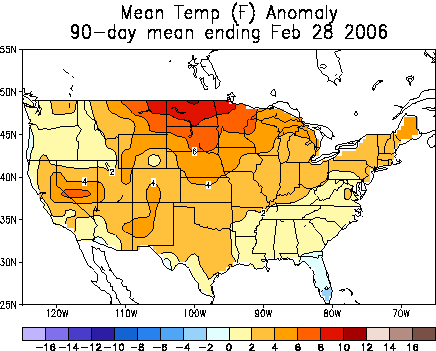
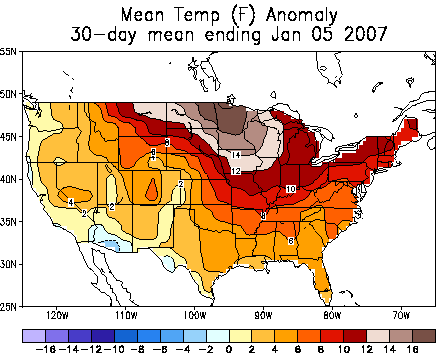
So what's really going on? The pattern so far this winter (admittedly after only 1 month) looks (figure on the immediate right) like a stronger version of what was observed last winter (figure to the far right–note that these anomalies reflect differences relative to a relatively warm 1971-2000 base period, this tends to decrease the amplitude of positive anomalies relative to the more commonly used, cooler 1961-1990 base period). This poses the first obvious conundrum for the pure "El Nino" attribution of the current warmth: since we were actually in a (weak) La Nina (i.e., the opposite of 'El Nino') last winter, how is it that we can explain away the anomalous winter U.S. warmth so far this winter by 'El Nino' when anomalous winter warmth last year occured in its absence?

The second conundrum with this explanation is that, while El Nino typically does perturb the winter Northern Hemisphere jet stream in a way that favors anomalous warmth over much of the northern half of the U.S., the typical amplitude of the warming (see Figure below right) is about 1C (i.e., about 2F). The current anomaly is roughly five times as large as this. One therefore cannot sensibly argue that the current U.S. winter temperature anomalies are attributed entirely to the current moderate El Nino event.
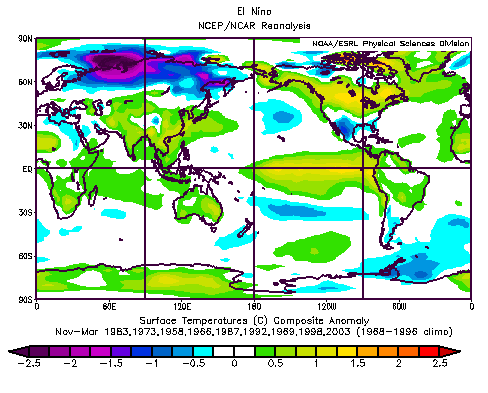
Indeed, though the current pattern of winter U.S. warmth looks much more like the pattern predicted by climate models as a response to anthropogenic forcing (see Figure below left) than the typical 'El Nino' pattern, neither can one attribute this warmth to anthropogenic forcing. As we are fond of reminding our readers, one cannot attribute a specific meteorological event, an anomalous season, or even (as seems may be the case here, depending on the next 2 months) two anomalous seasons in a row, to climate change. Moreover, not even the most extreme scenario for the next century predicts temperature changes over North America as large as the anomalies witnessed this past month. But one can argue that the pattern of anomalous winter warmth seen last year, and so far this year, is in the direction of what the models predict.

In reality, the individual roles of deterministic factors such as El Nino, anthropogenic climate change, and of purely random factors (i.e. "weather") in the pattern observed thusfar this winter cannot even in principle be ascertained. What we do know, however, is that both anthropogenic climate change and El Nino favor, in a statistical sense, warmer winters over large parts of the U.S. When these factors act constructively, as is the case this winter, warmer temperatures are certainly more likely. Both factors also favor warmer global mean surface temperatures (the warming is one or two tenths of a degree C for a moderate to strong El Nino). It is precisely for this reason that some scientists are already concluding, with some justification, that 2007 stands a good chance of being the warmest year on record for the globe.

A few other issues are worthy of comment in the context of this discussion. A canard that has already been trotted out by climate change contrarians (and unfortunately parroted uncritically in some media reports) holds that weather in certain parts of the U.S. (e.g. blizzards and avalanches in Colorado) negates the observation of anomalous winter warmth. This argument is disingenuous at best. As clearly evident from the figure shown above, temperatures for the first month of this winter have been above normal across the United States (with the only exceptions being a couple small cold patches along the U.S./Mexico border). The large snowfall events in Boulder were not associated with cold temperatures, but instead with especially moisture-laden air masses passing through the region. If temperatures are at or below freezing (which is true even during this warmer-than-average winter in Colorado), that moisture will precipitate as snow, not rain. Indeed, snowfall is often predicted to increase in many regions in response to anthropogenic climate change, since warmer air, all other things being equal, holds more moisture, and therefore, the potential for greater amounts of precipitation whatever form that precipitation takes.

Another issue here involves the precise role of El Nino in climate change. El Nino has a profound influence on disparate regional weather phenomena. Witness for example the dramatic decrease in Atlantic tropical cyclones this most recent season relative to the previous one. This decrease can be attributed to the El Nino that developed over the crucial autumn season, which favored a strengthening of the upper level westerlies over the tropical North Atlantic, increased tropical Atlantic wind shear, and a consequently less favorable environment for tropical cyclogenesis.

If a particular seasonal anomaly appears to be related to El Nino, can we conclude that climate change played no role at all? Obviously not. It is possible, in fact probable, that climate change is actually influencing El Nino (e.g. favoring more frequent and larger El Nino events), although just how much is still very much an issue of active scientific debate. One of the key remaining puzzles in the science of climate change therefore involves figuring out just how El Nino itself might change in the future, a topic we're certain to discuss here again in the future.


360 Responses to “El Nino, Global Warming, and Anomalous U.S. Winter Warmth”

  1. Magnus W Says:

    Hi!

    Is there any possibility that you have an address for the picture with the effect on temperature by El Nino, or a larger picture?

    (thanks again for a great blog)

    [Response: Sorry, should have included that. You can actually ‘custom build’ a composite on this NOAA site, choosing the region, season, type of event (El Nino vs. La Nina), etc. Unfortunately, you can’t change the base period :( -mike]

  2. James Says:

    The US is not the world - I’ve heard from various people that Europe seems to be experiencing an even more anomalously-warm winter this year - no snow in Norway & Sweden, crocus blooming at Christmastime in Germany, etc. Indeed, it almost seems that I’m in one of the few places (northern Nevada) that’s having fairly normal winter temperatures. Care to expand/comment on this?

    [Response: I confess that the resources I rely upon (e.g. NOAA’s web pages) don’t provide up-to-date global temperature information. Perhaps some of my European RC colleagues can help out here? -mike]

  3. rick Says:

    How can and I help and are there any careers available to make a living?

  4. Jeff Weffer Says:

    The current weather pattern is classic El Nino.

    Eastern Siberia has had a large area in the last several days which are below -50C. The really, really cold air has just moved to eastern Siberia rather than central northern Russia. The stormy weather of El Nino has hit Oregon and British Columbia rather than California. The cold water pattern in the north-western Pacific is exactly the same as the above graphic. The north Atlantic warm pool is exactly the same. North American temperatures are similar.

    One would expect some variation and that is what we have got.

  5. Eli Rabett Says:

    The most important thing about this post, is the NBC Nightly News had exactly the same story tonight.

  6. Steve Sadlov Says:

    Most of the scientific observation and analysis of ENSO was since 1976 and as a result, during a positive PDO phase. PDO has been behaving erratically since 1997 or 98 (some suggest it may want to flip negative). What should we expect due to ENSO during a negative phase PDO? Perhaps the period 1940 - 1976 might provide clues. At some point we’ll probably be able to characterize it better. Then the final food for thought, what sorts of even higher order, longer period things might be going on in terms of these SST anomaly oscillations? Is there something with an even longer period than the PDO that we simply don’t yet recognize because the pre 1940 data are not sufficient to reveal it? And all of this superimposed on even longer term changes.

  7. Charles Muller Says:

    #2 Not really an RC colleague :D but I confirm (from France) that west-European winter is unusually warm, even if december anomalies are a bit less pronounced than sep-nov (fall) ones (in France, the warmest fall since 1950, beginning of homogeneized daily measures, and probably since 1865 ; in Austria, Germany, Spain, Portugal… +1,5 to +4°C, snowfall deficit in all the Alpin region, etc.). Previous works (eg Moron et Plaut 2003) find an El Nino influence on European fall-winter weather, with a zonal mode dominant on nov-dec (warm and wet flux from Atlantic) and with a higher probability of a switch on west blocking or Greenland anticyclone regimes on feb-march. But correlations are not causations, weather conditions are more chaotic (and the present El Nino is weak).

  8. Steve Sadlov Says:

    RE: #2 - RE: The European drought (and warmth in the SW quadrant of Europe). So here is an image of current snow cover and sea ice. Southern Sweden is drought ridden (but yet cold enough for some shore fast / near shore sea ice nearby in the usual places). Northern Sweden and much of Norway have coverage. The coverage along the Western shore was greater during the fall and had since melted / sublimated away. The rest Western Europe is in a bad way and will need to get lots of snow / rain between now and mid year to get out of trouble.

  9. Charles Muller Says:

    A difficult point for me is : in what way can we partly attribute all phenomena (even a local cooling) to AGW (and if so, is there any sense for this kind of attribution)? Small changes in oceanic or atmospheric circulation due to small changes in radiative equilibrium may translate in flooding here and drying there, warming here and cooling there, etc. So, we allways need a long term trend (30 yrs) to assert a significative change, a potential link with AGW and a more-or-less good conformity with models’ predictions. Where are we now for 1977-2006 trends in the USA winter?

  10. Jim Roland Says:

    Sounds like NOAA’s pronouncement is distinctly unempirical, because if records are being broken over your way like they are here in Europe, then by definition that is not evidence of a cyclic description.

    From the point at which detailed records begin, you can always expect new records to break old ad infinitum in a chaotic system, but if there were no inherent trend then the rate of record-breaking for a finite set of annual indicators would tend to decay with a zero asymptote.

    As regards Katrina, although were it not for AGW a hurricane as damaging as Katrina might have occurred if one were to wait long enough, surely Katrina itself was made more damaging by AGW as that was a factor contributing to Caribbean SSTs and the local tropospheric vertical temperature gradients at that point in time?

    And now to get a life in the mild January over here…

  11. Edward Greisch Says:

    Have you and the US weather service been using a 10 year running average to compare higher and lower than “normal” temperatures? You and the US weather service need to set a period of time in the past as the “normal” period so that “normal” doesn’t change every year. The century from 1850 to 1950 seems appropriate. Against the century from 1850 to 1950, has the past half century been warmer?

  12. L. David Cooke Says:

    RE: 6

    Hey Steve;

    Actually, there were significant deviations before then. It was the winter of �84 that I stood on the Point near Port Washington, Wisconsin the day before New Years Eve in a brisk breeze and 60 Deg. F dangling my feet in the chilly water. A week later around the 10th of Jan. 1985, I was climbing over ice floes on the shore of Grand Haven Michigan, watching pot ice form in the Grand River.

    Dave Cooke

  13. Dan Says:

    re: 11. The statistical “normals” for climate data are 30-year periods, not 10-year running averages. For example, 1961-1990, 1971-2000, etc. However, they are 30-year blocks, not 30-year running averages. Generally in the eastern US, the 1961-1990 30-year normals are cooler than the 1971-2000 normals. Many will recall how snowy the 1960s were in particular.

    Most important, the word “normal” here is a statistical calculation/definition. It does not mean normal as the word is used in common speech. In fact, in my city, today’s statistical normal daily maximum temperature of 46 degrees F rarely actually occurs since that value is based on the daily maximum temperatures from each January 8th during the period from 1971-2000. In other words, the daily maximum temperature for each of those January 8th days is summed up and divided by 30.

    A 30-year period was determined to represent the statistical normal through various analyses. I beleive there is more detail at the National Climatic Data Center web site which is easily found via Google.

  14. Jim O'Donnell Says:

    Regarding the comments on the VERY warm winter in Scandanavia - my wife is a Finn. She is currently in Vaasa. Vaasa is not too far below the Arctic Circle. This morning, she called me to say that it is raining non-stop, the grass is green and, in the park yesterday, she saw tulips pushing up.

  15. john Says:

    Of course no one weather incident can be proven to be the result of any other one single factor, global warming or el nino. However it seems like saying that this latest anomoly fits the pattern we would expect from anthropormophic climate change, would be very useful and scientifically correct. I’m just a layman, but while denying direct correlation is correct, saying that what we are seeing fits the computer model predictions (even if it is more extreme than most predictions) would also be just as correct and more politcally useful.

  16. Pat Neuman Says:

    A surface temperature anomaly map by NASA for 2001-2005 shows that the warmest regions occurred over northern high latitude land mass areas, exactly what global climate modelers had predicted many years ago.

    2006 annual mean temperatures at climate stations in Montana, North Dakota and Minnesota were near or exceeded the warmest years of record (1890s-current).

    Based on things that we know, it seems irresponsible to me that some people continue to try to credit mainly El Nino for many of the warming conditions which we know have been happening for many years. Come on folks, wake up! It’s obvious.

    See photos and figures at:
    http://new.photos.yahoo.com/patneuman2000/album/576460762343894555

  17. Hank Roberts Says:

    > the word “normal” here is a statistical calculation/definition.
    > It does not mean normal as the word is used in common speech.

    This is important to know — the same definition is important for medical lab test reports:

    “… usually, these cutoffs are established by measuring the test in normal, healthy people (called “a reference group”) and figuring out where 95% of the results fall; if your result falls in between the cutoffs, your health care professional may call it “wnl,” “in the normal range” or “within the reference range.”
    http://www.intelihealth.com/IH/ihtIH/WSIHW000/35320/35328/375022.html?d=dmtHMSContent#not

  18. Paul M Says:

    Why is it mid January and now we are all beginning to hear of el-nino as the culprit of this “new” weather we are having? It is extremely after the fact, and a monkey could deduce this fact as late as it is. Save some water, same some food, and eat drink and be merry, for tomorrow we die. I swatted a mosquito on my back door today, did I say I was in central PA? What happened to Jack frost whipping in the house as I opened the door? no, I am going out without a coat.

  19. Hank Roberts Says:

    If you’d been reading Roger Pielke Jr.’s blog, you’d have known about it months ago!
    http://sciencepolicy.colorado.edu/prometheus/archives/climate_change/000771out_on_a_limb_with_a.html

  20. William Astley Says:

    In Reply to comment 9: “A difficult point for me is : in what way can we partly attribute all phenomena (even a local cooling) to AGW …?”

    If the analysis was scientific as opposed to political, other factors would be considered and discusssed. For example solar (Note the current solar activity is very, very, unusual). See the attached paper that shows there is a significant correlation of average planetary temperature and the solar index-ak. (See attached for details as to what ak measures, also check out the Solar Terrestrial Activity Report. The Dec 16, 2006 spike is what the paper is describing.)

    The following is an excerpt from the conclusions (Short paper. Difficult for scientific discussions without facts.)

    2005 paper by Georgieva, Bianchi, & Kirov �Once again about global warming and solar activity�

    http://sait.oat.ts.astro.it/MSAIt760405/PDF/2005MmSAI..76..969G.pdf

    “It could therefore be concluded that both the decreasing correlation between sunspot number and geomagnetic activity, and the deviation of the global temperature temperature long-term trend from solar activity as expressed by the sunspot index are due to the increased number of high speed streams of solar wind on the decreasing phase and the minimum of sunspot in the last decade.”

    Comments:
    1. The high speed solar wind (during the solar cycle minimum) has increased the net charge in the ionsphere. (Normally the ionsphere can discharge during the solar minimum and there is less charge to discharge.)
    2. As a result of the increased charge in the ionsphere, the newly observed phenomena called “Sprites” (a discharge from ionsphere to cloud tops) has been observed starting in about 1993. Sprites can and have destroyed aircraft.
    3. It is assumed that this solar driven phenomena is the reason why there is a reduction in low level clouds. See attached paper by Palle. Palle found there is a 99.9% oorrelation of GCR to cloud cover 1983 to 1993. From 1993 and on there is an anomalous reduction in low level clouds. Where have all the low level clouds gone?

    Solar Terrestrial Activity Report

    http://www.dxlc.com/solar/

    Copy Palle’s paper. (See figure 2. Note low level clouds are reduced by minus 0.065% per year, starting in about 1993.)

    http://solar.njit.edu/preprints/palle1264.pdf

  21. wayne davidson Says:

    What can I say, most excellent post, and also great remarks from RC bloggers, Eastern Siberia is it, we are sharing some of its cold, it is eerily like the winter of 2005-06 except its warmer, I might add what I wrote last November, this winter will be like fall with the occasional visit from winter. One must remember, the temperature mean is pushed upwards, but natural variations from the mean predicts some cold is bound to come, but not to last for very long.

  22. John Sully Says:

    #19, hmm sounds like the abnormally warm winter we’ve had in Montana. Due to get a couple of days of cold by the end of the week, but it is not supposed to last long.

  23. mark s Says:

    Hiya folks, here in the uk, the lovely weatherman said we might get a new nightime record high temperature for January, over night.

    This is following on from a ‘hottest on 350yr record’ 2006(by an alarmingly large margin), and it feels anomalous to me, but then i’m alarmed:-)

    To add to the pan-european flavour, i distinctly remember mention of the very late onset of winter in Moscow, in the reports of snowless ski resorts in the alps, back in mid-December!

    I agree with john, don’t say ‘its global warming, you know’, say ‘welcome to the future’! it saves time:-)

  24. Edward Greisch Says:

    Reference book: “The Way to Win, Taking the Whitehouse in 2008″ by Mark Halperin and John F. Harris, 2006
    The referenced book makes many references to www.drudgereport.com. The Drudge Report is where the “Freak Show” happens. The freak show is bad journalism that causes the best candidate to loose the election for president.
    You are battling the “Freak Show”. Many of the readers and commenters at that level have such poor reading comprehension that they will never understand you. Don’t try to accomodate them, they really don’t want to understand. But they Would enjoy making fun of a degreed person. If you answer them, don’t use your real name.
    “The Way to Win” also mentions many times that people are INSTINCTIVELY conservative. Take that literally. Management hasn’t changed much in the past 30 Million years. People still look to the president to be the Alpha Male.

  25. rasmus Says:

    Many of these explanations also apply to explain why the ‘winter’ has not yet ‘arrived’ in Northern Europe. December was record-warm in many parts of southern Norway, ann the autumns has been record-warm over extensive regions of Northern-Europe.

  26. Brad Arnold Says:

    What is astonishing to me is that El Nino is caused by abnormally warm Pacific ocean SST (surface sea temperature), and higher SSTs are quintessencial global warming, so why does NOAA (the National Oceanic and Atmospheric Administration) seek to disassociate El Nino from global warming?

    In other words, what is the hidden motive of NOAA to deny global warming and higher SST? Sooner or later the increased severity of hurricanes (which are already twice a strong due to higher SST), and increased frequency and severity of El Nino, will have to be called what they are: manifestations of global warming.

  27. David Wilson Says:

    please be careful with acronyms … AGW?

  28. Stephen Berg Says:

    Excellent post once again, Dr. Mann! I couldn’t have said it any better (and probably wouldn’t have done it nearly as succinctly and concisely). Keep up the good work!

  29. anonymous Says:

    I work for the US military in the German Alps. Despite the facts that we have had virtually no snow this year and that the grass is spring green in January - in a ski resort - and the temperature tomorrow is predicted to be 15-18 C, many of my colleagues, indoctrinated by army-provided Fox News and Rush Limbaugh, deny that global warming is taking place and continue to drive their huge gas guzzlers with no qualms. The Germans (and the thinking Americans here) are astounded and dismayed at how far media political indoctrination can go in helping people to ignore what is happening right before their eyes.

  30. suntau Says:

    El Nino, Global Warming, and Anomalous U.S. Winter Warmth
    should read and feature: El Nino, Global Warming, and Anomalous global Winter Warmth

  31. Almuth Ernsting Says:

    You say that the current anomalies in the US are well beyond the most extreme predictions from climate models, suggesting that the the chaotic nature of weather events must play a role, too (though within an overall warming trend).

    What really concerns me is that I’ve read a lot about climate models not being able to replicate the magnitude of abrupt regional temperature changes in the past, and Raypierre has said here that he fears that past climate records point towards some yet unknown positive feedback which might amplify warming at the northern latitudes.

    My feeling in Scotland is that the changes to the weather (ie where the wind comes from) are far more dramatic than the background warming. When we do get northerly winds they are probably less cold than they were 15 years ago but that’s far harder to notice than the fact that we now tend to get southerly or south-westerly winds nearly all of the time.

    Could we be looking at any fairly abrupt changes to the jet stream, possibly triggered by sea ice melting or stratospheric changes? Has anybody looked at whether the jet stream has behaved ‘abnormally’ over the past few years?

  32. Janne Sinkkonen Says:

    About the winter in Finland: December was the warmest measured in a large part of the country. Deviations from the 1971-2000 climatology were 6-8 degrees (C). I don’t know how many sigmas that is, but local news cited “two times in thousand years” - and the reference period includes warm winters of 90’s! The situation is pretty much similar for the whole Scandinavia, including northern parts of Russia west of Ural. The beginning of January has been about equally warm, and the models do not show an immediate (7-14 days) cooling.

    From the newspapers one get the feeling that with respect to global warming, this has been the strongest wake-up call so far. People have been aware and mostly believing in AGW in a theoretical sense, but now it is concrete that something strange is really happening. The exceptionally dry past summer amplifies the feeling.

    By the way, Vaasa is not exactly close to the Arctic Circle, at least not from our point of view. :) Instead, it is close to the seashore in south-west Finland. Finnish Arctic Circle currently has about 40cm snow. But it is true that in the south we have seen some quite strange effects in nature.

    I don’t think ENSO can be blamed of our warmth. AO and NAO have been positive, but nothing extraordinary. I wonder if the (lack of) Arctic ice cover is somehow involved.

  33. Koen Says:

    Tobacco, asbestos, radiation and most health hazards have been hiding themselves for many years behind the fact that you cannot assign a single cause as determinant to a single effect: you cannot prove a single cancer has been caused specifically by that person’s smoking habit (or work environment, or whatever lethal cause is suspected).

    It took years and and overwhelming amount of statistical data to revert these statements, which caused numerous deaths of individuals.

    Do we need to wait until statistics also justify the underlying causes of numerous disasters affecting society all over the world?

    We know things are going the wrong way, and almost everything we see corresponds to that view. What more do we need to get some action?

  34. i. Says:

    Koen, I think we’ll need to see some very painfull events to wake up, much more painfull than Katrina.

    Good news is many people are waking up, at least in Spain and I think this is quite common around Europe. It’s just obvious climate is wrong. I just can’t remember a normal year here. It’s been hot since last week of February until December, then one week of colder weather and it’s hot again. My tomato plants are growing like weeds when they should be barelly alive. In the mountains, trees have gone up hundreds of meters… We are used to variable weather, but not to constantly variable.

  35. Urs Neu Says:

    In Switzerland, current January temperatures are 5-6 degrees C above the mean (1961-90), and current weather forecasts do not show any hint for a change for the next two weaks. Last fall set a new temperature record for the instrumental period (since 1864) which was about one degree C above the previous record (three months mean). July 2006 was the warmest month ever in the instrumental period.

    From a quick search for global anomaly charts (850hPa temperature):
    http://www.bom.gov.au/cgi-bin/climate/cmb.cgi?page=map&variable=850t&vstatus=anomaly&period=month&area=global

  36. Valuethinker Says:

    British weather report:

    - 2006 is shaping up to be the the hottest year since records were kept (1659)

    England Mean Temperature Series (series began in 1914). The provisional mean value for the month of December is 6.1 °C 1.8 °C above the 1961-1990 average, which is in the well above average category.

    - we haven’t had a winter yet, here in London. I’m not even sure we’ve yet had a frost. Flowers are blooming and there are migratory birds in evidence (3 months early). Average temperature would seem to be about 5 degrees centigrade above normal. It’s 13 degrees centigrade today, London in January is normally betwen 0 and about 8 degrees. Also we have near record gales forecast, and we had a tornado last month in North London (a very rare occurrence)

    The forecast, however, is for a cold snap in February.

    Will post the Met Office press release.

  37. Valuethinker Says:

    I can’t seem to link to the URL, so please have a look at

    www.metoffice.co.uk under ‘press releases: 4th January 2007′

    4 January 2007
    2007 - forecast to be the warmest year yet

    2007 is likely to be the warmest year on record globally, beating the current record set in 1998, say climate-change experts at the Met Office.

    Each January the Met Office, in conjunction with the University of East Anglia, issues a forecast of the global surface temperature for the coming year. The forecast takes into account known contributing factors, such as solar effects, El Nino, greenhouse gases concentrations and other multi-decadal influences. Over the previous seven years, the Met Office forecast of annual global temperature has proved remarkably accurate, with a mean forecast error size of just 0.06 °C.

    Met Office global forecast for 2007

    * Global temperature for 2007 is expected to be 0.54 °C above the long-term (1961-1990) average of 14.0 °C;
    * There is a 60% probability that 2007 will be as warm or warmer than the current warmest year (1998 was +0.52 °C above the long-term 1961-1990 average).

    The potential for a record 2007 arises partly from a moderate-strength El Nino already established in the Pacific, which is expected to persist through the first few months of 2007. The lag between El Nino and the full global surface temperature response means that the warming effect of El Nino is extended and therefore has a greater influence the global temperatures during the year.

    Katie Hopkins from Met Office Consulting said: “This new information represents another warning that climate change is happening around the world. Our work in the climate change consultancy team applies Met Office research to help businesses mitigate against risk and adapt at a strategic level for success in the new environment.”
    Review of 2006 in the UK

    This startling forecast follows hard on the heels of news that 2006 was the warmest year on record across the UK.

    For 2006, all UK data have now been gathered, revealing a similar story to that of Central England Temperature already announced last month.

    For the whole of the UK, 2006 was the warmest year on record with a mean temperature of 9.7 °C, 1.1 °C above the 1971-2000 long-term average. Ranked warmest years in the series going back to 1914 are:
    # 2006 9.73 °C
    # 2003 9.51 °C
    # 2004 9.48 °C
    # 2002 9.48 °C
    # 2005 9.46 °C
    Mean temperature, sunshine and rainfall for regions of the UK compared with the long-term average UK regional averages for 2006, anomalies with respect to 1971-2000
    Region Mean temp Sunshine Rainfall
    Actual [°C] Anom [°C] Actual[hours] Anom[%] Actual[mm] Anom[%]
    UK 9.7 +1.1 1,507 113 1,176 104
    England 10.6 +1.2 1,638 112 8,51 102
    Wales 9.9 +1.0 1,534 113 1,420 99
    Scotland 8.3 +1.1 1,300 112 1,652 109
    N Ireland 9.6 +1.0 1,409 115 1,156 104

    Autumn 2006 (September to November) was also exceptionally mild over many parts of Europe at more than 3 °C above the climatological average from north of the Alps to southern Norway. In many countries it was the warmest autumn since official measurements began.

    Notes:

    * The Met Office is the UK’s National Weather Service, providing world-renowned scientific excellence in weather and climate change.
    * Met Office climate change consultancy provides data and risk-management services that are used by other government departments and agencies, the private sector and the public to mitigate and adapt to climate change.
    * Met Office Hadley Centre for Climate Change is funded by Defra and the MoD.
    * The 95% confidence range of the global forecast is that the temperature will lie between 0.38°C to 0.70°C above normal.

  38. PHE Says:

    Sitting here in Brussels, the temperature today is around 12degC. Thats 8degC above average for Jan. Global temperatures have risen 0.7degC in 100 years. Thus global warming could explain about 0.4degC of this rise above ‘average’ (5%). Something else must explain the rest.

  39. Grant Says:

    Re: #22

    Thank you Koen! You expressed very well what’s been in the back of my mind since this post appeared.

  40. Jim Cross Says:

    Re #18

    I don’t know where you’ve been but I heard about this El Nino several months ago and figured this would be warm winter in North America.

    Re #20

    I wouldn’t characterize the El Nino phenonmenon as abnormal warm water. It’s a natural phenonmenon. The ocean warms and cools on a natural cycle of a few years. The warming phase is called El Nino. There is some evidence that El Nino was even more active during the Little Ice Age. Of course, the real point of this article is El Nino may be making only a small contribution to the current North American warm winter.

  41. Brian Allen Says:

    I haven’t seen this mentioned yet. Why are the anomalies (this winter) so much colder in eastern Siberia than prediced warmimg models. Are the very cold temperatures normal considering the El Nino and North Atlantic oscillation AND the warming over the rest of the arctic? It looked like the models would show warming in Siberia also when NA and Europe warmed. Thanks for your response.

  42. Alan Says:

    RE: “But one can argue that the pattern of anomalous winter warmth seen last year, and so far this year, is in the direction of what the models predict.”

    Here in Australia, we are getting a “sneak preview” what the CSIRO have been predicting to happen 20-50 years from now. The SE has been suffering the worst drought on record for the past five years. Meanwhile the NW has had enough extra rain to keep the nations average relatively stable. As for extremes of weather we have had heat waves and constant bushfires interspersed with unseasonal frost and snow.

    The result is a halving (down 62%) of our grain crop due to lack of rain, a large chunk of fruit crops have died on the vine due to the unseasonal frost. Dairy and livestock herds have also been drastically reduced in the SE due to lack of rain. I hope EL Nino does break our drought because rain falling on the desert instead of the remaining topsoil in the dried up Murry-Darling basin isn’t going to feed anyone (I think we are around the 4th largest grain exporter, a 62% reduction in our grain crop equals a loss of ~17,000,000 tons).

    Australian crop report, Dec quarter 2006

  43. Dr. J Says:

    I’m always a bit amused at those who promote AGW, and the media who support them, continue to use emotive, evocative words in their descriptions of mathematic statistical functions of temperatures and/or precipitation data sets. For instance, if it is warmer or colder, it is compared to “normal”, as in a norm or standard or the usual and expected state, when of course it is merely a statistical “average” they really mean. They give us no standard deviations, data distributions, nor other statistical tests, just one word, normal. So why not use the word average, or more precisely, statistical average? I think I know the reason, average doesn’t carry the emotional response that triggers fear and concern like something being abnormal does. Your words tend to prove your motives gentlemen.

  44. Grant Says:

    Re: #43 (Dr. J)

    Have you ever talked to people — nonscientists — about scientific topics? As soon as you use phrases like “statistical average,” “standard deviation,” “data distribution,” or “statistical tests,” their eyes glaze over and their attention wanders. We use the word “normal” because we’re communicating with lay readers, and that is the language as used by the general populace. When we scientists talk to each other, we use all the “technical” phrases you refer to.

    I think I know the reason for your post: your words reveal your motives. How weak is your case, when you must resort to “accusing” us of using the word “normal” in order to incite passion?

  45. Hank Roberts Says:

    You’re amusing too! You missed the explanation above, perhaps? You wouldn’t want people to be confused about this, and saying ‘average’ confuses people as you’re confused about it — ‘normal’ is used in science and medicine — as your doctor should have told you when you had normal lab results on routine medical tests — to mean within 2 sigma.

    You don’t want your thyroid or iron or blood pressure to be ‘average’ — you do want it in the normal range. Same for your climate, eh?

  46. Janne Sinkkonen Says:

    Re #43, on using “normal” instead of “average”. It is true that the words are not synomymous: normal implicitly refers to a distribution or a quantile, while average refers to a single number. Sometimes people use these correctly, sometimes not. I would attribute it more to expectations than to motives: if one is seeking deviations, it is natural to speak about “normal”.

    Speaking of emotive, “those who promote AGW, and the media who support them” could also read “those who try to educate people about AGW, including some media”. And “Your words tend to prove your motives” could be “Some of you seem to be really worried, and it shows in your language”. It’s really hard to be neutral. :)

  47. GAW Says:

    I was trained as a (mathematical) physicst but made a career as computer professional. I have had some contact with both large scale computer models and with the scientific establishment. I find RC an interesting read as an AWG skeptic. I think the following quote might add a little perspective to this discussion.

    “Like dreams, statistics are a form of wish fulfillment.”
    Jean Baudrillard

  48. Dr. J Says:

    Re: #44, well said GAW, and as Orwell said, sloppy language leads to sloppy thinking, this subject in spades. Why is it some scientists just can’t use precise, scientifically correct language? Again, your words prove your motives.

  49. pete best Says:

    Re #47. Hardly if they are telling you something that you do not want to hear. Climate Models are not fulfulling your wish as a skeptic are they?

  50. Steve Sadlov Says:

    RE; #32 - Over the past year or so, the NH extent anomaly has wiggled between just under -1M Km^2 and just over zero. At present, the anomaly is ~ -0.3M Km^2 and somewhat positive trending. As you are probably aware, the Barents Sea and to a somewhat lesser extent the Kara Sea had quite late icing up this year (as opposed to other NH basins which more or less froze up on queue). Another oddity has been the repeated highly compressive (in terms of lateral pressure) events driven by easterly winds, along the ice edge between Svalbard and SE Greenland. Along the NW coast of Svalbard the edge has repeatedly enveloped the shore then been pushed back out by these winds. You comment has piqued my interest, for I have long wondered how a good closure of sea ice to a continental land mass can impact things, witness Actic NE Asia this year.

  51. SecularAnimist Says:

    mike wrote:

    As we are fond of reminding our readers, one cannot attribute a specific meteorological event, an anomalous season, or even […] two anomalous seasons in a row, to climate change.

    It seems to me that an “anomalous” some number of seasons in a row is the definition of “climate change.”

    How many anomalous seasons in a row must we have before we can say that what was once anomalous is now normal, and “the climate has changed”?

    [Response: Your point is well taken, and raises one of the trickier issues. Lets extend the dice rolling analogy we used in our Hurricane and Global Warming” article of last year. Lets characterize the two anomalously warm U.S. winters in a row, last year and this year (assuming the rest of January and February are not anomalously cold) as ’snake eyes’ (double “1″s coming up in a roll of two dice, for the non-gamblers among us). Well, snake eyes will come up 1/6*1/6 = one out of every 36 rolls of two independent dice (3% of the time), randomly. Suppose we load the dice e.g. by erasing the “twos” and replacing them with “ones”. Snake eyes will now come up 1/3*1/3 = one out of every nine rolls of the two dice (11% of the time). It may take us quite a few rolls of the dice to determine decisively that the dice have been loaded (i.e. to conclude that the percentage is statistically significantly higher than the expected 3% rate). On the other hand, suppose that you really loaded the dice, by erasing the “twos”, “threes”, “fours” and “fives” and replacing them all with “ones”. Then snake eyes will come up 5/6*5/6 = 25/36, i.e. approx 70% of the time, rather than the expected 3% of the time. In this case, we would figure out quite quickly that the dice were loaded. So depending on just how loaded the dice really are, we may have to continue rolling for some time to determine decisively that they are loaded with respect to any particular phenomenon (e.g. U.S. winter warmth). On the other hand, such information does not exist in isolation. We have many other independent (theoretical and empirical) lines of evidence of climate change. The totality of the evidence convinces the vast majority of scientists in the field that we are indeed already seeing the influence of climate change in the collective observable phenomena. -mike]

  52. Dan Says:

    re: 48. As opposed to using phrases such as “those that promote AGW”, as if anyone is in favor of it for some reason. Yes, your words do certainly prove your unscientific motives.

  53. Jim Dukelow Says:

    Re #43-47

    One reason to be cautious about using “average” in talking to the general public or to a scientific/technical audience is its ambiguity. Depending on the context, “average” may refer to the arithmetic mean, the median, the geometric mean, or the harmonic mean. Each of these is appropriate in certain contexts and one of the ways of lying with statistics is to use an inappropriate one and refer to it, correctly, as the average whatever.

    For instance, you might tell us that average real income in the US has gone up in the last 6 years, referring to the arithmetic mean, even though median real income has decreased.

    “Normal” is probably a good surrogate for “within the normal range of variation” and doesn’t need to refer to the Gaussian distribution. It would probably be better to use the whole phrase or give a 5/95 range.

    Best regards.

  54. P. Lewis Says:

    Re #43. Is this mischievous semantics?

    That the term ‘climate normal’ has been curtailed to ‘normal’ is perhaps to be regretted, but most people hereabouts know exactly what ‘normal’ means, as I hazard do people hereabouts who wish to pretend mischievously is otherwise the case.

    According to the WMO definition, climate average/mean/normal are interchangeable/synonymous terms. It is an arithmetic calculation based on observed climate values for a given location over a specified time period (’normally’ 30 years) and is used to describe the climatic characteristics of that location. Real-time values, e.g. daily temperature, are compared with the ‘climate normal’ to determine how unusual or how great the departure from ‘average’ they are (whether you’re talking climatology or meteorology — and it is certainly the latter case recently here).

    Since this is a blog, not a peer-reviewed journal, I see no real problem with using ‘normal’. And anyone under a misapprehension as to what ‘normal’ means is likely to be corrected sharpish and/or pointed in the direction of the resources connected to this site.

    As to how this ‘normal’ term is portrayed in the media, that is in the domain of reporters and editors and their critically thinking (or otherwise) readers.

  55. teacher ocean Says:

    I am new to this stuff so please excuse the naivete of this question, but when we say the “warmest year on record” do we mean historical record, or since the mid 1800’s when regular measurements of air temperature were started?

    [Response: Depending on how much the trust the earlier instrumental records, and what you’re willing to consider ‘global’ coverage, we have a reasonably reliable record back to the mid 19th century. So by ‘warmest on record’ I simply mean in the context of the instrumental record available back to the mid 19th century. As for extending the record even further back than this using more tentative proxy and/or early instrumental and historical data, there is much discussion of this on the site. Just go to the ‘paleoclimate’ section of our ‘archive’. -mike]

  56. A.Escalas Says:

    Thank you for the post.

    When you say:
    we find ourselves well into the meteorological Northern Hemisphere winter..

    you mean:
    we find ourselves well into the astronomical Northern Hemisphere winter..

    [Response: Thanks, but not sure I follow the comment. The meteorological boreal winter is DJF, i.e. Dec 1-Feb 28/29, thats 90 days long (91 in leap year). As it stands today, Jan 9, we’re 40 days–almost half way–in. I consider that “well” in! -mike]

  57. Tom Huntington Says:

    Mike - - Regarding this discussion of climate normals, I wanted to ask you to post a few time series of climate normals if you could. Most people have a sense of what a 30-yr climate normal is. I think a simple plot showing how the “preceived normal” has changed over time would be interesting and compelling. I imagine that you or your RC colleagues would have the data at your fingertips to plot the 1930-1960, 1940-1970, 1950-1980 . . . . . 1970-2000 surafce air temperature normals for a few representative stations. These plots would how perceptions of what is “normal” are changing in different areas. Perhaps this has already been done and you could suggest a link.

    [Response: Thanks, this would be useful. But unfortunately I don’t have the data at my fingertips. We’re so used to working with anomalies that we usually just discard the climatologies. Perhaps some RC followers know of an online resource that provides a comparison of the evolving climatologies for one or more observing stations? -mike]

  58. Phil Carver Says:

    Regarding the connection between El Nino conditions and greenhouse gas (GHG) concentrations, I would be interested in RC’s opinion on the explanation for the apparently high temperatures in the Pliocene (5 to 3 million years ago (MYA)). At that time the GHG concentrations were not much above today’s level, yet sea levels were 10 to 20 meters higher.

    Two competing hypotheses both seem to involve alterations of ocean currents and ocean surface temperatures. The earlier hypothesis was that the restrictions of the Indonesian and Panamanian seaways were responsible for the shift to major northern hemisphere glaciations starting about 2.75 MYA. The other posited by A.C. Revelo and others at U.C. Santa Cruz and Mitchell Lyle at Boise State U. (see http://www.sciencemag.org/cgi/content/full/309/5735/758 and Nature Magazine, May 20, 2004, Vol. 429, pp. 263-267) is that higher temperatures might induce a permanent El Nino which could cause a significant positive feedback and amplify global warming. These two hypotheses have hugely different implications for the sea level rise in the centuries ahead, even if CO2 concentrations do not exceed 450 ppm.

    Even if the El Nino feedback is only a partial reason for the high sea level in the Pliocene, that would have significant implications for long-term planning for coastal areas. Which of these two hypotheses is more credible? Are there other hypotheses?

    Thanks in advance.

  59. Hank Roberts Says:

    >words prove your motives
    Always worth Googling: “Dr. J” +climate +skeptic
    Yep.

  60. Sashka Says:

    Ahem … So what was the need to pretend that I was talking nonsense in the previous thread and then turning around to make the same point (re: wrong order of magnitude) here?

    [Response: Sometimes our readers do raise points worthy of greater discussion in a more appropriate thread. So a hat tip to you indeed Sashka. You got a brief response earlier, and an expanded one in this latest post. -mike]

  61. Steve Sadlov Says:

    RE: #58 - In the day (old fart that I am) the “earlier hypothesis” was how they taught it in the UC Santa Barbara Geological Sciences Dept.

    I seem to recall an earlier thread where I brought it up, I seem to recall Dano and others making quite and effort to discredit it. IIRC - the discrediting factor was the time lag between the tectonic closures you mentioned, and the onset of the Pleistocene. My own continuing curiousity about it is based on my studies and work with transients in semi chaotic networks. An event (a step funtion or unit impulse) may occur, then it may take some time before the resulting perturbation settles and a new astable condition sets up. The tectonic closures would have constituted a fairly serious transient being imparted to ocean current systems. It would have taken some time after them for the new ocean current regime to be properly set up (the current THC/global conveyer system, more or less). Personally I would not rule out this theory. The time lag is actually expected. That’s how networks behave.

  62. Lynn Vincentnathan Says:

    It’s just as well that single events or seasons cannot conclusively be attributed to GW.

    What’s important is the recognition that AGW (assuming we keep emitting GHGs) will on the whole include greater warming, heat deaths, perhaps greater droughts, floods, storms, glacier melt, crop harm, fish harm (from warming, current disruption, acidification), wildlife harm, and many other problems. Because what we need to do is work to reverse this and avoid these future harms on the whole — rather than get tied up in court for decades trying to sue the pants off the perpetrators of some wacky weather event in Idaho. We need action to avoid enhancement of future hurricanes, not endless debates and recriminations about Katrina 2005 that prevent us from doing anything constructive to mitigate future GW. (I was able to tell a friend, a victim of Hurricane Rita, that it was in part to avert such mega-hurricanes, that I have been reducing my GHGs since 1990).

    I was actually motived to start reducing because GW “may have been exascerbating” drought & death in Africa. “May have” was a high enough standard to motivate me & it wasn’t unit 1995 that the 1st scientific studies reached 95% certainty re AGW. Likewise wacky weather and other possible current effects of GW (that portent worse to come in the future) should be good motivators for others…not to change weather tomorrow in some tiny location, but to avert or reduce such problems or increased effects in the future around the world. I hope no one realistically thinks that by running multiple instead of single errands or turning off the motor in drive-thrus that will make it colder today in Cincinnati so Johnny can build a snowman.

  63. Dan Says:

    Appropriate to the El Nino/global warming discussion and the warm December in the US:

    “Warm December pushes 2006 to record year in US”
    http://www.breitbart.com/news/2007/01/09/D8MHUMVO0.html

    Interesting to note the National Climatic Data Center says it is not certain as to how much is due to global warming and how much is due to El Nino.

  64. Gareth Says:

    Not to rain on anyone’s (warm) parade, but down here we’ve just had the coldest December for 60 years, and icebergs off the coast. Unsurprisingly, our local sceptics reckon this disproves global warming. For my part, I will acknowledge the variability in the system - but not revel in it. Could I please have some of your anomalous warmth for my grapevines?

  65. Kay Says:

    “The forecast, however, is for a cold snap in February.”

    A cold snap sounds like a sort of candy to me.

  66. Janne Sinkkonen Says:

    On attributing single weather events to climate change: has nobody really tried to formalize this?

    For example, suppose you have a background model M1, giving density p(x|M1) for a quantity, say temperature. M1 could represent a stable climate, and be for example a gaussian or t-distribution derived from past records. An alternative model M2, that could be derived from a climate model with AGW taken into account, predicts another density p(x|M2) for the same quantity.

    The basic idea would then be to quantify the surpriseness of an observation under both models, and compare these to some base level.

    By decision theory one can maybe justify the rationality of log-probability as a measure of surprise - at least log-probabilities are justifiable as a “score function”. Now if the most probable event by M1 is x_0, one can use it as a baseline, and evaluate the “surpriseness” of event x_1 under model M1 as log p(x_0|M1) - log p(x_1|M1). Under the model M2 the event x_1 would (maybe) be less surprising, and that surprise could be measured by log p(x_0|M1) - log p(x_1|M2). The numbers are comparable, and ratios of log-odds would allow fractional attribution of surprise. (No problem with using densities here as long as a physical symmetry spans a reasonable unique (Lebesque) measure into the x-space. But getting a justifiable baseline for the log-odds is critical and might be a challenge.)

    Of course the result would be conditional on a climatology and a climate model, and the climately model must be able to generate probability distributions for single events, such as daily temperatures on a station. This, especially the latter, adds a lot of assumptions. Model uncertainty, on the other hand, is easy to include if it’s quantifiable, once one gets the basic framework right.

    My version above is just hand-waving, and would probably fail miserably under a closer look. But has anyone seriously tried something along these lines and been unsuccessful?

    [Response:Good question. I’m not sure if I’ll succeed giving a sensible answer, but I’ll try: Your ideas bear many similarities to Bayesian statistics and attribution studies, e,g, Leroy (1998). Although this kind of analysis gives a probability associated with one explanatory factor, it cannot prove that the causation unless the probability is 0 or 1 (which is rarely the case). Furthermore, in complex systems such as the climate, it is difficult/impossible to statistically make any definete link between only one given event and a climate change, as the latter implies a change in the statistics - the pattern of behaviour (take the anology of a loaded dice). -rasmus]

  67. Tommy Says:

    An amateurs observations:
    There is a bug in the NAO index! Some surfers in the NW parts of Norway were excited when they learned about the NAO index. The index will normally show the track of low pressure systems in the N Atlantic. High index should indicate lows coming from the south tip of Greenland and crash right into the NW coast of Norway producing enjoyable waves. The peak in the NAO was in 90-92, when several hurricanes struck the coast. For the last three months, something odd has happened. The index has been quite positive, storms have been frequent, but the lows are traveling far more towards north, giving mild southernly winds in norway (and record high temperatures). Today is the very first day in many months with lows coming from north.
    I wonder why the lows are coming from SW, not W / NW as usual.
    To me, AGW is not a direct explanation. How well do we understand why the weather systems are stuck in these “modes”?

  68. Hank Roberts Says:

    Re #60, for reference, the prior good catch comment by Sashka and longer response by Mike are in the “New Heresy” thread, here:
    http://www.realclimate.org/index.php/archives/2007/01/consensus-as-the-new-heresy/#comment-23066
    It’s the comment by Sashka 5 Jan 2007, 8:56.

  69. Pat Neuman Says:

    Re 63.

    NOAA News public release:

    NOAA REPORTS 2006 WARMEST YEAR ON RECORD FOR U.S.
    General Warming Trend, El Niño Contribute to Milder Winter Temps

    The text released on the link (below) says nothing about global warming.
    http://www.noaanews.noaa.gov/stories2007/s2772.htm

  70. Phillip Shaw Says:

    Re #69:

    Pat - there is a brief mention of greenhouse gases in the third paragraph from the bottom. That make it a balanced account by some standards.

    And they do have a good graph of U.S. temperatures. Since the World revolves around us, of course, those are the only temperatures worth reporting. [Don’t write angry replies, I’m joking.]

    Anomalously Warm Regards - Phillip

  71. Jack Says:

    RE: Dave Cooke, in #12.

    Chicago experience: Christmas Eve, 1984, 70 F. Christmas Eve, 1985, -24 F. A 94 F degree difference on the same day in the same location, one year later (admittedly one was a high and one was a low, but the high in 1985 was still very cold).

  72. Gareth Says:

    Good post by Jeff Masters on the same subject. If you scroll down to the global temperature anomaly maps for December in El Nino years 1957 and 2006 you can see a striking illustration of why this year is different. ‘57 has a cold Arctic above the warm US. ‘06 has a warm Arctic above a warm ‘06. Compare ‘06 with model projections. Compelling, I would say.

    And look at Svalbard. What’s that station doing this year?

    Masters also uses the same dice-rolling analogy, but I think Mike got there first…

  73. Dr. J Says:

    RE: #59, Googling “Hank Roberts”+ AGW+ believer, is also instructive.
    As to the language, yes, I do assume there are many who “promote” or encourage the AGW hypothesis and it’s spread, are there some who deny that? I don’t think scientists should talk like reporters no matter who you are talking to, the piece on the NBC Nightly News last night was a case in point. Again, the public hears our words and listens with their experience and vocabulary, when our precise meaning is misunderstood, perhaps intentionally so, we do no good. And I think all the talk of this issue of a warmer winter is a little strange, it has been shown that colder weather kills many more people than heat waves and is more dangerous for longer periods and exacerbates disease as well. Are you all really advocating for colder weather?

  74. Alexander Ac Says:

    Just a short report on winter weather in Europe:
    Indeed, the whole Europe is experiencing very warm winter (if a record one will be clear after it will finish), at least the start of the winter. For the first time, we were able to drive BY CAR to our cottage in High Tatras, in Slovakia in January. But there is almost NO SNOW in all the Europe. Acually, TODAY, on my way by bus from Slovakia to Netherlands, it looked like a spring trip across Europe with no signs of snow anywhere, and temperatures reaching as much as 16C.
    Indeed, not a single weather event can be blamed on “global warming”, but also not a single weather event “is NOT affected by global warming”. Similarily, not a single cigatarette You will blame for cancer, but EACH cigarette contributes to the cancer… or not?

  75. ChrisC Says:

    Here in Australia, we’ve just experienced the 6th warmest year on record (0.47oC above standard 1961-1990 base period), including the warmest spring on record and extremely high temperatures in the country’s west. However, average temps were pushed down by an extreme drought in the South East and South West, and a very active tropical wet season.

    We’ve also experienced a near unprecedented drought, caused by the formation of the El Nino. This has devestated agriculture.

    So it’s not just the US and Europe. Spare a thought for us in the South!

    If anyone is interested, the 2007 Australian climate report is linked below

    www.bom.gov.au/announcements/media_releases/climate/change/20070103.shtml

  76. Phillip Shaw Says:

    Re #73:

    Dr J, you wrote “it has been shown that colder weather kills many more people than heat waves and is more dangerous for longer periods and exacerbates disease as well.”

    That’s a pretty bold statement given the tens of thousands who died in recent heat waves, and the tropical diseases such as West Nile Virus that are expanding into temperate areas where they were previously unknown. Please provide the citations to support your statement or have the integrity to retract it.

  77. Peter Winters Says:

    Excellent post!

    The more I read about how global warming is discussed by “media / the man in the street”, the more I think that many of the questions asked about it are the problem - they are fundamentally unscientific.

    People who frame questions in the manner of “Is this current hot weather due to global warming?”,

    a) do not understand risk, and/or
    b) do not understand that events can have multiple causes

  78. Dan Says:

    re: 73. “I do assume there are many who “promote” or encourage the AGW hypothesis and it’s spread…”

    That would be a very poor assumption as there are no legitimate (i.e., not political hacks/blogs and fiction writers) references which provide any evidence to support such a claim. To simply believe it for no good reason is to really deny science. And we are not in the Middle Ages anymore. If you are looking for promoting disinformation, just read the latest news about Exxon/Mobil’s funding of contrarians.

  79. Rod B. Says:

    re #33 Although there are scientific indications that tobacco, etc directly cause some deaths and clearly aggrevate serious health problems, the professed numbers, taken as gospel from the Mount, are Jon Lovitt style hyperbole and grow as fast and add health anamolies just as fast as the populace will accept. Statistics, in the scientific and meaningful mathematical sense, they ain’t. Though nobody much cares.

  80. Rod B. Says:

    a minor question: though it is probably implied, when the posts talk of El Nino “warming the pacific ocean” do they really mean the Eastern Pacific ocean which warms at the expense of the western Pacific ocean cooling. Does this make any difference ala global temperatures?

    [Response: The surface warming takes place over much of the eastern and central tropical Pacific, and does not come at the expense of any surface cooling elsewhere, i.e. it is isn’t a zero sum game. Rather, the warmer SSTs are due to the breakdown of the tropical easterlies or “trade winds” in the region, which are typically responsible for the upwelling of cold deeper sub-surface water in the eastern and central tropical Pacific. In the absence of the upwelling, the surface waters are free to warm in response to solar heating. So there is a net warming of the tropical Pacific ocean surface during an El Nino event. As the tropical Pacific ocean covers a sizeable chunk of the earth’s surface, this warming is responsible for a substantial part of the projection that El Nino has on to global mean surface temperature (the warming and cooling that occurs over various regions of the extratropics in response to El Nino, by contrast, largely cancels). You can find some useful resources on El Nino on the web here at this UCAR site, on Wikipedia’s El Nino page, or on NOAA’s El Nino page. Oh, and as usual, our glossary is often a good place to look too. -mike]

  81. Barton Paul Levenson Says:

    Re “If the analysis was scientific as opposed to political, other factors would be considered and discusssed. For example solar (Note the current solar activity is very, very, unusual). See the attached paper that shows there is a significant correlation of average planetary temperature and the solar index-ak.”

    Sure, because they scanned about 20 or 30 solar indices to find one that seemed to fit. This is called “the fallacy of the enumeration of favorable circumstances,” or to put it a shorter way, “cherry-picking.”

    The only obvious physical way for the Sun to link to climate is through the Solar constant, and that has been pretty flat for the last 50 years.

  82. Pat Neuman Says:

    Re #70. How does the 3rd from the bottom paragraph in the release by NOAA News (#69.) make the NOAA release a balanced account? Whose standards?

    The Jan 9 story by NOAA News has not balanced the Jan 4 story by NOAA’s NWS Climate Prediction Center on CNN at:
    http://www.cnn.com/2007/WEATHER/01/04/warm.winter.ap/index.html

    I gave my account on the Jan 4 story at:
    http://npat1.newsvine.com/

    under the title: So … you call this winter? - CNN.com (but say colder spells do not mean that global warming is not upon us), or linked at:
    http://npat1.newsvine.com/_news/2007/01/04/506075-so-you-call-this-winter-cnncom-but-say-colder-spells-do-not-mean-that-global-warming-is-not-upon-us

    I must admit I am, by some minor standards I go by, a bit happy to a few people begin to understand what NOAA’s NWS has been not doing to see to it that the public understands the truth about what’s really happening to our weather and climate.

    My thanks are offered to Mike for that bit of happiness.

  83. Barton Paul Levenson Says:

    Re Dr. J’s “Again, your words prove your motives.”

    The attribution of motive is known as the fallacy of argumentation ad hominem. I deny the motives you attribute are correct, but it doesn’t matter a bit whether they’re correct or not. One side’s motives has nothing to do with whether their argument is correct or not. A kid might be arguing that the French Revolution was in 1789 because he wants to show up his sister who guessed at 1750. But he’d still be right.

  84. Sally Says:

    Re: 73 “I think all the talk of this issue of a warmer winter is a little strange, it has been shown that colder weather kills many more people than heat waves and is more dangerous for longer periods and exacerbates disease as well. Are you all really advocating for colder weather?”

    No, I think those of us that are advocating are doing so for stability. The stable climate period during which human civilisation has developed is necessary for many reasons, only one of which is our species physical temperature range. We can, after all, either retreat to caves or wear furs, but we rely on the biota to provide everything we need, except minerals. So if water gets too warm or acidic we lose phytoplankton production, which is not only the base of the aquatic food chain but supplies a not inconsequential portion of the oxygen we need. Mention has already been made of food production in an uncertain climate. This can be affected by storms, surges of sea water, drought and pests and disease. Winter cold has a cleansing effect on some of the nasties we, as a species, have to contend with. “Normal” weather patterns are what our agricultural systems have adapted to. Can we adapt fast enough to extreme weather events at the rate they appear to be happening, and at what cost?

  85. Henk Lankamp Says:

    Re: #57
    I’ve made a graph using the raw data for KNMI station The Bilt, The Netherlands. The daily data starting 1901 can be found here.
    The KNMI calculates ‘normals’ every 10 years; in the graph I did it for every year; each bar represents the mean of 30 years mean temperatures ending in the year on the X-axis.
    Note that there is a urban effect for The Bilt, because it is situated near the city of Utrecht. There is an estimate from the KNMI that this urban effect results in 0,2°C extra warming over the last century.

    [Response: Thanks! -mike]

  86. Charles Muller Says:

    #51 50 years ? Strange. On all sunspot number reconstructions, cycle 19, 20, 21, 22 and 23 have not exactly the same maxima. More important, “solar constant” is no more significant, you should speak about total and spectral irradiance. For example, UV effect on stratosphere (and climate) are not presently integrated in GCM as a TOA forcing. But these UV do have an influence on climate and are studied by photochemistry and physics models. If a solar forcing is considered for 1750-2000, you should probably add this effect. As you should consider it for weather analysis, notably planetary waves, jet-stream and polar vortex. Nevertheless, It’s clear that total irradiance did not have much effect between cycles 21, 22 and 23 (less clear for 20 to 21 transition).

  87. Aaron Says:

    I think the role of el nino in mid-latitude temperature and precipitation anomalies is way overplayed. For instance, just because the current US temperature anomalies look like El Nino, doesn’t mean El Nino does a good job of explaining the anomalies.

    We are currently in a 1 standard deviation El Nino event. Therefore, take the composite El Nino temperature anomaly (which is probably fairly close to a one standard deviation composite) multiply by one standard deviation and you get expected anomalies over the midwest of order of 1C. Subtract this expectation from the observed anomaly from this winter and you still have of order 10F unexplained temperature anomaly.

    Even though this temperature anomaly looks like El Nino, the El Nino index only explains something like 25% of the variance. I’ve heard from folks who are well versed in El Nino dynamics, that you can only explain about 30% of the mid-latitude variance with the El Nino index. That leaves a lot of variance to other factors and I think the couple of months of data available from this year are no different.

  88. Eli Rabett Says:

    WRT 60, how about putting another comment there with a pointer to the additional info.

    [Response: previous commenter (#68) already provided above, its here. -mike]

  89. Hank Roberts Says:

    >60
    See 68 for the link to start from, Eli, and subsequent posts thereafter.

  90. Petro Says:

    It might be said, that this winter thusfar is quite different all around the Northern hemisphere than the previous ones. I have the foggest idea, what’s going on down there in the other side of Equator.

    However, I wonder if it happened to be a case that some drastic changes to the average temperature of the climate do occur by the thus far unknown mechanism, how fast such anomalous changes can be detected by the experimental measurements?

  91. Rhampton Says:

    Global Temperature Report: November 2006
    University of Alabama in Huntsville

    …The atmosphere has warmed by more than seven tenths of a degree Fahrenheit (0.71 degrees F) in the past 28 years, with the bulk of that warming in the Northern Hemisphere, according to data released today by Dr. John Christy, director of the Earth System Science Center at The University of Alabama in Huntsville (UAH).

    The 28-year data from Dec. 1, 1978 through Nov. 30, 2006 also show Earth’s polar extremes are heading in opposite directions: The Arctic has warmed by an average of more than two and a quarter degrees Fahrenheit (+2.27 degrees F or +1.26 C) in less than 30 years, while the Antarctic region has cooled by an average of more than half a degree (-0.55 F or -0.31 C).

    The contiguous 48-states of the U.S. have warmed at an average rate of 0.29 C per decade, a change of 0.81 C or 1.46 degrees Fahrenheit in 28 years.

    …The University of Alabama in Huntsville (UAH) and NOAA, Christy and Dr. Roy Spencer, a principal research scientist in the ESSC, use data gathered by microwave sounding units on NOAA satellites to get accurate temperature readings for almost all regions of the Earth.

  92. Ed Says:

    What is the 95% confidence interval of annual average temperature estimate for the U.S. in 2006? That information is not in the NCDC press release. Kind of hard to tell if a 0.07 deg difference is significant or not without the confidence interval.

    [Response: Good point, unfortunately the estimates often come without error bounds. Perhaps the error estimates (accounting for sampling uncertainties and estimate of potential systematic bias) shown for the global land surface temperature series in this figure (see part ‘b’) from chapter 2 of IPCC(2001) will give you at least a rough feel for what the uncertainties are. -mike]

  93. L. David Cooke Says:

    RE: 71

    Hey Jack;

    Granted, year to year you can get a large range of surface temperature deviation naturally. The point I was sharing with Steve was the range in a short period (covering around 15 days and a separation of 120 miles, as a crow flies) during a season that appears to track similar to the current winter pattern. As to your measures, have you tried graphing 150 years of Christmas Eves in Chicago and reviewed the long term trend?

    Dave Cooke

  94. S. Molnar Says:

    Re #51 and the response: The Guardian quotes climatologist David Viner as suggesting that we are not just seeing the effects of AGW, but that we may be seeing a path at the upper end of the IPCC forecast:
    What’s happened to winter?

    Is Viner’s view an isolated one? Are other climatologists considering this, but perhaps only in the “raised eyebrows” stage?

  95. L. David Cooke Says:

    RE: 71

    Hey Jack;

    For a follow up, my concern in the trend is not necessarily the trend of the peaks or the valleys. My concern is the trend of the differences. The greater the influence of global warming the more likely a reduction in the daily temperature range for a given weather pattern.

    Dave Cooke

  96. wayne davidson Says:

    #71, there is no role of the dice , just roving planetary waves!

  97. princeps Says:

    ok, sorry if said before, and sorry to quibble, but the phrase is on cue, not on queue, the latter referring (in Brit speak) to a line, and the former referring to a stage direction.

    [Response: Oops. Fixed, thanks much! -mike]

  98. Jonathan Says:

    Please don’t assume I’m an AGW heretic, I’m here to learn from very broad knowledge base provided by this site. I am a farmer in Australia and as such GW has important implications. Warmer nights here in conjunction with less humidity (in our near desert climate the heat should radiate away quicker) suggest GW is real.
    What I don’t understand is why, if water vapour is a significant GHG (the most significant according to a post I read on this site), that the tropical temperatures remain reasonably moderate despite the amount of moisture, say mid 30’s compared to experiencing 40’s in more southern(in my case) drier latitudes. Is the heat leaving the tropics on convection only.
    I guess my question really is do the increasing GHG’s of all decriptions act only as a trap for heat radiation or can they actually insulate against some of it.

  99. llewelly Says:

    Re Magnus W , replying to your first comment (sorry I’m so late), ESRL’s Monthly/Seasonal Climate Composites site allows you to create national or global graphs showing the difference between two arbitrary periods (between 1948 and 2006). This lets you show the anomaly versus an arbitrary baseline. For example, select ‘Air Temperature’ in the ‘Which variable’ box, ‘Surface’ in the ‘Level’ box, jan for the beginning month, dec for the ending month, 2006 to 2006 in the ‘Enter Range of Years’ boxes, 1948 to 1977 in the ‘optional minus’ boxes, and you should see a graph of global temp anomalies versus a 1948 to 1977 baseline. It shows most of the earth with about 0.5 C - 1C of warming, with a few cool patches around Australia, south of Alaska, and west of the tip of South America. Most of the Arctic is at least 3C warmer, and ranges up to 7C warmer near Svalbard. Some similar ERSL sites can be found via the CDC Interactive Plotting and Analysis Pages.

  100. llewelly Says:

    Jonathan:

    What I don’t understand is why, if water vapour is a significant GHG (the most significant according to a post I read on this site), that the tropical temperatures remain reasonably moderate despite the amount of moisture, say mid 30’s compared to experiencing 40’s in more southern(in my case) drier latitudes. Is the heat leaving the tropics on convection only.

    Most of the large land masses are away from the equator - which means much of the solar radiation intercepted by the tropics warms the ocean. Water can absorb much more heat than air. This moderates the temperatures of the tropics. In addition - moist air is less dense, and will rise faster than dry air at the same temperature. So moist air transports heat into the upper troposphere much faster than dry air. This moderates surface temperatures, a property which is largely independent of water vapor’s GHG properties (which are due to its optical properties).

  101. s.v.s.b.shankar Says:

    Dear sir,
    i am owning 20 aceres of land near the sea at andhra pradesh.I am intrested to start a therma power generation plant.Where this state is suffering with lack of power.I Request you to help me and suggest me on this project.You can visit to india you can start thermal power station in my land and i will act as share holder in this.KINDLY HELP ME.
    Regards
    saishankar

  102. Steve Bloom Says:

    I wanted to make sure everyone is aware of what an excellent job frequent RC commenter Grant is doing on his newish AGW-focused blog Open Mind.

    His posts are all good, but of particular note he has taken to deconstructing the weekly co2science.org “Not much global warming here!” posts purporting to show that a given location in the U.S. is actually experiencing cooling. Look in the right bar for the first two posts of the series. So far the Idsos look kinda like frauds. (For those who don’t know about it, co2science.org is one of the oldest denialist websites, and is infamous for its intentional distortions.)

    While working on the above Grant noticed this small change on co2science:

    “By the way - the opening line for their “Temperature Record of the Week” page used to say, “To bolster our claim that There Has Been No Net Global Warming Over the Past 70 Years.” Now it says “To bolster our claim that There Has Been Little Net Global Warming Over the Past 70 Years.” It’s such a ‘little’ change.”

    Wow. Now there’s a milestone.

    (Add this man’s blog to the RC sidebar, please. He richly deserves the traffic.)

  103. Alastair McDonald Says:

    Re #98 The reason the topics are cooler than the subtropics is because of the cloud. When the temperature rises the air becomes more humid, and eventually clouds form cutting off (well reducing) the heat from the sun.

    In Australia there is not enough water in the soil to produce clouds, and the high temperatures tend to dry the soil thus removing even the little that is there. cf the parable of the talents! Australian (and US) farmers have made things worse by ploughing up the soil, which releases moisture beneath the surface. At first this increased the humidty and made rain more likely, “The rain follows the plough”, but once all the moisture has gone then they got a Dust Bowl :-(

    Now, water is pumped from deep aquifers, but when that runs out, then you will get desertification.

    It is not just Austalian and US farmers who are making this mistake. They are only following the example of the farmers on the southern coast of the Mediteranean which was the bread basket of the Roman Empire and is now part of the Sahara Desert. The Bazilian and Indonesian farmers are carrying on this tradition by felling the jungle, which will have the same effect.

    It is not just anthropogenic greenhouse gases that are a problem. It is well known in the scientific community that change of land use is also a contributary factor to global warming.

  104. tears Says:

    Bush lifts Alaska drilling ban.
    “President Bush lifted the drilling ban Tuesday for Alaska’s Bristol Bay, clearing the way for the Interior Department to open the fish-rich waters to oil and natural gas development.”
    http://thinkprogress.org/2007/01/09/bush-lifts-alaska-drilling-ban/

  105. pete best Says:

    Re #100, I read yesterday that the democrats in power in the US senate and representatives are putting forward a bill to ban drilling in Alaska along with some form of CO2 emissions reduction as the same time as the EU is bringing forth a new CO2 emissions and environmental law. Emissions reduction of kyoto (5 %) style proportions might happen in the USA to.

    There are 10 billion barrels of Oil in Alaska apparently and some day without alternatives to Oil/Gas/Petrol this will be dug up esecially as we appraoch peak oil and the $100 a barrel price tag. The fact is that we have 1.1 trillion barrels of known Oil left to use and maybe some more from tar and oil sands and other heavy oil sources but thats only makes 30 to 40 years of continued oil use and thats without any growth which is running at one to two percent per annum.

    Without alternatives to Oil (and hence motion) it is going to get messy in terms of world energy security and the like as countries like the USA use its military might to secure scare oil areas.

    One such area is Iraq of course with its 115 billion barrels of known Oil reserves (3rd largest in the world) and first world countries have sought to get the private Oil companies back in there and are at the present moment in time arranging this in Law with the pro western Iraq government preapred to let this happen in order to get money to help rebuild their war torn country. 115 billion barrels equates to some $6 trillon at $60 a barrel or some $11.5 trillion at $100 a barrel. With incentives like this James Hansen better ne wright when he states that we can burn all of the gas and oil without causing serious climate change but we must get rid of coal and generate electricity by other means.

  106. Chella Rajan Says:

    A recent study by the Union of Concerned Scientists (UCS) says “summer in Massachusetts could feel like the typical summer in South Carolina by the end of the century unless we take action to reduce heat-trapping emissions today.” The report does not of course caution us that our winters could be like those in Los Angeles, nor that airconditioning suits South Carolinans just fine during the summer.

    What concerns me is that the really devastating effects of climate change will be manifest in those parts of the world with the weakest political voice (small island nations, Bangladesh, sub-Saharan Africa). Yet, in one of the world’s most economically and powerful regions (around Boston, New York and Washington), the impacts will be relatively benign at least in the foreseeable future — implying of course that there will be relatively little impetus for strong action.

  107. Grant Says:

    Re: #102 (Steve Bloom)

    Thanks for the endorsement! Actually, it was RC that motivated me to blog in the first place.

  108. Jacob Says:

    I would like to lend support to the comment by James Jan8th, 7:23.

    The weather in Europe (particularly northern Europe) is off the charts pt. We have no snow in most of Scandinavia (it is the warmest year ever recorded in norway, sweden and denmark). Heavy winds (12-24 m/s) hit more often than usual.

    Clearly, Europe is experiencing increasing anomalies over the last few years. So this certainly - I would claim - is a (N hemisphere) global tendency.

    Whether global warming is to ‘blame’ is not for me to assess, and neither the human impact factor regarding any possible global warming. However, it is important to monitor and model the climate globally. Further, to take steps to minimize our wasteful way with (all) resources, as well as taking precautions regarding living conditions globally, if things should turn out to be changing.

    Cheers, Jacob

  109. Dan Allan Says:

    Question:

    I’ve generally believed that the single most severe consequence of AGW was likely to be rising sea levels. However, it seems increasingly clear that the most significant warming is likely to be Northern Hemisphere, where most of the land-mass is, and within Northern hemisphere, the land areas themselves. This would tend to inhibit the sea-level rise due to h20 expansion in the oceans, as ocean temperature increase will be less than the overall forecast GMT increase (even after ocean temp equilibriates). At the same time, sea level rise due to Greenland ice-melt, if the arctic amplification is as extreme as it now appears to be, may be a more important factor in sea-level rise. Any thoughts on how recent findings and N. hemisphere anomaly might affect forecasted sea-level rise?

    Thanks.

    Dan

  110. Dr. J Says:

    RE: #76 by Mr. Shaw, he is one reference there are many more if you care to actually research it yourself:
    http://www.go-se.gov.uk/gose/publicHealth/improvement/extremeWeather/

  111. Andreas Mueller Says:

    BBC news: Chrysler’s chief economist Van Jolissaint has launched a fierce attack on “quasi-hysterical Europeans” and their “Chicken Little” attitudes to global warming.

    full story is here: http://news.bbc.co.uk/2/hi/business/6247371.stm

    My quasi-hysterical and humble opinion about this is, that such an ignorant behaviour should not turn out to be profitable for automotive industries this guy is working for, shouldn’t it?

  112. L. David Cooke Says:

    RE: #101

    Hey Saishankar;

    Looking over the area you are suggesting placing a thermal power source seems unlikely. Gelogically, there is not a quick enough drop off into the Bay of Bengal to get the thermal difference necessary for any type of Rankin or Sterling Engine of much size or power.

    If you are talking about the idea of a thermal tower or chiminey such as was tested in Spain in the mid-70’s with reinforced stacked dark brick of about 100 meters in height, with openings at the base and top to allow hot rising air to turn a propeller type fan might be a possibility, except for the lack of foundation strength geologically to support this construction in the deltas where you are.

    It would appear that the best consideration would likely be the installation of vertical axis Tidal Stream or flow turbines in the delta channels. There appears to be two large rivers that empty out in your district and the flow of water into and out of the tidal flats in this region would provide sufficient flow for several installations to provide about 15-30 KWh per unit. The best unit I know of today for this type of application is designed by the Italians, specifically I think the project was called the Enemar Project and used the Kobold platform. The reference site:

    http://www.pontediarchimede.it/language_us/progetti_det.mvd?RECID=2&CAT=002&SUBCAT=&MODULO=Progetti_ENG&returnpages=&page_pd=p

    may provide some background. In addition there is a study that was done here in the US about possible alternatives using Tidal sources. That reference should be at this site:

    http://www.epri.com/oceanenergy/attachments/streamenergy/reports/004TISECDeviceReportFinal111005.pdf

    They have a press release at the Ponte Di Archimede company talking about a Sri Lanka installation, so they should have a representative that would be available. Of issue is clearly the funding and installation and as you suggested you can only offer the site for a tidal energy Substation, the rest needs to be funded externally.

    Other then these information sources I am afraid I can not be of any further assistance. My hope for your success!

    (Note: I only pointed out the Kobold Platform from the study as it is very similar to a design I had been working on for nearly 30 years now and have a strong belief in it’s possible strengths in both an economic and speedy installation. The specific reference was for infomational purposes only, it is not an endorsement by this site or anyone associated with this site.)

    Dave Cooke

  113. Alexander Harvey Says:

    I would like to make a small appeal on behalf of anecdotal evidence.

    To be specific its ability to change individual thinking. In a sense the cause of a particular weather anomaly does not matter much. The important point is that we perceive that the weather is becoming increasingly odd.

    This is occurring, people are commenting on the weather and how it seems to be contradicting our expectations.

    Here in the UK, the weather has been puzzling in recent years. That we are noting this, and holding this anecdotal evidence to be significant, is changing our opinion regarding climatic change.

    When it comes down to it; the evidence of our own eyes will always sway us more heavily than any amount of learned words.

    I believe it to be important that our attention is drawn to anecdotal evidence. It is the way our opinions are formed.

    In this way it does