Site Google Custom Search

RealClimate logo

14 June 2007

Curve manipulation: lesson 2

Filed under: — stefan @ 10:57 AM

Two weeks ago, we published the first lesson in curve manipulation taught by German school teacher and would-be scientist E.G. Beck: How to make it appear as if the Medieval times were warmer than today, even if all scientific studies come to the opposite conclusion. Today we publish curve manipulation, lesson 2: How to make it appear as if 20th Century warming fits into a 1500-year cycle. This gem is again brought to us by E.G. Beck. In a recent article (in German), he published the following graph:
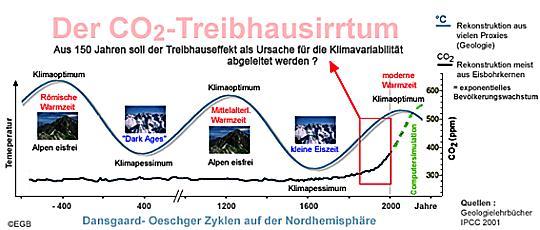
Notice how temperature goes up and down in beautifully regular cycles since 800 B.C.? At the bottom, they are labelled “Dansgaard-Oeschger cycles” – this refers to the Dansgaard-Oeschger events found in Greenland ice cores during the last Ice Age (but not during the last 10,000 years), about which there is a serious scientific discussion whether they are paced by a 1500-year cycle (see my paper in GRL). Beck’s curve shows a warm phase 400 BC and the next one 1200 AD – that’s 1600 years difference, so it just about fits. (I’m not endorsing his curve, by the way, I have no idea where it comes from - I'm just playing along with it for the sake of the argument). So the next warm phase should be in the year – oooops… 2700 or 2800? Hang on, how come it looks like the current warmth fits so nicely into the cycle? Shouldn't we be right in the coldest phase? Now I see it… two little lines across the x-axis indicate that the axis has been broken there – tick-marks after the break are in 200-year intervals and before the break in 400-year intervals, and there’s also a gap of 200 missing years there. So that’s how we make the current global warming fit past climate cycles – it’s so easy!

p.s. Beck appeared on German TV last Monday, after the "Swindle" film was shown, and he is announced to appear on the program “Report München” in the first channel of public German TV next Monday (18 June), to educate the viewers about another of his fantasy graphs, namely his CO2 curve. It promises to be a must-see for friends of the unintentionally farcical.


346 Responses to “Curve manipulation: lesson 2”

  1. Rick Says:

    This guy brings new meaning to the phrase “curve fitting”.

  2. Scaramanga Says:

    Its also funny that Beck wrote “Alpen eisfrei” (alps ice free).
    Have a look at the data: http://www.nccr-climate.unibe.ch/people/grosjean/publications/Grosjean_et_el_2007_(JQS).pdf
    Abstract: During the hot summer of 2003, reduction of an ice field in the Swiss Alps
    (Schnidejoch) uncovered spectacular archaeological hunting gear, fur, leather and woollen clothing
    and tools from four distinct windows of time: Neolithic Age (4900 to 4450 cal. yr BP), early Bronze
    Age (4100-3650 cal. yr BP), Roman Age (1st-3rd century AD), and Medieval times (8-9th century AD
    and 14-15th century AD). Transalpine routes connecting northern Italy with the northern Alps during
    these slots is consistent with late Holocene maximum glacier retreat. The age cohorts of the artefacts
    are separated which is indicative of glacier advances when the route was difficult and not used for
    transit. The preservation of Neolithic leather indicates permanent ice cover at that site from ca.
    4900 cal. yr BP until AD 2003, implying that the ice cover was smaller in 2003 than at any time during
    the last 5000 years. Current glacier retreat is unprecedented since at least that time. This is highly
    significant regarding the interpretation of the recent warming and the rapid loss of ice in the Alps.

    Beck’s appearance on German TV showed that he didn’t have a clue.

  3. Juha Haataja Says:

    Nicely spotted. Any time there is a break on one of the axes of a graph the viewer should beware.

  4. DaveK Says:

    Real Climate could do another service to society by monitoring talk radio and responding quickly to the deliberate misinformation they spread. I was recently on the Dennis Prager show(KRLA, Los Angeles) admonishing Prager to apologize to his audience for being a scientific ignoramus. (Prager was ridiculing the idea that scientists could predict changes 60 years from now when they can’t even predict tomorrow’s weather!) I told him that he doesn’t know the difference between weather and climate and told him to apologize. After my call, he labeled me another ‘hysterical left winger’, brought in the subject of heterosexual aids and how he beat the ‘predictions’ of scientists on this subject, then proceeded to name all the ’scientists’ that were skeptics( including Lindzen, Frederick Seitz, Tim Patterson, Svensmark, Willie Soon and others) along with their scientific ‘credentials’. I got to mention Gavin Schmidt and James Hansen at the beginning. He completely undermined my position of him. These types of broadcasts reach hundreds of thousands of listeners so I hurt the credibility of global warming idea in the public mind. Please pay attention to these broadcasts as they misinform millions. I will never go on talk radio again.

  5. cat black Says:

    I saw the tick-marks right away, even before I knew what the topic was, and was going “WTF is that supposed to mean?” I’ve taught some “visualization of information” classes in the past, and had much to say about such nonsense to my students then (including the “when the lower axis is implied to be, but is not actually, zero” gambit). That such things can slip past editors and become mainstream data for serious consumption points out either that media really are out to undermine this discussion, or that these editors should have taken my class while it was offered.

    What a bunch of clowns. Seems we’re in for a long and bumpy ride.

    cb

  6. Ray Ladbury Says:

    My God! That is at the very least scientific fraud, if not criminal fraud. If you are trying to demonstrate periodicity, any break in the graph invalidates the graph–unless you are excluding an interim period where the effect of interest is not extang, and then you would break the curve as well.
    One of the questions I always have when I confront a denialist argument is whether they know what they are doing is invalid. This leaves no room for doubt, just as Lindzen’s resorting to the canard about warming on other celestial bodies demonstrates his own insincerity.
    The other question I have is why this particular field of inquiry generates such vehemence that denailists feel it’s OK to resort to fraud to win the point. That seems to invalidate the thing I love most about science–the fact that even if we fail or are ultimately proven wrong, the very activity of sincerely trying to find out ennobles us. It is truly the best example of the means justifying the end, whatever that end may be.

    [Response: Indeed - I think one of the strongest indications that the science behind anthropogenic global warming is very solid by now, is the lack of quality and intellectual honesty of the counter-arguments and the lack of credibility of the skeptics personnel. The recent “Swindle” film illustrates that it is impossible to fundamentally question anthropogenic global warming without resorting to manipulated graphs, distortions and omissions of facts and debating tricks that exploit the lack of background knowledge of the lay audience. If there were still serious arguments and reputable scientists that challenge anthropogenic global warming, surely film-makers like Durkin would have found and presented them? stefan]

  7. Mike Donald Says:

    And if you want a straight line. Log-log scale and a thick marker pen!

  8. Philippe Chantreau Says:

    I’m not a scientist and do not deal with data on a regular basis. Before even reading the text, I looked at the x-axis, saw this thing and was like “what’s this”. How could something so egregious make it to any sort of publication, even not peer-reviewed?

  9. Philippe Chantreau Says:

    If there are any sincere skeptics out there, they should be up in arms against this and instructing anyone engaged in discussions to completely ban all “Beck products.”

    It will be interesting to see what actually happens. If there is no contrarian outcry, it will demonstrate that contrarians somewhat approve of data manipulation and fraud, and that their only concern is how their point of view fares in the public’s perception, not that it better reflects reality.

    I am waiting for opinions of our regular skeptic writers in this thread. What do you think of Beck?

  10. gerald spezio Says:

    Beck’s blatant doctoring of the data tragically illustrates the rampant escalation of “the age of rhetoric.” It will surely get much worse. Linguistic determinism and the social construction of reality writ small by a very small man.

  11. Arthur Smith Says:

    I recently looked through the arguments on the Medieval warm period business over at “co2science.org” - here’s the link, though I hesitate to give it any more publicity:

    http://www.co2science.org/scripts/CO2ScienceB2C/data/mwp/mwpp.jsp

    If you think scientific fraud is unusual in the “skeptic” community, the analysis there should put that thought to rest. Look at their “quantitative temperature differentials” graph, based on “level 1″ studies, and then compare with the references to the actual studies! What they’ve done is pick the highest temperature in any individual record from the entire 800-1200 period (and sometimes they extend it all the way to 600 AD or 1400 on the other end), and compare it to the most recent record of whatever proxy is involved. Sometimes that high point is in the year 800, sometimes around 1000, sometimes later. No matter, if at any point there was an indication of a higher temperature, it counts as proof of the “MWP” being warmer than today.

    If you actually averaged all of those different proxies in any give year, as the Hockey Stick analysis does, you’d see nothing. But no, they have *proof* that the MWP was warmer. Wow.

  12. Russell Seitz Says:

    Short of a Constitutional Amendment banning the use of rubber graph paper, only an improbable rise in statistical numeracy can save us from infinite replays of this sort of thing.

    I need not remind some RC syndics that _Nature_ started grumbling editorially about this bipartisan plague back in the days when the hockey stick was a pliable ash sapling, and rubbermeister Pat Michaels was still a State Climatologist.
    http://adamant.typepad.com/seitz/2007/02/the_day_after_t.html

  13. Theo H Says:

    If this graph were to appear in a UK newspaper it would fall foul of our Advertising Standards Agency … and the ASA is a trade body, not a government outfit!

  14. Dan Says:

    And yet despite the obvious scientific fraud, the silence from the skeptic/denialist/anti-science crowd here is deafening. Perhaps they can only attack something if it is peer-reviewed and can’t understand it. ;-)

  15. Lawrence Brown Says:

    Beck’s graph is pathetic. The distance on the x-axis between 400 and 1200. representing 800 years, is about the same as the distance between 1200 and 1600, representing 400 years. Because, as Stefan perceptively pointed out, he conveniently dropped several centurys. There are such things as semi logarithmic curves, but not on the same axis!It’s ridiculous but dangerous because many in the general public won’t notice this chicanery.

  16. Eli Rabett Says:

    There should be no bewilderment at these tactics. Plus which for clowns second raters like Beck and Benny, there is the chance at a bunch of fame.

  17. John Says:

    OT - IMO “smoothing” of data sets can also create problems under the ruberic of “curve manipulation”. Looking at the global CO2 dataset, current smoothing obscures a rather dramatic connection to ENSO, which I find truely bizarre. The surge in atmospheric CO2 that accompanies an ENSO warming event is obviously measured in gigatons, and this from a temperature change in a relatively small portion of the total ocean. Does this make sense? The large 1997 ENSO event apparently pumped an additional 2 ppm CO2 into the atmosphere? Which if measured in gigatons is quite a bit.

    [Response: Our recent brief Science paper shows the unsmoothed monthly CO2 data. -stefan]

  18. Alan Says:

    HaHa - (Nelson laugh)

    The politcal shoe is now on the other foot, people like this guy are destined to be remebered as something akin to the original “April fools”.

    Regarding the talk back radio comment. The only way to deal with the far-right provocateurs is to change the station and advise others to do the same.

  19. Trev Says:

    I was confused looking at that for a while, it is not the just the break that causes the issue though is it.. its the fact that the scale is changed to the right of the break, to the left one interval is 400 years, to the right one interval is 200 years.. sneaky!

  20. pete best Says:

    Ha, brilliant. However it points to a far deeper concern about science and scientists to me. What can’t the media treat science better. Its all gotta be ge whizz and hype or nothing at all. The media it would seem cannot allow anything dull and boring to fill it pages or screens. Scientific journalists and media communicators need to get their act together an get the message out better in the tabloids etc.

    I would imagine that climate scientists with the help of some politicians (AL Gore most notably) have finally got the message out to a significant portion of Europes masses. What about the USA though as its more ultra right wing and they are well organised and well funded to provide misleading information.

    Science needs a bigger voice in the media.

  21. Roger Says:

    Interesting, my 8th grade students would have 2 points deducted for the inconsistent interval, and another 2 points deducted for not showing a corresponding break in the graph plot (assuming it was unintentional). However if I felt they were intentionally altering their graph to match their hypothesis they would fail. Science doesn’t do that.

    Seems like someone wasn’t paying attention in middle school.

  22. Andrew Dodds Says:

    You can get put in prison for impersonating a policeman. Why not for impersonating a Scientist?

  23. ghost Says:

    Rather than admit that his view of the data was wrong, Beck chose to take his charts, leave the tent, and walk off into the storm. His famous parting words were “I am going out; I may be some time.” From then forward, those who fabricated data or turned in the work of others as their own were said to have “taken a Beckie.” Athletes who broke game rules or resorted to pathetic short cuts were said to “bend it like Beck.” Young girls returning from dates without their underwear and aging rock stars who lost their voices claimed that Beck took them. Beck’s writings inspired the obscure but important political philosophy that “you can’t expect to wield supreme executive power just because some watery tart threw a sword at you!” Beckludean Geometry was abandoned, reluctantly and with great handwringing, after a Mars mission based on it landed in Saskatoon instead. Eventually, the claim that the “question mark” should have been called the “Beckstion mark” was refuted after its inventorship was called into doubt. He was last seen on the premises of Not At All Naughty Chemists, Ltd., drinking Woolite and loudly disputing the existence of water.

  24. Lawrence Brown Says:

    RE 20, Pete Best says:”I would imagine that climate scientists with the help of some politicians (AL Gore most notably) have finally got the message out to a significant portion of Europes masses. What about the USA though as its more ultra right wing and they are well organised and well funded to provide misleading information.”

    It’s worse than we think. During a recent debate of candidates for the 2008 Presidential nomination, three of the debaters raised their hand when asked if they did not believe in Darwinian evolution. In an op-ed article days later, one of the prospective candidates modified his stance and said he accepted those parts of Darwin that didn’t interfere with his beliefs.(Hello?)Smorgasbord science? Take the parts you like and leave the rest? Is it possible that we could have somebody in the White House who thinks the world is 6000 years old? Will we have to recalibrate the ages of the ice core samples? Faith based science continues to rear it’s non-scientific head.

  25. Ike Solem Says:

    This is very surprising - I thought that Germany had a good reputation in the area of science education. It’s not surprising that some crackpot could come up with this curve - for example, there are ‘museums’ in the United States that portray dinosaurs living side-by-side with early humans. We all know it was much, much warmer when dinosaurs were around - so obviously, global warming is no big deal - when do we get to hear that one?

    What’s surprising is that media outlets would put such crackpots on - even in the US, where the media gives grossly undue coverage to a few contrarian scientists who are in denial about the problems involved with burning fossil fuels, it’d be hard to imagine this getting much airplay.

    On the other hand, maybe they German press is just putting this guy on just to show how ridiculous the diehard climate skeptics have become.

    As far as global warming denialist responses on this thread, you can be sure that the only responses will be efforts to take the discussion in some other direction. Take a look at the thread, ‘the weirdest millenium’ to see how this works.

  26. Koen Says:

    When I was at university, two students passed their thesis. They had a drawing showing a lot of dots, moreorless on a horizontal line, implying there was no relation between the two parameters under study.

    But the curve they fitted to the dots was a straight line at 45°, indicating a linear relationship.

    Questioned about this curve not really fitting the measurements, they told that their curve was a better fit to the expected results, and that their supervisor had instructed them to do this creative data fitting.

    Since that day, I’ve been a consistent sceptic of ‘new’ or ‘breakthrough’ discoveries, and wait until some confirmation comes in.

  27. Nick Odoni Says:

    As a further point re. Beck’s latest, even if his cycle were correct and he hadn’t fudged the x-axis scaling, it wouldn’t disprove the forecasts derived from the physically based climate models. All it would mean is that there appeared to have been been a cycle (cause unexplained, note!) during the Holocene, most of it experienced in the absence of anthropogenic forcing; it certainly wouldn’t mean that we should rely on that cycle continuing in the future, and thus saving us from Man-assisted climate change. One is reminded of Russell’s tale of the inductive Christmas turkey: relying on ‘Beck’s curve’ turns us all into inductive turkeys.

    Re. the talk radio problem, we get similar instances over here in the UK, and it’s very worrying. In particular, it seems to me that the quick-witted, clever response (well, superficially clever) is often given far more credence than a careful, deliberated argument; the former can be reduced to a soundbite, the latter can’t. The problem is multiplied by having to explain the behaviour of complex, multi-factorial systems, and their inherent uncertainties, all of which are well exemplified by our climate. I can’t suggest a solution, I’m afraid, only that we have to keep putting up the best science we can, without exaggeration or dumbing it down. It’s going to be a long, hard slog, I suspect.

  28. catman306 Says:

    For all you denialists, skeptics and dubious curve fitters, here’s the real reasons why climate change is NOT a good thing.

    Gone: Mass Extinction and the Hazards of Earth’s Vanishing Biodiversity
    http://www.motherjones.com/news/feature/2007/05/gone.html

    Incidently, National Geographic Magazine was warning of exactly this in 1991.
    Why do you supposed it has taken 15 years for this to reach Americans through the main stream media?

  29. Timothy Chase Says:

    Nick Odoni (#27) wrote:

    One is reminded of Russell’s tale of the inductive Christmas turkey: relying on ‘Beck’s curve’ turns us all into inductive turkeys.

    Never heard of the inductive turkey before. I came up with an inductive chicken - might have been in the context of the problem of universals. Good paper, borderline problems for the nominalists, anti-borderline problems for the realists - and humor that put my father-in-law in stitches!

  30. Timothy Chase Says:

    Koen () wrote:

    as at university, two students passed their thesis. They had a drawing showing a lot of dots, moreorless on a horizontal line, implying there was no relation between the two parameters under study.

    But the curve they fitted to the dots was a straight line at 45�°, indicating a linear relationship.

    Questioned about this curve not really fitting the measurements, they told that their curve was a better fit to the expected results, and that their supervisor had instructed them to do this creative data fitting.

    Since that day, I’ve been a consistent sceptic of ‘new’ or ‘breakthrough’ discoveries, and wait until some confirmation comes in.

    Good for you!

    There should always be a fair amount of confirmation before something in science is regarded as established.

    The good news is (at least from the perspective of science) that the role of carbon dioxide in climate change is very well established - at the theoretical level in terms of quantum physics, at the experimental level in terms of the study of the absorbtion and re-emission of radiation by carbon dioxide, at the numerical level (when equations get a little too complicated - but a good approximation can result from intensive computation by means of our fairly advanced computers), in terms of historical trends going back more than 500,000 years - and countless studies.

    I assume that you now fully accept the fact that carbon dioxide is currently driving climate change.

    Me too!

  31. Stephen Missal Says:

    Just a general comment…Beck’s junk is typical of what I’m debating here in the southwest (Arizona) for past couple of years. I’ve been trying to engage my local newspaper in Phoenix to write some articles related to the whole global warming issue. Their new policy is to allow only 500 words; my article was 1300. Oops. I got directed to their online guy (newest trend in papers) and have received no reply. My insistence that they actually look at data and sites like yours has fallen on basically deaf ears. The clear case for anthropogenic forcing is too complex and un-sexy for mass media. Their funding is from conservative camps anyway. They continue to quote people from contrarian camps and junk from folks at such places as the Cato Institute, funded from the right and, as an example, a denier of second-hand smoke health issues. Great source for scientific debate. Sigh. With the general public utterly scientifically ignorant, and fed daily the nonsense of these folks, I’m not optimistic that the US can move quickly enough once the effects of warming and other environmental catastrophes begin to shrink their wallets. I hope I’m wrong.

  32. Ike Solem Says:

    I think the real problem here isn’t the crackpot nonsense, but rather the press coverage of climate issues.

    As another example, the AP ran this headline today: Doubt Over Climate Change Forecasts

    Just looking at the headline, it gives the impression that the is scientific doubt over whether ‘climate change’ (notice: not ‘global warming’) is happening. However, the entire article is about the thermohaline circulation in the Atlantic. It has been fairly well understood for quite some time that reduced deep water formation in the North Atlantic (due to freshening surface waters) will not plunge Europe into a new Ice Age. The Gulf Stream is a western boundary current that arises due to basic physical processes involving the coriolis force and the North Atlantic Gyre; a similar current exist in the Pacific Basin.

    Furthermore, even if the net meridional overturning circulation, which is broader than just the Gulf Stream, slows, that doesn’t mean that the poleward heat transport will be reduced, as a warmer wetter atmosphere can also transport a great deal of heat (latent heat) to poleward regions, which seems to be what has been happening.

    So why did the AP run the headline, “Doubt Over Climate Change Forecasts”? Why not run the headline, “Scientists Say a Warming Arctic is Unlikely to Lead to a Cooler Europe?” Wouldn’t that be a more accurate description of the article in question?

  33. Timothy Chase Says:

    I (#29) wrote:

    Good paper, borderline problems for the nominalists, anti-borderline problems for the realists…

    Strike that!

    borderline problems for the nominalists, anti-borderline problems for the realists…

    Reverse it.

    anti-borderline problems for the nominalists, borderline problems for the realists…

  34. Richard Ordway Says:

    By sheer *definition* (Read Merriam-Webster and Wikipedia’s definition for “scientist”) skeptics such as Lindzen, Pilke, Singer et. al are *not* GW scientists but are simple frauds…Don’t believe me, believe the defintions.

    ie. they *don’t* do the scientific method (submitting evidence in an open way for the whole world to debate for veracity and let it be tested..and then ignore results if they are tested)on GW ie.:

    Merrian Webster:

    Scientist:

    “a scientific investigator”

    Science:
    “exhibiting the methods or principles of science”

    Science:
    “knowledge or a system of knowledge covering general truths or the operation of general laws especially as obtained and tested through scientific method”

    http://www.webster.com/dictionary/science

    Wikipedia:

    “A scientist is an expert in at least one area of science who uses the scientific method to do research.”

    http://en.wikipedia.org/wiki/Scientist

    Scientific Method:

    “a thorough peer review of the experimental results as well as conclusions of a study”

    “Often scientists have a preference for one outcome over another, and scientists are conscientious that it is important that this preference does not bias their interpretation. A strict following of the scientific method attempts to minimize the influence of a scientist’s bias on the outcome of an experiment.”

    Well, that concludes it for Lindzen, Singer and most skeptics. They don’t do peer review and let their results be tested or just ignore the results if they are tested.

    “The scientific method seeks to explain the complexities of nature in a replicable way, and to use these explanations to make useful predictions.

    “It provides an objective process to find solutions to problems in a number of scientific and technological fields. Often scientists have a preference for one outcome over another, and scientists are conscientious that it is important that this preference does not bias their interpretation. A strict following of the scientific method attempts to minimize the influence of a scientist’s bias on the outcome of an experiment. This can be achieved by correct experimental design, and a thorough peer review of the experimental results as well as conclusions of a study.”

    Merriam-Webster:

    “Principles and procedures…systematic pursuit”

    “principles and procedures for the systematic pursuit of knowledge involving the recognition and formulation of a problem, the collection of data through observation and experiment, and the formulation and testing of hypotheses.”

    http://www.m-w.com/dictionary/scientific+method

  35. Matthias Says:

    Who cares?

  36. John Mashey Says:

    re: #32 I & #31

    I used to spend a fair amount of time with the press, so:

    a) Reporters and editors range from awful to excellent, and oddly enough, most are closer to average. The Gaussian distribution strikes again.

    b) “Never ascribe to malice, that which can be explained by incompetence.”
    - Napoleon, supposedly, although I’ve not verified that.

    This is usually true, although occasionally someone is out to cherry-pick; I did an interview for Business Week where it turned out the writer was 100% dedicated to doing a hatchet job, and one for WSJ where I think somebody was hoping to dig up dirt, but failed. But, more problems come from incompetence.

    c) They have frequent deadlines, sometimes every day.

    d) It is unrealistic to expect a reporter to also be an expert in a complex technical domain, and it’s even harder for an editor. It’s even worse when they move people around: I once did an interview with a reporter who’d just taken over the technology column, … having mostly written for the food section.

    d) Some things don’t work in the obvious way. In particular, quite often the writer of the article does *NOT* pick the headline:

    I once did an interview for the WSJ, with a *terrific* writer, but the article’s unfortunate headline cost my company 15% of its stock value in an hour or two, which was not viewed with favor by my CEO & CFO. Fortunately, it was temporary, and in talking withe the reporter, he told me that *he* ahdn’t pikcedthat headline.

    If all that seems too bizarre to be true, here’s the story, including the WSJ article:
    http://yarchive.net/comp/mips_stock_glitch.html

    All of this happened because I’d written a report that used real data to analyze computer performance and get better metrics to replace marketing fantasies…

    ADVICE:
    Try to find a few good reporters and editors to cultivate, remembering a), be patient and help the ones willing to learn. If you can find one who’s really good, and gets well-educated, they can be priceless, because if they get to trust you, they call you up to check out stories *beforehand*.

    Persistence helps: the San Jose Mercury News once gave a big Op-Ed section to serious denialist ranting, as well as often printing similar Letters to Editor.
    [”Sea-level isn’t going up: see Stockholm!” … by an oceanic meteorologist].

    I stirred up friends of the editor, wrote letters [indeed, it’s hard to do sound-bites) and pointed out that there were world-class scientists handy like Stephen Schneider at Stanford,and might well write much better Op-Eds. I doubt I was the only one to point this out, but in any case, they ran a nice Op-ED by Stephen a few weeks later. The frequency of rant letters printed went down. Their reporting on climate issues is now pretty good, with good reporters being given time to do more in-depth articles that run several pages for several days.

    Of course, Silicon Valley is one of the easier places on the planet for this, so I sympathize with the writer from Arizona, where it may not be so easy.

    On the other hand: Stephen: you at least have a Senator (McCain) whose AGW views are clear enough to outrage Patrick Michaels, and AZ certainly is one of the states that will suffer seriously from AGW, so maybe there is some way for you to leverage McCain’s influence in AZ.

  37. Theo H Says:

    Re 32.

    The Doubt Over Climate Change Forecasts link sends me to my own newspaper, the UK�s Guardian. The Guardian is the newspaper of choice of the liberal left in the UK and my own chosen national daily. It is also the newspaper that weekly caries the op-ed/opinion column of George Monbiot (scourge of the climate sceptics/sceptics, and �constant guest� in RC�s pages). I will take a chance, and guess that the Guardian is the chosen newspaper of UK scientists.

    The Guardian generally accepts that global warming/climate change is a reality.

    I did a quick check on the Guardian�s own internal search engine. �Climate change� scored 6637 references, while �global warming� scored 5106 references.

    Might be interesting to have the comment of UK readers of the Guardian on this?

    Alternatively, why not have a go at e-mailing to John Vidal, the Guardian�s environmental editor jvidal@guardian.co.uk (that�s from memory) so; perhaps alert him to this somewhat dodgy graph. It�s just the sort of thing that might be suitable for the �Eco-soundings� shorts item on his Wednesday two page environment slot.

    Or try George Monbiot www.monbiot.com with the dodgy graph.

  38. Luna loves pictures Says:

    This picture you mentioned is qute simplified.
    I think the amount of heat and the amount of light have to be considered as a unified variable and not separeted like the graphic did.

    Thank you for sharing this story with me !

  39. ray ladbury Says:

    Re 36. John BTW, the quote per Wikiquote is due to Napoleon:
    “Never ascribe to malice that which is adequately explained by stupidity.”
    although it is also known as Hanlon’s Razor. And good advice it is. I used to be of the press of sorts–editor at a quasi-popularized physics trade publication, so I know the frustration from both sides. Every month I would have to immerse myself in a topic and learn it well enough to discuss it with Nobel Laureates without appearing to be a complete idiot. Awesome training. I cannot imagine doing it on a weekly, let alone a daily basis and not having a background in the subject to start with. On the other hand, I had a long talk with William Broad one time about science journalism. Broad did not think his lack of science background was a hindrance as a science journalist, since ultimately he had to make his piece understandable to his readers. The thing is that people are lazy–or maybe just busy–and they have limited patience with a piece they have to work at understanding. So, a journalist tries various tricks to make the piece interesting–highlighting conflict (the old science as sporting event ploy), manufacturing a narative (the old pretence of human interest in th sciences), or they oversell the importance or novelty of the research (aka the “read my piece or die” ploy). All of these do violence to the science, but it’s hard to present science to the general public if you don’t “dumb it down”. Even writing for physicists, we had readers who complained about very well written articles: “If I’m going to work that hard, I want to get paid for it.” Scientists need to keep in mind that while this is a complicated issue, it ultimately boils down to conservation of energy: The energy of the system is changing. The energy has to come from somewhere, and the only reasonable candidate is anthropogenic greenhouse gas forcing.

  40. Steve Reynolds Says:

    9>If there are any sincere skeptics out there, they should be up in arms against this …

    While not exactly an AGW skeptic, I am sometimes considered one here, and I think I am sincere.

    I certainly condemn this kind of manipulation.

    That said, and not in any way excusing Beck, are you sure that some of the graphics in Gore’s AIT are not nearly as bad?

  41. tinna Says:

    I wish I could understand German, not to read the article but to read the comments. I can see the article got quite a bit of reaction (343 comments so far) but what are the people saying, do they agree or are they furious?

  42. ray ladbury Says:

    Re 40. Steve, do you have a specific allegation against some of Gore’s figures, or is this just another excuse for an ad hominem attack? To my knowledge, most of Gore’s figures were reviewed by actual climate scientists-and like it or not, Gore is at least sincere. Beck is a fraud, or are the standards in the “skeptic” community that low?

  43. Aaron Lewis Says:

    Re 40
    Is this a troll or science?

    Which of Gore’s graphics do you have a problem with; and what problem do you have with it?

    My view is that most of Gore’s graphics are not perfect. I feel that they understate the extent and immediacy of global warming issues. That is based on that fact that the global warming climate models ignor a large number of known climate warming issues. For example there are changes in albedo of ice when soot is deposited. However, there are also changes in the albedo of snow due to growth of biological communities based on algae when nutrients are deposited on snow.

    Any biologists working on the snow models?

  44. Dick Veldkamp Says:

    Re #41 (343 comments on Beck’s article)

    After a quick scan through the 343 reactions on this article, I would say that about half of the contributions “agree” with Beck’s nonsense (for many contributions it is not that easy to say what side they are on, because the discussion quickly wanders off to wind power, China’s energy policy, etc)

    I don’t know whether we should draw any deep conclusions from this tally. Firstly it’s a general forum so some people probably can’t see this bunk for what it is. Secondly there’s a few contrarians who post many, many times. Thirdly there is bias: it’s mostly denialists that keep posting, most people that are convinced that climate change is a real problem presumably don’t bother writing.

  45. Barton Paul Levenson Says:

    [[This is very surprising - I thought that Germany had a good reputation in the area of science education.]]

    Oh no, Germany, alongside its respectable intellectual tradition, also has a long pseudoscience tradition. Horlegger’s “World Ice Theory” was a classic of crackpot science, and of course Nazi racial anthropology was a factor in millions of state murders.

  46. Barton Paul Levenson Says:

    [[Well, that concludes it for Lindzen, Singer and most skeptics. They don’t do peer review and let their results be tested or just ignore the results if they are tested.]]

    While I agree in general, there was a time when Lindzen published his research — even anti-global-warming research — in peer-reviewed journals, e.g. his “iris” article. Of course later research shot that one down, so that may explain why he doesn’t bother with peer review these days.

  47. Vivendi Says:

    “I’m just playing along with it for the sake of the argument”
    Do you mean “irresponsibly playful” = mischievous behavior?

    “Notice how temperature goes up and down in beautifully regular cycles since 800 B.C.?”
    Is it really the first time that you look at a graphical representation meant to symbolize a concept: the concept of cyclic recurrence of a phenomenon.
    Nowhere in this graphic do I see suggested that there is a fixed periodicity (the 2 slashes in the time scale clearly indicate a cut) nor does the graphic suggest that it shows real temperatures, in fact there is no scale on the y-axis.

    I haven’t read your entire blog, but I bet I wouldn’t find an article which denounces the fact that Al Gore forgot to mention and adequately explain the time lag between temperature and CO2 concentration. He simply used his technique to dramatize increases.

  48. ray ladbury Says:

    Vivendi, No, you didn’t read the blog. Nor did you do a search, which would have turned up:
    http://www.realclimate.org/index.php/archives/2007/04/the-lag-between-temp-and-co2/
    which would have explained that in fact, contrary to the propaganda from your neocon mothership, Gore does in fact mention the lag and correctly attributes the reason to the fact that initial warming in past epochs was most often to slight changes in insolation.
    Gee, maybe you should read more of this blog.

  49. Blair Dowden Says:

    I bet you would find an article on exactly that subject. The title says Gore got it right, but the text shows that he blew an opportunity to accurately demonstrate the importance of carbon dioxide on climate.

  50. Jim Eager Says:

    Re 47 Vivendi: “I haven’t read your entire blog…”

    Perhaps you should, you just might learn something about the actual science of greenhouse gasses and climate change.

  51. SinkingFeeling Says:

    Re #25 :

    Solem wrote [i]”As far as global warming denialist responses on this thread, you can be sure that the only responses will be efforts to take the discussion in some other direction. Take a look at the thread, ‘the weirdest millenium’ to see how this works. “[/i]

    Steve Reynolds in #24 does condemn the manipulation, then leaps straight to Al Gore, insinuating he’s equally guilty of manipulation (no reasons given, of course).

    Vivendi in #47 waffles a bit, then leaps to - [i]quelle suprise[/i] - Al Gore.

    Perhaps we need an equivalent to Godwin’s Law - first to mention Al Gore loses the climate debate.

  52. Timothy Chase Says:

    SinkingFeeling (#51) wrote:

    [edit for html]

    Perhaps we need an equivalent to Godwin’s Law - first to mention Al Gore loses the climate debate.

    Hey!

    As someone who strongly believes in the free market, I voted for Gore. And I really warmed up to him since then. Maybe I would like to mention him.

  53. Jamie Cate Says:

    It’s not directly related to “curve fitting” per se, but I’ve noticed that when one does a Google news search on a particular topic (i.e. Greenland ice), prominent contrarian articles come up very near the top of the list. Here’s an example from Patrick Michaels:
    http://www.cato.org/pub_display.php?pub_id=8285

    Any thoughts on this particular article? Are his facts correct?

  54. SomeBeans Says:

    #53 Jamie Cate

    He appears to be setting up a strawman and then knocking it down, AR4 says on p818:

    Abrupt climate changes, such as the collapse of the West Antarctic Ice Sheet, the rapid loss of the Greenland Ice Sheet or large-scale changes of ocean circulation systems, are not considered likely to occur in the 21st century, based on currently available model results. However, the occurrence of such changes becomes increasingly more likely as the perturbation of the climate system progresses.

    You can often find copies of original peer reviewed research papers using Google Scholar, so you can find the review he cites by Glen MacDonald here. You can also find a recent paper on the Greenland instrumental temperature record here

  55. Hank Roberts Says:

    >Google searches.
    Look at how often website links appear on other websites; Google page rank uses that and rates them higher the more links there are. This works perhaps better for the anti-science websites; they get mentioned more often — online as on AM rant radio.

  56. Zeno Says:

    Herewith my small contribution to the art of screwing up a graph: One picture is worth a thousand lies.

  57. Hank Roberts Says:

    >53, 54
    Note Ray Bradley is thanked as one of the reviewers of the MacDonald article.
    Seems to me — Ray will I hope correct me if I”m wrong — that what MacDonald is describing may be well known; temperatures peaked at the end of the last glaciation and began a long slow decline, typical pattern. The last couple of centuries is the anomaly from fossil fuels. Sea level has changed quite a bit since 10k years ago. I don’t know enough about the microfossil studies to comment on how fast treeline would be moving north with contemporary very fast warming.

  58. Timothy Chase Says:

    Hank Roberts (#55) wrote:

    Look at how often website links appear on other websites; Google page rank uses that and rates them higher the more links there are. This works perhaps better for the anti-science websites; they get mentioned more often — online as on AM rant radio.

    Well, it also helps that the people who link to those websites have fairly intense emotions - that are expressions of equations of the form:

    evolution = naturalism = materialism = atheism = evil

    liberalism = socialism = communism = atheism

    science = politics = war

    They link to one-another and form webs of connections between sites belonging to like-minded people. These sites contain the same superficial material, words that resonate with their core emotions. Linking is an expression of their commitment to their cause, of their solidarity, and proof of their own moral idealism that stands against all that is wrong with the world at large.

  59. Timothy Chase Says:

    PS to #58

    I forgot the most fundamental equation of all, that which lies at the base of every other one:

    us = not them

    Come to think of it, this might explain another equation of some relevance in this “debate”:

    patriotism = not internationalism

    … the last of which would explain the disregard for international law and the hatred for the UN.

  60. catman306 Says:

    patriotism = not internationalism

    … the last of which would explain the disregard for international law and the hatred for the UN.

    Comment by Timothy Chase

    Here’s a scenario:
    After the Greenland and Antarctic ice sheets slide into the sea and sea level rises, worldwide shipping will become expensive if not impossible. The global economy that we enjoy is totally dependent on cheap transportation to maintain the affordability of so many products. Regional and local economies will develop out of need and thrive. Larger countries will split into smaller countries based on regional interests and geography. The global economy will dissolve. It can only be hoped that it will be in the interest of all of the small regional countries to work together to curb fossil fuel use and help provide some stability to the world wide climate.

  61. Russell Seitz Says:

    Re 43
    If Aaron Lewis’ “view is that most of Gore’s graphics are not perfect. I feel that they understate the extent and immediacy of global warming issues.”

    he really ought to take a look at tThe Earth In The Balance — all the 29th century editions feature a rate of species extinction graph ending in the Mother Of All Hockey Stick blades, ramping vertical to infinity in the year 2000.

    It has been wisely excised from the newer and more elegant campaign 2008 edition lest the tender minded think it an assault on reason.

  62. dhogaza Says:

    he really ought to take a look at The Earth In The Balance — all the 29th century editions feature a rate of species extinction graph ending in the Mother Of All Hockey Stick blades, ramping vertical to infinity in the year 2000.

    1. Publishers hire graphic artists to make illustrations. Errors are not uncommon.

    2. We are in the midst of one of the largest species extinction events in the history of the planet.

    3. Just out: “nationwide, populations of 20 common birds fell at least by half during the past four decades, according to National Audubon Society figures released Thursday.” Not birds with narrow habitat needs like the northern spotted owl, but common, yard birds. Meadowlarsk have largely disappeared from the midwest. Pintails down over 50%. In Oregon, rufous humming bird down 79% in 40 years. 79% since I was a kid, in other words.

    Something tells me people like Mr. Seitz don’t get out much.

    4. How the heck did you get your hands on a pre-release of the 29th century edition of Gore’s book?

  63. Zeno Says:

    #61: he really ought to take a look at tThe Earth In The Balance — all the 29th century editions feature a rate of species extinction graph ending in the Mother Of All Hockey Stick blades

    It’s doubtful I’ll be around to see any 29th century editions, but I’ll do my best to hang in there.

  64. Hank Roberts Says:

    You’re repeating yourself, Dr. S.:
    http://www.google.com/search?q=%2Brealclimate+%2Bseitz+%2Bextinction+%2B2000

  65. Eli Rabett Says:

    Russell, I know it was a mis-print, but I really would like one of those 29th century editions! It gives one hope for the future:)

  66. Alexi Tekhasski Says:

    I’m sorry, I must miss where the Beck’s article mentions a “1500-year cycle”? It seems that he has matched the recent temperature pattern to a 1000-year cycle, and makes a guess that today we might be in another “Klimaoptimum”. How his speculation about 1000-year pattern is any worse than other equally groundless eyball pattern matching to a 1500-year “pacemaker” using artificially-selected events?

    [Response: He refers to “Dansgaard-Oeschger cycles” below the x-axis of his graph, which have a 1500-year periodicity. I assume he has this idea from the crackpot book “Unstoppable global warming every 1500 years”, which also tries to somehow squeeze the ongoing warming into a 1500-year cycle. -stefan]

  67. Barton Paul Levenson Says:

    [[patriotism = not internationalism
    … the last of which would explain the disregard for international law and the hatred for the UN.
    ]]

    I hated the UN long before it was fashionable. I was depressed by its absolute failure to suppress genocide anywhere, with the slight exception of SFOR in Bosnia, and by its embrace of anti-semitism and tricks like M’Bau of Unicef posting over US aid packages with stickers saying the food had come from the Soviet Union.

  68. Timothy Chase Says:

    dhogaza (#62) wrote:

    3. Just out: “nationwide, populations of 20 common birds fell at least by half during the past four decades, according to National Audubon Society figures released Thursday.” Not birds with narrow habitat needs like the northern spotted owl, but common, yard birds. Meadowlarsk have largely disappeared from the midwest. Pintails down over 50%. In Oregon, rufous humming bird down 79% in 40 years. 79% since I was a kid, in other words.

    Cherry picking.

    You are looking at what happens to birds (or agriculture as the result of drought and heat stress on other occasions), but you have neglected to point out that warmer temperatures are likely to be a net benefit for many species of insects - which will be doing quite well in the years to come. You will no doubt point dropping fish harvests, but then neglect to mention that jellyfish populations are exploding. We all too easily look upon climate change as a bad thing, but the higher sea temperatures and higher coastal salinity due to reduced river output is proving to be a near paradise for the Portuguese Man of War. It would do you well to take a more balanced view of things being out of balance.

  69. Timothy Chase Says:

    Barton Paul Levenson #67 wrote:

    I hated the UN long before it was fashionable. I was depressed by its absolute failure to suppress genocide anywhere, with the slight exception of SFOR in Bosnia, and by its embrace of anti-semitism and tricks like M’Bau of Unicef posting over US aid packages with stickers saying the food had come from the Soviet Union.

    The UN has a great many problems with it and is certainly far from perfect.

    In fact, I really haven’t any idea what “perfect” would mean in such a context. It has a fair amount of corruption, any member of the Security Council can veto an action voted for by the others, some offices were in the grips of a strong anti-Western setiment, its peace-keeping activities are often total failures, its policies have often been infected by anti-semitism and a kind of reverse racism which viewed ethnic clensing of Africans by Africans as tolerable but interference by non-Africans as intolerable, and I could surely go on. At best, its successes are generally mixed. But personally I think that these are reasons for reform, not the disbandment that many on the far right might find preferable.

    In any case, setting that all aside for the moment, there are a fair number of people for whom the endorsement of a given position by the UN, its offices or any of its sponsored organizations is more than enough for them to whole-heartedly embrace the opposite position - and they will argue in just such a manner. I would hold that this sort of a position and manner of arguing is invalid as I am sure you would as well. Neither of us view the IPCC as especially tainted by its association with the UN.

    Beyond this, I personally believe the UN serves a purpose, that it should continue to exist, and that it can and should be carefully reformed where needed. However, I don’t see this as a point upon which we need to agree. What is essential in my view is the problem of addressing climate change and of achieving the level of international cooperation that is required to address it effectively. Beyond this, I personally wish that the next US Administration will take less glee in such things as the prospect of shredding sixty years of international law.

  70. Ike Solem Says:

    One of the main themes that is promoted by “swindle” and people like Beck is that there was a Medieval Warm Period during which temperatures were warmer than they are today, and that therefore today’s global warming is due to “natural causes”. The main support for this is the paper that was printed by Climate Research, “Proxy climatic and environmental changes of the past 1000 years, by Sallie Baliunas and Willie Soon”. Six of the journal’s editors resigned over the publication of this paper.

    The abstract of that paper claimed that “Across the world, many records reveal that the 20th century is probably not the warmest nor a uniquely extreme climatic period of the last millennium.”

    The argument is just nonsense, and doesn’t deserve much rebuttal - just notice that tropical glaciers didn’t disappear during any Holocene ‘warm period’, for example.

    The summary of the 4th IPCC report on this issue (Chapter Six) is that

    “The evidence currently available indicates that NH mean temperatures during medieval times (950-1100) were indeed warm in a 2-kyr context and even warmer in relation to the less sparse but still limited evidence of widespread average cool conditions in the 17th century (Osborn and Briffa, 2006). However, the evidence is not sufficient to support a conclusion that hemispheric mean temperatures were as warm, or the extent of warm regions as expansive, as those in the 20th century as a whole, during any period in medieval times (Jones et al., 2001; Bradley et al., 2003a,b; Osborn and Briffa, 2006).”

    Once again, climate contrarians ignore any scientific evidence that disagrees with their views.

    The press is really doing a poor job on this - for example, the latest AP report is titled: “Could Some Win With Global Warming? Michael Hill, AP writer” The article contains a wide variety of claims that are almost as ridiculous as the ones mentioned in this post - but this is the Associated Press, supposedly one of the top news organizations on the planet! Not a good sign.

    The lead-off is, “It’s not in Al Gore’s Powerpoint presentation, but there are some upsides to global warming.” This is followed up by highly speculative and unsubstantiated claims that ‘the sweet spots for agriculture will move northwards’. There is very little discussion of the effect of climatic instability and heat waves on agriculture, and no mention of the fact that global warming has already decreased agricultural production in many areas.

    As mountain glaciers melt, many areas that relied on glaciers for their water supplies will be faced with unprecedented droughts. It seems that the subtropical dry zones in continental interiors will expand towards the poles as well. The AP news article also boldy states that ‘change will be gradual’ which is also very questionable. It’s more likely that warming will lead to more and more climate instability - look at the rapid pace of change in the Arctic as an example.

    The fossil fuel industry seems to be moving on to their last public relations stand: “Yes, human beings are causing global warming by burning fossil fuels - but that will be a good thing!”.

  71. Aaron Lewis Says:

    My point is that global warming is likely to damage our infrastructure. If you use electricity, or public water, or distilled petroleum products (including plastics and natural gas), or commercially produced foods, then global warming is likely to diminish the quality of your life.

    If you grow all of your own food without using chemicals (or smelted metals) and have a reliable source of water that does not depend on the weather, then global warming is not likely to affect your life style.

    Global warming may be great for cockroaches and Portuguese Man of War, but it is not going to be good for my lifestyle, and that is what counts to me.

    Anyone that talks about increased agricultural production in the north because of global warming has not seriously studied the capital requirements of the agricultural industry. A key element is that agriculture is very dependent on being able to predict next year�s weather. In a changing climate, that becomes much more difficult. Thus, agriculture is becomming a much higher risk activity and will demand much higher returns on investment. That will mean much higher prices on all agricultural products. Civilizations do not function well in times of high priced agricultural commodities.

  72. Jim Eager Says:

    When I talk to those who assert that global warming will be a good thing I like to refer to this [url=http://blog.sciam.com/index.php?title=thanks_to_climate_change_by_2050_america&more=1&c=1&tb=1&pb=1]map[/url] showing the potential northward shift of the climate zones suitable for growing wheat:

    First, notice that the blue hatched area is quite a bit less than half the size of the yellow hatched area.
    Then consider that most of the eastern third of the blue hatched area is Canadian Shield, some of the oldest exposed bedrock on Earth, while the western quarter or so is the Canadian Rockies. Now, try to feed North America from what can be produced on what’s left, let alone continue to export wheat.

  73. Timothy Chase Says:

    Aaron Lewis (#71) wrote:

    Global warming may be great for cockroaches and Portuguese Man of War, but it is not going to be good for my lifestyle, and that is what counts to me.

    Well, lets see, climate change will be bad for crops due to increased heat stress and drought, particularly since domesticated crops tend to be rather pampered, adapted to our needs rather than the variabilities of nature. But weeds should do fairly well.

    Climate change won’t be that good for birds, mammals or amphibians - and will probably happen too quickly for most of these larger animals to adapt or migrate to keep up with the climate they find most hospitable. But the heat should actually work to the advantage of many insects. Locusts should do quite well, I imagine, and I am sure they will enjoy whatever crops might be left.

    The increased acidity of the oceans is already proving to be quite a problem through the food web for fish, reducing fish harvests. Likewise, as the more polar regions are the places which are warming up the quickest, this diminishes the ability of the oceans to absorb oxygen - which won’t help the fish all that much and may result in hypoxic or anoxic conditions, but the last of these may benefit anaerobic bacteria.

    Then again, the jellyfish are doing better with the heat and salinity where the rivers along coastlines are beginning to dry up, and they don’t have quite as much trouble as fish with hypoxia - depending upon how bad it gets. Their novelty comes from their being exotic and not terribly common, but as they become commonplace, that will no doubt wear off. Unlike fish, they aren’t much good to eat, so about the only thing left at that point is a rather nasty sting.

    No, I suppose there isn’t much of a plus side, is there?

  74. Timothy Chase Says:

    Jim Eager (#72) wrote:

    When I talk to those who assert that global warming will be a good thing I like to refer to this map showing the potential northward shift of the climate zones suitable for growing wheat:

    First, notice that the blue hatched area is quite a bit less than half the size of the yellow hatched area.

    I had wondered about it given the maps that I had seen for 2100, and it would appear that we are talking about the very real possibility of having two permanent dust bowels: one in the south west and another in the south east. This did get underplayed a bit, though - after the representatives of various governments took the report from the scientists and edited it for general consumption. No real reason to upset those who might otherwise vote for you, I suppose.

  75. Jim Eager Says:

    Sorry, the html for the url of the map did not take. Here it is as a stand-alone:
    http://blog.sciam.com/index.php?title=thanks_to_climate_change_by_2050_america&more=1&c=1&tb=1&pb=1

  76. Steve Reynolds Says:

    Re 42 ray ladbury> Steve, do you have a specific allegation against some of Gore’s figures, or is this just another excuse for an ad hominem attack?

    I did post a (reasonable IMO) reply with a specific allegation, but it seems to have been censored.

    [Response: Try again without the ad homs. -gavin]

  77. ray ladbury Says:

    Steve, when the evidence is all on your side, you don’t have to manipulate the curves. You don’t have to like Gore, but by rejecting sound science, conservatives are giving him one helluva political platform.

  78. Lawrence Brown Says:

    Re 76 Steve’s attempt to reply. It might help to define terms. An ad hominem attack, as I understand it, goes like this: Someone states a proposition, another individual attacks the person who makes the initial proposition, ergo that proposition is false.
    As far as Becks curve is concerned it doesn’t look like any temperature curve I’ve ever seen. It’s too smooth even at this time scale.It looks like a sine wave or the propagation of an electromagnetic or sound wave,maybe damped down a little in amplitude as it moves toward the present. It’s reminiscent of what the physicist Wolfgang Pauli, a Nobel winner, said about a physics paper- “This isn’t even wrong.”

  79. Steve Reynolds Says:

    Re 42 ray ladbury> …Gore is at least sincere. Beck is a fraud…

    76> I did post a (reasonable IMO) reply with a specific allegation, but it seems to have been censored.

    [Response: Try again without the ad homs. -gavin]

    Gavin, how can anyone respond to Ray’s ’statement’ about Gore’s sincerity without providing (factual) evidence about said sincerity?

    Why did you not censor Ray’s ad hom against Beck?

    I do understand that moderating is not easy and appreciate your efforts.

    [Response: Just stick to the facts. Which graph and why? and don’t get into motivations/ethics etc. There are plenty of places on the web for that sort of thing. -gavin]

  80. Aaron Lewis Says:

    Re 75
    That whole map showing a new area for growing wheat is silly. Wheat wants soils typical of the tall grass plains. Much of the area shown on the map as the new wheat growing zone has wet, acid soils. Nobody is ever going to grow wheat in such soil; maybe amaranth, possibly corn, but not wheat.

    What will happen is that as the plains warm, and wheat production becomes difficult, is that agriculture in will switch to crops such as sorghum that will tolerate more warmth and drought. If you want a first taste of global warming, go down to your health food store, buy some sorghum and cook it up for dinner.

    It is very nutritious. I ate a lot of it when I was a runner. It was what some of the guys from Kenya ate, and they were winning, so I ate it. Let me put it this way; we were always so hungry that we did not really notice what we were eating.

  81. George Roman Says:

    Beck’s materials are used by Tim Ball (a well-known Canadian skeptic who frequently publishes myths in the media). Ball used one of Beck’s graphs for a published article in ‘Country Guide’-a magazine distrubuted mostly in rural Canada. The graph he used wasn’t as bad as the one here but was misleading nonetheless. Interestingly, Ball didn’t even reference Beck in the article to give him credit for the figure!!

  82. ray ladbury Says:

    Re 78: Recent history is replete with attempts to sway public opinion by repeating a lie until it is believed generally by the public. Geobels is the most famous practitioner of this strategy, with his dictum, “If I tell a lie 100 times, it becomes the truth.” Perhaps we could call this the ad nauseum attack.

  83. Paul Says:

    Re 74. So a dust bowl in the SE of the USA, presumably this is while there is also increased Atlantic hurricane activity, which is so often prophesised?

  84. Ray Ladbury Says:

    Re 83. Paul, your ignorance is showing. There is a big difference between a steady rainfall and having all the rain come in impuslive events like hurricanes. The former is conducive to agriculture, the latter to erosion–both by water during the hurricane and wind in the dry periods when there is no precipitation.

  85. Timothy Chase Says:

    Paul (#83) wrote:

    Re 74. So a dust bowl in the SE of the USA, presumably this is while there is also increased Atlantic hurricane activity, which is so often prophesised?

    Thats what the maps are showing. Remember: the temperatures in the northern hemisphere will be rising more quickly than the southern hemisphere and more quickly the farther you get away from the tropics. Likewise, the temperatures will be rising over land more quickly than over the ocean. This means that what rain falls over land will evaporate more quickly. The soil will tend to be dryer. Both heat and drought (when it happens, which will be more often in later decades) will be more severe. And hurricanes are an intermittent phenomena. Currently we aren’t really seeing more hurricanes, only more severe hurricanes - when they happen.

    Increased temperatures increase evaporation both over land and over sea.

    This will result in storms being more intense - but the rain will tend to fall prematurely - more quickly where the most water is evaporated - which is over sea. This is why we are expecting the Amazon river basin to dry out - and giving it a 10-40% chance of turning to desert. But over land? Well, even deserts have intense downfalls - on occasion. Flash floods. But don’t expect the water to just stay in the soil.

    In any case, this is just what I am picking up - from the projections. I want to know how things fit together. At a purely intellectual level it is fascinating, particularly with how all the feedbacks feed into each other. But the implications for the people who will have to live in that world aren’t pretty.

  86. Bob Schmitz Says:

    From the Financial Times: a piece from the Czech president, who doubts Global warming, quoting Crighton, Lindzen et al.

    http://www.ft.com/klaus

    Nothing new, but it is sad that young democracies can be so blinded by the ‘American model’. Same thing for the missile defense program which only puts Europe at risk, which some of these leaders are so eager to embrace.

  87. Jim Eager Says:

    Re 80 Aaron Lewis: “That whole map showing a new area for growing wheat is silly.”

    Of course it is, and for multiple reasons, including the ones you and I outlined. The map just shows the potential climate zone change and does not take into account soil type (or even if there is soil), topography, and moisture availability, yet many people simply take it, and other similar maps and assertions, at face value. One person once responded to my argument by pointing out how deep the soil is in permafrost and muskeg areas, and I replied by asking if they were thus proposing to grow wheat vertically. For some people it is shockingly easy to totally suspend rational thought.

  88. Rod B Says:

    re 69, Timothy says, “Beyond this, I personally wish that the next US Administration will take less glee in such things as the prospect of shredding sixty years of international law.”

    Huh?? Is this based on some objective analysis or just blindly out of the anti-Bush playbook?

    btw, IMHO your UN analysis is great. Also, while the purists would say that groups like the UN-sanctioned IPCC is a poor way to assess science, among other things because it’s fraught with built-in political biases, I think under the circumstances it 1)did a credible job, not void of the biases and prejudices, but pretty much kept them in check, and 2) there was no other way to do it.

  89. Timothy Chase Says:

    Jim Eager (#87) wrote:

    The map just shows the potential climate zone change and does not take into account soil type (or even if there is soil), topography, and moisture availability, yet many people simply take it, and other similar maps and assertions, at face value.

    I didn’t know the specifics regarding why the soil won’t work for wheat, but I had essentially raised this point on the “Cockburn’s form” among others regarding how crops are already adapted to specific soils which exist in specific climates - and you can’t just pick up the soil and move it as appropriate climate moves northward when one skeptic/optimist suggested climate change would be beneficial. What many don’t realize is that there is a negative feedback which has maintained the climate which has existed, something which life has adapted to, counted on and to some degree helped to maintain and flourished under as a result of its stability. The kind of rapid climate change which has begun will overwhelm that.

  90. Timothy Chase Says:

    Rod B (#88) wrote:

    re 69, Timothy says, “Beyond this, I personally wish that the next US Administration will take less glee in such things as the prospect of shredding sixty years of international law.”

    Huh?? Is this based on some objective analysis or just blindly out of the anti-Bush playbook?

    I am a moderate conservate.

    I believe in individual rights and property rights. I am also an economic conservative, and as such I believe in free trade. As someone who believes in free trade, I recognize the importance of international trade and the importance of peace to such trade. Financial markets do not react well to uncertainty. Long-range planning requires stability. Likewise, international economic cooperation requires the existence of international law and the respect for such law. To the extent that respect for such law is undermined, this erodes the foundation of international trade.

    From what I understand, the unilateralist approach of the current administration with respect to Iraq and other issues has violated international law and otherwise undermined it as well as much of the international cooperation which promotes free trade. As such, it has encouraged more nationalistic or regional approaches in opposition to the globalism which raises the living standards of all in the long-run.

    In opportunistically entering an unnecessary war in Iraq, it has created a great deal of economic uncertainty. And with respect to the United States, this choice has been costly to the economy, demonstrating an extraordinary amount of fiscal irresponsibility. Additionally, by courting the religious right, it has encouraged trends that are counter to the separation of church and state which I regard as an essential element in the constitutional defense of individual rights.

    This administration has been an unprecedented disaster for the Republican party, the nation and the world.

  91. Jim Galasyn Says:

    Timothy Chase wrote in 73:

    The increased acidity of the oceans is already proving to be quite a problem through the food web for fish, reducing fish harvests. Likewise, as the more polar regions are the places which are warming up the quickest, this diminishes the ability of the oceans to absorb oxygen - which won’t help the fish all that much and may result in hypoxic or anoxic conditions, but the last of these may benefit anaerobic bacteria.

    Indeed, isn’t it becoming an accepted view that the Permian-Triassic (”Great Dying”) extinction occurred when atmospheric CO2 approached 1000ppm, causing the ocean to become totally anoxic? In this theory, the anaerobes took over and produced enormous quantities of hydrogen sulfide, which poisoned life on land for several million years.

    Plausible? To my layman’s eye the case looks convincing.

  92. Rod B Says:

    Timothy (90), I am very much in agreement with your philosophy. I simply disagree 180 degrees with your analysis of the Iraq war and the US’involvement It clearly did not violate international law and had full support by the United Nations right up to the time to act, when the UN blinked, as they always do. I would say Iraq was the international law violater — invading Kuwait, violating cease-fire agreements with the coalition and the UN, pursuing WMDs, overtly sanctioning and supporting explicit terrorist acts (e.g. paying $25K to Palestine suicide bomber’s families), targeting or shooting at our pilots on a weekly basis over a number of years, formulating an assaination attempt against another country’s former president, stealing $billions from (in association with some of our int’l partners, no less) and subverting the Oil for Food program, sanctioned by the UN and heavily financed by US, etc., etc., etc….

    But I do like your international philosophy.

    [Response: This is not the place for a discussion on Iraq or the UN. That is definitely off-topic for this forum. -gavin]

  93. Jim Galasyn Says:

    In 90, Timothy wrote:

    I believe in individual rights and property rights. I am also an economic conservative, and as such I believe in free trade. As someone who believes in free trade, I recognize the importance of international trade and the importance of peace to such trade.

    As concerned as I am about climate change, I’m probably even more worried about the state of the oceans. The situation is that humans are strip-mining the oceans for biomass, half of which which is fed to cattle and pigs. Extinctions loom for many species (76 million sharks were taken last alone).

    The destruction of the oceans is almost entirely market-driven. I ask sincerely: how can market mechanisms be harnessed to avert this “tragedy of the commons”?

  94. Jim Galasyn Says:

    In 92, RodB justifies the invasion of Iraq.

    Now that the catastrophe has unfolded more-or-less as anti-war activists predicted, do you still think the invasion was justified?

    Keeping in mind:

    Iraq is now a failed state (#2 after Sudan), with

  95. The largest refugee crisis in the world (2 million Iraqis have fled the country, 2 million are IDPs);
  96. Almost total destruction of its national infrastructure;
  97. A similarly brutal fundamentalist regime dependent on institutional torture and mass murder;
  98. Complete loss of women’s rights;
  99. Subsidy by the immense expenditure of US blood and treasure.
  100. To my mind, any reasonable person would conclude that the “cure” was very much worse than the “disease.”

  101. John Mashey Says:

    re: #87 Jim Eager
    “For some people it is shockingly easy to totally suspend rational thought.”

    Actually, in this particular case, it is not so much suspension of rational thought as inexperience with the realities of farming. Although economics also matters, the dependence of specific crops upon climate, & soil is especially clear in California, where we sometimes say: “every vegetable has its own town & vice-versa”. Of course, vineyards are notorious in their specificity.

    Google: crop yield optimization climate soil : the literature is vast, but is not something that most people in developed countries know very well any more.

    I repeat the story from the Cockburn thread:
    In urban environments, many people really don’t *really* understand how food gets there (and how energy-intensive it is). A grad school colleague was from New York City, and his only office decoration was a NYC subway map. He liked chocolate milk, so one day we took him the farm at the edge of the (Penn State) campus, and showed him the dark chocolate cows. He wasn’t really sure we were kidding. :-)

  102. Timothy Chase Says:

    In the inline to #92, gavin wrote:

    Response: This is not the place for a discussion on Iraq or the UN. That is definitely off-topic for this forum.

    My apologies.

    After I sent it in, I realized it was probably a bad idea. Normally I will try to keep my criticisms of the administration out of the discussion, whether it is in regard to evolution or climate change - so as to keep the peace. I probably should have stuck to that rule.

  103. Don Thieme Says:

    I just browsed the piece in the Financial Times on the Czech president, Vaclav Klaus. Interestingly enough, Mr. Klaus is going to take questions about climate change by email this coming Thursday. Few of us on the periphery of climatological research pretend to be experts on the magnitude of global warming, but somehow all of the pundits and politicians are taken seriously by news outlets. If they have to talk to a European politician, at least they could turn Angela Merkl who has a Ph.D in physics. Klaus’ degrees are in economics.

  104. Jim Galasyn Says:

    In #92, gavin wrote:

    Response: This is not the place for a discussion on Iraq or the UN. That is definitely off-topic for this forum.

    You’re correct, of course. As I’m something of a war-blogger, I couldn’t help charging the man with the red cape. :)

  105. Timothy Chase Says:

    Jim Galasyn (#94) wrote:

    As concerned as I am about climate change, I’m probably even more worried about the state of the oceans. The situation is that humans are strip-mining the oceans for biomass, half of which which is fed to cattle and pigs. Extinctions loom for many species (76 million sharks were taken last alone).

    The destruction of the oceans is almost entirely market-driven. I ask sincerely: how can market mechanisms be harnessed to avert this “tragedy of the commons”?

    Agreed, and I won’t even pretend to have a solution with regard to overfishing.

    However, I will say this much: the situation is likely to be made much worse by the tragedy of the commons regarding our carbon emissions. We are raising the acidity of the oceans and raising the temperature in the polar waters - which have to remain cold if they are to absorb oxygen and act essentially as the lungs of our ocean. If I remember correctly, temperatures are rising in the arctic faster than anywhere else on the planet - so this would seem to be a fairly urgent issue - inextricably tied to all the others regarding carbon emissions and climate change.

  106. Timothy Chase Says:

    Jim Galasyn (#91) wrote:

    Indeed, isn’t it becoming an accepted view that the Permian-Triassic (”Great Dying”) extinction occurred when atmospheric CO2 approached 1000ppm, causing the ocean to become totally anoxic? In this theory, the anaerobes took over and produced enormous quantities of hydrogen sulfide, which poisoned life on land for several million years.

    Plausible? To my layman’s eye the case looks convincing.

    From what I understand, four out of five of the major extinctions may have involved this mechanism, and at least once the process may have begun shortly after 1000 ppm. Presumably the evidence for the mechanism is mounting. Particularly with biomarkers from sulfate-loving bacteria and suggestions that the ozone layer was compromised - judging from radiation-damaged spores.

  107. Jim Galasyn Says:

    Timothy wrote:

    However, I will say this much: the situation is likely to be made much worse by the tragedy of the commons regarding our carbon emissions. We are raising the acidity of the oceans and raising the temperature in the polar waters - which have to remain cold if they are to absorb oxygen and act essentially as the lungs of our ocean. If I remember correctly, temperatures are rising in the arctic faster than anywhere else on the planet - so this would seem to be a fairly urgent issue - inextricably tied to all the others regarding carbon emissions and climate change.

    I’ve seen reports that there are around 120 known dead zones in the oceans, and I saw a recent story which says the Gulf of Mexico dead zone is predicted to hit a near-record size this year.

    Here in Washington state, we have new, deadly algae and bacterial mats which have recently appeared in the Hood Canal. Recent monitoring of the dead zone off the Oregon coast showed it has increased greatly in size — marine biologists called it a “crab graveyard” for miles and miles.

  108. Rod B. Says:

    re 91 (Jim): “…Indeed, isn’t it becoming an accepted view that the Permian-Triassic (”Great Dying”) extinction occurred when atmospheric CO2 approached 1000ppm, causing the ocean to become totally anoxic?…”

    Per a recent article in “Science” the long-life (as opposed to catostrophic meteors, e.g.) extinctions seemed to occur with CO2 at 2000ppm, and, implied that life returned while CO2 dropped to 1500 - 1000ppm and beyond. It did blame CO2 for the genesis of the extinctions though didn’t explain the return. Maybe roughly 2000ppm is the trigger, not something less.

  109. Rod B. Says:

    “[Response: This is not the place for a discussion on Iraq or the UN. That is definitely off-topic for this forum. -gavin]”

    Sounds good and proper to me. Sorry.

  110. Timothy Chase Says:

    Jim Galasyn (#101) wrote:

    I’ve seen reports that there are around 120 known dead zones in the oceans, and I saw a recent story which says the Gulf of Mexico dead zone is predicted to hit a near-record size this year.

    Here in Washington state, we have new, deadly algae and bacterial mats which have recently appeared in the Hood Canal. Recent monitoring of the dead zone off the Oregon coast showed it has increased greatly in size — marine biologists called it a “crab graveyard” for miles and miles.

    I live in Seattle myself.

    I didn’t know about Hood Canal, but I did know about the Oregon coast dead zone - which has expanded within the past year or so into Washington state waters. Models had predicted changes in the ocean currents which would bring the algae blooms into the coastlines. When they die off, the process of organic decay takes all of the oxygen out of the water.

    While investigating the Oregon dead zone, they were amazed at how far it extended. They expected that at least crabs would survive. But everything was dead - except for the bacterial mats. The big question, as I remember, is the extent to which normal sea life will be able to re-establish itself between what appear to have become annual dead zones.

    Most blooms result from sewage and fertilizer. The Oregon coast bloom is due to a low pressure forming over land which is substantially warmer than the ocean itself resulting in the upwelling of nutrients which feed the bloom. I suppose the fact that climate change will result in land temperatures rising more quickly than sea temperatures means that this sort of thing will become more common.

    Cherry subject. I will either have to forget it before tommorrow morning or be especially careful while shaving.

    Don’t know what is happening this year, though.

  111. Rod B. Says:

    re 94 “To my mind, any reasonable person would conclude that the “cure” was very much worse than the “disease.”

    I would not so conclude, but Gavin rightly says I can’t talk anymore of it.

  112. Paul Says:

    Re 84/85. Summer rainfall in the SE USA is characterised by intensive downpours anyway. If these become less common, but Atlantic hurricanes, which also occur through the summer and autumn, become more intense and/or more frequent you will not get a â??dust bowlâ?? in the SE USA.

  113. Ray Ladbury Says:

    Paul, technically, you are correct, but that is because the dust will either blow or wash away. Moreover, getting all of your precipitation in hurricanes is not really conducive to agriculture, even if there were any topsoil left. Forgive me if I don’t find your reassurances too comforting.

  114. Paul Says:

    Re 107. Make your mind up. Either the soils is going to blow away because of years of continual drought or wash away because of a large increase in the frequency and intensity of hurricanes, you can’t have it both ways. Which was my original point.

  115. Timothy Chase Says:

    Paul (#108) wrote:

    Re 107. Make your mind up. Either the soils is going to blow away because of years of continual drought or wash away because of a large increase in the frequency and intensity of hurricanes, you can’t have it both ways. Which was my original point.

    Quite logical. It is either/or.

    Assuming we are talking about the same time and place.

  116. DOT Says:

    I have one question for GW advocates. I keep hearing about CO2 triggers at 1000-2000 ppm and the devastation that it will cause… if this happened before, what caused it last time?

    Now if you can answer that, is it happening now?

    Just a couple simple questions.

  117. tessil Says:

    folks : have you read this paper ?
    http://environment.independent.co.uk/climate_change/article2675747.ece

  118. Paul Says:

    Re 109 This is what irritates me about the AGW debate. The - its going to be a disaster what ever argument, its going to be hotter or colder or wetter or drier, we don’t know which, but which ever it is its going to be a disaster. Yes I am sure it will be for some people in some places, but not for all and not everywhere. Running around shouting we are all doomed just turns people like me off the debate. If we are all doomed anyway then I might as well keep on enjoying my lifestyle as it is.

  119. Nick Gotts Says:

    RE #110 [I have one question for GW advocates.]
    I think you’ve come to the wrong place. A “GW advocate” is surely someone who thinks global warming will/would be a good thing - like Thomas Gale Moore of the Hoover Institute for example.

  120. Ray Ladbury Says:

    Re 108. I’m not sure how to help you, as I am not sure whether your problem is ignorance or lack of imagination. First, hurricane season lasts from the end of May to the end of November–5 months in which topsoil can wash away. That leaves by my calculation 7 months during which the remaining topsoil can dry out and blow away. The two conditions are not mutually exclusive. During my time in Africa, we had the rainy season from June to August and Harmattan–a cold dusty wind–in December and January. Both caused serious erosion.

    Re 110. Most of these ultra-large increases in CO2 seem to have been caused by outgassing of supervolcanos–not operative at present. What is happening now is that we are dumping large and exponentially increasing amounts of CO2 into the atmosphere, leading, albeit more slowly, to comparable conditions.

  121. Jim Galasyn Says:

    In 110, DOT wrote:

    I have one question for GW advocates. I keep hearing about CO2 triggers at 1000-2000 ppm and the devastation that it will cause… if this happened before, what caused it last time?

    A good question. I only know what I read in the papers, but the developing theory for the Permian-Triassic extinction is that a giant range of volcanoes erupted in what is now Siberia. For tens of thousands of years, they poured gigatons of carbon into the atmosphere, leading to widespread ocean anoxia (warmer water can’t hold dissolved gases as efficiently).

    The issue is that humans are dumping comparable quantities of carbon into the atmosphere on the time scale of centuries, instead of millenia. Hence the concerns about rapid climate change.

  122. Timothy Chase Says:

    tessil (#111) wrote:

    folks : have you read this paper ?
    http://environment.independent.co.uk/climate_change/article2675747.ece

    Looking at it right now.

    Open access.

    I won’t be able to read the whole thing until lunchtime, though GMT - 8:00.

    HTML below, but PDF available:

    Climate change and trace gases
    James Hansen, Makiko Sato, Pushker Kharecha, Gary Russell, David W. Lea & Mark Siddall
    Philosophical Transactions of The Royal Society A
    Volume 365, Number 1856 / 15 July 2007
    http://www.journals.royalsoc.ac.uk/content/l3h462k7p4068780/fulltext.html

  123. Timothy Chase Says:

    Jim Galazyn (#115) wrote:

    I only know what I read in the papers, but the developing theory for the Permian-Triassic extinction is that a giant range of volcanoes erupted in what is now Siberia. For tens of thousands of years, they poured gigatons of carbon into the atmosphere, leading to widespread ocean anoxia (warmer water can’t hold dissolved gases as efficiently).

    There is a theory that the anoxia resulted in sulfate reducing anaerobes becoming prevailent, producing large amounts of hydrogen sulfide, a poisonous gas which also damages the ozone. This may have been responsible for much of the mass extinction on land. Evidence has been accumulating, including biomarkers and radiation damage to spores.

    Interestingly, the dead zones created by algae blooms also encourages the growth of sulfate reducers. Algae blooms are becoming more common due to sewage and phosphates, but also with the temperatures over land rising more quickly than the ocean resulting in low pressures over land, there are winds resulting in the upwelling of organics which feed the algae blooms. There was at least one sudden release of hydrogen sulfide in the US when water layers become disturbed after the formation of a dead zone. Lake Erie had one of these. People called it in as gas and sewage leaks. I ran across this in an online newspaper after googling for instances of it yesterday.

    I strongly doubt that the blooms could result in levels that would be a real danger to people, but it suggests that anoxic oceans could produce just the sort of thing that has been hypothesized to have occured during the major extinctions - assuming the anoxia is widespread enough. But probably not the sort of thing we would have to worry about for quite some time (centuries, in fact) as the anoxia would have to work its way up.

  124. John Mashey Says:

    re: #108 Paul

    Where are you located? This kind of problem already exists in other places, although sometimes for different reasons, but the general principle is the same. Any farmer will tell you that regular rainfall is far better than wildly-varying or unpredictable water supplies, even if the average is the same.

    Much of California has a 2-season climate, where almost all of the precipitation falls during 5 months, and 5 months where no rain falls.
    During a “normal” year, enough precipitation falls as snow in the Sierras, and then the snowpack slowly melts off during the rest of the year, feeding the rivers.
    If it is warm during the Winter & Spring, and more of the precipitation falls as rain, there can can be a big water pulse, which can cause immense floods and loss of topsoil, and then by late Summer, it’s drought.

    Recommended: Brian Fagan, “Floods, famines, and Emperors - El Nino and the Fate of Cilvilizations” (1999)

  125. Jim Galasyn Says:

    in 177, Timothy wrote:

    I strongly doubt that the blooms could result in levels that would be a real danger to people, but it suggests that anoxic oceans could produce just the sort of thing that has been hypothesized to have occured during the major extinctions - assuming the anoxia is widespread enough. But probably not the sort of thing we would have to worry about for quite some time (centuries, in fact) as the anoxia would have to work its way up.

    I’m not so sanguine about the time horizon for this scenario. Considering all the other accelerating human depradations against the oceans, I think we’re looking at an event that’s unprecedented in Earth’s history.

    If it were just CO2 driving ocean anoxia, we might have centuries, but with the billions of tons of sewage and fertilizer entering the ocean ecosystem, plus 38,000 factory trawlers, and thousands of miles of longlines/drift nets/drag nets, the higher trophic levels of the ocean ecosystems are being systematically removed. The simplest, most ancient organisms have a lot of space to grow logistically. And some of these produce toxic metabolites.

    In 114, Ray wrote:

    Most of these ultra-large