RealClimate logo


The Montford Delusion

Classé dans: — group @ 22 juillet 2010

Guest commentary by Tamino

If you don’t know much about climate science, or about the details of the controversy over the “hockey stick,” then A. W. Montford’s book The Hockey Stick Illusion: Climategate and the Corruption of Science might persuade you that not only the hockey stick, but all of modern climate science, is a fraud perpetrated by a massive conspiracy of climate scientists and politicians, in order to guarantee an unending supply of research funding and political power. That idea gets planted early, in the 6th paragraph of chapter 1.

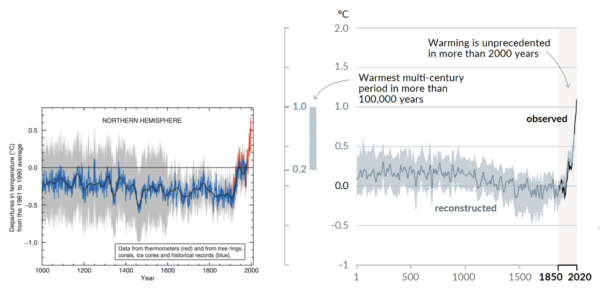
The chief focus is the original hockey stick, a reconstruction of past temperature for the northern hemisphere covering the last 600 years by Mike Mann, Ray Bradley, and Malcolm Hughes (1998, Nature, 392, 779, doi:10.1038/33859, available here), hereafter called “MBH98″ (the reconstruction was later extended back to a thousand years by Mann et al, 1999, or “MBH99″ ). The reconstruction was based on proxy data, most of which are not direct temperature measurements but may be indicative of temperature. To piece together past temperature, MBH98 estimated the relationships between the proxies and observed temperatures in the 20th century, checked the validity of the relationships using observed temperatures in the latter half of the 19th century, then used the relationships to estimate temperatures as far back as 1400. The reconstruction all the way back to the year 1400 used 22 proxy data series, although some of the 22 were combinations of larger numbers of proxy series by a method known as “principal components analysis” (hereafter called “PCA”–see here). For later centuries, even more proxy series were used. The result was that temperatures had risen rapidly in the 20th century compared to the preceding 5 centuries. The sharp “blade” of 20th-century rise compared to the flat “handle” of the 15-19th centuries was reminiscent of a “hockey stick” — giving rise to the name describing temperature history.
More »

Revisiting the Younger Dryas

Classé dans: — group @ 17 juillet 2010

Guest Commentary by Chris Colose

One of the most intriguing and well-studied climatic events in the past is the Younger Dryas (YD), a rather abrupt climate change between ~12.9 and 11.6 thousand years ago. As the world was slowly warming and ice was retreating from the last glaciation, the YD effectively halted the transition to today’s relatively warm, interglacial conditions in many parts of the world. This event is associated with cold and dry conditions increasing with latitude in the North, temperature and precipitation influences on tropical and boreal wetlands, Siberian-like winters in much of the North Atlantic, weakening of monsoon intensity, and southward displacement of tropical rainfall patterns. RealClimate has previously discussed the YD (here and here) however there have been a number of developments in recent years which deserve further attention, particularly with respect to the spatial characteristics and causes of the YD.
More »

The Muir Russell report

by Gavin and Mike

The long-awaited and surprisingly thorough Muir Russell report (readable online version) was released this morning. We’ve had a brief read through of the report, but a thorough analysis of this and the supplemental information on the web site will have to wait for a day or so.

The main issue is that they conclude that the rigour and honesty of the CRU scientists is not in doubt. For anyone who knows Phil Jones and his colleagues this comes as no surprise, and we are very pleased to have this proclaimed so vigorously. Secondly, they conclude that none of the emails cast doubt on the integrity and conclusions of the IPCC, again, something we have been saying since the beginning. They also conclude as we did that there was no ‘corruption’ of the peer-review process. Interestingly, they independently analysed the public domain temperature data themselves to ascertain whether the could validate the CRU record. They managed this in two days, somewhat undermining claims that the CRU temperature data was somehow manipulated inappropriately. (Note that this exercise has been undertaken by a number of people since November – all of which show that the CRU results are robust).

All in all, none of the various accusations and insinuations that have been floating around the blogosphere have been sustained. (See some of the early media coverage of the report).

However, there are two issues that have come up that deserve some comment. The first are the evolving practices of data presentation and access, and the second is the issue of how to handle Freedom of Information (FOI) requests.

As climate science has moved away from single researcher/single study/single site analyses towards synthesis across multiple studies, across the globe and involving more and more researchers, practices that were appropriate at one time don’t necessarily scale up to the new environment. Data requests dealt with on an ad-hoc and informal basis work fine if only a couple of people are interested, but more formal and automated procedures are needed when the data sets grow and many more people are involved (see the PCMDI/CMIP3 archive of model results for instance). Given too, the obsession in certain quarters with irrelevant details of smoothing techniques and end-point padding in decade-old papers, it is clear that the more information that is put out as supplementary material to the creation of high-profile figures, the better off we will be. Examples of this for figures in IPCC AR4 already exist, but it will be helpful for IPCC to adopt this practice more generally. Historically, this hasn’t been done – mainly because no-one thought it particularly interesting (most smoothing methods produce very similar results for instance), particularly for figures that weren’t for publication in the technical literature.

One example of this was the cover art on a WMO 1999 report which, until last November, was completely obscure (we are not aware of any mention of this report or this figure before November in any blogospheric discussion, ever). Nonetheless, in the way of these things, this figure is now described as ‘an icon’ in the Muir Russell report (one of their very few mistakes, how can something be an icon if no-one has ever seen it?). In retrospect (and as we stated last year) we agree with the Muir Russell report that the caption and description of the figure could indeed have been clearer, particularly with regard to the way proxy and instrumental data sources were spliced into a single curve, without indicating which was which. The WMO cover figure appears (at least to our knowledge) to be the only instance where that was done. Moving forward, nonetheless, it is advisable that scientists be as clear as possible about what sorts of procedures have gone into the preparation of a figure. But retrospective applications of evolving standards are neither fair nor useful.

With respect to the continuing barrage of FOI requests (which are predominantly for personal communications rather than for data), we can attest from personal experience how disconcerting these can be at first. Since there are no limits on what can be asked for (though there are many limits on what will be delivered), scientists presented with these requests often find them personally invasive and inappropriate. Institutions that do not have much experience with these kinds of requests, and who are not aware of what their employees do that is, and is not, covered by the legislation, are often not much help in sorting out how to respond. This can certainly be improved, as can the awareness of the community of what is recoverable using these procedures. While it is not relevant to the legislation, nor to what can be released, the obvious bad faith of many of the requesters indicates that actual information about the functioning of public bodies is not the primary goal in making these requests. However, it would be a terrible mistake for scientists to retreat from the public discussion on climate science because of these attempts at intimidation.

We will post on more specific aspects of the report, and perhaps the legacy of the whole affair over the next few days…

What we can learn from studying the last millennium (or so)

Classé dans: — mike @ 15 mai 2010 - (Español) (English)

With all of the emphasis that is often placed on hemispheric or global mean temperature trends during the past millennium, and the context they provide for interpreting modern warming trends, one thing is often lost in the discussion: space matters as much as time. Indeed, it is likely that the regional patterns of past climate changes, rather than simple hemispheric or global mean temperature trends, will best inform our understanding of the dynamical mechanisms involved. Since much of the uncertainty in future projections relates to regional climate change impacts, it makes particular sense to focus on those changes in the past that involve regional changes and the underlying mechanisms behind them.

For instance, melting of the cryosphere (and consequent rises in sea level), subtle shifts in drought and rainfall patterns, and extreme events, are all regional effects that could be important threats to ecosystems and our environment. Such changes are often associated with phenomena like ENSO or the North Atlantic Oscillation. Yet there remain large uncertainties about how such mechanisms will respond to anthropogenic climate change.

More »

The Guardian disappoints

Classé dans: — gavin @ 23 février 2010

Over the last few weeks or so the UK Guardian (who occasionally reprint our posts) has published a 12-part series about the stolen CRU emails by Fred Pearce that are well below the normal Guardian standards of reporting. We delineate some of the errors and misrepresentations below. While this has to be seen on a backdrop of an almost complete collapse in reporting standards across the UK media on the issue of climate change, it can’t be excused on the basis that the Mail or the Times is just as bad. As a long-time Guardian reader and avid Guardian crossword puzzle solver, I’m extremely unhappy writing this post, but the pathologies of media reporting on this issue have become too big to ignore.

We highlight issues with three of the articles below, which revisit a number of zombie arguments that have been doing the rounds of the sceptic blogs for years. Two follow-up pieces will deal with two further parts of the series. Hopefully some of the more egregious factual errors can be fixed as part of a ‘group experiment‘ in improving the stories, though the larger misconceptions probably can’t be (and readers should feel free to use this information to comment on the articles directly). Why the Guardian is asking for group input after the stories were published instead of before is however a puzzle. Some of the other pieces in this series are fine, which makes the ones that get it so wrong all the more puzzling. The errors consist of mistakes in the basic science, misunderstandings of scientific practice, more out of context quotes and some specific issues that are relatively new. (In the text below, quotes from the articles are in italics).
More »