The mystery of why the last million or so years of glacial variability are so different to what came before just got more mysterious…
It’s easy to understand why the ice ages have such a hold on our imaginations. Putting aside the cavemen, woolly mammoths, and sabre-toothed tigers of popular culture, the scientific questions around the pacing of the glacial cycles, their magnitude, variability, and impacts are truly profound.
Despite huge strides in understanding the ice ages – from the ground-breaking work of Hayes, Imbrie and Shackleton (1974) that demonstrated the skill of the Milankovitch model in the 1970s, the paradigm-busting results from the Greenland Ice Cores in the 1990s, the discovery of the Heinrich events, etc., there remain plenty of real and abiding mysteries including:
- Why are the 100kyr cycles so strong?
- What are the details of the carbon feedbacks on glacial-interglacial cycles?
- What triggered the ice ages in the first place? (i.e. why did the impact of Milankovitch cycles get much larger over the last 2.5 million years?)
- Why didn’t humans develop agriculture in the last interglacial?
- What triggers the Dansgaard-Oeschgar oscillations?
- and… what caused the change from lower magnitude 40kyr cycles to 100kyr cycles across the Mid-Pleistocene Transition (MPT)?
We have good evidence from the deep Antarctic ice cores of the coupling between CO2 and temperature over the last 800kyrs and from ocean sediment proxies, we have reasonable estimates of the coupling between CO2 and temperature over the long cooling during the Cenozoic (the last 65 million years). But, until now, we haven’t been able to really examine that intervening period – the early Pleistocene.
Theories, of course, abound. The obvious one is that the long term declines in CO2 crossed a threshold that allowed for larger ice volumes that had more resonance with the 100kyr cycles. Another is that the early ice advances (which were more spread out but less voluminous) scraped all the soils off the rocks and that subsequent ice sheets were less mobile. I think most folks expected the data (when it arrived) to basically confirm what people expected.
But sometimes the observations don’t confirm your preconceived notions. The nice thing about science is that scientists (ideally) tend to get excited at this point (instead of, say, trying to deny the new information). So what has just happened?
Two new papers, Marks-Peterson et al. (2025) (direct link) and Shackleton et al. (2025) (direct link) in Nature this week report on analyses of very old Antarctic ice. These samples come from the “blue ice” in the Allan Hills in Antarctica where multi-million year old ice surfaces after having been deposited and transported over large distances. This is quite distinct from deep drilling in places where you hope the ice has not moved much, and while it doesn’t have the nice stratigraphy of the cores, you can sample snapshots of the atmosphere over a much longer time – in this case, almost 3 million years – albeit with coarser dating.
There are two main measurements presented. The first are the GHG concentrations in the air bubbles trapped in the ice (Fig. 1), and the second is a record of mean ocean temperature inferred from the ratio of noble gases in the air bubbles (Fig. 2).
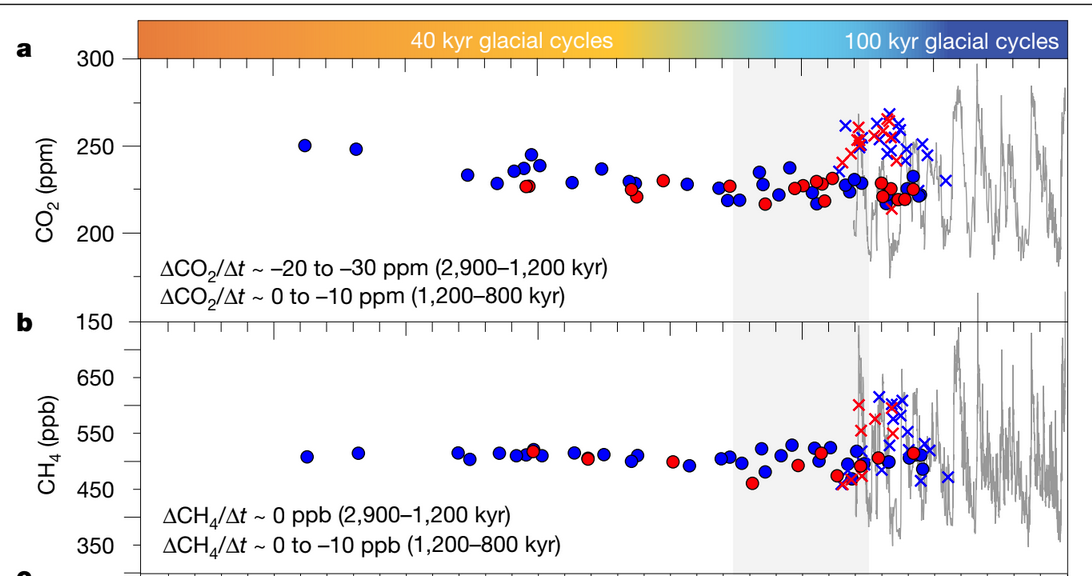
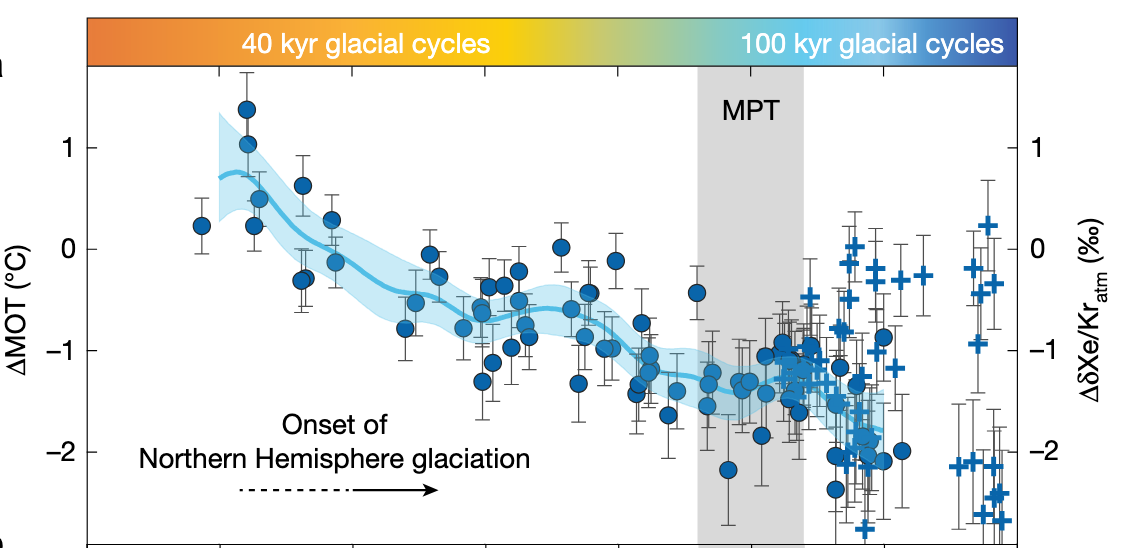
The first and most dramatic (or rather, non-dramatic) result, is that CO2 levels appear to have barely changed (on average) over this key period – dropping only 20-30ppm over the onset period. That isn’t nothing, but it’s only about 0.45-0.7 W/m2 in forcing, and would lead to around 1ºC in global surface cooling. The CH4 levels might have been expected to fall too, but they seem to be static. [Note that this method is not sampling the glacial/interglacial variations which are apparent in the more recent records]. The second, and somewhat confounding, result is that the global ocean seems to have cooled by about 2ºC over the same time period (with the global surface temperature change would have been larger).
So we have a conundrum. The onset of NH glaciation did happen as the planet cooled (as might be expected), but the first guess for what caused that cooling (long term trends in CO2 and/or CH4) does not appear to work.
How might this be resolved?
There are always multiple potential ways out of a conundrum: subsequent analyses might find an issue with the observations, there might be a hyper-sensitivity to the small CO2 changes at this time (but why?), there might be something else driving the change (volcanism? dust aerosols?), or… what? None of these possibilities are obvious winners, and of course, they are not mutually exclusive. Eric Wolff (direct link) in his commentary seems to think that the ocean is doing the driving, but I think that might be backwards.
The funny thing is that paleo-climatologists have been wanting these old ice analyses for a long time – with the anticipation that they would help answer these questions. But they seem to be posing many more questions than they have answered.
Broader issues
One thing this shows is that scientists can’t be complacent. As we’ve seen with surprising climate events even over the last few years (2023, Antarctic sea ice, the increases in the Earth’s Energy Imbalance), the more you look at the planet (or even the universe) the more surprising things you find. Science is an active search for deeper understanding – and we are not done yet.
Final thought
At face value, these results seem to suggest that CO2 declines were not the dominant/only cause of the cooling at the onset of the ice ages, despite expectations. Some of the usual suspects are certainly going to claim (fallaciously) that this means that CO2 can’t be the cause of anything. This is obviously a stupid argument so feel free to judge anyone that makes it.
Nonetheless,…
There are more things in heaven and earth, Horatio, than are dreamt of in your philosophy.
References
- J.D. Hays, J. Imbrie, and N.J. Shackleton, "Variations in the Earth's Orbit: Pacemaker of the Ice Ages", Science, vol. 194, pp. 1121-1132, 1976. http://dx.doi.org/10.1126/science.194.4270.1121
- H. Heinrich, "Origin and Consequences of Cyclic Ice Rafting in the Northeast Atlantic Ocean During the Past 130,000 Years", Quaternary Research, vol. 29, pp. 142-152, 1988. http://dx.doi.org/10.1016/0033-5894(88)90057-9

Comment Policy:Please note that if your comment repeats a point you have already made, or is abusive, or is the nth comment you have posted in a very short amount of time, please reflect on the whether you are using your time online to maximum efficiency. Thanks.