The fantasy version of the normal updating of scenarios for a new round of CMIP simulations doing the rounds is bad faith BS.
As climate folk will know, the community is currently embarking on a new round of climate model simulations to support analyses and projections for the next IPCC report (due in 2028/9). This new effort has been dubbed CMIP7, because it is the sixth iteration of the CMIP effort (IYKYK), that started in the late 1990s. For each of these iterations, a new set of projections has been formulated for the modeling groups to use and the ones for this round were just published (van Vuuren et al., 2026). So far, so totally normal.
Why do scenarios need updating? Why can’t we use the three scenarios that Hansen et al. (1988) first came up with in the early 1980s? Three reasons. First the scenarios need to be continuous with the trajectories of the observed changes. The ‘join’ point was 1984 for Hansen’s original scenarios, then 2000 for the CMIP3, 2005 for CMIP5, 2014 for CMIP6, and it will be 2023 for CMIP7. As you can imagine, things have changed over the last 40 years (the Montreal Protocol, the Clean Air Acts, renewable energy price falls, fracking, the Paris Agreement, actual climate policies, reversal of climate policies, etc.). All of these things are the result of humans behaving in ways that humans behave and which are not easily predictable ahead of time. This is why future simulations have long been described as ‘projections’ and not predictions.
Second, the rationale for future scenarios has shifted in light of what we (as a society) are doing. At the beginning it made sense to think about a spread of baseline scenarios where no climate policy was enacted: “Business as usual” so to speak. But now? we have already done things and so ‘business’ is no longer ‘usual’. Now, ranges based on ‘current policies’, ‘current aspirations’ and ‘possible backsliding’ are perhaps more useful. Additionally, we are now much closer to 2100 than we used to be (also obvious, but often forgotten) and so scenarios need to be extended out further.
Third, what we are making scenarios for has expanded enormously. In 1984 there were only concentrations of well-mixed greenhouse gases, the solar cycle and the occasional volcano to project, but now, we have emissions of GHGs including CO2, plus all of the halogenated gases, the short lived climate forcers (CH4, aerosols, NOx, SO2/SO4), land use change (deforestation, irrigation, agricultural shifts), possible anthropogenic impacts on dust and fire, and freshwater inputs from melting glaciers and ice sheets that are not otherwise represented in models. Did I mention nitrogen inputs, solar particle fluxes, and volcanic emissions of water vapor as well as sulfates? Keeping this all coherent and up-to-date is an enormous undertaking.
This all means that, duh, of course the scenarios would be updated for CMIP7.
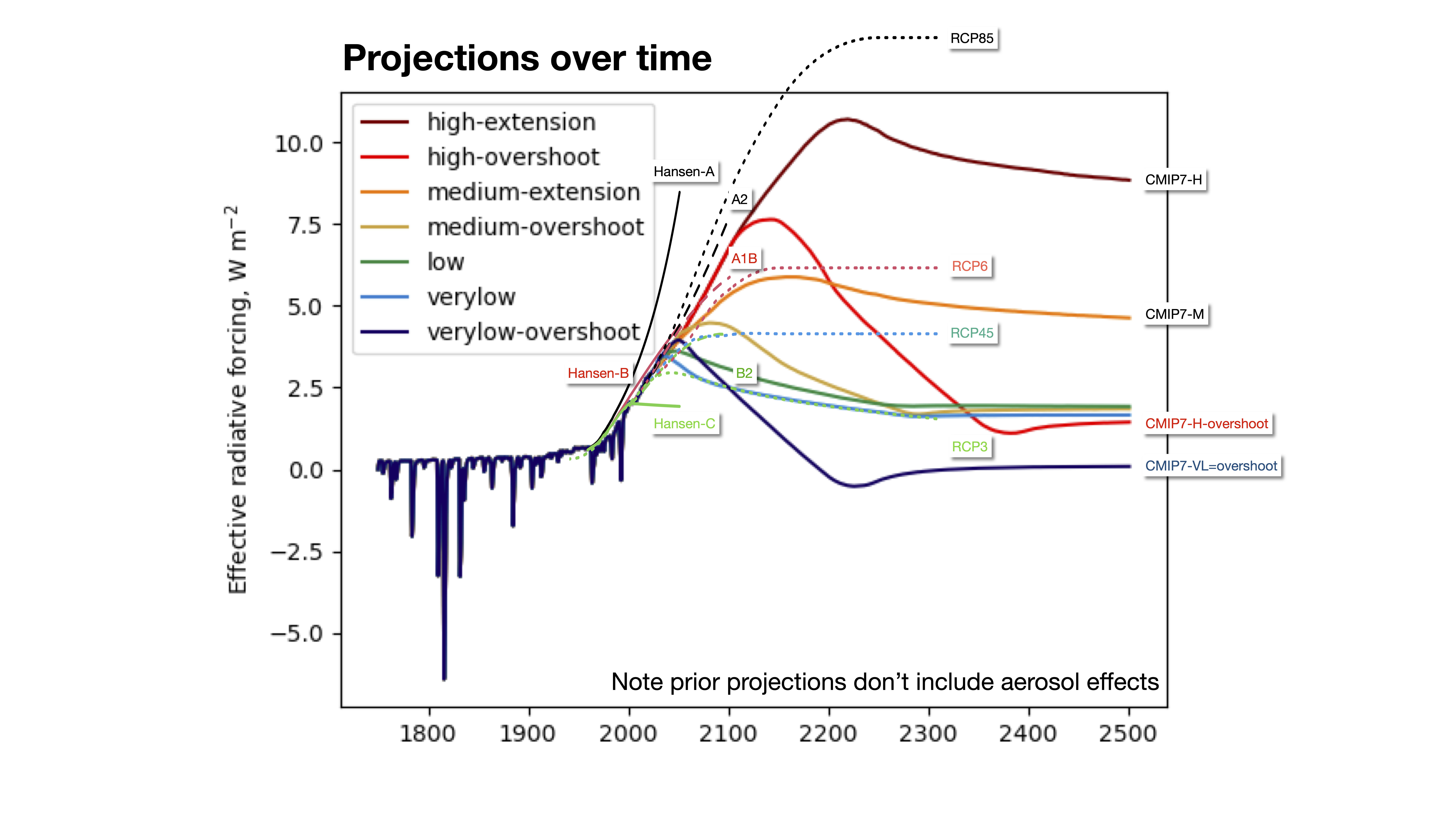
People (hi Roger!) acting as if the publication of new CMIP7 scenarios is some huge policy shift or an admission that previous scenarios are no longer ‘official’ are just bull-shitting. This is something that was planned for and expected for literally years. Previous scenario sets were used in previous rounds, a new set will be used for the new round – that is all there is to it.
Oh noes!
The supposed focus of the ire are the high end scenarios of RCP85 (CMIP5) and SSP5-85 (in CMIP6). The reasons why these were set up in the first place (back in 2007!) was that IPCC wanted to span what had appeared in the literature before then – going beyond (in sophistication) what the (CMIP3) SRES projections had done. But the IAM folks involved decided (correctly) that they didn’t have the time to start from scratch, and so they decided to split up the task – come up with a spread that covered 99% of published scenarios with ‘representative’ concentration pathways (RCPs – gettit?) for the climate models to use quickly (in CMIP5), and back-fill plausible socio-economic pathways later (to be used in CMIP6). Thus the CMIP5 models (which were run in 2007-9 or so) used the RCPs (including RCP85 – which was so-called because it reached 8.5 W/m2 of direct radiative forcing from GHGs in 2100).
For climate modellers, the reasons why the pathways are the way they are is a secondary concern – if they were only to be given CO2 levels (and other GHGs etc.), the basic need is just for a low, middle and high scenario that encompass our most ambitious climate policy pathways, a worst case scenario (‘Burn it all!’), and something in the middle. When it came time for CMIP6 (2016-2019 or so), the SSPs (that had been promised a decade earlier) were ready, and so they were used. But for the purposes of the climate modellers, the drivers underlying the SSPs were not really that relevant. A climate model really doesn’t care how cooperative or antagonistic regional economic blocks are – it just responds to the resulting emissions. That there is a need for high end scenarios should be obvious – where are the tipping points in the system? what are the impacts of a 2ºC warmer world? what about 3ºC or 4ºC? Are these worth avoiding perhaps? Having seen these results, the answer (IMO) is definitely yes!
In the last few years, a number of people have pointed out that assumptions underlying the highest SSPs don’t look as plausible as they used to seem (this is also true of the lowest projections, but people seem less bothered by that). Note this is many years after all the models that were ever going to use them were run. But this is less of an issue that some people portray. Climate impacts rely on a chain of calculations – a specific set of emissions, a resulting concentration pathway, and a modelled sensitivity. Similar impacts can arise with lower emissions, but greater carbon cycle feedbacks and higher sensitivities, and given that each of these steps are quite uncertain, it is not really worthwhile for climate models (or modelers) to get too attached the specific storylines the IAM folks put together. Hence the collective shrug from climate modelers around the RCP85 ‘dialogue’ in the last couple of years.
Let me give two examples why high end scenarios are important: Impacts on ice sheets are a very important part of the climate change and have yet to be fully integrated into the standard climate models. So independent efforts with ice sheet models were set up using the output from the CMIP5 and CMIP6 models – they used two scenarios, RCP85 and RCP26 to bracket possibilities in ISMIP6 (Seroussi et al, 2020). Interestingly, they found that, particularly for Greenland, that none of the models had melt rates as high as observed even with RCP85 forcing. Thus for a situation where the (ice sheet) models are insufficiently sensitive, a higher than expected forcing might give you a more likely outcome.
A second example is the use of ‘global warming levels’ in the last IPCC assessment. These were averages of the models when they reached particular temperature levels (2ºC, 3ºC, 4ºC etc.), but for that to work, enough models had to reach those temperatures in order to make an average – and in practice for 3ºC and 4ºC, this was only possible with SSP5-85 scenarios. Other assessments used the higher signal-to-noise ratios in the high end scenarios to estimate sensitivities across many systems that would have been noisier and more uncertain if that was not available. How the models got there is basically irrelevant. The new high end runs will also be used for this (note that H gets to 8.5 W/m2 only about 20 years after RCP85).
Note that even the harshest critics of RCP85 will admit (in academic circles at least) that these are legitimate uses. However, some of the more stupid commentaries equate the mere mention of RCP85/SSP585 with scientific misconduct, claiming that counting the number of times the ‘naughty’ words of RCP85 appear in publications or assessments is a damning indictment of the entire field’s integrity. This is so dumb and lazy that I find it hard to credit.
But wait!
The funny thing is that there are real issues with the way this whole endeavor has grown up. First, because CMIP is the only (serious) climate projection game in town, as climate change has become more salient, CMIP projections have been used to inform a far wider array of science than was imagined back in 2007. Not all of those uses are optimal. For instance, the ERA5 reanalysis still uses CMIP5 projections of solar forcing from 2008 which didn’t turn out to be so good at matching what actually happened. Consultants and banks have used CMIP6 projections as if they were real predictions, and the adaptation community have often assumed that specific CMIP6 pathways are the most likely outcomes.
All of these misuses are compounded by the fact that it appears to need a decade to update these pathways in the light of new science and societal decisions and changes. This is way too long – annual updates of the process should be achievable if funders prioritized it.
And finally, there are of course far more scenarios that would be interesting to explore in climate models (policy specific scenarios, delta scenarios (where only one thing changes at a time), in-between scenarios, annually updated scenarios etc.) than can possibly be performed given existing computational capacity. This is (right now) prohibitive, but at the rate that faster, more efficient machine-learning emulators are advancing, it might not be for much longer.
A serious critique of the climate modeling enterprise would be focused on these issues (for instance), rather than tilting at RCPs.
References
- D. van Vuuren, B. O'Neill, C. Tebaldi, L. Chini, P. Friedlingstein, T. Hasegawa, K. Riahi, B. Sanderson, B. Govindasamy, N. Bauer, V. Eyring, C. Fall, K. Frieler, M. Gidden, L. Gohar, A. Jones, A. King, R. Knutti, E. Kriegler, P. Lawrence, C. Lennard, J. Lowe, C. Mathison, S. Mehmood, L. Prado, Q. Zhang, S. Rose, A. Ruane, C. Schleussner, R. Seferian, J. Sillmann, C. Smith, A. Sörensson, S. Panickal, K. Tachiiri, N. Vaughan, S. Vishwanathan, T. Yokohata, and T. Ziehn, "The Scenario Model Intercomparison Project for CMIP7 (ScenarioMIP-CMIP7) ", 2025. http://dx.doi.org/10.5194/egusphere-2024-3765
- J. Hansen, I. Fung, A. Lacis, D. Rind, S. Lebedeff, R. Ruedy, G. Russell, and P. Stone, "Global climate changes as forecast by Goddard Institute for Space Studies three‐dimensional model", Journal of Geophysical Research: Atmospheres, vol. 93, pp. 9341-9364, 1988. http://dx.doi.org/10.1029/JD093iD08p09341
- H. Seroussi, S. Nowicki, A.J. Payne, H. Goelzer, W.H. Lipscomb, A. Abe-Ouchi, C. Agosta, T. Albrecht, X. Asay-Davis, A. Barthel, R. Calov, R. Cullather, C. Dumas, B.K. Galton-Fenzi, R. Gladstone, N.R. Golledge, J.M. Gregory, R. Greve, T. Hattermann, M.J. Hoffman, A. Humbert, P. Huybrechts, N.C. Jourdain, T. Kleiner, E. Larour, G.R. Leguy, D.P. Lowry, C.M. Little, M. Morlighem, F. Pattyn, T. Pelle, S.F. Price, A. Quiquet, R. Reese, N. Schlegel, A. Shepherd, E. Simon, R.S. Smith, F. Straneo, S. Sun, L.D. Trusel, J. Van Breedam, R.S.W. van de Wal, R. Winkelmann, C. Zhao, T. Zhang, and T. Zwinger, "ISMIP6 Antarctica: a multi-model ensemble of the Antarctic ice sheet evolution over the 21st century", The Cryosphere, vol. 14, pp. 3033-3070, 2020. http://dx.doi.org/10.5194/tc-14-3033-2020

Gavin — agree with the substantive point that scenario updating is routine and the RCP8.5 framing is being used in bad faith by people who know better. Two related concerns that I think deserve more attention than they’re getting:
First, the artificial end dates. Extending out to 2150 helps, but 2150 is still roughly where peak warming occurs under current-policy emissions. The committed sea level rise, ice sheet response, and ocean heat redistribution all run for centuries to millennia past the modeling horizon. Zickfeld et al. show CO₂ and temperature staying elevated for centuries after emissions stop; Clark et al. (2016) extend that to multi-millennial sea level commitments of meters to tens of meters depending on cumulative emissions. The framing convention of ending at 2100 (or now 2150) implicitly communicates to non-specialists that this is a 21st-century problem, when most of the impact integral happens after that.
Second, the CDR dependence in the low scenarios. The CMIP7 low scenarios — the ones aligned with current international agreements — only get to their temperature endpoints by assuming substantial CDR deployment at scales far beyond anything currently achievable. The medium scenario stays emissions-positive and doesn’t depend on this assumption, but the low scenarios carry the same baggage that AR6’s 1.5°C-compatible pathways did. None of this is visible in the headline temperature numbers reported to the public. The risk is communicating that there’s a science-validated path to limiting warming when the path requires technology deployment that doesn’t currently exist at the required scale.
Between the tipping points you raise and the longer-term emphasis above, the medium scenario is alarming enough on its own — a ~2.8°C 2100 endpoint that continues rising past 2150, with sea level and ice sheet response committed for centuries beyond that. The retirement of the high-end scenarios doesn’t change that picture.
Neither of these is a critique of the science or the modeling process — the scenarios are doing what they’re designed to do, and the choices about horizon and CDR are defensible within the modeling community. The problem is on the communication side. When journalists, consultants, and the public absorb “medium scenario, 2.8°C by 2100” and “low scenario, well below 2°C,” the horizon truncation and the embedded technology assumptions become invisible. The serious critique of the enterprise isn’t about RCP8.5 retirement; it’s about how the scenarios that remain in use get translated for non-specialist audiences.
Dean
Hello Dean,
You will be happy with CIMP7 end dates because if go to 2500.
About CDR, I agree with you. It’s a big problem on the communication side : by design scenarios HL, ML and L leads to the same goal : 1.5°C. The layman will conclude that whatever we do before 2070 we have the same result : 1.5°C.
Authors say “ML and HL scenario assumptions risk exceeding limits of prudent use of sequestration capacity” and “challenge current estimates of geophysical feasibility”.
“However, they are included […] to ultimately serve as narratives for interactive CDR deployment experiments in Earth System Models (for example, in CDRMIP), and scenarios in which the limits of CDR are challenged are useful for identifying where Earth System Models are unable to deliver the scenario negative emissions rates (for example if bioenergy yields in the ESM are lower than the IAM estimates).”
As you note above, there are obviously good reasons to have a high end scenario. I don’t recall anyone saying otherwise, actually. What is a pity is that when politicians, lobbyists and the occasional blogger (Hi ATTP) defended the description of RCP 8.5 as ‘business as usual,’ despite the explicit statements of the developers of RCP 8.5, and when literally thousands of papers were published using it as a base case, corrective statements like what you write here did not appear in a timely fashion.
As I was writing about this either before or at the same time as Roger, I hope you’ll forgive me beating on this dead horse one more time.
But let’s raise a glass to RCP 8.5, which served to alert people in time to start the corrective policies that helped send it to its deserved place of rest in the archives. And I hope we all get to work on doing the same to RCP 6.5 in its turn.
Hi Tom,
RCP6.5 will be retired at the same time as RCP8.5. The new set of emission scenario’s is meant to replace the old set (though of course the model calculations still have to be done, so the process of retirement still takes time.
It’s just that the highest of the new scenarios is less high, and the lowest less low, compared to the current SSP’s.
Hi Bart! It’s been ages since I’ve seen you pop up in the climate conversation. How are you and your family?
Yes, cutting off the fat tails is finally happening on both ends. Not before time. But I still want to see more action. Guess we’ll have to wait until Trump leaves town before any work gets done in the USA. But good things are happening elsewhere.
I would say it was the 7th iteration. The first attempt also counts as an iteration.
We don’t speak of CMIP4
Why not actively promote enhancing albedo, hydrating, and greening up the tropics. It’s ground zero for solar irradiation. Billions live there mercilessly broiled by the totally insane heat.
I also talk about this subject at https://substack.com/home/post/p-198538383. I will note that Roger does NOT qualify as one of the harsh critics who “will admit (in academic circles at least) that these are legitimate uses”…
If that “Roger” is me–>
There are plenty of legitimate scientific uses for exploratory, extreme scenarios, as I’ve explained many times, dating back at least to our 2000 book on Prediction and directly wrt RCP8.5 in ERL, and pretty much in every public discussion I have on climate scenarios.
And our critcism is not “harsh” but, as the fullness of time has shown, accurate and fair.
I read https://rogerpielkejr.substack.com/p/no-rcp85-did-not-become-implausible where you said “RCP8.5 — and indeed all of the RCP and SSP scenarios — had a single point of failure in its assumption of a return-to-coal. This assumption alone settles the question of plausibility. A scenario requiring five times proven coal reserves is not plausible by any standard.4”, went to reference 4: “The new HIGH “what if?” scenario in the ScenarioMIP ensemble continues to employ the return-to-coal hypothesis, as acknowledged by its creators:….”
That only refers to the HIGH scenario for fossil fuels (I’m guessing not just coal), and not what you said:”and indeed all of the RCP and SSP scenarios — had a single point of failure in its assumption of a return-to-coal.”
So then I went to “The Scenario Model Intercomparison Project for CMIP7 (ScenarioMIP-CMIP7)” at https://gmd.copernicus.org/articles/19/2627/2026/ and again I can’t find anything that backs up your “return-to-coal.” statement. Where do I read about the “return-to-coal.” for all the other scenarios? Was it for older CMIP scenarios?
Great question – The ScenarioMIP paper refers to the “return to coal” theory in this sentence, with appropriate references: “Clearly, the cumulative amount of fossil fuel use in the High emission scenario is considerably larger than the estimated total reserves (known deposits that are extractable at current prices and technologies) (Bauer et al., 2016; Rogner, 1997).”
To learn more about the theory, and why it is flawed, and certainly should not have been the single basis for RCPs and SSPs, see this: https://www.rff.org/publications/working-papers/evaluating-the-learning-by-doing-theory-of-long-run-oil-gas-and-coal-economics/
Gavin: “So independent efforts with ice sheet models were set up using the output from the CMIP5 and CMIP6 models – they used two scenarios, RCP85 and RCP26 to bracket possibilities in ISMIP6 (Seroussi et al, 2020). Interestingly, they found that, particularly for Greenland, that none of the models had melt rates as high as observed even with RCP85 forcing. Thus for a situation where the (ice sheet) models are insufficiently sensitive, a higher than expected forcing might give you a more likely outcome.”
To me, this theme plus this theme https://m.youtube.com/watch?v=FI24IJOAyLc – the risk of extreme methane emissions from thawing permafrost, thawing subsea clathrates, thawing subglacial clathrates etc. are the most important.
First this study: “The last two abrupt warmings at the onset of our present warm interglacial period, interrupted by the Younger Dryas cooling event, were investigated at high temporal resolution from the North Greenland Ice Core Project ice core. The deuterium excess, a proxy of Greenland precipitation moisture source, switched mode within 1 to 3 years over these transitions and initiated a more gradual change (over 50 years) of the Greenland air temperature, as recorded by stable water isotopes. The onsets of both abrupt Greenland warmings were slightly preceded by decreasing Greenland dust deposition, reflecting the wetting of Asian deserts. A northern shift of the Intertropical Convergence Zone could be the trigger of these abrupt shifts of Northern Hemisphere atmospheric circulation, resulting in changes of 2 to 4 kelvin in Greenland moisture source temperature from one year to the next.” https://www.researchgate.net/publication/5288829_High-Resolution_Greenland_Ice_Core_Data_Show_Abrupt_Climate_Change_Happens_in_Few_Years . This points to the fact that there is persistant uncertainty in our possible knowledge concerning the future development of deglaciation processes in both Greenland and Antarctica. The same goes for permafrost warming/thawing etc.
To me, the main problem with most climate modelling so far is, that it tends to look away from the big picture. It seems no to consider this fundamental problem: Since our *climate gas emissions since at least around 1960 are rising around fifteen times faster than the fastest known from the whole geological/paleoclimatological history* (which to my knowledge was 252 m. yrs ago just before the end permian extinction event and was caused by the volcanism producing the large igneous province called the Siberian Traps. This volcanism burned enormous carbon-rich sediments of coal, oil and gas and thus made the atmospheric CO2 level go as high as maybe over 2000 ppmv). This fact ought to tell us, that the global physical experiment we are “conducting” with our climate must be very difficult to model, since any model has to be calibrated against past climate developments, *but we don’t know of any past climate developments where the levels of climate gasses were rising *anywhere near so fast* as they have been rising since around 1960.* Thus the unknown factors are much larger than the climate modellers seem to imply, when they fx. predict the sea-level rise until 2100 in numbers down to one centimeter, albeit with a statistical margin of safety up to plus/minus thirty centimeters or so. To me, this is pure statistical nonsense. It has no meaning to say fx. we expect the sea-level to rise 68 cm plus/minus 32 cm. It leaves a false impression of exact predictions, and why do that? The only reasonable thing would be to say that we, under these emission scenarios, can expect between 0,6 and 1,5 meters of sea level rise, maybe even some more, because there are a lot of things we don’t know.
But: such as the political development is now, especially in the US, where we are witnessing a new kind of what I call scientific analfabetization, fascisation/”liberalist”-totalitarian/oligarchic systemic undermining of democracy and freedom of speech (some figures around the current “secretary of war” – Hegseth – recently even proposed to roll back female suffrage, which tells you how extreme this tendency is…) etc., it is of course very understandable for scientific researchers to end up in a very defensive position. Careers etc. are at stake. Meaning fx. you can end up only being arguing very anxiously restrained against dropping all pessimistic heating scenarios completely. I think this easily ends in the trap which the historian Timothy Snyder calls “obeying in advance”: you end up learning the climate deniers/ignorants and the fossil fuel lobbying oligarchs how to suppress science.
The “optimistic bias” is inherent in all future outlooks being produced by mainstream/neoclassical economic theory, and since this kind of economic theory de facto since around 1970 is the only accepted in politics almost anywhere in the world (in fact since around 1930 – even stalinist economic theory believes in eternal economic growth and have long ago left any kind of critical pretenses behind), even the rising amount of scientificly well-founded warnings from climate and ecosystems science have fallen on deaf ears among 99 pct. of the elites, delegitimized and defamated as “doomism” etc. Today they are almost completely suppressed in the mainstream media: the norm now is leaving any unpleasant reality completely behind except for the eternal warnings anywhere, in all camps, about “the evil enemy” from within and outside, against which we have to accelerate the arms race, the surveillance apparatuses etc.: the schizophrenic combination of megalomaniac-optimist growth visions and enemy paranoia is everywhere, realism not so much. Since science doesn’t exist in splendid isolation, it is being influenced by this poisonous societal atmosphere, which I call liberalist-totalitarian.
I think history tells us, that it is very important to avoid any kind of obeying in advance.
This is why scientists are not good risk managers. The concept of risk within science is that a v.narrow assessment might be slightly less narrow. It in no sense at all considers whether (outside of specified assumptions and models) the assessment is totally awry.
In simple terms in these situations the only suitable action is one framed with the Precautionary Principle in mind.
A quick note re: “However, some of the more stupid commentaries equate the mere mention of RCP85/SSP585 with scientific misconduct, claiming that counting the number of times the ‘naughty’ words of RCP85 appear in publications or assessments is a damning indictment of the entire field’s integrity. This is so dumb and lazy that I find it hard to credit.”
https://x.com/matthewgburgess/status/2057192401907945872
Beneath all the heated rhetoric, I don’t think most academics on various sides of the scenarios issue are actually that far apart. For example, I think your “But wait!” section is pretty spot on above (and echoes things we’ve called for in our various scenario papers).
Uhm, wouldn’t be the only result of this proposed combination of incorrect Greenland ice melt rates in models with implausible high RCP8.5 forcing be that the confidence in the output is lower than necessary?
Is there any expected benefit of that combination of two known sources of high uncertainty?
Spoken like a man who doesn’t understand the purposes of the scenarios at all!
You are correct, I really do not see the purpose of this intentional accumulation of model flaws.
The idea to somehow correct one error by allowing for another seems mathematically very questionable. In science generally huge effort is made to reduce errors and uncertainty.
What happens in your opinion to the confidence in the outcome for this idea?
Maybe GS should reduce the resolution too, so he won’t need all that expensive computer time.
(That’s essentially what Rahmstorf suggested when he preferred CMIP5 results over CMIP6 ones and no one here raised any objections)
MAGA rag the Bezos Post (formerly the Washington Post) has elevated Pielke’s grotesque dishonesty on this to their editorial page.
Not surprising, really, since the Post has for decades promoted global warming denial in its editorial pages, and has normalized, sanitized and legitimized the fossil fuel industry’s bought-and-paid-for stooges by falsely branding them as “skeptics”.
The scenarios are fine. The framing is not. The arrogance on all sides is unchanged.
Gavin, thank you for the clear technical post. I agree that swapping scenario sets for a new CMIP round is normal, not a scandal, and that RCP8.5 remains physically plausible for the century if carbon cycle feedbacks and societal inertia are accounted for.
But two deeper problems are not addressed here, and they are not technical—they are cultural.
First. The low scenarios in CMIP7, like those in AR6, depend on CDR at scales that do not currently exist and may never exist. That is not a minor uncertainty. That is a structural assumption baked into “policy-relevant” pathways. When those pathways are communicated to the public and policymakers as the 1.5°C or 2°C futures, the CDR assumption is almost always elided. That is not science. That is wish fulfillment dressed in GCM clothing.
Second, and more fundamentally. The modern climate science establishment operates with the same unexamined sense of authority that John Locke once invoked to “subdue the earth”—later manifest destiny, then industrial capitalism, then the technocratic confidence that we can model our way out of a crisis created by that same mindset. Five centuries of slavery, colonial wealth extraction, world wars, and now planetary boundary overshoot, all justified by some claimed right to manage, predict, and control.
The CMIP process is not immune to this. The arrogance is quieter now—expressed in overconfidence in multi-century model integrations, in CDR fairy dust, in the casual dismissal of RCP8.5 as “implausible” by people who have never run a coupled carbon-climate model, and in the implicit assumption that this generation of scientists is not repeat the errors of the last 500 years.
Nature does not care about our scenarios. Nature will find balance. It always does. The question is whether that balance includes a stable Holocene-like state for human civilization, or a hothouse trajectory with meters of sea level rise over millennia. The models are tools, not oracles. And the people running them are not exempt from the critique we would apply to any other powerful institution: who authorized you to subdue the earth with equations?
This is not science’s finest hour. It is just the latest chapter in a very old story of masculine, imperial, technocratic, divine arrogance and superiority. More polite, peer-reviewed. Still wrong in the same fundamental ways that brought us to this point in Earth history.
Mankind: thy name is Vanity.
Most voters still see climate disruption & related issues as a low priority or as a non-issue. The details of climate modelling will never interest them; all they are interested in is their pay packet and job security, and (possibly) their kids’ future.
When people finally understand what we are up against, they might, perhaps, start to act. But we are not at that point yet – we’re not even close.
And anyone who thinks we can motivate the apathetic by offering hope or proffering solutions is deluded. As a civilisation – as a species – we have our backs to the wall. This is the fight of our lives. The laws of physics take no prisoners and care nothing for human politics. We are about to be downsized.
Surely it’s time for more effective outreach. Outreach and education may or may not work; but without it, failure is certain.
https://newptc75.medium.com/human-nature-and-the-climate-041b9273653e
Graham, most of what you say is correct. But “as a species” is one of those not-so-scientific exaggerations that doesn’t really help. IIRC humans went through a period of very low population (a few thousands or tens of thousands ??) at one early point, but here we are. Clever apes indeed.
Of course it would be better if we drastically “downsized” because women were empowered and made the rational self-interested choice of limiting their offspring. But climate, nuclear war, AI-designed viruses… whatever… are not going to completely eliminate humans.
So, outreach and education need to be very carefully focused, and distanced from the natural inclinations of academic discourse. Not only does it not help; as pointed out here, it is dishonestly used by the opposition.
Of course, I’ve been saying this for a long time, but if RC is any evidence, the psychological need to say more when less works better is very powerful
I wonder if this next (still only possible, but more probable than not) super el Nino might possibly change a few minds?
Graham, you’re right that the public isn’t acting. But calling them ‘deluded’ for caring about their pay packet is just blaming the customer. That’s not strategy. That’s burnout wearing a superiority complex.
You need Sarah Wilson. She agrees we can’t offer ‘hope,’ so she offers something better: permission to live fully anyway. Her Substack/TEDx doesn’t just scream about the 2-tonne target; it answers the question you can’t — ‘How do I show up to this fight without burning out or hating my neighbors?’
Search ‘Sarah Wilson TEDx societal collapse’ (Editor’s Pick). It’s 15 minutes of brutal honesty without the ‘activist lecture’ tone. Or go here: https://sarahwilson.substack.com/
Sarah is the voice for those who know the ship is sinking but refuse to spend their last moments yelling at the passengers for being wet.
She also has something difficult but necessary to say to men. Not because men are all stupid, but because the myth that we need to own, trademark, or lead the revolution is actually holding us back. She asks: what if humility was the real work?
“Men, this revolution will not be incentivised. We can’t trademark, podcast, or ‘start up’ our way out of this… shall we try humility?”
https://sarahwilson.substack.com/p/blokes-for-the-love-of-gaia-dont
As Sarah says: catch up.
For those interested in hearing from the author of the new CMIP7 scenarios, listen to our recent Climate Chat interview with Detlef van Vuuren:
https://www.youtube.com/live/MYWokv0Byas