RealClimate logo


Technical Note: We have changed the contact email for the blog to reduce the amount of unsolicited email. If you want to contact us at the blog, please use contact-at-realclimate.org.

Solar

Filed under: — stefan @ 4 May 2010

The new novel Solar by Ian McEwan, Britain’s “national author” (as many call him) tackles the issue of climate change. I should perhaps start my review with a disclosure: I’m a long-standing fan of McEwan and have read all of his novels, and I am also mentioned in the acknowledgements of Solar. I met McEwan in Potsdam and we had some correspondence while he wrote his novel. Our recent book The Climate Crisis quotes a page of McEwan as its Epilogue. And of course I’m not a literature critic but a scientist. So don’t expect a detached professional review. More »

Climate Cover-Up: A (Brief) Review

Filed under: — mike @ 20 October 2009 - (Español)

We often allude to the industry-funded attacks against climate change science, and the dubious cast of characters involved, here at RealClimate. In recent years, for example, we’ve commented on disinformation efforts by industry front groups such as the “Competitive Enterprise Institute, the Cato Institute, the Fraser Institute, and a personal favorite, The Heartland Institute, and by industry-friendly institutions such as the Wall Street Journal editorial board, and other media outlets that assist in the manufacture and distribution of climate change disinformation.

More »

Communicating Science: Not Just Talking the Talk
Filed under: — group @ 16 September 2009

Michael Mann and Gavin Schmidt

The issues involved in science communication are complex and often seem intractable. We’ve seen many different approaches, but guessing which will work (An Inconvenient Truth, Field Notes from a Catastrophe) and which won’t (The Eleventh Hour) is a tricky call. Mostly this is because we aren’t the target audience and so tend to rate popularizations by different criteria than lay people. Often, we just don’t ‘get it’.

Into this void has stepped Randy Olsen with his new book “Don’t be such a scientist”. For those who don’t know Randy, he’s a rather extraordinary individual – one of the few individuals who has run the gamut from hard-core scientist to Hollywood film maker. He’s walked the walk, and can talk the talk–and when he does talk, we should be listening!
More »

‘Unscientific America’: A Review

Filed under: — mike @ 8 July 2009

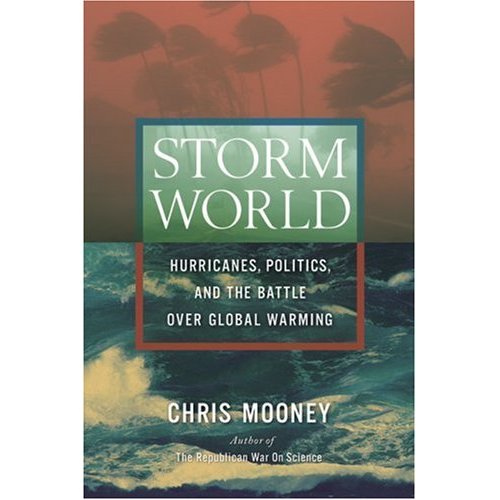
Author Chris Mooney (of “Storm World” fame) and fellow “Intersection” blogger, scientist, and writer Sheril Kirshenbaum have written an extraordinary, if rather sobering book entitled ‘Unscientific America’. What I found most refreshing about the book is that it not only isolates the history behind, and source of, the problem in question—the pervasiveness and dangerousness of scientific illiteracy in modern society–but it offers viable solutions. This book is a must read for anybody who cares about science, and the growing disconnect between the scientific and popular cultures (the problem of the so-called “Two Cultures” first discussed by C.P. Snow).

‘Unscientific America’ explores how we’ve come to the point we’re now at, examining the historical factors behind the diminishing prominence of science and scientists in the popular culture of the U.S. since its heyday in the years following WW II. The authors uncover more than enough blame to go around. They find fault with the media, both in how it portrays science and scientists (e.g. the icon of the ‘mad scientist’), and in the decreasing news coverage devoted to issues involving science and technology. They find fault in the way policy makers often abuse science (cherry-picking those particular scientific findings which suit their agenda), and in the behavior of corporate special interests who, in areas such as our own area of ‘climate change’, have often deliberately manufactured false controversy and confusion to dissuade the public from demanding action be taken. At this point, the scientists among you might begin to feel absolved of any responsibility for the problem. Don’t–Mooney and Kirshenbaum won’t allow us to escape blame, and with good reason. As they point out, we ‘eat our own’, when it comes to colleagues engaged in public outreach and science popularization. Case in point: Carl Sagan–a hero to many of us who value science outreach. One of the darker episodes in modern U.S. science history was the blocking by Sagan’s fellow scientists of his entry into the U.S. National Academy of Sciences. Evidently, a majority of his colleagues resented his having become a household name–something they presumably considered unbecoming for a scientist. What sort of message does it send when the most effective science communicator in modern history was shunned by his colleagues for his efforts? Certainly not a good one. This is just one example, and there are many others–it is not surprising that so few scientists to choose to pursue the path of outreach and public education. The reward systems in academia and the scientific world typically do not favor scientists who choose to expend considerable time and effort engaging in public discourse. And here of course, it is as much that system, as the scientists themselves, which is to blame.

More »

Breaking the silence about Spring

Filed under: — eric @ 11 April 2009

Did you know that in 1965 the U.S. Department of Agriculture planted a particular variety of lilac in more than seventy locations around the U.S. Northeast, to detect the onset of spring — in turn to be used to determine the appropriate timing of corn planting and the like? The records the USDA have kept show that those same lilacs are blooming as much as two weeks earlier than they did in 1965. April has, in a very real sense, become May. This is one of the interesting facts that you’ll read about in Amy Seidl’s book, Early Spring, a hot-off-the-press essay about the impacts of climate change on the world immediately around us – the forest, the birds, the butterflies in our backyards.
More »


Switch to our mobile site