Guest commentary from Nathan Lenssen (Colorado School of Mines)
A new analysis of historical temperatures suggests that things are getting warmer faster, but what does it mean for the future?
A study (Foster & Rahmstorf 2026) was published on Friday claiming evidence that “Global Warming Has Accelerated Significantly”. This study is an update by the authors of a similar study they published in 2011 where they found no statistical evidence for an acceleration in global warming. Both studies sought to determine if there is a detectable acceleration in warming, after statistically removing the effects of ENSO, volcanoes and changes in solar forcing from the observed global mean temperature (GMT) series (through to 2024).
As I’ll discuss further below, there was no detectable acceleration in the raw GMT series – this doesn’t mean there isn’t any, but that the noise (internal variability etc.) doesn’t allow us to see if there is clearly. Thus, the study has detected an acceleration in the rate of warming of inferred long-term trends – which we can pretty confidently attribute to anthropogenic effects. This study has understandably gotten substantial attention in the media. Here, I will outline what I think we have learned from this study, what this means for our understanding of the current state of the climate system, and what it means for projections of climate change (Hint: not much).
FR26 make three contributions in this recent work: (1) the production of an “adjusted” GMT series that removes statistically estimated impacts of a few short term changes in GMT, to hopefully leave just the warming associated with changes in anthropogenic forcings, (2) the detection of an acceleration in the rate of warming on this series using three different statistical methods, and (3) a forecast that 1.5ºC warming will be reached by ~2030. The methods used here are generally sound, particularly by engaging with the state of the art in changepoint detection methods as one of the methods for acceleration detection (Beaulieu et al. 2024). The figure below shows the three statistical methods for detecting changes in trend, all of which provide statistically significant evidence that the recent trend is faster than previous trends.
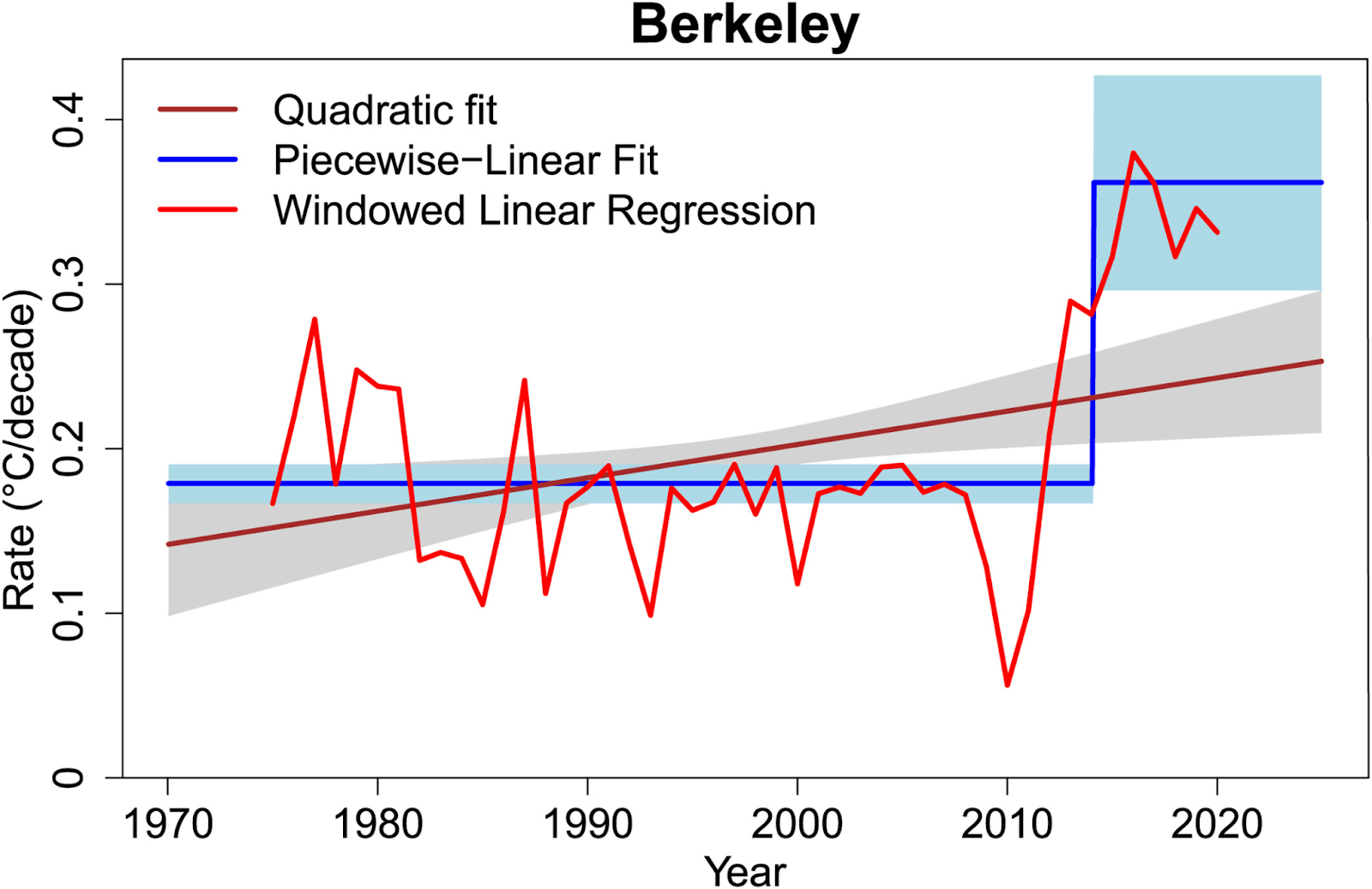
Given the assumptions made by the authors, this provides statistically robust evidence that acceleration has been detected. On first glance, this may be surprising or alarming as, to the zeroth order from our understanding of the Earth’s system’s response to CO2, we expect a roughly generally linear warming in GMT given the exponential rise in CO2 due to the log-scaling of GMT with CO2. Acceleration could be the result of the decrease of cooling anthropogenic forcings (as is hypothesized for some regional accelerations detected in Beaulieu et al. 2024) or substantial feedbacks/tipping points that are causing the Earth to warm faster than the simple CO2 forcing physics dictates. Note though that the climate models that are used to inform our future projections also expect an acceleration around now (of course, given the assumptions that went into them).
However, as the authors point out, their method of ‘removing’ ENSO could be improved (for instance, Compo and Sardeshmukh (2010)), and there is still some imprint of natural climate variability in their adjusted time series. Note that an estimate of the “true” natural variability of the climate system, and correspondingly the “true” forced response, is one of the white whale problems in climate science! FR26 does an credible, but necessarily imperfect, job of isolating the forced response, but don’t account for this uncertainty in their statistical tests.
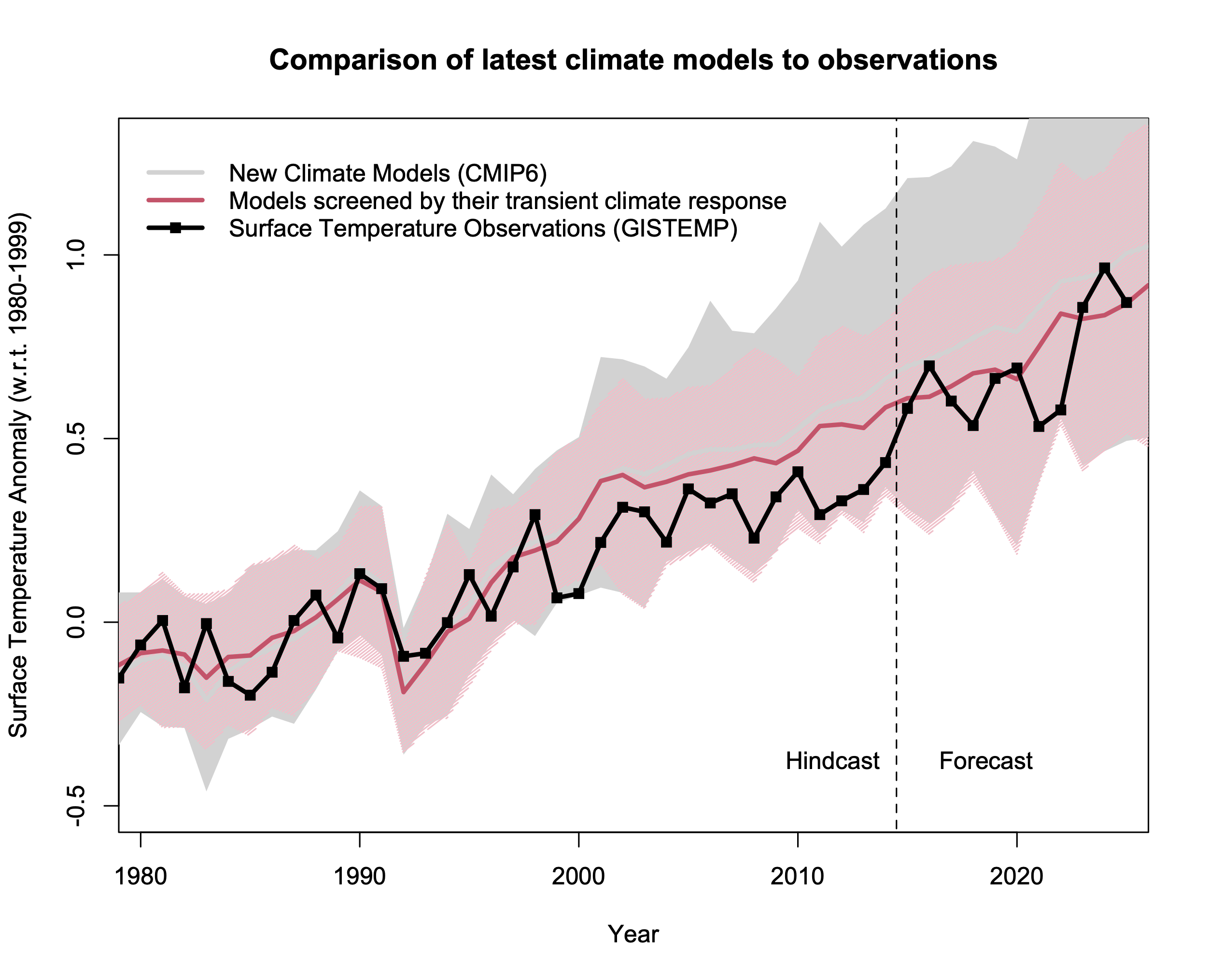
While we can’t know the true internal variability perfectly, we have climate models which provide an estimate of this variability. The figure below shows that the CMIP6 models (screened for a likely Transient Climate Response (TCE)) have a spread that fully contains the observed climate signal. Notably, the ensemble mean of these models demonstrates a slightly greater than linear warming (minus the effects 1991 eruption of Mount Pinatubo).
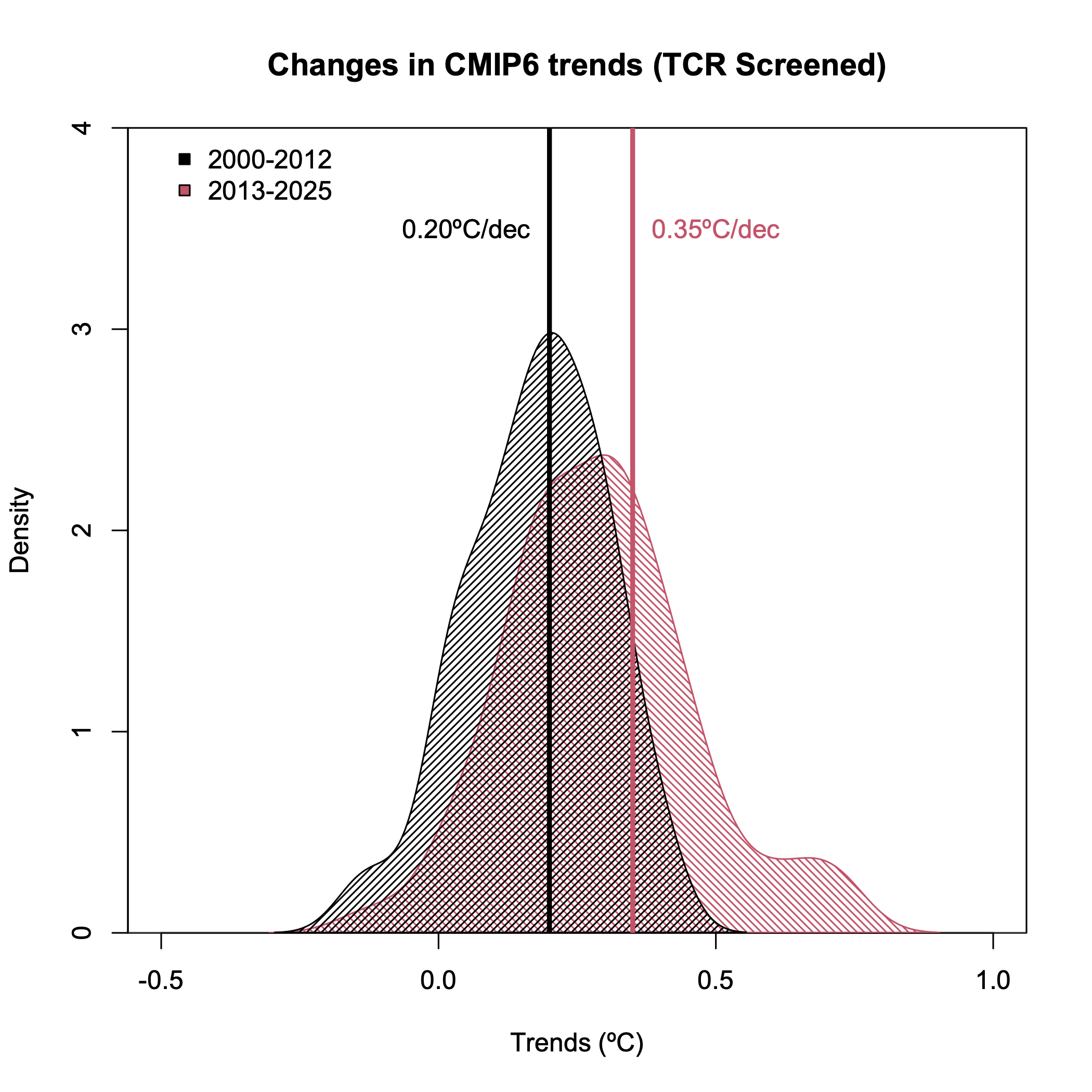
We can look at this more closely. If we look at the trends in individual model simulations for the last 13 years (2013-2025) and the 13 years before that (2000-2012), on average, the models show a slight acceleration over the same period highlighted by FR26 (0.18ºC to 0.30ºC). However, while there is a difference in the mean of these distributions, they are not clearly separate. This shows that, at least in model land, the acceleration in trend (given the internal variability and model uncertainty) is going to be difficult to detect. Note that comparisons between the models and the real world are complicated by any divergences in the forcings in the scenarios (designed more than 15 years ago) and what actually happened (Hunga Tonga, the IMO regulations, Chinese aerosol decreases etc.).
So where does this leave us? There is no detectable acceleration in the raw observed GMT, but there is an acceleration in GMT when removing the linear effects of ENSO, volcanoes, and solar variability, and there is slight acceleration in GMT when estimated using a multi-model ensemble of climate models. John Kennedy recently discussed some of these results in the context of FR26, expanding to a wider discussion of estimates of warming rate. He hits the nail on the head by pointing out two key open questions: “If there is an acceleration, what is physically driving it?” and “What will happen to the warming rate in the future?” The question about mechanism is key to trustworthy predictions of the future rate, and this is not addressed in the new paper.
The prediction of 1.5ºC warming by ~2030 made in FR26 is made in this context by estimating the rate of warming in this adjusted GMT. While made in the imperfect context discussed here, this estimate is reasonable when compared to a more comprehensive attempt to estimate this date . However, as John states, we already know the planet was warming, we have some evidence for acceleration, but we need a better path forward to predict how GMT and subsequent regional climate will change under continued CO2 emission
References
- G. Foster, and S. Rahmstorf, "Global Warming Has Accelerated Significantly", Geophysical Research Letters, vol. 53, 2026. http://dx.doi.org/10.1029/2025GL118804
- G. Foster, and S. Rahmstorf, "Global temperature evolution 1979–2010", Environmental Research Letters, vol. 6, pp. 044022, 2011. http://dx.doi.org/10.1088/1748-9326/6/4/044022
- C. Beaulieu, C. Gallagher, R. Killick, R. Lund, and X. Shi, "A recent surge in global warming is not detectable yet", Communications Earth & Environment, vol. 5, 2024. http://dx.doi.org/10.1038/s43247-024-01711-1
Foster, aka Tamino, has a post about thier work here, the closing paragraph is included below
https://tamino.wordpress.com/2026/03/07/global-warming-has-accelerated/
>”Which estimate is best? I don’t know, but I do know that even 0.24 °C per decade will take us past 2 °C right around the year 2050. The whole point of the Paris agreement is: DON’T GO THERE. My advice: fasten your seat belt, things are going to get ugly”
I thought the whole thing was based around shipping emissions cutting sulphur from the fuel and this means less radiation being reflected back to space and less cloud being formed as one aspect of the increased warming.
Increased methane emissions too means more short term warming
I wonder why the radiative power imbalance detected by CERES is not mentioned. It fits well to FR26. Are CERES findings considered as too uncertain – yes or no? If yes, this should be explicitly stated. Then, the lower albedo values from CERES are being caused by less low level clouds and partly by less direct sulfur reflection, afaik. So to say “We don’t know the reason.” and leaving the question open as if there hasn’t been important research already is a bit strange.
Hi Nathan,
In your Fig. 3, the skews for the earlier and later periods differ substantially–with the 2000-2012 skew being leftward and that from 2013-2024 being more pronounced and rightward. Can you estimate how much of the difference derives from the different skewing, and if you remove this, is the change still significant?
A minor correction. We didn’t actually predict that we’ll cross 1.5°C by 2030, we stated that IF we continue at the same pace as the last decade THEN we’ll cross 1.5°C by 2030. Whether or not we do so, depends crucially on why the last decade warmed so fast (we make no attempt to identify that) and whether or not we can cut CO2 emissions “significantly” in the next few years (I’m skeptical).
The press has emphasized “cross 1.5°C by 2030,” but I think what they should emphasize is faster warming, and that almost everybody expected faster warming, even before we published our paper. Some say it’s only 0.24°C per decade, some say 0.27, others estimate 0.30, but nobody I know still believes in the “slightly below 0.2°C per decade” that it was for nearly 40 years. More worrisome is the fact that even at low estimates (like 0.24°C) we’ll cross 2°C right around the year 2050.
Grant Foster (a.k.a. Tamino)
Thank you for including the assumptions and caveats relevant to this study. Those caveats and assumptions will be used against this report by your political opponents. However, it was the right thing to do. Congratulations and thank you for the hard work involved in this.
While some scientists are discussing the statistical details and finesses of this, the political juggernaut of fossil fuel addicted and sectarian-calvinist-zionist doomsday-christian/satanistic belief/dogma-driven US oligarchy has left the harbour and in it’s own kind of hitlerian runaway hubris started the third world war (the second fascist initiated, if one really can detect any significant and stable downturn in the relentless and totalitarian continuous warring since august 1945, which is at least highly debatable. It’s also plausible, as the world affairs have developed since 1914, that what we are seeing in fact is the same thing going on with the global population of homo sapiens, as with other local/regional animal populations when they cross the carrying capacity of their ecosystem niche and collapse. In fact many things point towards the conclusion that what we call capitalism is simply the collapse of mankind, mainly because it fell into a fatal ecological trap by expanding it’s consumption beyond sustainable limits by becoming addicted to “burning buried sunshine” (J. S. Dukes 2003) and other overuses of resources and thereby manipulating the global ecosystem over the edge to a degenerative collapse causing the sixth global extinction catastrophe for life on earth).
One result of this is for certain, that the Trump mafia regime has begun the systematical liquidation of science in favour of totalitarian, pseudoscientific myth-making, fascist style like the one known under Hitler as “german physics” (denial of Einstein’s theory of relativity by racist/anti-semitic “arguments” etc.) and under Stalin as lysenkoism (Stalin “confirmed” Trofim Lysenko’s denial of the darwinian theory by stalinist dogma, coupled to dogmatic conflicts in the ruling party around the development of agricultural production). This trend towards civilizational and cultural collapse was long in the making in the US, especially since Reagan came to power via the Iran-Contras trick/coup in kahoots with the Khomeiny regime 1979. No other country in the world today (maybe to a degree except some islamist countries?) fx. harbours a lot of anti-darwinian (and thus anti-geologic!) pseudo-scientific museums of biblical-dogmatic “natural history”. Of course this represents a long running and widespread anti-scientific and totalitarian tendency in the US. And if you don’t recognize scientific geological history/paleontology, it’s no wonder that you also don’t accept climate history and science. With Trump and pseudo-scientific nonsense as it is spread by the oligarchs Peter Thiel and Elon Musk in power, this has by now reached a highly critical stage.
The wise answer to this from the mainstream US science community, cannot be what the exiled historian Timothy Snyder precisely calls “to obey in advance”. But that is unfortunately exactly what the remaining feeble and opportunist Washington ruling leadership of the Democratic party around Kamala Harris and the Clintons, Hakim Jeffries etc. is doing: in fact they do obey Trump in advance, as does also the mainstream european NATO leadership. These “liberals” again and again believe that they can “talk it over” with Trump, even as the evidence for this being pure illusionism is by now long ago mounting sky-high. The result of this chamberlainian “strategy” is that the remaining pockets of democratic and scientific resistance to totalitarian oligarchy are being dismantled, faster and faster.
To conclude: I can’t avoid noticing, that the discussions going on here on Realclimate are being more and more narrowly focused on what to me seem like a kind of statistical escapism into petitesses from the bitter reality of the oligarchic-totalitarian crushing offensive which is by now succeding in rapidly destroying any vague remaining elements (there aren’t many) of climate policies around the world. To me this is just fiddling while Rome burns to the ground. It’s a blind alley for the attempts to stop the fossil fuel industry from destroying our common future. It’s simply irrelevant to the future of mankind, because *we will never be able to say exactly when the world crossed the fatal climatic (and ecosystemic!) tipping points to catastrophic collapse, before it’s far too late.
The attempt to avoid passing these tipping points by defining some “degree goals” has been a total political failure. It hasn’t achieved anything but Trump etc., because it’s far too abstract for most citizens to grasp. *Among the climate aware public it has mainly functioned as a distraction from the important issue: that we need to cut the use of fossil fuels as fast as possible*, and that *far more important than any degree measure of the pace of global heating is what the effects of a given amount of heating in fact are for nature and society: in wildfires, droughts, flooding, landslides, hurricanes, agricultural losses, epidemics etc.* That failed policy has alienated the main public from the important societal issues concerning global heating and energy use.
This statistical discussion has been and is now more than ever simply clouding that fatal political fact. namely that focussing on these degree goals creates the illusion that “there is still time to act”, as every UN leader has now been mechanically repeating for over forty years, of course without achieving anything but delivering eternal excuses for the politicians to continue with business as extremely usual, pleading that “at least we are doing something, and more than others” – which has always been a lie, a greenwashing of the in fact just stupid and denialist, opportunistic reality of mainstream – even socalled “green” – politics. Now we have just oligarchic-imperialist war, renewed armaments race just creating even more and deeper fossil fuel dependency, even more and faster environmental degradation etc. – which is of course exactly the central goal of the Trump, Putin, mideastern etc. fascist/totalitarian oligarchies, because they thrive on this deadly societal downward spiral into the abyss.
Time to wake up now. https://www.pnas.org/doi/10.1073/pnas.1810141115 . https://www.theguardian.com/environment/2026/feb/16/europe-climate-advisory-board-3c-global-heating – as if that was possible without societal collapse… but they simply don’t care – adapting to any heating was always the just slightly hidden goal behind fossil capitalist policy, because for the owners it’t only their profits that count. That we do know since Hitler and the activities in Auschwitz of IG Farben etc., since the Vietnam war, since the Gulf wars and other oil wars, the wars of Putin (now new ones!), the chinese attempts to conquer oil reserves in the South China Sea, the Taiwan Strait, the oil wars in Sudan, Nigeria etc. etc.
The common men have no choice. Their only chance is to fight oligarchy and fascism. In this existential fight for the survival of mankind, scientists have to choose which side they are on. If they don’t, merciless historical forces will do it for them anyway. As Timothy Snyder puts it: “Never obey in advance” is your only choice if you support freedom and not slavery.
https://agupubs.onlinelibrary.wiley.com/doi/full/10.1029/2021RG000757
https://m.youtube.com/watch?v=-zvAIuYOzU8
https://m.youtube.com/watch?v=tVFSJINGueM
https://m.youtube.com/watch?v=e2paRMQ1k6k
Time for who to wake up exactly – the political class who pander to voters who dont appear to be interested much.
You make some good points (in a looong screed). Really if the constitution of the US was working the way it was meant to the US wound have overthrown this ******* stupid dictator a long time ago. Instead it seems the “Right” foresaw that and figured sections of the lower class had to be softened up and dumbed down over the decades first. So now if the US tried to get rid of this Russia loving creep they risk civil war. Madman Putin is running the world.
Whoever among the gnostic foresaw this? Is there a, as you imply because we overshot our natural carrying capacity, a self-destructive species-limiting gene involved? Hmm…
So what’s the solution as far as the democratic world is concerned? They are trying the “wait him out” (hopeful) solution, praying that he won’t do too much damage before his time runs out. If they were asleep before I doubt they are now. Putin and T knowing this and knowing this is his last term are pulling out all the stops. Fascism’s last stand.
Don’t give up on the good people of the US. They are still “a light on the hill”.
—-
To be fair, there are a few good things that clownish or just cunning/evil T has done (likely for appearances sake to get more votes). Things that the ultra liberal and ultra compromising left didn’t try because they figured it might tick someone off. An obvious one is removal of artificial colors from foods, something the gutless left should have done a long time ago.
/this off topic discussion
Let us see if Stefan and Tamino have reached 95% in their latest work and now actuaries and the University of Exeter back it up.
https://actuaries.org.uk/media/isvotyer/parasol-lost.pdf
From this video:
https://youtu.be/e2paRMQ1k6k?si=BpH1y9GHfmRGiaHp
I’m on your side, but after a career spent trying to dissuade my colleagues from forcing data to fit their favorite model, when I look at your fits I am reminded that Paul Simon got it right: “A man sees what he wants to see…”
This is a bit misleading: while this study uses observational data, it modifies these observations through statistical filtering. Therefore, it is not a direct result of the observations, but rather a statistically reconstructed signal. Its robustness depends entirely on the validity of the corrections applied. This is not direct empirical evidence of climate acceleration; it is, once again, a statistical hypothesis obtained after removing MODELED natural phenomena !
Recently, Zeke Hausfather, PhD in climatology and researcher at the Breakthrough Institute, also expressed reservations regarding the study’s conclusions…