• Skip to primary navigation
  • Skip to main content
  • Skip to primary sidebar
  • Skip to footer

RealClimate

Climate science from climate scientists...

  • Start here
  • Model-Observation Comparisons
  • Miscellaneous Climate Graphics
  • Surface temperature graphics
You are here: Home / Archives for Climate Science / Greenhouse gases

Greenhouse gases

How much of the recent CO2 increase is due to human activities? L’accroissement du CO2 atmosphérique: sommes nous entièrement responsable?

7 Jun 2005 by group

Contributed by Corinne Le Quéré, University of East Anglia.

This question keeps coming back, although we know the answer very well: all of the recent CO2 increase in the atmosphere is due to human activities, in spite of the fact that both the oceans and the land biosphere respond to global warming. There is a lot of evidence to support this statement which has been explained in a previous posting here and in a letter in Physics Today . However, the most convincing arguments for scientists (based on isotopes and oxygen decreases in the atmosphere) may be hard to understand for the general public because they require a high level of scientific knowledge. I present simpler evidence of the same statement based on ocean observations, and I explain how we know that not only part of the atmospheric CO2 increase is due to human activities, but all of it.
Corinne Le Quéré, Université d’East Anglia.

C’est une question qui revient sans cesse, bien que nous connaissions déjà la réponse : nous sommes responsable de la totalité de l’accroissement récent du CO2 atmosphérique, et ceci, malgré le fait que les océans et la biosphère terrestre répondent tous deux aux changements de réchauffement global. Les évidences les plus convaincantes pour les scientifiques (basées sur le décroissement de l’oxygène et des isotopes du carbone) ont déja été expliquées dans une page précédente disponible ici et dans une lettre à la revue spécialisée Physics Today. Cependant, ces évidences peuvent être difficiles à saisir pour les non-spécialistes car elles requièrent des connaissances scientifiques importantes. Je présente ici des évidences plus simples qui mènent aux mêmes conclusions et qui expliquent comment on sait que nous sommes responsables non seulement d’une partie de l’accroissement récent du CO2 atmosphérique, mais de la totalité.
(suite…)


[Read more…] about How much of the recent CO2 increase is due to human activities? L’accroissement du CO2 atmosphérique: sommes nous entièrement responsable?

Filed Under: Climate Science, FAQ, Greenhouse gases, Oceans

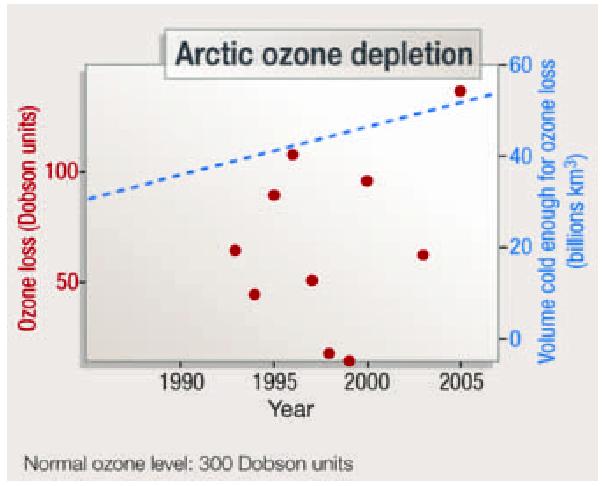
2005 Record Arctic Ozone Loss

6 May 2005 by group


You read it here first!


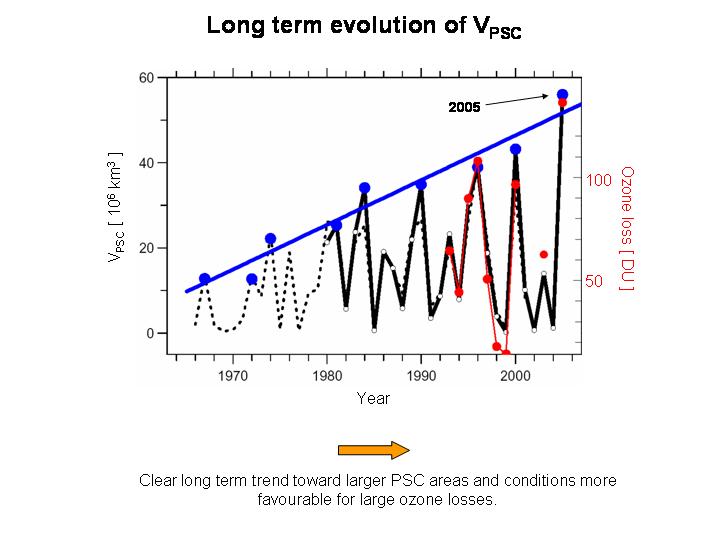
Update (09/05/05): Markus Rex was kind enough to send us the full figure from which Nature made their thumbnail, and which is a little clearer. He also cautions that the 2005 numbers are still preliminary, however there is a clear trend towards increasing potential for Arctic ozone loss, which is realised or not depending on the vagaries of each individual winter.

Filed Under: Arctic and Antarctic, Climate Science, Greenhouse gases

Planetary energy imbalance?

3 May 2005 by Gavin


The recent paper in Science Express by Hansen et al (on which I am a co-author) has garnered quite a lot of press attention and has been described as the ‘smoking gun’ for anthropogenic climate change. We have discussed many of the relevant issues here before, but it may be useful to go over the arguments again here.

The key points of the paper are that: i) model simulations with 20th century forcings are able to match the surface air temperature record, ii) they also match the measured changes of ocean heat content over the last decade, iii) the implied planetary imbalance (the amount of excess energy the Earth is currently absorbing) which is roughly equal to the ocean heat uptake, is significant and growing, and iv) this implies both that there is significant heating “in the pipeline”, and that there is an important lag in the climate’s full response to changes in the forcing.

[Read more…] about Planetary energy imbalance?

Filed Under: Climate modelling, Climate Science, Greenhouse gases, Oceans

Pollution-Climate Connections Liens entre Pollution et Climat

26 Apr 2005 by group

Guest commentary by Loretta Mickley, Harvard University

Every summer over much of the United States, we brace ourselves for heat waves. During these periods, the air turns muggy and usually smoggy. After a few days, a cold front moves in, sweeping away the pollution and ending the heat. Given that we are on a path towards global warming, atmospheric chemists are asking how climate change could affect air quality. Will warmer temperatures mean more pollution during these episodes? Will episodes last longer? Most importantly, what effect will changes in air quality have on human health?
Article invité par Loretta Mickley, Harvard University (Traduit par Pierre Allemand)

Tous les étés, dans la plupart des régions des USA, nous nous préparons aux vagues de chaleur. Pendant ces périodes, l’air devient très humide et généralement brumeux. Après quelques jours, un front froid survient, balayant la pollution et mettant fin à la chaleur. Etant donné que nous nous acheminons vers un réchauffement global, les spécialistes de la chimie de l’atmosphère se demandent de quelle façon le changement climatique pourrait affecter la qualité de l’air. Des températures plus élevées signifieront-elles plus de pollution durant ces épisodes ? Ces épisodes dureront-ils plus longtemps ? Plus important : quels sont les effets des changements dans la qualité de l’air sur la santé humaine ?
(suite…)

[Read more…] about Pollution-Climate Connections Liens entre Pollution et Climat

Filed Under: Aerosols, Climate modelling, Climate Science, Greenhouse gases

Ozone depletion and global warming Perte d’ozone et réchauffement climatique Ozon Azalması ve Küresel Isınma

14 Apr 2005 by Gavin

One of the most common mistakes that we have observed in discussions of climate and atmospheric change is confusion between the rather separate concepts of ozone depletion and global warming. This isn’t necessarily surprising given the scant information that most people pick up from the media. However, for many years meteorologists have been fighting a rearguard action to persuade people that the globe isn’t warming because there is more sun coming through the ozone hole. There are however important connections between the two issues that complicate potential actions that we might take to alleviate the different problems. This week, for instance, a new IPCC report was released that looked at the greenhouse warming potential of many of the replacement chemicals (HFCs and HCFCs) that were used to replace CFCs in aerosol cans and refrigeration units under the Montreal Protocol (and subsequent amendments).
par Gavin Schmidt, traduit par Vincent Noel

Dans le débat sur le changement climatique, l’une des erreurs les plus courantes est la confusion entre la diminution de l’ozone et le réchauffement planétaire. Ceci n’est pas vraiment surprenant, compte tenu de la qualité discutable des informations propagées par les medias.

Depuis plusieurs années maintenant, les climatologues et météorologues tentent d’expliquer au public que si la planète se rechauffe, ce n’est pas parce qu’il y a davantage de rayonnement solaire qui passe par le trou dans la couche d’ozone. Les deux phénomenes sont cependant étroitement liés, ce qui complique l’adoption d’une stratégie pour s’attaquer à l’un ou l’autre de ces problèmes. Cette semaine, par exemple, un nouveau rapport de l’IPCC s’est interessé au possible effet de serre des produits chimiques (HCF et HCFC) utilisés pour remplacer les CFC dans les bombes aérosols et les systèmes de refroidissement dans le cadre du protocole de Montréal (et de ses amendements).

(suite…)

[Read more…] about Ozone depletion and global warming Perte d’ozone et réchauffement climatique Ozon Azalması ve Küresel Isınma

Filed Under: Climate Science, Greenhouse gases

Water vapour: feedback or forcing?

6 Apr 2005 by Gavin

Whenever three or more contrarians are gathered together, one will inevitably claim that water vapour is being unjustly neglected by ‘IPCC’ scientists. “Why isn’t water vapour acknowledged as a greenhouse gas?”, “Why does anyone even care about the other greenhouse gases since water vapour is 98% of the effect?”, “Why isn’t water vapour included in climate models?”, “Why isn’t included on the forcings bar charts?” etc. Any mainstream scientist present will trot out the standard response that water vapour is indeed an important greenhouse gas, it is included in all climate models, but it is a feedback and not a forcing. From personal experience, I am aware that these distinctions are not clear to many, and so here is a more in-depth response (see also this other attempt).

Eine Übersetzung in deutsch finden Sie hier.
[Read more…] about Water vapour: feedback or forcing?

Filed Under: Climate modelling, Climate Science, FAQ, Greenhouse gases

How long will global warming last? Pendant combien de temps le réchauffement global persistera-t-il ?

15 Mar 2005 by david

Guest commentary from David Archer (U. Chicago)

The notion is pervasive in the popular and scientific literature that the lifetime of anthropogenic CO2 released to the atmosphere is some fuzzy number measured most conveniently in decades or centuries. The reality is that the CO2 from a gallon out of every tank of gas will continue to affect climate for tens and even hundreds of thousands of years into the future.


Commentaire invité par David Archer (Univ. Chicago) (traduit par Thibault de Garidel)

La notion que la durée de vie du CO2 émis dans l’atmosphère par l’action humaine se situe entre quelques décennies � quelques siècles, est omniprésente dans les revues de vulgarisation scientifique ainsi que celles spécialisées. La réalité est que chaque litre de pétrole que nous utilisons en faisant le plein de notre voiture continuera � affecter le climat pendant les prochaines dizaines et mêmes centaines de milliers d’années.

(suite…)

[Read more…] about How long will global warming last? Pendant combien de temps le réchauffement global persistera-t-il ?

Filed Under: Climate Science, Greenhouse gases, Paleoclimate

Strange Bedfellows En Etrange Compagnie

8 Feb 2005 by Gavin

Here’s a curious observation. Some commentators who for years have been vocally decrying the IPCC consensus are lining up to support the ‘Ruddiman’ hypothesis. A respected paleoceanographer, Bill Ruddiman has recently argued that humans have been altering the level of important greenhouse gases since the dawn of agriculture (5 to 8000 years ago), and in so doing have prevented a new ice age from establishing itself. This intriguing idea is laid out in a couple of recent papers (Ruddiman, 2003; Ruddiman et al, 2005) and has received a fair degree of media attention (e.g. here, and here).


par Gavin Schmidt (traduit par Thibault de Garidel)

Voici une curieuse observation. Les mêmes commentateurs qui pendant des années ont décrié le consensus autour du GIEC s’alignent désormais pour soutenir l’hypothèse dite de ‘Ruddiman’. Bill Ruddiman, un paléocéanographe respecté, a en effet récemment suggéré que l’action humaine avait changé la concentration de certains gaz à effet de serre, depuis le développement de l’agriculture (il y a 5 à 8000 ans), empêchant ainsi la mise en place d’une nouvelle période glaciaire. Cette idée intrigante est présentée dans deux articles récents ( Ruddiman, 2003 ; Ruddiman et autres, 2005 ), et a suscité depuis une certaine attention des médias (voir par exemple ici , et ici ).
(suite…)

[Read more…] about Strange Bedfellows En Etrange Compagnie

Filed Under: Climate Science, Greenhouse gases, Paleoclimate

Exeter conference: Avoiding Dangerous Climate Change Conférence d’Exeter (G-B): éviter un changement climatique dangereux

7 Feb 2005 by group

The conference last week in Exeter on “Avoiding Dangerous Climate Change” grew out of a speech by UK Prime Minister Tony Blair. He asked “What level of greenhouse gases in the atmosphere is self-evidently too much?” and “What options do we have to avoid such levels?”. The first question is very interesting, but also very difficult. As Roger Pielke has noted the conference organisers actually choose three “key questions”:

  1. For different levels of climate change what are the key impacts, for different regions and sectors, and for the world as a whole?
  2. What would such levels of climate change imply in terms of greenhouse gas stabilisation concentrations and emission pathways required to achieve such levels?
  3. What technological options are there for achieving stabilisation of greenhouse gases at different stabilisation concentrations in the atmosphere, taking into account costs and uncertainties?

It is worth thinking about the difference between the initial aim and the “key questions” chosen. Question 1 is essentially IPCC WGII impacts); question 2 is firmly WGI (how-much-climate-change); question 3 is fairly WG III (mitigation, including technical options). I guess they switched questions 1 and 2 round to avoid making the identification too obvious. The conference steering committee report makes it very clear that they are building on the IPCC TAR foundation.


Par William Connoley (traduit par Thibault de Garidel)

La conférence ayant eu lieu la semaine dernière à Exeter intitulée “Eviter un changement climatique dangereux” a pour origine un discours du premier ministre britannique Tony Blair. Celui-ci avait alors posé deux questions “quel niveau de concentration de gaz à effet de serre dans l’atmosphère peut être considéré comme excessif ?” et “quelles options avons-nous pour éviter de tels niveaux ?”. La première question est très intéressante, mais également problématique. Comme Roger Pielke l’a noté, les organisateurs de cette conférence ont en fait choisi trois “questions principales” :

1. Pour différents niveaux de changement climatique, quels sont les impacts principaux, pour les différentes régions et secteurs, et pour le monde entier ?
2. Pour que de tels niveaux de changement climatique soient atteints, quelles sont les implications en terme de stabilisation des concentrations en gaz à effet de serre, et des options d’émission ?
3. Quelles options technologiques existent pour arriver à stabiliser les gaz à effet de serre à différentes concentrations, en tenant compte des coûts et incertitudes?

(suite…)

[Read more…] about Exeter conference: Avoiding Dangerous Climate Change Conférence d’Exeter (G-B): éviter un changement climatique dangereux

Filed Under: Climate modelling, Climate Science, Greenhouse gases

11ºC warming, climate crisis in 10 years? 11ºC de réchauffement, une crise climatique dans 10 ans ?

29 Jan 2005 by Gavin

by Gavin Schmidt and Stefan Rahmstorf

Two stories this week, a paper in Nature (Stainforth et al, 2005) describing preliminary results of the climateprediction.net experiments, and the Meeting the Climate Challenge report from a high level political group have lead to dramatic headlines. On the Nature paper, BBC online reported that “temperatures around the world could rise by as much as 11ºC “; on the latter report it headlined: “Climate crisis near ‘in 10 years’”. Does this mean there is new evidence that climate change is more serious than previously thought? We think not.


par Gavin Schmidt et Stefan Rahmstorf (traduit par Thibault de Garidel et Gilles Delaygue)

Deux travaux sortis cette semaine, un papier publié dans Nature (Stainforth et al., 2005) décrivant des résultats préliminaires de l’expérience climateprediction.net, et le rapport Meeting the Climate Challenge d’un groupe politique, ont mené à des titres catastrophistes dans les médias. Sur l’article de Nature, BBC on line indique que les “températures globales pourraient s’élever de près de 11ºC”; sur le second rapport il est écrit: “Une crise climatique proche pour dans 10 ans”. [N-d-T. : Voir également Le Monde : Un réchauffement climatique de plus de 6ºC n’est plus à exclure ; Libération : Prédire chez soi]. Cela signifie-t-il que de nouvelles preuves montrent un changement climatique plus sérieux que précédemment estimé ? Nous ne le pensons pas.

(suite…)

[Read more…] about 11ºC warming, climate crisis in 10 years? 11ºC de réchauffement, une crise climatique dans 10 ans ?

Filed Under: Climate modelling, Climate Science, Greenhouse gases, Paleoclimate

  • « Go to Previous Page
  • Page 1
  • Interim pages omitted …
  • Page 13
  • Page 14
  • Page 15
  • Page 16
  • Page 17
  • Go to Next Page »

Primary Sidebar

Search

Search for:

Email Notification

get new posts sent to you automatically (free)
Loading

Recent Posts

  • Scenarios, schmenarios…
  • Unforced Variations: May 2026
  • Unforced Variations: Apr 2026
  • A reflection on reflection
  • Spencer’s Shenanigans: Part II
  • The Puzzling Pleistocene

Our Books

Book covers
This list of books since 2005 (in reverse chronological order) that we have been involved in, accompanied by the publisher’s official description, and some comments of independent reviewers of the work.
All Books >>

Recent Comments

  • Thomas Fuller on Scenarios, schmenarios…
  • Tomáš Kalisz on A reflection on reflection
  • jgnfld on A reflection on reflection
  • Charles Hett on Scenarios, schmenarios…
  • Bart Verheggen on Scenarios, schmenarios…
  • Yebo Kando on Scenarios, schmenarios…
  • Ray Ladbury on A reflection on reflection
  • Robert Cutler on A reflection on reflection
  • Ray Ladbury on A reflection on reflection
  • Ray Ladbury on Scenarios, schmenarios…
  • Martin Smith on A reflection on reflection
  • Robert Cutler on A reflection on reflection
  • Joke Zonderkop on Scenarios, schmenarios…
  • prl on Unforced Variations: May 2026
  • Nigelj on A reflection on reflection
  • jgnfld on Scenarios, schmenarios…
  • Tomáš Kalisz on A reflection on reflection
  • Yebo Kando on Scenarios, schmenarios…
  • Dan Miller on Scenarios, schmenarios…
  • Robert Cutler on A reflection on reflection
  • Paul Pukite (@whut) on A reflection on reflection
  • zebra on Scenarios, schmenarios…
  • iännis Roland on Scenarios, schmenarios…
  • Roger Pielke Jr on Scenarios, schmenarios…
  • Martin Smith on A reflection on reflection
  • Graham Townsend on Scenarios, schmenarios…
  • Joke Zonderkop on Scenarios, schmenarios…
  • MEV on Scenarios, schmenarios…
  • jgnfld on A reflection on reflection
  • Secular Animist on Scenarios, schmenarios…

Footer

ABOUT

  • About
  • Translations
  • Privacy Policy
  • Contact Page
  • Login

DATA AND GRAPHICS

  • Data Sources
  • Model-Observation Comparisons
  • Surface temperature graphics
  • Miscellaneous Climate Graphics

INDEX

  • Acronym index
  • Index
  • Archives
  • Contributors

Realclimate Stats

1,406 posts

15 pages

251,601 comments

Copyright © 2026 · RealClimate is a commentary site on climate science by working climate scientists for the interested public and journalists.