Michael Mann & Gavin Schmidt
The precise factors underlying the so-called “Little Ice Age” (LIA) have been intensely debated within the scientific community. One key metric in this debate is the spatial pattern of cooling which may provide a ‘fingerprint’ of the underlying climate change, whether that was externally forced (from solar or volcanic activity) or was part of an intrinsic mode of variability.
Surface temperatures in parts of Europe appear to have have averaged nearly 1°C below the 20th century mean during multidecadal intervals of the late 16th and late 17th century (and with even more extreme coolness for individual years), though most reconstructions indicate less than 0.5°C cooling relative to 20th century mean conditions for the Northern Hemisphere as a whole. There is much less data during these time intervals for the Southern Hemisphere, and that severely limits what conclusions can be drawn there. Just what combination of factors could explain this pattern of observations has remained somewhat enigmatic. A new ingredient in this debate comes with a recent paper in Nature by Lund et al.
More »
In the wake of the NY times editorial yesterday, we’ve been asked to provide a link to the Amicus Curiae (draft) written by David Battisti, Christopher Field, Inez Fung, James E. Hansen, John Harte, Eugenia Kalnay, Daniel Kirk-Davidoff, James C. Mcwilliams, Jonathan T. Overpeck, F. Sherwood Rowland, Joellen Russell, Scott R. Saleska, John M. Wallace and Steven C. Wofsy in the current Supreme Court case (Commonwealth of Massachusetts et al vs. US EPA et al). Some discussion of this statement is also available at Prometheus.
Update: The actual brief (of which the first link was a draft) is available here (see comments below).
Update 2: We also note that on the final brief, Mario Molina, Ed Sarachik, Bill Easterling, and Pam Matson were additional signers.
Gavin Schmidt & Michael Mann
Extending the instrumental record of climate beyond the late 19th Century when many of the national weather centers were first started is an important, difficult and undervalued task. It often is more akin to historical detective work than to climatology and can involve long searches in dusty archives, the ability to read archaic scripts and handwriting, and even Latin translations (for instance, when going through the archives of the Paris Observatory) (sounds like a recent bestseller, only less lucrative, no?).
More »

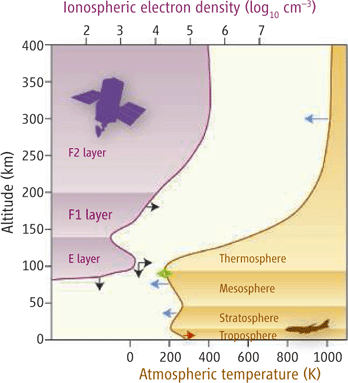
A timely perspective article in Science this week addresses the issues of upper atmosphere change. ‘Upper’ atmosphere here is the stratosphere up to the ionosphere (~20 to 300 km). Laštovička et al point out that cooling trends are exactly as predicted by increasing greenhouse gas trends, and that the increase in density that this implies is causing various ionspheric layers to ‘fall’. This was highlighted a few years back by Jarvis et al (1998) and in New Scientist in 1999 (and I apologise for stealing their headline!).
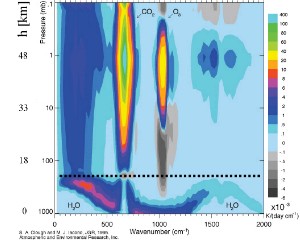
The changes in the figure are related to the cooling seen in the lower stratospheric MSU-4 records (UAH or RSS), but the changes there (~ 15-20 km) are predominantly due to ozone depletion. The higher up one goes, the more important the CO2 related cooling is. It’s interesting to note that significant solar forcing would have exactly the opposite effect (it would cause a warming) – yet another reason to doubt that solar forcing is a significant factor in recent decades.
Update: The best explanation for the cooling trends can be found on ESPERE, in particular, figure 3.