A lot has been made of a paper (Lyman et al, 2006) that appeared last year that claimed that the oceans had, contrary to expectation, cooled over the period 2003-2005. At the time, we (correctly) pointed out that this result was going to be hard to reconcile with continued increases in sea level rise (driven in large part by thermal expansion effects), and that there may still be issues with way that the new ARGO floats were being incorporated into the ocean measurement network. Now it seems as if there is a problem in the data and in the latest analysis, the cooling has disappeared.
Ocean heat content changes are potentially a great way to evaluate climate model results that suggest that the planet is currently significantly out of equilibrium (i.e. it is absorbing more energy than it is emitting). However, the ocean is a very big place and the historical measurement networks are plagued with sampling issues in space and time. Large scale, long term compilations globally (such as by Levitus et al, 2001; Willis et al, 2004) and regionally (i.e. North Atlantic) have indicated that the oceans have warmed in recent decades at pretty much the rate the models expected.
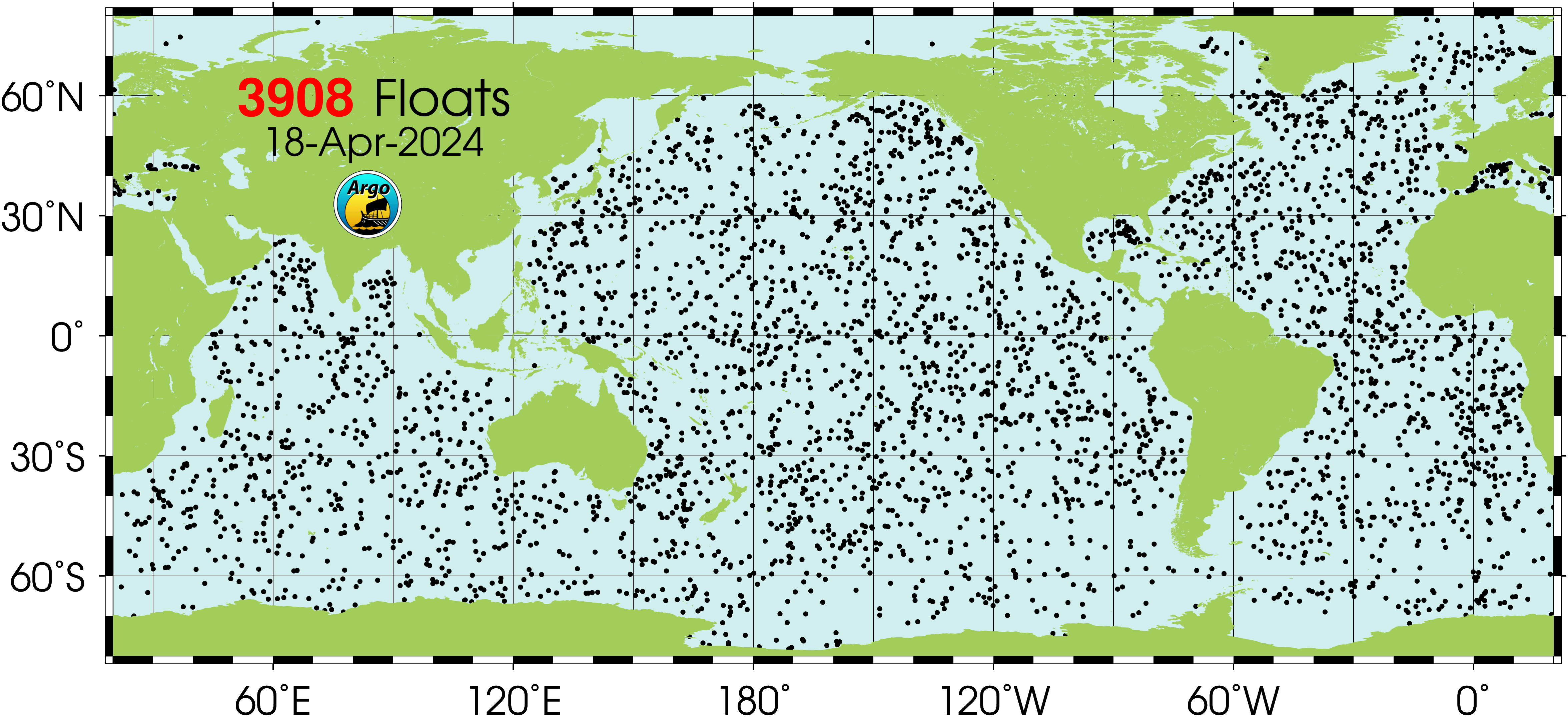 Since 2000, though, ARGO – which is a network of floats that move up and down in the ocean and follow the currents – has offered the potential to dramatically increase the sampling density in the ocean and provide, pretty much for the first time, continuous, well spaced data from the least visited, but important parts of the world (such as the Southern Oceans). Data on ocean heat content from these floats had been therefore eagerly anticipated.
Initial ARGO measurements were incorporated into the Willis et al, 2004 analysis, but as the ARGO data started to dominate the data sources from around 2003, Lyman et al reported that the ocean seemed to be cooling. These were only short term changes, and while few would confuse one or two anomalous years with a long term trend, they were a little surprising, even if they didn’t change the long term picture very much.
The news this week though is that all of that ‘cooling’ was actually due to combination of a faulty pressure reading on a subset of the floats and a switch between differently-biased observing systems (Update: slight change in wording to better reflect the paper). The pressure error meant that the temperatures were being associated with a point higher in the ocean column than they should have been, and this (given that the ocean cools with depth) introduced a spurious cooling trend when compared to earlier data. This error may be fixable in some cases, but for the time being the suspect data has simply been removed from the analysis. The new results don’t show any cooling at all.
Are we done then? Unfortunately no. Because of the paucity of measurements, assessments of ocean heat content need to use a wide variety of sensors, each with their own quirks and problems. Combined with switches in data sources over the years, there is a significant potential for non-climatic trends to creep in. In particular, the eXpendable BathyThermographs (XBTs – sensors that are essentially just thrown off the side of the ship) have a known problem in that they didn’t fall as quickly as they were originally assumed to. This gives a warm bias (see this summary from Ingleby and Palmer or the paper by Gouretski and Koltermann) , particularly in data from the 1970s before corrections were fully implemented. We are still going to have to wait for the ‘definitive’ ocean heat content numbers, however, it is important to note that all analyses give long term increases in ocean heat content – particularly in the 1990s – whether they include the good ARGO data or exclude the XBTs or not).
There are a number of wider lessons here:
- New papers need to stand the test of time before they are uncritically accepted.
- The ARGO float data are available in near real-time, and while that is very useful, any such data stream is always preliminary.
- The actual problem with these data was completely unknowable when Lyman et al wrote their paper. This is in fact very common given the number of steps required to create global data sets. Whether it’s an adjustment of the orbit of a satellite, a mis-calibration of a sensor, an unrecorded shift in station location, a corruption of the data logger or a human error, these problems often only get fixed after a lot of work.
- Anomalous results are often the driver of fundamental shifts in scientific thinking. However, most anomalous results end up being resolved much more straightforwardly (as in the case, or the MSU satellite issue a couple of years back).
Scientists working in a field build up a certain intuition about how things ‘work’. This intuition can come from a gut instinct, deep theoretical understanding, robust model results, long experience with observations etc. New results that fall outside of that framework often have a tough time getting accepted, but if they are solid and get subsequent support they will generally be incorporated. But that intuition is also very good at detecting results that just don’t fit. When that happens, scientists spend a lot of time thinking about what might be wrong – with the data, the analysis, the model or the interpretation. It generally pays to withhold judgment until that process is finished.
últimas análises, o resfriamento desapareceu.
Mudanças no conteúdo calórico dos oceanos são potencialmente uma ótima maneira de avaliar resultados de modelos climáticos que sugerem que o planeta está atualmente fora de equilíbrio (isto é, está absorvendo mais energia que emitindo). Entretanto, os oceanos são muito extensos e as redes de medidas históricas estão infestadas com problemas de amostragem no tempo e espaço. Compilações de longa duração e em grandes escalas globais (como as de Levitus et al, 2001; Willis et al, 2004) e regionais (i.e. Atlântico Norte) indicaram que os oceanos aqueceram-se em décadas recentes mais ou menos na taxa esperada pelos modelos.
Desde 2000, entretanto, ARGO – que é uma rede de bóias que se movem para cima e para baixo nos oceanos e seguem as correntes – ofereceram o potencial de aumentar dramaticamente a densidade de amostragem nos oceanos e de fornecer, pela primeira vez, dados contínuos e bem espaçados das regiões menos visitadas mas muito importantes do planeta (como os oceanos do sul). Dados sobre o conteúdo calórico dos oceanos eram conseqüentemente ansiosamente esperados.
Medidas iniciais ARGO foram incorporadas na análise de 2004 de Willis et al, mas a medida que os dados ARGO passaram a dominar as fontes de dados em torno de 2003, Lyman et al relataram que os oceanos pareciam estar se resfriando. Estas eram apenas mudanças de curto prazo, e enquanto poucos iriam confundir um ou dois anos anômalos com uma tendência de longo prazo, elas eram um pouco surpreendentes, mesmo considerando que o panorama de longo prazo era pouco modificado
A notícia esta semana é, no entanto, que todo aquele ‘resfriamento’ era na realidade devido à combinação de uma leitura de pressão defeituosa num subconjunto das bóias e a uma troca entre sistemas de observação com diferentes tendências. (Atualização:
leve mudança no palavreado para melhor refletir o paper). O erro na pressão significou que as temperaturas estavam sendo associadas com um ponto mais elevado na coluna oceânica do que deveria ser, e isto (dado que o oceano resfria-se com a profundidade) introduziu uma tendência de resfriamento espúria quando comparada com dados anteriores. Este erro pode ser corrigido em alguns casos, mas por enquanto os dados suspeitos foram simplesmente retirados da análise. Os novos resultados não mostram assim nenhum resfriamento.
Está tudo então no lugar novamente? Infelizmente não. Por causa da escassez de dados, levantamentos do conteúdo calórico dos oceanos devem utilizar uma ampla variedade de sensores, cada um com suas próprias peculiaridades e problemas. Tudo isto combinado com mudanças nas fontes de dados ao longo dos anos, há então um grande potencial para tendências não-climáticas aparecerem. Em particular, os eXpendable BathyThermographs (XBTs – sensores que são simplesmente jogados de um navio) têm um problema conhecido no fato de que estes não caem tão depressa quanto supostamente deveriam. Isto gera uma tendência de aquecimento (veja este resumo de Ingleby e Palmer ou o trabalho de Gouretski e Koltermann), particularmente nos dados dos anos 70, antes das correções terem sido plenamente implementadas. Nós teremos ainda que esperar pelos números ‘definitivos’ do conteúdo calórico dos oceanos, entretanto, é importante notar que todas as analises fornecem tendências de aquecimento no longo prazo – particularmente nos anos 90 – seja se elas incluem os dados ARGOS bons ou excluem as XBTs ou não).
Há aqui um número de importantes lições a serem tiradas:
- Novos trabalhos científicos devem passar pelo teste do tempo antes de serem aceitos sem nenhuma crítica.
- Os dados de bóias ARGO estão disponíveis em tempo quase real, e apesar disto ser extremamente útil, todo conjunto de dados deste tipo é sempre preliminar.
- O problema real com estes dados era completamente desconhecido quando Lyman et al escreveram seu artigo. Este fato é muito comum dado o número de etapas necessárias para criar conjuntos de dados globais. Seja um ajuste na órbita de um satélite, a descalibração de um sensor, um desvio despercebido na localização de uma estação, a degradação de um armazenador de dados ou um erro humano, estes problemas são frequentemente corrigidos apenas após muito trabalho.
- Resultados anômalos são frequentemente responsáveis por mudanças fundamentais no pensamento científico. Entretanto, a maior parte dos resultados anômalos terminam por serem explicados de uma maneira muito mais simples (como no caso em questão, ou o caso do satélite MSU há alguns anos).
Cientistas que trabalham num determinado campo de atividades desenvolvem uma certa intuição a respeito de como as coisas ‘funcionam’. Esta intuição vem de um certo faro, um profundo conhecimento teórico, resultados robustos de modelos, uma longa experiência com observações, etc. Novos resultados que caem fora dos padrões pré-estabelecidos freqüentemente enfrentam dificuldades para serem aceitos, mas se eles são sólidos e obtêm apoio subseqüente, eles geralmente são incorporados. Mas aquela intuição é também muito boa para detectar resultados que simplesmente não se encaixam. Quando isto acontece, cientistas gastam muito tempo pensando no que pode ter dado errado – com os dados, a análise, o modelo ou a interpretação. Geralmente é recompensador não emitir nenhum julgamento até que este processo tenha terminado.
traduzido por Fernando M. Ramos e Ivan B. T. Lima
Traduit par Etienne Pesnelle
L’analyse des variations de la quantité de chaleur océanique est potentiellement une méthode importante pour contrôler les résultats des modèles climatiques qui suggèrent que la planète n’est pas actuellement en état d’équilibre (c’est-à-dire qu’elle absorbe plus d’énergie qu’elle n’en émet). Toutefois, l’océan est un endroit très vaste et les anciens réseaux de mesure océanique sont la proie d’erreurs d’échantillonnage spatial et temporel. Les compilations à grande échelle et sur de longues périodes, qu’elles soient mondiales (comme celle de Levitus et al, 2001 ou Willis et al, 2004) ou régionales (par exemple dans l’Atlantique Nord) indiquent que les océans se sont réchauffés durant les dernières décennies, quasiment à la vitesse donnée par les modèles.
Depuis 2000, cependant, ARGO – un réseau de bouées qui montent et descendent dans les profondeurs océaniques et qui suivent les courants – a offert la possibilité d’augmenter spectaculairement la densité d’échantillonnage océanique et de fournir, quasiment pour la première fois, des données continues et bien espacées en provenance d’endroits parmi les moins visités mais néanmoins importants (comme le Sud des océans Atlantique et Pacifique). Les mesures de quantité de chaleur océanique en provenance de ces bouées étaient donc attendues avec impatience.
Les mesures initiales fournies par ARGO ont été intégrées dans l’analyse 2004 de Willis et al, mais comme ARGO a commencé à dominer les sources de données à partir de 2003 environ, Lyman et al ont constaté que l’océan semblait se refroidir. C’était seulement des évolutions à court terme, et même si peu de personnes confondent une ou deux années anormales avec une tendance à long terme, ces évolutions étaient un peu surprenantes, même si elles ne modifiaient pas beaucoup la vision à long terme.
Quant à la nouvelle de la semaine, c’est que tout ce “refroidissement” était en fait dû à la combinaison de mauvaises mesures de pression sur un sous-ensemble de bouées et d’un basculement entre deux systèmes de mesures présentant des distortions différentes (mise à jour : petite modification de forme pour mieux refléter l’article). L’erreur de pression signifiait que les températures mesurées étaient associées à un point situé plus haut qu’il n’aurait dû être dans la colonne d’eau, et que (comme l’océan se refroidit au fut et à mesure qu’on descend) cela a introduit une tendance fallacieuse au refroidissement quand on a comparé les mesures à des données plus anciennes. Cette erreur peut être réparée dans certains cas, mais pour l’instant les données suspectes ont été simplement retirées de l’analyse. Les nouveaux résultats ne montrent pas de refroidissement du tout.
Alors, c’est tout ? Malheureusement non. A cause du manque de mesures, l’évaluation de la quantité de chaleur océanique nécessite d’utiliser une large palette de capteurs, chacun ayant son lot de caprices et de problèmes. En y ajoutant des changements de sources de données au fil des ans, cela donne beaucoup de possibilités à des tendances non-climatiques d’entrer discrètement. En particulier, les bathythermographes extensibles (en anglais BathyThermographs ou XBT ; en gros ce sont des capteurs qui sont jetés par
dessus bord) présentent un défaut connu, à savoir qu’ils ne coulent pas aussi rapidement que prévu. Cela “réchauffe” les mesures (voir ce résumé d’Ingleby et Palmer, ou bien l’article de Gouretski et
Koltermann), notamment celles des années 1970, avant que les corrections aient été effectuées. Nous sommes toujours à attendre les chiffres “définitifs” de la quantité de chaleur océanique, cependant il est important de noter que toutes les analyses donnent des augmentations à long terme de la quantité de chaleur océanique – notamment dans les années 1990 – qu’on inclut les bonnes données ARGO ou qu’on exclut les XBT ou non.
Il y a un certain nombre de leçons à tirer de cela :
- les nouveaux articles doivent résister à l’épreuve du temps avant d’être acceptés sans critique ;
- les données des bouées ARGO sont disponibles en quasi-temps réel, et bien que ce soit très pratique, un tel flux de données est toujours un préalable à l’analyse ;
- il était impossible de s’apercevoir de ce qui entachait ces données quand Lyman et al ont écrit leur article. Cela est très courant, compte tenu du nombre d’étapes nécessaires pour créer une base de données mondiale. Que ce soit le mauvais ajustement de l’orbite d’un satellite, la mauvaise calibration d’un capteur, un décalage non identifié de la localisation d’une station, la corruption d’un journal de bord ou une erreur humaine, ces problèmes ne sont souvent corrigés qu’après beaucoup de travail.
- Des résultats anormaux sont souvent les moteurs de changements fondamentaux de la rélflexion scientifique. Cependant, la plupart des résultats anormaux finissent par être résolus de façon beaucoup plus directe (comme c’est le cas ici, ou dans l’incident du satellite MSU il y a deux ans de cela)
Les scientifiques qui travaillent dans un domaine donné se construisent une certaine intuition sur la façon dont les choses “fonctionnent”. Cette intuition peut venir des tripes, d’une compréhension profonde de la théorie, de résultats robustes de modélisations, d’une longue expérience de l’observation, etc. De nouveaux résultats qui tombent en dehors du cadre mettent souvent beaucoup de temps à être acceptés, mais s’ils sont solides et s’ils obtiennent un soutien conséquent, ils finissent par être intégrés. Mais l’intuition est aussi excellente pour détecter les résultats qui ne collent pas. Quand cela arrive, les scientifiques passent beaucoup de temps à comprendre ce qui pourrait être faux – les données, l’analyse, le modèle ou l’interprétation. D’une manière générale, cela paie de retenir son jugement jusqu’à ce que ce processus soit achevé.

Nice post, Gavin. I had not heard of this issue before. It does seem to be very similar to the MSU satellite data issue. I still run into people who argue that satellite data shows no warming, at which point I have to go into my monologue about the corrections to Christy’s data. Was the Lyman paper a deliberate attempt to discredit AGW like M&M, or honest research that was subsequently pounced on by skeptics like Caillon’s ice core paper?
[Response: Definitely the latter. As I stated above, they couldn’t have been aware of the sensor problem and they updated their analysis as soon as it was discovered. -gavin]
This is great news Gavin. The Lyman et al paper has been a bit of a stumbling block, something that flew in the face of what we would expect to happen, and I’m glad that it has turned out to be something as simple as faulty equipment. With this one now sorted, the contrarians will have to find something else to hang their hat on.
How likely is it that we’ll be able to correct for the mistaken depth estimates?
When the Hipparcos satellite was launched, it had severe orbit problems, and this was big trouble for its onboard photometers. But by comparing the satellite photometry to ground-based observations, it was possible to “calibrate” the satellite photometers, finally yielding very high-quality results (I was part of that effort). Any chance a similar strategy might recover good data from Argo?
Thanks for the quick posting of this. I’ve been waiting for a simple explanation to Lyman’s report (something zealously promoted by some skeptics) for a while. Instrumentation (especially new equipment) should always be suspect when results seem counterintuitive.
More info available; first hit is from the Argo site on this subject.
I wonder who else may have bought from the bad batch and installed them in even less accessible or more life-critical equipment.
Posting just the Google search since many hits are PDFs; people may prefer to look at Google’s HTML versions.
http://www.google.com/search?q=Argo+float+pressure+transducer+error&start=0
Thanks gavin,
When I started to look at the global warming issue my initial inclination was to look at Ocean data, since it’s such a huge heat sink, relatively constant backscatter, and potentially the source one would want to measure with as much accuracy as possible.,Also, Seemed to me like it was a “natural” filter of noisy data.( does that make sense?).
The sea level response to heating looks nearly linear over the past century . The air/land temp record looked to be rather noisy. Having both signals is nice, but from one perspective focusing on the sea level/temp metrics is much less susceptible to local chaotic distruptions ( hey it was cold this month in New york).
Compared to air temps. the signal from the ocean appears to be much cleaner. Although, from a publicity standpoint, it air temp that gets people interested.
I read about the Laymen report on Pielke’s site. The simultaneous cooling and sea level increase made no sense, from a physics standpoint, prima facia. So one would expect some kind of instrumentation correction. ( no hypothesis faces disconfirmintion in isolation).
Anyways, if you had a $1 dollar to spend on instrumentation. would you spend it on an ocean temp sensor, sea level sensor? or air temp sensor?
Gavin
You fail to mention that the corrected data show no temperature increase, still a problem for the models, no?
[Response: Not really, having flat trends for a couple of years at a time is neither unprecedented nor unusual. Natural variability hasn’t been banished after all. But, I think it’s better to wait for the definitive time series (which we don’t yet have). Right now all analyses show significant long term warming, just like the models suggested they would. -gavin]
Gavin, I think it would be worth adding to the post 1) the main reason why there was so much doubt about the Lyman et al results (the unphysical melt amounts for 2003-5), 2) the expected role of GRACE in obtaining a reliable result, 3) the fact that the ARGOs don’t measure the deep oceans, and 4) that it’s inappropriate to take the remaining ARGO data (shown in the Lyman et al correction to be essentially flat for the last two years) and draw any conclusions about ocean heat content trends for that period. This latter point is especially important since the usual suspects are already spreading the idea that the correction is somehow additional confirmation of lack of warming.
Should not the climatologist’s (and RC’s) response to the question, “Are the oceans warming?” be: “Likely, but we don’t know for sure.” Or, “maybe; maybe not.”?
[Response: No. There is good evidence that the oceans warming on the long term. Look at the Ingleby and Palmer presentation linked to above – it doesn’t matter if don’t use the XBTs or the ARGO data. I would say that it’s ‘very likely’ (on the IPCC scale) the oceans are warming. – gavin]
Re #3: Tamino, let me first state how excited I am to find a climate subject about which I know more than you, however temporary past experience would seem to indicate that condition is likely to be. :) The ARGO folks seem to think their data is correctable, but according to the Lyman et al correction the XBTs (which are needed for any sort of long-term trend analysis) are a different story. Even the corrected ARGO data will have potential remaining problems, the obvious one being the lack of coverage of the deep oceans, plus of course additional calibration problems may remain. It appears that any definitive results will have to rely on GRACE (which as I understand it, being a new instrument itself will require another couple of years of data in order to make sure its results are self-consistent).
Re #6: There was a reconciling hypothesis. The problem was that it called for an “unphysical” amount of recent melt (in direct conflict with other obs). To be fair, Lyman et al did note that this was a shaky idea, and looked forward to GRACE resolving all in a couple of years.
Re #7: Et voila.
[Response: I’m not sure about your statements re: GRACE. Those instruments measure gravity anomalies (and hence mass) and so are will be great at measuring the loss of ice from the ice sheets etc. Combined with the altimeter data you should be able to back out the component of sea level rise associated with thermal expansion. However, while this is an important check on the ocean heat content data, it isn’t a substitute for it and GRACE will not ‘resolve it all’ in a couple of years time. -gavin]
RE 2
You wrote:
“This is great news Gavin. The Lyman et al paper has been a bit of a stumbling block, something that flew in the face of what we would expect to happen, and I’m glad that it has turned out to be something as simple as faulty equipment. With this one now sorted, the contrarians will have to find something else to hang their hat on. ”
When people write things like this I think of two words: confirmation bias.
” The Lyman et al paper has been a bit of a stumbling block, something that flew in the face of what we would expect to happen”
An observation is NOT a stumbling block unless you have an agenda. A scientist puts up a hypothesis. The task is then to CONFIRM/DISCONFIRM the hypothesis. One does not profess an interest in certain outcomes. It’s
objective. It’s science. Not religion. not politics. Just the facts maam. From one perspective( popper, you can wiki him) Science seeks observations to prove theories wrong. theories are made STRONGER by facing tough tests. I’ll explain a bit more..
2+2=4 is not a scientific hypothesis. Do any experiement you like, I won’t give up that knowledge/power. This sentence is observationally vacant. Let’s take another extreme.
For the religious, “god created the world” cannot be disconfirmed. Everything tells them their belief is true. Evidence to the contrary is a test of faith. stumbling block.
So the scientist is not interesting in things that are observationally vacant ( 3+3 =6) or in things that cannot be DISCONFIRMED by observation ( an invisible non measureable force made the world). They are intersted in things that can be Proven wrong. They are intersted in things that fly in the face of expectation.
Then you wrote:
“and I’m glad that it has turned out to be something as simple as faulty equipment.”
Well, you cannot be glad of that. Let me reframe this. These scientists spend millions of dollars to take the temp of the ocean. And look. THEY SCREWED UP. Now, they ask me to trust the temp from land systems?
Now they ask me to trust computer models. The scientist must master the job of being the fallible priest.
Pointing out the errors of another scientist, while claiming infallibility for yourself, does not work from a rhetorical standpoint.
See how that works. The issue is science progresses by continual failure. by a belief in the falibility of human intellegence. Retest, duplicate the results, open source, don’t pre judge, be willing to throw your theory to the winds. If you are not open to being wrong, then you are wrong.
Finally:
“With this one now sorted, the contrarians will have to find something else to hang their hat on”
Yes, this is a GOOD THING. You want them pounding and questioning and improving the grounding of the belief. The contrarians are GOOD for the theory, good for the science.
So the sceptics will pound on ocean temp and then that will drive a better understanding of that area. And they will pound on land use,and that will drive a better understanding of that. And they will pound on the lack of understanding clouds, and that will drive…..
YOU SEE? the DISBELIEVER drives the science. Science needs the disbeleivers. Otherwise it’s just scholasticism.
[Response: It’s generally not the contrarians who drive better understandings of the science, because most of the contrarian points are completely irrelevant and are used as rhetorical, not scientific, points. If, however, you go to scientific meetings like AGU and you sit in on a session where there is some conflict (real or apparent), what you’ll see is not contrarians vs establishment, but a whole bunch of skeptical individuals trying all sorts of ways to reconcile the different data. This is certainly the case for the ocean heat content discussion, and the GW/hurricane links, the aerosol issues etc. The ‘contrarians’ as you see them generally play the role of Greek chorus – just adding to the background noise. They are (with a couple of exceptions, Lindzen having been one in the past) completely irrelevant to the actual practice of science. – gavin]
hi gavin
you wrote:
“It’s generally not the contrarians who drive better understandings of the science, because most of the contrarian points are completely irrelevant and are used as rhetorical, not scientific, points. If, however, you go to scientific meetings like AGU and you sit in on a session where there is some conflict (real or apparent), what you’ll see is not contrarians vs establishment, but a whole bunch of skeptical individuals trying all sorts of ways to reconcile the different data. ”
I think you misunderstood. we are talking about the same thing. Scepticism has always been percieved in these two modes. one mode is merely rhetorical. the other pragmatic. I’m talking about the pragmatic mode. Namely, people looking at ARGO data. characterizing them as contraians ( the polite version of denier) isn’t really factual now.
you go on:
“This is certainly the case for the ocean heat content discussion, and the GW/hurricane links, the aerosol issues etc. The ‘contrarians’ as you see them generally play the role of Greek chorus – just adding to the background noise. ”
Is there some new issue on GW and huricanes? Is somebody somewhere claiming that GW will lead to fewer or less strong hurricanes? WHAT? Utter nonsense! It is not logicaly possible. the link between GW and hurricanes is settled science. it’s like the laws of newton, it’s like F=ma. Nobody could argue that GW leads to fewer hurricanes. don’t they know that 2+2 =4? these sceptical greek chorus idiots; are they talking about wind shear, or long term cycles. Hmm is there a test we could set up.. maybe a hypothesis.. a prediction.. and then test, yes test the theory?
Dang, they should shut up and get on with the program. ( called normal science). We have code to write.
You went on:
“They are (with a couple of exceptions, Lindzen having been one in the past) completely irrelevant to the actual practice of science.”
The great OZ would not appreciate the irony of the following.
“Thomas Kuhn is most famous for his book The Structure of Scientific Revolutions (SSR) (1962) wherein he argued that science does not progress via a linear accumulation of new knowledge, but undergoes periodic revolutions that he called “paradigm shifts”, in which the nature of scientific inquiry within a particular field is abruptly transformed. In general, science is broken up into three distinct stages. Prescience, which lacks a central paradigm, comes first. This is followed by “normal science”, when scientists attempt to enlarge the central paradigm by “puzzle-solving”. Thus, the failure of a result to conform to the paradigm is seen not as refuting the paradigm, but as the mistake of the researcher, contra Popper’s refutability criterion. As anomalous results build up, science reaches a crisis, at which point a new paradigm, which subsumes the old results along with the anomalous results into one framework, is accepted. This is termed revolutionary science. In SSR, Kuhn also argues that rival paradigms are incommensurableâ??that is, it is not possible to understand one paradigm through the conceptual framework and terminology of another rival paradigm. For many critics, this thesis seemed to entail that theory choice is fundamentally irrational: if rival theories cannot be directly compared, then one cannot make a rational choice as to which one is better.”
RELEVANCE is a social/politocal determination. Predictive power is what matters. So when you say irrelevant that merely recapitulates a social structure
[Response: I specifically make a distinction between skepticism – which every good scientist has in spades, and contrarianism which has been the mainstay of people like Singer, Crichton, Carter, and now Lindzen. The former is vital to the scientific enterprise, the latter is about as useful as promoters of perpetual motion machines to the understanding of particle physics. Who ever called the people looking at the ARGO data contrarians? We’re not talking about paradigms here, we’re talking about rhetorical devices. With respect to GW and hurricanes, I’d ask you to point out anything I’ve ever written that said that that issue was settled. If you want to converse seriously here, drop the snark. -gavin]
This is not just a lesson about changes in ocean temperature. It is also about the scientific process and how well it is working.
1) A paper was published in a peer reviewed journal with data that was viewed by AGW denialists as proof of their viewpoint.
Data contrary to the consensus does make it to print. AGW denialists, please, stop arguing it doesn’t.
2) The self correcting nature of scientific research is apparent in this story. The process works and it is not corrupt as the denialists falsely report.
Thanks for a great post.
http://oceans.pmel.noaa.gov/Pdf/heat_2006.pdf
“The OCHA estimate made using all data (thick solid line), including spurious float profiles, shows an apparent cooling of about 48 Ã� 10^21
J (48 zeta joules) from 2004 through 2006. This erroneous cooling arises because of the increasing fraction of spurious profiles in the Argo data stream produced by the WHOI SOLO floats. Another estimate using all data except the spurious float data (thick dashed line) suggests much less cooling, only about 25 zeta joules.”
Much less cooling, but cooling none the less.
Also, how does this new information change the point made in the discussion from the original paper?
“This work has several implications. First, the updated time series of ocean heat content presented here (Figure 1) and the newly estimated confidence limits (Figure 3) support the significance of previously reported large inter annual variability in globally integrated upper-ocean heat content [Levitus et al., 2005]. However, the physical causes
for this type of variability are not yet well understood. Furthermore, this variability is not adequately simulated in the current generation of coupled climate models used to study the impact of anthropogenic influences on climate [Gregory et al., 2004; Barnett et al.
2005; Church et al. 2005; and Hansen et al., 2005]. Although these models do simulate the long-term rates of ocean warming, this lack of inter annual variability represents a shortcoming that may complicate detection and attribution of human-induced climate influences.”
Re #13 — definitely agree. Although it clearly shows that the study of global climate is a very young science. Given the data failures in both the satellite and now oceanic data, I would not trust any predictions at this time. Need a lot more of (2) “correcting nature of scientific research.” This “oceans cooling – not” is terrible news for the credibility of AGW.
It’s great that this work is being done, but it’s going to be years (if not a decade or two) before definitive conclusions can be made.
I’d like to extend Steven Mosher’s point, but goes further. When looking at data phenominologists are at a severe disadvantage because they only look at the numbers. Scientist, on the other hand, compare the data to their theoretical model. When there are major differences, before shooting wildly, we (yes, even the fuzzy took classes) look for consistency. A good scientist is extremely reluctant to accept data that does not conform to her understanding of reality and will test such non-conforming information because the alternative is that the model, built and tested on a large body of data has much more support than a single set of measurements.
gavin> “But that intuition is also very good at detecting results that just don’t fit. When that happens, scientists spend a lot of time thinking about what might be wrong – with the data, the analysis, the model or the interpretation.”
That implies that ‘scientists _do not_ spend a lot of time thinking about what might be wrong – with the data, the analysis, the model or the interpretation’ if those fit their intuition. While that is probably natural, it seems like a potential trap to avoid.
Is anyone looking for what might be wrong with the data that does fit the current model?
re 14:
Eli it’s actually a bit more complicated than that. because science is not math, because it is not true by definition, there is ALWAYS some tension between “theory” ( a dubious term) and observation. In the face of this tension humans have several coping mechanisms.
1. Accept the prevailing socially accepted norms, follow current theory and engage in behavior to make the non conforming data go away.
2. Accept the data, but work to make it consistent with accepted theory by introucing ancillary hypotheses.
3. Accept the data, reject the theory and suggest a replacement paradigm.
4. Withhold judgement and do so more study.
Throughout the history of science one could probably find examples of each of these behaviors being successful. None is inherently more rational than another. But you could submit a proof.
Since this paper was heavily trumpeted by Pielke et al as ‘proof’ of the failings of climate models, it’s worth reviewing their comments:
“The recent dramatic cooling of the average heat content of the upper oceans, and thus a significant negative radiative imbalance of the climate system for at least a two year period, that was mentioned in the Climate Science weblog posting of July 27, 2006, should be a wake-up call to the climate community that the focus on predictive modeling as the framework to communicate to policymakers on climate policy has serious issues as to its ability to accurately predict the behavior of the climate system.
“ No climate model that we are aware of has anticipated such a significant cooling, nor is able to reproduce such a significant negative radiative imbalance. “Meaningless distinctions between “projections” and “predictions” will be unlikely to convince consumers of climate models to overlook experience that does not jibe with modeled output.”
Roger Pielke also claimed that the IPCC should have modified their report to include the results.
The list of ‘climate skeptics’ who widely claimed that the paper was proof that the models were wrong is long: Patrick J. Michaels (American Spectator), Dennis Avery (Orange County Register). The conclusion so far? Despite long searches for ‘fatal flaws’ in modern climate models, a handful of contrarians still have no supporting evidence.
Will Pielke&Pielke now write an article about the success of climate models in predicting ocean warming over the past few decades? Will they even write a retraction of their previous claims?
“There is good evidence that the oceans warming on the long term. ….. I would say that it’s ‘very likely’ (on the IPCC scale) the oceans are warming. – gavin]”
Well, that’s pretty much what I said, with a little wiggle with emphasis. My point is that all of the anamolies with measurements showing an increase are all rationalized away with almost a wave of the hand. The anamolies with measurements showing cooling are highlighted and patently justified. Maybe in reality it all might be true. But on the surface it sounds way too pat, and borders on incredulous — at least in scientific circles. (Might work just fine in political circles.)
I blogged on this here. My main point is similar to yours about how new papers must stand the test of time. I said that one must view “revolutionary” results suspiciously, esp. if they overturn a claim that is accepted with high confidence by the scientific community. Such results will be retested by the scientific community, and if they are right, such retests will verify the results.
Re: Steve Reynolds,
You remarked that “Is anyone looking for what might be wrong with the data that does fit the current model?”
Clearly many are, as there is a damn good paper (and reputation) in store for the individual(s) who brings the AGW house of cards crashing down. However, I imagine you will find its foundations are a tad stronger than you seem to think.
Gavin, thanks for this post, it is really helpful in understanding this specific point.
I’m sure it’s not lost on you that you are describing here a textbook example of a paradigm leading scientists to the rejection and reinterpretation of an anomaly that appears to contradict the paradigm.
I am reminded very strongly of the first scientific paper I ever wrote while a UROP student at MIT on “apparent super-luminal motion”, which is to say astronomical observations that seemed to indicate that two celestial objects were moving apart faster than the speed of light. The astrophysics community was loath to accept this result, since overturning Special Relativity would have required either going back to the Newtonian mechanics that had many unexplained anomalies that led to relativity theory in the first place or else developing a better framework than Einstein had (not real likely).
Eventually, of course, the mystery was solved and the observations were reconciled with the paradigm – rest assured relativity is safe. The big difference (admittedly of degree) is that Special Relativity had already passed many rigorous falsification tests of a kind that climate models have not (readers of my prior posts will know this is a monomaniacal obsession of mine)
The practical question that I think this leads to is how do we develop confidence that we have found all of the material measurement error and properly eliminated it? If a measurement error of this severity has escaped notice up until now, how do we know that there are not other undiscovered errors of similar or greater import? If our stopping condition is conformance with the model-driven paradigm, and the models have not been subject to sufficiently rigorous falsification tests, this becomes circular.
Clearly there is no absolute answer to this question – there is always some philosophical possibility of error in any measurement – but I’m asking it in a spirit of practicality. That is, this seems like a pretty huge set of adjustments that in retrospect look kind of obvious, and we are conforming to a set of models that I think any fair-minded observer would agree are not at the stage of maturity of, say, Special Relativity.
Thanks,
Dana
[Response: As you say, there always remains the possibility that any and all measurements are contaminated in some way. So you need to look at a wide range of indicators all of which have independent sources of error (for instance, errors in satellites are not likely to be correlated with errors in weather stations or ocean buoys) and see if your understanding matches all of the different aspects that you expect from the theory (stratospheric cooling, ocean warming, Arctic melt, poleward and upward expansion of biomes etc…). There is never going to be an absolute proof in the mathematical sense, and frankly we are never going to get to the confidence that we have in QED for instance. But the level of confidence we do have (having passed a whole bunch of tests) is enough to allow to project pretty confidently a lot of what’s going to happen. – gavin]
re: #15
“Given the data failures in both the satellite and now oceanic data, I would not trust any predictions at this time…. This “oceans cooling – not” is terrible news for the credibility of AGW…..but it’s going to be years (if not a decade or two) before definitive conclusions can be made.”
This is throwing out the baby with the (ocean) water.
1) Science doesn’t instantly discard huge masses of data, just because a few new results (especially new types of measurements):
– disagree
– disagree, then get changed, and converge into consistency with older data
2) Surely, anyone who reads RC understands that it is easy to have jiggles in climate time series, and not just measurement errors, and it takes more than 3 years to yield a strong long-term conclusion in any direction.
It is *really* exciting when new data contradicts older data, and turns out to be right, and leads to radical new hypotheses that evolve into strong theories (i.e., like Michaelson-Morley … Special Relativity). That’s a dream case!
But it just happens far less than when new data that confirms old data, maybe filling in holes, or getting another decimal point. Most science works by successive approximations, not flying leaps.
Re #2. I don’t understand why one should one be glad about this correction – why should warming of the oceans be something to celebrate? Apparently, your Schadenfreude towards the contrarians is stronger than your concern about global warming. Wouldn’t it be best to keep your emotions out of the debate and try to avoid liking some results and disliking others? Like Gavin explained, it is very likely that science will correct itself.
Gavin, I know this is only tangential to this thread but do you have any comment on the new paper by Vecchi and Soden in GRL, which Chris Landsea is promoting as evidence both that the recent increase in Atlantic hurricane activity is due to the AMO, and that global warming should reduce activity (because it increases windshear)?
[Response: I have no knowledge of what Chris Landsea may be saying about the paper, but I don’t see this paper as changing the picture significantly. Two points are relevant here, (1) our modeling of future changes in TC remains an uncertain area of the science. Nonetheless, predictions of increased potential intensity due to rising SST which rest on fairly fundamental thermodynamic arguments, remain robust, and I would refer you back to our discussion of this previously. Climate model predictions of changes in ENSO and the Walker circulation, upon which the conclusions of this paper with regard to possible changes in wind shear rest, remain far from robust for reasons we discussed here previously. In short, the Emanuel (2005) study continues to stand on its merit, and I don’t see where this paper puts even a dent in it. We may have more to say about this paper in the near future. -mike]
Great news this, eh! Another rotten apple thrown out of the barrel. As the satellite data’s errors get sorted, as the Argo float’s errors get sorted, as we recognise with increasing clarity the changes happening underfoot on the Antarctic ice sheets and elsewhere the picture does become clearer.
I think (unlike some here) that we ARE able to place increasing trust in the models. Finding an error means it can be allowed for. It’s knowing nothing, or denying everything that are the dangerous positions to assume. It’s sad (but I guess inevitable) to see those with their heads in the sand (or in this case in a thermos flask!) using this correction as a reason to toss the baby out with the bath water. But I guess when they assume that posture they do make a nice target for the rest of us to expend our ammunition upon, eh!
I think it is a bit premature to hope that GRACE will help solve this issue; I have written about this here: http://fergusbrown.wordpress.com/
and am taking the opportunity to shamelessly promote my own new blog on climate and similar matters.
Sorry. *blush*
I’d also be very interested to know what proper scientists think about the material on ocean circulation in the same article.
Regards,
Why? In both cases, the predictions (models) were claimed to be shown to be bogus, while in reality it was the instrumentation that was broken.
This makes me tend to be skeptical of new data which contradicts our current understanding of how climate works, rather than make me question that understanding.
Re #25. Matti, the celebration is not that the oceans are warming, but that the models are working. The models and paleoclimate data are the only handles we have on the potential effects of climate change–and the models are much better understood than paleoclimate. Thus, we may be able to bound risk at some reasonable level and that will be invaluable in deciding how we allocate resources toward mitigating the effects of warming. The contrarians may be objects of wrath from climate scientists, but they are also increasingly irrelevant. Does this make sense to you?
re: #25
No offense, but I find your comment somewhat counter-intuitive, a bit of a disconnect, if you will.
The inference you seem to be making is that someone is happy data points to reinforcing the body of evidence regarding Global Warming. I would be willing to wager hard cash that there are few, if any, people that are concerned about Global Warming and the potential for harm it presents who would like nothing better than to have solid, irrefutable evidence it won’t be a problem.
Re # 17 Is anyone looking for what might be wrong with the data that does fit the current model?
They should be. Competent, credible scientists are usually very self-critical, and always scrutinizing their data. And even if they aren’t as self-critical as they should be, their collaborators, post docs, graduate students, and technicians will likely also be scrutining the data – they all know that experimental results should be repeatable, both internally (in the lab that generated them) and externally (in labs that try to replicate them). And even if no one actually replicates the original experiment (which may be too costly or expensive), predictions generated from those results will likely be tested (esp. if the original results are important) and the new results should be consistent with the original results.
And any scientist who works with electronic instruments knows that spurious results often arise (due to electronic noise, baseline drift, etc), so careful calibration and close analysis of the data is crucial. This point was driven home to me as a graduate student using a data recorder powered by rechargeable batteries. Half way through the experiment I kept getting a sudden sharp deflection of the recorder thermal pen, suggesting some previously unknown and dramatic physiological response by my experimental animals. My excitement was tempered by my skeptical graduate advisor who assured me that my results were “very unlikely.” Sure enough, the batteries in the recorder were not holding a full charge, and were dying in the middle of my experiment.
Re: data reliability
Even statistical analysts like me have to be constantly alert to this. I can often prove that a statistically significant change has occured in the data. But this doesn’t mean there’s a significant change in the physical signal — it could be, or there may be a significant deviation between reality and measurement. This emphasizes the need to take a long, hard look at the data to establish its reliability and consistency.
Re # 9 Should not the climatologist’s (and RC’s) response to the question, “Are the oceans warming?” be: “Likely, but we don’t know for sure.” Or, “maybe; maybe not.”?
For an issue of such importance, do you really think that response would be accepted by the press, or politicians, or the general public? I seem to recall a controversy in California years ago dealing with an earthquake prediction; if I remember correctly, seismologists predicted an earthquake that never occurred, and were severly chastized for being alarmist and scaring the public. Surely, any seismologist who detects rumblings deep in the earth and refuses to speculate on the likelihood of an earthquake in the very near futue would be severely criticized, as well?
So, what ethical obligation do scientists have when it comes to informing the public (or not) about a possible natural disaster, be it global warming, an earthquake, flood, hurricane, disease outbreak, etc? Should they maintain a conservative, scientific skepticism and just shrug their shoulders and say, “We don’t know for sure if the disaster will strike…any prediction is just a guess…we’ll just have to wait and see”? Or should they give their best professional assessment, describing the threat and assigning a degree of confidence in their prediction?
It seems to me the climatologist community has adopted the latter position.
“But that intuition is also very good at detecting results that just don’t fit. When that happens, scientists spend a lot of time thinking about what might be wrong – with the data, the analysis, the model or the interpretation. It generally pays to withhold judgment until that process is finished.”
I think -just my opinion, no pun intended- that’s a very simplistic approach to scientists work. Sometimes, the results that do not fit are discarded, because they are not considered representative, because they do not follow other data collection standards, because they provide from other sources, etc. Sometimes, new hypothesis and conditions are added to the original theory to make that results fit. And sometimes, the results are just ignored because they don’t fit.
Scientists are people, they make mistakes and sometimes, it’s hard to recognize your work might be walking on the wrong direction. And usually theere is a mass of followers that are ready to deny any objection made to the theory. There are indeed plenty of examples in Philosophy and History of Science.
Not that this applies to GW research -or the rest of the psot-, but I don’t think reflects exactly how scientists work.
Chuck:
http://eqint.cr.usgs.gov/eq/html/eqprob.html
Something like that happen to me yesterday when I figured grades. I was multiplying .9 x total points for the A cut-off, etc., & came up with a odd-looking cut-off for the Bs. It caught my eye, and I redid the calc & got a number that looked right. Then I turned to my students and said, it’s very important to eyeball results to see if they look right, and also recalculate to see if they jive.
The point is (Re #11), nn observation is NOT a stumbling block unless it looks wrong, based on what you know and expect. It has nothing to do with an agenda.
GW believers would love nothing more than to find out they are entirely wrong. I keep thinking, when will I wake up from this unpleasant dream (made more unpleasant by GW-deniers — that really demoralizes me), and find out GW is not at all an issue in the real world.
The people with an agenda are those who would deny facts and probabilities of harm from GW. But I have a hard time understanding that agenda. ? They want the world to be destroyed & want people to do nothing to reduce the harm ? That doesn’t make sense. They desire to live in pleasant dreamland. They want to stay hooked up to the matrix? Doesn’t make sense either.
Bottom line, THEY DON’T WANT AGW TO BE TRUE. But that’s just how the believers in AGW feel. No one wants it to be true.
Re: #24 “(especially new types of measurements)”
Exactly. No one (on either side of the debate) should be making hay (let alone predictions) off such new information. As Gavin said, ARGO “has offered the potential to dramatically increase the sampling density in the ocean and provide, pretty much for the first time” data. As just happened, the initial version of the information was somewhat incorrect.
Question: The CO2-T lag suggests that it takes hundreds of years for the ocean mass to warm. Does that mean we need to wait a long time (say 25 years) to see non-surface heating?
There was an article in the recent issue of Spektrum der Wissenschaft, the German version of Scientific American, about shortcomings of climate models. It says that the study of Gouretski and Koltermann (2007, GRL 34) has reduced the 1957-1997 increase in ocean heat content (0-3000m) by about 38% and that this would be a big problem for climate models. Looking at the paper of Levitus et al. (2005, GRL 32) I find that the 1955 to 1998 ocean heat increase was 14.5*10^22 J. The corresponding value from the paper of Gouretski and Koltermann is 12.8*10^22 J for a slightly shorter interval (1957-1966 to 1987-1996). Considering the different time periods the two values are in fact identical within error. So where is the 38% reduction? Why should there be a problem for climate model verification? Can anybody explain that to me?
I am very curious about another glaring error in the making, which is the continuance of MSU graphs not showing 2005 as the warmest year in history at all, if there is a scandal in atmospheric science that’s the biggest one I know of at this time. Rather you have to read the fine print that MSU mixes lower stratospheric temperatures (usually quite cold) with the mid troposphere.
Has there been a theory , from proponents confident in MSU data, which limits the warming of the atmosphere strictly near the surface? No, not like a Chrichton Urban warming error proposal blunder, the world is not one paved big city yet.
re 34: As I mentioned in a follow-up post my suggestion might not be good for political situations. In the dilemmas you present there is no best answer: there is exactly a 50% chance the person will be hailed and a 50% chance of being creamed. The response should be “we don’t know for sure” but also include a learned opinion with a degree of certainty. I had a minor concern in how, in scientific circles like RC, the level of confidence is drawn, like (exaggerating a bit): “Bad measurements that show warming? NO PROBLEM! Bad measurements that show cooling? SEE? NO GOOD!”
Lynn (37): If AGW proves to be wrong, some of the proponents will be apoplectic, some angry, some depressed and some disappointed — for a while. This does not make them nefarious (except maybe the first two groups who probably do have strong secondary agendas.) To presume they’d be happy is naive; maybe accepting and redirecting a year or two down the road, but not happy
Guys (re: #26),
Emanuel (2005) finds that the increase in potential intensity during his study period (~10%) far exceeds the increase in potential intensity resulting from rising SST (that he estimates as ~2-3%). So thermodynamical goings-on besides SST can (and apparently do) have a large impact on the potential intensity. Emanuel explains, the observed atmospheric temperature does not keep pace with SST which leads to a decrease in vertical stability and an increase in potential intensity. This result, decreasing atmospheric stability, is confirmed by Hoyos et al. (2006). Knutson and Tuleya (2004) show that climate models run with increasing CO2 project that in the tropics the atmosphere should become more stable as there is more warming aloft than at the surface. Thus, I think we all should be able to agree, that unless the upper-air observations are wrong, the observed trend in atmospheric stability over the tropical Atlantic is in a sense opposite to direction that models suggest it will be, at least into the future. As Gavin pointed out over at ClimateScience, perhaps it is not so much that the observations are wrong, just that the observed forcings over the past 30 years or so, have been different from the simplified set of forcings used by Knutson and Tuleya, and that when the observed forcings are used as input, climate models do a better job at handling the evolution of the Atlantic tropical atmosphere. I would be very interested in seeing climate model simulations of the evolution of the atmospheric stability in the Atlantic (both with and without CO2 changes) during the past 30 years to see if they do indeed replicate the observed trend and to what degree CO2 increases were involved in the match.
The same goes for vertical wind shear trends. As Vecchi and Soden report, there is a robust increase in vertical wind shear over a good deal of the tropical Atlantic in the collection of the 18 climate model results they examined (running SRES A1B). Again, there is a good deal of evidence that vertical wind shear has generally declined over the past 30 years in the Atlantic (e.g. Hoyos et a., 2006). Again, I think we can agree that the trend in observed vertical wind shear is opposite that projected to occur under SRES A1B. Agreeing with Gavin, A1B is not what happened during the past 30 years. If someone actually does know how the models simulated the evolution of vertical wind shear over the Atlantic during the past 30 years, it would be very worthwhile to share that information.
However, even without the actual results from the models for the past 30 years, I think we can surmise that driven by changes in anthropogenic forcings alone, the models simulations of the past 30 years would be trending in a similar direction as the model projections for the future, that is, vertical stability and wind shear should be increasing, at least over the tropical Atlantic. Adding non-anthropogenic forcings to the mix may, or may not, overwhelm these trends (they will if the models are getting things right, they wont if things in the models are still amiss). But assuming the case that the models aren’t horribly wrong, non-anthropogenic influences must be largely responsible for the observed trends being in the direction that they area which is towards producing a more hospitable environment (that works along with SST increases) for tropical cyclone development and intensification.
The only problem I have with Emanuel (2005) is that his results are overplayed to infer that the observed trend in tropical cyclone activity is largely anthropogenic in nature. The results in his paper, coupled with the results of Knutson and Tuleya (2004) and Vecchi and Soden (2007) argue otherwise. So [edited] I think that the results of Vecchi and Soden do put a dent in the hypothesis that human industrial emissions are largely responsible for the observed increase in Atlantic tropical cyclones and that they will have a larger impact into the future [edited]
-Chip Knappenberger
to some degree, funded by the fossil fuels industry since 1992
[Response: Chip, we’ll permit this one comment, but since this is obviously not supposed to be the topic of this thread, we’ll limit it at that. You seem to have missed the central point here. Emanuel (2005) shows that the warming SSTs are behind the increased TC intensity in the Atlantic. No impartial reading of that paper could come to any other conclusion. Independent studies, such as the Santer et al PNAS paper, show that this warming is inconsistent with natural variability, i.e. it is likely only explainable in terms of anthropogenic forcing. That basically closes the loop on the argument that anthropogenic forcing is likely behind increased tropical Atlantic Hurricane intensity. Future predictions of shear changes are interesting, but they have no bearing on this fairly simple logic. -mike]
Joe White: “This is great news Gavin. The Lyman et al paper…”
Yes! Great news. Now the prediction still is that the world goes into the global warming inferno! Good news. You CO2 devoted are so funny. :D
Let me be blunter: Without a theoretical framework one wanders in ignorance. The more quantitative and basic the framework the better (Gray vs. Trenberth).
Models (aka theory) provide a bullsh*t test for observations as much as data is a bullsh*t test for observations.
You ain’t Einstein and you ain’t Gallileo either.
Re: #41
No, it’s not great news because the world is going into inferno. It’s great news because our understanding of climate, and therefore our ability to deal with the problems it presents, is more likely to be sound.
The objection you raise was already raised on this thread, and already addressed.
You delusionists are most definitely not funny.
[[Joe White: “This is great news Gavin. The Lyman et al paper…”
Yes! Great news. Now the prediction still is that the world goes into the global warming inferno! Good news. You CO2 devoted are so funny.]]
Obviously it’s bad news for human well-being. But it’s good news in cutting the feet out from under the deniers who are trying to stop us from doing anything about the problem.
Re: 41.
1. There won’t be a global warming inferno if people finally start to react (and start quickly because some may need a little longer to realize they have to act). 2. It definitely is good news for those people who try to understand how climate works. It is probably bad news for those who try to make people think it is impossible to understand how climate works. 3. Three years of ocean cooling would certainly not have saved the world from warming.
Environmentalism is no longer a popular movement like it was at the time of the first Earth Day in 1971. It’s become a very esoteric academic discipline that only a few select “experts” in an elite priesthood can understand and participate in. Much like in the humanities and literary studies. And the inferior common folk are to be derided and excluded for their gauche taste in reading Michael Crichton and so on. The result of one is “reading at risk” and the dissolution of the American publishing industry, the result of the other is slow but steady enviromental degradation.
Re 45.
Yes, that’s what I meant with my comment. Thanks to all the others, special mentions to 44 & 46, who have gone in to bat on my behalf.
http://joewhiteleftfield.blogspot.com/