The discussion and analysis of the latest round of climate models continues – but not always sensibly.
[Read more…] about Sensitive but unclassified: Part IIClimate modelling
BAU wow wow
How should we discuss scenarios of future emissions? What is the range of scenarios we should explore? These are constant issues in climate modeling and policy discussions, and need to be reassessed every few years as knowledge improves.
I discussed some of this in a post on worst case scenarios a few months ago, but the issue has gained more prominence with a commentary by Zeke Hausfather and Glen Peters in Nature this week (which itself partially derives from ongoing twitter arguments which I won’t link to because there are only so many rabbit holes that you want to fall into).
My brief response to this is here though:
Mike Mann has a short discussion on this as well. But there are many different perspectives around – ranging from the merely posturing to the credible and constructive. The bigger questions are certainly worth discussing, but if the upshot of the current focus is that we just stop using the term ‘business-as-usual’ (as was suggested in the last IPCC report), then that is fine with me, but just not very substantive.
References
- Z. Hausfather, and G.P. Peters, "Emissions – the ‘business as usual’ story is misleading", Nature, vol. 577, pp. 618-620, 2020. http://dx.doi.org/10.1038/d41586-020-00177-3
Update day 2020!
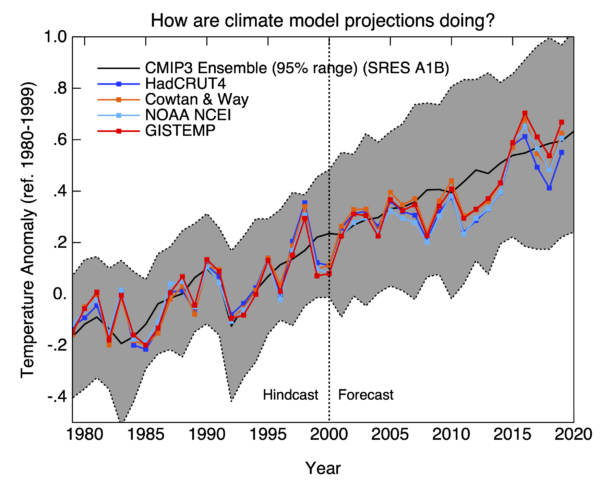
Following more than a decade of tradition (at least), I’ve now updated the model-observation comparison page to include observed data through to the end of 2019.
As we discussed a couple of weeks ago, 2019 was the second warmest year in the surface datasets (with the exception of HadCRUT4), and 1st, 2nd or 3rd in satellite datasets (depending on which one). Since this year was slightly above the linear trends up to 2018, it slightly increases the trends up to 2019. There is an increasing difference in trend among the surface datasets because of the polar region treatment. A slightly longer trend period additionally reduces the uncertainty in the linear trend in the climate models.
To summarize, the 1981 prediction from Hansen et al (1981) continues to underpredict the temperature trends due to an underestimate of the transient climate response. The projections in Hansen et al. (1988) bracket the actual changes, with the slight overestimate in scenario B due to the excessive anticipated growth rate of CFCs and CH4 which did not materialize. The CMIP3 simulations continue to be spot on (remarkably), with the trend in the multi-model ensemble mean effectively indistinguishable from the trends in the observations. Note that this doesn’t mean that CMIP3 ensemble means are perfect – far from it. For Arctic trends (incl. sea ice) they grossly underestimated the changes, and overestimated them in the tropics.
The CMIP5 ensemble mean global surface temperature trends slightly overestimate the observed trend, mainly because of a short-term overestimate of solar and volcanic forcings that was built into the design of the simulations around 2009/2010 (see Schmidt et al (2014). This is also apparent in the MSU TMT trends, where the observed trends (which themselves have a large spread) are at the edge of the modeled histogram.
A number of people have remarked over time on the reduction of the spread in the model projections in CMIP5 compared to CMIP3 (by about 20%). This is due to a wider spread in forcings used in CMIP3 – models varied enormously on whether they included aerosol indirect effects, ozone depletion and what kind of land surface forcing they had. In CMIP5, most of these elements had been standardized. This reduced the spread, but at the cost of underestimating the uncertainty in the forcings. In CMIP6, there will be a more controlled exploration of the forcing uncertainty (but given the greater spread of the climate sensitivities, it might be a minor issue).
Over the years, the model-observations comparison page is regularly in the top ten of viewed pages on RealClimate, and so obviously fills a need. And so we’ll continue to keep it updated, and perhaps expand it over time. Please leave suggestions for changes in the comments below.
References
- J. Hansen, D. Johnson, A. Lacis, S. Lebedeff, P. Lee, D. Rind, and G. Russell, "Climate Impact of Increasing Atmospheric Carbon Dioxide", Science, vol. 213, pp. 957-966, 1981. http://dx.doi.org/10.1126/science.213.4511.957
- J. Hansen, I. Fung, A. Lacis, D. Rind, S. Lebedeff, R. Ruedy, G. Russell, and P. Stone, "Global climate changes as forecast by Goddard Institute for Space Studies three‐dimensional model", Journal of Geophysical Research: Atmospheres, vol. 93, pp. 9341-9364, 1988. http://dx.doi.org/10.1029/JD093iD08p09341
- G.A. Schmidt, D.T. Shindell, and K. Tsigaridis, "Reconciling warming trends", Nature Geoscience, vol. 7, pp. 158-160, 2014. http://dx.doi.org/10.1038/ngeo2105
How good have climate models been at truly predicting the future?
A new paper from Hausfather and colleagues (incl. me) has just been published with the most comprehensive assessment of climate model projections since the 1970s. Bottom line? Once you correct for small errors in the projected forcings, they did remarkably well.
[Read more…] about How good have climate models been at truly predicting the future?Sensitive But Unclassified
The US federal government goes to quite a lot of effort to (mostly successfully) keep sensitive but unclassified (SBU) information (like personal data) out of the hands of people who would abuse it. But when it comes to the latest climate models, quite a few are SBU as well.
[Read more…] about Sensitive But UnclassifiedKoonin’s case for yet another review of climate science
We watch long YouTube videos so you don’t have to.
In the seemingly endless deliberations on whether there should be a ‘red team’ exercise to review various climate science reports, Scott Waldman reported last week that the original architect of the idea, Steve Koonin, had given a talk on touching on the topic at Purdue University in Indiana last month. Since the talk is online, I thought it might be worth a viewing.
[Spoiler alert. It wasn’t].
[Read more…] about Koonin’s case for yet another review of climate scienceUnforced Variations vs Forced Responses?
Guest commentary by Karsten Haustein, U. Oxford, and Peter Jacobs (George Mason University).
One of the perennial issues in climate research is how big a role internal climate variability plays on decadal to longer timescales. A large role would increase the uncertainty on the attribution of recent trends to human causes, while a small role would tighten that attribution. There have been a number of attempts to quantify this over the years, and we have just published a new study (Haustein et al, 2019) in the Journal of Climate addressing this question.
Using a simplified climate model, we find that we can reproduce temperature observations since 1850 and proxy-data since 1500 with high accuracy. Our results suggest that multidecadal ocean oscillations are only a minor contributing factor in the global mean surface temperature evolution (GMST) over that time. The basic results were covered in excellent articles in CarbonBrief and Science Magazine, but this post will try and go a little deeper into what we found.
[Read more…] about Unforced Variations vs Forced Responses?References
- K. Haustein, F.E.L. Otto, V. Venema, P. Jacobs, K. Cowtan, Z. Hausfather, R.G. Way, B. White, A. Subramanian, and A.P. Schurer, "A Limited Role for Unforced Internal Variability in Twentieth-Century Warming", Journal of Climate, vol. 32, pp. 4893-4917, 2019. http://dx.doi.org/10.1175/JCLI-D-18-0555.1
First successful model simulation of the past 3 million years of climate change
Guest post by Matteo Willeit, Potsdam Institute for Climate Impact Research
A new study published in Science Advances shows that the main features of natural climate variability over the last 3 million years can be reproduced with an efficient model of the Earth system.
The Quaternary is the most recent geological Period, covering the past ~2.6 million years. It is defined by the presence of glacial-interglacial cycles associated with the cyclic growth and decay of continental ice sheets in the Northern Hemisphere. Climate variations during the Quaternary are best seen in oxygen isotopes measured in deep-sea sediment cores, which represent variations in global ice volume and ocean temperature. These data show clearly that there has been a general trend towards larger ice sheets and cooler temperatures over the last 3 million years, accompanied by an increase in the amplitude of glacial-interglacial variations and a transition from mostly symmetry cycles with a periodicity of 40,000 years to strongly asymmetric 100,000-year cycles at around 1 million years ago. However, the ultimate causes of these transitions in glacial cycle dynamics remain debated.
[Read more…] about First successful model simulation of the past 3 million years of climate changeThe best case for worst case scenarios
The “end of the world” or “good for you” are the two least likely among the spectrum of potential outcomes.
Stephen Schneider

Scientists have been looking at best, middling and worst case scenarios for anthropogenic climate change for decades. For instance, Stephen Schneider himself took a turn back in 2009. And others have postulated both far more rosy and far more catastrophic possibilities as well (with somewhat variable evidentiary bases).
[Read more…] about The best case for worst case scenariosReferences
- S. Schneider, "The worst-case scenario", Nature, vol. 458, pp. 1104-1105, 2009. http://dx.doi.org/10.1038/4581104a
New Ocean Heat Content Histories
Guest commentary from Laure Zanna (U. Oxford) and G. Jake Gebbie (WHOI)
Two recent papers, Zanna et al. (2019) (hereafter ZKGIH19) and Gebbie & Huybers (2019) (hereafter GH19), independently reconstructed ocean heat content (OHC) changes prior to the instrumentally-based records (which start ~1950). The goals (and methodologies) of the two papers were quite different – ZKGIH19 investigated regional patterns of ocean warming and thermal sea level rise, while GH19 analyzed the long-term memory of the deep ocean – but they both touch on the same key questions of climate forcing and response.
[Read more…] about New Ocean Heat Content HistoriesReferences
- L. Zanna, S. Khatiwala, J.M. Gregory, J. Ison, and P. Heimbach, "Global reconstruction of historical ocean heat storage and transport", Proceedings of the National Academy of Sciences, vol. 116, pp. 1126-1131, 2019. http://dx.doi.org/10.1073/pnas.1808838115
- G. Gebbie, and P. Huybers, "The Little Ice Age and 20th-century deep Pacific cooling", Science, vol. 363, pp. 70-74, 2019. http://dx.doi.org/10.1126/science.aar8413