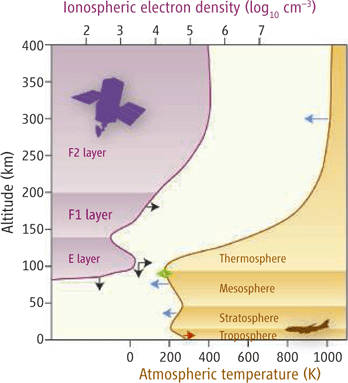
A timely perspective article in Science this week addresses the issues of upper atmosphere change. ‘Upper’ atmosphere here is the stratosphere up to the ionosphere (~20 to 300 km). Laštovička et al point out that cooling trends are exactly as predicted by increasing greenhouse gas trends, and that the increase in density that this implies is causing various ionspheric layers to ‘fall’. This was highlighted a few years back by Jarvis et al (1998) and in New Scientist in 1999 (and I apologise for stealing their headline!).
The changes in the figure are related to the cooling seen in the lower stratospheric MSU-4 records (UAH or RSS), but the changes there (~ 15-20 km) are predominantly due to ozone depletion. The higher up one goes, the more important the CO2 related cooling is. It’s interesting to note that significant solar forcing would have exactly the opposite effect (it would cause a warming) – yet another reason to doubt that solar forcing is a significant factor in recent decades.


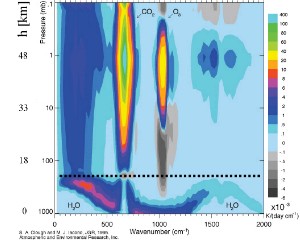
Update: The best explanation for the cooling trends can be found on ESPERE (alternative site), in particular, figure 3 (alt. version).

Traduit par Etienne Pesnelle
Dans le numéro de cette semaine de Science, un article opportun de mise en perspective traite des problèmes du changement de l’atmosphère supérieure. Ladite atmosphère “supérieure” consiste en la stratosphère jusqu’à l’ionosphère (~20 à 300 km). Laštovicka et al soulignent que la tendance au refroidissement est exactement telle que prédite par la tendance à la hausse des gaz à effet de serre, et que l’accroissement de densité que cela implique est en train de provoquer la “chute” de différentes couches de la ionosphère. Cela a été mis en exergue il y a quelques années par Jarvis et al. (1998) et dans New Scientist en 1999 (et je m’excuse de leur avoir volé le titre de leur article!).
Les changements dans le graphique sont liés au refroidissement constaté dans les enregistrements MSU-4 de la basse stratosphère (que ce soit ceux provenant des bases de données UAH ou RSS), mais les changements à ces altitudes (~ 15-20 km) sont principalement dûs à la raréfaction de l’ozone. Plus on monte, plus le refroidissement dû au CO2 est important. Il est intéressant de noter qu’un forçage solaire significatif aurait exactement l’effet inverse (il provoquerait un réchauffement) – encore une autre raison de douter que le forçage solaire est un facteur significatif [du réchauffement climatique] des dernières décennies.
Mise à jour : la meilleure explication des tendances au refroidissement peut être trouvée sur ESPERE, en particulier la figure 3.