Glaciers in West Antarctica have thinned and accelerated in the last few decades. A new paper provides some of the first evidence that this is due to human activities.
by Eric Steig
It’s been some time since I wrote anything for RealClimate. In the interim there’s been a lot of important new work in the area of my primary research interest – Antarctica. Much of it is aimed at addressing the central question in Antarctic glaciology: How much ice is going to be lost from the West Antarctic ice sheet, and how soon? There’s been a nearly continuous stream of evidence supporting the view that the West Antarctic Ice Sheet is in serious trouble – perhaps already undergoing the beginning of “collapse”, which John Mercer presaged more than four decades ago.
Yet showing that the ice sheet has changed doesn’t really address the question about what will happen in the future. To do that, we also need to answer another one: How much of the ice loss that has already happened is a response to anthropogenic climate change? A new paper in Nature Geoscience this week is one of the first to attempt an answer, and that is what has inspired me to get back to RealClimate blogging. Full disclosure: I’m a co-author on the paper.
In this post, I’d like to provide a bit of context for our new paper, and to emphasize some points about our findings that are generally going to be lost in popular accounts of our work.
The key finding is that we now have evidence that the increasing loss of ice from the West Antarctic Ice Sheet is a result of human activities — rising greenhouse gas concentrations in particular. Now, some may be surprised to learn that this wasn’t already known. But the argument that humans are responsible has rested largely on the grounds that there must be a connection. After all, why should melting have increased only in the late 20th century, precisely when the impacts of anthropogenic climate change were becoming more and more apparent? It seems an unlikely coincidence.
As Richard Alley* put it:
It has been hard to imagine that the ice sat around happily for millennia and then decided to retreat naturally just as humans started perturbing the system, but the evidence for forcing by natural variability was strong.
To be sure, there have been studies suggesting a discernible anthropogenic impact on Antarctic surface temperature, particularly on the Antarctic Peninsula. And it’s known that the depletion of stratospheric ozone and the rise in greenhouse gases has caused the circumpolar winds to increase in strength. But there has been little direct evidence that what’s happening to the ice sheet itself can be attributed to human-induced climate changes. Consequently, there has been no paper published that makes a strong claim about this. Indeed, a formal solicitation of expert views in 2013 showed that opinion was pretty much evenly divided on whether observed changes to the Antarctic ice sheet were simply part of the natural variability of the climate/ice-sheet system. In stark contrast, agreement among those same experts was (and is) unanimous that Greenland is melting because of anthropogenic global warming.
Before getting into what is new in our paper, it’s worth starting with a bit of background on West Antarctica, and a review of the evidence for the role of natural variability. Since not everyone will want to read the play-by-play, I’ve put most of that in a separate post, here. I hope you’ll read it.
In short, glacier melt in West Antarctica has increased because more Circumpolar Deep Water (which is relatively warm) is getting from the ocean surrounding Antarctica onto the Antarctic continental shelf and reaching the floating ice shelves of the large outlet glaciers that drain the West Antarctic ice sheet into the ocean. As shown by Thoma et al. (2008) in a seminal modeling study in Geophysical Research Letters**, how much Circumpolar Deep Water (CDW) gets onto the continental shelf is strongly influenced by the strength and direction of the winds at the shelf edge. Essentially, stronger westerlies (or simply weaker easterlies) tend to cause more CDW inflow, and hence, more glacial melt.
Because of the important role played by the winds, many have assumed that there must be a link between the melting glaciers and the ozone hole. But the greatest control on wind variability along the coast of West Antarctica is the state of the tropics. Just as El Niño event causes widespread climate anomalies in the Northern Hemisphere — such as increased rainfall in southern California — it also causes changes in the West Antarctic. Indeed, the Amundsen Sea, where the largest West Antarctic glaciers are, is one of the areas on the planet that is most strongly dependent on the El Niño-Southern Oscillation (ENSO) (e.g. Lachlan-Cope and Connolley, 2006). In 2012, we published a paper showing that changes in the winds in this region in the last few decades, which correspond well with variations in the glaciers, are very well explained by changes in ENSO, and very poorly by changes in ozone. We also noted that because big ENSO events had occurred in the past, it was quite plausible that wind conditions not that different than those of today had also occurred in the past. Indeed, we have very good evidence from ice cores that climate conditions in West Antarctica in the 1940s were not very different than those in the 1990s.
It is clear from this work, and much other recent research, that ENSO plays a dominant role in determining the climate conditions in West Antarctica that are relevant to the ice sheet. And since there is little evidence for a long-term anthropogenic change in ENSO, this implies that natural variability in Amundsen Sea winds (driven by natural variability in ENSO) may be the primary driver of observed ice-sheet change in West Antarctica in the last few decades. This is what Richard Alley is referring when he says that the evidence for forcing by natural variability was strong, and it throws a lot of cold water (no pun intended) on the purported link with human activities. But that’s not very satisfying. It doesn’t answer the question of why glacier retreat is occuring now. This is where our new paper comes in.
The new work is led by Paul Holland of the British Antarctic Survey (BAS), with help from Tom Bracegirdle, Adrian Jenkins (also of BAS), Pierre Dutrieux (now at LDEO) and myself. What we argue, in brief, is that although ENSO does indeed dominate the wind variability in the Amundsen Sea on timescales from interannual to multi-decadal, there is also a longer-term trend in the winds, on which the ENSO-related variability is superimposed.
The graph below (Figure 1) summarizes the key finding. What is shown are the winds in the key sector of the Amundsen Sea, centered on ~71°S and ~108°W, with observations in blue, and model results in black and gray. The model results are from an ensemble of simulations, referred to as the “tropical pacemaker” or “PACE” runs, of the CESM climate model. Details are given in Schneider and Deser (2017). Briefly, what has been done is to adjust an otherwise free-running climate model (forced by greenhouse gas emissions) so that it follows the actual history of sea surface temperature in the tropics, but is otherwise left unconstrained by data. We use these experiments as an estimate of how winds have varied over the last century in the Amundsen Sea, a) given what we know happened in the tropics and b) given what the climate model’s physics dictates about how conditions in the tropics affect the Amundsen Sea. Critically, there is nothing done to make the model match observations outside the tropics. Yet the results are in superb agreement with the observed Amundsen Sea winds. While we can never know exactly what happened prior to the advent of satellite observations in the late 1970s, the PACE ensemble provides a set of histories that is plausible, and compatible with modern data. This is probably the best current estimate of how winds have in fact varied in this region.
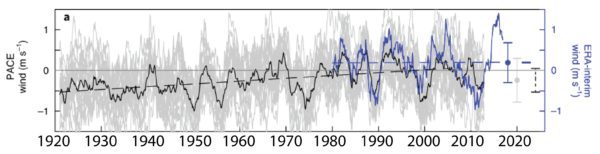
What Figure 1 suggests is that the winds in this region have varied between easterly and westerly from decade to decade, throughout the 20th century. This is the natural variability associated with ENSO, and is no surprise. But in addition, there is a long-term trend. When averaged over several decades, the winds can be seen to have shifted from mean easterly in the 1920s through 1980s, to mean westerly thereafter.
The trend in the winds is small, and easily lost within the variability of individual model ensemble members, but it is robust (it occurs in all the ensemble members) and statistically significant. Moreover, we know its cause (at least in the model experiments): radiative forcing. Although these experiments also include radiative forcing changes resulting from the ozone hole, it’s clear that the trend in the winds begins well before ozone depletion begins in 1970s. Thus, the key forcing is greenhouse gases.
These results show that variations in the winds that have occurred at the same time as we have been observing the glaciers retreat (i.e., since the 1970’s) are largely attributable to ENSO, as we had thought. But at the same time, the prevalance of strong westerlies in the Amundsen Sea has gradually increased throughout the 20th century. That is, although anomalous westerlies tend to occur most often during an El Niño, the long-term underlying trend means that the likelihood of strong westerlies in any given year is increasing, regardless of whether there is an El Niño or not. Thus, the radiatively-forced change (the trend) accentuates the effect of the natural variabilty (ENSO). As we wrote in the paper, the recent wind anomalies of the last few decades “…reflect Pacific variability that is not at all unusual…. However, when superimposed on the anthropogenic trend, this variability produces periods of absolute westerly winds that are sufficiently anomalous to account for much of the current ice loss.”
Now, a couple of caveats:
First of all, our finding are “simply” the result of looking at climate model simulations. We don’t know exactly what happened in the Amundsen Sea in the last century. On the other hand, Figure 1 looks very much like the data from ice cores from West Antarctica: variability that can be related to ENSO, superimposed upon a long-term trend. (See e.g. Schneider and Steig, 2008 and Steig et al. 2013 for details.)
Second, we are assuming that the Amundsen Sea shelf-edge winds are indeed the most relevant aspect of the system to consider. Again, this is based on the body of work showing that the inflow of CDW onto the Amundsen Sea continental shelf is strongy controlled by these winds. But the physics linking wind variability and CDW inflow is complex, and not everyone agrees with our view on this. Indeed, it is most certainly an oversimplification. Furthermore, as many authors has emphasized, there are complex feedbacks and internal ice-sheet and glacier dynamics involved, and it’s not as if there is a one-to-one relationship between changing winds and glacier retreat. For an excellent discussion of this, see the paper by Christianson et al. (2018).
Third, even without the first two caveats, we are far from proving that the ongoing ice loss from Antarctica can be attributed to human-induced climate change. The challenge here is that the natural component of the wind variabilty is so large that actually detecting (with direct observations) the trend inferred from the model results is not likely to be possible for some time. As we say in the paper, “Decadal internal variability therefore dominates ice-sheet and ocean variability during the modern observational era (since 1979), and will continue to dominate observations for decades to come.” We are not likely to find the smoking gun any time soon.
That all said, our findings are supported by other experiments. It is not only CESM, which is the main focus of the paper, that shows a long-term trend in the winds. In fact, most climate models (i.e., “CMIP5” — see details in our paper) show the same thing. Also, we find that the better the agreement between a given model and observations, the stronger the trend. (Note that the wind speeds shown in the figure above are not anomalies. These are the actual modeled and observed wind speeds. As it happens, CESM has unusally low bias in comparison with observations.)
Finally, our findings provide an important opportunity to glimpse into the future. We examined additional results with CESM, from the so-called “Large Ensemble” (LENS) and “Medium Ensemble” (MENS) set of experiments. These are identical to those of the PACE set-up but without the constraint to follow the observed tropical sea surface temperature. The results are illustrated in Figure 2, below.
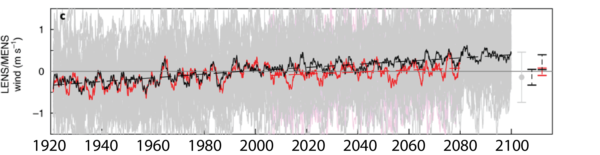
The ensemble mean trend in the LENS experiments is nearly identical to that of the PACE experiments, which further demonstrates that the trend is not part of the natural variability. Comparison between the LENS experiments, which uses the “business-as-usual”*** RCP 8.5 IPCC scenario for the future, and MENS, which uses RCP 4.5, shows that reducing greenhouse gases reduces the future trends.
This is a big deal! Although we humans have evidently caused a long-term increase in westerly winds along the Amundsen Sea coast (which is bad for the West Antarctic ice sheet), the future is not yet written (which is an opportunity). Lowering greenhouse gases to a more modest rate of increase might be enough to prevent further changes in those winds.
Of course, many glaciologists believe we have already passed the point of no return for West Antarctica. I personally think the jury is still out on that. But that’s a discussion for another time.
*The quote from Richard Alley is from a National Geographic article about our paper.
**Not all the most important papers are published in Nature or Science.
***Some people think calling RCP 8.5 “business as usual” is misleading. Hence the quotes.