Technical Note: We have changed the contact email for the blog to reduce the amount of unsolicited email. If you want to contact us at the blog, please use contact-at-realclimate.org.
Sea level rise: The New York Times got the story
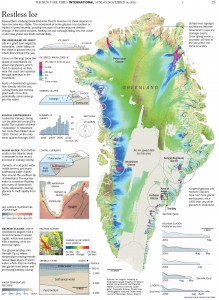
Yesterday, the New York Times ran an excellent cover story on sea level rise, together with two full pages inside the paper, fancy graphs and great photographs (online version here). The author, Justin Gillis, researched the piece for months, visited Greenland and talked to most of the leading scientists in the field – many of which he cites in the article. The science presented is correct and up-to-date and the story is a gripping read. That’s how science journalism should be!
What is going on in Greenland? (c) The New York Times.More »
Leakegate: A retraction
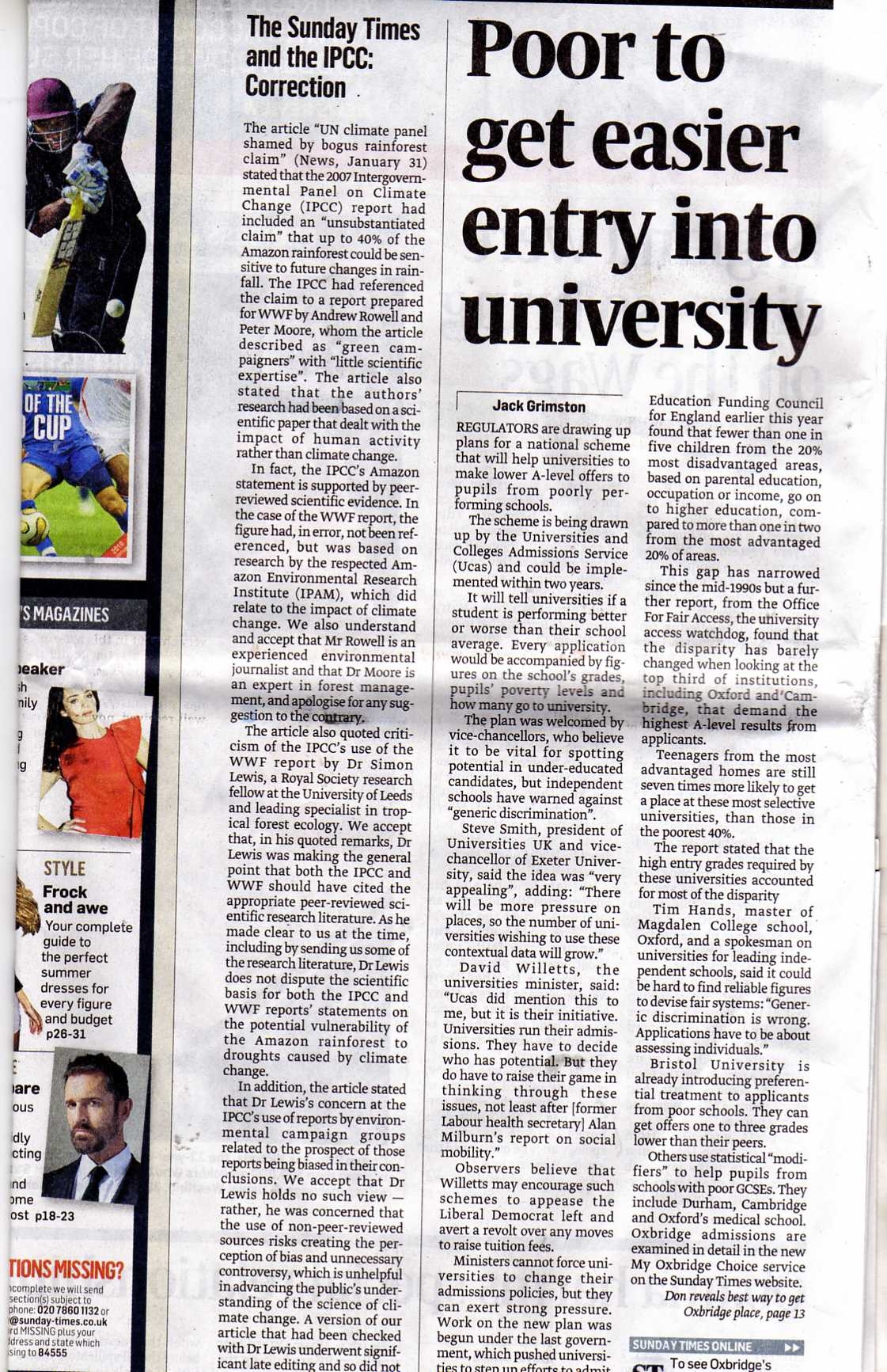
Back in February, we commented on the fact-free IPCC-related media frenzy in the UK which involved plentiful confusion, the making up of quotes and misrepresenting the facts. Well, a number of people have pursued the newspapers concerned and Simon Lewis at least filed a complaint (pdf) with the relevant press oversight body. In response, the Sunday Times (UK) has today retracted a story by Jonathan Leake on a supposed ‘Amazongate’ and published the following apology:
The article “UN climate panel shamed by bogus rainforest claim” (News, Jan 31) stated that the 2007 Intergovernmental Panel on Climate Change (IPCC) report had included an “unsubstantiated claim” that up to 40% of the Amazon rainforest could be sensitive to future changes in rainfall. The IPCC had referenced the claim to a report prepared for the World Wildlife Fund (WWF) by Andrew Rowell and Peter Moore, whom the article described as “green campaigners” with “little scientific expertise.” The article also stated that the authors’ research had been based on a scientific paper that dealt with the impact of human activity rather than climate change.
In fact, the IPCC’s Amazon statement is supported by peer-reviewed scientific evidence. In the case of the WWF report, the figure had, in error, not been referenced, but was based on research by the respected Amazon Environmental Research Institute (IPAM) which did relate to the impact of climate change. We also understand and accept that Mr Rowell is an experienced environmental journalist and that Dr Moore is an expert in forest management, and apologise for any suggestion to the contrary.
The article also quoted criticism of the IPCC’s use of the WWF report by Dr Simon Lewis, a Royal Society research fellow at the University of Leeds and leading specialist in tropical forest ecology. We accept that, in his quoted remarks, Dr Lewis was making the general point that both the IPCC and WWF should have cited the appropriate peer-reviewed scientific research literature. As he made clear to us at the time, including by sending us some of the research literature, Dr Lewis does not dispute the scientific basis for both the IPCC and the WWF reports’ statements on the potential vulnerability of the Amazon rainforest to droughts caused by climate change.
In addition, the article stated that Dr Lewis’ concern at the IPCC’s use of reports by environmental campaign groups related to the prospect of those reports being biased in their conclusions. We accept that Dr Lewis holds no such view – rather, he was concerned that the use of non-peer-reviewed sources risks creating the perception of bias and unnecessary controversy, which is unhelpful in advancing the public’s understanding of the science of climate change. A version of our article that had been checked with Dr Lewis underwent significant late editing and so did not give a fair or accurate account of his views on these points. We apologise for this.
Note that the Sunday Times has removed the original article from their website (though a copy is available here), and the retraction does not appear to have ever been posted online. Here is a scan of the print version just in case there is any doubt about its existence. (Update: the retraction has now appeared).
This follows on the heels of a German paper, the Frankfurter Rundschau, recently retracting a story on the ‘Africagate’ non-scandal, based on reporting from….. Jonathan Leake.
It is an open question as to what impact these retractions and apologies have, but just as with technical comments on nonsense articles appearing a year after the damage was done, setting the record straight is a important for those people who will be looking at this at a later date, and gives some hope that the media can be held (a little) accountable for what they publish.
The Guardian responds
We recently ran two articles that were quite critical of aspects of the Guardian’s coverage of the stolen emails. This is a response from Dr. James Randerson, the editor of the Guardian’s environmental website.
I edit the Guardian’s environment website and was part of the editorial team that produced the 12-part investigation by veteran science journalist Fred Pearce into the hacked East Anglia climate emails. I’m very grateful to RealClimate for giving us the opportunity to respond to the recent posts on the investigation: “The Guardian Disappoints” and “Close Encounters of the Absurd Kind”.
More »
Sealevelgate
Imagine this. In its latest report, the IPCC has predicted up to 3 meters of sea level rise by the end of this century. But “climate sceptics” websites were quick to reveal a few problems (or “tricks”, as they called it).
First, although the temperature scenarios of IPCC project a maximum warming of 6.4 ºC (Table SPM3), the upper limit of sea level rise has been computed assuming a warming of 7.6 ºC. Second, the IPCC chose to compute sea level rise up to the year 2105 rather than 2100 – just to add that extra bit of alarmism. Worse, the IPCC report shows that over the past 40 years, sea level has in fact risen 50% less than predicted by its models – yet these same models are used uncorrected to predict the future! And finally, the future projections assume a massive ice sheet decay which is rather at odds with past ice sheet behaviour.
Some scientists within IPCC warned early that all this could lead to a credibility problem, but the IPCC decided to go ahead anyway.
Now, the blogosphere and their great media amplifiers are up in arms. Heads must roll!