• Skip to primary navigation
  • Skip to main content
  • Skip to primary sidebar
  • Skip to footer

RealClimate

Climate science from climate scientists...

  • Start here
  • Model-Observation Comparisons
  • Miscellaneous Climate Graphics
  • Surface temperature graphics
You are here: Home / Archives for Climate Science / Instrumental Record

Instrumental Record

Mountains and molehills Mucho ruido y pocas nueces

11 Nov 2008 by Gavin

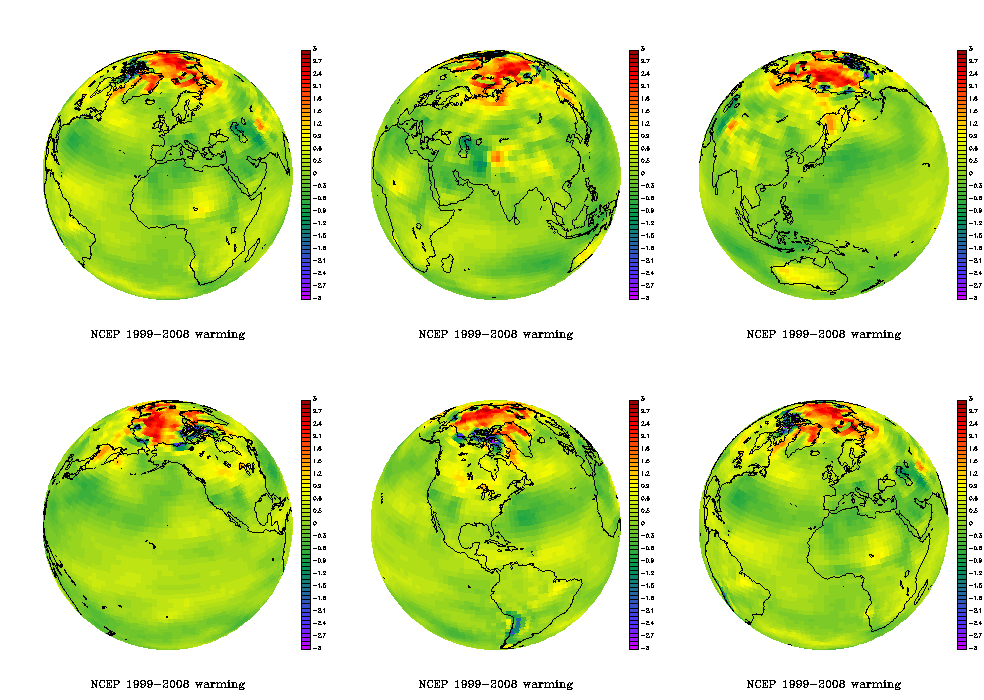
As many people will have read there was a glitch in the surface temperature record reporting for October. For many Russian stations (and some others), September temperatures were apparently copied over into October, giving an erroneous positive anomaly. The error appears to have been made somewhere between the reporting by the National Weather Services and NOAA’s collation of the GHCN database. GISS, which produces one of the more visible analyses of this raw data, processed the input data as normal and ended up with an October anomaly that was too high. That analysis has now been pulled (in under 24 hours) while they await a correction of input data from NOAA (Update: now (partially) completed).

Una traducción en español está disponible aquí.
[Read more…] about Mountains and molehills Mucho ruido y pocas nueces

Filed Under: Climate Science, Instrumental Record

Tropical tropospheric trends again (again) Ancora i trends troposferici tropicali (ancora)

12 Oct 2008 by Gavin

Many readers will remember our critique of a paper by Douglass et al on tropical tropospheric temperature trends late last year, and the discussion of the ongoing revisions to the observational datasets. Some will recall that the Douglass et al paper was trumpeted around the blogosphere as the definitive proof that models had it all wrong.

At the time, our criticism was itself criticised because our counterpoints had not been submitted to a peer-reviewed journal. However, this was a little unfair (and possibly a little disingenuous) because a group of us had in fact submitted a much better argued paper making the same principal points. Of course, the peer-review process takes much longer than writing a blog post and so it has taken until today to appear on the journal website.

Una traduzione in italiano è disponibile qui.

[Read more…] about Tropical tropospheric trends again (again) Ancora i trends troposferici tropicali (ancora)

Filed Under: Climate modelling, Climate Science, Instrumental Record

Hypothesis testing and long range memory

10 Aug 2008 by Gavin

What is the actual hypothesis you are testing when you compare a model to an observation? It is not a simple as ‘is the model any good’ – though many casual readers might assume so. Instead, it is a test of a whole set of assumptions that went into building the model, the forces driving it, and the assumptions that went in to what is presented as the observations. A mismatch between them can arise from a mis-specification of any of these components and climate science is full of examples where reported mismatches ended up being due to problems in the observations or forcing functions rather than the models (ice age tropical ocean temperatures, the MSU records etc.). Conversely of course, there are clear cases where the models are wrong (the double ITCZ problem) and where the search for which assumptions in the model are responsible is ongoing.

[Read more…] about Hypothesis testing and long range memory

Filed Under: Climate Science, Instrumental Record

Global trends and ENSO Tendencias globales y ENSO

4 Jul 2008 by Gavin

It’s long been known that El Niño variability affects the global mean temperature anomalies. 1998 was so warm in part because of the big El Niño event over the winter of 1997-1998 which directly warmed a large part of the Pacific, and indirectly warmed (via the large increase in water vapour) an even larger region. The opposite effect was seen with the La Niña event this last winter. Since the variability associated with these events is large compared to expected global warming trends over a short number of years, the underlying trends might be more clearly seen if the El Niño events (more generally, the El Niño – Southern Oscillation (ENSO)) were taken out of the way. There is no perfect way to do this – but there are a couple of reasonable approaches.

Una traducción en español está disponible aquí
[Read more…] about Global trends and ENSO Tendencias globales y ENSO

Filed Under: Climate Science, El Nino, Instrumental Record

North Pole notes

27 Jun 2008 by Gavin

I always find it interesting as to why some stories get traction in the mainstream media and why some don’t. In online science discussions, the fate of this years summer sea ice has been the focus of a significant betting pool, a test of expert prediction skills, and a week-by-week (almost) running commentary. However, none of these efforts made it on to the Today program. Instead, a rather casual article in the Independent showed the latest thickness data and that quoted Mark Serreze as saying that the area around the North Pole had 50/50 odds of being completely ice free this summer, has taken off across the media.

[Read more…] about North Pole notes

Filed Under: Arctic and Antarctic, Climate Science, Instrumental Record, Reporting on climate

Of buckets and blogs

1 Jun 2008 by Gavin

This last week has been an interesting one for observers of how climate change is covered in the media and online. On Wednesday an interesting paper (Thompson et al) was published in Nature, pointing to a clear artifact in the sea surface temperatures in 1945 and associating it with the changing mix of fleets and measurement techniques at the end of World War II. The mainstream media by and large got the story right – puzzling anomaly tracked down, corrections in progress after a little scientific detective work, consequences minor – even though a few headline writers got a little carried away in equating a specific dip in 1945 ocean temperatures with the more gentle 1940s-1970s cooling that is seen in the land measurements. However, some blog commentaries have gone completely overboard on the implications of this study in ways that are very revealing of their underlying biases.

The best commentary came from John Nielsen-Gammon’s new blog where he described very clearly how the uncertainties in data – both the known unknowns and unknown unknowns – get handled in practice (read that and then come back). Stoat, quite sensibly, suggested that it’s a bit early to be expressing an opinion on what it all means. But patience is not one of the blogosphere’s virtues and so there was no shortage of people extrapolating wildly to support their pet hobbyhorses. This in itself is not so unusual; despite much advice to the contrary, people (the media and bloggers) tend to weight new individual papers that make the news far more highly than the balance of evidence that really underlies assessments like the IPCC. But in this case, the addition of a little knowledge made the usual extravagances a little more scientific-looking and has given it some extra steam.
[Read more…] about Of buckets and blogs

Filed Under: Climate Science, Instrumental Record, Oceans

Tropical tropospheric trends again

24 May 2008 by Gavin

Back in December 2007, we quite heavily criticised the paper of Douglass et al (in press at IJoC) which purported to show that models and data were inconsistent when it came to the trends in the tropical troposphere. There were two strands to our critique: i) that the statistical test they used was not appropriate and ii) that they did not acknowledge the true structural uncertainty in the observations. Most subsequent discussion has been related to the statistical issue, but the second point is perhaps more important.

Even when Douglass et al was written, those authors were aware that there were serious biases in the radiosonde data (they had been reported in Sherwood et al, 2005 and elsewhere), and that there were multiple attempts to objectively address the problems and to come up with more homogeneous analyses. We mentioned the RAOBCORE project at the time and noted the big difference using their version 1.4 vs 1.2 made to the comparison (a difference nowhere mentioned in Douglass et al’s original accepted paper which only reported on v1.2 despite them being aware of the issue). However, there are at least three new papers in press that independently tackle the issue, and their results go a long towards addressing the problems.
[Read more…] about Tropical tropospheric trends again

Filed Under: Climate modelling, Climate Science, Instrumental Record

Uncertainty, noise and the art of model-data comparison Incertidumbre, ruido y el arte de comparar datos y modelos

11 Jan 2008 by Gavin

Gavin Schmidt and Stefan Rahmstorf

John Tierney and Roger Pielke Jr. have recently discussed attempts to validate (or falsify) IPCC projections of global temperature change over the period 2000-2007. Others have attempted to show that last year’s numbers imply that ‘Global Warming has stopped’ or that it is ‘taking a break’ (Uli Kulke, Die Welt)). However, as most of our readers will realise, these comparisons are flawed since they basically compare long term climate change to short term weather variability.

This becomes immediately clear when looking at the following graph:
Una traducción está disponible aquí (pdf)
There is a chinese translation available here.
[Read more…] about Uncertainty, noise and the art of model-data comparison Incertidumbre, ruido y el arte de comparar datos y modelos

Filed Under: Climate modelling, Climate Science, Instrumental Record

A barrier to understanding?

27 Dec 2007 by Gavin

People don’t seem to embrace global measures of temperature rise (~0.2ºC/decade) or sea level rise (> 3mm/yr) very strongly. They much prefer more iconic signs – The National Park formerly-known-as-Glacier, No-snows of Kilimanjaro, Frost Fairs on the Thames etc. As has been discussed here on many occasions, any single example often has any number of complicating factors, but seen as part of a pattern (Kilimanjaro as an example of the other receding tropical glaciers), they can be useful for making a general point. However, the use of an icon as an example of change runs into difficulty if it is then interpreted to be proof of that change.

With respect to sea level, the Thames Barrier is a concrete example that has been frequently raised.
[Read more…] about A barrier to understanding?

Filed Under: Climate Science, Instrumental Record, Oceans

Tropical tropospheric trends

12 Dec 2007 by group

Once more unto the breach, dear friends, once more!

Some old-timers will remember a series of ‘bombshell’ papers back in 2004 which were going to “knock the stuffing out” of the consensus position on climate change science (see here for example). Needless to say, nothing of the sort happened. The issue in two of those papers was whether satellite and radiosonde data were globally consistent with model simulations over the same time. Those papers claimed that they weren’t, but they did so based on a great deal of over-confidence in observational data accuracy (see here or here for how that turned out) and an insufficient appreciation of the statistics of trends over short time periods.

Well, the same authors (Douglass, Pearson and Singer, now joined by Christy) are back with a new (but necessarily more constrained) claim, but with the same over-confidence in observational accuracy and a similar lack of appreciation of short term statistics.
[Read more…] about Tropical tropospheric trends

Filed Under: Climate modelling, Climate Science, Greenhouse gases, Instrumental Record

  • « Go to Previous Page
  • Page 1
  • Interim pages omitted …
  • Page 20
  • Page 21
  • Page 22
  • Page 23
  • Page 24
  • Interim pages omitted …
  • Page 26
  • Go to Next Page »

Primary Sidebar

Search

Search for:

Email Notification

get new posts sent to you automatically (free)
Loading

Recent Posts

  • Unforced Variations: Apr 2026
  • A reflection on reflection
  • Spencer’s Shenanigans: Part II
  • The Puzzling Pleistocene
  • How robust is our accelerometer?
  • Unforced Variations: Mar 2026

Our Books

Book covers
This list of books since 2005 (in reverse chronological order) that we have been involved in, accompanied by the publisher’s official description, and some comments of independent reviewers of the work.
All Books >>

Recent Comments

  • Piotr on The Puzzling Pleistocene
  • MA Rodger on Unforced Variations: Apr 2026
  • Karsten V. Johansen on Unforced Variations: Apr 2026
  • Paul Pukite (@whut) on Unforced Variations: Apr 2026
  • Tomáš Kalisz on A reflection on reflection
  • Ron R. on Unforced Variations: Apr 2026
  • Ron R. on Unforced Variations: Apr 2026
  • patrick o twentyseven on A reflection on reflection
  • jgnfld on A reflection on reflection
  • MA Rodger on A reflection on reflection
  • Radge Havers on Unforced Variations: Apr 2026
  • Robert Cutler on A reflection on reflection
  • zebra on Unforced Variations: Apr 2026
  • Martin Smith on A reflection on reflection
  • Martin Smith on Unforced Variations: Apr 2026
  • jgnfld on Unforced Variations: Apr 2026
  • Robert Cutler on A reflection on reflection
  • Ray Ladbury on Unforced Variations: Apr 2026
  • Tomáš Kalisz on A reflection on reflection
  • Piotr on Unforced Variations: Apr 2026
  • Barton Paul Levenson on A reflection on reflection
  • Robert Cutler on A reflection on reflection
  • Ron R. on Unforced Variations: Apr 2026
  • MA Rodger on Unforced Variations: Apr 2026
  • Tomáš Kalisz on A reflection on reflection
  • Paul Pukite (@whut) on Unforced Variations: Apr 2026
  • Barton Paul Levenson on A reflection on reflection
  • jgnfld on A reflection on reflection
  • Barry E Finch on Unforced Variations: Apr 2026
  • Ray Ladbury on A reflection on reflection

Footer

ABOUT

  • About
  • Translations
  • Privacy Policy
  • Contact Page
  • Login

DATA AND GRAPHICS

  • Data Sources
  • Model-Observation Comparisons
  • Surface temperature graphics
  • Miscellaneous Climate Graphics

INDEX

  • Acronym index
  • Index
  • Archives
  • Contributors

Realclimate Stats

1,404 posts

15 pages

251,264 comments

Copyright © 2026 · RealClimate is a commentary site on climate science by working climate scientists for the interested public and journalists.