• Skip to primary navigation
  • Skip to main content
  • Skip to primary sidebar
  • Skip to footer

RealClimate

Climate science from climate scientists...

  • Start here
  • Model-Observation Comparisons
  • Miscellaneous Climate Graphics
  • Surface temperature graphics
You are here: Home / Archives for Climate Science

Climate Science

Arctic misrepresentations

8 Jul 2013 by Gavin

At the weekend, Christopher Booker at the Daily Telegraph made another attempt (see previous) to downplay the obvious decreases in Arctic sea ice by (mis-)quoting a statement from Arctic oceanographer Ken Drinkwater and colleagues:
[Read more…] about Arctic misrepresentations

Filed Under: Arctic and Antarctic, Climate Science

AGU Chapman Conference on Climate Science Communication

8 Jul 2013 by Gavin

A couple of weeks ago, there was a small conference on Climate Science communication run by the AGU. Both Mike and I attended, but it was very notable that it wasn’t just scientists attending – there were also entertainers, psychologists, film-makers and historians. There were a lot of quite diverse perspectives and many discussions about the what’s, why’s and how’s of climate science communication.

There were a couple of notable features: the conference had a lively twitter hashtag (#climatechapman), and almost the entire proceedings were webcast live (schedule). The video from this has now been posted on YouTube in more bite-sized chunks.

While our own presentations (Mike here and Gavin here) are available, it is worth watching the presentations from people you might not have heard of, as well as a few from more established people. We’ll embed a few here, but please point out some of the other ones of interest in the comments.
[Read more…] about AGU Chapman Conference on Climate Science Communication

Filed Under: Climate Science, Communicating Climate

Unforced Variations: July 2013

1 Jul 2013 by group

This month’s open thread…

We have just updated the blog software, and are taking a little time to assess how up-to-date some the content is (including the theme, mobile theme, blogroll, about pages and the RC wiki etc.). So this might be a good time to chime in with your suggestions as well as discussing the latest climate science issues.

Filed Under: Climate Science, Open thread

A new experiment with science publication

28 Jun 2013 by rasmus

A while ago, I received a request to publish a paper on a post that I had written here on RealClimate, exposing the flaws in the analysis of Humlum et al., (2011).

Instead of writing a comment to one paper, however, I thought it might be useful to collect a sample of papers that I found unconvincing (usual suspects), and that have had a fairly high public profile.

[Read more…] about A new experiment with science publication

References

  1. O. Humlum, J. Solheim, and K. Stordahl, "Identifying natural contributions to late Holocene climate change", Global and Planetary Change, vol. 79, pp. 145-156, 2011. http://dx.doi.org/10.1016/j.gloplacha.2011.09.005

Filed Under: Climate Science, Reviews, Scientific practice, skeptics

Yamal and Polar Urals: a research update

3 Jun 2013 by group

Guest commentary from Tim Osborn, Tom Melvin and Keith Briffa, Climatic Research Unit, UEA

Records of tree-ring characteristics such as their width (TRW) and density (usually the maximum density of the wood formed towards the end of the growing season – the “maximum latewood density” – MXD) are widely used to infer past variations in climate over recent centuries and even millennia. Chronologies developed from sites near to the elevational or latitudinal tree lines often show sensitivity to summer temperature and, because of their annual resolution, absolute dating and relatively widespread nature, they have contributed to many local, continental and hemispheric temperature reconstructions. However, tree growth is a complex biological process that is subject to a range of changing environmental influences, not just summer temperature, and so replication, coherence and consistency across records and other proxies are an important check on the results.

Tree-ring records have greater replication (both within a site and between nearby sites) than other types of climate proxy. Good replication helps to minimise the influence of random localised factors when extracting the common signal, and it also allows the comparison of information obtained from different independent sets or sub-sets of data. If independent sets of data – perhaps trees with different mean growth rates or from different sites – show similar variations, then we can have greater confidence that those variations are linked to real variations in climate.

In a new QSR paper (Briffa et al., 2013), (BEA13) we have used these approaches to re-assess the combined tree-ring evidence from the Yamal and Polar Urals region (Yamalia) of northern Siberia, considering the common signal in tree-growth changes at different sites and in subsets of data defined in other ways. Together with our Russian colleagues and co-authors, we have incorporated many new tree-ring data, to increase the replication and to update the chronology to 2005 and have reassessed the inferences about summer temperature change that can be drawn from these data. The paper is published as an open-access paper (no paywall) and supplementary information including the raw tree-ring and instrumental temperature data are available from our website.
[Read more…] about Yamal and Polar Urals: a research update

References

  1. K.R. Briffa, T.M. Melvin, T.J. Osborn, R.M. Hantemirov, A.V. Kirdyanov, V.S. Mazepa, S.G. Shiyatov, and J. Esper, "Reassessing the evidence for tree-growth and inferred temperature change during the Common Era in Yamalia, northwest Siberia", Quaternary Science Reviews, vol. 72, pp. 83-107, 2013. http://dx.doi.org/10.1016/j.quascirev.2013.04.008

Filed Under: Climate Science, IPCC, Paleoclimate, skeptics

Unforced Variations: June 2013

1 Jun 2013 by group

June’s open thread…

Filed Under: Climate Science, Open thread

The scientific debate on climate change

24 May 2013 by david

by Jill and David Archer

Filed Under: Climate Science

Unforced Variations: May 2013

3 May 2013 by group

This month’s open thread.

Filed Under: Climate Science, Open thread

The answer is blowing in the wind: The warming went into the deep end

26 Apr 2013 by rasmus

There has been an unusual surge of interest in the climate sensitivity based on the last decade’s worth of temperature measurements, and a lengthy story in the Economist tries to argue that the climate sensitivity may be lower than previously estimated. I think its conclusion is somewhat misguided because it missed some important pieces of information (also see skepticalscience’s take on this story here).

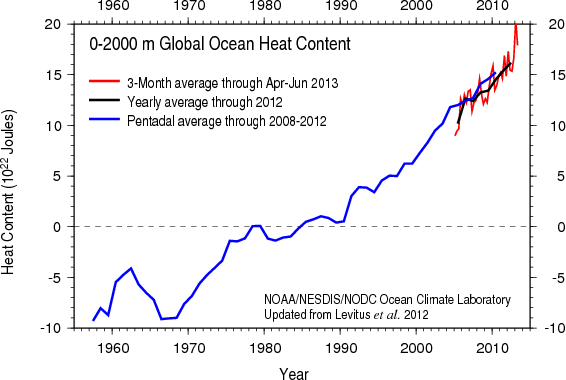
The ocean heat content and the global mean sea level height have marched on.

While the Economist referred to some unpublished work, it missed a new paper by Balmaseda et al. (2013) which provides a more in-depth insight. Balmaseda et al suggest that the recent years may not have much effect on the climate sensitivity after all, and according to their analysis, it is the winds blowing over the oceans that may be responsible for the ‘slow-down’ presented in the Economist.

[Read more…] about The answer is blowing in the wind: The warming went into the deep end

References

  1. M.A. Balmaseda, K.E. Trenberth, and E. Källén, "Distinctive climate signals in reanalysis of global ocean heat content", Geophysical Research Letters, vol. 40, pp. 1754-1759, 2013. http://dx.doi.org/10.1002/grl.50382

Filed Under: Climate impacts, Climate modelling, Climate Science, El Nino, Greenhouse gases, In the News, Instrumental Record, Oceans

The PAGES-2k synthesis

21 Apr 2013 by group

Guest commentary by Darrell Kaufman (N. Arizona U.)

In a major step forward in proxy data synthesis, the PAst Global Changes (PAGES) 2k Consortium has just published a suite of continental scale reconstructions of temperature for the past two millennia in Nature Geoscience. More information about the study and its implications are available at the FAQ on the PAGES website and the datasets themselves are available at NOAA Paleoclimate.

The main conclusion of the study is that the most coherent feature in nearly all of the regional temperature reconstructions is a long-term cooling trend, which ended late in the 19th century, and which was followed by a warming trend in the 20th C. The 20th century in the reconstructions ranks as the warmest or nearly the warmest century in all regions except Antarctica. During the last 30-year period in the reconstructions (1971-2000 CE), the average reconstructed temperature among all of the regions was likely higher than anytime in at least ~1400 years. Interestingly, temperatures did not fluctuate uniformly among all regions at multi-decadal to centennial scales. For example, there were no globally synchronous multi-decadal warm or cold intervals that define a worldwide Medieval Warm Period or Little Ice Age. Cool 30-year periods between the years 830 and 1910 CE were particularly pronounced during times of weak solar activity and strong tropical volcanic eruptions and especially if both phenomena often occurred simultaneously.
[Read more…] about The PAGES-2k synthesis

References

  1. . , "Continental-scale temperature variability during the past two millennia", Nature Geoscience, vol. 6, pp. 339-346, 2013. http://dx.doi.org/10.1038/ngeo1797

Filed Under: Climate Science, IPCC, Paleoclimate

  • « Go to Previous Page
  • Page 1
  • Interim pages omitted …
  • Page 52
  • Page 53
  • Page 54
  • Page 55
  • Page 56
  • Interim pages omitted …
  • Page 129
  • Go to Next Page »

Primary Sidebar

Search

Search for:

Email Notification

get new posts sent to you automatically (free)
Loading

Recent Posts

  • AI/ML climate magic?
  • Unforced variations: Jan 2026
  • 1.5ºC and all that
  • Unforced Variations: Dec 2025
  • Who should pay?
  • Site updates etc.

Our Books

Book covers
This list of books since 2005 (in reverse chronological order) that we have been involved in, accompanied by the publisher’s official description, and some comments of independent reviewers of the work.
All Books >>

Recent Comments

  • Barry E Finch on Unforced variations: Jan 2026
  • Pete best on Unforced variations: Jan 2026
  • Pete best on 1.5ºC and all that
  • Piotr on Unforced variations: Jan 2026
  • Piotr on Unforced variations: Jan 2026
  • Piotr on Unforced variations: Jan 2026
  • Atomsk's Sanakan on Unforced variations: Jan 2026
  • Atomsk's Sanakan on 1.5ºC and all that
  • Data on 1.5ºC and all that
  • Atomsk's Sanakan on 1.5ºC and all that
  • Data on 1.5ºC and all that
  • Piotr on Unforced variations: Jan 2026
  • Piotr on Unforced variations: Jan 2026
  • Data on 1.5ºC and all that
  • Piotr on AI/ML climate magic?
  • Nigelj on 1.5ºC and all that
  • Tomáš Kalisz on Unforced variations: Jan 2026
  • Nigelj on Unforced variations: Jan 2026
  • Susan Anderson on Unforced variations: Jan 2026
  • Ron R. on Unforced variations: Jan 2026
  • Steven Emmerson on Unforced variations: Jan 2026
  • JCM on Unforced variations: Jan 2026
  • Barton Paul Levenson on 1.5ºC and all that
  • Barton Paul Levenson on 1.5ºC and all that
  • Barton Paul Levenson on 1.5ºC and all that
  • Pete Best on 1.5ºC and all that
  • Tomáš Kalisz on Unforced variations: Jan 2026
  • Data on 1.5ºC and all that
  • Piotr on Unforced variations: Jan 2026
  • Data on AI/ML climate magic?

Footer

ABOUT

  • About
  • Translations
  • Privacy Policy
  • Contact Page
  • Login

DATA AND GRAPHICS

  • Data Sources
  • Model-Observation Comparisons
  • Surface temperature graphics
  • Miscellaneous Climate Graphics

INDEX

  • Acronym index
  • Index
  • Archives
  • Contributors

Realclimate Stats

1,392 posts

15 pages

249,558 comments

Copyright © 2026 · RealClimate is a commentary site on climate science by working climate scientists for the interested public and journalists.