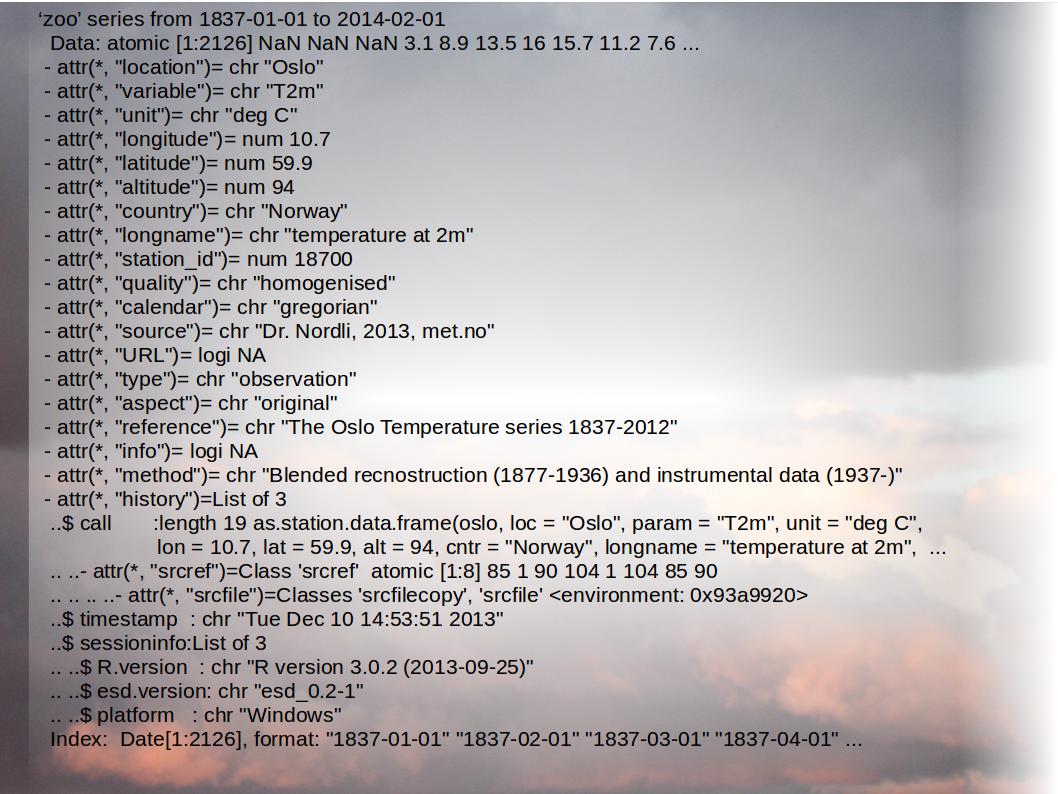
“These results are quite strange”, my colleague told me. He analysed some of the recent climate model results from an experiment known by the cryptic name ‘CMIP5‘. It turned out that the results were ok, but we had made an error when reading and processing the model output. The particular climate model that initially gave the strange results had used a different calendar set-up to the previous models we had examined.
Scientific practice
AGU 2013 preview and participation
So, it’s that time of year again.
Fall AGU is the largest Earth Science conference on the planet, and is where you will get previews of new science results, get a sense of what other experts think about current topics, and indulge in the more social side of being a scientist. The full scientific program is available for searching here.
In recent years, there has been an increasing amount of virtual content – including live streaming of key sessions and high profile lectures, and continuous twitter commentary (follow the hashtag #AGU13), that give people not attending to get a sense of what’s going on. Gavin and Mike are attending and will try and give some highlights as the week goes along, here and via twitter (follow @ClimateOfGavin and @MichaelEMann).
Some obvious highlights (that will be live-streamed) are the Frontiers of Geophysics lecture from the Jim Hansen (Tuesday, 12:30pm PST), Senator Olympia Snowe (Monday, 12:30pm), Judith Lean (Tues 10:20am), the Charney Lecture from Lenny Smith (Tues 11:20am), James Elsner on tornado connections to climate change (Tues 2:40pm), David Grinspoon (the Sagan lecture, Thurs 9am), and Bill Ruddiman (Thursday 2:40pm). Some full sessions will also be livestreamed – for instance, The future of IPCC session (Tues 10:20am-12:30pm), and the Climate Literacy sessions (Tues 4:00pm-6:00pm, Wed 8am-12:30pm).
For attendees, there are a number of events close to our hearts: A bloggers forum for discussion on science blogging (Mon 5pm), the Open Mic night hosted by Richard Alley (Mon 7:30pm at Jillian’s Restaurant), and the AGU 5k run on Wednesday morning (6:30am).
Also AGU and the Climate Science Legal Defense Fund have organised a facility for individual consultations with a lawyer (by appointment via lawyer@climatesciencedefensefund.org) for people either who have found themselves involved in legal proceedings associated with their science or people who are just interested in what they might need to be prepared for. There is a brown bag lunch session on Friday (12:30pm PST) for a more informal discussion of relevant issues.
There are obviously many individual presentations that will be of interest, but too many to list here. Feel free to add suggestions in the comments and look out for updates all next week.
Statistics and Climate
Do different climate models give different results? And if so, why? The answer to these questions will increase our understanding of the climate models, and potentially the physical phenomena and processes present in the climate system.
We now have many different climate models, many different methods, and get a range of different results. They provide what we call ‘multi-model‘ and ‘multi-method‘ ensembles. But how do we make sense out of all this information?
A new experiment with science publication
A while ago, I received a request to publish a paper on a post that I had written here on RealClimate, exposing the flaws in the analysis of Humlum et al., (2011).
Instead of writing a comment to one paper, however, I thought it might be useful to collect a sample of papers that I found unconvincing (usual suspects), and that have had a fairly high public profile.
[Read more…] about A new experiment with science publication
References
- O. Humlum, J. Solheim, and K. Stordahl, "Identifying natural contributions to late Holocene climate change", Global and Planetary Change, vol. 79, pp. 145-156, 2011. http://dx.doi.org/10.1016/j.gloplacha.2011.09.005
Introducing PubPeer.com
Guest post from PubPeer.com
The process of reviewing published science is constantly occurring and is now commonly being called post-publication peer review. It occurs in many places including on blogs such as this one, review articles, at conferences around the world, and has even been encouraged on the websites of some journals. However, the process of recording and searching these comments is, unfortunately, inefficient and underused by the larger scientific community for several reasons: To successfully impact the publication process, this database of knowledge has to accomplish two important tasks. First it requires participation by a large part of a given scientific community so that it reflects an average impression instead of an outlier’s impression. Second, it requires that the collective knowledge is centralized and easy to search in order find out what the community collectively thinks about an individual paper or a body of work. A recent initiative, the San Francisco Declaration on Research Assessment (DORA), echoes many of these same concerns.
In an attempt to assemble such a database, a team of scientists, have put together a website called PubPeer.com that is searchable and encourages participation by the larger scientific community. With a critical mass of usage an organized system of post-publication review could improve both the process of scientific publication as well as the research that underlies those publications.
AGU time again…
This week is Fall AGU, the biggest climate-related conference around. Not everything is related to climate – there is a lot of other geophysics and astrophysics, but it is generally the place to go if you want to see and be seen (and incidentally, be crushed, be excited, be friendly and be frustrated that you can’t be in three places at once).
If you are not going, you should check out the improvements in the ‘Virtual meeting‘, which will offer live streaming of some big sessions, and for those and many additional sessions there is video-on-demand (VOD) after the fact. Many posters will also be available via ePoster. The twitter hashtag is #AGU12.
And if you are going to be there, here is a limited selection of sessions that will discuss issues that often come up here (more details in the scientific program).
Monday, Dec 03:
PP11F. The Climate of the Common Era I + II
8:00 AM – 12:30 AM; 2010 (Moscone West) (including Kevin Anchukatis, Philip Brohan, Eric, and many others).
12:30 PM – 01:30 PM: San Francisco Marriott Marquis – Salon 10 Brown Bag Lunch Workshop with Michael Gerrard on “Legal Duties to Preserve and Disclose Scientific Data and Personal Communications” (note that anyone who wants a private one-on-one session with a lawyer related to these or related issues, can email lawyer(at)climatesciencedefensefund.org to set up a meeting).
PA13B. Countering Denial and Manufactured Doubt of 21st Century Science
1:40 PM – 3:40 PM; 302 (Moscone South)
6:30 PM – 8:30PM; Open Mike Night hosted by Richard Alley. Jillian’s, 175 4th Street, Suite 1070.
Tuesday, Dec 04:
PA21B. Communication of Science Through Art: A Raison d’Etre for Interdisciplinary Collaboration
8:00 AM – 10:00 AM; 104 (Moscone South) (VOD)
GC22B. Communicating Climate Science—Seeking the Best of Old and New Paradigms
10:20 AM – 12:20 PM; 3014 (Moscone West) (including Mike, Richard Alley, Dan Kahan, Richard Somerville and Naomi Oreskes)
PA23B. PA23B. Facebook, Twitter, Blogs: Science Communication Gone Social—The Social Media 101
1:40 PM – 3:40 PM; 302 (Moscone South) (Including Mike, Michael Tobis, Peter Sinclair, and Zeke Hausfather)
Bloggers Forum: Science on the Web:
5:00 pm – 6:00 pm: 3000 (Moscone West)
Wednesday, Dec 05:
Session Title: A32D. New Atmospheric Sciences Fellows Presentations I + II
8:00 AM – 12:20PM; 3002 (Moscone West) (including Tony DelGenio, Mike, Ron Stouffer, Dave Neelin… ) (VOD)
PP31D. Continental Archives of Past Climate and Seismic Events II
8:00 AM – 10:00 AM; 2006 (Moscone West) (including Ray B. discussing this)
PP32A. Emiliani Lecture
10:20 AM – 11:20 AM; 103 (Moscone South)
“No future without a past” or “History will teach us nothing”? (Invited) Richard E. Zeebe (VOD)
12:30 PM – 1:30 PM; Brown Bag lunch with Pete Fontaine “An inside look at the Michael Mann case”. 226 (Moscone South)
GC33F. Construing Uncertainty in Climate Science
2:40 PM – 3:40 PM; 3003 (Moscone West) (including Naomi Oreskes, Gerard Roe)
GC44B. Links Between Rapid Arctic Change and Midlatitude Weather Patterns
5:00 PM – 6:00 PM; 3001 (Moscone West) (including Steve Vavrus, Judah Cohen)
Thursday, Dec 06:
GC43I. Tyndall History of Global Environmental Change Lecture:
2:40 PM – 3:40 PM; 2022-2024 (Moscone West): “Successful Predictions” (Invited), Raymond Pierrehumbert (VOD)
U44A. Dissolving Boundaries Between Scientists, Media, and the Public
4:00 PM – 6:00 PM; 102 (Moscone South) (Including Eric as speaker and panelist).
Friday, Dec 07:
C54B. The Ice Core Record of Carbon Cycle History and Processes
4:00 PM – 6:00 PM; 3007 (Moscone West)
Feel free to advertise other sessions/talks that might be of interest in the comments. Hopefully we’ll get some reports of interesting sessions to share with you (and if anyone wants to send us anything, we’ll post it up that evening).
Data presentation: A trend lesson
I just came across an interesting way to eliminate the impression of a global warming. A trick used to argue that the global warming had stopped, and the simple recipe is as follows:
Copernicus and Arrhenius: Physics Then and Physics Today
There was a really interesting article in Physics Today this past October on the parallels between the slow acceptance of the idea of anthropogenic climate change and of the idea that the earth circles the sun.
[Read more…] about Copernicus and Arrhenius: Physics Then and Physics Today
Curve-fitting and natural cycles: The best part

It is not every day that I come across a scientific publication that so totally goes against my perception of what science is all about. Humlum et al., 2011 present a study in the journal Global and Planetary Change, claiming that most of the temperature changes that we have seen so far are due to natural cycles.
They claim to present a new technique to identify the character of natural climate variations, and from this, to produce a testable forecast of future climate. They project that
the observed late 20th century warming in Svalbard is not going to continue for the next 20–25 years. Instead the period of warming may be followed by variable, but generally not higher temperatures for at least the next 20–25 years.
However, their claims of novelty are overblown, and their projection is demonstrably unsound.
[Read more…] about Curve-fitting and natural cycles: The best part
References
- O. Humlum, J. Solheim, and K. Stordahl, "Identifying natural contributions to late Holocene climate change", Global and Planetary Change, vol. 79, pp. 145-156, 2011. http://dx.doi.org/10.1016/j.gloplacha.2011.09.005
AGU 2011: Day 5 and wrap-up
After 5 days, there is a definite slowdown in energy, desire to ask questions and attendance. But there were still a lot of good talks to be seen. Perhaps most relevant here were a few sessions talking about initial results from the CMIP5 models and the data with which they are being assessed. Overall, most comparisons to the CMIP3 models showed that despite substantial improvements in resolution, completeness, and scope, the CMIP5 models do not show any dramatic differences at the broad-scale diagnostics (global means etc.).
This is not particularly surprising, since it is expected that the importance of the new simulations will be seen in the differences between model types (i.e. including carbon cycles, atmospheric chemistry etc.), or in new kinds of diagnostics from say, the initialized decadal predictions, that weren’t available before.
Looking back at the whole meeting (20,000+ scientists, dozens of simultaneous sessions), it is perhaps worth noting the reasons why such meetings are so important. Obviously, no-one can see everything that is relevant to their research, or talk to everyone they might want to, but there is a lot that can be seen and absorbed much more efficiently than would be possible at home. The social aspect of conferences is also important – beer is an essential lubricant for geophysicists it seems. More important than the sessions are often the chance encounters on the escalators or corridors. Many people get to meet in person who only ever emailed – and this includes other bloggers as well as scientists. We met Eli Rabett, John Cook (Skeptical Science), Zeke Hausfather, Kate @ ClimateSight, Steve Easterbrook, and many others who are only known by their screen names and comments. Many of the scientists whose work has been discussed here recently were also present – Andreas Schmittner, Robert Rohde (of BEST), Jim Hansen, Ben Santer, Roy Spencer, along with many, many first timers whose work will become more prominent. The palpable sense of excitement at the directions the science is taking is very much driven by the bright ideas and new approaches being generated by the younger scientists – including undergraduates and graduate students. And it is the serendipitous encounters with these new voices that are the most unanticipated (and unplanned) benefits of these meetings. This doesn’t happen with Skype unfortunately.
We know that we didn’t see everything we wanted to, so if any other attendees are reading this, we encourage them to point out in the comments any particular highpoints they came across – especially if the talks were part of those broadcast, or if the poster is available on-line.