The fantasy version of the normal updating of scenarios for a new round of CMIP simulations doing the rounds is bad faith BS.
[Read more…] about Scenarios, schmenarios…Aerosols
Are direct water vapor emissions endangering anyone?
In the EPA EF reconsideration document there is a section on p62 where they attempt to make the argument that the CO2 endangerment finding would also apply to direct water vapor emissions to the atmosphere, which is (according to them) obviously absurd. But both claims are bogus.
[Read more…] about Are direct water vapor emissions endangering anyone?WMO: Update on 2023/4 Anomalies
The WMO released its (now) annual state of the climate report this week. As well as the (now) standard set of graphs related to increasing greenhouse gas concentrations, rising temperatures, reducing glacier mass, etc., Zeke Hausfather and I wrote up a short synthesis on the contributions to recent temperature anomalies.
[Read more…] about WMO: Update on 2023/4 Anomalies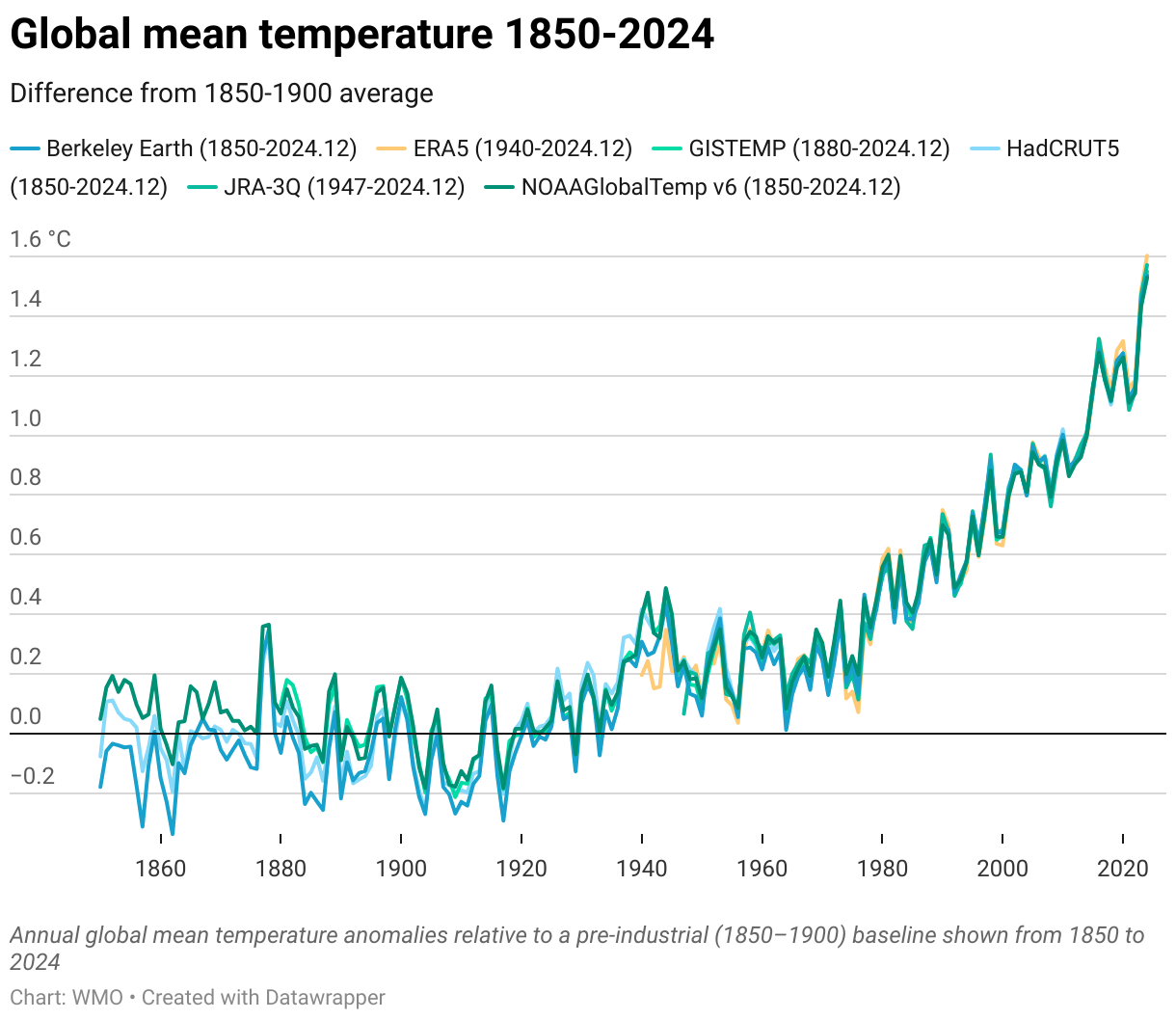
Nature 2023: Part II
This is a follow-on post to the previous summary of interesting work related to the temperatures in 2023/2024. I’ll have another post with a quick summary of the AGU session on the topic that we are running on Tuesday Dec 10th, hopefully in the next couple of weeks.
6 Dec 2024: Goessling et al (2024)
This is perhaps the most interesting of the papers so far that look holistically at the last couple of years of anomalies. The principle result is a tying together the planetary albedo and the temperature changes. People have been connecting these changes in vague (somewhat hand-wavy ways) for a couple of years, but this is the first paper to do so quantitatively.
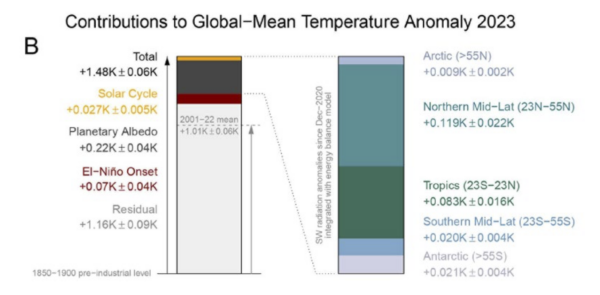
The authors use the CERES data and some aspects of the ERA5 reanalysis (which is not ideal for these purposes because of issues we discussed last month) to partition the changes by latitude, and to distinguish impacts from the solar cycle anomaly (~0.03 K), ENSO (~0.07K) and the albedo (~0.22K) (see figure above).
What they can’t do using this methodology is partition the albedo changes across cloud feedbacks, aerosol effects, surface reflectivity, volcanic activity etc., and even less, partition that into the impacts of marine shipping emission reductions, Chinese aerosol emissions, aerosol-cloud interactions etc. So, in terms of what the ultimate cause(s) are, more work is still needed.
Watch this space…
References
- H.F. Goessling, T. Rackow, and T. Jung, "Recent global temperature surge intensified by record-low planetary albedo", Science, vol. 387, pp. 68-73, 2025. http://dx.doi.org/10.1126/science.adq7280
Operationalizing Climate Science
There is a need to make climate science more agile and more responsive, and that means moving (some of it) from research to operations.
[Read more…] about Operationalizing Climate ScienceNew journal: Nature 2023?
[Last update Dec 6, 2024] There were a number of media reports today [May 11, 2024] related to Yuan et al. (2024), for instance, New Scientist, The Guardian etc. However, this is really just the beginning of what is likely to be a bit of a cottage industry in the next few months relating to possible causes/influences on the extreme temperatures seen in 2023. So to help people keep track, we’ll maintain a list here to focus discussions. Additionally, we’ll extract out the key results (such as the reported radiative forcing) as a guide to how this will all eventually get reconciled.
[Read more…] about New journal: Nature 2023?References
- T. Yuan, H. Song, L. Oreopoulos, R. Wood, H. Bian, K. Breen, M. Chin, H. Yu, D. Barahona, K. Meyer, and S. Platnick, "Abrupt reduction in shipping emission as an inadvertent geoengineering termination shock produces substantial radiative warming", Communications Earth & Environment, vol. 5, 2024. http://dx.doi.org/10.1038/s43247-024-01442-3
A CERES of fortunate events…
[latexpage]
The CERES estimates of the top-of-atmosphere radiative fluxes are available from 2001 to the present. That is long enough to see that there has been a noticeable trend in the Earth’s Energy Imbalance (EEI), mostly driven by a reduction in the solar radiation reflected by the planet, while the outgoing long wave radiation does not appear to contribute much. But what can be causing this?
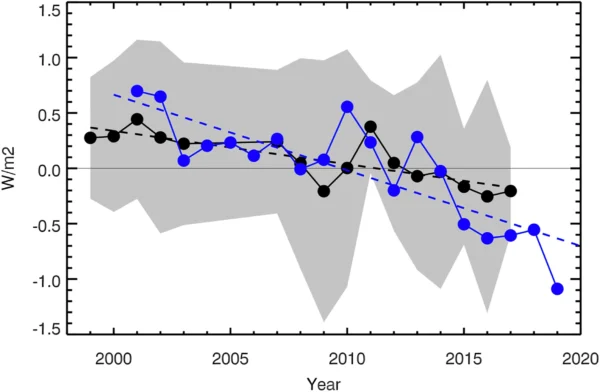
A paper last year (Goode et al., 2021) also reported on a two decade estimate of Earthshine measurements which appear to confirm a small decrease in albedo (and decrease in reflected short wave (SW) radiation). While the two measurements are subtly different due to the distinct geometries, they do show sufficient coherence to give us some confidence that they are real.
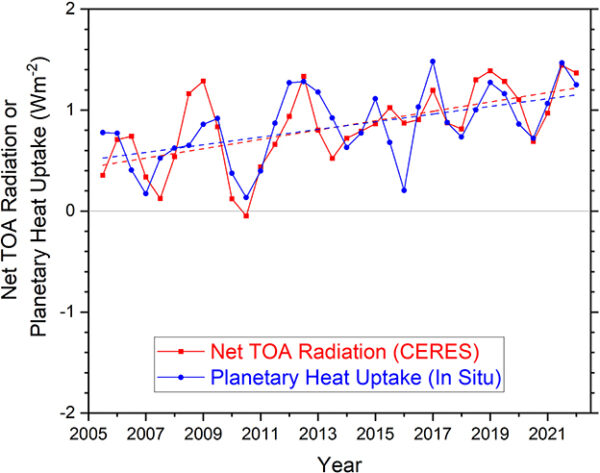
Similarly, Loeb et al. (2021) show that the trends in the EEI derived from CERES match what you get from the changes in ocean heat content.
A few people have started to interpret the dominance of the SW trends to imply that the overall trends in climate are not (despite copious evidence) being driven by the rise in greenhouse gases (for instance, the rather poorly argued and seemingly un-copyedited Dübal and Vahrenholt (2021)) but these simplistic interpretations are seriously confused.
We can explore the issues and pitfalls of this using the ‘simple model’ of the greenhouse effect we explored back in 2007. At that time, we said:
[Read more…] about A CERES of fortunate events…You should think of these kinds of exercises as simple flim-flam detectors – if someone tries to convince you that they can do a simple calculation and prove everyone else wrong, think about what the same calculation would be in this more straightforward system and see whether the idea holds up. If it does, it might work in the real world (no guarantee though) – but if it doesn’t, then it’s most probably garbage.
References
- P.R. Goode, E. Pallé, A. Shoumko, S. Shoumko, P. Montañes‐Rodriguez, and S.E. Koonin, "Earth's Albedo 1998–2017 as Measured From Earthshine", Geophysical Research Letters, vol. 48, 2021. http://dx.doi.org/10.1029/2021GL094888
- N.G. Loeb, G.C. Johnson, T.J. Thorsen, J.M. Lyman, F.G. Rose, and S. Kato, "Satellite and Ocean Data Reveal Marked Increase in Earth’s Heating Rate", Geophysical Research Letters, vol. 48, 2021. http://dx.doi.org/10.1029/2021GL093047
- H. Dübal, and F. Vahrenholt, "Radiative Energy Flux Variation from 2001–2020", Atmosphere, vol. 12, pp. 1297, 2021. http://dx.doi.org/10.3390/atmos12101297
The CO2 problem in six easy steps (2022 Update)
One of our most-read old posts is the step-by-step explanation for why increasing CO2 is a significant problem (The CO2 problem in 6 easy steps). However, that was written in 2007 – 15 years ago! While the basic steps and concepts have not changed, there’s 15 years of more data, updates in some of the details and concepts, and (it turns out) better graphics to accompany the text. And so, here is a mildly updated and referenced version that should be a little more useful.
[Read more…] about The CO2 problem in six easy steps (2022 Update)Another dot on the graph
So last week was the annual release of the temperature records from NASA, NOAA and Berkeley Earth. The Copernicus ERA5 data was released a few days ago, and the HadCRUT data will follow soon. Unlike in years past, there is no longer any serious discrepancy between the records – which use multiple approaches for the ocean temperatures, the homogenization of the weather stations records, and interpolation.
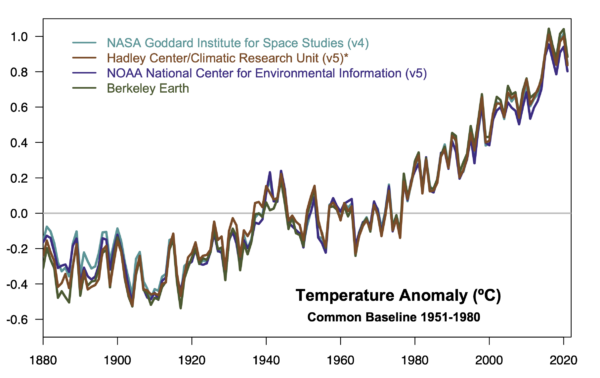
Depending on the product, 2021 was either the 5th, 6th or 7th warmest year, but in all cases, it is part of the string of warm years (since 2015) that have all been more than 1ºC warmer than the late 19th C.
[Read more…] about Another dot on the graphCoronavirus and climate
As we collectively reel from the changes wrought by the current pandemic, people are being drawn by analogy to climate issues – but analogies can be tricky and often distort as much as they illuminate.
For instance, in the Boston Globe, Jeff Jacoby’s commentary was not particularly insightful and misquoted Mike Mann pretty egregiously. Mike’s response is good:
I am relieved to see policy makers treating the coronavirus threat with the urgency it deserves. They need to do the same when it comes to an even greater underlying threat: human-caused climate change.
In a recent column (“I’m skeptical about climate alarmism, but I take coronavirus fears seriously,” Ideas, March 15), Jeff Jacoby sought to reconcile his longstanding rejection of the wisdom of scientific expertise when it comes to climate with his embrace of such expertise when it comes to the coronavirus.
In so doing, Jacoby took my words out of context, mischaracterizing my criticisms of those who overstate the climate threat “in a way that presents the problem as unsolvable, and feeds a sense of doom, inevitability, and hopelessness.”
As I have pointed out in past commentaries, the truth is bad enough when it comes to the devastating impacts of climate change, which include unprecedented floods, heat waves, drought, and wildfires that are now unfolding around the world, including the United States and Australia, where I am on sabbatical.
The evidence is clear that climate change is a serious challenge we must tackle now. There’s no need to exaggerate it, particularly when it feeds a paralyzing narrative of doom and hopelessness.
There is still time to avoid the worst outcomes, if we act boldly now, not out of fear, but out of confidence that the future is still largely in our hands. That sentiment hardly supports Jacoby’s narrative of climate change as an overblown problem or one that lacks urgency.
While we have only days to flatten the curve of the coronavirus, we’ve had years to flatten the curve of CO2 emissions. Unfortunately, thanks in part to people like Jacoby, we’re still currently on the climate pandemic path.
Michael E. Mann
State College, Pa.
The writer is a professor at Penn State University, where he is director of the Earth System Science Center.
Direct connections
There are some direct connections too. The lockdowns and travel restrictions are having a material effect on emissions of short-lived air pollutants (like NOx, SO2 etc.), water discharges and carbon dioxide as well. The impacts on air and water quality are already being seen – perhaps allowing people to reset their shifted baselines for what clean air and water are like.
Business-as-usual is kaput
Obviously, nothing is going to be quite the same after this. We will soon be describing prior norms and behaviours as “that is so BC” (before coronavirus). Already, when watching pre-recorded TV shows, I internally cringe when seeing the handshaking and hugging.
But it should also be obvious that for worst-case scenarios to materialise, it is a combination of factors that drive the results. Luck, good or bad, and decisions, wise or unwise, combine to create the future. Luck drives the specific potency of the virus, it’s incubation period and lethality, but societal decisions determined the preparation (or lack thereof), the health care system design or capacity (or lack thereof), and governmental responses (adequate or not).
Indeed, every possible future can only be reached by a specific track of what is (the science) and what we do about it (the policy). That is no different with climate as it is with pandemics. There is no possible future in which no-one made any decisions.
This probably doesn’t need to be said, but planning for low probability, high impact, worst case scenarios is looking pretty smart right now.
— Gavin Schmidt (@ClimateOfGavin) March 15, 2020