 The International Geological Congress (IGC) is sometimes referred to as the geologists’ equivalent of the Olympic Games and is an extremely large gathering of geologists from all over the world, taking place at 4-year intervals. This time, the IGC took place in Lillestrøm, a small place just outside Oslo, Norway (August 6-14). The congress was opened by the Norwegian King (before he continued to the real games in Beijing), and was attended by some 6,000 scientists from 113 countries. Even the Danish Minister of Energy & Climate participated in a panel discussion on climate change. In other words, this was a serious meeting.
Climate Science
Hypothesis testing and long range memory
What is the actual hypothesis you are testing when you compare a model to an observation? It is not a simple as ‘is the model any good’ – though many casual readers might assume so. Instead, it is a test of a whole set of assumptions that went into building the model, the forces driving it, and the assumptions that went in to what is presented as the observations. A mismatch between them can arise from a mis-specification of any of these components and climate science is full of examples where reported mismatches ended up being due to problems in the observations or forcing functions rather than the models (ice age tropical ocean temperatures, the MSU records etc.). Conversely of course, there are clear cases where the models are wrong (the double ITCZ problem) and where the search for which assumptions in the model are responsible is ongoing.
Comprehensive climate glossary
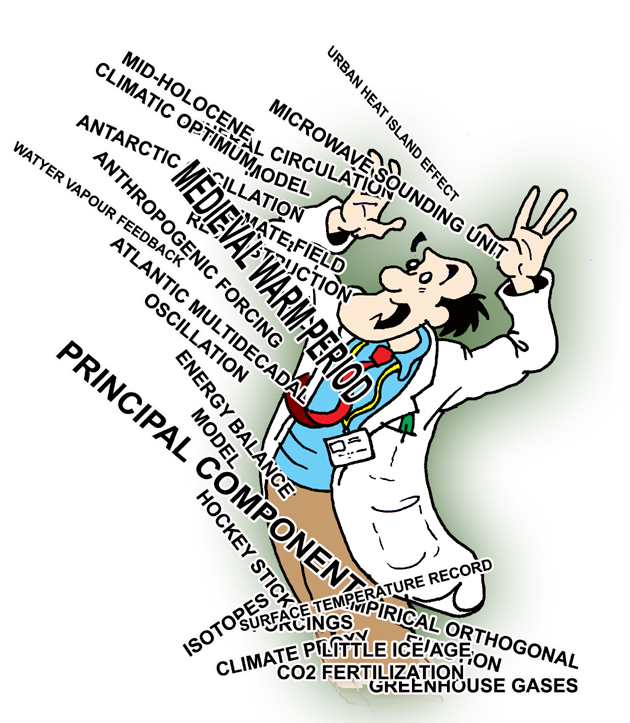 Recently we received a request for setting up a glossary-only search mechanism, or perhaps one web page with a long list of glossary entries with hot links to full explanations. The glossary that we already have is a good start, but we are all busy and it’s hard to find the time for extending this.
But there are also a number of external web pages which provide climate-related glossaries, such as the NOAA (they also have a seperate page for paleo-stuff), the Bureau of Meteorology (Australia, and there is even one by the Australian EPA), the Environmental Protection Agency (EPA, the U.S.), and the Western Regional Climate Center (WRCC, the U.S.). Wikipedia also has a glossary for climatological terms.
For those who seek the explanation for more bureaucratic terms, both the EU and the UNFCCC provide glossaries that may be useful.
Furthermore, there are some nice resources available, such as the Encyclopedia of Earth.
Bridging the divides
 We often discuss the issues that arise in doing interdisciplinary work in climate science, and Liz Moyer and I have a commentary on that just out in Nature Reports Climate Change. Normally I don’t mention these kinds of pieces on the blog, but in this case the editors commissioned a nice cartoon (from Mark Roberts) illustrating our point. I liked the cartoon a lot, and so it deserves as wide an audience as possible.
A bit of context is probably useful. The three main protagonists are representative of the somewhat different foci of paleo-climatologists, climate modellers and economists. Very broadly speaking, paleo-climate science is built around the analysis of single location time series (often from holes that are drilled). Climate modellers spend a lot of time trying to see what is coming up in all its complexity, while economists tend to eschew complexity and look for insight in highly idealised situations. But in order to increase the credibility of models, they have to do well at simulating past climates and what might happen in the future is certainly informed by what has happened in the past. And in order to better understand the impacts of climate change and various proposed policies, economists will need to embrace the complexity of human-climate interactions while modellers need to better understand what aspects of climate really do make a difference. None of these things will happen if we continue to all look in different directions, and more problematically, fail to support and reward those scientists who want to bridge the divides. Sea monsters notwithstanding.
Journalistic whiplash
Andy Revkin has a good article in the Science Times today on the problem of journalistic whiplash in climate change (also discussed here). This phenomena occurs with the more uncertain parts of a science that are being actively researched and where the full story is only slowly coming together. In such cases, new papers often appear in high profile journals (because they meet the ‘of general interest’ test), and are often parsed rather simplistically to see what side of the fence they fall – are they pro or anti? This leads to wide press interest, but rather shallow coverage, and leaves casual readers with ‘whiplash’ from the ‘yes it is’, ‘no it isn’t’ messages every other week.
This is a familiar pattern in health reporting (is coffee good for you/bad for you etc.), but in more recent times has started happening in climate science too. Examples picked out in the article include the hurricanes/global warming connection and the state of Greenland’s ice sheet. In both cases, many new pieces of evidence, new theories and new models are being thrown into the pot, but full syntheses of the problems remain elusive. Scientists are of course interested in knowing how it all fits together (and it usually does), but the public – unaware of what is agreed on and what is uncertain – see only the ping-pong across the media. Unlike more mature parts of the science (such as the radiative effect of greenhouse gases), there is much less context available to relate to these new pieces of science.
This spectacle of duelling and apparently contradictory science fuels the notion that scientists can’t agree on anything. Ironically, just as climate change has made it on to the front page because the weight of evidence supporting a human role in recent warming, increased coverage may actually be leading people to think that scientists are more divided on the basic questions.
Is this inevitable? Or can scientists, press officers and journal editors and journalists actually do anything about it? Your thoughts are most welcome!
Once more unto the bray
We are a little late to the party, but it is worth adding a few words now that our favourite amateur contrarian is at it again. As many already know, the Forum on Physics and Society (an un-peer-reviewed newsletter published by the otherwise quite sensible American Physical Society), rather surprisingly published a new paper by Monckton that tries again to show using rigorous arithmetic that IPCC is all wrong and that climate sensitivity is negligible. His latest sally, like his previous attempt, is full of the usual obfuscating sleight of hand, but to save people the time in working it out themselves, here are a few highlights.
Aerosols, Chemistry and Climate
Everyone can probably agree that the climate system is complex. Not only do the vagaries of weather patterns and ocean currents make it hard to see climate changes, but the variability in what are often termed the Earth System components complicates the picture enormously. These components – specifically aerosols (particulates in the air – dust, soot, sulphates, nitrates, pollen etc.) and atmospheric chemistry (ozone, methane) – are both affected by climate and affect climate, since aerosols and ozone can interact, absorb, reflect or scatter solar and thermal radiation. This makes for a rich research environment, but can befuddle the unwary.
[Read more…] about Aerosols, Chemistry and Climate
Weekend round-up
A few interesting pieces from around the web relevant to some previous postings:
-
 The latest satellite imagery from the Wilkins Ice Sheet (discussed recently) is not looking good. And most curiously the collapse is happening in winter.
 - The Weather Channel “Forecast Earth” team make a valiant attempt to explain the problems and promise for regional climate change projections by 2050. See our post on the general subject from last year).
- And for those of you following the various sagas of political interference in the communication of climate science, a nice interactive graphic summary, courtesy of UCS.

Next week will be a little quiet – it is mid-summer after all – so apologies in advance if the moderation is a somewhat slow. You may also note that we have instituted a “captcha” step to the commenting process. This uses reCAPTCHA which as well as providing protection against spam, helps with the digitization of old books.
All-paper salutes to the environment
The Onion last week had a great (recycled) spoof on the various ‘green’ special issues being published but, not to be outdone, the contributors to RealClimate have also been busy producing paper products about the environment.
Surprisingly perhaps, as well as having day jobs and writing for this blog, collectively we have written a number of popular science books about climate change. Some of these have already been published, but there are a few more “in the pipeline”. We try not to overdo self-promotion on this website (for instance, we don’t blog about most of our own technical publications) but since these projects are synergistic with our aims here, it makes sense to let people know what we’ve been up to. We have therefore set up a page listing “Our Books” that we will keep up-to-date as more titles become available. It’s also linked from the new animated gif image on the side bar.
CO2 is not the only greenhouse gas, and greenhouse effects are not the only CO2 problem El CO2 no es el único gas de efecto invernadero, y el efecto invernadero no es el único problema del CO2
The title here should strike a familiar theme for most readers. Climate forcings do not just include CO2 (other greenhouse gases, aerosols, land use, the sun, the orbit and volcanoes all contribute), and the impact of human emissions often has non-climatic effects on biology and ecosystems.
[Read more…] about CO2 is not the only greenhouse gas, and greenhouse effects are not the only CO2 problem