Did you know that in 1965 the U.S. Department of Agriculture planted a particular variety of lilac in more than seventy locations around the U.S. Northeast, to detect the onset of spring — in turn to be used to determine the appropriate timing of corn planting and the like? The records the USDA have kept show that those same lilacs are blooming as much as two weeks earlier than they did in 1965. April has, in a very real sense, become May. This is one of the interesting facts that you’ll read about in Amy Seidl’s book, Early Spring, a hot-off-the-press essay about the impacts of climate change on the world immediately around us – the forest, the birds, the butterflies in our backyards.
[Read more…] about Breaking the silence about Spring
Blog – realclimate.org – All Posts
Wilkins ice shelf collapse
Since people are wanting to talk about the latest events on the Antarctic Peninsula, this is a post for that discussion.
The imagery from ESA (animation here) tells the recent story quite clearly – the last sliver of ice between the main Wilkins ice shelf and Charcot Island is currently collapsing in a very interesting way (from a materials science point of view). For some of the history of the collapse, see our previous post. This is the tenth major ice shelf to collapse in recent times.
Maybe we can get some updates and discussion of potential implications from the people working on this in the comments….?
Advocacy vs. Science
The advocate will pick up any piece of apparently useful data and without doing any analysis, decide that their pet theory perfectly explains any anomaly without consideration of any alternative explanations. Their conclusion is always that their original theory is correct.
The scientist will look at all possibilities and revise their thinking based on a thorough assessment of all issues – data quality, model quality and appropriateness of the the comparison. Their conclusion follows from the analysis whatever it points to.
Farewell to our Readers
We would like to apologize to our loyal readers who have provided us so much support since we first went online in December 2004. However, after listening to the compelling arguments of the distinguished speakers who participated in the Heartland Institute’s recent global warming contrarian conference, we have decided that the science is settled — in favor of the contrarians. Indeed, even IPCC chair Rajendra Pachauri has now admitted that anthropogenic climate change was a massive hoax after all. Accordingly, RealClimate no longer has a reason for existence. The contrarians have made a convincing case that (a) global warming isn’t happening, (b) even if it is, its entirely natural and within the bounds of natural variability, (c) well, even if its not natural, it is modest in nature and not a threat, (d) even if anthropogenic warming should turn out to be pronounced as projected, it will sure be good for us, leading to abundant crops and a healthy environment, and (e) well, it might actually be really bad, but hey, its unstoppable anyway. (Can we get our check now?)
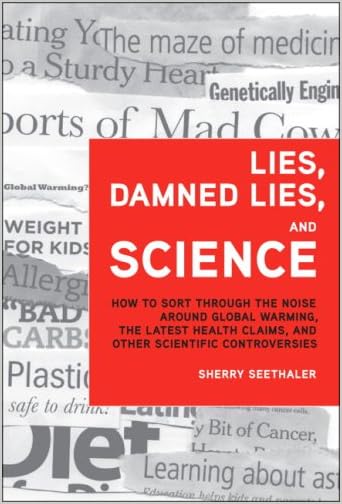
A potentially useful book – Lies, Damn lies & Science
According to a recent article in Eos (Doran and Zimmermann, ‘Examining the Scientific consensus on Climate Change‘, Volume 90, Number 3, 2009; p. 22-23 – only available for AGU members – update: a public link to the article is here), about 58% of the general public in the US thinks that human activity is a significant contributing factor in changing the mean global temperature, as opposed to 97% of specialists surveyed. The disproportion between these numbers is a concern, and one possible explanation may be that the science literacy among the general public is low. Perhaps Sherry Seethaler’s new book ‘Lies, Damn Lies, and Science’ can be a useful contribution in raising the science literacy?
[Read more…] about A potentially useful book – Lies, Damn lies & Science
Michaels’ new graph
Every so often people who are determined to prove a particular point will come up with a new way to demonstrate it. This new methodology can initially seem compelling, but if the conclusion is at odds with other more standard ways of looking at the same question, further investigation can often reveal some hidden dependencies or non-robustness. And so it is with the new graph being cited purporting to show that the models are an “abject” failure.
With all due respect…
There was a great comedy piece a few years back (whose origin escapes us) that gave examples of how the English would use their language when speaking to a non-native speaker to imply the precise opposite of what was actually being understood. This allowed the English to feel superior without actually damaging international relations. One example was the phrase “with all due respect” which is generally understood to imply that the speaker has a great deal of respect for their counterpart, while the speaker is actually implying that they have no respect in the slightest for their interlocutor. The respect due being precisely zero.
This thought occurred to us when a few of us opened our email this week to see a draft ad being sent around by the Cato Institute (i.e. Pat Michaels) looking for signatories prior to being published in “major US newspapers” sometime soon:
[Read more…] about With all due respect…
Olympian efforts to control pollution
There is a new paper in Science this week on changes to atmospheric visibility. In clear sky conditions (no clouds), this is related mainly to the amount of aerosols (particulate matter) in the air (but is slightly dependent on the amount of water vapour as well, which is corrected for in this study). The authors report that the clear-sky visibility has decreased almost everywhere (particularly in Asia) from 1973 to 2007, with the exception of Europe where visibility has increased (consistent with the ‘brightening trend’ reported recently). Trends in North American stations seem relatively flat.
There is another story that didn’t get as much press when it came out late last year but that is highly relevant to this issue – whether any of the efforts that the Chinese authorities to reduce air pollution ahead of the Olympics last year had any impact. To the extent that they did, they might point the way to reducing aerosols and other pollutants across Asia, but it might also reveal how hard it is to do so.
[Read more…] about Olympian efforts to control pollution
Advice for a young climate blogger
Congratulations! You have taken the first step towards attempting to communicate your expertise and thoughts to the wider world, which remains poorly served by its traditional sources of information when it comes to complex societally relevant issues like climate change. Your aim to clarify the science (or policy options or ethical considerations or simply to explain your views) is a noble endeavor and we wish you luck and wide readership. But do be aware that you are dipping your blog into sometimes treacherous waters. Bad things can happen to good bloggers. So in a spirit of blog-camaraderie, and in light of our own experiences and observations, we offer some advice that may be of some help in navigating the political climate relatively unscathed.
What George Will should have written
We’ve avoided piling on to the George Will kerfuffle, partly because this was not a new story for us (we’d commented on very similar distortions in previous columns in 2004 and 2007), but mostly because everyone else seems to be doing a great job in pointing out the problems in his recent columns.
We are actually quite gratified that a much wider group of people than normal have been involved in calling out this latest nonsense, taking the discussion well outside the sometimes-rarefied atmosphere of the scientific blogosphere (summary of links). Maybe RealClimate has succeeded in its original aim of increasing the wider awareness of the scientific context? However, like many, we are profoundly disappointed in the reaction of the Washington Post editors and George Will himself (though the ombudsman’s column today is a step in the right direction). It would have been pleasant to see an example of the conservative punditocracy actually learning something from the real world instead of resorting to ever-more unconvincing pseudo-legalistic justifications and attacks on the messenger to avoid taking their head out of the sand. Nonetheless, in a moment of naive optimism, we have allowed ourselves to indulge in a fantasy for how a more serious columnist might have dealt with the issue:
[Read more…] about What George Will should have written