Let’s suppose that the Arctic started to degas methane 100 times faster than it is today. I just made that number up trying to come up with a blow-the-doors-off surprise, something like the ozone hole. We ran the numbers to get an idea of how the climate impact of an Arctic Methane Nasty Surprise would stack up to that from Business-as-Usual rising CO2
Arctic and Antarctic
Curve-fitting and natural cycles: The best part
It is not every day that I come across a scientific publication that so totally goes against my perception of what science is all about. Humlum et al., 2011 present a study in the journal Global and Planetary Change, claiming that most of the temperature changes that we have seen so far are due to natural cycles.
They claim to present a new technique to identify the character of natural climate variations, and from this, to produce a testable forecast of future climate. They project that
the observed late 20th century warming in Svalbard is not going to continue for the next 20–25 years. Instead the period of warming may be followed by variable, but generally not higher temperatures for at least the next 20–25 years.
However, their claims of novelty are overblown, and their projection is demonstrably unsound.
[Read more…] about Curve-fitting and natural cycles: The best part
References
- O. Humlum, J. Solheim, and K. Stordahl, "Identifying natural contributions to late Holocene climate change", Global and Planetary Change, vol. 79, pp. 145-156, 2011. http://dx.doi.org/10.1016/j.gloplacha.2011.09.005
Times Atlas map of Greenland to be corrected
We were pleased to hear from the University of Arizona’s Jeff Kargel that the Times Atlas folks are now updating their atlas of Greenland. As we reported earlier, the first edition was completely in error, and led to some rather bizarre claims about the amount of ice loss in Greenland. Kargel reports that HarperCollins (publisher of the Times Atlas) has now fully retracted their error and has produced a new map of Greenland that will be made available as a large-format, 2-side map insert for the Atlas and will also be available free online. Meanwhile, Kargel and colleagues have produced their own updated small-scale map and have written a paper that includes both their new map and a description of the incident that led up to it. Kargel was instrumental in pushing the cryosphere community to send a strong message to the publishers that they needed to correct their mistake. (A pre-print of the paper, currently under review and under public discussion on Cryolist, is available here.)
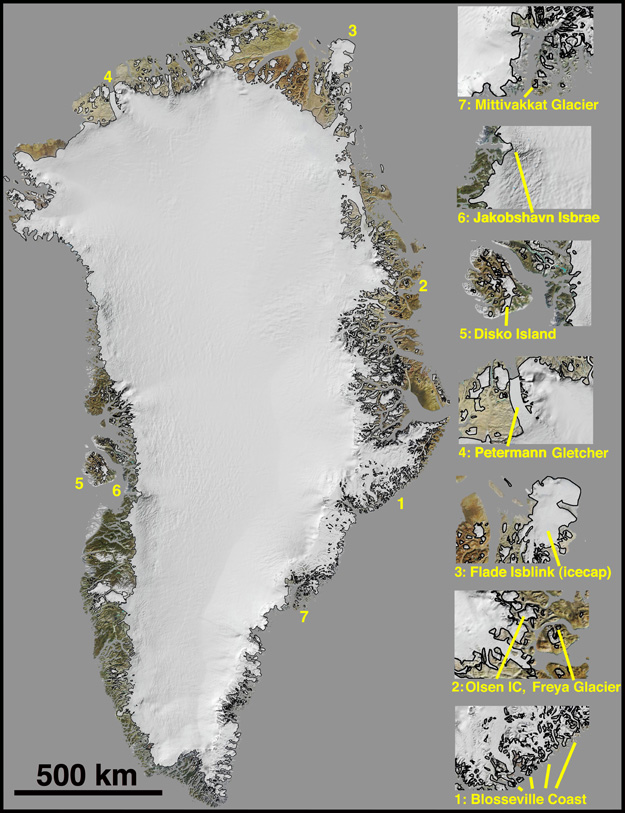 Figure 1 in Kargel et al. (2011) generated by a collaboration of the Geological Survey of Denmark and Greenland (GEUS) and the Programme for Monitoring of the Greenland Ice Sheet (PROMICE) with the Polar Geospatial Center Department of Geology and Geophysics, University of Minnesota. Contact: Michele Citterio (GEUS) for questions about the glacier outlines or Paul Morin (UMinn.) for questions about the MODIS base image mosaic.
HarperCollins is to be commended for listening to the scientific community and producing a corrected map. Unfortunately, and despite recent events demonstrating that popular allegations against climate scientists are all wrong, HarperCollins still says on their web site that it’s all the scientists’ fault for not being clear (“The one thing that is very apparent is that there is no clarity in the scientific and cartographic community on this issue”,they write). Hmm. Our own view is that anyone flying over Greenland en route to Europe from North America would instantly have recognized a problem with the Times Atlas (assuming they knew their location of course). As Kargel and colleagues write in their paper:
“Distinguishing manifest, ignorable nonsense from falsehoods that might take root in the public mind is difficult, but the magnitude of and apparent authority behind this particular mistake seemed to warrant a rapid and firm response. The eventually constructive reaction of HarperCollins, which not only withdrew its mistaken claim but also produced a new map to be included in the Times Atlas as an insert, shows the value of such a response. No less than grotesque trivialization, grotesque exaggeration of the pace or consequences of climate change needs to be countered energetically.”
Nevertheless, they caution that “scientists cannot possibly challenge all of the innumerable misunderstandings and misrepresentations of their work in public discourse.”
Well said. Of course, many scientists can do more, and we encourage all of our colleagues to speak publically about their research and, as the international glaciological research community did in this case, to try to correct misconceptions. At the same time, hopefully, HarperCollins will catch on and recognize that being scientifically literate is not just scientists’ responsibility, but is everyone’s responsibility.
Speculative polar cartography
Guest commentary from Kevin Brown
The curious mismapping of Greenland’s ice sheet cover by the venerable Times Atlas recently has excited a lot of outraged commentary. But few people noted that this follows an old tradition of speculative cartography of the polar regions. ‘Modern’ mapmakers as early as the 16th century combined real facts and scientific knowledge with fundamental misinterpretations of that knowledge to create speculative mappings of the world’s unknown shores – and nowhere was this more prevalent than at the poles.
Early cartographers had a particularly difficult time mapping the Polar Regions. Factually, they based their maps on reports from mariners who dared sail the dangerous waters. This was supplemented by information from earlier maps, speculations based upon their personal theories of geography, religious beliefs, and the fiscal and political ambitions of their patrons.
[Read more…] about Speculative polar cartography
Greenland meltdown
After a record-breaking 2010 in terms of surface melt area in Greenland Tedesco et al, 2011, numbers from 2011 have been eagerly awaited. Marco Tedseco and his group have now just reported their results. This is unrelated to other Greenland meltdown this week that occurred at the launch of the new Times Atlas.
[Read more…] about Greenland meltdown
References
- M. Tedesco, X. Fettweis, M.R. van den Broeke, R.S.W. van de Wal, C.J.P.P. Smeets, W.J. van de Berg, M.C. Serreze, and J.E. Box, "The role of albedo and accumulation in the 2010 melting record in Greenland", Environmental Research Letters, vol. 6, pp. 014005, 2011. http://dx.doi.org/10.1088/1748-9326/6/1/014005
The unnoticed melt
Guest commentary from Dirk Notz, MPI Hamburg
“Well, it’s not really good timing to write about global warming when the summer feels cold and rainy”, a journalist told me last week. Hence, at least here in Germany, there hasn’t been much reporting about the recent evolution of Arctic sea ice – despite the fact that Arctic sea ice extent in July, for example, was the lowest ever recorded for that month throughout the entire satellite record. Sea-ice extent in August was also extremely low, second only to August 2007 (Fig. 1). Whether or not we’re in for a new September record, the next weeks will show.
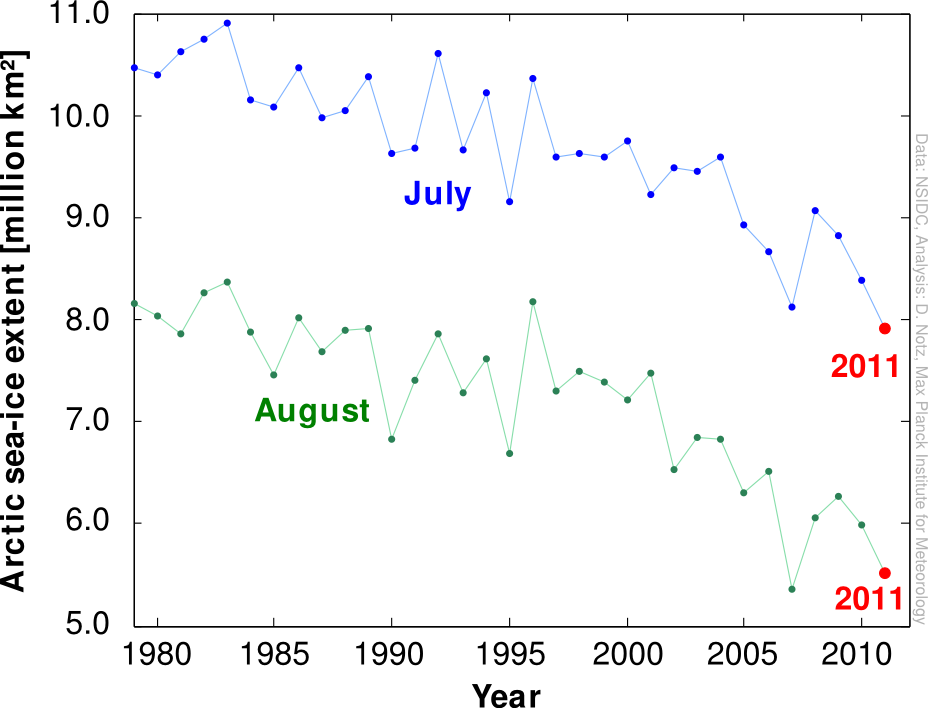
Figure 1: Evolution of Arctic sea-ice extent in July and August from 1979 until 2011. (NSIDC)
[Read more…] about The unnoticed melt
Arctic sea ice minimum discussions
Here is a continuation of the last Arctic sea ice discussion as we get closer to the 2011 minimum. All figures will update continuously.
JAXA Sea ice extent and area:


Cryosphere Today sea ice concentration:

Estimated sea ice volume from UW PIOMAS (updated every month):

Arctic sea ice discussions
This is a thread to discuss issues related to the 2011 Arctic sea ice minimum. The following graphs will update every day:
JAXA Sea ice extent:
Cryosphere Today sea ice concentration:
How Soon is now?
Willie Soon is a name that pops up every so often in climate ‘debate’. He was the lead author on the Soon and Baliunas (2003) paper (the only paper that has ever led to the resignation of 6 editors in protest at the failure of peer-review that led to its publication). He was a recent speaker (from 37.20) at the 2011 Heartland Institute conference, and can be counted on to produce a contrarian take on any particular issue that anyone might care about – ranging from climate, to mercury in fish and polar bear population dynamics.
[Read more…] about How Soon is now?
Lu: from ‘interesting but incorrect’ to just wrong
Some readers might recall a story from a couple of years of ago relating polar ozone depletion to cosmic rays and the subsequent failure of predictions made using that theory. The idea came from from a Qian-B. Lu (U. Waterloo), and initially seemed interesting (at least to those of us who were not specialists). Perhaps cosmic ray induced chemistry was playing some part in releasing chlorine from CFCs as well as the more accepted idea of heterogeneous chemistry on polar stratospheric particles? Lu’s predictions for increased polar ozone loss in 2008/2009 as a function of the low solar activity (and therefore higher CR flux) did not come to pass. Worse (for this idea), new analyses demonstrated that the hypothesized CR-induced CFC loss wasn’t detectable at all.
[Read more…] about Lu: from ‘interesting but incorrect’ to just wrong