I really like the fact that there is still so much to discover about important parts of the climate system. The Bell et al paper in Science Express this week (final version in Science) reporting on the surprising results from airborne ground-penetrating radar studies of the Antarctic Ice Sheet is a great example. The ice sheets themselves are the biggest challenge for climate modelling since we don’t have direct evidence of the many of the key processes that occur at the ice sheet base (for obvious reasons), nor even of what the topography or conditions are at the base itself. And of course, the future fate of the ice sheets and how they will dynamically respond to climate warming is hugely important for projections of sea level rise and polar hydrology. The fact that ice sheets will respond to warming is not in doubt (note the 4-6 m sea level rise during the last interglacial), but the speed at which that might happen is highly uncertain, though the other story this week shows it is ongoing.
Arctic and Antarctic
West Antarctica: still warming
The temperature reconstruction of O’Donnell et al. (2010) confirms that West Antarctica is warming — but underestimates the rate
Eric Steig
At the end of my post last month on the history of Antarctic science I noted that I had an initial, generally favorable opinion of the paper by O’Donnell et al. in the Journal of Climate. O’Donnell et al. is the peer-reviewed outcome of a series of blog posts started two years ago, mostly aimed at criticizing the 2009 paper in Nature, of which I was the lead author. As one would expect of a peer-reviewed paper, those obviously unsupportable claims found in the original blog posts are absent, and in my view O’Donnell et al. is a perfectly acceptable addition to the literature. O’Donnell et al. suggest several improvements to the methodology we used, most of which I agree with in principle. Unfortunately, their actual implementation by O’Donnell et al. leaves something to be desired, and yield a result that is in disagreement with independent evidence for the magnitude of warming, at least in West Antarctica.
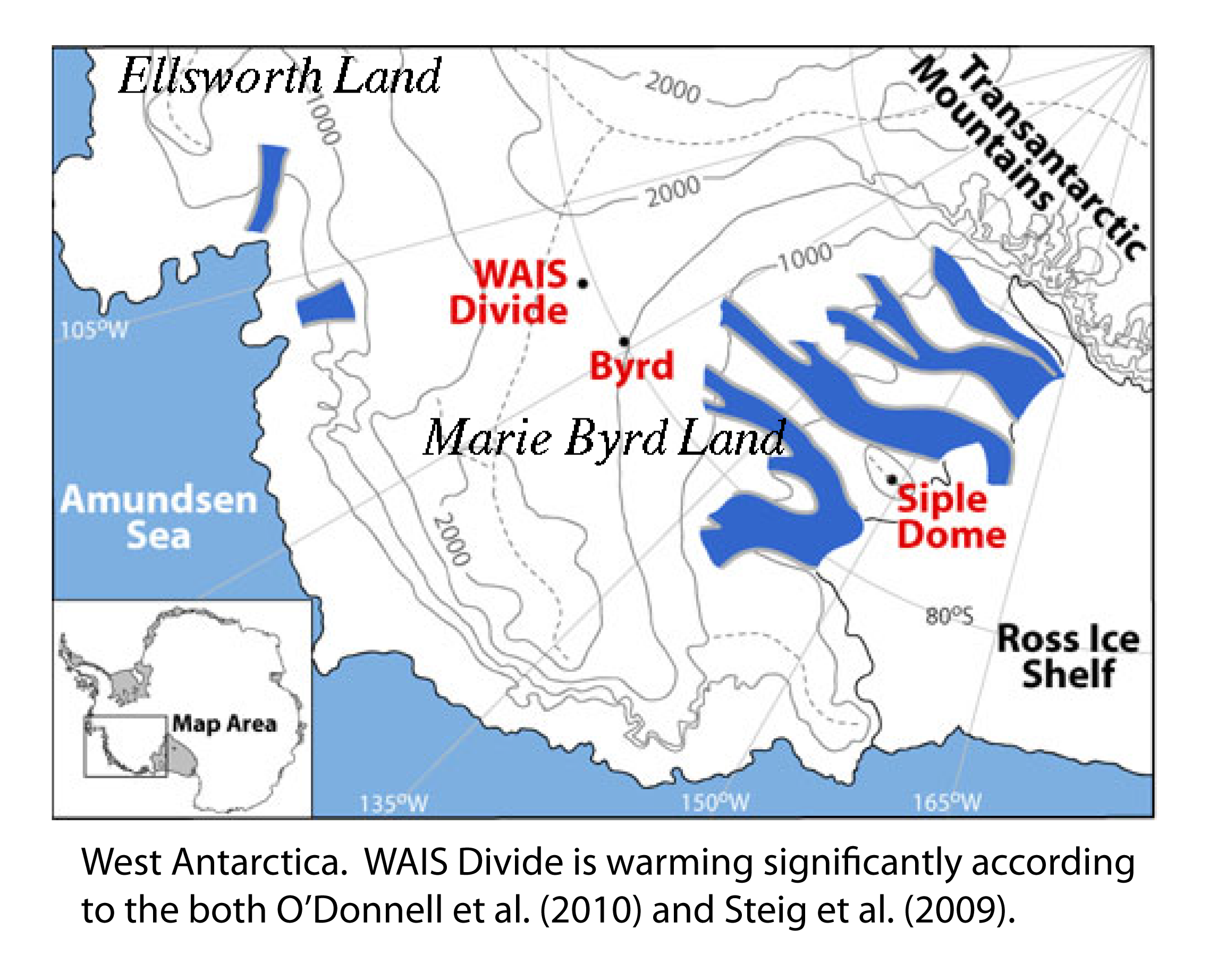 In this post, I’ll summarize the key methodological changes suggested by O’Donnell et al., discuss how their results compare with our results, and the implications for our understanding of recent Antarctic climate change. I’ll then try to make sense of how O’Donnell et al. have apparently wound up with an erroneous result.
[Read more…] about West Antarctica: still warming
Cold winter in a world of warming?
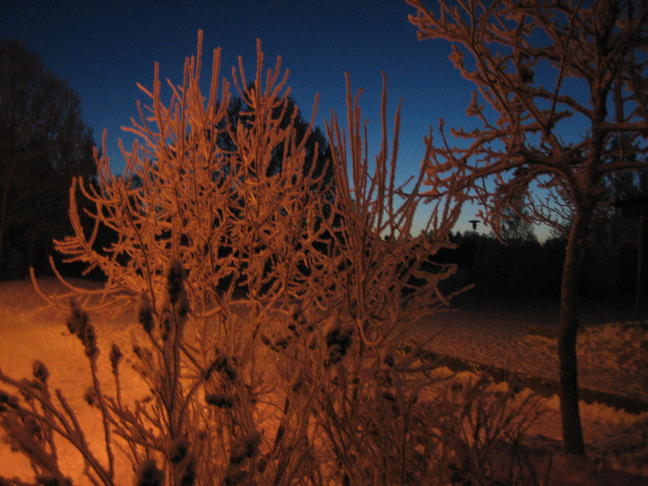
Last June, during the International Polar Year conference, James Overland suggested that there are more cold and snowy winters to come. He argued that the exceptionally cold snowy 2009-2010 winter in Europe had a connection with the loss of sea-ice in the Arctic. The cold winters were associated with a persistent ‘blocking event’, bringing in cold air over Europe from the north and the east.
A brief history of knowledge about Antarctic temperatures
Sources in italics.
Early 20th Century: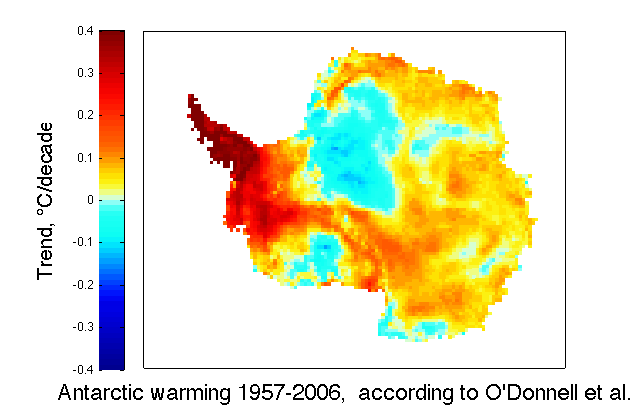
Scott: It’s cold here.
The media: Scott is a hero!
Scott: It’s really really cold here.
The media: Scott is a hero!
Amundsen: It’s not that cold.
The media: Scott is a hero. Oh, and Amundsen.
Public: Shackleton is a hero, but please shut up, there’s a war on.
Mid 20th Century:
Geophizzicists: Let’s find out just how cold it is.
Media: Scott is a hero!
Public: yawn…
Late 20th Century:
Scientists: It’s colder in some place than others.
Media: Antarctica is cooling.
Scientists: It’s cooling at the South Pole, but warming very fast on the Peninsula.
Media: Antarctica is cooling, but warming faster than anywhere else on earth.
Public: Huh…?
2000
Thompson and Solomon: Most of Antarctica is cooling in summer, but it is warming on the Peninsula. We think it has to do with the ozone hole.
Media: Because of ozone, Antarctica is warming faster than anywhere else on earth and we are all going to die.
Public: Huh…?
Early 21st Century:
2006
Scientists: The troposphere over Antarctica is warming significantly in winter.
Media: Even though that paper was published in Science, our readers don’t know what the troposphere is. Neither do we. Next?
2007
Scientists: The troposphere over Antarctica is warming significantly in winter and spring, especially over West Antarctica.
Media: That paper wasn’t published in Nature, so we’re not very interested.
2009
Scientists: Antarctica is cooling in fall — not summer — in some places, but warming, especially in winter and spring, especially in West Antarctica.
Media: Antarctica stops cooling! Conservative or liberal, we are ALL going to die.
Steve McIntyre: The “team” made up the data again. I don’t know what Antarctica is doing, but I think it is probably cooling.
Media: Antarctica starts cooling again, global warming is a fraud.
2010
Ryan O’Donnell: Our paper in the Journal of Climate shows a somewhat better way to look at the same data. Antarctica is warming a bit more in summer, and a bit less in winter in the Ross Sea region. In fall it is cooling a bit more too, and so the overall trends are smaller. Still, West Antarctica is definitely warming significantly, as Steig et al. found. That’s interesting.
Eric Steig: Nice paper Ryan. Thanks for sending along a pre-print.
Steve McIntyre: Hey, we got published in the Journal of Climate! Another paper showing that the “team” made up the data again! (Sotto voce): Ryan says it it is warming a bit more in summer, and a bit less in winter in the Ross Sea region. In fall it is cooling a bit more. Otherwise we get the same results, though the magnitude of the trends is smaller. But West Antarctica is still warming significantly. But I really don’t care. The peer review process is broken, which is why.. umm…our paper was published in the leading climate journal.
Liberal Media: That paper wasn’t published in Nature, so we’re not very interested.
Conservative Media: Antarctica is cooling. Global warming is a fraud.
Public: zzzZZZzzz
————-
P.S. For those actually interested, yes, I’ll have more to say about O’Donnell et al., but overall, I like it.–eric
The A-train
A little behind schedule, I finally found time to read the article in the July 2010 edition of Physics Today “Touring the atmosphere aboard the A-Train” by Tristan S. L’Ecuyer and Jonathan H. Jiang. I think this article is a worth-while read, telling a fascinating story about how new satellite missions lead to greater understanding of our climate system.

An icy retreat
Guest Commentary by Dirk Notz, MPI Hamburg
 It’s almost routine by now: Every summer, many of those interested in climate change check again and again the latest data on sea-ice evolution in the Arctic. Such data are for example available on a daily basis from the US National Snow and Ice Data Center. And again and again in early summer the question arises whether the most recent trend in sea-ice extent might lead to a new record minimum, with a sea-ice cover that will be smaller than that in the record summer of 2007.
However, before looking at the possible future evolution of Arctic sea ice in more detail, it might be a good idea to briefly re-capitulate some events of the previous winter, because some of those are quite relevant for the current state of the sea-ice cover. The winter 2009/2010 will be remembered by many people in Europe (and not only there) as particularly cold, with lots of snow and ice. Not least because of the sustained cold, some began to wonder if global warming indeed was real.
[Read more…] about An icy retreat
Is Pine Island Glacier the Weak Underbelly of the West Antarctic Ice Sheet?
Guest post by Mauri Pelto
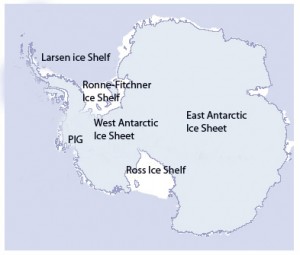 It is popularly understood that glaciologists consider West Antarctica the biggest source of uncertainty in sea level projections. The base of the 3000-m thick West Antarctic Ice Sheet (WAIS) – unlike the much larger East Antarctic Ice Sheet – lies below sea level, and it has been recognized for a long time that this means it has the potential to change very rapidly. Most of the grounded West Antarctic ice sheet drains into the floating Ross and Ronne-Filchner ice shelves, but a significant fraction also drains into the much smaller Pine Island Glacier. Glaciologists are paying very close attention to Pine Island Glacier (“PIG” on map, right) and nearby Thwaites Glacier. In the following guest post, Mauri Pelto explains why.
[Read more…] about Is Pine Island Glacier the Weak Underbelly of the West Antarctic Ice Sheet?
Putting the recent Antarctic snowmelt minimum into context
Guest Commentary by Andrew Monaghan and Marco Tedesco
Our study published in mid October in Geophysical Research Letters (Tedesco and Monaghan, 2009) documents record minimum snowmelt for Antarctica during austral summer 2008-2009 and lower-than-normal melt for several recent years, based on a 30-year satellite microwave record. Numerous blogs have cited the results as a challenge to previous studies reporting Antarctic warming, while also steadfastly ignoring other studies with similar results (e.g. Barrett et al., 2009). They have overlooked that these studies show that Antarctic warming has occurred mostly in winter and spring, whereas melting of course occurs in summer. And they oversimplify the causality and hence confuse our prediction for the future. We found that the same mechanism that has primarily caused low snowmelt in recent years will likely change in a manner that will enhance snowmelt in forthcoming decades. A brief summary follows. [Read more…] about Putting the recent Antarctic snowmelt minimum into context
Resolving technical issues in science
One of the strengths of science is its capacity to resolve controversies by generally accepted procedures and standards. Many scientific questions (especially more technical ones) are not matters of opinion but have a correct answer.
Scientists document their procedures and findings in the peer-reviewed literature in such a way that they can be double-checked and challenged by others. The proper way to challenge results is, of course, also through the peer-reviewed literature, so that the challenge follows the same standards of documentation as did the original finding.
[Read more…] about Resolving technical issues in science
Sea ice minimum forecasts
One of the interesting things about being a scientist is seeing how unexpected observations can galvanize the community into looking at a problem in a different way than before. A good example of this is the unexpectedly low Arctic sea ice minimum in 2007 and the near-repeat in 2008. What was unexpected was not the long term decline of summer ice (this has long been a robust prediction), but the size of 2007 and 2008 decreases which were much larger than any model had hinted at. This model-data mismatch raises a number of obvious questions – were the data reliable? are the models missing some key physics? is the comparison being done appropriately? – and some less obvious ones – to what extent is the summer sea ice minimum even predictable? what is the role of pre-conditioning from the previous year vs. the stochastic nature of the weather patterns in any particular summer?
The concentration of polar expertise on the last couple of questions has increased enormously in the last couple of years, and the summer minimum of 2009 will be a good test of some of the ideas that are being discussed. The point is that whether 2009 is or is not a record-setting or near-record setting minimum, the science behind what happens is going to be a lot more interesting than the September headline.