RealClimate logo


Technical Note: We have changed the contact email for the blog to reduce the amount of unsolicited email. If you want to contact us at the blog, please use contact-at-realclimate.org.

Find the error

Filed under: — mike @ 9 November 2007

A colleague alerted me to a small town Nevada newspaper (The Ely Times) that has recently taken to publishing some rather egregious contrarian editorials and op-ed pieces about climate change (see e.g. here, and here).

Much in the spirit of what we attempt here at RealClimate (that is, public outreach and education), I figured I’d make an effort to inform the paper’s readers of the misleading nature of what they’re being told.

I decided to respond to their most recent editorial ‘Is CO2 a Poison?’ and other questions which wasn’t really a contrarian hit piece (i.e., what we’re used to seeing on the op-ed pages of the Wall Street Journal) so much as a confused mix of half-truths, irrelevant facts, flat-out errors, and, admittedly, some reasonable points (e.g. that there are challenging issues of fairness in how we go about achieving greenhouse gas emissions cutbacks). My letter was firmly critical, but, I felt, reasonably polite and fair.

I never received any correspondence from the editor (Kent Harper), and assumed that he had thus chosen not to publish my letter. So you can imagine my surprise yesterday in finding that, not only did the editor publish my letter, but in fact ran a contemporaneous and scattershot rebuttal along with it.

What I found particularly amusing was his denial that the original editorial contained any errors, as I had asserted. In particular, he challenged me to defend my assertion that he was wrong in claiming that the natural greenhouse effect leads to a warming of about 100F and that the correct number was closer to 60F.

Here is Mr. Kent, in his own words:

I asked Dr. Mann, in an answer to his e-mail, if the Wikipedia entry on the Greenhouse Effect (http://en.wikipedia.org/wiki/Greenhouse_effect) was incorrect. It said: “The Earth’s average surface temperature of 15 C (288 K) is about 33 C warmer than it would be without the greenhouse effect.” A celsius temperature of 33 degrees, converts to 91.4 degrees Fahrenheit, which I rounded off to “almost 100 degrees”.

Kent: if you are reading this, I would be more than happy to personally answer your question. But since you’ve decided to take our ‘discussion’ public anyway, I thought I’d rather use this as a ‘learning moment’ here at RealClimate. So I encourage our readers to provide their own answers to your question in the comments below.

Bookmark and Share

Worth a Look

Filed under: — mike @ 20 September 2007

We’re pleased to report that, after a rough start, Nature’s blog ‘Climate Feedback’ seems to have gotten back on track. We’re happy to endorse it as a useful resource for those interested in relatively informal discussions of issues at the leading edge of current climate research.

A good place to start are two excellent recent entries by Kevin Trenberth of NCAR. The first of these provides an update on where the scientific debate over the influence of global warming on hurricanes currently stands. The second responds to the latest attempt by the Wall Street Journal editorial page to foist fallacies about climate change upon its readers.

Bookmark and Share

Storm World: A Review

Filed under: — mike @ 18 June 2007

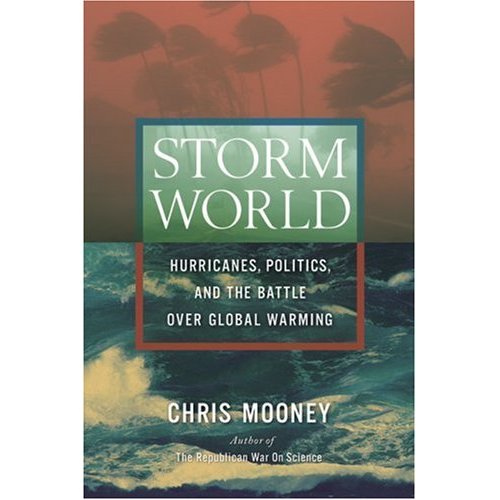
If you are a RealClimate regular, you are undoubtedly aware of our ongoing interest in the developments in the scientific understanding of potential hurricane-climate change linkages. This is an area of the science where a substantial body of significant new research has emerged even since RealClimate’s inception in late 2004. The scientific research in this area, and the media frenzy and political theatrics that have inescapably followed it, are thoughtfully placed in a broader historical context in a fascinating new book by Chris Mooney entitled Storm World: Hurricanes, Politics, and the Battle over Global Warming. Anyone who is at all interested in the scientific history that has led to our current understanding of Hurricanes and their potential linkages with climate change, will find this book a page turner. The book is a nice complement to Kerry Emanuel’s recent book Divine Wind: The History and Science of Hurricanes (which too is so readable that it lies on our coffee table). Mooney in a sense picks up where Emanuel’s left off. Like Emanuel, he explores the history of the science. But he uses this historical context, and his studies of the personalities of key actors, to explore how the current scientific debate can be traced back to a rift that has emerged over many decades between distinct communities of atmospheric scientists.
More »

Bookmark and Share

This Week

Filed under: — mike @ 4 May 2007 - (Türkçe)

There are a few minor items this week worthy of mention:

1. The CO2 rise. Who dunnit?

Here at RealClimate, we have been (naively, apparently) operating under the assumption that climate change contrarians had long ago moved on from the untenable position that humans are not even responsible for the observed increase in CO2 concentrations over the past two centuries. The dubious paper by Ernst Beck we commented on the other day indicates that there is indeed still a rear guard attack being waged. As if to drive the point home further, pundit Alexander Cockburn, known generally for his progressive views, has perplexingly disputed the existence of any link between CO2 emissions and rising CO2 concentrations in the atmosphere in a screed he penned this week for the online journal “Counterpunch” (also printed in The Nation). It’s hard to know where to start, since his piece is so over the top and gets just about everything so thoroughly wrong, it’s almost comical. So we’ll just hit the low points: (a) Cockburn claims that there is zero empirical evidence that anthropogenic production of CO2 is making any measurable contribution to the world’s present warming trend, despite the fact that not even such strident climate change contrarians as Pat Michaels dispute that there is a measurable influence of anthropogenic greenhouse gases on global temperature. Plus there’s all the empirical evidence of course (see the new IPCC report). (b) Going further, Cockburn brazenly opines that ‘it is impossible to assert that the increase in atmospheric CO2 stems from human burning of fossil fuels’ despite the fact that there is an isotopic smoking gun for this connection. He then (c) fails to understand that water vapor is a feedback not a forcing, and citing ‘expert’ Dr. Martin Hertzberg, quite remarkably states that ‘It is the warming of the earth that is causing the increase of carbon dioxide and not the reverse.’ Never mind that isotopic evidence proves otherwise. Upon what evidence does he base this assertion?

Since no anti-global warming op-ed these days is complete without it, Cockburn (d) resorts to the usual misrepresentation of lag/lead relationships between CO2 and temperatures during glacial/interglacial cycles as if they disprove the causal relationship between greenhouse gas concentrations and surface temperatures (see our most recent debunking of this favorite contrarian talking point here). Oh dear.

2. The other (Glenn) Beck–Even Worse!

CNN gave their resident shock-jock Glenn Beck a forum for spreading more disinformation on global warming in an hour-long segment entitled Exposed: The Climate of Fear (see also this discussion by “Media Matters”). We could pick apart his (rather thin) arguments, which constitute the usual cocktail of long debunked contrarian talking points. Suffice it to say, however, that the moment a rhetorician invokes Hitler, Nazi Germany, and Eugenics, it is the moment they are no longer worthy of being listened to (cf Godwin’s Law of usenet debates). We don’t seem to be alone in our opinion here. Beck’s performance earned him the dubious title of “worst person in the world” from analyst Keith Olbermann.

However, there was one amusing moment: Beck asked Christopher ‘Incorrect’ Horner what the key thing to google was that would show that Al Gore was wrong. Horner suggested the lag between CO2 and temperature in the ice cores. Of course, if you do Google that, the first hit is the RealClimate debunking of the issue. Thanks!

3. Nature’s new blog

Nature has started a new blog called “Climate Feedback”, which says of itself ‘Climate Feedback is a blog hosted by Nature Reports: Climate Change to facilitate lively and informative discussion on the science and wider implications of global warming. The blog aims to be an informal forum for debate and commentary on climate science in our journals and others, in the news, and in the world at large.’

We wish it well, remembering their welcome for RealClimate, though early reviews based on the first few posts are decidedly mixed.

Bookmark and Share

The Human Hand in Climate Change

Filed under: — mike @ 23 January 2007

Kerry Emanuel (whose influential scientific work we’ve discussed here previously) has written a particularly lucid and poignant popular article on climate change for the literary forum “Boston Review”. The article is entitled Phaeton’s Reins: The human hand in climate change. We thought it worth passing along.

Bookmark and Share

Switch to our mobile site