At a public event debating the DOE CWG report, Steve Koonin embarrasses himself further.
This week there was a bit of a peculiar event at the Civitas Institute at UT Austin, with three of the CWG authors (John Christy, Steve Koonin and Ross McKitrick) being rebutted by Andy Dessler (working solo).
The event itself was a rehash of the CWG’s reports ‘findings’ (or rather, a repeat of their cherry picks, uncontextualized statements, and ignoring of the literature), and Dessler somewhat successfully pointing this out. The event seemed a bit rushed (too much content being crammed into too short a time) and is a great example of the applicability of the Brandolini’s Law.
There would be a lot to criticise in the presentations if one wanted (most of this was gone over in the Scientists response to the DOE report that Andy helped organise), but the presentation by Koonin went even further into nonsense territory than the CWG report itself. Apparently, “internal variability” (something noticeably ignored in many claims by the CWG) is the “last refuge of fools and scoundrels” (at least according to Koonin)!
What this stems from is Koonin’s reliance on Nicola Scafetta’s work on evaluating climate models – readers here will know that is a very bad idea, and we went through a lot of this in respect to a GRL paper that Scafetta published in 2022. That led to a whole saga, which took so long that while we were trying to get the 2022 paper retracted on the grounds of being totally wrong, Scafetta basically published the same analysis again (with almost all the same errors and some new ones) in another journal. Our enthusiasm to go another round pointing out his mistakes was limited, and so the second paper still stands nominally unrebutted in the literature despite having been pre-rebbutted by our comment on the first paper (Schmidt et al., 2023). This came up in the ‘internal review’ of the CWG report, where one of the reviewers said that the CWG should deal with our criticism of Scafetta’s work (pointing to the published comment), and were blown off by the CWG who claimed that because they cited the second paper (not the first), our comment was moot. Classic dissembling.
Anyway, Koonin’s presentation at the Civitas event (starts around 20:20 in the video) repeats the errors, but goes even further. First, he notes that some CMIP6 models have climate sensitivities that are too high. That’s fine – I have made the same point here, and in Nature Hausfather et al., 2022. But then he elides from ‘some models’ to ‘the models’ without even taking a breath (Hmm…). He doubles down on Spencer’s cherrypicking (itself not peer-reviewed of course), and claims that people pointing out that something has been cherry-picked are trying to “change the topic”. Yes, that metric that no-one had ever mentioned before Spencer did this analysis is *the* topic that the assessment was designed to address /sarc.
Koonin additionally claims that the mainstream scientists are blaming model-observation discrepancies on internal variability for the last twenty years, while ignoring it for the previous twenty years. Of course, he provides no citation nor evidence that anyone has ever done such a thing. Worse, in response to a suggestion that they utilise the uncertainty in the modeling (esp. the internal variability), he makes an incredible statement (starting at 30:47):
Well, if you do that, it effectively broadens the uncertainty so much as to be almost essentially useless.
Let’s parse this out. He isn’t claiming that the internal variability isn’t real (it is of course). He is claiming that his model-observation comparison doesn’t show any discrepancy if you include the uncertainties and that therefore it’s useless! To repeat, Koonin is stating that he isn’t including the uncertainties because it would undermine the conclusion he is trying to draw.
This is as clear an admission of scientific misconduct as I’ve heard.
He then illustrates this with reference to Tokarska et al. (2020) (Fig 3, Panel A) which is not really trying to do the same thing, but fine. [I think there must be a second half to that slide showing individual runs – but I’m not sure where that would have been from]. However, we addressed this exact issue with the comment on the first Scafetta paper:
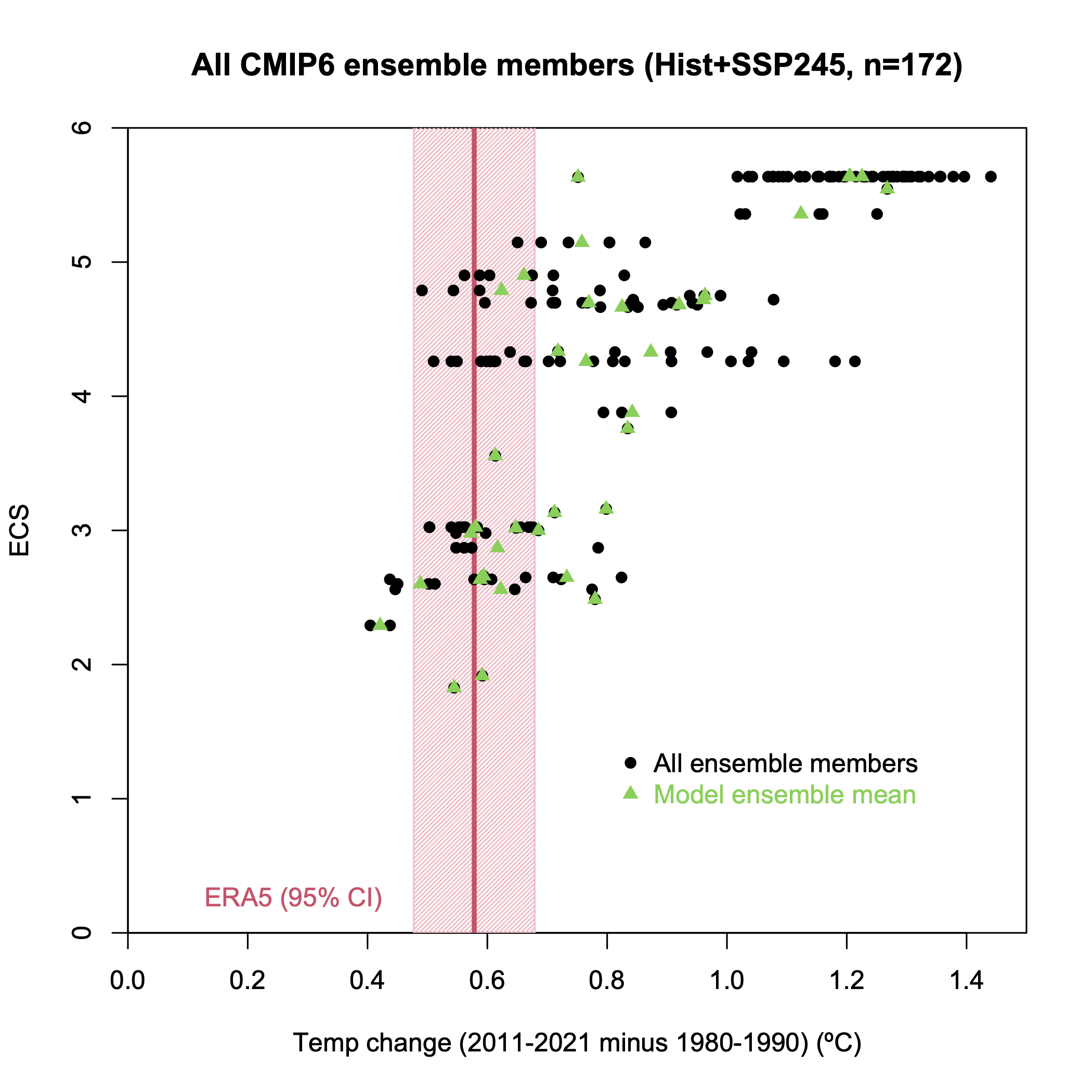
The question being asked is whether there is a discrepancy between any specific model and the observations. An initial condition (IC) ensemble starts the model with a different weather pattern, but each run has the same forcing. The standard deviation of the IC ensemble is a reasonable measure of the internal variability (i.e. the spread that could occur only as a function of the (unpredictable) weather. The real world can be considered a single realization of the real world climate, so the standard way to assess whether the a model is consistent with the real world is to estimate the probability that the real world result could be part of the model distribution. In practice, one can calculate the 95% confidence interval for the model (based on it’s ensemble) and ask whether the real world data falls within that range. Wherever it is, you can calculate the probability of getting that result, assuming that model distribution. The further away the observation from the model spread, the less likely that it could have generated by that distribution.
So if the real world falls inside the 95% CI, it is clearly consistent with the distribution, even if the ensemble mean is different from the observations. As the signal grows, the spread due to the internal variability will shrink, and discrepancies might emerge more clearly. But no-one is arguing that internal variability should be ignored for one period, and used in another. Rather, it should be used consistently at all times. If that prevents Steve Koonin from trashing the models, so be it.
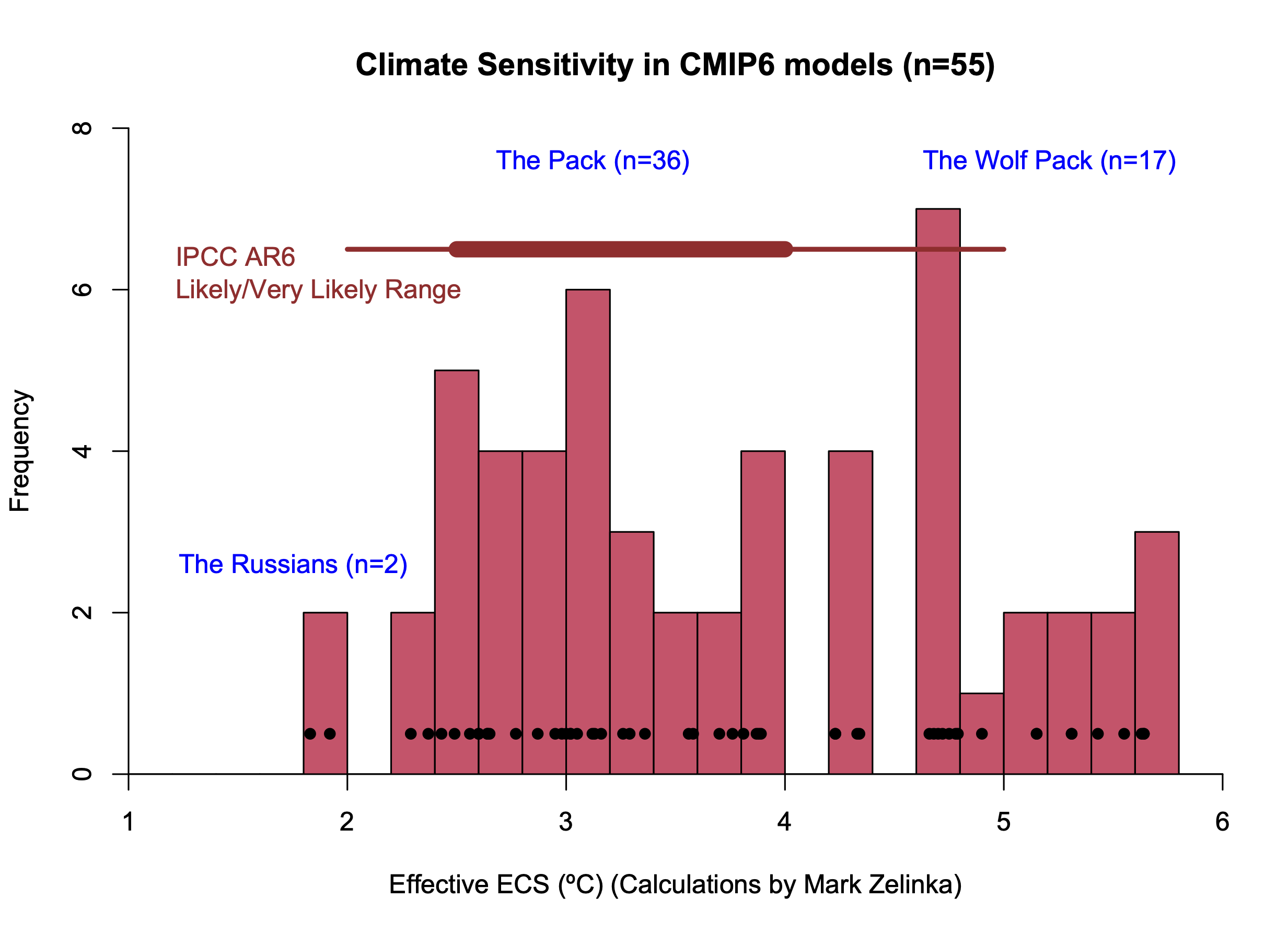
To go back to the claim though, there are multiple models with sensitivities up to about 5ºC that have surface temperature trends that are compatible with the observations. A few models don’t have sufficient simulations to say, and a few are clearly incompatible. This is what Koonin says:
They say that the fact I can find one starting point that agrees with the data is enough to validated that model. In fact that doesn’t sound right at all. I don’t think that would pass peer review – at least among my peers.
This is not quite an accurate reflection of the mainstream position, nor do his feelings on the issue make sense. The mainstream position is first more nuanced (as explained above); it is not that seeing that observations fall within the spread validates the model, rather if this happens you should not reject that model (a much less onerous claim). But why does this sound strange to Koonin? Is he in the habit of rejecting models that are consistent with observations? And of course, this position has passed peer-review many times, though I will accept that his peers might not agree (which is a statement about his peers, not the claims).
To wrap this up, I updated the figure above to look at a slightly longer period (the change to 2015-2025) using the latest observations from ERA5.
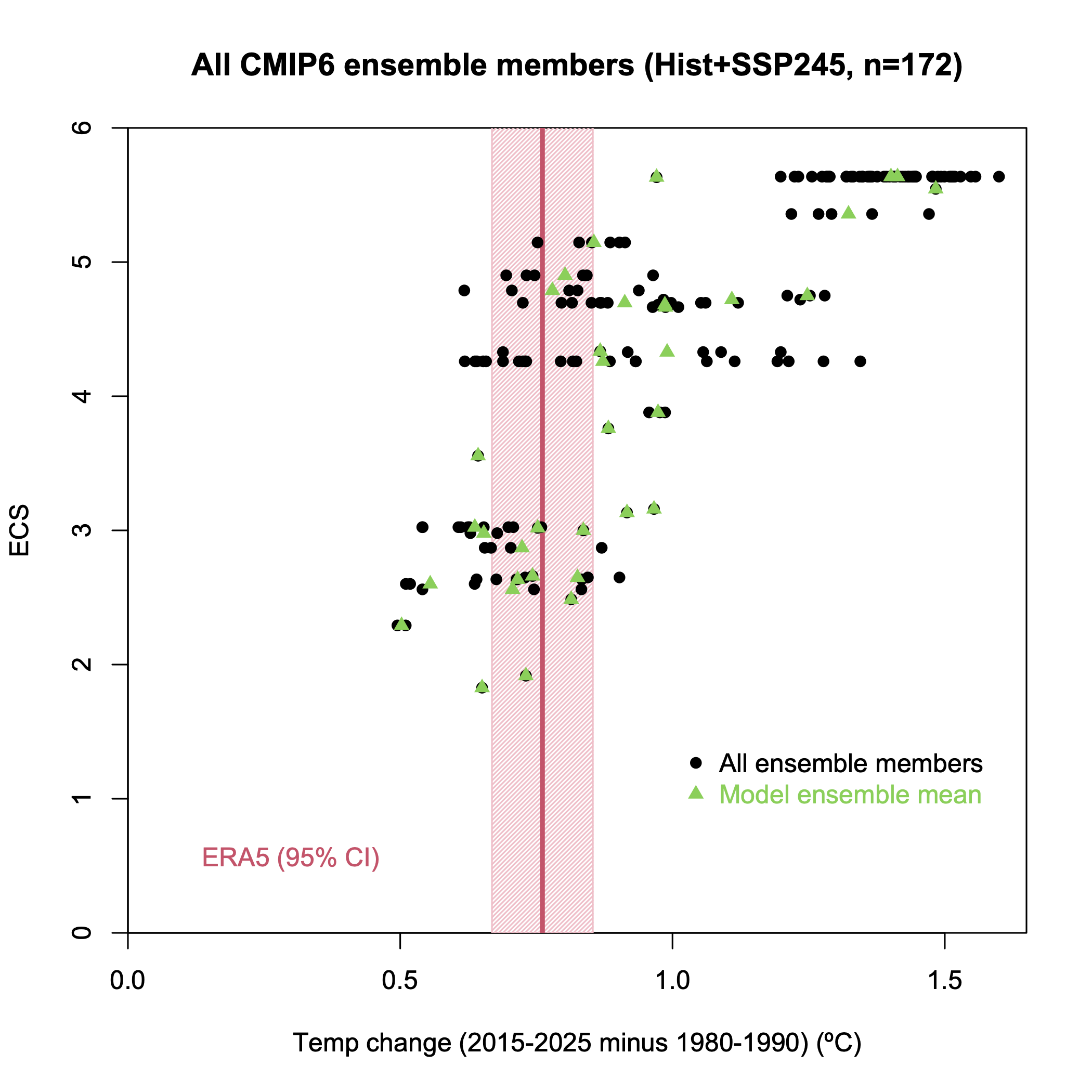
It is still clear that some models are not consistent with ERA5 (notably the five models with the highest sensitivity), but it is also clear that many of them are – and that Koonin’s claims (like Scafetta’s before him) are hogwash. His implicit claim that you should ignore uncertainty if that gets in the way of your preferred conclusion is simply embarrassing for someone who likes to think of himself as an “eminent” scientist.
References
- G.A. Schmidt, G.S. Jones, and J.J. Kennedy, "Comment on “Advanced Testing of Low, Medium, and High ECS CMIP6 GCM Simulations Versus ERA5‐T2m” by N. Scafetta (2022)", Geophysical Research Letters, vol. 50, 2023. http://dx.doi.org/10.1029/2022GL102530
- Z. Hausfather, K. Marvel, G.A. Schmidt, J.W. Nielsen-Gammon, and M. Zelinka, "Climate simulations: recognize the ‘hot model’ problem", Nature, vol. 605, pp. 26-29, 2022. http://dx.doi.org/10.1038/d41586-022-01192-2
- K.B. Tokarska, M.B. Stolpe, S. Sippel, E.M. Fischer, C.J. Smith, F. Lehner, and R. Knutti, "Past warming trend constrains future warming in CMIP6 models", Science Advances, vol. 6, 2020. http://dx.doi.org/10.1126/sciadv.aaz9549

Gosh, I wish we lived in a society where people like Koonin (and many others who have no idea what they’re talking about) could be simply ignored and not put in positions of power. It’s honestly baffling they still continue to spew their nonsense after being proven wrong time and time again in agonizing detail, if I may add.
Hi Gavin, Do you mean slightly later period? The start year moved along with the end year, so span still ten years.
“To wrap this up, I updated the figure above to look at a slightly longer period (the change to 2015-2025) using the latest observations from ERA5.”
But yes, it’s much easier to spout a mess than to clean it up with a thorough fact-checking. Why else would the preferred approach of the delaying industry be to “have a debate”. Ted Cruz was a debate whiz in college, it hasn’t done much for making factual statements his personal trademark.
Good article and useful information
The whole scenery of this “conference” – this typically propagandistic session driven by the Trump regime’s fanatic brain-inflammatory fever – is set from the beginning, when the introductor in a typically evangilizing manner says that “the weather today is extremely good!”, thereby implying not only that any talk of “extreme weather” is misplaced, but also a god-given atmosphere of pure goodness surrounding everything he and the regime he adores and adheres to, is doing. This evangelizing tone of leading politicians – recognizable from it’s former heyday in the fascist period 1914-45 – has been getting louder and louder ever since Reagan/Bush1 (the latter coming directly from his position as leader of the CIA…) took power in 1979/80, and it evolved/devolved into fullblown hysterical mode when Trump/Musk/Thiel got elected 2024, boasting with imperial hubris, fascist arm-waving etc. Confronted with this second coming of goebbelsian fervour, now even more easily recognizable as absurd theatricals as the first time it was around, it is important never to forget how childish and ridiculous this all is. It shouldn’t be mistaken for more than it is: pure ballooney, a clear sign of the representatives of a desperate ancien regime trying to hide their inner insecurity by brushing their feathers, raising their voices etc. – trying to impress themselves.
What Dessler says about the climate sceptics’ use of economic models is rather precise, but maybe he doesn’t quite grasp that this is the core of this whole and *purely ideological* issue: *the climate sceptics are trying to subordinate the physical reality to “economics”, ie. their neoclassical economic dogmas, ie. *their dreamed up view that endless and exponential growth in profits obtained by exponential growth in the consumption of energy and other raw materials has no physical limits.* They intuitively know they are wrong, even if – and especially when – they are trying to suppress that thought. That’s exactly why Elon Musk (with his first name Elon picked by his father Eroll from a novel written by the old nazi and creator of the hitlerian V2/V3 etc. rockets, Wernher von Braun https://m.youtube.com/watch?v=QEJ9HrZq7Ro&list=RDQEJ9HrZq7Ro&start_radio=1&pp=ygURd2VybmhlciB2b24gYnJhdW6gBwHSBwkJkQoBhyohjO8%3D , when leading the US space programme in the 1950ies. In the novel which is about an expedition to Mars, the leader of this is new imperial adventure is named Elon…), Peter Thiel etc. are dreaming of escaping to Mars (maybe from the US Pituffik “Space Base” in north Greenland – renamed from “Air Base” in 2023…): they are trying to escape the harsh reality, as are all our leaders in their different ways in these times, now even with artificial “intelligence” (electronic escapism…) etc.
Dessler unfortunately seems to be missing this important insight into the madness of neoclassical economic dogmas, which is at the ideological center of all neoliberal “thinking”, including from William Nordhaus, even when the latter seems to be just a little bit more reasonable than the worst fanaticals of that religion. Nordhaus really isn’t. I think it may be enlightening for Dessler to read this about William Nordhaus: “Forecasts by economists of the economic damage from climate change have been notably sanguine, compared to warnings by scientists about damage to the biosphere. This is because economists made their own predictions of damages, using three spurious methods: assuming that about 90% of GDP will be unaffected by climate change, because it happens indoors; using the relationship between temperature and GDP today as a proxy for the impact of global warming over time; and using surveys that diluted extreme warnings from scientists with optimistic expectations from economists. Nordhaus has misrepresented the scientific literature to justify the using a smooth function to describe the damage to GDP from climate change. Correcting for these errors makes it feasible that the economic damages from climate change are at least an order of magnitude worse than forecast by economists, and may be so great as to threaten the survival of human civilization.” https://www.tandfonline.com/doi/full/10.1080/14747731.2020.1807856 .
As the ancient greeks knew: hubris leads to nemesis. All those emperors, even with their new clothing…, are just dust in the wind, and that’s the reason why they hate science: it reminds them how insignificant they are.
(Gavin, you have a small error in this sentence: “That led to a whole saga, which took so long that while we (here should be a “were” inserted, KJ) trying to get the 2022 paper retracted on the grounds of being totally wrong, Scafetta basically published the same analysis again (with almost all the same errors and some new ones) in another journal.” Or maybe it’s just me not knowing the american language?)
Gavin!
I remain astonished by this persistence of the grotesque farce of the “models” supposedly meant to explain everything, when a single observation is enough to destroy their entire legitimacy:
… it is the oceans that have warmed over the past 200 years or so … and probably 300.
… they are completely insensitive to atmospheric energies: heat and infrared radiation
… they are influenced in terms of enthalpy increase ONLY by the visible and UV rays of the sun or the geothermal energy of the ocean floor.
… the sun has experienced, over the past 1000 years, a series of hiatuses … perfectly documented and has only returned to nominal activity over the past 300 years … which coincides with the … slow … warming of the oceans … and therefore the atmosphere, which is merely a TOTALLY dependent corollary.
All of this confirms the complete independence of the climate from Greenhouse Gases, confirming:
– paleo-climatological studies that deny any systematic correlation in the sense of CO2 > Temperature
https://royalsocietypublishing.org/rspa/article/478/2261/20210836/20210836/82494/Revisiting-causality-using-stochastics-2 https://www.researchgate.net/publication/320123470_The_Relationship_between_Atmospheric_Carbon_Dioxide_Concentration_and_Global_Temperature_for_the_Last_425_Million_Years – theoretical concepts such as that of Manabe et al., which conclude … at most … an impact of less than 1 degree … in 130 years for CO2 doubling … but whose impact on high troposphere warming (Hot Spot) has never been observed despite the 35% increase in CO2. Given the importance of these findings, I urgently request a personal response from Gavin
Gavin !
je reste effaré de cette persistance de la farce grotesque des “modèles” censés tout expliquer alors qu’un seul constat suffit à en détruire toute légitimité :
:
… ce sont les océans qui se sont réchauffés depuis 200 ans environ … et sans doute 300.
… ils sont totalement insensible aux énergies atmosphériques : chaleur et rayonnements infrarouges
… ils ne sont influencés en gain d’enthalpie, QUE par les rayons visibles et UV du soleil ou la géothermie des fonds marins.
… le soleil a connu depuis 1000 ans, une série de hiatus … parfaitement documentés et n’a repris un retour vers l’activité nominale que depuis 300 ans … ce qui coincide avec le … lent … réchauffement réchauffement des océans … et donc de l’atmosphère qui n’en est qu’un corollaire TOTALEMENT dépendant.
Tout ceci confirme la totale indépendance du climat envers les Gaz à Effet de Serre confirmant :
– les études paléo-climatologiques qui nient toute corrélation systémique dans le sens CO2 > Températures
https://royalsocietypublishing.org/rspa/article/478/2261/20210836/82494/Revisiting-causality-using-stochastics-2
https://www.researchgate.net/publication/320123470_The_Relationship_between_Atmospheric_Carbon_Dioxide_Concentration_and_Global_Temperature_for_the_Last_425_Million_Years
– les concepts théoriques tel celui de Manabe et al. qui concluent … au plus … à un impact de moins de 1 degré … dans 130 ans pour doublement CO2 … mais dont l’impact sur le réchauffement de haute troposphère (Hot Spot) n’a jamais été observé malgré la hausse de 35% du CO2
Compte tenu de l’importance de ces constats, je demandes instamment une réponse personnelle de Gavin
https://www.dropbox.com/scl/fi/dxs4tavgrfie1ghd01o3n/R-futation-Anglais-CO2-climat.fr.en-2.pdf?rlkey=0pfl8mhgp82k2v3muehr1y5ht&dl=0
Hello. First of all, you have no right to demand anything from anyone here. Are we demanding that you be scientifically honest? Secondly, the answers to your series of questions have already been given to you in the other article. Repeating the same questions over and over again when they have already been answered does not advance the debate. As for your article in MDPI (a predatory journal…) published by an “isolated” researcher, take a look at the one published on the subject in Science: https://www.science.org/doi/10.1126/science.adk3705
The authors of this article clearly state the importance of CO2 in these processes. You can read an interview with the research team here:https://www.forbes.com/sites/davidbressan/2024/09/22/new-study-shows-485-million-years-of-earths-temperature/
B J-C: the oceans . . . are completely insensitive to atmospheric energies: heat and infrared radiation
BPL: Not true. Increased longwave radiation heats the skin layer, which means the contrast with deeper water is less, which slows down convection in the upper layers, which keeps the oceans warmer than they would be otherwise.
B J-C: All of this confirms the complete independence of the climate from Greenhouse Gases
BPL: You can’t do that without throwing out hundreds of years of observations and theory which explains the observations. Don’t try to reinvent physics. It’s a thankless job.
Falsehoods don’t sound any better in French. You’re wasting your and our time.
However, since I’m here, this: Study Finds Ocean Impacts Nearly Double Economic Cost of Climate Change. The “blue” social cost of carbon provides a more complete measure of the monetary harm caused by global climate damages – https://scripps.ucsd.edu/news/study-finds-ocean-impacts-nearly-double-economic-cost-climate-change
FAQ: Ocean Warming – https://scripps.ucsd.edu/research/climate-change-resources/faq-ocean-warming
“As human activities have released greenhouse gases into the atmosphere, trapping excess heat and warming the planet, the ocean has absorbed more than 90% of that excess heat since the 1970s. The ocean can do this because of its size and because it’s made of water, which can absorb four times as much heat as the same volume of air.
“One estimate suggests that the heat energy absorbed by the ocean’s upper 2,000 meters (6,500 feet) between 1955 and 2010 would have warmed Earth’s atmosphere by 36°C (64.8°F). Instead, greenhouse gases piling up in the atmosphere have so far led to a 1.2°C (2.2°F) increase in global average air temperatures compared to preindustrial times.
“The absorption of all this heat by the ocean has protected land dwellers like humans from temperatures that would make life impossible in certain regions, but that energy, almost impossible to quantify in comprehensible terms, will remain present for decades, if not centuries.”
It is always possible to find contrarian reports. All too often, they take advantage of the vast funding coming from fake skeptics to support their profitable industries. But some do it for free. They do not come close to representing the main body of honest research.
https://www.realclimate.org/index.php/archives/2026/02/koonins-continuing-calumnies/#comment-844842
Dear Sir,
A look into Koutsouyiannis et al 2022 article (https://doi.org/10.1098/rspa.2021.0836) cited by you reveals that they analysed
a) paleoclimate data (CO2 samples from Antarctic ice cores) and
b) short-term (up to 100 months) variability in present temperature – atmospheric CO2 concentration relationship.
For both, the found causal relationship (that a change in T caused the observed change in atmospheric CO2 concentration) is completely plausible. The broadly accepted explanation for paleoclimate data are temperature changes due to slow periodic changes in Earth insolation, caused by Earth precession and further orbital movements. For the short-term (quasi-peiodic within a few years) variability in the present data, the explanation are oscillations in heat uptake and release by Earth oceans, especially by Pacific (ENSO).
Both kinds of these temperature variations change the equilibrium between CO2 in the atmosphere and in the ocean, the resulting changes in the atmospheric CO2 concentration then in certain extent further amplify the amplitude of the observed temperature oscillations.
Koutsouyiannis et al., however, seem to be completely silent about the CO2 increasing trend during more than 200 years of the industrial era. This trend, lacking any periodicity, obviously does not fit with the patterns they studied.
For this unique event, their analysis would have been likely inapplicable, moreover, there is quite solid evidence from independent data, primarily from 14C depletion in atmospheric CO2 between 1750 and 1950, that the rise of atmospheric CO2 concentration during the industrial era does not come from the ocean but from anthropogenic CO2 emissions.
For details, please compare my recent reply to Mr. Demol in another thread:
https://www.realclimate.org/index.php/archives/2026/01/2025-updates/#comment-844844
I conclude that if you assume that the rise of atmospheric concentration during the industrial era might have been caused by the rising global mean surface temperature during this period, your post lacks any support for this assumption, as well as any evidence disproving the existing very solid support for the opposite.
Best regards
Tomáš
TK: a change in T caused the observed change in atmospheric CO2 concentration
BPL: Yes, but the elevated CO2 then caused a change in T, effectively acting as a positive feedback.
in Re to Barton Paul Levenson, 9 Feb 2026 at 9:37 AM,
https://www.realclimate.org/index.php/archives/2026/02/koonins-continuing-calumnies/#comment-844877
Hallo Barton Paul,
Nice to hear from you!
I mentioned this feedback in the next paragraph.
I should, however, apologize to Prof. Koutsoyiannis for misspelling his name.
Greetings
Tomáš
Tomáš,
I did reply to your comment of the 2025_updates thread, but will expand on it now. I do apologise in advance as this will have some geological content, I hope readers here can keep up :-)
Yes, it is well known that palaeo records show changes in temperature from changes in Earth’s orbit drive changes in atmospheric CO2, and the outgassing of oceans is clearly understood by anyone who has opened a warm bottle of soft drink. As you have observed, and BPL quickly reiterated, climate scientists love a positive feedback as it allows CO2 to continue to be the main driver of climate change.
However the regular patterns of climate change so clearly seen in the ice cores have been observed consistently over all times over the last 200MY across sedimentary basins around the world. Near shore sediments show a distinct pattern of prograding and transgressive sedimentation as sea levels oscillate. So? What does that tell us about ECS, positive feedbacks, or the concept of CO2 increases bootstrapping temperature rises? Plenty actually. Over the last half a million years or so when we have decent ice core data, CO2 levels are around 180PPM during glacial max, rising to around 280PPM at the warmest times. That is a huge increase.
Now let’s rewind a hundred million years or so when we see the same temperature oscillations. The CO2 level is around 1200PPM, but a CO2 rise of 100PPM is going to have a negligible impact on the forcing.
in Re to Keith Woollard, 11 Feb 2026 at 2:40 AM,
https://www.realclimate.org/index.php/archives/2026/02/koonins-continuing-calumnies/#comment-844962
Dear Keith,
Thank you very much for both your responses. Your remarks sound very interesting. Unfortunately, I am very unfamiliar with geology. Do I understand correctly that about 100 million years ago, there were also temperature oscillations with a similar amplitude and periodicity as in the Pleistocene, however, at a CO2 atmospheric concentration about 1200 ppm?
If so, do you think that this observation is still consistent with the record of the respective oscillations in CO2 atmospheric concentration (in which range, actually?) during this geological era, or do you rather think that there may be a gap or discrepance in existing theory?
Thank you in advance for more details and greetings
Tomáš
Good question Tomáš,
Regarding your understanding in paragraph 1 – yes, you are correct.
We certainly do not have the temporal resolution to measure CO2 variation on anything like the scale needed. Ice cores are great because they capture actual samples of air from the period. When dealing with millions of years ago any atmospheric CO2 estimations has to be done via indirect methods. It is easy to see the sea level swings in the sedimentary record, and you may not always be able to accurately age them, but you can certainly calculate the oscillation frequency and the amplitude of the change. Never say never, but I do not think it likely that CO2 concentration data are there to be recovered.
The idea that those same swings in CO2 concentrations comes from the simple physics of ocean outgassing
Blais Jean-Claude identity declares “I remain astonished by this persistence of the grotesque farce of the “models” supposedly meant to explain everything, when a single observation is enough to destroy their entire legitimacy:”
Yet you don’t present such observations. For those who want to remember part of the chain of evidence you disregard, here are two observations which document the increase in warming tied to increases in CO2 and from methane, directly measured in a pair of observational studies spanning eleven years for the CO2 and ten years for the methane..
CO2 in a 2015 article from Lawrence Berkeley National Laboratory:
“First Direct Observation of Carbon Dioxide’s Increasing Greenhouse Effect at the Earth’s Surface”
“They found that CO2 was responsible for a significant uptick in radiative forcing at both locations, about two-tenths of a Watt per square meter per decade. They linked this trend to the 22 parts-per-million increase in atmospheric CO2 between 2000 and 2010. Much of this CO2 is from the burning of fossil fuels, according to a modeling system that tracks CO2 sources around the world.
“We see, for the first time in the field, the amplification of the greenhouse effect because there’s more CO2 in the atmosphere to absorb what the Earth emits in response to incoming solar radiation,” says Daniel Feldman, a scientist in Berkeley Lab’s Earth Sciences Division and lead author of the Nature paper.
“Numerous studies show rising atmospheric CO2 concentrations, but our study provides the critical link between those concentrations and the addition of energy to the system, or the greenhouse effect,” Feldman adds.”
https://newscenter.lbl.gov/2015/02/25/co2-greenhouse-effect-increase/
A 2018 article on methane, also from Lawrence Berkeley National Laboratory:
“First Direct Observations of Methane’s Increasing Greenhouse Effect at the Earth’s Surface”
“Scientists have directly measured the increasing greenhouse effect of methane at the Earth’s surface for the first time. A research team from the U.S. Department of Energy’s Lawrence Berkeley National Laboratory (Berkeley Lab) tracked a rise in the warming effect of methane — one of the most important greenhouse gases for the Earth’s atmosphere — over a 10-year period at a DOE field observation site in northern Oklahoma.
These findings were published online April 2 in the journal Nature Geoscience in an article entitled “Observationally derived rise in methane surface forcing mediated by water vapour trends.” The paper indicates that the greenhouse effect from methane tracked the global pause in methane concentrations in the early 2000s and began to rise at the same time that the concentrations began to rise in 2007.
“We have long suspected from laboratory measurements, theory, and models that methane is an important greenhouse gas,” said Berkeley Lab Research Scientist Dan Feldman, the study’s lead author. “Our work directly measures how increasing concentrations of methane are leading to an increasing greenhouse effect in the Earth’s atmosphere.””
https://newscenter.lbl.gov/2018/04/02/methane-greenhouse-effect/
BLAIS JEAN-CLAUDE: I remain astonished by this persistence of the grotesque farce of the “models” supposedly meant to explain everything, when a single observation is enough to destroy their entire legitimacy:
Heh. He may be wrong, but at least he’s sure! M. Blais is making his second demand for attention on RC in 3 weeks (https://www.realclimate.org/index.php/archives/2026/01/2025-updates/#comment-844624). Is he a fresh new face of denialism? Been a while since we’ve had one here.
J-CB: :Given the importance of these findings, I urgently request a personal response from Gavin
I casually request you let PZ Myers introduce you to the Mediocrity Principle (https://www.edge.org/response-detail/11272), i.e. “You’re not special.” Then, please reconsider your comment in light of the Dunning-Kruger Effect. No hurry, the rest of us know that about you already.
Il manque une suite, le temps des accusations est plus long que celui des réponses des accusés….
Donc oui, vidéo intéressante, mais incomplète.
Maybe they took the Brandolini law into account !
hat tip to DEVEKER: “Brandolini’s law is an Internet adage coined in 2013 by Italian programmer Alberto Brandolini. It compares the considerable effort of debunking misinformation to the relative ease of creating it in the first place. The adage states: The amount of energy needed to refute bullshit is an order of magnitude bigger than that needed to produce it. The challenge of refuting bullshit does not come just from its time-consuming nature, but also from the challenge of defying and confronting one’s community …” – https://en.wikipedia.org/wiki/Brandolini's_law
JPD: I understand French, but RealClimate uses English. It’s not your language but your invalid assertions which are the problem here.
There is a similar statement of the second law of thermodynamics:
If you add a teaspoon of wine to a gallon of sewage, you get sewage.
If you add a teaspoon of sewage to a gallon of wine, you get sewage.
Quoting Dessler from the video transcript, it should be self-evident where the problem lays, not once but twice:
1:01:07 I’m not raising my hand. I absolutely don’t think economists have any clue about that. They simply can’t do it. And I’m not here to bash economists. I’m just saying they have unlike the climate models which have a track record of correctly predicting the temperature. Economists don’t. And in fact, the economic models are made up. This is a very important point. This is a slide from Robert Pendik who’s a professor of economics at MIT. He he was giving this in a talk. I screenshotted it and I asked it’s reproduced here with his permission. Now let’s compare economic models to climate models. Climate models are based on laws of physics. Conservation of mass, conservation of momentum, conservation of energy, water thermodynamics. The physical system runs on rails. Okay? And that’s why we can predict the temperature in 100 years. There is no equivalent to economics. The economic models are made up. “ end quote.
https://www.youtube.com/watch?v=yTYLswTEVS8&t=3660s
This is from a leading public facing climate scientist and self-appointed active communicator. Do readers grasp what is self-evident, what is scientifically not correct and unsupported by climate science literature and physics in these kinds of comments?
Consider: Saying climate is predictable because it follows physical laws confuses determinism with predictability. Dessler’s claim that climate “runs on rails” and so it’s “predictable” is a gross category error. Compressing epistemic uncertainty into a political metaphor doesn’t make it true. The most gracious way to put it is Dessler is speaking rhetorically, not scientifically.
Deterministic physics does not imply predictable trajectories in chaotic coupled systems—this is foundational dynamical systems theory. That’s a first-year under-graduate principle from foundational chaos theory.
Climate Models constrain physically possible futures; they do not predict real-world outcomes. To be clear: Models explore conditional possibilities; they do not, can not predict what will happen. A model cannot rule out reality. Reality rules out models.
Climate Science:101
Dessler’s rhetoric and that video being posted here helps no one.
Data: “Consider: Saying climate is predictable because it follows physical laws confuses determinism with predictability. Dessler’s claim that climate “runs on rails” and so it’s “predictable” is a gross category error…..etcetera”
I asked Google Gemini about Datas comments. Result: “A chaotic system is deterministic, meaning it follows precise physical laws, but its future state is highly sensitive to its current state—a phenomenon popularly known as the butterfly effect. Because we can never measure the “starting” state of the entire planet perfectly, we cannot predict the exact state of the system (like the weather on a specific day) far into the future. Because the system is chaotic and coupled, the Intergovernmental Panel on Climate Change (IPCC) notes that long-term prediction of specific “states” is impossible.”
“Instead, scientists focus on probability distributions: 1) Ensemble Modeling: Scientists run many simulations with slightly different starting points. If most models show a similar trend (like rising temperatures), they have higher confidence in that outcome. 2) Climate vs. Weather: While weather is chaotic and “runs free” (unpredictable after ~14 days), the climate is “on a leash” held by boundary conditions like solar radiation and greenhouse gas levels. We can’t predict the weather on 1 September 2045, but we can predict that the average temperature of that decade will be higher if CO2 levels increase. ”
So Datas comments are not the full picture and appear to be quite misleading.
Data: “Climate Models constrain physically possible futures; they do not predict real-world outcomes.”
Again according to google gemini (edited to keep it short): “Climate scientists generally state that they do not “predict” what will happen in the absolute sense because the future depends on unpredictable human choices and natural variations. They make “projections” which are simulations of how the climate might change based on specific assumptions about human activity, such as future greenhouse gas emissions. They are “if-then” statements: if humans emit X amount of carbon, then the climate will likely warm by Y amount. ”
So we know if we continue to burn fossil fuels at certain levels, certain “real world” outcomes are possible. So I would say climate models are certainly useful for discerning likely future outcomes. We can say they are making a prediction based on assumptions xyz. And the early models have done this and predicted warming trends quite well. I think Dessler was using the term prediction as convenient shorthand the public would understand, and it was obviously implicit that it was dependent on certain assumptions about fossil fuels use.
In comparison Dessler is right that Economic models have a very poor track record of making predictions or projections. IMHO the models are not just made up or useless, because they are based on certain well understood relationships but unfortunately they are much more primitive than climate models, partly because its hard to model the complexity of human behaviour. Some of the assumptions made by economic models are astonishing: eg that humans always act rationally. Assumptions made in climate models appear to be much more realistic and evidence based.
So I just think that Dessler is far more right about the issues than he is wrong.
This nukes denialists and naive model worshippers:
Climate models do not literally predict the future climate trajectory the way weather models predict next week’s weather. What CMIP6 primarily produces are conditional projections: “If society follows this emissions pathway, physics implies this range of outcomes.”
That’s different from a forecast. The IPCC explicitly distinguishes initialized climate predictions (seasonal–decadal, limited by chaos) from long-term projections that depend on unknowable socioeconomic choices.
Models have correctly predicted many structural features of climate change (e.g., stratospheric cooling, polar amplification), but they cannot predict exact temperatures in 2100 or the timing of internal variability.
Public discourse often collapses projections into predictions for communication purposes, but technically they are counterfactual scenario simulations, not deterministic forecasts. Dessler overstepped the science boundaries, made a serious and fundamental category error, going straight to narrative storytelling mode.
Dressler’s statements are scientifically unsupportable:
“….the climate models which have a track record of correctly predicting the temperature. Economists don’t. And in fact, the economic models are made up.
The physical system runs on rails. Okay? And that’s why we can predict the temperature in 100 years. There is no equivalent to economics. The economic models are made up. “
To be clear: Models explore conditional possibilities; they do not, can not predict what will happen. A model cannot rule out reality. Reality rules out models.
Reliance on Data proves the rules. Rhetoric achieves nothing. The IPCC AR6 Glossary provides the Data about “Prediction” vs everything else https://www.ipcc.ch/report/ar6/wg1/downloads/report/IPCC_AR6_WGI_AnnexVII.pdf
No Google Gemini / ChatGPT AI LLM is required.
Whereas Prediction and similar do NOT appear in the tech summary https://www.ipcc.ch/report/ar6/wg1/downloads/report/IPCC_AR6_WGI_TS.pdf
Nor the AR6 SPM read by “policy makers/staffers. https://www.ipcc.ch/report/ar6/wg1/downloads/report/IPCC_AR6_WGI_SPM_final.pdf
The question to ask is “Why?”
The “Answer” will be found by following the Data and not the spurious rhetoric about that Data.
Data says: “Models have correctly predicted many structural features of climate change (e.g., stratospheric cooling, polar amplification), but they cannot predict exact temperatures in 2100 or the timing of internal variability.”
Strawman argument. Nobody has claimed climate models can predict exact temperatures by 2100. They can however predict (or project if you prefer that term) a temperature range, based on a particular assumption about fossil fuels use. So for example assuming fossil fuels use continues on a business as usual basis we are looking at approx. 3.3 – 5.7 degrees c by 2100 according to the IPCC.
It’s like watching a masterclass in unintended comedy.
You have a climate scientist literally saying: “Economic models are made up” — with zero self-awareness that every CMIP/IPCC scenario is also a giant human-crafted simulation.
The physics gives it structure, yes, but the assumptions, parameterizations, tuning, mitigation scenarios — basically made up by committees and software engineers.
It’s the perfect mix of naïve hubris and live irony. Stand-up material indeed. You almost have to laugh to not cry. While knowing next to no one will ever get THE JOKE was even spoken, let alone so funny/sad; no depressing!
Nordhaus’ damage function is a wild assed guess and it won the Nobel Economics prize.
That seems to meet Dessler’s criteria
Eli,
The fact that some economists are charlatans does not invalidate the entire field. There are good economists out there, and we’ll need their help in the future making the right decisions about future mitigation and amelioration.
The answer to bad economic analysis is good economic analysis.
Eli/Ray: Strongly recommend Paul Krugman’s substack (mostly short posts, not paywalled (except some of the more intensive material), and he often includes lively music links.
https://paulkrugman.substack.com/
Thanks Ray, you’re the adult in this room.
People, I took enough Economics courses during my prolonged formal education to recognize the “tragedy of the commons,” i.e. common-pool resource market failure leading to secular loss of value for all parties, voluntary or not. The costs of anthropogenic climate change in money and tragedy, ensue because the capacity of the Earth to absorb greenhouse gases without heating up is a finite common good. I, for one, see both the past three centuries of accelerating transfer of geologic carbon to the atmosphere, and continuing resolute denial of its economic consequences, as the authors of the tragedy of the global climate commons: otherwise: no one would care!
Whatever Hardin’s motivation in 1968, his assignment of “environmental” (i.e. social) costs to the “free” market’s tendency to socialize every private transaction cost it can get away with, has withstood time and passionate criticism. So has his conclusion that TotCs can only be mitigated by “mutual coercion, mutual agreed upon”, i.e. collective intervention in the otherwise-free market, requiring consumers of fossil fuels, or goods and services made with them, to internalize costs they’ve hitherto been able to externalize: ‘coercion’ of a sort. Hardin later expressed regret he didn’t title his 1968 Science article “The Tragedy of the Unmanaged Commons”, as coercion of individuals may only be by mutually-agreed peer pressure within a limited stakeholder population.
And I’ve tried to keep up with current economic thought regarding global warming. E. Ostrom has emphasized voluntary agreements among common-pool resource users, e.g. fishermen, to limit exploitation to sustainable rates. Even here, however, peer-enforced conformity can be frankly coercive. Ostrom acknowledged that rewriting the drama of the global climate commons to avert maximum tragedy would require coercion in some form or other, although it may be by majority vote within nominal democracies, followed by “voluntary”, i.e. negotiated, agreement among nations to discourage “free-riding”.
Folks, I’m here to tell you: the fossil fuel producers and investors who’ve grown wealthy beyond historical dreams of avarice by socializing their private climate-change costs by the gigatonne, understand the economics of climate change very well. Why else would they reinvest mere $billions of their $trillions in annual profits to obstruct collective intervention to decarbonize (https://www.theguardian.com/business/2020/jan/08/oil-companies-climate-crisis-pr-spending)? IMO, they’d be fools not to!
It -Nordhaus’ damage function- and worse meets IPCC Criteria repeatedly across several Assessments. Tell the whole truth not only half of it.
In fact, if what Dessler says is true and correct quoting “And in fact, the economic models are made up.” ref – https://www.youtube.com/watch?v=yTYLswTEVS8&t=3660s
Then what are they doing inside any IPCC Assessment Report?
Because you will find conclusions from Economic Models all through IPCC Assessments and SMPs.
Dessler continues quote: “The physical system runs on rails. Okay? And that’s why we can predict the temperature in 100 years. There is no equivalent to economics. The economic models are made up. “ ref – https://www.youtube.com/watch?v=yTYLswTEVS8&t=3660s
What we get, instead of credible scientific analysis equal to Feynman, Charney and Sagan, from Dessler’s typical Climate discourse is trying to place the Climate itself outside of normal political-economic and physical material boundary constraints. It’s as if the entire Climate Science community is a special exception layer that can override neoliberal economic growth politics, material reality, and global governance practices all by themselves.
That is a Frame Maintenance illusion-a Category Error.
The Mainstream Climate Narrative Assumption (based on Models) is:> Climate is an existential threat → therefore society will restructure itself.
When the Actual System Dynamics is:> Growth, legitimacy, jobs, capital flows, and political stability override everything—including climate.
Climate discourse and scientists imagine a Meta-layer that does not exist. That’s possibly why Dessler thinks it’s ok for him to insult and label what the others say as “Bullshit”
Ref: https://youtu.be/yTYLswTEVS8?si=FKXDIyCMH7SyVGxY&t=4222
Seemingly he’s believing the climate models alone are enough to convince the world he’s right–everyone else is wrong. And therefore everyone else but himself and the CMIP is “making it up”!
As Steve Koonin says: 1:08:37 – > So, so the
question if I remember right is what was the practical import of having many 40%
of the climate models being too sensitive and your statement Andy that it was well
known in the scientific community indeed true.
But what matters is not the knowledge in the scientific community what matters is
the knowledge among the public and particular the decision decision makers.
Ref: https://youtu.be/yTYLswTEVS8?si=ya4k9Iyf_dNP3jRD&t=4112
Who uses slide headings of “Scientific Felonies” in slides for a science discussion at a University?
Dessler does Ref: https://youtu.be/yTYLswTEVS8?si=ZwaJtkE1osfq6_0S&t=2121
It is clear for some time Climate Scientists have lost the Climate War but they cannot yet see it.
Data: “The Mainstream Climate Narrative Assumption (based on Models) is:> Climate is an existential threat → therefore society will restructure itself.”
That’s misinformation. The true narrative is “Climate is an existential threat, therefore society SHOULD restructure itself. This is a crucial difference. Nobody in the climate community has said a restructure will happen or would be easy. Only that it is a potential solution to be considered. it is not the scientists jobs to do political evaluations. Only to suggest some potential solutions.
Is a restructure possible? The mitigation measures contained in the IPCC report centre around a new energy system and transport grid. Many argue this is possible. The IPCC does not suggest major restructures such as the overthrow of capitalism or democracy.
Data: “When the Actual System Dynamics is:> Growth, legitimacy, jobs, capital flows, and political stability override everything—including climate.”
Such things are important. The irony is a new energy system CREATES jobs and capital flows and some level of economic growth. Open your eyes Data.
Reply to Eli Rabett
That seems to meet Dessler’s criteria?
Nordhaus’s DICE (Dynamic Integrated Climate–Economy) and related Integrated Assessment Models (IAMs) are cited in IPCC reports, especially: AR4 (2007) AR5 (2013–2014) and AR6 (2021–2023)
Therefore, if as Dessler states: “And in fact, the economic models are made up.”… what are they doing in any IPCC Assessment Report?
Three classic Integrated Assessment Models (IAMs) dominate early climate economics literature: DICE (Nordhaus) PAGE (Hope) FUND (Tol). These models were foundational and widely discussed in IPCC assessments up to today.
Yet Dessler goes further : “The physical system runs on rails. Okay? And that’s why we can predict the temperature in 100 years. There is no equivalent to economics. The economic models are made up. “ Ref – https://www.youtube.com/watch?v=yTYLswTEVS8&t=3660s
What we get, instead of credible scientific analysis equal to Feynman, Charney and Sagan, is a Climate discourse trying to place the Climate itself outside of normal political-economic and physical material boundary constraints.
It’s as if the entire Climate Science community is a special exception layer that can override universally accepted neoliberal economic growth politics, material reality, and global governance practices all by themselves. If so, that is a Frame Maintenance illusion-a Category Error.
This Mainstream Climate Narrative Assumption (based on Climate and Economic Models) is:> Climate is an existential threat → therefore society will restructure itself.
When the Actual System Dynamics is:> Growth, legitimacy, jobs, capital flows, and political stability override everything—including climate.
Climate discourse and scientists imagine a Meta-layer that does not exist. That’s possibly why Dessler thinks it’s ok for him to insult and label what the others say as “BS”
See ref: https://youtu.be/yTYLswTEVS8?si=FKXDIyCMH7SyVGxY&t=4222
Does he really believe the CMIP/climate models alone are enough to convince the world he’s right–and the Economic models are enough to prove everyone else is wrong? Is everyone else “making it up” including Nordhaus in those IPCC Assessments? Because I’m sensing a hole in the argument here.
As Steve Koonin says: 1:08:37 – > So, so the
question if I remember right is what was the practical import of having many 40%
of the climate models being too sensitive and your statement Andy that it was well
known in the scientific community indeed true.
But what matters is not the knowledge in the scientific community what matters is
the knowledge among the public and particular the decision decision makers.
Ref: https://youtu.be/yTYLswTEVS8?si=ya4k9Iyf_dNP3jRD&t=4112
Why would you use a overhead slide heading of “Scientific Felonies” in a science talk?
Ref: https://youtu.be/yTYLswTEVS8?si=ZwaJtkE1osfq6_0S&t=2121
Things are getting desperate when claiming “economic models are made up” but they’re still good enough to be used in IPCC Reports simultaneously failing mention this fact. It is clear to me for many years Climate Scientists and the institutions they defend no matter what. have lost the Climate Wars. And they cannot yet see it let alone accept it.
When in a hole, better to stop digging.
Steve Koonin at 21:12 says the following which succinctly expresses his lack o understanding of climate models.
It’s a clear case of someone telling you he doesn’t understand something without saying he doesn’t understand something.
Steve Koonin at 21:12 says
We’re interested in how the climate will change under human and other influences.
Ref: https://youtu.be/yTYLswTEVS8?si=zHq52K8VjSAMrm25&t=1272
Crusty Caballero says: It’s a clear case of someone telling you he doesn’t understand something without saying he doesn’t understand something.
Data responds: Crusty, go read the IPCC Assessments. You do not understand something.
What you’ll find Crusty is that Koonin’s understanding is quite accurate. Irrespective of his opinions about the degree of “impacts/damages caused” or “response to GHGs”.
Here read this :
Climate system The global system consisting of five major
components: the atmosphere, the hydrosphere, the cryosphere, the
lithosphere and the biosphere and the interactions between them.
The climate system changes in time under the influence of its own
internal dynamics and because of external forcings such as volcanic
eruptions, solar variations, orbital forcing, and anthropogenic
forcings such as the changing composition of the atmosphere and
land-use change.
https://www.ipcc.ch/report/ar6/wg1/downloads/report/IPCC_AR6_WGI_AnnexVII.pdf
Go the extra step and keyword search “influence” x22
Try “climate change” x75 Or “human” x58
Natural variability refers to climatic fluctuations that occur without
any human influence, that is, internal variability combined with
the response to external natural factors such as volcanic eruptions,
changes in solar activity and, on longer time scales, orbital effects
and plate tectonics.
Sometimes referred to as Unforced Variations – ha ha.
Data, no you are wrong. Climate models are primarily models of how climate works. That includes animations of how the jet stream works etc, etc. Climate models are not just how the climate will respond to anthropogenic forcings. To be useful for something like that, they FIRST have to model how the climate works as a total thing. They do this based on energy balance equations.
Reply to Crusty Caballero
Steve Koonin at 21:12 says
We’re interested in how the climate will change under human and other influences.
Ref: https://youtu.be/yTYLswTEVS8?si=zHq52K8VjSAMrm25&t=1272
Crusty Caballero misunderstands the point he quotes then says: It’s a clear case of someone telling you he doesn’t understand something without saying he doesn’t understand something.
Data responds: Pot Kettle Black! Crusty, go read the IPCC Assessments.
What you’ll find Crusty is that Koonin’s understanding is quite accurate and grounded. Irrespective of his opinions about the degree of “impacts/damages caused” or “response to GHGs”.
Read this :
Climate system The global system consisting of five major
components: the atmosphere, the hydrosphere, the cryosphere, the
lithosphere and the biosphere and the interactions between them.
The climate system changes in time under the influence of its own
internal dynamics and because of external forcings such as volcanic
eruptions, solar variations, orbital forcing, and anthropogenic
forcings such as the changing composition of the atmosphere and
land-use change.
https://www.ipcc.ch/report/ar6/wg1/downloads/report/IPCC_AR6_WGI_AnnexVII.pdf
Go the extra step and keyword search “influence” x22
Try “climate change” x75 Or “human” x58
Natural variability refers to climatic fluctuations that occur without
any human influence, that is, internal variability combined with
the response to external natural factors such as volcanic eruptions,
changes in solar activity and, on longer time scales, orbital effects
and plate tectonics.
Then go read Gavin’s latest “RC article”
https://www.realclimate.org/index.php/archives/2026/02/the-climate-science-reference-they-dont-want-judges-to-read/
Quoting from Gavin’s Ref we find at the very beginning:
Reference Guide on Climate Science
pg 1563 Introduction
Climate science examines the structure and dynamics of the Earth’s climate
system and how that system is influenced by human and natural processes.
https://www.realclimate.org/wp-content/uploads/Reference_Guide_on_Climate_Science_RMSE_4th_Ed.pdf
Speaks for itself, obviously. Steve Koonin at least understands this.
Data at 8:30 PM and at 12:23 AM.
Re: Steve Koonin at 21:12 says…
Folly (stupidity) is a more dangerous enemy to the good than evil. One can protest against evil; it can be unmasked and, if need be, prevented by force. Evil always carries the seeds of its own destruction, as it makes people, at the least, uncomfortable.
Against folly we have no defense. Neither protests nor force can touch it; reasoning is no use; facts that contradict personal prejudices can simply be disbelieved – indeed, the fool can counter by criticizing them, and if they are undeniable, they can just be pushed aside as trivial exceptions.
So the fool, as distinct from the scoundrel, is completely self-satisfied; in fact, he can easily become dangerous, as it does not take much to make him aggressive. A fool must therefore be treated more cautiously than a scoundrel; we shall never again try to convince a fool by reason, for it is both useless and dangerous.
Reply to Crusty Caballero
Neither evil nor foolishness is required. What you’re seeing is institutional systems doing what systems always do: self-protecting and self-validating their own frameworks. That’s how we ended up here. And why I’ll leave it there.
P.s.:
Source: Bonhoeffer, Dietrich. Letters and Papers from Prison
. Edited by Eberhard Bethge, translated by Reginald Fuller, Frank Clarke, and John Bowden, Touchstone, 1997, p. 7
As I am over here in Portugal with not much to do as we wait for our household goods, I decided to reread Jayne’s Probability Theory text and came across this gem of a story illustrating the difference between the ideas of = vs. is, which are often used nearly interchangeably.:
“Another amusing example is the old adage: \Knowledge is Power”, which is a very cogent
truth, both in human relations and in thermodynamics. An ad writer for a chemical trade journal
fouled this up into: \Power is Knowledge”, an absurd { indeed, obscene { falsity.”
This is precisely the attitude of Koonin et al. They are utterly convinced that the only thing that has kept them from being taken seriously is the fact that they were not in power. And now that the powers that be are friendly to them, they expect their narrative to become cannon.
But their narrative is still false, and their attitude that might will make it right is–as Jaynes notes–obscene. Koonin and the fraudulent five have no credibility precisely because they have nothin that adds understanding . Cherrypicking data and scenarios, invoking uncertainty monsters under the bed and nitpicking the literature and attacking the credibility of one’s colleagues do not help us understand climate better.. And if you don’t add to understanding, why should we take you seriously?
in Re to Ray Ladbury, 9 Feb 2026 at 2:27 PM,
https://www.realclimate.org/index.php/archives/2026/02/koonins-continuing-calumnies/#comment-844891
Dear Ray,
You should hope that your opponents do not find too much cannon fodder for their narrative ..
Greetings
Tomáš
I have read this post a few times but I have been unable to understand what all the fuss is about. Why is the DOE DWG report important? I am a layman and read realclimate.org from time-to-time to follow the latest findings in climate science, which is to say I have little or no context for the discussion in this post. However, I doubt it would have been that difficult or lengthy to provide that context, which leaves me wondering why it was omitted. I thought it was important to communicate with the public.
Is the DOE DWG report an important policy document or does it feed u.s. policy decision processes? If so, I think the present government has shown its clear intention to ignore, defund, and largely gut Science including Climate Science. Will debate over the DOE DWG report have any impact on u.s. climate policy? I doubt it. The current u.s. government has already decided the science it intends to support and follow — and I think Science will have little ability to sway the direction of science. However, I would appreciate a little more understanding about what is going on as the 2026 elections approach, assuming there will be 2026 elections. This post just leaves me puzzled.
[I apologize for criticizing this post, but my pseudonym tends to bring it out in me. I feel that things have grown so bad that a tendency to be a little brusque might be better than simply being nice and skipping on to other reading.]
[Response: The DOE report is not at all important. It was an attempted runaround the real science to support the reconsideration of the CO2 endangerment finding and adds absolutely nothing to the science or policy discussion. Koonin pretends to be a serious contributor to the discussion but it’s all just vibes. – gavin ]
The question is about what should drive that climate sensitivity. It is not going to be water vapor feedback. There it would have been helpful reading my short summary on the subject that I sent out on the 1st Dec last year. There is a multitude of errors in the way consensus science treats the role of WV within the climate system.
1. There is the overestimation of the GHE itself, based on the surface emissivity = 1 assumption. Given water has a hemispheric spectral emissivity of only 0.91, surface emissions will be in the ~360W/m2 range, the GHE only about 120W/m2 (360-240).
2. In the attribution of said GHE this has no impact on the share of clouds and only minor one on non-condensing GHGs. With CO2 for instance, its contribution sinks by a very few W/m2, while the impact on GHGs (CH4, O3, N2O..) is almost negligible. However, the “rest” is then attributed to the WV-continuum, and that is how its share is widely overestimated.
3. But WV has a cooling side as well. That is a 86.4W/m2 in the NASA “Earth Energy Budget” due to latent heat, or respectively the effect it has by shrinking the lapse rate. In Schmidt et al 2010 the warming by WV amounts to 60.5W/m2 (net) and 96W/m2 (gross). Even with these figures, which I consider vast overstatements for the reasons named above, removing WV as a single factor would warm the Earth. Adding up the numbers correctly, WV turns into a strong cooling agent.
4. Then we have the proxies. With the regional proxy the lapse rate is positively correlated to Ts, so it does not work as proxy, as Dessler et al 2008 already pointed out.
5. The same is true for the seasonal proxy. In both instances the delicate problem is, that if you assume a neg. lapse rate component, that is actually strongly positive, you would mistake this as evidence of a strong pos. WV feedback, which I am afraid is exactly what happened. Therefore also the tropical “super GHE” is just a mistake.
6. We are left with the interannual proxy, which might work, as it does feature the required negative correlation between lapse rate and Ts. The problem is just, it actually indicates negative feedbacks throughout. How has this not be seen? First by “clear sampling”. Clouds have the highest average emission altitude (within the troposphere) among all GH-agents and thus most strongly “communicate” lapse rate feedback. By excluding them, one also excludes most of the neg. lapse rate feedback. Second it is standard to apply illicit OLS regressions, despite errors in Ts and a very steep numerical relation dOLR/dTs. Just inverting x and y values reveals the blunder. In this instance a TLS regression, or similar, is opportune – but that will indicate neg. feedbacks.
7. The modelled strong pos. WV feedback is incompatible with radiative transfer models, even if you include lapse rate effects. That is a stronger warming of the (upper) troposphere theoretically comes along additional WV up there. It is way too high.
8. The modelled lapse rate feedback is incompatible with the modelled change in the lapse rate, especially in the tropics, and the “hot spot” there. It is far too low.
9. AR6 explains this violation of physics: “Feedback parameters in climate models are calculated assuming that they are independent of each other, except for a well-known co-dependency between the water vapour (WV) and lapse rate (LR) feedbacks”. This “co-dependency” is so “well-known”, that logical contradictions are just get ignored.
Sorry, but WV (including LR-) feedback is a strong negative feedback! And it is totally obvious.
Anyone want to let Dr. Steven Koonin know that Earth continues warming sharply and that this global warming hasn’t slowed down?
After all, 21st century warming exceeds the ~0.036°F/year trend he claimed counted as “sharply” warming. And Dr. Koonin incorrectly claimed 21st century warming slowed down in a manner that conflicted with climate model projections:
Dr. Koonin conveniently dropped this topic, likely to avoid admitting that ‘sharp’ warming continues as projected by climate models. A defense attorney would likewise be interested in promoting DNA evidence when they think it exonerates their client, but conveniently ignore DNA evidence when they think it incriminates their client. This, along with other examples, illustrates how Dr. Koonin acts like a defense attorney for a predetermined narrative, instead of as an investigator trying to figure out what’s most likely to be true. Dr. Andrew Dessler made that point before about Dr. Koonin.