 In a new GRL paper, Svensmark et al., claim that liquid water content in low clouds is reduced after Forbush decreases (FD), and for the most influential FD events, the liquid water content in the oceanic atmosphere can diminish by as much as 7%. In particular, they argue that there is a substantial decline in liquid water clouds, apparently tracking a declining flux of galactic cosmic rays (GCR), reaching a minimum days after the drop in GCR levels. The implication would be that GCR can affect climate through modulating the low-level cloudiness. The analysis is based on various remote sensing products.
ACRIM vs PMOD
Two recent papers (Lockwood & Fröhlich, 2008 – ‘LF08’; Scafetta & Willson, 2009 – ‘SW09’) compare the analysis of total solar irradiance (TSI) and the way the TSI measurements are combined to form a long series consisting of data from several satellite missions. The two papers come to completely opposite conclusions regarding the long term trend. So which one (if either) is right, then? And does it really matter?
[Read more…] about ACRIM vs PMOD
Friday round-up
They knew all along?
A recent story in NYT: ‘Industry Ignored Its Scientists on Climate‘ has caught our attention.
Update: Marc Roberts’ take:
(web).jpg)
Latest skeptical song from Singer
This week, the annual European Geophysical Union (EGU)’s general assembly was held in Vienna. Friday afternoon, I went to one of the conference’s last talks to learn about the latest news from the climate skeptics (have to keep an open mind…). It was probably the talk with the smallest audience in the whole conference (see the photo, but note there were a couple of individuals who were not captured by camera), despite an unusually long slot (30 min) allocation.
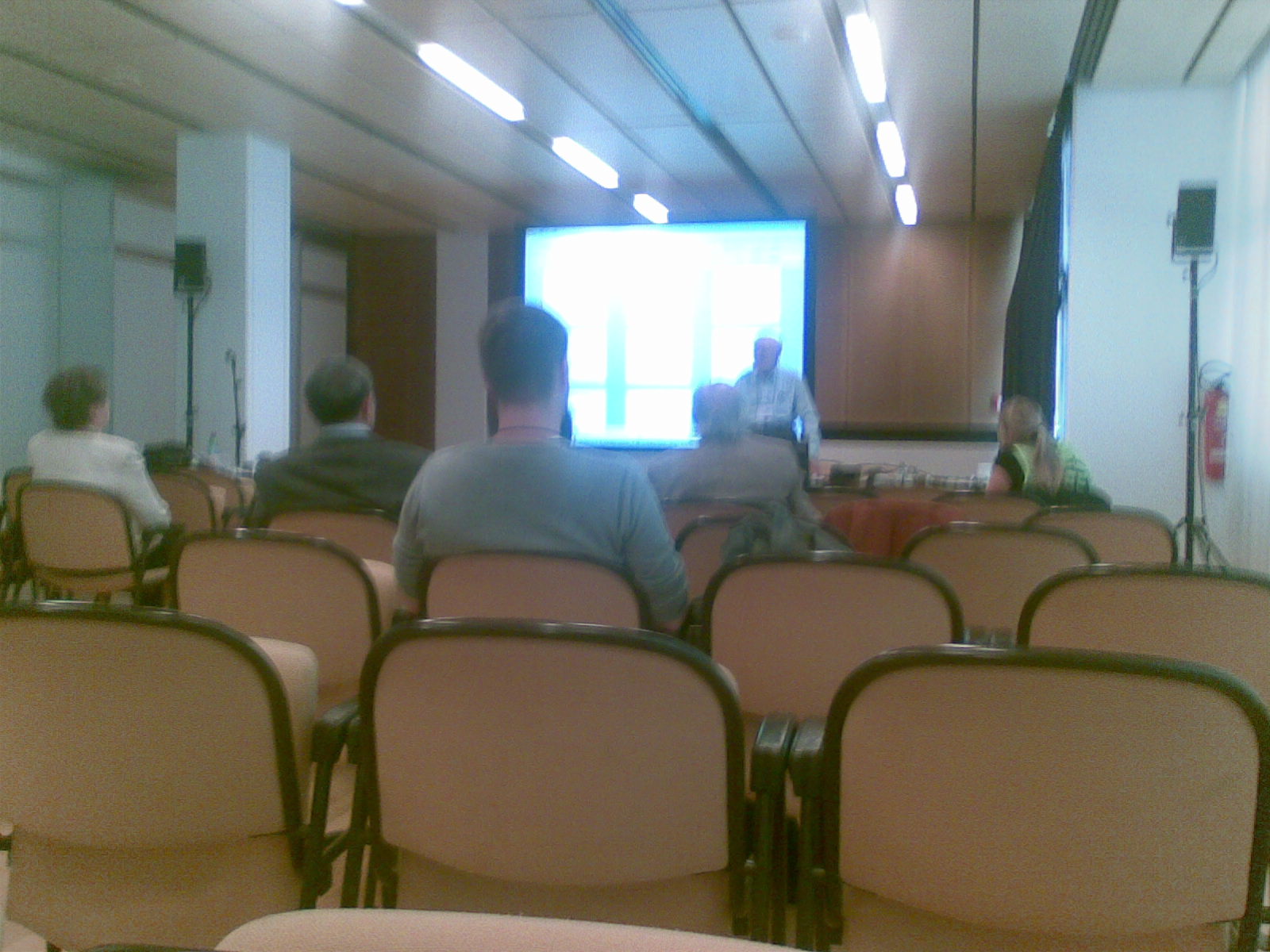 And not much news, I’m afraid, apart from that SEPP plans to release it’s NIPCC’09 in May. I understand it will be a thick report (800 pages?). The main messages were (a) that GHGs were unimportant – allegedlly supported by Douglass et al. (2007), and (b) solar activity was the main reason for the recent global warming and the mechanism involved galactic cosmic rays (GCR).
I asked Singer how he could explain the most recent warming when there is no trend in the GCR-flux or other indices of solar activity since 1952. He countered by saying he was glad I asked him this question, and announced that he had done his thesis exactly on the topic solar wind and GCRs.
So I had to answer that I had written a book about solar activity and climate, and I repeated my question. He could not answer in the end – other than saying that we have to look at the data. I told him that we already have looked at the data (e.g. Richardsson et al 2002; Benestad, 2005; Lockwood & Frohlich, 2007), so I recommended him to read up on RC.
A potentially useful book – Lies, Damn lies & Science
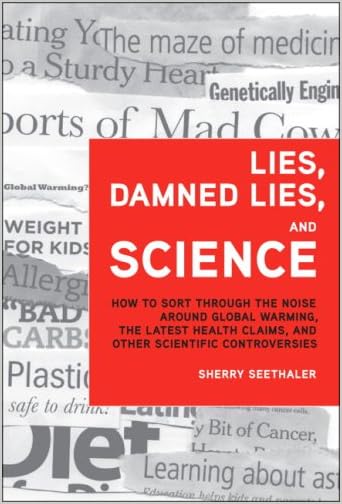 According to a recent article in Eos (Doran and Zimmermann, ‘Examining the Scientific consensus on Climate Change‘, Volume 90, Number 3, 2009; p. 22-23 – only available for AGU members – update: a public link to the article is here), about 58% of the general public in the US thinks that human activity is a significant contributing factor in changing the mean global temperature, as opposed to 97% of specialists surveyed. The disproportion between these numbers is a concern, and one possible explanation may be that the science literacy among the general public is low. Perhaps Sherry Seethaler’s new book ‘Lies, Damn Lies, and Science’ can be a useful contribution in raising the science literacy?
[Read more…] about A potentially useful book – Lies, Damn lies & Science
Reindeer herding, indigenous people and climate change La cría de renos, los indígenas y el cambio climático
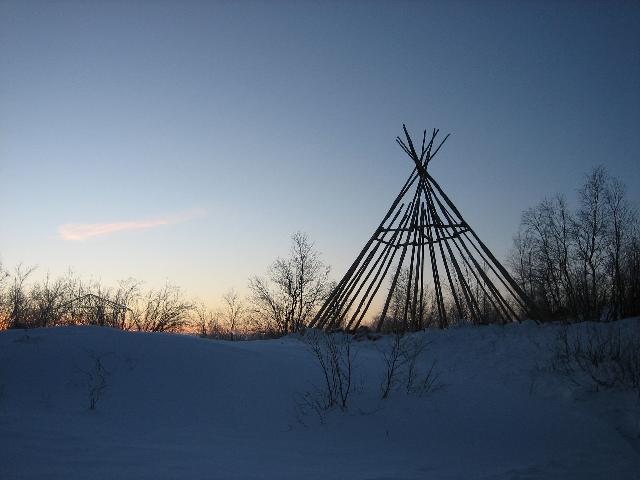 The Sámi are keenly aware about climate change, and are thus concerned about their future. Hence, the existence of the International Polar Year (IPY) project called EALÁT involving scientists, Sámi from Norway/Sweden/Finland, as well as Nenets from Russia. The indigenous people in the Arctic are closely tuned to the weather and the climate. I was told that the Sámi have about 300 words for snow, each with a very precise meaning.
[Read more…] about Reindeer herding, indigenous people and climate change
Mind the Gap! Attenzione alla differenza!
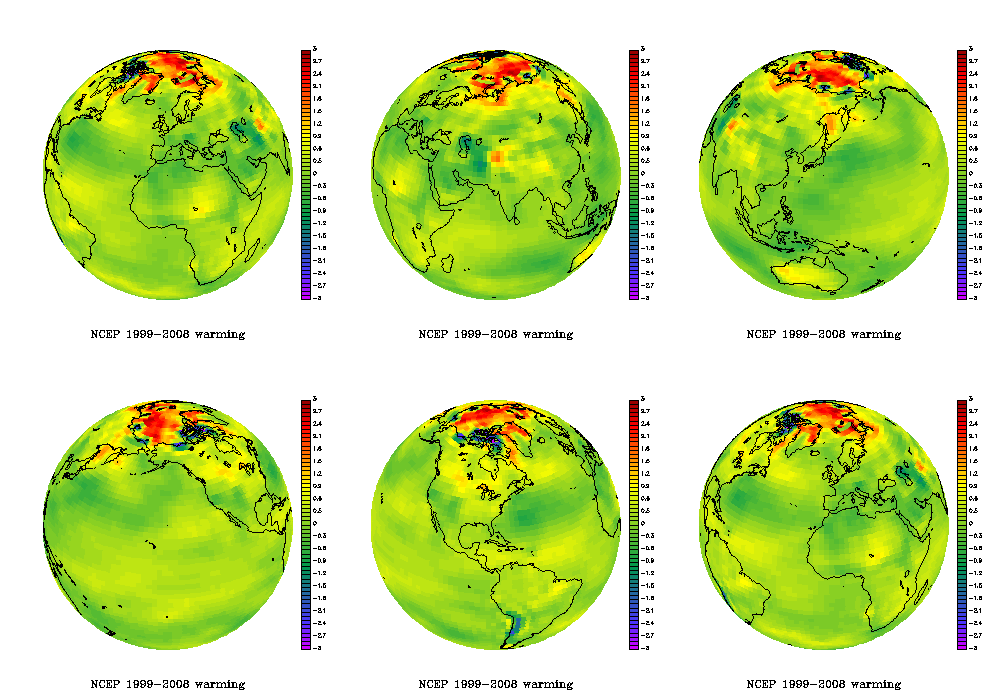
Confusion has continued regarding trends in global temperatures. The misconception ‘the global warming has stopped’ still lives on in some minds. We have already discussed why this argument is flawed. So why have we failed to convince ;-) ?
Una traduzione in italiano è disponibile qui.
[Read more…] about Mind the Gap!
Adapting in Amsterdam
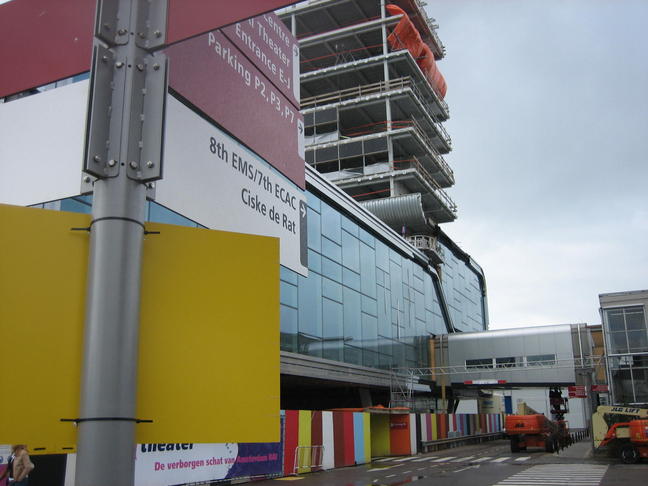 The theme of this year’s annual meeting of the European Meteorological Society (EMS) [European Congress on Applied Climatology (ECAC)] was adaptation to climate change. So what’s more appropriate then, than hosting the meeting in Amsterdam – on a building site?
Are geologists different?
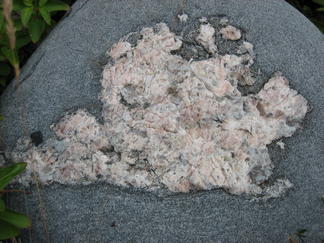 The International Geological Congress (IGC) is sometimes referred to as the geologists’ equivalent of the Olympic Games and is an extremely large gathering of geologists from all over the world, taking place at 4-year intervals. This time, the IGC took place in Lillestrøm, a small place just outside Oslo, Norway (August 6-14). The congress was opened by the Norwegian King (before he continued to the real games in Beijing), and was attended by some 6,000 scientists from 113 countries. Even the Danish Minister of Energy & Climate participated in a panel discussion on climate change. In other words, this was a serious meeting.
Comprehensive climate glossary
 Recently we received a request for setting up a glossary-only search mechanism, or perhaps one web page with a long list of glossary entries with hot links to full explanations. The glossary that we already have is a good start, but we are all busy and it’s hard to find the time for extending this.
But there are also a number of external web pages which provide climate-related glossaries, such as the NOAA (they also have a seperate page for paleo-stuff), the Bureau of Meteorology (Australia, and there is even one by the Australian EPA), the Environmental Protection Agency (EPA, the U.S.), and the Western Regional Climate Center (WRCC, the U.S.). Wikipedia also has a glossary for climatological terms.
For those who seek the explanation for more bureaucratic terms, both the EU and the UNFCCC provide glossaries that may be useful.
Furthermore, there are some nice resources available, such as the Encyclopedia of Earth.
Climate Change and Tropical Cyclones (Yet Again)
By Rasmus Benestad & Michael Mann
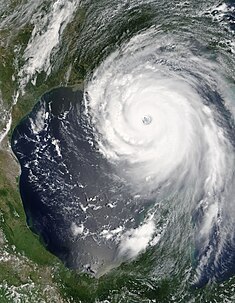
Just as Typhoon Nargis has reminded us of the destructive power of tropical cyclones (with its horrible death toll in Burma–around 100,000 according to the UN), a new paper by Knutson et al in the latest issue of the journal Nature Geosciences purports to project a reduction in Atlantic hurricane activity (principally the ‘frequency’ but also integrated measures of powerfulness).
The close timing of the Knutson et al and Typhoon Nargis is of course coincidental. But the study has been accorded the unprecedented privilege (that is, for a climate change article published during the past 7 years) of a NOAA press conference. What’s the difference this time? Well, for one thing, the title of the paper: “Simulated reduction in Atlantic hurricane frequency under twenty-first-century warming conditions” (emphasis added).
[Read more…] about Climate Change and Tropical Cyclones (Yet Again)