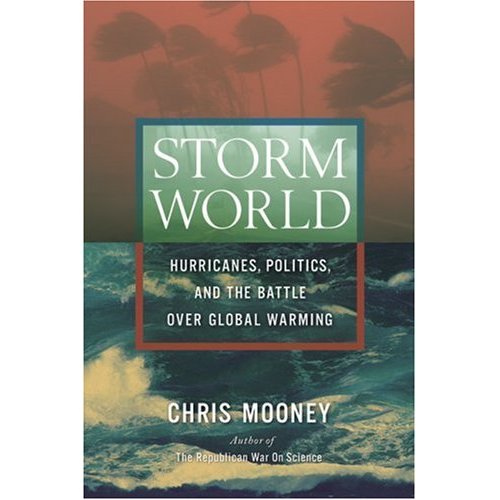
 If you are a RealClimate regular, you are undoubtedly aware of our ongoing interest in the developments in the scientific understanding of potential hurricane-climate change linkages. This is an area of the science where a substantial body of significant new research has emerged even since RealClimate’s inception in late 2004. The scientific research in this area, and the media frenzy and political theatrics that have inescapably followed it, are thoughtfully placed in a broader historical context in a fascinating new book by Chris Mooney entitled Storm World: Hurricanes, Politics, and the Battle over Global Warming. Anyone who is at all interested in the scientific history that has led to our current understanding of Hurricanes and their potential linkages with climate change, will find this book a page turner. The book is a nice complement to Kerry Emanuel’s recent book Divine Wind: The History and Science of Hurricanes (which too is so readable that it lies on our coffee table). Mooney in a sense picks up where Emanuel’s left off. Like Emanuel, he explores the history of the science. But he uses this historical context, and his studies of the personalities of key actors, to explore how the current scientific debate can be traced back to a rift that has emerged over many decades between distinct communities of atmospheric scientists.
[Read more…] about Storm World: A Review
Climate Science
Curve manipulation: lesson 2
Two weeks ago, we published the first lesson in curve manipulation taught by German school teacher and would-be scientist E.G. Beck: How to make it appear as if the Medieval times were warmer than today, even if all scientific studies come to the opposite conclusion. Today we publish curve manipulation, lesson 2: How to make it appear as if 20th Century warming fits into a 1500-year cycle. This gem is again brought to us by E.G. Beck. In a recent article (in German), he published the following graph:
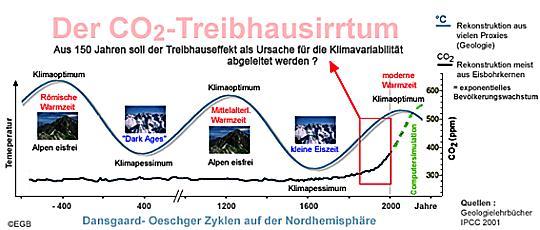
Notice how temperature goes up and down in beautifully regular cycles since 800 B.C.? At the bottom, they are labelled “Dansgaard-Oeschger cycles” – this refers to the Dansgaard-Oeschger events found in Greenland ice cores during the last Ice Age (but not during the last 10,000 years), about which there is a serious scientific discussion whether they are paced by a 1500-year cycle (see my paper in GRL). Beck’s curve shows a warm phase 400 BC and the next one 1200 AD – that’s 1600 years difference, so it just about fits. (I’m not endorsing his curve, by the way, I have no idea where it comes from – I’m just playing along with it for the sake of the argument). So the next warm phase should be in the year – oooops… 2700 or 2800? Hang on, how come it looks like the current warmth fits so nicely into the cycle? Shouldn’t we be right in the coldest phase? Now I see it… two little lines across the x-axis indicate that the axis has been broken there – tick-marks after the break are in 200-year intervals and before the break in 400-year intervals, and there’s also a gap of 200 missing years there. So that’s how we make the current global warming fit past climate cycles – it’s so easy!
p.s. Beck appeared on German TV last Monday, after the “Swindle” film was shown, and he is announced to appear on the program “Report München” in the first channel of public German TV next Monday (18 June), to educate the viewers about another of his fantasy graphs, namely his CO2 curve. It promises to be a must-see for friends of the unintentionally farcical.
G8 summit declaration
We assume that many of our readers will be interested in the declaration of the G8 summit in Heiligendamm (Germany), which was agreed yesterday by the leaders of the G8 countries. We therefore document the key passages on climate change below. As usual we refrain from a political analysis, but as scientists we note that it is rewarding to see that the results of climate science are fully acknowledged by the heads of state.
The declaration states:
CLIMATE CHANGE
48. We take note of and are concerned about the recent UN Intergovernmental Panel on Climate Change (IPCC) reports. The most recent report concluded both, that global temperatures are rising, that this is caused largely by human activities and, in addition,that for increases in global average temperature, there are projected to be major changes in ecosystem structure and function with predominantly negative consequences for biodiversity and ecosystems, e.g. water and food supply.
Fighting Climate Change
49. We are therefore committed to taking strong and early action to tackle climate change in order to stabilize greenhouse gas concentrations at a level that would prevent dangerous anthropogenic interference with the climate system. Taking into account the scientific knowledge as represented in the recent IPCC reports, global greenhouse gas emissions must stop rising, followed by substantial global emission reductions. In setting a global goal for emissions reductions in the process we have agreed today involving all major emitters, we will consider seriously the decisions made by the European Union, Canada and Japan which include at least a halving of global emissions by 2050. We commit to achieving these goals and invite the major emerging economies to join us in this endeavour.
Cockburn’s form
Alexander Cockburn (writing in the Nation) has become the latest contrarian-de-jour, sallying forth with some rather novel arithmetic to show that human-caused global warming is nothing to be concerned about. This would be unworthy of comment in most cases, but Cockburn stands out as one of only a few left-wing contrarians, as opposed to the more usual right-wing variety. Casual readers may have thought this is a relatively recent obsession of his (3 articles and responses over the last month), however, Cockburn has significant form* and has a fairly long history of ill-informed commentary on the subject of global warming.
[Read more…] about Cockburn’s form
The weirdest millennium
Much research effort over the past years has gone into reconstructing the temperature history of the last millennium and beyond. The new IPCC report compiles a dozen reconstructions for the temperature of the Northern Hemisphere (including of course the original “hockey stick” reconstruction, despite opposite claims by the Wall Street Journal). Lack of data does not permit robust reconstructions for the Southern Hemisphere. Without exception, the reconstructions show that Northern Hemisphere temperatures are now higher than at any time during the past 1,000 years (Figure 1), confirming and strengthening the conclusions drawn in the previous IPCC report of 2001.
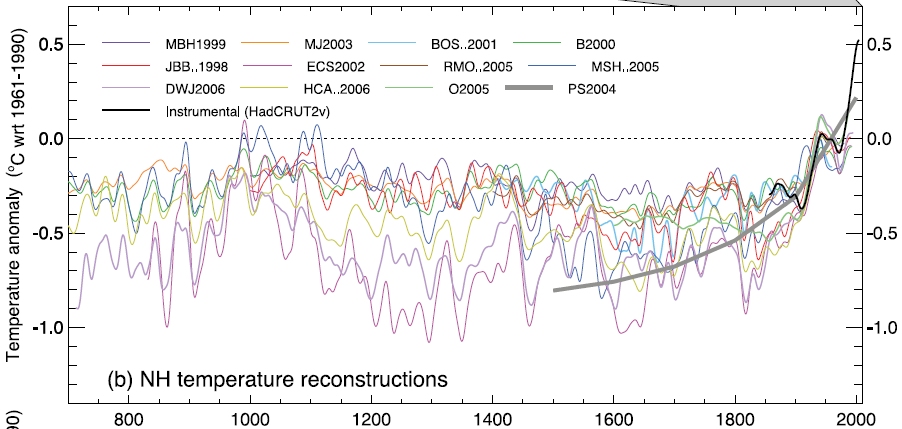
Fig. 1: Figure 6.10 (panel b) from the paleoclimate chapter of the current IPCC report (see there for details).
“Climate sceptics” do not like this and keep coming up with their own temperature histories. One of the weirdest has been circulated for years by German high-school teacher E.G. Beck (notorious for his equally weird CO2 curve). This history shows a medieval warm phase that is warmer than current climate by more than 1 ºC (see Figure 2). So how did Beck get this curve?
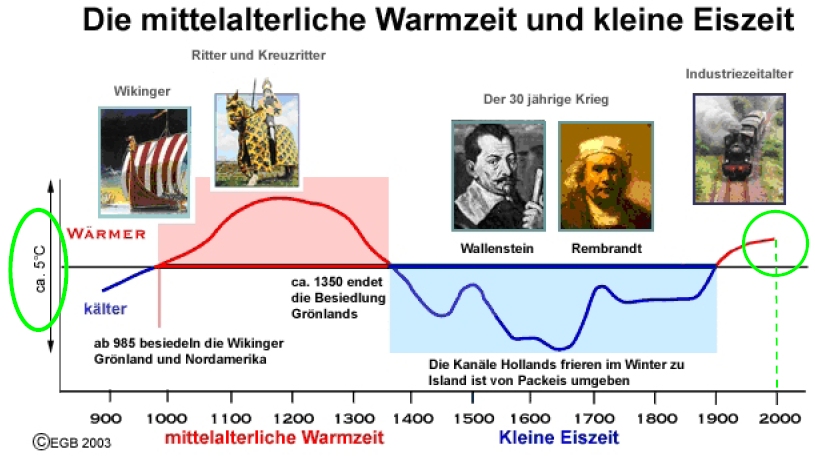
Fig. 2, modified from E.G. Beck (we added the green parts).
Why global climate models do not give a realistic description of the local climate Por que os Modelos Climáticos Globais não Fornecem uma Descrição Realista do Clima Local
Global climate
 Global climate statistics, such as the global mean temperature, provide good indicators as to how our global climate varies (e.g. see here). However, most people are not directly affected by global climate statistics. They care about the local climate; the temperature, rainfall and wind where they are. When you look at the impacts of a climate change or specific adaptations to a climate change, you often need to know how a global warming will affect the local climate.
Yet, whereas the global climate models (GCMs) tend to describe the global climate statistics reasonably well, they do not provide a representative description of the local climate. Regional climate models (RCMs) do a better job at representing climate on a smaller scale, but their spatial resolution is still fairly coarse compared to how the local climate may vary spatially in regions with complex terrain. This fact is not a general flaw of climate models, but just the climate models’ limitation. I will try to explain why this is below.
Glacier Mass Balance: equilibrium or disequilibrium response?
Guest Commentary from Mauri S. Pelto
I get asked at least once a day about the future prognosis for alpine glaciers and whether they have a future. I will focus here on North American glaciers whose mass balance measurements in the West from 1984-2005 indicate a declining trend. The trend suggests that all of the glaciers are out of balance and that some will disappear. The question is determining which glaciers are merely out of equilibrium and can retreat to a position of equilibrium, and which are in complete disequilibrium and will melt away? Let me explain.
[Read more…] about Glacier Mass Balance: equilibrium or disequilibrium response?
Start here
[Note this is page is updated somewhat regularly. Please notify us of any dead links. Last update: 10 May 2022.]
We’re often asked to provide a one stop link for resources that people can use to get up to speed on the issue of climate change, and so here is a selection. Unlike our other postings, we’ll amend this as we discover or are pointed to new resources. Different people have different needs and so we will group resources according to the level people start at.
For complete beginners:
NCAR: Weather and climate basics
Center for Climate and Energy Solutions: Climate basics
Wikipedia: Global Warming
NASA: Global Warming
National Academy of Science: America’s Climate Choices (2011)
Encyclopedia of Earth: Climate Change
Global Warming: Man or Myth? (Scott Mandia, SUNY Suffolk)
Open Learn: The Basics of Climate Prediction
There is a booklet on Climate Literacy from multiple agencies (NOAA, NSF, AAAS) available here (pdf).
The UK Govt. had a good site on The Science of Climate Change (archived).
The portal for climate and climate change of the ZAMG (Zentralaanstalt für Meteorologie und Geodynamik, Vienna, Austria). (In German) (added Jan 2011).
Those with some knowledge:
The IPCC Frequently Asked Questions are an excellent start (AR4 version here , updates were provided in the 5th Assessment report (pdf) and again for AR6).
The UK Royal Society and US National Academies of Science produced a joint Q&A on climate change in 2014, and an update in 2017.
RealClimate: Start with our index.
Informed, but in need of more detail:
Science: You can’t do better than the IPCC reports themselves (AR6 2021, AR5 2013, AR4 2007, TAR 2001). Also the Climate Science Special Report for the US National Climate Assessment.
History: Spencer Weart’s “Discovery of Global Warming” (AIP)
Informed, but seeking serious discussion of common contrarian talking points:
All of the below links have indexed debunks of most of the common points of confusion:
- Coby Beck’s How to talk to Global Warming Skeptic
- New Scientist: Climate Change: A guide for the perplexed
- RealClimate: Response to common contrarian arguments
- NERC (UK): Climate change debate summary (archived)
- UK Met Office: Climate Science
- Brian Angliss A Thorough Debunking
- John Cook Skeptical Science
- The Global Warming Debate (Presentations from around 2010 resurrected)
Please feel free to suggest other suitable resources, particularly in different languages, and we’ll try to keep this list up to date.
A Slovak translation is available here
Tłumaczenie na polski dostępne jest tutaj
A Bulgarian translation is available here (via Ivan Boreev).
A bit of philosophy
Eric Steig and Gavin Schmidt
The two of us participated last week in an interesting meeting at the University of Washington on Ethics and Climate Change. Other scientists in attendance included Dennis Hartmann, who gave an overview of the current state of the science, and sometime RealClimate contributor Cecilia Bitz. Organized by Associate Professor of Philosophy Stephen Gardiner, the conference was dedicated to the particular ethical and moral issues raised by the spectre of anthropogenic climate change. Since we aren’t philosophers by training, and since it would probably stray too far from RealClimate’s focus on science, we won’t comment in great detail. However, we thought it worth making our readers aware that there is a very interesting and growing literature on the subject. Based on their remarks at the conference, we heartily recommend checking out the papers and commentaries written by the various philosphers, scientists, and political theorists who attended. You can get abstracts of their talks on the conference web page. Below, we simply wish to note several issues raised at the conference that we found particularly interesting.
[Read more…] about A bit of philosophy
Hansen’s 1988 projections
At Jim Hansen’s now famous congressional testimony given in the hot summer of 1988, he showed GISS model projections of continued global warming assuming further increases in human produced greenhouse gases. This was one of the earliest transient climate model experiments and so rightly gets a fair bit of attention when the reliability of model projections are discussed. There have however been an awful lot of mis-statements over the years – some based on pure dishonesty, some based on simple confusion. Hansen himself (and, for full disclosure, my boss), revisited those simulations in a paper last year, where he showed a rather impressive match between the recently observed data and the model projections. But how impressive is this really? and what can be concluded from the subsequent years of observations?
[Read more…] about Hansen’s 1988 projections