A new study by British and Canadian researchers shows that the global temperature rise of the past 15 years has been greatly underestimated. The reason is the data gaps in the weather station network, especially in the Arctic. If you fill these data gaps using satellite measurements, the warming trend is more than doubled in the widely used HadCRUT4 data, and the much-discussed “warming pause” has virtually disappeared. [Read more…] about Global Warming Since 1997 Underestimated by Half
Climate Science
Simple physics and climate
No doubt, our climate system is complex and messy. Still, we can sometimes make some inferences about it based on well-known physical principles. Indeed, the beauty of physics is that a complex systems can be reduced into simple terms that can be quantified, and the essential aspects understood.
A recent paper by Sloan and Wolfendale (2013) provides an example where they derive a simple conceptual model of how the greenhouse effect works from first principles. They show the story behind the expression saying that a doubling in CO2 should increase the forcing by a factor of 1+log|2|/log|CO2|. I have a fondness for such simple conceptual models (e.g. I’ve made my own attempt posted at arXiv) because they provide a general picture of the essence – of course their precision is limited by their simplicity.
[Read more…] about Simple physics and climate
References
- T. Sloan, and A.W. Wolfendale, "Cosmic rays, solar activity and the climate", Environmental Research Letters, vol. 8, pp. 045022, 2013. http://dx.doi.org/10.1088/1748-9326/8/4/045022
Cows, Carbon and the Anthropocene: Commentary on Savory TED Video
Guest post by Jason West and David Briske
Allan Savory delivered a highly publicized talk at a “Technology, Entertainment, Design (TED)” conference in February of this year (2013) entitled “How to fight desertification and reverse climate change.” Here we address one of the most dramatic claims made – that a specialized grazing method alone can reverse the current trajectory of increasing atmospheric CO2 and climate change.
The talk was attended by many conferees and has since been viewed on the TED website over 1.6 million times. It has received substantial acclaim in social media, some of which is available at the Savory Institute website, but it has also received considerable criticism (of particular note is a blog post from Adam Merberg and an article in Slate magazine. Although these criticism quickly followed Mr. Savory’s presentation and are broadly supported by the available science, his sweeping claims have continued to resonate with lay audiences. An apparent example is his invitation to deliver a speech to Swiss Re during their 150 year anniversary celebration in London in September, in which he is quoted as saying “…only now due largely to my TED talk on the desertification aspect of the global problem, was the public becoming aware of such hope in a world so short on solutions…”.
[Read more…] about Cows, Carbon and the Anthropocene: Commentary on Savory TED Video
From global climate change to local consequences
Some will be luckier than others when it comes to climate change. The effects of a climate change on me will depend on where I live. In some regions, changes may not be as noticeable as in others. So what are the impacts in my region?

[Read more…] about From global climate change to local consequences
Unforced Variations: Nov 2013
A new European report on climate extremes is out
A new report on extreme climate events in Europe is just published: ‘Extreme Weather Events in Europe: preparing for climate change adaptation‘. It was launched in Oslo on October 24th by the Norwegian Academy of Science and Letters, and the report is now available online.
preparing for climate change adaptation’
What’s new? The new report provides information that is more specific to Europe than the SREX report from the Intergovernmental Panel on Climate Change (IPCC), and incorporate phenomena that have not been widely covered.
It provides some compelling information drawn from the insurance industry, and indeed, a representative from Munich Re participated in writing this report. There is also material on convective storms, hail, lightening, and cold snaps, and the report provides a background on extreme value statistics, risk analysis, impacts, and adaptation.
[Read more…] about A new European report on climate extremes is out
Sea level in the 5th IPCC report
What is happening to sea levels? That was perhaps the most controversial issue in the 4th IPCC report of 2007. The new report of the Intergovernmental Panel on Climate Change is out now, and here I will discuss what IPCC has to say about sea-level rise (as I did here after the 4th report).
Let us jump straight in with the following graph which nicely sums up the key findings about past and future sea-level rise: (1) global sea level is rising, (2) this rise has accelerated since pre-industrial times and (3) it will accelerate further in this century. The projections for the future are much higher and more credible than those in the 4th report but possibly still a bit conservative, as we will discuss in more detail below. For high emissions IPCC now predicts a global rise by 52-98 cm by the year 2100, which would threaten the survival of coastal cities and entire island nations. But even with aggressive emissions reductions, a rise by 28-61 cm is predicted. Even under this highly optimistic scenario we might see over half a meter of sea-level rise, with serious impacts on many coastal areas, including coastal erosion and a greatly increased risk of flooding.
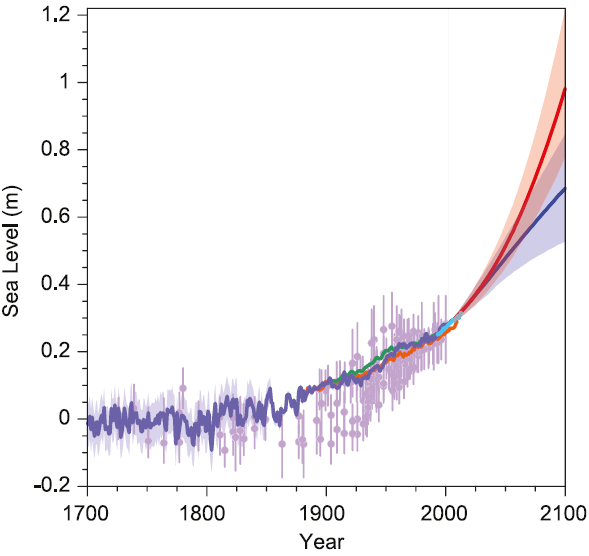
Fig. 1. Past and future sea-level rise. For the past, proxy data are shown in light purple and tide gauge data in blue. For the future, the IPCC projections for very high emissions (red, RCP8.5 scenario) and very low emissions (blue, RCP2.6 scenario) are shown. Source: IPCC AR5 Fig. 13.27.
[Read more…] about Sea level in the 5th IPCC report
Science of Climate Change online class starting next week on Coursera
Maybe you remember the rollout a few years ago of Open Climate 101, a massive open online class (MOOC) that was served sort of free-range from a computer at the University of Chicago. Now the class has been entirely redone as Global Warming: The Science of Climate Change within the far slicker Coursera platform. Beginning on October 21, the class is free and runs for 8 weeks. The videos have been reshot in a short and punchy (2-10 minute) format, for example here (8:13). These seem like they will be easier to watch than traditional 45-minute lectures from a classroom. It’s based on, and will show you how to play with, all-new on-line computer models, including extensive new browsing systems for global climate records and model results from the new AR5 climate model archive, an ice sheet model you can clobber with slugs of CO2 as it evolves, and more. Come and watch the train wreck join the fun! [Read more…] about Science of Climate Change online class starting next week on Coursera
The IPCC AR5 attribution statement
Last year I discussed the basis of the AR4 attribution statement:
Most of the observed increase in global average temperatures since the mid-20th century is very likely due to the observed increase in anthropogenic greenhouse gas concentrations.
In the new AR5 SPM (pdf), there is an analogous statement:
It is extremely likely that more than half of the observed increase in global average surface temperature from 1951 to 2010 was caused by the anthropogenic increase in greenhouse gas concentrations and other anthropogenic forcings together. The best estimate of the human-induced contribution to warming is similar to the observed warming over this period.
This includes differences in the likelihood statement, drivers and a new statement on the most likely amount of anthropogenic warming.
Climate Change on Film
Making a film about climate change is difficult, especially if you want it to reach a wide audience. One problem is the long time scale of climate change, which fits badly with the time scale of a typical film narrative. That was the reason why in the Hollywood blockbuster The Day After Tomorrow some laws of physics were treated with a certain artistic freedom, in order to present a dramatic climate change within a few weeks instead of decades.
Mike and I have spent the last few days at a very interesting workshop in Iceland, where climate scientists, social scientists and filmmakers were brought together in conjunction with the Reykjavik International Film Festival. I will make no attempt to reproduce the many exciting discussions which we had, that often continued into the night. Instead, I’d like to present two short films by workshop participants. I chose a contrast of hot and cold.
First, the cold. The following film is a trailer by Phil Coates, a British filmmaker and expedition leader, who has filmed in extreme conditions on all seven continents. It is a “work in progress” under the working title “North Pole Living on Thin Ice”. Coates was dropped off with three scientists on the sea ice near the North Pole. On foot out on the Arctic Ocean they made oceanographic and ice thickness measurements. Soon you will be able to experience this research expedition on film. The scientific findings of the team will of course come out in the scientific literature.
http://vimeo.com/70558290#