• Skip to primary navigation
  • Skip to main content
  • Skip to primary sidebar
  • Skip to footer

RealClimate

Climate science from climate scientists...

  • Start here
  • Model-Observation Comparisons
  • Miscellaneous Climate Graphics
  • Surface temperature graphics
You are here: Home / Archives for Communicating Climate

Communicating Climate

An open letter to Steve Levitt

29 Oct 2009 by raypierre

Dear Mr. Levitt,

The problem of global warming is so big that solving it will require creative thinking from many disciplines. Economists have much to contribute to this effort, particularly with regard to the question of how various means of putting a price on carbon emissions may alter human behavior. Some of the lines of thinking in your first book, Freakonomics, could well have had a bearing on this issue, if brought to bear on the carbon emissions problem. I have very much enjoyed and benefited from the growing collaborations between Geosciences and the Economics department here at the University of Chicago, and had hoped someday to have the pleasure of making your acquaintance. It is more in disappointment than anger that I am writing to you now.

I am addressing this to you rather than your journalist-coauthor because one has become all too accustomed to tendentious screeds from media personalities (think Glenn Beck) with a reckless disregard for the truth. However, if it has come to pass that we can’t expect the William B. Ogden Distinguished Service Professor (and Clark Medalist to boot) at a top-rated department of a respected university to think clearly and honestly with numbers, we are indeed in a sad way.

By now there have been many detailed dissections of everything that is wrong with the treatment of climate in Superfreakonomics , but what has been lost amidst all that extensive discussion is how really simple it would have been to get this stuff right. The problem wasn’t necessarily that you talked to the wrong experts or talked to too few of them. The problem was that you failed to do the most elementary thinking needed to see if what they were saying (or what you thought they were saying) in fact made any sense. If you were stupid, it wouldn’t be so bad to have messed up such elementary reasoning, but I don’t by any means think you are stupid. That makes the failure to do the thinking all the more disappointing. I will take Nathan Myhrvold’s claim about solar cells, which you quoted prominently in your book, as an example.

[Read more…] about An open letter to Steve Levitt

Filed Under: Communicating Climate, Reporting on climate

350

27 Oct 2009 by Gavin

I was quoted by Andrew Revkin in the New York Times on Sunday in a piece about the 350.org International Day of Climate Action (involving events in 181 countries). The relevant bit is:

Gavin A. Schmidt, a climate scientist who works with Dr. Hansen and manages a popular blog on climate science, realclimate.org, said those promoting 350 or debating the number might be missing the point.
“The situation is analogous to people trying to embark on a cross-country road trip to California but they’ve started off heading to Maine instead,” Dr. Schmidt said. “But instead of working out ways to turn around, they have decided to argue about where they are going to park when they get to L.A.”
“If you ask a scientist how much more CO2 do you think we should add to the atmosphere, the answer is going to be none.”

I’ve been told that some readers may have misinterpreted the quote as a criticism of the 350.org campaign itself. This was not the intent and in fact my metaphor wouldn’t have made sense in that context at all. Instead, it was a criticism of people who are expending effort arguing about whether 350 is precisely the right number for a long term target, or whether it should be somewhat higher or lower. Since we aren’t currently headed anywhere near 350 ppmv (in fact we are at 388 ppmv CO2 and increasing by about 2 ppmv/yr), we need to urgently think of ways the situation can turn around. Tapping into the creativity and enthusiasm shown by the 350.org campaigners will certainly be part of that process.

We discussed some of the thinking behind this ‘Target CO2‘ when Jim Hansen and colleagues’ paper first came out, where I think we made it clear that picking a specific CO2 target to avoid ‘dangerous’ climate change is an inexact science at best. The comments by Robert Brulle and Ray Pierrehumbert at DotEarth and James Hrynyshyn also highlight some of that complexity. And I think the suggestions by ‘Paulina‘ for how a tweaked article might have been clearer are very apropos.

However, as the final line in my NYT quote should make clear, personally I think the scientific case not increasing CO2 any further is very strong. Since the planet has not caught up with current levels of concentrations emissions (and thus will continue to change), picking an ultimate target that is less than today’s level is therefore wise. Of course, how we get there is much trickier than knowing where it is we should be going, but having a map of the destination is useful. As we discussed in the ‘trillionth ton‘ posting a couple of months back, how we get there also makes a difference.

In my original email to Andy Revkin, I had actually appended a line:

If you ask a scientist how much more CO2 do you think we should add to the atmosphere, the answer is going to be none.

All the rest is economics.

(and technology, and sociology, and psychology and politics etc.) but the point is that working out how we get there from here is the real challenge and the more people who are aware and involved in developing those solutions the better.

Filed Under: Climate Science, Greenhouse gases, Reporting on climate

A warming pause?

6 Oct 2009 by Stefan

The blogosphere (and not only that) has been full of the “global warming is taking a break” meme lately. Although we have discussed this topic repeatedly, it is perhaps worthwhile reiterating two key points about the alleged pause here.

(1) This discussion focuses on just a short time period – starting 1998 or later – covering at most 11 years. Even under conditions of anthropogenic global warming (which would contribute a temperature rise of about 0.2 ºC over this period) a flat period or even cooling trend over such a short time span is nothing special and has happened repeatedly before (see 1987-1996). That simply is due to the fact that short-term natural variability has a similar magnitude (i.e. ~0.2 ºC) and can thus compensate for the anthropogenic effects. Of course, the warming trend keeps going up whilst natural variability just oscillates irregularly up and down, so over longer periods the warming trend wins and natural variability cancels out.

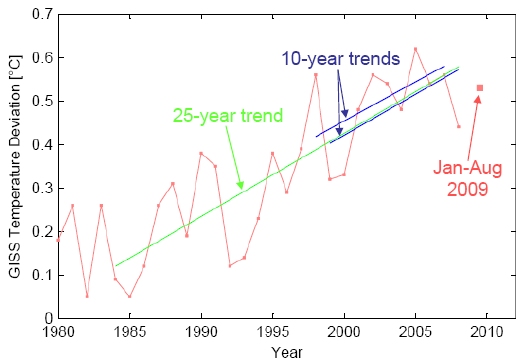
(2) It is highly questionable whether this “pause” is even real. It does show up to some extent (no cooling, but reduced 10-year warming trend) in the Hadley Center data, but it does not show in the GISS data, see Figure 1. There, the past ten 10-year trends (i.e. 1990-1999, 1991-2000 and so on) have all been between 0.17 and 0.34 ºC per decade, close to or above the expected anthropogenic trend, with the most recent one (1999-2008) equal to 0.19 ºC per decade – just as predicted by IPCC as response to anthropogenic forcing.

GISS temperature trends

Figure 1. Global temperature according to NASA GISS data since 1980. The red line shows annual data, the larger red square a preliminary value for 2009, based on January-August. The green line shows the 25-year linear trend (0.19 ºC per decade). The blue lines show the two most recent ten-year trends (0.18 ºC per decade for 1998-2007, 0.19 ºC per decade for 1999-2008) and illustrate that these recent decadal trends are entirely consistent with the long-term trend and IPCC predictions. Even the highly “cherry-picked” 11-year period starting with the warm 1998 and ending with the cold 2008 still shows a warming trend of 0.11 ºC per decade (which may surprise some lay people who tend to connect the end points, rather than include all ten data points into a proper trend calculation).

Una traducción en español está disponible aquí.
[Read more…] about A warming pause?

Filed Under: Climate Science, Communicating Climate, Instrumental Record, skeptics

Communicating Science: Not Just Talking the Talk

16 Sep 2009 by group

Michael Mann and Gavin Schmidt

The issues involved in science communication are complex and often seem intractable. We’ve seen many different approaches, but guessing which will work (An Inconvenient Truth, Field Notes from a Catastrophe) and which won’t (The Eleventh Hour) is a tricky call. Mostly this is because we aren’t the target audience and so tend to rate popularizations by different criteria than lay people. Often, we just don’t ‘get it’.

Into this void has stepped Randy Olsen with his new book “Don’t be such a scientist”. For those who don’t know Randy, he’s a rather extraordinary individual – one of the few individuals who has run the gamut from hard-core scientist to Hollywood film maker. He’s walked the walk, and can talk the talk–and when he does talk, we should be listening!
[Read more…] about Communicating Science: Not Just Talking the Talk

Filed Under: Climate Science, Communicating Climate, Reviews

Climate Services

9 Sep 2009 by rasmus

I recently attended the World Climate Conference-3 (WCC-3), hosted by the World Meteorological Organization (WMO) in Geneva. Most of the talk was of providing “climate services” (CS) and coordinating these globally. But what are climate services, and how much of what was envisaged is scientifically doable?
[Read more…] about Climate Services

Filed Under: Climate Science, RC Forum, Reporting on climate

Plimer’s homework assignment

24 Aug 2009 by Gavin

Some of you may be aware of George Monbiot’s so-far-unsuccessful attempt to pin down Ian Plimer on his ridiculous compendium of non-science. In response to Monbiot’s request for explanation and sources for some of Plimer’s more bizarre claims, Plimer has responded with a homework assignment that is clearly beyond even his (claimed) prowess. This is quite transparently a device to avoid dealing with Monbiot’s questions and is designed to lead to an argument along the lines of “Monbiot can’t answer these questions and so knows nothing about the science (and by the way, please don’t notice that I can’t cite any sources for my nonsense or even acknowledge that I can’t answer these questions either)”. (Chris Colose and Greenfyre have made similar points). It’s also worth pointing out as Andrew Dodds has done that each question is actually referencing a very well known contrarian and oft-debunked argument, but dressed up in pseudo-scientific complexity.

However, as a service both to Plimer and Monbiot (as well as anyone else interested), we give a quick scorecard on the relevance, actual scientific content (whether the questions can actually be answered) and sources for discussion for each of the, to be charitable, ‘odd’ questions. For relevance, we grade each question on a scale from 0 to 5, 0 being irrelevant to the issue of detection and attribution of 20th Century climate change, 5 being extremely relevant. For scientific content, we rate the reasonableness of the question posed (i.e. does it make any sense at all), from A to F (A being a very well posed question, F making no sense). For sources, we generally point to a paper or discussion that addresses the real issue.
[Read more…] about Plimer’s homework assignment

Filed Under: Climate Science, skeptics

Resolving technical issues in science

14 Aug 2009 by group

One of the strengths of science is its capacity to resolve controversies by generally accepted procedures and standards. Many scientific questions (especially more technical ones) are not matters of opinion but have a correct answer.

Scientists document their procedures and findings in the peer-reviewed literature in such a way that they can be double-checked and challenged by others. The proper way to challenge results is, of course, also through the peer-reviewed literature, so that the challenge follows the same standards of documentation as did the original finding.
[Read more…] about Resolving technical issues in science

Filed Under: Arctic and Antarctic, Climate Science, Communicating Climate, Reporting on climate, skeptics

PETM Weirdness

10 Aug 2009 by Gavin

The Paleocene-Eocene Thermal Maximum (PETM) was a very weird period around 55 million years ago. However, the press coverage and discussion of a recent paper on the subject was weirder still.

[Read more…] about PETM Weirdness

Filed Under: Climate Science, Greenhouse gases, Paleoclimate, Reporting on climate

‘Unscientific America’: A Review

8 Jul 2009 by mike

Author Chris Mooney (of “Storm World” fame) and fellow “Intersection” blogger, scientist, and writer Sheril Kirshenbaum have written an extraordinary, if rather sobering book entitled ‘Unscientific America’. What I found most refreshing about the book is that it not only isolates the history behind, and source of, the problem in question—the pervasiveness and dangerousness of scientific illiteracy in modern society–but it offers viable solutions. This book is a must read for anybody who cares about science, and the growing disconnect between the scientific and popular cultures (the problem of the so-called “Two Cultures” first discussed by C.P. Snow).

‘Unscientific America’ explores how we’ve come to the point we’re now at, examining the historical factors behind the diminishing prominence of science and scientists in the popular culture of the U.S. since its heyday in the years following WW II. The authors uncover more than enough blame to go around. They find fault with the media, both in how it portrays science and scientists (e.g. the icon of the ‘mad scientist’), and in the decreasing news coverage devoted to issues involving science and technology. They find fault in the way policy makers often abuse science (cherry-picking those particular scientific findings which suit their agenda), and in the behavior of corporate special interests who, in areas such as our own area of ‘climate change’, have often deliberately manufactured false controversy and confusion to dissuade the public from demanding action be taken. At this point, the scientists among you might begin to feel absolved of any responsibility for the problem. Don’t–Mooney and Kirshenbaum won’t allow us to escape blame, and with good reason. As they point out, we ‘eat our own’, when it comes to colleagues engaged in public outreach and science popularization. Case in point: Carl Sagan–a hero to many of us who value science outreach. One of the darker episodes in modern U.S. science history was the blocking by Sagan’s fellow scientists of his entry into the U.S. National Academy of Sciences. Evidently, a majority of his colleagues resented his having become a household name–something they presumably considered unbecoming for a scientist. What sort of message does it send when the most effective science communicator in modern history was shunned by his colleagues for his efforts? Certainly not a good one. This is just one example, and there are many others–it is not surprising that so few scientists to choose to pursue the path of outreach and public education. The reward systems in academia and the scientific world typically do not favor scientists who choose to expend considerable time and effort engaging in public discourse. And here of course, it is as much that system, as the scientists themselves, which is to blame.

[Read more…] about ‘Unscientific America’: A Review

Filed Under: Climate Science, Communicating Climate, Reviews

Science at the bleeding edge

6 Jul 2009 by Gavin

The vast majority of mainstream media items about science are related to new hot-off-the-press studies, often in high profile journals, that report a new breakthrough, or that purportedly overturn previous ideas. However, while these are exciting news items, this preponderance of coverage given to these state-of-the-art studies compared to assessments such as from the National Academies, can give a misleading impression about the state of a scientific knowledge. The more mature and solid a field, the less controversy there is, and thus the fewer news stories. Ironically, this means the public is told the least about the most solid aspects of science.

One effect of this tendency is that quite often news stories are focused on claims that turn out to be wrong, or if not actually wrong, heavily reduced in importance by the time the dust settles. This is not deliberate, but merely how science works at the frontier. People push measurements to the limit of their accuracy (and sometimes beyond) and theories are used slightly out of their domain of applicability. In recognition of that, Richard Feynman had a useful rule of thumb that the last data point on any graph should be discounted because, if it had been easy to obtain, there would have been another one further along.

[Read more…] about Science at the bleeding edge

Filed Under: Climate Science, Reporting on climate

  • « Go to Previous Page
  • Page 1
  • Interim pages omitted …
  • Page 18
  • Page 19
  • Page 20
  • Page 21
  • Page 22
  • Interim pages omitted …
  • Page 29
  • Go to Next Page »

Primary Sidebar

Search

Search for:

Email Notification

get new posts sent to you automatically (free)
Loading

Recent Posts

  • AI/ML climate magic?
  • Unforced variations: Jan 2026
  • 1.5ºC and all that
  • Unforced Variations: Dec 2025
  • Who should pay?
  • Site updates etc.

Our Books

Book covers
This list of books since 2005 (in reverse chronological order) that we have been involved in, accompanied by the publisher’s official description, and some comments of independent reviewers of the work.
All Books >>

Recent Comments

  • Atomsk’s Sanakan on Unforced variations: Jan 2026
  • DOAK on Unforced variations: Jan 2026
  • Atomsk’s Sanakan on 1.5ºC and all that
  • Nigelj on Unforced variations: Jan 2026
  • Adam Lea on AI/ML climate magic?
  • Nigelj on Unforced variations: Jan 2026
  • Nigelj on 1.5ºC and all that
  • Ray Ladbury on Unforced variations: Jan 2026
  • zebra on 1.5ºC and all that
  • Mr. Know It All on Unforced variations: Jan 2026
  • Pete Best on Unforced variations: Jan 2026
  • Pete Best on 1.5ºC and all that
  • Data on Unforced variations: Jan 2026
  • Data on 1.5ºC and all that
  • Piotr on Unforced variations: Jan 2026
  • Piotr on Unforced variations: Jan 2026
  • Tomáš Kalisz on Unforced variations: Jan 2026
  • JCM on Unforced variations: Jan 2026
  • Atomsk’s Sanakan on 1.5ºC and all that
  • Atomsk’s Sanakan on 1.5ºC and all that
  • Susan Anderson on 1.5ºC and all that
  • Susan Anderson on 1.5ºC and all that
  • Susan Anderson on 1.5ºC and all that
  • Susan Anderson on 1.5ºC and all that
  • Susan Anderson on Unforced variations: Jan 2026
  • Susan Anderson on Unforced variations: Jan 2026
  • Atomsk’s Sanakan on 1.5ºC and all that
  • Atomsk’s Sanakan on 1.5ºC and all that
  • Atomsk’s Sanakan on Unforced variations: Jan 2026
  • Barton Paul Levenson on 1.5ºC and all that

Footer

ABOUT

  • About
  • Translations
  • Privacy Policy
  • Contact Page
  • Login

DATA AND GRAPHICS

  • Data Sources
  • Model-Observation Comparisons
  • Surface temperature graphics
  • Miscellaneous Climate Graphics

INDEX

  • Acronym index
  • Index
  • Archives
  • Contributors

Realclimate Stats

1,392 posts

15 pages

249,307 comments

Copyright © 2026 · RealClimate is a commentary site on climate science by working climate scientists for the interested public and journalists.