• Skip to primary navigation
  • Skip to main content
  • Skip to primary sidebar
  • Skip to footer

RealClimate

Climate science from climate scientists...

  • Start here
  • Model-Observation Comparisons
  • Miscellaneous Climate Graphics
  • Surface temperature graphics
You are here: Home / Archives for Climate Science / Paleoclimate

Paleoclimate

Q & A about the Gulf Stream System slowdown and the Atlantic ‘cold blob’

14 Oct 2016 by Stefan

Last weekend, in Reykjavik the Arctic Circle Assembly was held, the large annual conference on all aspects of the Arctic. A topic of this year was: What’s going on in the North Atlantic? This referred to the conspicuous ‘cold blob’ in the subpolar Atlantic, on which there were lectures and a panel discussion (Reykjavik University had invited me to give one of the talks). Here I want to provide a brief overview of the issues discussed.

What is the ‘cold blob’?

This refers to exceptionally cold water in the subpolar Atlantic south of Greenland. In our paper last year we have shown it like this (see also our RealClimate post about it):
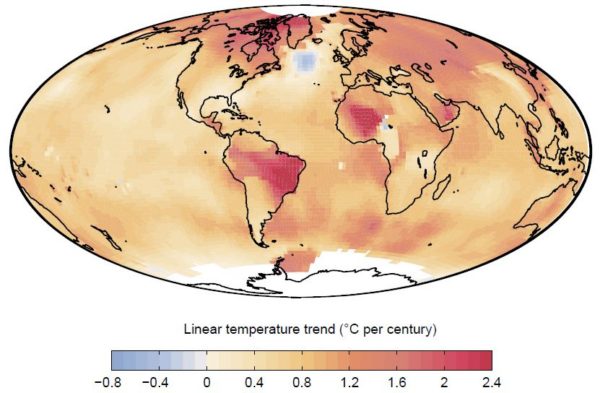
fig1a_new

Fig. 1 Linear temperature trends from 1901 to 2013 according to NASA data. Source: Rahmstorf et al, Nature Climate Change 2015.

[Read more…] about Q & A about the Gulf Stream System slowdown and the Atlantic ‘cold blob’
Filed Under: Climate conference report, Climate modelling, Climate Science, Oceans, Paleoclimate

The Snyder Sensitivity Situation

26 Sep 2016 by Gavin

Nature published a great new reconstruction of global temperatures over the past 2 million years today. Snyder (2016) uses 61 temperature reconstructions from 59 globally diverse sediment cores and a correlation structure from model simulations of the last glacial maximum to estimate (with uncertainties) the history of global temperature back through the last few dozen ice ages cycles. There are multiple real things to discuss about this – the methodology, the relatively small number of cores being used (compared to what could have been analyzed), the age modeling etc. – and many interesting applications – constraints on polar amplification, the mid-Pleistocene transition, the duration and nature of previous interglacials – but unfortunately, the bulk of the attention will be paid to a specific (erroneous) claim about Earth System Sensitivity (ESS) that made it into the abstract and was the lead conclusion in the press release.

The paper claims that ESS is ~9ºC and that this implies that the long term committed warming from today’s CO2 levels is a further 3-7ºC. This is simply wrong.

[Read more…] about The Snyder Sensitivity Situation

References

  1. C.W. Snyder, "Evolution of global temperature over the past two million years", Nature, vol. 538, pp. 226-228, 2016. http://dx.doi.org/10.1038/nature19798

Filed Under: Climate modelling, Climate Science, Oceans, Paleoclimate

Why correlations of CO2 and Temperature over ice age cycles don’t define climate sensitivity

24 Sep 2016 by Gavin

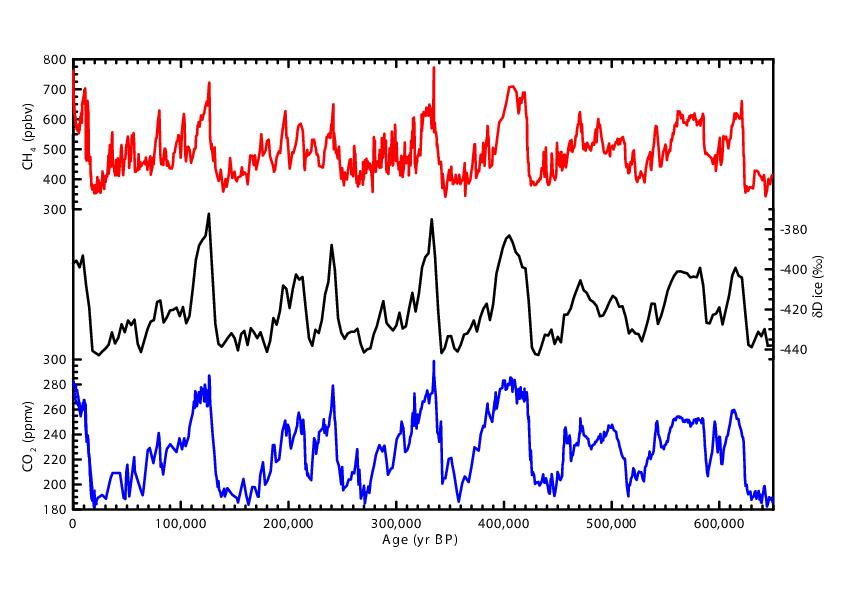
We’ve all seen how well temperature proxies and CO2 concentrations are correlated in the Antarctic ice cores – this has been known since the early 1990’s and has featured in many high-profile discussions of climate change.


EPICA Dome C ice core greenhouse gas and isotope records.

The temperature proxies are water isotope ratios that can be used to estimate Antarctic temperatures and, via a scaling, the global values. The CO2 and CH4 concentration changes can be converted to radiative forcing in W/m2 based on standard formulas. These two timeseries can be correlated and the regression (in ºC/(W/m2)) has the units of climate sensitivity – but what does it represent?

[Read more…] about Why correlations of CO2 and Temperature over ice age cycles don’t define climate sensitivity

Filed Under: Carbon cycle, Climate Science, Greenhouse gases, Paleoclimate

Millennia of sea-level change

22 Feb 2016 by Stefan

How has global sea level changed in the past millennia? And how will it change in this century and in the coming millennia? What part do humans play? Several new papers provide new insights.

2500 years of past sea level variations

This week, a paper will appear in the Proceedings of the National Academy of Sciences (PNAS) with the first global statistical analysis of numerous individual studies of the history of sea level over the last 2500 years (Kopp et al. 2016 – I am one of the authors). Such data on past sea level changes before the start of tide gauge measurements can be obtained from drill cores in coastal sediments. By now there are enough local data curves from different parts of the world to create a global sea level curve.

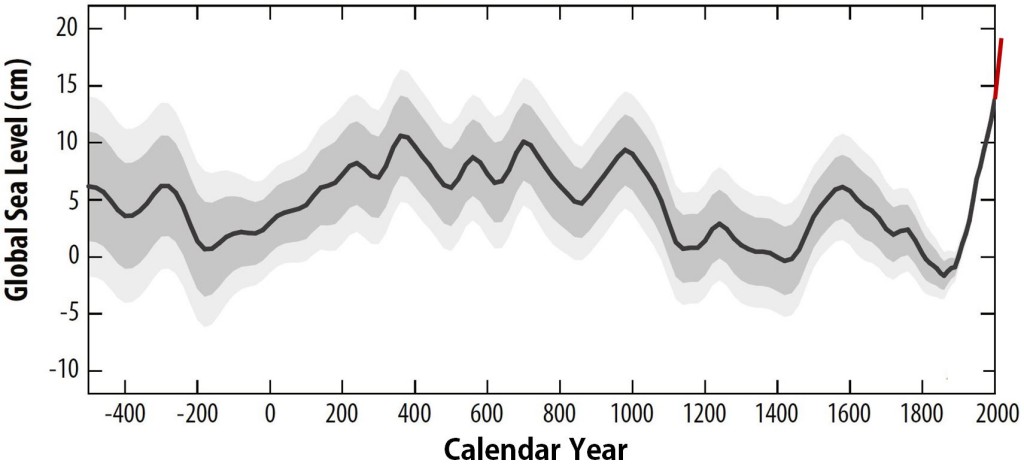
Let’s right away look at the main result. The new global sea level history looks like this:

Kopp2016_Fig1a+sat

Fig. 1 Reconstruction of the global sea-level evolution based on proxy data from different parts of the world. The red line at the end (not included in the paper) illustrates the further global increase since 2000 by 5-6 cm from satellite data. [Read more…] about Millennia of sea-level change

References

  1. R.E. Kopp, A.C. Kemp, K. Bittermann, B.P. Horton, J.P. Donnelly, W.R. Gehrels, C.C. Hay, J.X. Mitrovica, E.D. Morrow, and S. Rahmstorf, "Temperature-driven global sea-level variability in the Common Era", Proceedings of the National Academy of Sciences, vol. 113, 2016. http://dx.doi.org/10.1073/pnas.1517056113

Filed Under: Arctic and Antarctic, Climate impacts, Climate modelling, Climate Science, Oceans, Paleoclimate

Ice-core dating corroborates tree ring chronologies

5 Aug 2015 by group

Guest commentary from Jonny McAneney

You heard it here first…

Back in February, we wrote a post suggesting that Greenland ice cores may have been incorrectly dated in prior to AD 1000. This was based on research by Baillie and McAneney (2015) which compared the spacing between frost ring events (physical scarring of living growth rings by prolonged sub-zero temperatures) in the bristlecone pine tree ring chronology, and spacing between prominent acids in a suite of ice cores from both Greenland and Antarctica. The main conclusion was that ice core dates, in particular those ice cores relied upon the Greenland Ice Core Chronology 2005 (GICC05), such as the NEEM S1 core, were too old by approximately seven years during the 6th and 7th centuries AD.

Last month, in an excellent piece of research (Sigl et al., 2015) by a collaboration including Earth scientists, dendrochonologists, and historians, the chronology of the Greenland North Eemian Ice Drilling core (NEEM) has been reassessed and re-dated, confirming that such an offset does indeed exist in the GICC05 timescale below AD 1000. The clinching evidence was provided by linking tree-ring chronologies to ice cores through two extraterrestrial events…
[Read more…] about Ice-core dating corroborates tree ring chronologies

References

  1. M.G.L. Baillie, and J. McAneney, "Tree ring effects and ice core acidities clarify the volcanic record of the first millennium", Climate of the Past, vol. 11, pp. 105-114, 2015. http://dx.doi.org/10.5194/cp-11-105-2015
  2. B.M. Vinther, H.B. Clausen, S.J. Johnsen, S.O. Rasmussen, K.K. Andersen, S.L. Buchardt, D. Dahl‐Jensen, I.K. Seierstad, M. Siggaard‐Andersen, J.P. Steffensen, A. Svensson, J. Olsen, and J. Heinemeier, "A synchronized dating of three Greenland ice cores throughout the Holocene", Journal of Geophysical Research: Atmospheres, vol. 111, 2006. http://dx.doi.org/10.1029/2005JD006921
  3. M. Sigl, J.R. McConnell, L. Layman, O. Maselli, K. McGwire, D. Pasteris, D. Dahl‐Jensen, J.P. Steffensen, B. Vinther, R. Edwards, R. Mulvaney, and S. Kipfstuhl, "A new bipolar ice core record of volcanism from WAIS Divide and NEEM and implications for climate forcing of the last 2000 years", Journal of Geophysical Research: Atmospheres, vol. 118, pp. 1151-1169, 2013. http://dx.doi.org/10.1029/2012JD018603
  4. M. Sigl, M. Winstrup, J.R. McConnell, K.C. Welten, G. Plunkett, F. Ludlow, U. Büntgen, M. Caffee, N. Chellman, D. Dahl-Jensen, H. Fischer, S. Kipfstuhl, C. Kostick, O.J. Maselli, F. Mekhaldi, R. Mulvaney, R. Muscheler, D.R. Pasteris, J.R. Pilcher, M. Salzer, S. Schüpbach, J.P. Steffensen, B.M. Vinther, and T.E. Woodruff, "Timing and climate forcing of volcanic eruptions for the past 2,500 years", Nature, vol. 523, pp. 543-549, 2015. http://dx.doi.org/10.1038/nature14565

Filed Under: Climate Science, Paleoclimate, Sun-earth connections

Reflections on Ringberg

1 Apr 2015 by Gavin

As previewed last weekend, I spent most of last week at a workshop on Climate Sensitivity hosted by the Max Planck Institute at Schloss Ringberg. It was undoubtedly one of the better workshops I’ve attended – it was focussed, deep and with much new information to digest (some feel for the discussion can be seen from the #ringberg15 tweets). I’ll give a brief overview of my impressions below.

[Read more…] about Reflections on Ringberg

Filed Under: Aerosols, Climate modelling, Climate Science, Greenhouse gases, Instrumental Record, IPCC, Oceans, Paleoclimate

Climate Sensitivity Week

22 Mar 2015 by Gavin

Some of you will be aware that there is a workshop on Climate Sensitivity this week at Schloss Ringberg in southern Germany. The topics to be covered include how sensitivity is defined (and whether it is even meaningful (Spoiler, yes it is)), what it means, how it can be constrained, what the different flavours signify etc. There is an impressive list of attendees with a very diverse range of views on just about everything, and so I am looking forward to very stimulating discussions.
[Read more…] about Climate Sensitivity Week

Filed Under: Aerosols, Climate modelling, Climate Science, Greenhouse gases, Instrumental Record, IPCC, Paleoclimate, statistics

The mystery of the offset chronologies: Tree rings and the volcanic record of the 1st millennium

19 Feb 2015 by group

Guest commentary by Jonny McAneney

Volcanism can have an important impact on climate. When a large volcano erupts it can inject vast amounts of dust and sulphur compounds into the stratosphere, where they alter the radiation balance. While the suspended dust can temporarily block sunlight, the dominant effect in volcanic forcing is the sulphur, which combines with water to form sulphuric acid droplets. These stratospheric aerosols dramatically change the reflectivity, and absorption profile of the upper atmosphere, causing the stratosphere to heat, and the surface to cool; resulting in climatic changes on hemispheric and global scales.

Interrogating tree rings and ice cores

Annually-resolved ice core and tree-ring chronologies provide opportunities for understanding past volcanic forcing and the consequent climatic effects and impacts on human populations. It is common knowledge that you can tell the age of a tree by counting its rings, but it is also interesting to note that the size and physiology of each ring provides information on growing conditions when the ring formed. By constructing long tree ring chronologies, using suitable species of trees, it is possible to reconstruct a precisely-dated annual record of climatic conditions.

Ice cores can provide a similar annual record of the chemical and isotopic composition of the atmosphere, in particular volcanic markers such as layers of volcanic acid and tephra. However, ice cores can suffer from ambiguous layers that introduce errors into the dating of these layers of volcanic acid. To short-circuit this, attempts have been made to identify know historical eruptions within the ice records, such as Öraefajökull (1362) and Vesuvius (AD 79). This can become difficult since the ice chronologies can only be checked by finding and definitively identifying tephra (volcanic glass shards) that can be attributed to these key eruptions; sulphate peaks in the ice are not volcano specific.

Thus, it is fundamentally important to have chronological agreement between historical, tree-ring and ice core chronologies: The ice cores record the magnitude and frequency of volcanic eruptions, with the trees recording the climatic response, and historical records evidencing human responses to these events.

But they don’t quite line up…
[Read more…] about The mystery of the offset chronologies: Tree rings and the volcanic record of the 1st millennium

Filed Under: Aerosols, Climate Science, Paleoclimate

Can we make better graphs of global temperature history?

13 Mar 2014 by Gavin

I’m writing this post to see if our audience can help out with a challenge: Can we collectively produce some coherent, properly referenced, open-source, scalable graphics of global temperature history that will be accessible and clear enough that we can effectively out-compete the myriad inaccurate and misleading pictures that continually do the rounds on social media?

[Read more…] about Can we make better graphs of global temperature history?

Filed Under: Climate Science, Communicating Climate, Instrumental Record, Paleoclimate

The new IPCC climate report

27 Sep 2013 by Stefan

The time has come: the new IPCC report is here! After several years of work by over 800 scientists from around the world, and after days of extensive discussion at the IPCC plenary meeting in Stockholm, the Summary for Policymakers was formally adopted at 5 o’clock this morning. Congratulations to all the colleagues who were there and worked night shifts. The full text of the report will be available online beginning of next week. Realclimate summarizes the key findings and shows the most interesting graphs.

Update 29 Sept: Full (un-copyedited) report available here.

Portuguese translation available here

Global warming

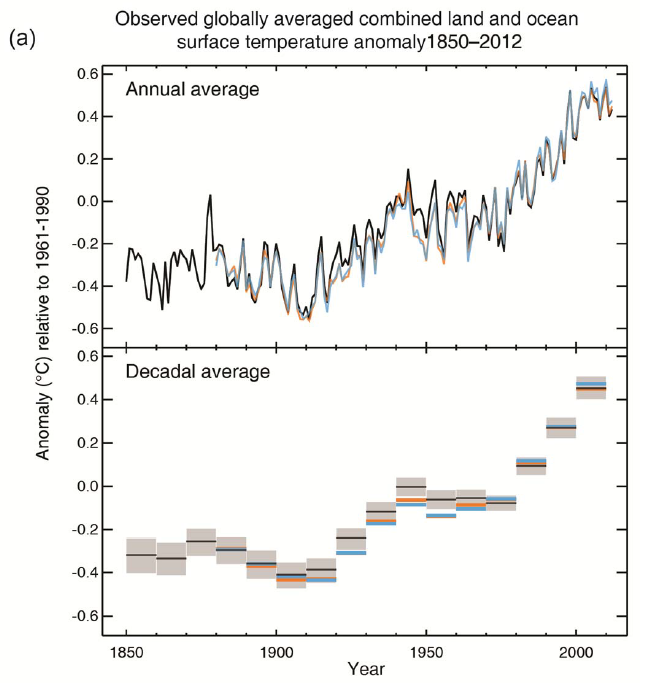
It is now considered even more certain (> 95%) that human influence has been the dominant cause of the observed warming since the mid-20th century. Natural internal variability and natural external forcings (eg the sun) have contributed virtually nothing to the warming since 1950 – the share of these factors was narrowed down by IPCC to ± 0.1 degrees. The measured temperature evolution is shown in the following graph.

Figure 1 The measured global temperature curve from several data sets. Top: annual values. ​​Bottom: averaged values ​​over a decade.
[Read more…] about The new IPCC climate report

Filed Under: Arctic and Antarctic, Carbon cycle, Climate impacts, Climate modelling, Climate Science, Greenhouse gases, IPCC, Oceans, Paleoclimate

  • « Go to Previous Page
  • Page 1
  • Page 2
  • Page 3
  • Page 4
  • Page 5
  • Interim pages omitted …
  • Page 13
  • Go to Next Page »

Primary Sidebar

Search

Search for:

Email Notification

get new posts sent to you automatically (free)
Loading

Recent Posts

  • The Puzzling Pleistocene
  • How robust is our accelerometer?
  • Unforced Variations: Mar 2026
  • EPA’s final* ruling on CO2
  • The Climate Science reference they don’t want Judges to read
  • Koonin’s Continuing Calumnies

Our Books

Book covers
This list of books since 2005 (in reverse chronological order) that we have been involved in, accompanied by the publisher’s official description, and some comments of independent reviewers of the work.
All Books >>

Recent Comments

  • JCM on Unforced Variations: Mar 2026
  • zebra on Unforced Variations: Mar 2026
  • Julian on Unforced Variations: Mar 2026
  • Atomsk's Sanakan on How robust is our accelerometer?
  • Martin Smith on Unforced Variations: Mar 2026
  • Data on Unforced Variations: Mar 2026
  • Ron R. on Unforced Variations: Mar 2026
  • Barry E Finch on How robust is our accelerometer?
  • Nigelj on Unforced Variations: Mar 2026
  • Nigel on Unforced Variations: Mar 2026
  • patrick o twentyseven on EPA’s final* ruling on CO2
  • patrick o twentyseven on EPA’s final* ruling on CO2
  • Tomáš Kalisz on Unforced Variations: Mar 2026
  • Piotr on The Puzzling Pleistocene
  • patrick o twentyseven on EPA’s final* ruling on CO2
  • Martin Smith on Unforced Variations: Mar 2026
  • Barry E Finch on How robust is our accelerometer?
  • Barton Paul Levenson on The Puzzling Pleistocene
  • Ray Ladbury on Unforced Variations: Mar 2026
  • MA Rodger on The Puzzling Pleistocene
  • Ron R. on Unforced Variations: Mar 2026
  • Atomsk's Sanakan on How robust is our accelerometer?
  • Piotr on The Puzzling Pleistocene
  • Piotr on The Puzzling Pleistocene
  • Joseph O'Sullivan on EPA’s final* ruling on CO2
  • Dean Rovang on The Puzzling Pleistocene
  • Ray Ladbury on How robust is our accelerometer?
  • Martin Smith on Unforced Variations: Mar 2026
  • Martin Smith on Unforced Variations: Mar 2026
  • Susan Anderson on Unforced Variations: Mar 2026

Footer

ABOUT

  • About
  • Translations
  • Privacy Policy
  • Contact Page
  • Login

DATA AND GRAPHICS

  • Data Sources
  • Model-Observation Comparisons
  • Surface temperature graphics
  • Miscellaneous Climate Graphics

INDEX

  • Acronym index
  • Index
  • Archives
  • Contributors

Realclimate Stats

1,401 posts

15 pages

250,874 comments

Copyright © 2026 · RealClimate is a commentary site on climate science by working climate scientists for the interested public and journalists.