The fantasy version of the normal updating of scenarios for a new round of CMIP simulations doing the rounds is bad faith BS.
[Read more…] about Scenarios, schmenarios…Reporting on climate
Critiques of the ‘Critical Review’
The first somewhat comprehensive reviews of the DOE critical review are now coming online.
[Read more…] about Critiques of the ‘Critical Review’The Endangerment of the Endangerment Finding?
The EPA, along with the “Climate Working Group” (CWG) of usual suspects (plus Judith Curry and Ross McKitrick) at DOE, have just put out a document for public comment their attempt to rescind the 2009 Endangerment Finding for greenhouse gas emissions.
[Read more…] about The Endangerment of the Endangerment Finding?The most recent climate status

The Arctic Council’s Arctic Monitoring and assessment Programme (AMAP) recently released a Summary for PolicyMakers’ Arctic Climate Change Update 2024.
[Read more…] about The most recent climate statusThe AMOC is slowing, it’s stable, it’s slowing, no, yes, …
There’s been a bit of media whiplash on the issue of AMOC slowing lately – ranging from the AMOC being “on the brink of collapse” to it being “more stable than previously thought”. AMOC, of course, refers to the Atlantic Meridional Overturning Circulation, one of the worlds major ocean circulation systems which keeps the northern Atlantic region (including Europe) exceptionally warm for its latitude. So what is this whiplash about?
As is often the case with such media whiplash, there isn’t much scientific substance behind it, except for the usual small incremental steps in the search for improved understanding. It is rare that one single paper overthrows our thinking, though media reports unfortunately often give that impression. Real science is more like a huge jigsaw puzzle, where each new piece adds a little bit.
The latest new piece is a new reconstruction of how the AMOC has changed over the past 60 years, by Jens Terhaar and colleagues. The background to this discussion is familiar to our regular readers (else just enter ‘AMOC’ in the RealClimate search field): proper measurements of the AMOC flow are only available since 2004 in the RAPID project, thus for earlier times we need to use indirect clues. One of these is the sea surface temperature ‘finger print’ of AMOC changes as discussed in our paper Caesar et al. 2018 (Fig. 1). There we used the cold blob temperature anomaly (Nov-May) as an index for AMOC strength. Other studies have used other sea surface temperature or salinity patterns as well as paleoclimatic proxy data (e.g. sediment grain sizes), and generally found an AMOC decline since the 19th Century superimposed by some decadal variability. The new paper critices our (i.e. Caesar et al) reconstruction and suggests a new method using surface heat fluxes from reanalysis data as an indicator of AMOC strength.
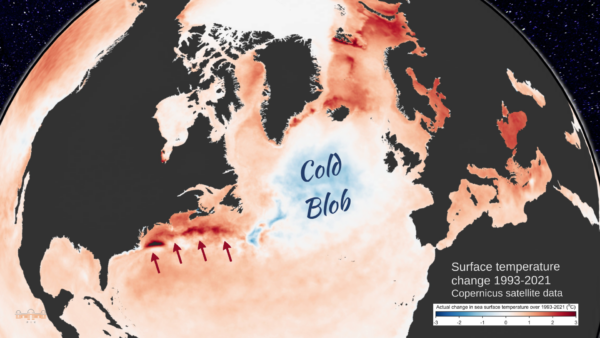
Here’s three questions about it.
1. Does the ‘cold blob’ work well as AMOC indicator?
We had tested that in the historic runs of 15 different CMIP5 climate models in Caesar et al. 2018 (our Fig. 5) and found it works very well, except for two outlier models which were known to not produce a realistic AMOC. Now Terhaar et al. redid this test with the new CMIP6 model generation und found it works less well, i.e. the uncertainty is larger (although for future simulations where the AMOC shows a significant decline in the models, our AMOC index also works well in their analysis).
Which raises the question: which models are better for this purpose: CMIP5 or CMIP6? One might think that newer models are better – but this does not seem to be the case for CMIP6. Irrespective of the AMOC, the CMIP6 models created substantial controversy when their results came out: the climate sensitivity of a subset of ‘hot models’ was far too high, these models did not reproduce past temperature evolution well (compared to observed data), and IPCC made the unprecedented move of not presenting future projections as straightforward model average plus/minus model spread, but instead used the new concept of “assessed global warming” where models are weighted according to how well they reproduce observational data.
In the North Atlantic, the historic runs of CMIP6 models on average do not reproduce the ‘cold blob’ despite this being such a striking feature of the observational data, as shown clearly in the Summary for Policy Makers of the IPCC AR6 (see Fig. 2 below). Of the 24 CMIP6 models, a full 23 underestimate the sea surface cooling in the ‘cold blob’. And most of the CMIP6 models even show a strengthening of the AMOC in the historic period, which past studies have shown to be linked to strong aerosol forcing in many of these models (e.g. Menary et al. 2020, Robson et al. 2022). The historic Northern Hemisphere temperature evolution in the models with a strong aerosol effect “is not consistent with observations” and they “simulate the wrong sign of subpolar North Atlantic surface salinity trends”, as Robson et al. write. Thus I consider CMIP6 models as less suited to test how well the ‘cold blob’ works as AMOC indicator than the CMIP5 models.
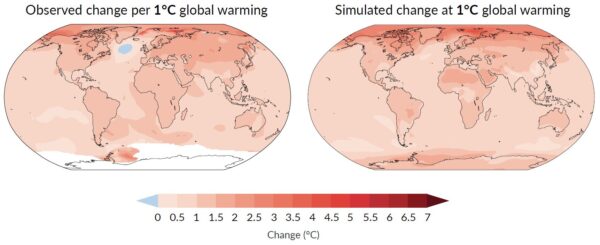
2. Is the new AMOC reconstruction method, based on the surface heat loss, better?
In the CMIP6 models it looks like that, and the link between AMOC heat transport and surface heat loss to the north makes physical sense. However, in the models the surface heat loss is perfectly known. In the real ocean that is not an observed quantity. It has to be taken from model simulations, the so-called reanalysis. While these simulations assimilate observational data, over most of the ocean surface these are basically sea surface temperatures, but surface heat loss depends also on air temperature, wind speed, humidity, radiation and cloud cover in complex ways, all of which are not accurately known. Therefore these surface heat loss data are much less accurate than sea surface temperature data and in my view not well suited to reconstruct the AMOC time evolution.
That is supported by the fact that two different reanalysis data sets were used, leading to quite different AMOC reconstructions. Also the AMOC time evolution they found differs from other reconstruction methods for the same time period (see point 3 below).
And there is another issue: we’ve previously looked at ERA5 surface heat flux trend, as shown here from my article in Oceanography 2024:
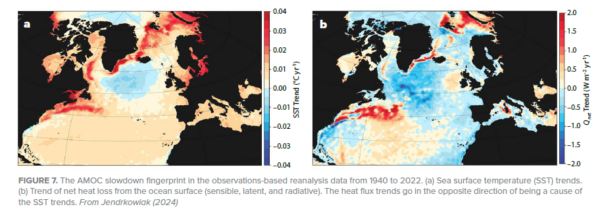
You see in both figures (in temperature as well as surface heat flux) the AMOC slowdown ‘fingerprint’ which includes both the ‘cold blob’ and a warming along the American coast due to a northward Gulf Stream shift, which is also a symptom of AMOC weakening. However, Terhaar et al. integrate over the whole northern Atlantic north of 26 °N so that the red area of increasing heat loss largely compensates for the blue area of decreasing heat loss. So in their analysis these two things cancel, while in the established concept of the ‘fingerprint’ (see Zhang 2008: Coherent surface-subsurface fingerprint of the Atlantic meridional overturning circulation) these two things both reinforce the evidence for an AMOC weakening.
3. How do these new reconstructions compare to others?
Here is how the Terhaar reconstructions (bottom two) compare:
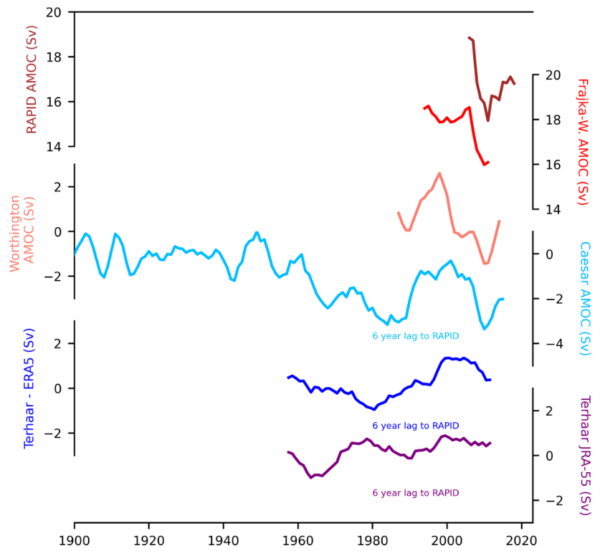
The reconstruction at the bottom using a reanalysis product from Japan doesn’t resemble anything, while the blue one using the European ERA5 reanalysis at least has the 1980s minimum and early 2000s maximum in common with other data, albeit with much smaller amplitude; it is a lot smoother. Thus it also misses the strong AMOC decline 2004-2010 and subsequent partial recovery seen in the RAPID measurements as well as the Caesar and Worthington reconstructions. A main reason for the lack of significant trend in the Terhaar reconstructions further is the time interval they used; for the same time span the Caesar reconstruction also does not show an even remotely significant trend (p-value is only 0.5), so in this respect our reconstructions actually agree for the period they overlap. The fact that ours shows a significant AMOC decline is because of the stable AMOC we find during 1900-1960, which is stronger than in the following sixty years. Here our reconstruction method shows its advantage in that reliable and accurate sea surface temperature data exist so far back in time.
Hence, I do not believe that the new attempt to reconstruct the AMOC is more reliable than earlier methods based on temperature or salinity patterns, on density changes in the ‘cold blob’ region, or on various paleoclimatic proxy data, which have concluded there is a weakening. But since we don’t have direct current measurements going far enough back in time, some uncertainty about that remains. The new study however does not change my assessment of AMOC weakening in any way.
And all agree that the AMOC will weaken in response to global warming in future and that this poses a serious risk, whether this weakening has already emerged from natural variability in the limited observational data we have, or not. Hence the open letter of 44 experts presented in October at the Arctic Circle Assembly (see video of my plenary presentation there), which says:
We, the undersigned, are scientists working in the field of climate research and feel it is urgent to draw the attention of the Nordic Council of Ministers to the serious risk of a major ocean circulation change in the Atlantic. A string of scientific studies in the past few years suggests that this risk has so far been greatly underestimated. Such an ocean circulation change would have devastating and irreversible impacts especially for Nordic countries, but also for other parts of the world.
Post script
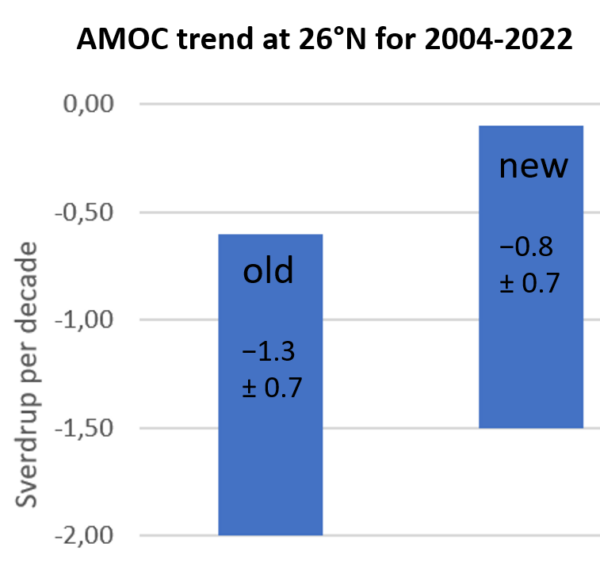
Since I’m sometimes asked about that: last year a data study by Volkov et al. revised the slowing trend of the Florida current as well as the AMOC. Contrary to ‘climate skeptics’ claims, it has no impact on our long-term estimate of ~3 Sv slowing since 1950, i.e. -0.4 Sv/decade (Caesar et al. 2018). Both the original and the revised trend estimates for the RAPID section data (see Figure) suggest the recent AMOC weakening since 2004 is steeper than the long-term trend we estimated.
2023 appears to follow an upward trend in the North Atlantic/Caribbean named tropical cyclone count
This year’s (2023) tropical cyclone season in the North Atlantic and Caribbean witnessed a relatively high number of named tropical cyclones: 20. In spite of the current El Niño, which tends to give lower numbers. But it appears to follow a historical trend for named tropical cyclones with an increasing number over time.
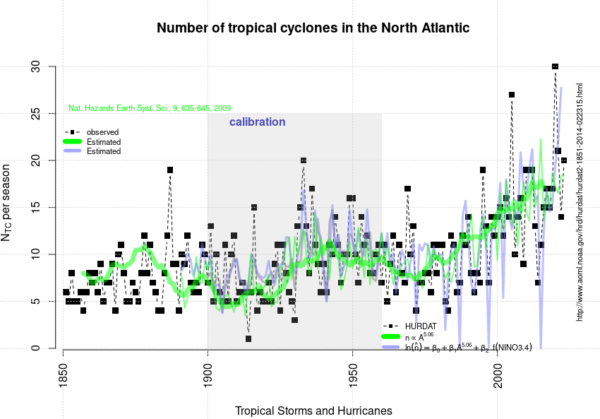
The curve presented above is an update of the analysis presented in 2020 and posted here on RealClimate.
[Read more…] about 2023 appears to follow an upward trend in the North Atlantic/Caribbean named tropical cyclone countReferences
- R.E. Benestad, "On tropical cyclone frequency and the warm pool area", Natural Hazards and Earth System Sciences, vol. 9, pp. 635-645, 2009. http://dx.doi.org/10.5194/nhess-9-635-2009
Old habits
Media awareness about global warming and climate change has grown fairly steadily since 2004. My impression is that journalists today tend to possess a higher climate literacy than before. This increasing awareness and improved knowledge is encouraging, but there are also some common interpretations which could be more nuanced. Here are two examples, polar amplification and extreme rainfall.
[Read more…] about Old habitsDeciphering the ‘SPM AR6 WG1’ code
I followed with great interest the launch of the sixth assessment report Working Group 1 (The Physical Science Basis) from the Intergovernmental Panel on Climate Change (IPCC) on August 9th.
The main report is quite impressive (see earlier posts here, here, here, and here) but the press conference didn’t come across as being focused and well-prepared. In my opinion the press conference on 9 August 2021 didn’t do justice to the vast effort that went into it.
[Read more…] about Deciphering the ‘SPM AR6 WG1’ codeThe best case for worst case scenarios
The “end of the world” or “good for you” are the two least likely among the spectrum of potential outcomes.
Stephen Schneider

Scientists have been looking at best, middling and worst case scenarios for anthropogenic climate change for decades. For instance, Stephen Schneider himself took a turn back in 2009. And others have postulated both far more rosy and far more catastrophic possibilities as well (with somewhat variable evidentiary bases).
[Read more…] about The best case for worst case scenariosReferences
- S. Schneider, "The worst-case scenario", Nature, vol. 458, pp. 1104-1105, 2009. http://dx.doi.org/10.1038/4581104a
Musing about Losing Earth
The NY Times Magazine has a special issue this weekend on climate change. The main article is “Losing the Earth” by Nathaniel Rich, is premised on the idea that in the period 1979 to 1989 when we basically knew everything we needed to know that climate change was a risk, and the politics had not yet been polarized, we missed our opportunity to act. Stated this way, it would probably be uncontroversial, but since the article puts the blame for this on “human nature”, rather than any actual humans, extensive Twitter discussion ensues…