• Skip to primary navigation
  • Skip to main content
  • Skip to primary sidebar
  • Skip to footer

RealClimate

Climate science from climate scientists...

  • Start here
  • Model-Observation Comparisons
  • Miscellaneous Climate Graphics
  • Surface temperature graphics
You are here: Home / Archives for Communicating Climate

Communicating Climate

Movie review: SWITCH

2 Apr 2013 by raypierre

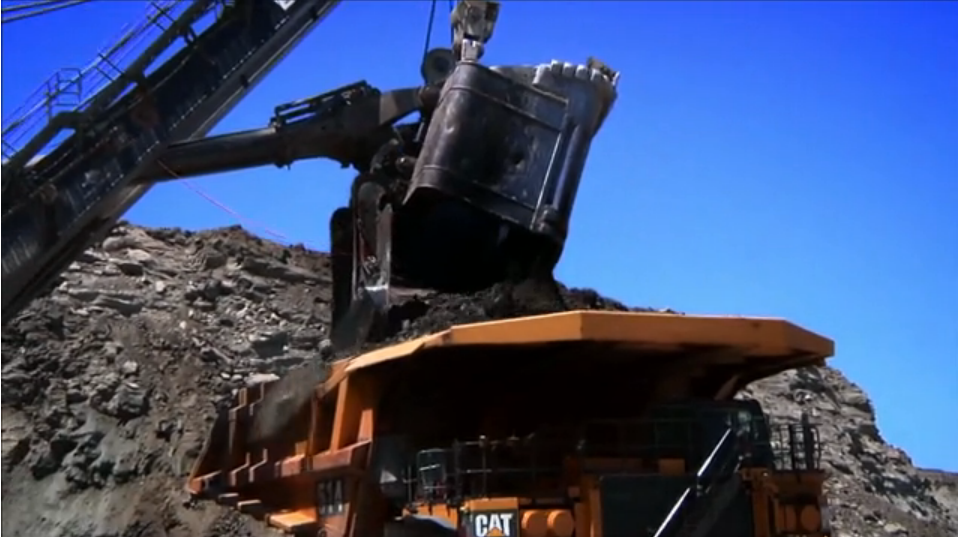
This year, the Geological Society of America is rolling out their SWITCH Energy Awareness campaign . The centerpiece of the campaign is a documentary film, SWITCH, which purports to be about the need for a transformation in the world’s energy systems. Recently, I attended the Chicago premier of the film, presented as part of the Environmental Film Series of the Lutheran School of Theology. I had high hopes for this film. They were disappointed. Given the mismatch between what the movie promises and what it delivers, it would be more aptly titled, “BAIT AND SWITCH.”
Switch Still
[Read more…] about Movie review: SWITCH

Filed Under: Climate Science, Communicating Climate, Reporting on climate

Climate change and consequences on the ground

13 Mar 2013 by rasmus

The link between extreme weather events, climate change, and national security is discussed in Extreme Realities, a new episode in PBS’ series Journey To Planet Earth hosted by Matt Damon.

The video features a number of extreme weather phenomena: hurricanes, tornadoes, floods, wild fires, and flooding. The discussion is about climate change and the consequences on the ground – or, how climate change may affect you.

It is important to ask what is the story behind the assertions made in the video. What scientific support is there for the link between such extremes and climate change?

[Read more…] about Climate change and consequences on the ground

Filed Under: Climate Science, Communicating Climate, Reporting on climate

Sea-level rise: Where we stand at the start of 2013 — Part 2

11 Jan 2013 by Stefan

This is Part 2 of my thoughts on the state of sea-level research. Here is Part 1.

Sea-level cycles?

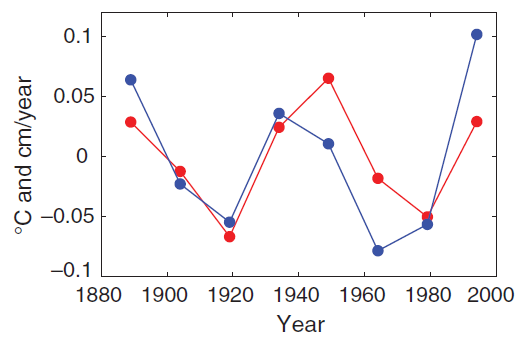
A topic that keeps coming up in the literature is the discussion on a (roughly) 60-year cycle in sea level data; a nice recent paper on this is Chambers et al. in GRL (2012). One thing I like about this paper is its careful discussion of the sampling issue of the tide gauges, which means that variability in the tide gauges is not necessarily variability in the true global mean sea level (see Part 1 of this post). I want to add some thoughts on the interpretation of this variability. Consider this graph from my Response to Comments in Science (2007):


Fig. 1: Fifteen-year averages of the global mean temperature (blue, °C, GISS data) and rate of sea level rise (red, cm/year, Church&white data), both detrended.
[Read more…] about Sea-level rise: Where we stand at the start of 2013 — Part 2

References

  1. D.P. Chambers, M.A. Merrifield, and R.S. Nerem, "Is there a 60‐year oscillation in global mean sea level?", Geophysical Research Letters, vol. 39, 2012. http://dx.doi.org/10.1029/2012GL052885
  2. S. Rahmstorf, "Response to Comments on "A Semi-Empirical Approach to Projecting Future Sea-Level Rise"", Science, vol. 317, pp. 1866-1866, 2007. http://dx.doi.org/10.1126/science.1141283

Filed Under: Climate Science, Communicating Climate, Instrumental Record, IPCC, Oceans

AGU time again…

1 Dec 2012 by group

This week is Fall AGU, the biggest climate-related conference around. Not everything is related to climate – there is a lot of other geophysics and astrophysics, but it is generally the place to go if you want to see and be seen (and incidentally, be crushed, be excited, be friendly and be frustrated that you can’t be in three places at once).

If you are not going, you should check out the improvements in the ‘Virtual meeting‘, which will offer live streaming of some big sessions, and for those and many additional sessions there is video-on-demand (VOD) after the fact. Many posters will also be available via ePoster. The twitter hashtag is #AGU12.

And if you are going to be there, here is a limited selection of sessions that will discuss issues that often come up here (more details in the scientific program).

Monday, Dec 03:

PP11F. The Climate of the Common Era I + II
8:00 AM – 12:30 AM; 2010 (Moscone West) (including Kevin Anchukatis, Philip Brohan, Eric, and many others).

12:30 PM – 01:30 PM: San Francisco Marriott Marquis – Salon 10 Brown Bag Lunch Workshop with Michael Gerrard on “Legal Duties to Preserve and Disclose Scientific Data and Personal Communications” (note that anyone who wants a private one-on-one session with a lawyer related to these or related issues, can email lawyer(at)climatesciencedefensefund.org to set up a meeting).

PA13B. Countering Denial and Manufactured Doubt of 21st Century Science
1:40 PM – 3:40 PM; 302 (Moscone South)

6:30 PM – 8:30PM; Open Mike Night hosted by Richard Alley. Jillian’s, 175 4th Street, Suite 1070.

Tuesday, Dec 04:

PA21B. Communication of Science Through Art: A Raison d’Etre for Interdisciplinary Collaboration
8:00 AM – 10:00 AM; 104 (Moscone South) (VOD)

GC22B. Communicating Climate Science—Seeking the Best of Old and New Paradigms
10:20 AM – 12:20 PM; 3014 (Moscone West) (including Mike, Richard Alley, Dan Kahan, Richard Somerville and Naomi Oreskes)

PA23B. PA23B. Facebook, Twitter, Blogs: Science Communication Gone Social—The Social Media 101
1:40 PM – 3:40 PM; 302 (Moscone South) (Including Mike, Michael Tobis, Peter Sinclair, and Zeke Hausfather)

Bloggers Forum: Science on the Web:
5:00 pm – 6:00 pm: 3000 (Moscone West)

Wednesday, Dec 05:

Session Title: A32D. New Atmospheric Sciences Fellows Presentations I + II
8:00 AM – 12:20PM; 3002 (Moscone West) (including Tony DelGenio, Mike, Ron Stouffer, Dave Neelin… ) (VOD)

PP31D. Continental Archives of Past Climate and Seismic Events II
8:00 AM – 10:00 AM; 2006 (Moscone West) (including Ray B. discussing this)

PP32A. Emiliani Lecture
10:20 AM – 11:20 AM; 103 (Moscone South)
“No future without a past” or “History will teach us nothing”? (Invited) Richard E. Zeebe (VOD)

12:30 PM – 1:30 PM; Brown Bag lunch with Pete Fontaine “An inside look at the Michael Mann case”. 226 (Moscone South)

GC33F. Construing Uncertainty in Climate Science
2:40 PM – 3:40 PM; 3003 (Moscone West) (including Naomi Oreskes, Gerard Roe)

GC44B. Links Between Rapid Arctic Change and Midlatitude Weather Patterns
5:00 PM – 6:00 PM; 3001 (Moscone West) (including Steve Vavrus, Judah Cohen)

Thursday, Dec 06:

GC43I. Tyndall History of Global Environmental Change Lecture:
2:40 PM – 3:40 PM; 2022-2024 (Moscone West): “Successful Predictions” (Invited), Raymond Pierrehumbert (VOD)

U44A. Dissolving Boundaries Between Scientists, Media, and the Public
4:00 PM – 6:00 PM; 102 (Moscone South) (Including Eric as speaker and panelist).

Friday, Dec 07:

C54B. The Ice Core Record of Carbon Cycle History and Processes
4:00 PM – 6:00 PM; 3007 (Moscone West)

Feel free to advertise other sessions/talks that might be of interest in the comments. Hopefully we’ll get some reports of interesting sessions to share with you (and if anyone wants to send us anything, we’ll post it up that evening).

Filed Under: Climate Science, Communicating Climate, Scientific practice

Don’t estimate acceleration by fitting a quadratic…

20 Nov 2012 by Stefan

… if your data do not look like a quadratic!

This is a post about global sea-level rise, but I put that message up front so that you’ve got it even if you don’t read any further.

The reputable climate-statistics blogger Tamino, who is a professional statistician in real life and has published a couple of posts on this topic, puts it bluntly:

Fitting a quadratic to test for change in the rate of sea-level rise is a fool’s errand.

I’d like to explain why, with the help of a simple example. Imagine your rate of sea-level rise changes over 100 years in the following way:
[Read more…] about Don’t estimate acceleration by fitting a quadratic…

Filed Under: Climate Science, Oceans, skeptics, statistics

Stronger regional differences due to large-scale atmospheric flow.

20 Nov 2012 by rasmus

A new paper by Deser et al. (2012) (free access) is likely to have repercussions on discussions of local climate change adaptation. I think it caught some people by surprise, even if the results perhaps should not be so surprising. The range of possible local and regional climate outcomes may turn out to be larger than expected for regions such as North America and Europe.

Deser et al. imply that information about the future regional climate is more blurred than previously anticipated because of large-scale atmospheric flow responsible for variations in regional climates. They found that regional temperatures and precipitation for the next 50 years may be less predictable due to the chaotic nature of the large-scale atmospheric flow. This has implications for climate change downscaling and climate change adaptation, and suggests a need to anticipate a wider range of situations in climate risk analyses.

Although it has long been recognised that large-scale circulation regimes affect seasonal, inter-annual climate, and decadal variations, the expectations have been that anthropogenic climate changes will dominate on time scales longer than 50 years. For instance, an influential analysis by Hawking & Sutton (2009) (link to figures) has suggested that internal climate variability account for only about 20% of the variance over the British isles on a 50-year time scale.
[Read more…] about Stronger regional differences due to large-scale atmospheric flow.

References

  1. C. Deser, R. Knutti, S. Solomon, and A.S. Phillips, "Communication of the role of natural variability in future North American climate", Nature Climate Change, vol. 2, pp. 775-779, 2012. http://dx.doi.org/10.1038/nclimate1562
  2. E. Hawkins, and R. Sutton, "The Potential to Narrow Uncertainty in Regional Climate Predictions", Bulletin of the American Meteorological Society, vol. 90, pp. 1095-1108, 2009. http://dx.doi.org/10.1175/2009BAMS2607.1

Filed Under: Climate impacts, Climate modelling, Climate Science, Communicating Climate, Reporting on climate, statistics

ClimateDialogue: Exploring different views on climate change

15 Nov 2012 by group

This is a guest posting from some Dutch colleagues on a new online experiment in fostering dialogue on climate change. Bart Verheggen has asked us to host this quick introduction. We are interested to hear if you think this is a good idea.

Guest Commentary by Bart Strengers (PBL)

ClimateDialogue.org offers a platform for discussions between invited climate scientists on important climate topics that have been subject to scientific and public debate. The goal of the platform is to explore the full range of views currently held by scientists by inviting experts with different views on the topic of discussion. We encourage the invited scientists to formulate their own personal scientific views; they are not asked to act as representatives for any particular group in the climate debate.

Obviously, there are many excellent blogs that facilitate discussions between climate experts, but as the climate debate is highly polarized and politicized, blog discussions between experts with opposing views are rare.

Background


The discovery, early 2010, of a number of errors in the Fourth IPCC Assessment Report on climate impacts (Working Group II), led to a review of the processes and procedures of the IPCC by the InterAcademy Council (IAC). The IAC-report triggered a debate in the Dutch Parliament about the reliability of climate science in general. Based on the IAC recommendation that ‘the full range of views’ should be covered in the IPCC reports, Parliament asked the Dutch government ‘to also involve climate skeptics in future studies on climate change’.

In response, the Ministry of Infrastructure and the Environment announced a number of projects that are aimed to increase this involvement. ClimateDialogue.org is one of these projects.


We are starting ClimateDialogue with a discussion on the causes of the decline of Arctic Sea Ice, and the question to what extent this decline can be explained by global warming. Also, the projected timing of the first year that the Arctic will be ice free will be discussed. With respect to the latter, in its Fourth Assessment Report in 2007, IPCC anticipated that (near) ice free conditions might occur by the end of this century. Since then, several studies have indicated this could be between 2030-2050, or even earlier.

We invited three experts to take part in the discussion: Judith Curry, chair of the School of Earth and Atmospheric Sciences at the Georgia Institute of Technology; Walt Meier, research scientist at the National Snow & Ice Data Center (NSIDC) in Boulder, Colorado; and Ron Lindsay, Senior Principal Physicist at the Polar Science Center of the University of Washington in Seattle.

Future topics that will be discussed include: climate sensitivity, sea level rise, urban heat island-effects, the value of comprehensive climate models, ocean heat storage, and the warming trend over the past few decades.

Our format


Each discussion will be kicked off by a short introduction written by the editorial staff, followed by a guest blog by two or more invited scientists. The scientists will start the discussion by responding to each other’s arguments. It is not the goal of ClimateDialogue to reach a consensus, but to stimulate the discussion and to make clear what the discussants agree or disagree on and why. 
To round off the discussion on a particular topic, the ClimateDialogue editor will write a summary, describing the areas of agreement and disagreement between the discussants. The participants will be asked to approve this final article, the discussion between the experts on that topic will then be closed and the editorial board will open a new discussion on a different topic.

The public (including other climate scientists) are also free to comment, but for practical reasons these comments will be shown separately.

The project organization consists of an editorial staff of three people and an advisory board of seven people, all of whom are based in the Netherlands. The editorial staff is concerned with the day-to-day operation of researching topics, finding participants for the discussion and moderating the discussions between the experts. The main task of the advisory board is to guard the neutrality of the platform and to advise the editorial staff about its activities

The project leader is Rob van Dorland of the Royal Netherlands Meteorological Institute (KNMI), a senior scientist and climate advisor in the Climate Services section and is often active at the interface between science and society. The second member is Bart Strengers. He is a climate policy analyst and modeler in the IMAGE-project at the PBL Netherlands Environmental Assessment Agency (PBL) and has been involved in the discussion with climate skeptics for many years. The third member is Marcel Crok, an investigative science writer, who published a critical book (in Dutch) about the climate debate.

We welcome comments here and are happy to answer any questions regarding this project. You can also send an email to info [at] climatedialogue [dot] org.

Filed Under: Climate Science, Communicating Climate, skeptics

PBS: Climate of Doubt

24 Oct 2012 by Gavin

The video of Tuesday’s PBS show on the politics of the climate debate is available – I make a minor appearance…

The PBS website has more background.

Filed Under: Climate Science, Communicating Climate, skeptics

A sea level Golden Horseshoe nominee*

14 Oct 2012 by Gavin

I was reading a sign high on the wall behind the bar:

‘Only genuine pre-war British and American whiskeys served here’

I was trying to count how many lies could be found in those nine words, and had reached four, with promise of more …”

Dashiell Hammett, “The Golden Horseshoe”

Google News occasionally throws up some obscure postings that I would never otherwise come across. A recent example was a letter to an editor of a Scottish newspaper (not my usual reading material) declaring that “Climate change is not man-made”. The letter itself is uninteresting – a basic confusion between weather and climate seguing into a NIMBY-ish rant about windmills. Ho hum.

However, in one of the comments from a “Dr John Cameron, St Andrews” (posted 9/Oct/2012), there was this unrelated pseudo-factoid:

As regards the catastrophic sea level rise in the Pacific, it became obvious some 20 years ago that results from island tide gauges did not support computer predictions. Scientists from Flinders University in Adelaide set up new, modern, tide-gauges in 12 Pacific islands to test whether there was in fact any evidence of sinking. Recently the whole project was abandoned as there had been no sign whatsoever of a change in sea level at any of the 12 islands for the past 16 years.

Now this is specific enough to probably actually refer to something real, but doesn’t pass the sniff test for something that might actually be true. Scientists don’t set up monitoring stations only to get the answer they want and then stop monitoring if it doesn’t happen. This only happens in the fevered imaginations of conspiracy theorists. So I was intrigued enough to investigate what this actually referred to…
[Read more…] about A sea level Golden Horseshoe nominee*

Filed Under: Climate Science, Oceans, skeptics

Climate Change videos: Part I

9 Oct 2012 by group

The US National Research Council has been doing a lot recently to expand background knowledge of the climate system and of climate change. In tandem with a new report discussing strategies for advancing climate modeling, they have put up a an introductory web site on climate models (including some interviews with some actual climate modelers).

More comprehensively, they have helped put together a series of videos discussing everything from the definition of climate to attribution of climate changes and future projections. The series is in seven parts, viewable here. There are additional resources here.

We thought it would be interesting to have a separate post on each of the seven videos so that discussions on the videos themselves, or the topics covered (or not) could be more focused. So, with no further ado, here is part I: “What is Climate?”

Filed Under: Climate Science, Communicating Climate

  • « Go to Previous Page
  • Page 1
  • Interim pages omitted …
  • Page 11
  • Page 12
  • Page 13
  • Page 14
  • Page 15
  • Interim pages omitted …
  • Page 29
  • Go to Next Page »

Primary Sidebar

Search

Search for:

Email Notification

get new posts sent to you automatically (free)
Loading

Recent Posts

  • Unforced Variations: Apr 2026
  • A reflection on reflection
  • Spencer’s Shenanigans: Part II
  • The Puzzling Pleistocene
  • How robust is our accelerometer?
  • Unforced Variations: Mar 2026

Our Books

Book covers
This list of books since 2005 (in reverse chronological order) that we have been involved in, accompanied by the publisher’s official description, and some comments of independent reviewers of the work.
All Books >>

Recent Comments

  • Robert Cutler on A reflection on reflection
  • Robert Cutler on A reflection on reflection
  • Barry E Finch on Unforced Variations: Apr 2026
  • MA Rodger on A reflection on reflection
  • Tomáš Kalisz on Unforced Variations: Apr 2026
  • Keith Woollard on A reflection on reflection
  • Tomáš Kalisz on A reflection on reflection
  • Barton Paul Levenson on Unforced Variations: Apr 2026
  • Barton Paul Levenson on A reflection on reflection
  • Barton Paul Levenson on A reflection on reflection
  • Ron R. on Unforced Variations: Apr 2026
  • Paul Pukite (@whut) on A reflection on reflection
  • patrick o twentyseven on A reflection on reflection
  • patrick o twentyseven on A reflection on reflection
  • Ray Ladbury on Unforced Variations: Apr 2026
  • Nigelj on Unforced Variations: Apr 2026
  • Ray Ladbury on Unforced Variations: Apr 2026
  • Ray Ladbury on A reflection on reflection
  • Ray Ladbury on A reflection on reflection
  • zebra on Unforced Variations: Apr 2026
  • Robert Cutler on A reflection on reflection
  • jgnfld on Unforced Variations: Apr 2026
  • Radge Havers on Unforced Variations: Apr 2026
  • Robert Cutler on A reflection on reflection
  • zebra on A reflection on reflection
  • Radge Havers on Unforced Variations: Apr 2026
  • W.R. Agner on Unforced Variations: Apr 2026
  • Ron R. on Unforced Variations: Apr 2026
  • Paul Pukite (@whut) on Unforced Variations: Apr 2026
  • Matt Skaggs on A reflection on reflection

Footer

ABOUT

  • About
  • Translations
  • Privacy Policy
  • Contact Page
  • Login

DATA AND GRAPHICS

  • Data Sources
  • Model-Observation Comparisons
  • Surface temperature graphics
  • Miscellaneous Climate Graphics

INDEX

  • Acronym index
  • Index
  • Archives
  • Contributors

Realclimate Stats

1,404 posts

15 pages

251,187 comments

Copyright © 2026 · RealClimate is a commentary site on climate science by working climate scientists for the interested public and journalists.