• Skip to primary navigation
  • Skip to main content
  • Skip to primary sidebar
  • Skip to footer

RealClimate

Climate science from climate scientists...

  • Start here
  • Model-Observation Comparisons
  • Miscellaneous Climate Graphics
  • Surface temperature graphics
You are here: Home / Archives for Communicating Climate

Communicating Climate

Another dot on the graph

15 Jan 2022 by Gavin

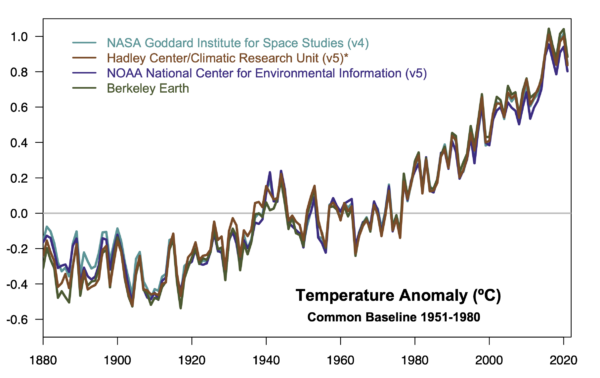
So last week was the annual release of the temperature records from NASA, NOAA and Berkeley Earth. The Copernicus ERA5 data was released a few days ago, and the HadCRUT data will follow soon. Unlike in years past, there is no longer any serious discrepancy between the records – which use multiple approaches for the ocean temperatures, the homogenization of the weather stations records, and interpolation.

Depending on the product, 2021 was either the 5th, 6th or 7th warmest year, but in all cases, it is part of the string of warm years (since 2015) that have all been more than 1ºC warmer than the late 19th C.

[Read more…] about Another dot on the graph

Filed Under: Aerosols, Climate Science, Communicating Climate, El Nino, Greenhouse gases, Instrumental Record

“Don’t Look Up”

1 Jan 2022 by Gavin

The highlight of the movie season for climate science has clearly been the release on Dec 24th 2021 of “Don’t Look Up”. While nominally about a different kind of disaster – the discovery of a comet heading to Earth on a collision course – the skewering of our current science-policy dysfunction transcends the specifics and makes a powerful metaphor for climate change, and even the ongoing COVID-19 pandemic.

[Read more…] about “Don’t Look Up”

Filed Under: Climate Science, Communicating Climate, coronavirus, Scientific practice

Deciphering the ‘SPM AR6 WG1’ code

12 Aug 2021 by rasmus

I followed with great interest the launch of the sixth assessment report Working Group 1 (The Physical Science Basis) from the Intergovernmental Panel on Climate Change (IPCC) on August 9th. 

The main report is quite impressive (see earlier posts here, here, here, and here) but the press conference didn’t come across as being focused and well-prepared. In my opinion the press conference on 9 August 2021 didn’t do justice to the vast effort that went into it.

[Read more…] about Deciphering the ‘SPM AR6 WG1’ code

Filed Under: Communicating Climate, Reporting on climate

The IPCC Sixth Assessment Report

9 Aug 2021 by group

Climate scientists are inordinately excited by the release of a new IPCC report (truth be told, that’s a bit odd – It’s a bit like bringing your end-of-(seven)-year project home and waiting anxiously to see how well it will be received). So, in an uncharacteristically enthusiastic burst of effort, we have a whole suite of posts on the report for you to read.

  • AR6 of the Best. Half a dozen takeaways from the report from Gavin
  • New (8/13): Sea Level Rise in AR6 from Stefan
  • A Tale of Two Hockey Sticks by Mike
  • #NotAllModels discusses the use (and mis-use) of the CMIP6 ensemble by Gavin
  • We are not reaching 1.5ºC earlier than previously thought from guest authors Malte Meinshausen, Zebedee Nicholls and Piers Forster
  • New (8/12): Deciphering the SPM AR6 WG1 Code by Rasmus
  • New (8/12): A deep dive into the IPCC’s updated carbon budget numbers from guest author Joeri Rogelj

If/when we add some more commentary as we digest the details and we see how the report is being discussed, we’ll link it from here. Feel free to discuss general issues with the report in the comments here, and feel free to suggest further deep dives we might pursue.

Filed Under: Climate impacts, Climate modelling, Climate Science, Communicating Climate, Greenhouse gases, In the News, Instrumental Record, IPCC, Paleoclimate, Sea level rise

Climate adaptation should be based on robust regional climate information

25 Jul 2021 by rasmus

Climate adaptation steams forward with an accelerated speed that can be seen through the Climate Adaptation Summit in January (see previous post), the ECCA 2021 in May/June, and the upcoming COP26. Recent extreme events may spur this development even further (see previous post about attribution of recent heatwaves). 

To aid climate adaptation, Europe’s Climate-Adapt programme provides a wealth of resources, such as guidance, case studies and videos. This is a good start, but a clear and transparent account on how to use the actual climate information for adaptation seems to be missing. How can projections of future heatwaves or extreme rainfall help practitioners, and how to interpret this kind of information? 

[Read more…] about Climate adaptation should be based on robust regional climate information

Filed Under: Climate impacts, Climate modelling, Climate Science, climate services, downscaling, heatwaves, hydrological cycle, Solutions, statistics

A potential rule of thumb for hourly rainfall?

20 Mar 2021 by rasmus

Future global warming will be accompanied by more intense rainfall and flash floods due to increased evaporation, as a consequence of higher surface temperatures which also lead to a higher turn-around rate for the global hydrological cycle. In other words, we will see changing rainfall patterns. And if the global area of rainfall also shrinks, then a higher regional concentration of the rainfall is bound to lead to more intense downpours (the global rainfall indicator is discussed here). 

[Read more…] about A potential rule of thumb for hourly rainfall?

Filed Under: Climate impacts, Climate Science, climate services, hydrological cycle, Solutions, statistics

Regional information for society (RifS) and unresolved issues

14 Feb 2021 by rasmus

It’s encouraging to note the growing interest for regional climate information for society and climate adaptation, such as recent advances in the World Climate Research Programme (WCRP), the climate adaptation summit CAS2021, and the new Digital Europe. These efforts are likely to boost the Global Framework for Climate Services (GFCS) needed as a guide to decision-makers on matters influenced by weather and climate. 

[Read more…] about Regional information for society (RifS) and unresolved issues

Filed Under: Climate impacts, Climate modelling, Climate Science, climate services, Communicating Climate, downscaling, Solutions

Don’t climate bet against the house

3 Feb 2021 by Gavin

Decades ago (it seems) when perhaps it was still possible to have good faith disagreements about the attribution of current climate trends, James Annan wrote a post here summarizing the thinking and practice of Climate Betting. That led to spate of wagers on continued global warming (a summary of his bets through 2005 and attempts to set up others is here).

There were earlier bets, the most well known perhaps was the one for $100 between Hugh Ellsaesser and Jim Hansen in 1989 on whether there would be a new temperature record within three years. There was (1990), and Ellsaesser paid up in January 1991 (Kerr, 1991). But these more recent bets were more extensive.

[Read more…] about Don’t climate bet against the house

References

  1. R.A. Kerr, "Global Temperature Hits Record Again", Science, vol. 251, pp. 274-274, 1991. http://dx.doi.org/10.1126/science.251.4991.274

Filed Under: Arctic and Antarctic, Climate Science, Instrumental Record, skeptics, statistics

Climate Adaptation Summit 2021

31 Jan 2021 by rasmus

The first ever Climate Adaptation Summit (#adaptationsummit) that I have heard about took place last week, on January 25-26. I think such a summit was a step in the right direction. It was adapted to the Covid-19 situation and therefore an online virtual summit streamed on YouTube. 

I watched a few of the streamed sessions, and it struck me that climate change adaptation seems to be a fairly new concept to many leaders. It were sometimes mix-ups with mitigation during the high-level talks. Mitigation and adaptation are both important and sometimes they overlap, so mix-ups are understandable. 

One important point addressed during the summit was of course financing climate change adaptation, which is promising. Financing is clearly needed for climate change adaptation. To ensure progress and avoid lofty visions without results on the ground, there may also be a need for tangible results and to show examples and demonstrations. One specific type discussed at the summit was “Early warning systems” which play an important role.

But it was not crystal clear what was meant by the concept “early warning systems”. My interpretation is that it involves something on par with weather forecasts which would imply that they are more about weather than climate. This is of course important too. Probably the first priority in many places. 

But early warning systems, the way I understand them, don’t provide information about climate risks on longer timescales. Weather and climate – short and long timescales – are of course connected but nevertheless different (“climate” can be viewed as weather statistics). Other examples of climate adaptation can be found in a recent Eos article on food security in Africa. I think it is important to mention maladaptation and avoid long-term problems connected to short-term fixes. Resilience is a keyword. 

As with many other summits, I felt that the scientists’ voice was largely missing. There seems to be a gap between high-level politics and science. I think we need a better dialogue between the leaders and climate scientists partly to help distinguish between different and difficult concepts. But the main reason is that we need to know what we must adapt to. We need to know the situation: the state of the climate and how it is changing. This knowledge is not readily downloadable from the Internet.

There are key questions that should involve scientists: What is needed for proper climate change adaptation? And what are the challenges in terms of meeting our objectives? What do we know about future risks? In addition, biodiversity, nature conservation, cultural, social and economic aspects are important. 

Data is crucial, but is often unavailable because of lack of sharing and lack of openness. Often due to lacking finance. Information about the regional climate change must be distilled from large volumes of data, and we need to ask what information is useful and how it can be used in the best possible way.

The required analysis is often carried out in climate services and often includes downscaling. It involves tools, methods and understanding that are still evolving with regards to these topics. This fact wasn’t explained clearly during the summit in the sessions I watched. I think it would be useful with a presentation of the state of climate science relevant for climate change adaptation at a high level in the summit. Perhaps science should get an equal amount of attention as the NGOs and the businesses. 

Much of the latest research relevant to the climate adaptation summit is coordinated within the World Climate Research Programme (WRCP) which also is setting a new focus on regional information for society (“RifS”). Furthermore, there is considerable scientific experience on adaptation from the Arctic with the fastest climate change on Earth, such as the Adaptive Actions in a Changing Arctic (AACA) report for the Arctic Council. 

Climate adaptation involves many communities and disciplines (e.g. weather forecasting, climate services, regional climate modelling, “distillation“, disaster risk reduction) which I think aren’t well coordinated at the moment. One message from the summit was “Let’s work together” which I think implies a better coordination of the different disciplines and communities.

Filed Under: Climate impacts, Climate Science, climate services

Flyer tipping

12 Jan 2021 by Gavin

You would be forgiven for not paying attention to the usual suspects of climate denial right now, but they are trying to keep busy anyway.

Last week (January 8), Roy Spencer [Update Jan 13: now deleted] posted a series of Climate Change “flyers” on his personal blog that purported to be organised by David Legates (NOAA, detailed to Office of Science and Technology Policy (OSTP), nominally on leave from (and soon to return to) U. Delaware). Each was a rather garishly colored rehash of standard climate denial talking points, but featuring the OSTP official logo, and claiming to be copyrighted by OSTP (a legal impossibility). Note that if this was an official US Govt. work, they could not copyright them, but if it wasn’t, they could not legally use the OSTP logo to indicate that it was.

Dubious use of an official government logo…

The reaction to this definitive refutation of mainstream science (ha!) was… silence. Spencer’s post was reblogged at WUWT but again, nothing happened [Update Jan 13: Also now deleted]. . Many of the authors of the pieces themselves – many of whom are active on social media – didn’t bother to tweet or post about them. Odd.

The whole thing seems to be Legates trying to get a pet project out into the world before the new administration comes in, but without bothering with all that messy peer-review, official permission, proper channels or, you know, actual science. Almost certainly this is also a violation of the Data Quality Act, something Patrick Michaels (one of the flyer authors) was quite exercised about in his effort. Consistency is also apparently optional.

Anyway, a couple of days ago (Jan 10), they were also posted on Willie Soon’s new website where they were noticed on twitter, and today there have been some media eyebrows raised.

Is there a there there?

The flyers themselves are remarkably thin on valid argumentation. Will Happer’s discussion of Radiative Transfer is mostly textbook stuff except for the last paragraph where he simply asserts that a radiative forcing of 3 W/m2 can’t possibly matter. That’s kind of the key issue, which he totally elides.

Christopher Essex purports to discuss climate models, without ever showing anything from a climate model. He seems to be arguing against some Aristotelian concept of climate models that never has to be bothered with actually looking at the real world (for instance). Weird, and totally pointless.

Spencer makes the remarkable assertion that climate has changed for natural reasons in the past (I’m shocked, shocked!), and ignores how attribution actually works (I’m not at all shocked).

The Connollys and Willie Soon’s flyer purports to talk about sun-climate connections, but they spend most of their effort talking about Milankovitch forcing before pivoting to imagining a universe where the temperatures have not in fact been steadily climbing but where they could conceivably have a higher correlation to out-of-date and unsupported reconstructions of solar activity. In so doing, they even have the chutzpah to cite a paper of mine. Meh.

Etc. If there is a demand in the comments, I could expand on the others, but for now, I think you get the idea.

Why should anyone care?

Great question! I don’t think anyone should. But this whole effort is emblematic of how far the climate question has moved. With a new US administration poised to act on climate across a whole series of fronts, this feeble throwback (were they released on a Thursday?), serves to underline how out-of-touch these old school deniers and their talking points really are. This is perhaps the last weak ‘hurrah’ of a bankrupt cause.

Good riddance to bad rubbish.

Update (4pm, Jan 12): that was quick:

BREAKING: @WHOSTP has fired climate contrarians David Legates and @RyanMaue days before their last scheduled day of service, due to their role in the unauthorized writing and publishing of controversial climate papers w/ White House markings. https://t.co/3aMhpZJ65w

— Andrew Freedman (@afreedma) January 12, 2021

Filed Under: Climate Science, In the News, skeptics

  • « Go to Previous Page
  • Page 1
  • Page 2
  • Page 3
  • Page 4
  • Page 5
  • Page 6
  • Interim pages omitted …
  • Page 29
  • Go to Next Page »

Primary Sidebar

Search

Search for:

Email Notification

get new posts sent to you automatically (free)
Loading

Recent Posts

  • Unforced Variations: Dec 2025
  • Who should pay?
  • Site updates etc.
  • Raising Climate Literacy
  • Unforced variations: Nov 2025
  • High-resolution ‘fingerprint’ images reveal a weakening Atlantic Ocean circulation (AMOC)

Our Books

Book covers
This list of books since 2005 (in reverse chronological order) that we have been involved in, accompanied by the publisher’s official description, and some comments of independent reviewers of the work.
All Books >>

Recent Comments

  • Pete Best on Unforced Variations: Dec 2025
  • Paul Pukite (@whut) on Unforced Variations: Dec 2025
  • b fagan on Unforced Variations: Dec 2025
  • patrick o twentyseven on Unforced Variations: Dec 2025
  • Atomsk's Sanakan on Unforced Variations: Dec 2025
  • Atomsk's Sanakan on Unforced Variations: Dec 2025
  • patrick o twentyseven on Unforced Variations: Dec 2025
  • Susan Anderson on Who should pay?
  • Susan Anderson on Unforced Variations: Dec 2025
  • Susan Anderson on Who should pay?
  • Yebo Kandu on Raising Climate Literacy
  • MA Rodger on Unforced Variations: Dec 2025
  • David on Unforced Variations: Dec 2025
  • David on Unforced Variations: Dec 2025
  • Michael Flynn on Who should pay?
  • b fagan on Unforced Variations: Dec 2025
  • Neurodivergent on Unforced Variations: Dec 2025
  • patrick o twentyseven on Unforced Variations: Dec 2025
  • zebra on Who should pay?
  • Jon Kirwan on Who should pay?
  • MA Rodger on Unforced Variations: Dec 2025
  • One Anonymous Bloke on Unforced Variations: Dec 2025
  • One Anonymous Bloke on Unforced Variations: Dec 2025
  • One Anonymous Bloke on Unforced Variations: Dec 2025
  • Nigelj on Raising Climate Literacy
  • Nigelj on Who should pay?
  • E. Schaffer on Unforced Variations: Dec 2025
  • Susan Anderson on Who should pay?
  • Susan Anderson on Unforced Variations: Dec 2025
  • Susan Anderson on Unforced Variations: Dec 2025

Footer

ABOUT

  • About
  • Translations
  • Privacy Policy
  • Contact Page
  • Login

DATA AND GRAPHICS

  • Data Sources
  • Model-Observation Comparisons
  • Surface temperature graphics
  • Miscellaneous Climate Graphics

INDEX

  • Acronym index
  • Index
  • Archives
  • Contributors

Realclimate Stats

1,389 posts

15 pages

248,862 comments

Copyright © 2025 · RealClimate is a commentary site on climate science by working climate scientists for the interested public and journalists.