The bimonthly open thread focused on climate solutions, mitigation and adaptation. Please keep this focused.
Blog – realclimate.org – All Posts
Unforced variations: May 2018
Nenana Ice Classic 2018
Another year, another ice out date. As in previous years, here’s an update of the Nenana Ice Classic time series (raw date, and then with a small adjustment for the calendrical variations in ‘spring’). One time series doesn’t prove much, but this is of course part of a much larger archive of phenomenological climate-related data that I’ve talked about before.
This year the ice on the Tanana River went out on May 1st, oddly enough the same date as last year, after another very warm (but quite snowy) Alaskan winter.
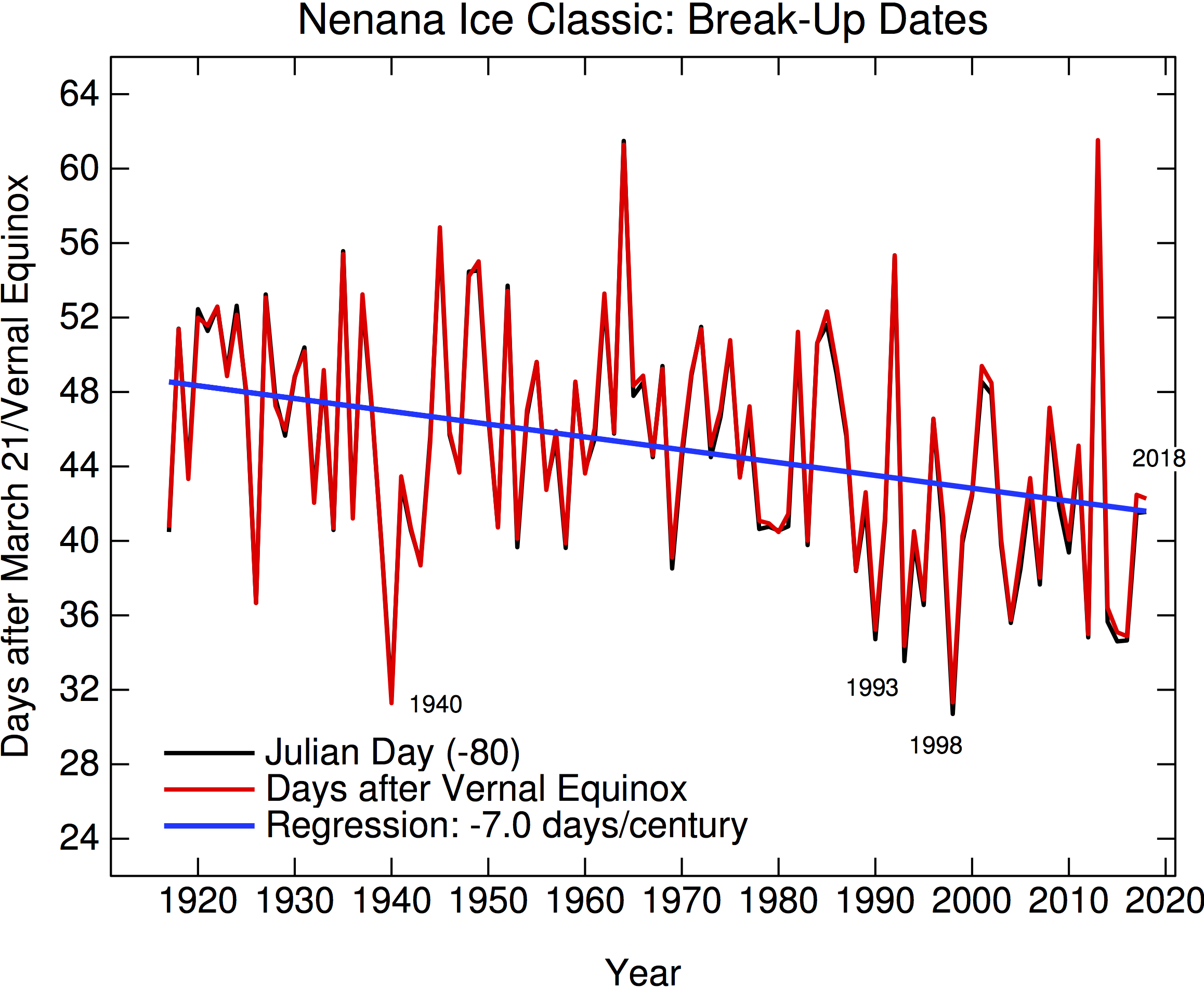
My shadow bet on whether any climate contrarian site will mention this dataset remains in play (none have since 2013 which was an record late year). [Update: It was mentioned on WUWT!]
The Alsup Aftermath
The presentations from the Climate Science tutorial last month have all been posted (links below), and Myles Allen (the first presenter for the plaintiffs) gives his impression of the events.
[Read more…] about The Alsup Aftermath
The Silurian Hypothesis
One of the benefits of working for NASA is that the enormous range of science the agency covers – from satellite records for the present day, to exoplanet climates, from early Mars and deep time on Earth to the far future – and the opportunity to think ‘big’. This week sees the publication of a paper I wrote with Adam Frank that we hope might provoke some ‘big’ thinking.
The Silurian Hypothesis (preprint) is the idea if industrial civilization had arisen on Earth prior to the existence of hominids, what traces would be left that could be detectable now? As a starting point, we explore what the traces of the Anthropocene will be in millions of years – carbon isotope changes, global warming, increased sedimentation, spikes in heavy metal concentrations, plastics and more – and then look at previous examples of similar events in the geological record. What is unique about our presence on Earth and what might be common to any industrial civilization? Can we rule out similar causes?
[Read more…] about The Silurian Hypothesis
References
- G.A. Schmidt, and A. Frank, "The Silurian hypothesis: would it be possible to detect an industrial civilization in the geological record?", International Journal of Astrobiology, vol. 18, pp. 142-150, 2018. http://dx.doi.org/10.1017/S1473550418000095
Stronger evidence for a weaker Atlantic overturning circulation
Through two new studies in Nature, the weakening of the Gulf Stream System is back in the scientific headlines. But even before that, interesting new papers have been published – high time for an update on this topic.
Let’s start with tomorrow’s issue of Nature, which besides the two new studies (one of which I was involved in) also includes a News&Views commentary. Everything revolves around the question of whether the Gulf Stream System has already weakened. Climate models predict this will be one consequence of global warming – alongside other problems such as rising sea levels and increasing heat waves, droughts and extreme precipitation. But is such a slowdown already underway today? This question is easier asked than answered. The Atlantic Meridional Overturning Circulation (AMOC, also known as Gulf Stream System) is a huge, three-dimensional flow system throughout the Atlantic, which fluctuates on different time scales. It is therefore by no means enough to put a current meter in the water at one or two points. [Read more…] about Stronger evidence for a weaker Atlantic overturning circulation
Harde Times
Readers may recall a post a year ago about a nonsense paper by Hermann Harde that appeared in Global and Planetary Change. We reported too on the crowd-sourced rebuttal led by Peter Köhler that was published last October. Now comes an editorial by three members of the Editorial Board (Martin Grosjean, Joel Guiot and Zicheng Yu) reporting on what the circumstances were that led to the Harde paper appearing.
[Read more…] about Harde Times
References
- H. Harde, "Scrutinizing the carbon cycle and CO2 residence time in the atmosphere", Global and Planetary Change, vol. 152, pp. 19-26, 2017. http://dx.doi.org/10.1016/j.gloplacha.2017.02.009
- P. Köhler, J. Hauck, C. Völker, D.A. Wolf-Gladrow, M. Butzin, J.B. Halpern, K. Rice, and R.E. Zeebe, "Comment on “ Scrutinizing the carbon cycle and CO 2 residence time in the atmosphere ” by H. Harde", Global and Planetary Change, vol. 164, pp. 67-71, 2018. http://dx.doi.org/10.1016/j.gloplacha.2017.09.015
- M. Grosjean, J. Guiot, and Z. Yu, "Commentary", Global and Planetary Change, vol. 164, pp. 65-66, 2018. http://dx.doi.org/10.1016/j.gloplacha.2017.12.023
Unforced Variations: Apr 2018
Alsup asks for answers
Some of you might have read about the lawsuit by a number of municipalities (including San Francisco and Oakland) against the major oil companies for damages (related primarily to sea level rise) caused by anthropogenic climate change. The legal details on standing, jurisdiction, etc. are all very interesting (follow @ColumbiaClimate for those details), but somewhat uniquely, the judge (William Alsup) has asked for a tutorial on climate science (2 hours of evidence from the plaintiffs and the defendents). Furthermore, he has posted a list of eight questions that he’d like the teams to answer.
Forced responses: Mar 2018
This month’s open thread on responses to climate change (politics, adaptation, mitigation etc.). Please stay focused on the overall topic. Digressions into the nature and history of communism/feudal societies/anarchistic utopias are off topic and won’t be posted. Thanks. The open thread for climate science topics is here.