It is a truism that all models are wrong. Just as no map can capture the real landscape and no portrait the true self, numerical models by necessity have to contain approximations to the complexity of the real world and so can never be perfect replications of reality. Similarly, any specific observations are only partial reflections of what is actually happening and have multiple sources of error. It is therefore to be expected that there will be discrepancies between models and observations. However, why these arise and what one should conclude from them are interesting and more subtle than most people realise. Indeed, such discrepancies are the classic way we learn something new – and it often isn’t what people first thought of.
[Read more…] about On mismatches between models and observations
Instrumental Record
The answer is blowing in the wind: The warming went into the deep end
There has been an unusual surge of interest in the climate sensitivity based on the last decade’s worth of temperature measurements, and a lengthy story in the Economist tries to argue that the climate sensitivity may be lower than previously estimated. I think its conclusion is somewhat misguided because it missed some important pieces of information (also see skepticalscience’s take on this story here).

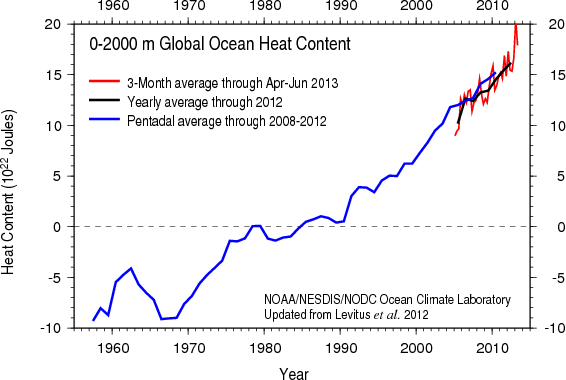
While the Economist referred to some unpublished work, it missed a new paper by Balmaseda et al. (2013) which provides a more in-depth insight. Balmaseda et al suggest that the recent years may not have much effect on the climate sensitivity after all, and according to their analysis, it is the winds blowing over the oceans that may be responsible for the ‘slow-down’ presented in the Economist.
[Read more…] about The answer is blowing in the wind: The warming went into the deep end
References
- M.A. Balmaseda, K.E. Trenberth, and E. Källén, "Distinctive climate signals in reanalysis of global ocean heat content", Geophysical Research Letters, vol. 40, pp. 1754-1759, 2013. http://dx.doi.org/10.1002/grl.50382
Ice hockey
Eric Steig
It is well known that ice shelves on the Antarctic Peninsula have collapsed on several occasions in the last couple of decades, that ice shelves in West Antarctica are thinning rapidly, and that the large outlet glaciers that drain the West Antarctic ice sheet (WAIS) are accelerating. The rapid drainage of the WAIS into the ocean is a major contributor to sea level rise (around 10% of the total, at the moment).
All of these observations match the response, predicted in the late 1970s by glaciologist John Mercer, of the Antarctic to anthropogenic global warming. As such, they are frequently taken as harbingers of greater future sea level rise to come. Are they?
Two papers published this week in Nature Geoscience provide new information that helps to address this question. One of the studies (led by me) says “probably”, while another (Abram et al.) gives a more definitive “yes”. [Read more…] about Ice hockey
Urban Heat Islands and U.S. Temperature Trends
Guest Commentary by Zeke Hausfather and Matthew Menne (NOAA)
The impact of urban heat islands (UHI) on temperature trends has long been a contentious area, with some studies finding no effect of urbanization on large-scale temperature trend and others finding large effects in certain regions. The issue has reached particular prominence on the blogs, with some claiming that the majority of the warming in the U.S. (or even the world) over the past century can be attributed to urbanization. We therefore set out to undertake a thorough examination of UHI in the Conterminous United States (CONUS), examining multiple ‘urban’ proxies, different methods of analysis, and temperature series with differing degrees of homogenization and urban-specific corrections (e.g. the GISTEMP nightlight method; Hansen et al, 2010). The paper reporting our results has just been published in the Journal of Geophysical Research.
[Read more…] about Urban Heat Islands and U.S. Temperature Trends
References
- D.E. Parker, "Large-scale warming is not urban", Nature, vol. 432, pp. 290-290, 2004. http://dx.doi.org/10.1038/432290a
- X. Yang, Y. Hou, and B. Chen, "Observed surface warming induced by urbanization in east China", Journal of Geophysical Research, vol. 116, 2011. http://dx.doi.org/10.1029/2010JD015452
- J. Hansen, R. Ruedy, M. Sato, and K. Lo, "GLOBAL SURFACE TEMPERATURE CHANGE", Reviews of Geophysics, vol. 48, 2010. http://dx.doi.org/10.1029/2010RG000345
2012 Updates to model-observation comparisons
Time for the 2012 updates!
As has become a habit (2009, 2010, 2011), here is a brief overview and update of some of the most discussed model/observation comparisons, updated to include 2012. I include comparisons of surface temperatures, sea ice and ocean heat content to the CMIP3 and Hansen et al (1988) simulations.
[Read more…] about 2012 Updates to model-observation comparisons
Sea-level rise: Where we stand at the start of 2013 — Part 2
This is Part 2 of my thoughts on the state of sea-level research. Here is Part 1.
Sea-level cycles?
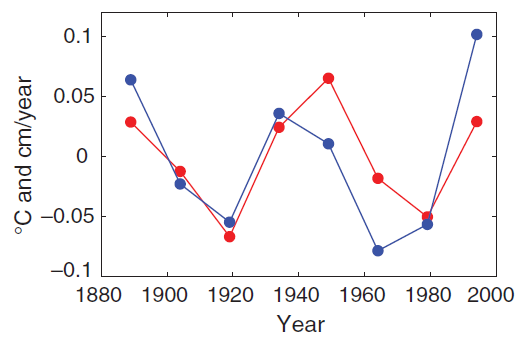
A topic that keeps coming up in the literature is the discussion on a (roughly) 60-year cycle in sea level data; a nice recent paper on this is Chambers et al. in GRL (2012). One thing I like about this paper is its careful discussion of the sampling issue of the tide gauges, which means that variability in the tide gauges is not necessarily variability in the true global mean sea level (see Part 1 of this post). I want to add some thoughts on the interpretation of this variability. Consider this graph from my Response to Comments in Science (2007):

Fig. 1: Fifteen-year averages of the global mean temperature (blue, °C, GISS data) and rate of sea level rise (red, cm/year, Church&white data), both detrended.
[Read more…] about Sea-level rise: Where we stand at the start of 2013 — Part 2
References
- D.P. Chambers, M.A. Merrifield, and R.S. Nerem, "Is there a 60‐year oscillation in global mean sea level?", Geophysical Research Letters, vol. 39, 2012. http://dx.doi.org/10.1029/2012GL052885
- S. Rahmstorf, "Response to Comments on "A Semi-Empirical Approach to Projecting Future Sea-Level Rise"", Science, vol. 317, pp. 1866-1866, 2007. http://dx.doi.org/10.1126/science.1141283
Sea-level rise: Where we stand at the start of 2013
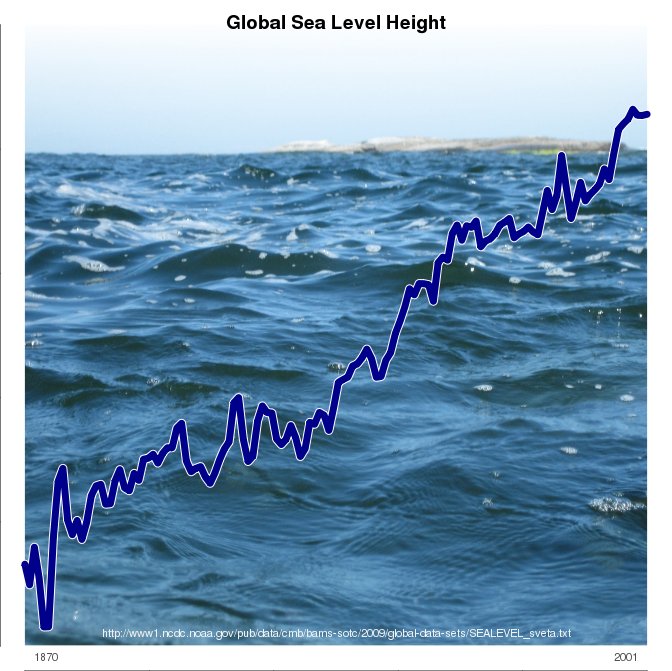
Progress has been made in recent years in understanding the observed past sea-level rise. As a result, process-based projections of future sea-level rise have become dramatically higher and are now closer to semi-empirical projections. However, process-based models still underestimate past sea-level rise, and they still project a smaller rise than semi-empirical models.
Sea-level projections were probably the most controversial aspect of the 4th IPCC report, published in 2007. As an author of the paleoclimate chapter, I was involved in some of the sea-level discussions during preparation of the report, but I was not part of the writing team for the projections. At the core of the controversy were the IPCC-projections which are based on process models (i.e. models that aim to simulate individual processes like thermal expansion or glacier melt). Many scientists felt that these models were not mature and understated the sea-level rise to be expected in future, and the IPCC report itself documented the fact that the models seriously underestimated past sea-level rise. (See our in-depth discussion published after the 4th IPCC report appeared.) That was confirmed again with the most recent data in Rahmstorf et al. 2012.
[Read more…] about Sea-level rise: Where we stand at the start of 2013
References
- S. Rahmstorf, G. Foster, and A. Cazenave, "Comparing climate projections to observations up to 2011", Environmental Research Letters, vol. 7, pp. 044035, 2012. http://dx.doi.org/10.1088/1748-9326/7/4/044035
A review of cosmic rays and climate: a cluttered story of little success
A number of blogs were excited after having leaked the second-order draft of IPCC document, which they interpreted as a “game-changing admission of enhanced solar forcing”.
However, little evidence remains for a link between galactic cosmic rays (GCR) and variations in Earth’s cloudiness. Laken et al. (2012) recently provided an extensive review of the study of the GCR and Earth’s climate, from the initial work by Ney (1959) to the latest findings from 2012.
[Read more…] about A review of cosmic rays and climate: a cluttered story of little success
References
- B.A. Laken, E. Pallé, J. Čalogović, and E.M. Dunne, "A cosmic ray-climate link and cloud observations", Journal of Space Weather and Space Climate, vol. 2, pp. A18, 2012. http://dx.doi.org/10.1051/swsc/2012018
Improving the Tropical Cyclone Climate Record
Guest Commentary by Christopher Hennon (UNC Asheville)
Get involved in a new citizen science project at CycloneCenter.org.
The poor quality of the tropical cyclone (TC) data record provides severe constraints on the ability of climate scientists to: a) determine to what degree TCs have responded to shifts in climate, b) evaluate theories on how TCs will respond to climate change in the future. The root cause for the poor data is the severity of the TC conditions (e.g. high wind, rough seas) and the remoteness of these storms – the vast majority of which form and remain well away from most observing networks. Thus, most TCs are not observed directly and those that are (with buoys, aircraft reconnaissance, ships) are often not sampled sufficiently (see the IBTrACS, (Knapp et al., 2010)).
This leaves tropical cyclone forecasters, who are ultimately responsible for recording TC tracks and intensities (i.e. maximum wind speeds), with a challenging problem. Fortunately, there is a tool called the Dvorak Technique which allows forecasters to make a reasonable determination of the TC intensity by simply analyzing a single infrared or visible satellite image, which is almost always available Velden et al., 2006). The technique calls for the analyst to determine the center location of the system, the cloud pattern type, the degree of organization of the pattern, and the intensity trend. A maximum surface wind speed is determined after the application of a number of rules and constraints.
The Dvorak Technique has been used for many years at all global tropical cyclone forecast centers and has been shown in many cases to yield a good estimate of maximum TC wind speed, when applied properly (Knaff et al., 2010). However, there is a level of analyst subjectivity inherent in the procedure; the cloud patterns are not always clear, it is sometimes difficult to accurately determine the storm center and the rules and constraints have been interpreted and applied differently across agencies. This introduces heterogeneity in the global TC record since the Dvorak Technique is usually the only available tool for assessing the maximum wind speed.
There has been recent work to eliminate the human element in the Dvorak Technique by automating the procedure. The Advanced Dvorak Technique (ADT) uses objective storm center and cloud pattern schemes to remove the subjectivity (Olander and Velden, 2007). All other classification rules and constraints are then applied and combined with additional statistical information to produce automated intensity estimates. Although the ADT skill is comparable to experienced human Dvorak analysts, large errors can occur if the scene type is not identified properly.
A new crowd sourcing project, called Cyclone Center, embraces the human element by enabling the public to perform a simplified version of the Dvorak Technique to analyze historical global tropical cyclone (TC) intensities (Hennon, 2012). Cyclone Center’s primary goal is to resolve discrepancies in the recent global TC record arising principally from inconsistent development of tropical cyclone intensity data. The Cyclone Center technique standardizes the classification procedure by condensing the Dvorak Technique to a few simple questions that can be answered by global, nonprofessional users.
One of the main advantages of this approach is the inclusion of thousands of users, instead of the 1-3 who would normally classify a TC image. This allows the computation of measures of uncertainty in addition to a mean intensity. Nearly 300,000 images, encompassing all global TCs that formed from 1978-2009, will be classified 30 times each – a feat that would take a dedicated team of twenty Dvorak-trained experts about 12 years to complete. Citizen scientists have already performed over 100,000 classifications since the project launch in September. Once the project is complete, a new dataset of global TC tracks and intensities will be made available to the community to contribute to our efforts to provide the best possible TC data record.
Interested readers are encouraged to learn more about and participate in the project at the cyclonecenter.org website (there are some FAQ on the project blog). The CycloneCenter project is a collaboration between the Citizen Science Alliance, NOAA National Climatic Data Center (NCDC), University of North Carolina at Asheville, and the Cooperative Institute for Climate and Satellites (CICS) – North Carolina.
References
- K.R. Knapp, M.C. Kruk, D.H. Levinson, H.J. Diamond, and C.J. Neumann, "The International Best Track Archive for Climate Stewardship (IBTrACS)", Bulletin of the American Meteorological Society, vol. 91, pp. 363-376, 2010. http://dx.doi.org/10.1175/2009BAMS2755.1
- C. Velden, B. Harper, F. Wells, J.L. Beven, R. Zehr, T. Olander, M. Mayfield, C.. Guard, M. Lander, R. Edson, L. Avila, A. Burton, M. Turk, A. Kikuchi, A. Christian, P. Caroff, and P. McCrone, "The Dvorak Tropical Cyclone Intensity Estimation Technique: A Satellite-Based Method that Has Endured for over 30 Years", Bulletin of the American Meteorological Society, vol. 87, pp. 1195-1210, 2006. http://dx.doi.org/10.1175/BAMS-87-9-1195
- J.A. Knaff, D.P. Brown, J. Courtney, G.M. Gallina, and J.L. Beven, "An Evaluation of Dvorak Technique–Based Tropical Cyclone Intensity Estimates", Weather and Forecasting, vol. 25, pp. 1362-1379, 2010. http://dx.doi.org/10.1175/2010WAF2222375.1
- T.L. Olander, and C.S. Velden, "The Advanced Dvorak Technique: Continued Development of an Objective Scheme to Estimate Tropical Cyclone Intensity Using Geostationary Infrared Satellite Imagery", Weather and Forecasting, vol. 22, pp. 287-298, 2007. http://dx.doi.org/10.1175/WAF975.1
- C.C. Hennon, "Citizen scientists analyzing tropical cyclone intensities", Eos, Transactions American Geophysical Union, vol. 93, pp. 385-387, 2012. http://dx.doi.org/10.1029/2012EO400002
Short term trends: Another proxy fight
One might assume that people would be happy that the latest version of the Hadley Centre and CRU combined temperature index is now being updated on a monthly basis. The improvements over the previous version in terms of coverage and error estimates is substantial. One might think that these advances – albeit incremental – would at least get mentioned in a story that used the new data set. Of course, one would not be taking into account the monumental capacity for some journalists and the outlets they work for to make up stories whenever it suits them. But all of the kerfuffle over the Mail story and the endless discussions over short and long term temperature trends hides what people are actually arguing about – what is likely to happen in the future, rather than what has happened in the past.
The fundamental point I will try and make here is that, given a noisy temperature record, many different statements can be true at the same time, but very few of them are informative about future trends. Thus vehemence of arguments about the past trends is in large part an unacknowledged proxy argument about the future.